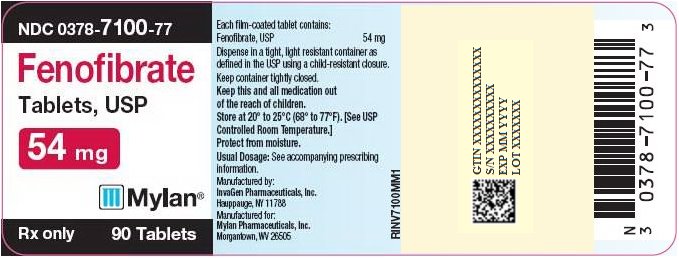
Fenofibrate label

Fenofibrate

Fenofibrate Recall

Get an alert when a recall is issued.

Side Effects & Adverse Reactions

There is currently no warning information available for this product. We apologize for any inconvenience.

FDA Safety Alerts

There are currently no FDA safety alerts available for this drug.

Manufacturer Warnings

There is currently no manufacturer warning information available for this drug.

FDA Labeling Changes

There are currently no FDA labeling changes available for this drug.

Uses

1.1 Primary Hypercholesterolemia and Mixed Dyslipidemia

Fenofibrate tablets are indicated as adjunctive therapy to diet to reduce elevated low-density lipoprotein cholesterol (LDL-C), total cholesterol (Total-C), Triglycerides (TG), and apolipoprotein B (Apo B), and to increase high-density lipoprotein (HDL-C) in adult patients with primary hypercholesterolemia or mixed dyslipidemia.

1.2 Severe Hypertriglyceridemia

Fenofibrate tablets are also indicated as adjunctive therapy to diet for treatment of adult patients with severe hypertriglyceridemia. Improving glycemic control in diabetic patients showing fasting chylomicronemia will usually reduce fasting triglycerides and eliminate chylomicronemia thereby obviating the need for pharmacologic intervention.

Markedly elevated levels of serum triglycerides (e.g. >2,000 mg/dL) may increase the risk of developing pancreatitis. The effect of fenofibrate tablet therapy on reducing this risk has not been adequately studied.

1.3 Important Limitations of Use

Fenofibrate was not shown to reduce coronary heart disease morbidity and mortality in patients with type 2 diabetes mellitus [see Warnings and Precautions (5.1)].

History

There is currently no drug history available for this drug.

Other Information

Fenofibrate tablets, is a lipid regulating agent available as tablets for oral administration. Each tablet contains 40 mg or 120 mg fenofibrate. The chemical name for fenofibrate is 2-[4-(4-chlorobenzoyl) phenoxy]-2-methyl-propanoic acid, 1-methylethyl ester with the following structural formula:

Chemical Structure

The empirical formula is C20H21O4Cl and the molecular weight is 360.83; fenofibrate is insoluble in water. The melting point is 79° to 82°C. Fenofibrate is a white solid which is stable under ordinary conditions.

Inactive Ingredients: Each tablet contains lactose monohydrate, NF; Polyethylene Glycol 6000, NF; Poloxamer 188, NF; and magnesium stearate, NF.

Fenofibrate Manufacturers

  • Fenofibrate | Global Pharmaceuticals, Division Of Impax Laboratories Inc.
    No Recall

    Fenofibrate | Global Pharmaceuticals, Division Of Impax Laboratories Inc.

    Fenofibrate | Global Pharmaceuticals, Division Of Impax Laboratories Inc.
    2.1 General Considerations

    Fenofibrate tablets should be given with food to optimize the absorption of the medicine. Patients should be advised to swallow fenofibrate tablets whole. Do not crush, dissolve or chew tablets.

    The initial treatment for dyslipidemia is dietary therapy specific for the type of lipoprotein abnormality. Excess body weight and excess alcoholic intake may be important factors in hypertriglyceridemia and should be addressed prior to any drug therapy. Physical exercise can be an important ancillary measure. Diseases contributory to hyperlipidemia, such as hypothyroidism or diabetes mellitus should be looked for and adequately treated. Estrogen therapy, thiazide diuretics and beta-blockers, are sometimes associated with massive rises in plasma triglycerides, especially in subjects with familial hypertriglyceridemia. In such cases, discontinuation of the specific etiologic agent may obviate the need for specific drug therapy of hypertriglyceridemia.

    Lipid levels should be monitored periodically and consideration should be given to reducing the dosage of fenofibrate tablets if lipid levels fall significantly below the targeted range.

    Therapy should be withdrawn in patients who do not have an adequate response after two months of treatment with the maximum recommended dose of 120 mg once daily.

    2.2 Primary Hypercholesterolemia or Mixed Dyslipidemia

    The initial dose of fenofibrate tablets is 120 mg per day.

    2.3 Severe Hypertriglyceridemia

    The initial dose is 40 to 120 mg per day. Dosage should be individualized according to patient response, and should be adjusted if necessary following repeat lipid determinations at 4 to 8 week intervals. The maximum dose is 120 mg per day.

    2.4 Impaired Renal Function

    Treatment with fenofibrate tablets should be initiated at a dose of 40 mg per day in patients with mild to moderately impaired renal function, and increased only after evaluation of the effects on renal function and lipid levels at this dose. The use of fenofibrate tablets should be avoided in patients with severe renal impairment [see Use in Specific Populations (8.6) and Clinical Pharmacology (12.3)].

    2.5 Geriatric Patients

    Dose selection for the elderly should be made on the basis of renal function [see Use in Specific Populations (8.5)].

  • Remedyrepack Inc.
    Fenofibrate | Remedyrepack Inc.
    No Recall

    Fenofibrate | Remedyrepack Inc.

    Fenofibrate | Remedyrepack Inc.

    Patients should be placed on an appropriate lipid-lowering diet before receiving fenofibrate tablets, and should continue this diet during treatment with fenofibrate tablets. Fenofibrate tablets should be given with meals, thereby optimizing the bioavailability of the medication.

    For the treatment of adult patients with primary hypercholesterolemia or mixed hyperlipidemia, the initial dose of fenofibrate tablets is 160 mg per day.

    For adult patients with hypertriglyceridemia, the initial dose is 54 to 160 mg per day. Dosage should be individualized according to patient response, and should be adjusted if necessary following repeat lipid determinations at 4 to 8 week intervals. The maximum dose is 160 mg per day.

    Treatment with fenofibrate tablets should be initiated at a dose of 54 mg/day in patients having impaired renal function, and increased only after evaluation of the effects on renal function and lipid levels at this dose. In the elderly, the initial dose should likewise be limited to 54 mg/day.

    Lipid levels should be monitored periodically and consideration should be given to reducing the dosage of fenofibrate tablets if lipid levels fall significantly below the targeted range.


  • Northwind Pharmaceuticals
    Fenofibrate | Northwind Pharmaceuticals
    No Recall

    Fenofibrate | Northwind Pharmaceuticals

    Fenofibrate | Northwind Pharmaceuticals

    2.1 General Considerations

    Patients should be placed on an appropriate lipid-lowering diet before receiving Fenofibrate tablets for oral use, and should continue this diet during treatment with Fenofibrate tablets for oral use. Fenofibrate tablets for oral use can be given without regard to meals.

    The initial treatment for dyslipidemia is dietary therapy specific for the type of lipoprotein abnormality. Excess body weight and excess alcoholic intake may be important factors in hypertriglyceridemia and should be addressed prior to any drug therapy. Physical exercise can be an important ancillary measure. Diseases contributory to hyperlipidemia, such as hypothyroidism or diabetes mellitus should be looked for and adequately treated. Estrogen therapy, thiazide diuretics and beta-blockers, are sometimes associated with massive rises in plasma triglycerides, especially in subjects with familial hypertriglyceridemia. In such cases, discontinuation of the specific etiologic agent may obviate the need for specific drug therapy of hypertriglyceridemia.

    Lipid levels should be monitored periodically and consideration should be given to reducing the dosage of Fenofibrate tablets for oral use if lipid levels fall significantly below the targeted range.

    Therapy should be withdrawn in patients who do not have an adequate response after two months of treatment with the maximum recommended dose of 145 mg once daily.

    2.2 Primary Hypercholesterolemia or Mixed Dyslipidemia

    The initial dose of Fenofibrate tablets for oral use is 145 mg once daily.

    2.3 Severe Hypertriglyceridemia

    The initial dose is 48 to 145 mg per day. Dosage should be individualized according to patient response, and should be adjusted if necessary following repeat lipid determinations at 4 to 8 week intervals. The maximum dose is 145 mg once daily.

    2.4 Impaired Renal Function

    Treatment with Fenofibrate tablets for oral use should be initiated at a dose of 48 mg per day in patients having mild to moderately impaired renal function, and increased only after evaluation of the effects on renal function and lipid levels at this dose. The use of Fenofibrate tablets for oral use should be avoided in patients with severe renal impairment [see Use in Specific Populations (8.6) and Clinical Pharmacology (12.3)].

    2.5 Geriatric Patients

    Dose selection for the elderly should be made on the basis of renal function [see Use in Specific Populations (8.5)].

    Please see full information on Fenofibrate 145mg Zydus Pharmaceuticals at Permanent Link: http://dailymed.nlm.nih.gov/dailymed/drugInfo.cfm?setid=1c3696b1-23c1-2992-86a0-c0882b81048d

  • Northwind Pharmaceuticals, Llc
    Fenofibrate | Northwind Pharmaceuticals, Llc
    No Recall

    Fenofibrate | Northwind Pharmaceuticals, Llc

    Fenofibrate | Northwind Pharmaceuticals, Llc

    The recommended initial dose is 15 mg daily (7.5 mg b.i.d.). To achieve an optimal therapeutic response, at intervals of 2 to 3 days the dosage may be increased 5 mg per day, as needed. The maximum daily dosage should not exceed 60 mg per day. In clinical trials allowing dose titration, divided doses of 20 to 30 mg per day were commonly employed.

    The bioavailability of buspirone is increased when given with food as compared to the fasted state (see CLINICAL PHARMACOLOGY). Consequently, patients should take buspirone in a consistent manner with regard to the timing of dosing; either always with or always without food.

    When buspirone is to be given with a potent inhibitor of CYP3A4, the dosage recommendations described in the PRECAUTIONS, Drug Interactions section should be followed.

  • Avkare, Inc.
    Fenofibrate | Laboratoires Clarins S.a.
    No Recall

    Fenofibrate | Laboratoires Clarins S.a.

    Fenofibrate | Laboratoires Clarins S.a.

    • apply liberally 15 minutes before sun exposure
    • apply to all skin exposed to the sun
    • children under 6 months: Ask a doctor
    • Sun Protection Measures.
    Spending time in the sun increases your risk of skin cancer and early skin aging. To decrease this risk, regularly use a sunscreen with a broad spectrum SPF of 15 or higher and other sun protection measures including:
    • limit time in the sun, especially from 10 a.m. – 2 p.m.
    • wear long-sleeved shirts, pants, hats and sunglasses.
    • reapply at least every 2 hours
    • use a water resistant sunscreen if swimming or sweating.

  • Physicians Total Care, Inc.
    Fenofibrate | Physicians Total Care, Inc.
    No Recall

    Fenofibrate | Physicians Total Care, Inc.

    Fenofibrate | Physicians Total Care, Inc.

    Patients should be placed on an appropriate lipid-lowering diet before receiving fenofibrate capsules, and should continue this diet during treatment with fenofibrate capsules. Fenofibrate capsules should be given with meals, thereby optimizing the bioavailability of the medication.

    For the treatment of adult patients with primary hypercholesterolemia or mixed hyperlipidemia, the initial dose of fenofibrate capsules is 200 mg per day.

    For adult patients with hypertriglyceridemia, the initial dose is 67 to 200 mg per day. Dosage should be individualized according to patient response, and should be adjusted if necessary following repeat lipid determinations at 4 to 8 week intervals. The maximum dose is 200 mg per day.

    Treatment with fenofibrate capsules should be initiated at a dose of 67 mg/day in patients having impaired renal function, and increased only after evaluation of the effects on renal function and lipid levels at this dose. In the elderly, the initial dose should likewise be limited to 67 mg/day.

    Lipid levels should be monitored periodically and consideration should be given to reducing the dosage of fenofibrate capsules if lipid levels fall significantly below the targeted range.

  • Remedyrepack Inc.
    Fenofibrate | Remedyrepack Inc.
    No Recall

    Fenofibrate | Remedyrepack Inc.

    Fenofibrate | Remedyrepack Inc.
    DOSAGE AND ADMINISTRATION
    Patients should be placed on an appropriate lipid-lowering diet before receiving fenofibrate capsules, and should continue this diet during treatment with fenofibrate capsules. Fenofibrate capsules should be given with meals, thereby optimizing the bioavailability of the medication.
    For the treatment of adult patients with primary hypercholesterolemia or mixed hyperlipidemia, the initial dose of fenofibrate capsules is 200 mg per day.
    For adult patients with hypertriglyceridemia, the initial dose is 67 to 200 mg per day. Dosage should be individualized according to patient response, and should be adjusted if necessary following repeat lipid determinations at 4 to 8 week intervals. The maximum dose is 200 mg per day.
    Treatment with fenofibrate capsules should be initiated at a dose of 67 mg/day in patients having impaired renal function, and increased only after evaluation of the effects on renal function and lipid levels at this dose. In the elderly, the initial dose should likewise be limited to 67 mg/day.
    Lipid levels should be monitored periodically and consideration should be given to reducing the dosage of fenofibrate capsules if lipid levels fall significantly below the targeted range.

  • Fenofibrate | Global Pharmaceuticals, Division Of Impax Laboratories Inc.
    No Recall

    Fenofibrate | Global Pharmaceuticals, Division Of Impax Laboratories Inc.

    Fenofibrate | Global Pharmaceuticals, Division Of Impax Laboratories Inc.

    Patients should be placed on an appropriate lipid-lowering diet before receiving fenofibrate tablets, and should continue this diet during treatment with fenofibrate tablets. Fenofibrate tablets should be given with meals, thereby optimizing the bioavailability of the medication.

    For the treatment of adult patients with primary hypercholesterolemia or mixed hyperlipidemia, the initial dose of fenofibrate tablets is 160 mg per day.

    For adult patients with hypertriglyceridemia, the initial dose is 54 to 160 mg per day. Dosage should be individualized according to patient response, and should be adjusted if necessary following repeat lipid determinations at 4 to 8 week intervals. The maximum dose is 160 mg per day.

    Treatment with fenofibrate tablets should be initiated at a dose of 54 mg/day in patients having impaired renal function, and increased only after evaluation of the effects on renal function and lipid levels at this dose. In the elderly, the initial dose should likewise be limited to 54 mg/day.

    Lipid levels should be monitored periodically and consideration should be given to reducing the dosage of fenofibrate tablets if lipid levels fall significantly below the targeted range.

  • Physicians Total Care, Inc.
    Fenofibrate | Physicians Total Care, Inc.
    No Recall

    Fenofibrate | Physicians Total Care, Inc.

    Fenofibrate | Physicians Total Care, Inc.

    Patients should be placed on an appropriate lipid-lowering diet before receiving fenofibrate tablets, and should continue this diet during treatment with fenofibrate tablets. Fenofibrate tablets should be given with meals, thereby optimizing the bioavailability of the medication.

    For the treatment of adult patients with primary hypercholesterolemia or mixed hyperlipidemia, the initial dose of fenofibrate tablets is 160 mg per day.

    For adult patients with hypertriglyceridemia, the initial dose is 54 to 160 mg per day. Dosage should be individualized according to patient response, and should be adjusted if necessary following repeat lipid determinations at 4 to 8 week intervals. The maximum dose is 160 mg per day.

    Treatment with fenofibrate tablets should be initiated at a dose of 54 mg/day in patients having impaired renal function, and increased only after evaluation of the effects on renal function and lipid levels at this dose. In the elderly, the initial dose should likewise be limited to 54 mg/day.

    Lipid levels should be monitored periodically and consideration should be given to reducing the dosage of fenofibrate tablets if lipid levels fall significantly below the targeted range.

  • St Marys Medical Park Pharmacy
    Fenofibrate | St Marys Medical Park Pharmacy
    No Recall

    Fenofibrate | St Marys Medical Park Pharmacy

    Fenofibrate | St Marys Medical Park Pharmacy

    Patients should be placed on an appropriate lipid-lowering diet before receiving fenofibrate tablets, and should continue this diet during treatment with fenofibrate tablets. Fenofibrate tablets should be given with meals, thereby optimizing the bioavailability of the medication.

    For the treatment of adult patients with primary hypercholesterolemia or mixed hyperlipidemia, the initial dose of fenofibrate tablets is 160 mg per day.

    For adult patients with hypertriglyceridemia, the initial dose is 54 to 160 mg per day. Dosage should be individualized according to patient response, and should be adjusted if necessary following repeat lipid determinations at 4 to 8 week intervals. The maximum dose is 160 mg per day.

    Treatment with fenofibrate tablets should be initiated at a dose of 54 mg/day in patients having impaired renal function, and increased only after evaluation of the effects on renal function and lipid levels at this dose. In the elderly, the initial dose should likewise be limited to 54 mg/day.

    Lipid levels should be monitored periodically and consideration should be given to reducing the dosage of fenofibrate tablets if lipid levels fall significantly below the targeted range.

  • Fenofibrate | Kaiser Foundation Hospitals
    No Recall

    Fenofibrate | Kaiser Foundation Hospitals

    Fenofibrate | Kaiser Foundation Hospitals

    Patients should be placed on an appropriate lipid-lowering diet before receiving fenofibrate tablets, and should continue this diet during treatment with fenofibrate tablets. Fenofibrate tablets can be given without regard to meals.

    For the treatment of adult patients with primary hypercholesterolemia or mixed hyperlipidemia, the initial dose of fenofibrate tablets is 145 mg per day.

    For adult patients with hypertriglyceridemia, the initial dose is 48 to 145 mg per day. Dosage should be individualized according to patient response, and should be adjusted if necessary following repeat lipid determinations at 4 to 8 week intervals. The maximum dose is 145 mg per day.

    Treatment with fenofibrate tablets should be initiated at a dose of 48 mg/day in patients having having mild to moderately impaired renal function, and increased only after evaluation of the effects on renal function and lipid levels at this dose.

    Lipid levels should be monitored periodically and consideration should be given to reducing the dosage of fenofibrate tablets if lipid levels fall significantly below the targeted range.

  • Lake Erie Medical & Surgical Supply Dba Quality Care Products Llc
    Fenofibrate | Lake Erie Medical & Surgical Supply Dba Quality Care Products Llc
    No Recall

    Fenofibrate | Lake Erie Medical & Surgical Supply Dba Quality Care Products Llc

    Fenofibrate | Lake Erie Medical & Surgical Supply Dba Quality Care Products Llc

    Patients should be placed on an appropriate lipid-lowering diet before receiving fenofibrate tablets and should continue this diet during treatment with fenofibrate. Fenofibrate tablets can be given without regard to meals.

    For the treatment of adult patients with primary hypercholesterolemia or mixed hyperlipidemia, the initial dose of fenofibrate is 160 mg per day.

    For adult patients with hypertriglyceridemia, the initial dose is 54 mg to 160 mg per day. Dosage should be individualized according to patient response and should be adjusted if necessary following repeat lipid determinations at 4 to 8 week intervals. The maximum dose is 160 mg per day.

    Treatment with fenofibrate tablets should be initiated at a dose of 54 mg/day in patients having mild to moderately impaired renal function and increased only after evaluation of the effects on renal function and lipid levels at this dose.

    Lipid levels should be monitored periodically and consideration should be given to reducing the dosage of fenofibrate tablets if lipid levels fall significantly below the targeted range.

  • Mylan Pharmaceuticals Inc.
    Fenofibrate | Metacon Labs
    No Recall

    Fenofibrate | Metacon Labs

    Fenofibrate | Metacon Labs

    Prime Can Before Initial Use:
    Shake can well (until product moves inside can). Firmly strike bottom of can onto palm of hand at least three times.

    Hold can upright and direct initial spray to a non-skin surface. Until foam dispenses, DO NOT spray directly on the skin as the initial spray may expel cold liquid propellant. Press down on actuator for 1 to 3 seconds until foam begins to dispense. If foam does not dispense within 3 seconds, repeat priming process.

    WASH-OFF APPLICATION: Cleanse affected skin thoroughly and pat dry before each application. Dispense product onto fingertips. Massage the dispensed foam into the affected area and wait 10 minutes. Rinse thoroughly with water and pat dry. Treat the affected area 1 to 3 times daily, or as directed by a physician.

    LEAVE-ON APPLICATION: Cleanse affected skin thoroughly and pat dry before each application. Dispense product onto fingertips. Massage the dispensed foam into the affected area 1 to 3 times daily or as directed by a physician.

    Wipe off any excess foam from actuator after use.

  • Mylan Pharmaceuticals Inc.
    Fenofibrate | Mylan Pharmaceuticals Inc.
    No Recall

    Fenofibrate | Mylan Pharmaceuticals Inc.

    Fenofibrate | Mylan Pharmaceuticals Inc.
    2.1 General Considerations

    Patients should be placed on an appropriate lipid-lowering diet before receiving fenofibrate capsules, and should continue this diet during treatment with fenofibrate capsules. Fenofibrate capsules can be given without regard to meals.

    Patients should be advised to swallow fenofibrate capsules whole. Do not open, crush, dissolve or chew capsules.

    The initial treatment for dyslipidemia is dietary therapy specific for the type of lipoprotein abnormality. Excess body weight and excess alcoholic intake may be important factors in hypertriglyceridemia and should be addressed prior to any drug therapy. Physical exercise can be an important ancillary measure. Diseases contributory to hyperlipidemia, such as hypothyroidism or diabetes mellitus should be looked for and adequately treated. Estrogen therapy, thiazide diuretics and beta-blockers are sometimes associated with massive rises in plasma triglycerides, especially in subjects with familial hypertriglyceridemia. In such cases, discontinuation of the specific etiologic agent may obviate the need for specific drug therapy of hypertriglyceridemia.

    Lipid levels should be monitored periodically and consideration should be given to reducing the dosage of fenofibrate if lipid levels fall significantly below the targeted range.

    Therapy should be withdrawn in patients who do not have an adequate response after 2 months of treatment with the maximum recommended dose of 130 mg once daily.

    2.2 Primary Hypercholesterolemia and Mixed Dyslipidemia

    The initial dose of fenofibrate capsules is 130 mg per day.

    2.3 Severe Hypertriglyceridemia

    The initial dose is 43 mg to 130 mg per day. Dosage should be individualized according to patient response, and should be adjusted if necessary following repeat lipid determinations at 4 to 8 week intervals. The maximum dose is 130 mg per day.

    2.4 Impaired Renal Function

    Treatment with fenofibrate capsules should be initiated at a dose of 43 mg per day in patients having mild to moderately impaired renal function, and increased only after evaluation of the effects on renal function and lipid levels at this dose. The use of fenofibrate capsules should be avoided in patients with severe renal impairment [see Use in Specific Populations (8.6) and Clinical Pharmacology (12.3)].

    2.5 Geriatric Patients

    Dose selection for the elderly should be made on the basis of renal function [see Use in Specific Populations (8.6) and Clinical Pharmacology (12.3)].

  • Ncs Healthcare Of Ky, Inc Dba Vangard Labs
    Fenofibrate | Ncs Healthcare Of Ky, Inc Dba Vangard Labs
    No Recall

    Fenofibrate | Ncs Healthcare Of Ky, Inc Dba Vangard Labs

    Fenofibrate | Ncs Healthcare Of Ky, Inc Dba Vangard Labs

    Patients should be placed on an appropriate lipid-lowering diet before receiving fenofibrate capsules, and should continue this diet during treatment with fenofibrate capsules. Fenofibrate capsules should be given with meals, thereby optimizing the bioavailability of the medication.

    For the treatment of adult patients with primary hypercholesterolemia or mixed hyperlipidemia, the initial dose of fenofibrate capsules is 200 mg per day.

    For adult patients with hypertriglyceridemia, the initial dose is 67 to 200 mg per day. Dosage should be individualized according to patient response, and should be adjusted if necessary following repeat lipid determinations at 4 to 8 week intervals. The maximum dose is 200 mg per day.

    Treatment with fenofibrate capsules should be initiated at a dose of 67 mg/day in patients having impaired renal function, and increased only after evaluation of the effects on renal function and lipid levels at this dose. In the elderly, the initial dose should likewise be limited to 67 mg/day.

    Lipid levels should be monitored periodically and consideration should be given to reducing the dosage of fenofibrate capsules if lipid levels fall significantly below the targeted range.

  • Lupin Pharmaceuticals, Inc.
    Fenofibrate | Lupin Pharmaceuticals, Inc.
    No Recall

    Fenofibrate | Lupin Pharmaceuticals, Inc.

    Fenofibrate | Lupin Pharmaceuticals, Inc.
    2.1 General Considerations

    Patients should be placed on an appropriate lipid-lowering diet before receiving fenofibrate capsules, and should continue this diet during treatment with fenofibrate. Fenofibrate capsules can be given without regard to meals.

    Patients should be advised to swallow fenofibrate capsules whole. Do not open, crush, dissolve or chew capsules.

    The initial treatment for dyslipidemia is dietary therapy specific for the type of lipoprotein abnormality. Excess body weight and excess alcoholic intake may be important factors in hypertriglyceridemia and should be addressed prior to any drug therapy. Physical exercise can be an important ancillary measure. Diseases contributory to hyperlipidemia, such as hypothyroidism or diabetes mellitus should be looked for and adequately treated. Estrogen therapy, thiazide diuretics and beta-blockers are sometimes associated with massive rises in plasma triglycerides, especially in subjects with familial hypertriglyceridemia. In such cases, discontinuation of the specific etiologic agent may obviate the need for specific drug therapy of hypertriglyceridemia.

    Lipid levels should be monitored periodically and consideration should be given to reducing the dosage of fenofibrate if lipid levels fall significantly below the targeted range.

    Therapy should be withdrawn in patients who do not have an adequate response after two months of treatment with the maximum recommended dose of 130 mg once daily.

    2.2 Primary Hypercholesterolemia and Mixed Dyslipidemia

    The initial dose of fenofibrate capsules is 130 mg per day.

    2.3 Severe Hypertriglyceridemia

    The initial dose is 43 to 130 mg per day. Dosage should be individualized according to patient response, and should be adjusted if necessary following repeat lipid determinations at 4 to 8 week intervals. The maximum dose is 130 mg per day.

    2.4 Impaired Renal Function

    Treatment with fenofibrate should be initiated at a dose of 43 mg per day in patients having mild to moderately impaired renal function, and increased only after evaluation of the effects on renal function and lipid levels at this dose. The use of fenofibrate should be avoided in patients with severe renal impairment [see Use in Specific Populations (8.6) and Clinical Pharmacology (12.3)].

    2.5 Geriatric Patients

    Dose selection for the elderly should be made on the basis of renal function [see Use in Specific Populations (8.6) and Clinical Pharmacology (12.3)].

  • Fenofibrate | Ranbaxy Pharmaceuticals Inc.
    No Recall

    Fenofibrate | Ranbaxy Pharmaceuticals Inc.

    Fenofibrate | Ranbaxy Pharmaceuticals Inc.

    Patients should be placed on an appropriate lipid-lowering diet before receiving fenofibrate tablets, and should continue this diet during treatment with fenofibrate tablets. Fenofibrate tablets should be given with meals, thereby optimizing the bioavailability of the medication.

    For the treatment of adult patients with primary hypercholesterolemia or mixed hyperlipidemia, the initial dose of fenofibrate tablets is 160 mg per day.

    For adult patients with hypertriglyceridemia, the initial dose is 54 to 160 mg per day. Dosage should be individualized according to patient response, and should be adjusted if necessary following repeat lipid determinations at 4 to 8 week intervals. The maximum dose is 160 mg per day.

    Treatment with fenofibrate tablets should be initiated at a dose of 54 mg/day in patients having impaired renal function, and increased only after evaluation of the effects on renal function and lipid levels at this dose. In the elderly, the initial dose should likewise be limited to 54 mg/day.

    Lipid levels should be monitored periodically and consideration should be given to reducing the dosage of fenofibrate tablets if lipid levels fall significantly below the targeted range.

  • St Marys Medical Park Pharmacy
    Fenofibrate | St Marys Medical Park Pharmacy
    No Recall

    Fenofibrate | St Marys Medical Park Pharmacy

    Fenofibrate | St Marys Medical Park Pharmacy

    Patients should be placed on an appropriate lipid-lowering diet before receiving fenofibrate capsules, and should continue this diet during treatment with fenofibrate capsules. Fenofibrate capsules should be given with meals, thereby optimizing the bioavailability of the medication.

    For the treatment of adult patients with primary hypercholesterolemia or mixed hyperlipidemia, the initial dose of fenofibrate capsules is 200 mg per day.

    For adult patients with hypertriglyceridemia, the initial dose is 67 to 200 mg per day. Dosage should be individualized according to patient response, and should be adjusted if necessary following repeat lipid determinations at 4 to 8 week intervals. The maximum dose is 200 mg per day.

    Treatment with fenofibrate capsules should be initiated at a dose of 67 mg/day in patients having impaired renal function, and increased only after evaluation of the effects on renal function and lipid levels at this dose. In the elderly, the initial dose should likewise be limited to 67 mg/day.

    Lipid levels should be monitored periodically and consideration should be given to reducing the dosage of fenofibrate capsules if lipid levels fall significantly below the targeted range.

  • Fenofibrate | Teva Pharmaceuticals Usa Inc
    No Recall

    Fenofibrate | Teva Pharmaceuticals Usa Inc

    Fenofibrate | Teva Pharmaceuticals Usa Inc
    2.1 General Considerations

    Patients should be placed on an appropriate lipid-lowering diet before receiving Fenofibrate tablets for oral use, and should continue this diet during treatment with Fenofibrate tablets for oral use. Fenofibrate tablets for oral use can be given without regard to meals.

    The initial treatment for dyslipidemia is dietary therapy specific for the type of lipoprotein abnormality. Excess body weight and excess alcoholic intake may be important factors in hypertriglyceridemia and should be addressed prior to any drug therapy. Physical exercise can be an important ancillary measure. Diseases contributory to hyperlipidemia, such as hypothyroidism or diabetes mellitus should be looked for and adequately treated. Estrogen therapy, thiazide diuretics and beta-blockers, are sometimes associated with massive rises in plasma triglycerides, especially in subjects with familial hypertriglyceridemia. In such cases, discontinuation of the specific etiologic agent may obviate the need for specific drug therapy of hypertriglyceridemia.

    Lipid levels should be monitored periodically and consideration should be given to reducing the dosage of Fenofibrate tablets for oral use if lipid levels fall significantly below the targeted range.

    Therapy should be withdrawn in patients who do not have an adequate response after two months of treatment with the maximum recommended dose of 145 mg once daily.

    2.2 Primary Hypercholesterolemia or Mixed Dyslipidemia

    The initial dose of Fenofibrate tablets for oral use is 145 mg once daily.

    2.3 Severe Hypertriglyceridemia

    The initial dose is 48 to 145 mg per day. Dosage should be individualized according to patient response, and should be adjusted if necessary following repeat lipid determinations at 4 to 8 week intervals. The maximum dose is 145 mg once daily.

    2.4 Impaired Renal Function

    Treatment with Fenofibrate tablets for oral use should be initiated at a dose of 48 mg per day in patients having mild to moderately impaired renal function, and increased only after evaluation of the effects on renal function and lipid levels at this dose. The use of Fenofibrate tablets for oral use should be avoided in patients with severe renal impairment [see Use in Specific Populations (8.6) and Clinical Pharmacology (12.3)].

    2.5 Geriatric Patients

    Dose selection for the elderly should be made on the basis of renal function [see Use in Specific Populations (8.5)].

    2.5 Geriatric Patients

    Dose selection for the elderly should be made on the basis of renal function [see Use in Specific Populations (8.5)].

  • Fenofibrate | Unit Dose Services
    No Recall

    Fenofibrate | Unit Dose Services

    Fenofibrate | Unit Dose Services

    Patients should be placed on an appropriate lipid-lowering diet before receiving fenofibrate capsules, and should continue this diet during treatment with fenofibrate capsules. Fenofibrate capsules should be given with meals, thereby optimizing the bioavailability of the medication.

    For the treatment of adult patients with primary hypercholesterolemia or mixed hyperlipidemia, the initial dose of fenofibrate capsules is 200 mg per day.

    For adult patients with hypertriglyceridemia, the initial dose is 67 to 200 mg per day. Dosage should be individualized according to patient response, and should be adjusted if necessary following repeat lipid determinations at 4 to 8 week intervals. The maximum dose is 200 mg per day.

    Treatment with fenofibrate capsules should be initiated at a dose of 67 mg/day in patients having impaired renal function, and increased only after evaluation of the effects on renal function and lipid levels at this dose. In the elderly, the initial dose should likewise be limited to 67 mg/day.

    Lipid levels should be monitored periodically and consideration should be given to reducing the dosage of fenofibrate capsules if lipid levels fall significantly below the targeted range.

  • Fenofibrate | Unit Dose Services
    No Recall

    Fenofibrate | Unit Dose Services

    Fenofibrate | Unit Dose Services

    Patients should be placed on an appropriate lipid-lowering diet before receiving fenofibrate tablets, and should continue this diet during treatment with fenofibrate tablets. Fenofibrate tablets should be given with meals, thereby optimizing the bioavailability of the medication.

    For the treatment of adult patients with primary hypercholesterolemia or mixed hyperlipidemia, the initial dose of fenofibrate tablets is 160 mg per day.

    For adult patients with hypertriglyceridemia, the initial dose is 54 to 160 mg per day. Dosage should be individualized according to patient response, and should be adjusted if necessary following repeat lipid determinations at 4 to 8 week intervals. The maximum dose is 160 mg per day.

    Treatment with fenofibrate tablets should be initiated at a dose of 54 mg/day in patients having impaired renal function, and increased only after evaluation of the effects on renal function and lipid levels at this dose. In the elderly, the initial dose should likewise be limited to 54 mg/day.

    Lipid levels should be monitored periodically and consideration should be given to reducing the dosage of fenofibrate tablets if lipid levels fall significantly below the targeted range.

  • Lake Erie Medical Dba Quality Care Products Llc
    Fenofibrate | Lake Erie Medical Dba Quality Care Products Llc
    No Recall

    Fenofibrate | Lake Erie Medical Dba Quality Care Products Llc

    Fenofibrate | Lake Erie Medical Dba Quality Care Products Llc

    Patients should be placed on an appropriate lipid-lowering diet before receiving fenofibrate capsules, and should continue this diet during treatment with fenofibrate capsules. Fenofibrate capsules should be given with meals, thereby optimizing the bioavailability of the medication.

    For the treatment of adult patients with primary hypercholesterolemia or mixed hyperlipidemia, the initial dose of fenofibrate capsules is 200 mg per day.

    For adult patients with hypertriglyceridemia, the initial dose is 67 to 200 mg per day. Dosage should be individualized according to patient response, and should be adjusted if necessary following repeat lipid determinations at 4 to 8 week intervals. The maximum dose is 200 mg per day.

    Treatment with fenofibrate capsules should be initiated at a dose of 67 mg/day in patients having impaired renal function, and increased only after evaluation of the effects on renal function and lipid levels at this dose. In the elderly, the initial dose should likewise be limited to 67 mg/day.

    Lipid levels should be monitored periodically and consideration should be given to reducing the dosage of fenofibrate capsules if lipid levels fall significantly below the targeted range.

  • Mylan Pharmaceuticals Inc.
    Fenofibrate | Mylan Pharmaceuticals Inc.
    No Recall

    Fenofibrate | Mylan Pharmaceuticals Inc.

    Fenofibrate | Mylan Pharmaceuticals Inc.
    2.1 General Considerations

    Patients should be placed on an appropriate lipid-lowering diet before receiving fenofibrate tablets and should continue this diet during treatment with fenofibrate tablets. Fenofibrate tablets can be given without regard to meals.

    The initial treatment for dyslipidemia is dietary therapy specific for the type of lipoprotein abnormality. Excess body weight and excess alcoholic intake may be important factors in hypertriglyceridemia and should be addressed prior to any drug therapy. Physical exercise can be an important ancillary measure. Diseases contributory to hyperlipidemia, such as hypothyroidism or diabetes mellitus should be looked for and adequately treated. Estrogen therapy, thiazide diuretics and beta-blockers, are sometimes associated with massive rises in plasma triglycerides, especially in subjects with familial hypertriglyceridemia. In such cases, discontinuation of the specific etiologic agent may obviate the need for specific drug therapy of hypertriglyceridemia.

    Lipid levels should be monitored periodically and consideration should be given to reducing the dosage of fenofibrate tablets if lipid levels fall significantly below the targeted range.

    Therapy should be withdrawn in patients who do not have an adequate response after 2 months of treatment with the maximum recommended dose of 145 mg once daily.

    2.2 Primary Hypercholesterolemia or Mixed Dyslipidemia

    The initial dose of fenofibrate tablets is 145 mg once daily.

    2.3 Severe Hypertriglyceridemia

    The initial dose is 48 mg to 145 mg per day. Dosage should be individualized according to patient response and should be adjusted if necessary following repeat lipid determinations at 4 to 8 week intervals. The maximum dose is 145 mg once daily.

    2.4 Impaired Renal Function

    Treatment with fenofibrate tablets should be initiated at a dose of 48 mg per day in patients having mild to moderately impaired renal function and increased only after evaluation of the effects on renal function and lipid levels at this dose. The use of fenofibrate tablets should be avoided in patients with severe renal impairment [see Use in Specific Populations (8.6) and Clinical Pharmacology (12.3)].

    2.5 Geriatric Patients

    Dose selection for the elderly should be made on the basis of renal function [see Use in Specific Populations (8.5)].

  • Clinical Solutions Wholesale
    Fenofibrate | Clinical Solutions Wholesale
    No Recall

    Fenofibrate | Clinical Solutions Wholesale

    Fenofibrate | Clinical Solutions Wholesale

    Patients should be placed on an appropriate lipid-lowering diet before receiving fenofibrate tablets, and should continue this diet during treatment with fenofibrate tablets. Fenofibrate tablets should be given with meals, thereby optimizing the bioavailability of the medication.

    For the treatment of adult patients with primary hypercholesterolemia or mixed hyperlipidemia, the initial dose of fenofibrate tablets is 160 mg per day.

    For adult patients with hypertriglyceridemia, the initial dose is 54 to 160 mg per day. Dosage should be individualized according to patient response, and should be adjusted if necessary following repeat lipid determinations at 4 to 8 week intervals. The maximum dose is 160 mg per day.

    Treatment with fenofibrate tablets should be initiated at a dose of 54 mg/day in patients having impaired renal function, and increased only after evaluation of the effects on renal function and lipid levels at this dose. In the elderly, the initial dose should likewise be limited to 54 mg/day.

    Lipid levels should be monitored periodically and consideration should be given to reducing the dosage of fenofibrate tablets if lipid levels fall significantly below the targeted range.

  • Fenofibrate | Akorn, Inc.
    No Recall

    Fenofibrate | Akorn, Inc.

    Fenofibrate | Akorn, Inc.

    Timolol Maleate Ophthalmic Solution is available in concentrations of 0.25 and 0.5 percent. The usual starting dose is one drop of 0.25 percent timolol in the affected eye(s) twice a day. If the clinical response is not adequate, the dosage may be changed to one drop of 0.5 percent solution in the affected eye(s) twice a day.

    Since in some patients the pressure-lowering response to timolol may require a few weeks to stabilize, evaluation should include a determination of intraocular pressure after approximately 4 weeks of treatment with timolol.

    If the intraocular pressure is maintained at satisfactory levels, the dosage schedule may be changed to one drop once a day in the affected eye(s). Because of diurnal variations in intraocular pressure, satisfactory response to the once-a-day dose is best determined by measuring the intraocular pressure at different times during the day.

    Dosages above one drop of 0.5 percent timolol twice a day generally have not been shown to produce further reduction in intraocular pressure. If the patient's intraocular pressure is still not at a satisfactory level on this regimen, concomitant therapy with other agent(s) for lowering intraocular pressure can be instituted. The concomitant use of two topical beta-adrenergic blocking agents is not recommended. (See PRECAUTIONS, Drug Interactions, Beta-adrenergic blocking agents.)

  • Lake Erie Medical Dba Quality Care Products Llc
    Fenofibrate | Lake Erie Medical Dba Quality Care Products Llc
    No Recall

    Fenofibrate | Lake Erie Medical Dba Quality Care Products Llc

    Fenofibrate | Lake Erie Medical Dba Quality Care Products Llc

    Patients should be placed on an appropriate lipid-lowering diet before receiving fenofibrate tablets, and should continue this diet during treatment with fenofibrate tablets. Fenofibrate tablets should be given with meals, thereby optimizing the bioavailability of the medication.

    For the treatment of adult patients with primary hypercholesterolemia or mixed hyperlipidemia, the initial dose of fenofibrate tablets is 160 mg per day.

    For adult patients with hypertriglyceridemia, the initial dose is 54 to 160 mg per day. Dosage should be individualized according to patient response, and should be adjusted if necessary following repeat lipid determinations at 4 to 8 week intervals. The maximum dose is 160 mg per day.

    Treatment with fenofibrate tablets should be initiated at a dose of 54 mg/day in patients having impaired renal function, and increased only after evaluation of the effects on renal function and lipid levels at this dose. In the elderly, the initial dose should likewise be limited to 54 mg/day.

    Lipid levels should be monitored periodically and consideration should be given to reducing the dosage of fenofibrate tablets if lipid levels fall significantly below the targeted range.

  • Fenofibrate | Apotex Corp.
    No Recall

    Fenofibrate | Apotex Corp.

    Fenofibrate | Apotex Corp.

    2.1 General Considerations

    Patients should be placed on an appropriate lipid-lowering diet before receiving fenofibrate capsules, and should continue this diet during treatment with fenofibrate capsules. Fenofibrate capsules can be given without regard to meals.

    Patients should be advised to swallow fenofibrate capsules whole. Do not open, crush, dissolve or chew capsules.

    The initial treatment for dyslipidemia is dietary therapy specific for the type of lipoprotein abnormality. Excess body weight and excess alcoholic intake may be important factors in hypertriglyceridemia and should be addressed prior to any drug therapy. Physical exercise can be an important ancillary measure. Diseases contributory to hyperlipidemia, such as hypothyroidism or diabetes mellitus should be looked for and adequately treated. Estrogen therapy, thiazide diuretics and beta-blockers are sometimes associated with massive rises in plasma triglycerides, especially in subjects with familial hypertriglyceridemia. In such cases, discontinuation of the specific etiologic agent may obviate the need for specific drug therapy of hypertriglyceridemia.

    Lipid levels should be monitored periodically and consideration should be given to reducing the dosage of fenofibrate capsules if lipid levels fall significantly below the targeted range.

    Therapy should be withdrawn in patients who do not have an adequate response after two months of treatment with the maximum recommended dose of 130 mg once daily.

    2.2 Primary Hypercholesterolemia and Mixed Dyslipidemia

    The initial dose of fenofibrate capsules is 130 mg per day.

    2.3 Severe Hypertriglyceridemia

    The initial dose is 43 to 130 mg per day. Dosage should be individualized according to patient response, and should be adjusted if necessary following repeat lipid determinations at 4 to 8 week intervals. The maximum dose is 130 mg per day.

    2.4 Impaired Renal Function

    Treatment with fenofibrate capsules should be initiated at a dose of 43 mg per day in patients having mild to moderately impaired renal function, and increased only after evaluation of the effects on renal function and lipid levels at this dose. The use of fenofibrate capsules should be avoided in patients with severe renal impairment [see Use in Specific Populations (8.6) and Clinical Pharmacology (12.3)].

    2.5 Geriatric Patients

    Dose selection for the elderly should be made on the basis of renal function [see Use in Specific Populations (8.6) and Clinical Pharmacology (12.3)].

  • Lupin Pharmaceuticals, Inc.
    Fenofibrate | Lupin Pharmaceuticals, Inc.
    No Recall

    Fenofibrate | Lupin Pharmaceuticals, Inc.

    Fenofibrate | Lupin Pharmaceuticals, Inc.
    2.1 General Considerations

    Patients should be placed on an appropriate lipid-lowering diet before receiving fenofibrate, and should continue this diet during treatment with fenofibrate. Fenofibrate tablets can be given without regard to meals.

    The initial treatment for dyslipidemia is dietary therapy specific for the type of lipoprotein abnormality. Excess body weight and excess alcoholic intake may be important factors in hypertriglyceridemia and should be addressed prior to any drug therapy. Physical exercise can be an important ancillary measure. Diseases contributory to hyperlipidemia, such as hypothyroidism or diabetes mellitus should be looked for and adequately treated. Estrogen therapy, thiazide diuretics and beta-blockers, are sometimes associated with massive rises in plasma triglycerides, especially in subjects with familial hypertriglyceridemia. In such cases, discontinuation of the specific etiologic agent may obviate the need for specific drug therapy of hypertriglyceridemia.

    Lipid levels should be monitored periodically and consideration should be given to reducing the dosage of fenofibrate if lipid levels fall significantly below the targeted range.

    Therapy should be withdrawn in patients who do not have an adequate response after two months of treatment with the maximum recommended dose of 145 mg once daily.

    2.2 Primary Hypercholesterolemia or Mixed Dyslipidemia

    The initial dose of fenofibrate is 145 mg once daily.

    2.3 Severe Hypertriglyceridemia

    The initial dose is 48 to 145 mg per day. Dosage should be individualized according to patient response, and should be adjusted if necessary following repeat lipid determinations at 4 to 8 week intervals. The maximum dose is 145 mg once daily.

    2.4 Impaired Renal Function

    Treatment with fenofibrate should be initiated at a dose of 48 mg per day in patients having mild to moderately impaired renal function, and increased only after evaluation of the effects on renal function and lipid levels at this dose. The use of fenofibrate should be avoided in patients with severe renal impairment [see USE IN SPECIFIC POPULATIONS (8.6)  and CLINICAL PHARMACOLOGY (12.3)]

    2.5 Geriatric Patients

    Dose selection for the elderly should be made on the basis of renal function [see USE IN SPECIFIC POPULATIONS (8.5)].

  • Aidarex Pharmaceuticals Llc
    Fenofibrate | Aidarex Pharmaceuticals Llc
    No Recall

    Fenofibrate | Aidarex Pharmaceuticals Llc

    Fenofibrate | Aidarex Pharmaceuticals Llc

    Patients should be placed on an appropriate lipid-lowering diet before receiving fenofibrate tablets, and should continue this diet during treatment with fenofibrate tablets. Fenofibrate tablets should be given with meals, thereby optimizing the bioavailability of the medication.

    For the treatment of adult patients with primary hypercholesterolemia or mixed hyperlipidemia, the initial dose of fenofibrate tablets is 160 mg per day.

    For adult patients with hypertriglyceridemia, the initial dose is 54 to 160 mg per day. Dosage should be individualized according to patient response, and should be adjusted if necessary following repeat lipid determinations at 4 to 8 week intervals. The maximum dose is 160 mg per day.

    Treatment with fenofibrate tablets should be initiated at a dose of 54 mg/day in patients having impaired renal function, and increased only after evaluation of the effects on renal function and lipid levels at this dose. In the elderly, the initial dose should likewise be limited to 54 mg/day.

    Lipid levels should be monitored periodically and consideration should be given to reducing the dosage of fenofibrate tablets if lipid levels fall significantly below the targeted range.

  • Fenofibrate | American Health Packaging
    No Recall

    Fenofibrate | American Health Packaging

    Fenofibrate | American Health Packaging
    2.1 General Considerations

    Patients should be placed on an appropriate lipid-lowering diet before receiving fenofibrate, and should continue this diet during treatment with fenofibrate. Fenofibrate tablets can be given without regard to meals.

    The initial treatment for dyslipidemia is dietary therapy specific for the type of lipoprotein abnormality. Excess body weight and excess alcoholic intake may be important factors in hypertriglyceridemia and should be addressed prior to any drug therapy. Physical exercise can be an important ancillary measure. Diseases contributory to hyperlipidemia, such as hypothyroidism or diabetes mellitus should be looked for and adequately treated. Estrogen therapy, thiazide diuretics and beta-blockers, are sometimes associated with massive rises in plasma triglycerides, especially in subjects with familial hypertriglyceridemia. In such cases, discontinuation of the specific etiologic agent may obviate the need for specific drug therapy of hypertriglyceridemia.

    Lipid levels should be monitored periodically and consideration should be given to reducing the dosage of fenofibrate if lipid levels fall significantly below the targeted range.

    Therapy should be withdrawn in patients who do not have an adequate response after two months of treatment with the maximum recommended dose of 145 mg once daily.

    2.2 Primary Hypercholesterolemia or Mixed Dyslipidemia

    The initial dose of fenofibrate is 145 mg once daily.

    2.3 Severe Hypertriglyceridemia

    The initial dose is 48 to 145 mg per day. Dosage should be individualized according to patient response, and should be adjusted if necessary following repeat lipid determinations at 4 to 8 week intervals. The maximum dose is 145 mg once daily.

    2.4 Impaired Renal Function

    Treatment with fenofibrate should be initiated at a dose of 48 mg per day in patients having mild to moderately impaired renal function, and increased only after evaluation of the effects on renal function and lipid levels at this dose. The use of fenofibrate should be avoided in patients with severe renal impairment [see USE IN SPECIFIC POPULATIONS (8.6)  and CLINICAL PHARMACOLOGY (12.3)]

    2.5 Geriatric Patients

    Dose selection for the elderly should be made on the basis of renal function [see USE IN SPECIFIC POPULATIONS (8.5)].

  • Zydus Pharmaceuticals Usa Inc
    Fenofibrate | Zydus Pharmaceuticals Usa Inc
    No Recall

    Fenofibrate | Zydus Pharmaceuticals Usa Inc

    Fenofibrate | Zydus Pharmaceuticals Usa Inc
    2.1 General Considerations

    Patients should be placed on an appropriate lipid-lowering diet before receiving Fenofibrate tablets for oral use, and should continue this diet during treatment with Fenofibrate tablets for oral use. Fenofibrate tablets for oral use can be given without regard to meals.

    The initial treatment for dyslipidemia is dietary therapy specific for the type of lipoprotein abnormality. Excess body weight and excess alcoholic intake may be important factors in hypertriglyceridemia and should be addressed prior to any drug therapy. Physical exercise can be an important ancillary measure. Diseases contributory to hyperlipidemia, such as hypothyroidism or diabetes mellitus should be looked for and adequately treated. Estrogen therapy, thiazide diuretics and beta-blockers, are sometimes associated with massive rises in plasma triglycerides, especially in subjects with familial hypertriglyceridemia. In such cases, discontinuation of the specific etiologic agent may obviate the need for specific drug therapy of hypertriglyceridemia.

    Lipid levels should be monitored periodically and consideration should be given to reducing the dosage of Fenofibrate tablets for oral use if lipid levels fall significantly below the targeted range.

    Therapy should be withdrawn in patients who do not have an adequate response after two months of treatment with the maximum recommended dose of 145 mg once daily.

    2.2 Primary Hypercholesterolemia or Mixed Dyslipidemia

    The initial dose of Fenofibrate tablets for oral use is 145 mg once daily.

    2.3 Severe Hypertriglyceridemia

    The initial dose is 48 to 145 mg per day. Dosage should be individualized according to patient response, and should be adjusted if necessary following repeat lipid determinations at 4 to 8 week intervals. The maximum dose is 145 mg once daily.

    2.4 Impaired Renal Function

    Treatment with Fenofibrate tablets for oral use should be initiated at a dose of 48 mg per day in patients having mild to moderately impaired renal function, and increased only after evaluation of the effects on renal function and lipid levels at this dose. The use of Fenofibrate tablets for oral use should be avoided in patients with severe renal impairment [see Use in Specific Populations (8.6) and Clinical Pharmacology (12.3)].

    2.5 Geriatric Patients

    Dose selection for the elderly should be made on the basis of renal function [see Use in Specific Populations (8.5)].

    2.5 Geriatric Patients

    Dose selection for the elderly should be made on the basis of renal function [see Use in Specific Populations (8.5)].

  • Mylan Pharmaceuticals Inc.
    Fenofibrate | Mylan Pharmaceuticals Inc.
    No Recall

    Fenofibrate | Mylan Pharmaceuticals Inc.

    Fenofibrate | Mylan Pharmaceuticals Inc.
    2.1 General Considerations

    Patients should be placed on an appropriate lipid-lowering diet before receiving fenofibrate tablets, and should continue this diet during treatment with fenofibrate tablets. Fenofibrate tablets should be given with meals, thereby optimizing the bioavailability of the medication.

    The initial treatment for dyslipidemia is dietary therapy specific for the type of lipoprotein abnormality. Excess body weight and excess alcoholic intake may be important factors in hypertriglyceridemia and should be addressed prior to any drug therapy. Physical exercise can be an important ancillary measure. Diseases contributory to hyperlipidemia, such as hypothyroidism or diabetes mellitus should be looked for and adequately treated. Estrogen therapy, thiazide diuretics and beta-blockers, are sometimes associated with massive rises in plasma triglycerides, especially in subjects with familial hypertriglyceridemia. In such cases, discontinuation of the specific etiologic agent may obviate the need for specific drug therapy of hypertriglyceridemia.

    Lipid levels should be monitored periodically and consideration should be given to reducing the dosage of fenofibrate tablets if lipid levels fall significantly below the targeted range.

    Therapy should be withdrawn in patients who do not have an adequate response after 2 months of treatment with the maximum recommended dose of 160 mg once daily.

    2.2 Primary Hypercholesterolemia or Mixed Dyslipidemia

    The initial dose of fenofibrate tablets is 160 mg once daily.

    2.3 Severe Hypertriglyceridemia

    The initial dose is 54 mg to 160 mg per day. Dosage should be individualized according to patient response, and should be adjusted if necessary following repeat lipid determinations at 4 to 8 week intervals. The maximum dose is 160 mg once daily.

    2.4 Impaired Renal Function

    Treatment with fenofibrate tablets should be initiated at a dose of 54 mg per day in patients having mild to moderately impaired renal function, and increased only after evaluation of the effects on renal function and lipid levels at this dose. The use of fenofibrate tablets should be avoided in patients with severe renal impairment [see Use in Specific Populations (8.6) and Clinical Pharmacology (12.3)].

    2.5 Geriatric Patients

    Dose selection for the elderly should be made on the basis of renal function [see Use in Specific Populations (8.5)].

  • Dr. Reddy’s Laboratories Limited
    Fenofibrate | Dr. Reddy's Laboratories Limited
    No Recall

    Fenofibrate | Dr. Reddy's Laboratories Limited

    Fenofibrate | Dr. Reddy's Laboratories Limited

    2.1 General Considerations

    Patients should be placed on an appropriate lipid-lowering diet before receiving fenofibrate capsules, and should continue this diet during treatment with fenofibrate capsules. Fenofibrate capsules can be given without regard to meals.  

    Patients should be advised to swallow fenofibrate capsules whole. Do not open, crush, dissolve or chew capsules.  

    The initial treatment for dyslipidemia is dietary therapy specific for the type of lipoprotein abnormality. Excess body weight and excess alcoholic intake may be important factors in hypertriglyceridemia and should be addressed prior to any drug therapy. Physical exercise can be an important ancillary measure. Diseases contributory to hyperlipidemia, such as hypothyroidism or diabetes mellitus should be looked for and adequately treated. Estrogen therapy, thiazide diuretics and beta-blockers are sometimes associated with massive rises in plasma triglycerides, especially in subjects with familial hypertriglyceridemia. In such cases, discontinuation of the specific etiologic agent may obviate the need for specific drug therapy of hypertriglyceridemia.

    Lipid levels should be monitored periodically and consideration should be given to reducing the dosage of fenofibrate if lipid levels fall significantly below the targeted range.  

    Therapy should be withdrawn in patients who do not have an adequate response after two months of treatment with the maximum recommended dose of 130 mg once daily.

    2.2 Hypercholesterolemia and Mixed Dyslipidemia

    The initial dose of fenofibrate capsules is 130 mg per day.

    2.3 Severe Hypertriglyceridemia

    The initial dose is 43 to 130 mg per day. Dosage should be individualized according to patient response, and should be adjusted if necessary following repeat lipid determinations at 4 to 8 week intervals. The maximum dose is 130 mg per day.

    2.4 Impaired Renal Function

    Treatment with fenofibrate  capsules should be initiated at a dose of 43 mg per day in patients having mild to moderately impaired renal function, and increased only after evaluation of the effects on renal function and lipid levels at this dose. The use of fenofibrate capsules should be avoided in patients with severe renal impairment [see Use in Specific Populations (8.6) and Clinical Pharmacology (12.3)].

    2.5 Geriatric Patients

    Dose selection for the elderly should be made on the basis of renal function [see Use in Specific Populations (8.6) and Clinical Pharmacology (12.3)].

  • St Marys Medical Park Pharmacy
    Fenofibrate | St Marys Medical Park Pharmacy
    No Recall

    Fenofibrate | St Marys Medical Park Pharmacy

    Fenofibrate | St Marys Medical Park Pharmacy

    Patients should be placed on an appropriate lipid-lowering diet before receiving fenofibrate capsules, and should continue this diet during treatment with fenofibrate capsules. Fenofibrate capsules should be given with meals, thereby optimizing the bioavailability of the medication.

    For the treatment of adult patients with primary hypercholesterolemia or mixed hyperlipidemia, the initial dose of fenofibrate capsules is 200 mg per day.

    For adult patients with hypertriglyceridemia, the initial dose is 67 to 200 mg per day. Dosage should be individualized according to patient response, and should be adjusted if necessary following repeat lipid determinations at 4 to 8 week intervals. The maximum dose is 200 mg per day.

    Treatment with fenofibrate capsules should be initiated at a dose of 67 mg/day in patients having impaired renal function, and increased only after evaluation of the effects on renal function and lipid levels at this dose. In the elderly, the initial dose should likewise be limited to 67 mg/day.

    Lipid levels should be monitored periodically and consideration should be given to reducing the dosage of fenofibrate capsules if lipid levels fall significantly below the targeted range.

  • Fenofibrate | H2-pharma, Llc
    No Recall

    Fenofibrate | H2-pharma, Llc

    Fenofibrate | H2-pharma, Llc
    2.1 General Considerations

    Fenofibrate capsules should be given with meals thereby optimizing the absorption of the medication.

    Patients should be advised to swallow fenofibrate capsules whole. Do not open, crush, dissolve or chew capsules.

    Patients should be placed on an appropriate lipid-lowering diet before receiving fenofibrate capsules, and should continue this diet during treatment with fenofibrate capsules.

    The initial treatment for dyslipidemia is dietary therapy specific for the type of lipoprotein abnormality. Excess body weight and excess alcoholic intake may be important factors in hypertriglyceridemia and should be addressed prior to any drug therapy. Physical exercise can be an important ancillary measure. Diseases contributory to hyperlipidemia, such as hypothyroidism or diabetes mellitus should be looked for and adequately treated. Estrogen therapy, thiazide diuretics and beta-blockers, are sometimes associated with massive rises in plasma triglycerides, especially in subjects with familial hypertriglyceridemia. In such cases, discontinuation of the specific etiologic agent may obviate the need for specific drug therapy of hypertriglyceridemia.

    Periodic determination of serum lipids should be obtained during initial therapy in order to establish the lowest effective dose of fenofibrate. Therapy should be withdrawn in patients who do not have an adequate response after two months of treatment with the maximum recommended dose of 150 mg per day.

    Consideration should be given to reducing the dosage of fenofibrate if lipid levels fall significantly below the targeted range.

    2.2 Primary Hypercholesterolemia or Mixed Dyslipidemia

    The dose of fenofibrate capsules is 150 mg once daily.

    2.3 Severe Hypertriglyceridemia

    The initial dose is 50 to 150 mg per day. Dosage should be individualized according to patient response, and should be adjusted if necessary following repeat lipid determination at 4 to 8 week intervals.

    The maximum dose of fenofibrate capsules is 150 mg once daily.

    2.4 Impaired Renal Function

    In patients with mild-to-moderate renal impairment, treatment with fenofibrate capsules should be initiated at a dose of 50 mg per day, and increased only after evaluation of the effects on renal function and lipid levels at this dose. The use of fenofibrate should be avoided in patients with severe renal impairment [see Use in Specific Populations (8.6) and Clinical Pharmacology (12.3)].

    2.5 Geriatric Patients

    Dose selection for the elderly should be made on the basis of renal function [see Use in Specific Populations (8.5) and Clinical Pharmacology (12.3)].

  • Northwind Pharmaceuticals
    Fenofibrate | Northwind Pharmaceuticals
    No Recall

    Fenofibrate | Northwind Pharmaceuticals

    Fenofibrate | Northwind Pharmaceuticals

    There is currently no dosage information available for this product. We apologize for any inconvenience.

  • Northwind Pharmaceuticals
    Fenofibrate | Northwind Pharmaceuticals
    No Recall

    Fenofibrate | Northwind Pharmaceuticals

    Fenofibrate | Northwind Pharmaceuticals

    There is currently no dosage information available for this product. We apologize for any inconvenience.

  • Mylan Institutional Inc.
    Fenofibrate | Mylan Institutional Inc.
    No Recall

    Fenofibrate | Mylan Institutional Inc.

    Fenofibrate | Mylan Institutional Inc.
    2.1 General Considerations

    Patients should be placed on an appropriate lipid-lowering diet before receiving fenofibrate tablets and should continue this diet during treatment with fenofibrate tablets. Fenofibrate tablets can be given without regard to meals.

    The initial treatment for dyslipidemia is dietary therapy specific for the type of lipoprotein abnormality. Excess body weight and excess alcoholic intake may be important factors in hypertriglyceridemia and should be addressed prior to any drug therapy. Physical exercise can be an important ancillary measure. Diseases contributory to hyperlipidemia, such as hypothyroidism or diabetes mellitus should be looked for and adequately treated. Estrogen therapy, thiazide diuretics and beta-blockers, are sometimes associated with massive rises in plasma triglycerides, especially in subjects with familial hypertriglyceridemia. In such cases, discontinuation of the specific etiologic agent may obviate the need for specific drug therapy of hypertriglyceridemia.

    Lipid levels should be monitored periodically and consideration should be given to reducing the dosage of fenofibrate tablets if lipid levels fall significantly below the targeted range.

    Therapy should be withdrawn in patients who do not have an adequate response after 2 months of treatment with the maximum recommended dose of 145 mg once daily.

    2.2 Primary Hypercholesterolemia or Mixed Dyslipidemia

    The initial dose of fenofibrate tablets is 145 mg once daily.

    2.3 Severe Hypertriglyceridemia

    The initial dose is 48 mg to 145 mg per day. Dosage should be individualized according to patient response and should be adjusted if necessary following repeat lipid determinations at 4 to 8 week intervals. The maximum dose is 145 mg once daily.

    2.4 Impaired Renal Function

    Treatment with fenofibrate tablets should be initiated at a dose of 48 mg per day in patients having mild to moderately impaired renal function and increased only after evaluation of the effects on renal function and lipid levels at this dose. The use of fenofibrate tablets should be avoided in patients with severe renal impairment [see Use in Specific Populations (8.6) and Clinical Pharmacology (12.3)].
    2.5 Geriatric Patients

    Dose selection for the elderly should be made on the basis of renal function [see Use in Specific Populations (8.5)].

  • Fenofibrate | Global Pharmaceuticals, Division Of Impax Laboratories Inc.
    No Recall

    Fenofibrate | Global Pharmaceuticals, Division Of Impax Laboratories Inc.

    Fenofibrate | Global Pharmaceuticals, Division Of Impax Laboratories Inc.

    Patients should be placed on an appropriate lipid-lowering diet before receiving fenofibrate capsules, and should continue this diet during treatment with fenofibrate capsules. Fenofibrate capsules should be given with meals, thereby optimizing the bioavailability of the medication.

    For the treatment of adult patients with primary hypercholesterolemia or mixed hyperlipidemia, the initial dose of fenofibrate capsules is 200 mg per day.

    For adult patients with hypertriglyceridemia, the initial dose is 67 to 200 mg per day. Dosage should be individualized according to patient response, and should be adjusted if necessary following repeat lipid determinations at 4 to 8 week intervals. The maximum dose is 200 mg per day.

    Treatment with fenofibrate capsules should be initiated at a dose of 67 mg/day in patients having impaired renal function, and increased only after evaluation of the effects on renal function and lipid levels at this dose. In the elderly, the initial dose should likewise be limited to 67 mg/day.

    Lipid levels should be monitored periodically and consideration should be given to reducing the dosage of fenofibrate capsules if lipid levels fall significantly below the targeted range.

  • Fenofibrate | Carilion Materials Management
    No Recall

    Fenofibrate | Carilion Materials Management

    Fenofibrate | Carilion Materials Management
    2.1 General Considerations

    Patients should be placed on an appropriate lipid-lowering diet before receiving Fenofibrate tablets for oral use, and should continue this diet during treatment with Fenofibrate tablets for oral use. Fenofibrate tablets for oral use can be given without regard to meals.

    The initial treatment for dyslipidemia is dietary therapy specific for the type of lipoprotein abnormality. Excess body weight and excess alcoholic intake may be important factors in hypertriglyceridemia and should be addressed prior to any drug therapy. Physical exercise can be an important ancillary measure. Diseases contributory to hyperlipidemia, such as hypothyroidism or diabetes mellitus should be looked for and adequately treated. Estrogen therapy, thiazide diuretics and beta-blockers, are sometimes associated with massive rises in plasma triglycerides, especially in subjects with familial hypertriglyceridemia. In such cases, discontinuation of the specific etiologic agent may obviate the need for specific drug therapy of hypertriglyceridemia.

    Lipid levels should be monitored periodically and consideration should be given to reducing the dosage of Fenofibrate tablets for oral use if lipid levels fall significantly below the targeted range.

    Therapy should be withdrawn in patients who do not have an adequate response after two months of treatment with the maximum recommended dose of 145 mg once daily.

    2.2 Primary Hypercholesterolemia or Mixed Dyslipidemia

    The initial dose of Fenofibrate tablets for oral use is 145 mg once daily.

    2.3 Severe Hypertriglyceridemia

    The initial dose is 48 to 145 mg per day. Dosage should be individualized according to patient response, and should be adjusted if necessary following repeat lipid determinations at 4 to 8 week intervals. The maximum dose is 145 mg once daily.

    2.4 Impaired Renal Function

    Treatment with Fenofibrate tablets for oral use should be initiated at a dose of 48 mg per day in patients having mild to moderately impaired renal function, and increased only after evaluation of the effects on renal function and lipid levels at this dose. The use of Fenofibrate tablets for oral use should be avoided in patients with severe renal impairment . [see Use in Specific Populations and Clinical Pharmacology ] (8.6)(12.3)

    2.5 Geriatric Patients

    Dose selection for the elderly should be made on the basis of renal function . [see Use in Specific Populations ] (8.5)

    2.5 Geriatric Patients

    Dose selection for the elderly should be made on the basis of renal function . [see Use in Specific Populations ] (8.5)

  • Oceanside Pharmaceuticals
    Fenofibrate | Oceanside Pharmaceuticals
    No Recall

    Fenofibrate | Oceanside Pharmaceuticals

    Fenofibrate | Oceanside Pharmaceuticals
    2.1 General Considerations

    Patients should be placed on an appropriate lipid-lowering diet before receiving fenofibrate tablets, and should continue this diet during treatment with fenofibrate tablets. Fenofibrate tablets can be given without regard to meals.

    The initial treatment for dyslipidemia is dietary therapy specific for the type of lipoprotein abnormality. Excess body weight and excess alcoholic intake may be important factors in hypertriglyceridemia and should be addressed prior to any drug therapy. Physical exercise can be an important ancillary measure. Diseases contributory to hyperlipidemia, such as hypothyroidism or diabetes mellitus should be looked for and adequately treated. Estrogen therapy, thiazide diuretics and beta-blockers, are sometimes associated with massive rises in plasma triglycerides, especially in subjects with familial hypertriglyceridemia. In such cases, discontinuation of the specific etiologic agent may obviate the need for specific drug therapy of hypertriglyceridemia.

    Lipid levels should be monitored periodically and consideration should be given to reducing the dosage of fenofibrate tablets if lipid levels fall significantly below the targeted range.

    Therapy should be withdrawn in patients who do not have an adequate response after two months of treatment with the maximum recommended dose of 145 mg once daily.

    2.2 Primary Hypercholesterolemia or Mixed Dyslipidemia

    The initial dose of fenofibrate tablets is 145 mg once daily.

    2.3 Severe Hypertriglyceridemia

    The initial dose is 48 to 145 mg per day. Dosage should be individualized according to patient response, and should be adjusted if necessary following repeat lipid determinations at 4 to 8 week intervals. The maximum dose is 145 mg once daily.

    2.4 Impaired Renal Function

    Treatment with fenofibrate tablets should be initiated at a dose of 48 mg per day in patients having mild to moderately impaired renal function, and increased only after evaluation of the effects on renal function and lipid levels at this dose. The use of fenofibrate tablets should be avoided in patients with severe renal impairment [see Use in Specific Populations (8.6) and Clinical Pharmacology (12.3)].

    2.5 Geriatric Patients

    Dose selection for the elderly should be made on the basis of renal function [see Use in Specific Populations (8.5)].

  • Bryant Ranch Prepack
    Fenofibrate | Bryant Ranch Prepack
    No Recall

    Fenofibrate | Bryant Ranch Prepack

    Fenofibrate | Bryant Ranch Prepack

    Patients should be placed on an appropriate lipid-lowering diet before receiving fenofibrate tablets, and should continue this diet during treatment with fenofibrate tablets. Fenofibrate tablets should be given with meals, thereby optimizing the bioavailability of the medication.

    For the treatment of adult patients with primary hypercholesterolemia or mixed hyperlipidemia, the initial dose of fenofibrate tablets is 160 mg per day.

    For adult patients with hypertriglyceridemia, the initial dose is 54 to 160 mg per day. Dosage should be individualized according to patient response, and should be adjusted if necessary following repeat lipid determinations at 4 to 8 week intervals. The maximum dose is 160 mg per day.

    Treatment with fenofibrate tablets should be initiated at a dose of 54 mg/day in patients having impaired renal function, and increased only after evaluation of the effects on renal function and lipid levels at this dose. In the elderly, the initial dose should likewise be limited to 54 mg/day.

    Lipid levels should be monitored periodically and consideration should be given to reducing the dosage of fenofibrate tablets if lipid levels fall significantly below the targeted range.

  • Perrigo New York Inc
    Fenofibrate | Perrigo New York Inc
    No Recall

    Fenofibrate | Perrigo New York Inc

    Fenofibrate | Perrigo New York Inc
    2.1 General Considerations

    Patients should be placed on an appropriate lipid-lowering diet before receiving fenofibrate tablets, and should continue this diet during treatment with fenofibrate tablets. Fenofibrate tablets can be given without regard to meals.

    The initial treatment for dyslipidemia is dietary therapy specific for the type of lipoprotein abnormality. Excess body weight and excess alcoholic intake may be important factors in hypertriglyceridemia and should be addressed prior to any drug therapy. Physical exercise can be an important ancillary measure. Diseases contributory to hyperlipidemia, such as hypothyroidism or diabetes mellitus should be looked for and adequately treated. Estrogen therapy, thiazide diuretics and beta-blockers, are sometimes associated with massive rises in plasma triglycerides, especially in subjects with familial hypertriglyceridemia. In such cases, discontinuation of the specific etiologic agent may obviate the need for specific drug therapy of hypertriglyceridemia.

    Lipid levels should be monitored periodically and consideration should be given to reducing the dosage of fenofibrate tablets if lipid levels fall significantly below the targeted range.

    Therapy should be withdrawn in patients who do not have an adequate response after two months of treatment with the maximum recommended dose of 145 mg once daily.

    2.2 Primary Hypercholesterolemia or Mixed Dyslipidemia

    The initial dose of fenofibrate tablets is 145 mg once daily.

    2.3 Severe Hypertriglyceridemia

    The initial dose is 48 to 145 mg per day. Dosage should be individualized according to patient response, and should be adjusted if necessary following repeat lipid determinations at 4 to 8 week intervals. The maximum dose is 145 mg once daily.

    2.4 Impaired Renal Function

    Treatment with fenofibrate tablets should be initiated at a dose of 48 mg per day in patients having mild to moderately impaired renal function, and increased only after evaluation of the effects on renal function and lipid levels at this dose. The use of fenofibrate tablets should be avoided in patients with severe renal impairment [see Use in Specific Populations (8.6) and Clinical Pharmacology (12.3)].

    2.5 Geriatric Patients

    Dose selection for the elderly should be made on the basis of renal function [see Use in Specific Populations (8.5)].

  • Fenofibrate | Avpak
    No Recall

    Fenofibrate | Avpak

    Fenofibrate | Avpak

    Patients should be placed on an appropriate lipid-lowering diet before receiving fenofibrate tablets, and should continue this diet during treatment with fenofibrate tablets. Fenofibrate tablets should be given with meals, thereby optimizing the bioavailability of the medication.

    For the treatment of adult patients with primary hypercholesterolemia or mixed hyperlipidemia, the initial dose of fenofibrate tablets is 160 mg per day.

    For adult patients with hypertriglyceridemia, the initial dose is 54 to 160 mg per day. Dosage should be individualized according to patient response, and should be adjusted if necessary following repeat lipid determinations at 4 to 8 week intervals. The maximum dose is 160 mg per day.

    Treatment with fenofibrate tablets should be initiated at a dose of 54 mg/day in patients having impaired renal function, and increased only after evaluation of the effects on renal function and lipid levels at this dose. In the elderly, the initial dose should likewise be limited to 54 mg/day.

    Lipid levels should be monitored periodically and consideration should be given to reducing the dosage of fenofibrate tablets if lipid levels fall significantly below the targeted range.

  • Fenofibrate | Directrx
    No Recall

    Fenofibrate | Directrx

    Fenofibrate | Directrx

    Patients should be placed on an appropriate lipid-lowering diet before receiving fenofibrate tablets, and should continue this diet during treatment with fenofibrate tablets. Fenofibrate tablets should be given with meals, thereby optimizing the bioavailability of the medication.

    For the treatment of adult patients with primary hypercholesterolemia or mixed hyperlipidemia, the initial dose of fenofibrate tablets is 160 mg per day.

    For adult patients with hypertriglyceridemia, the initial dose is 54 to 160 mg per day. Dosage should be individualized according to patient response, and should be adjusted if necessary following repeat lipid determinations at 4 to 8 week intervals. The maximum dose is 160 mg per day.

    Treatment with fenofibrate tablets should be initiated at a dose of 54 mg/day in patients having impaired renal function, and increased only after evaluation of the effects on renal function and lipid levels at this dose. In the elderly, the initial dose should likewise be limited to 54 mg/day.

    Lipid levels should be monitored periodically and consideration should be given to reducing the dosage of fenofibrate tablets if lipid levels fall significantly below the targeted range.