
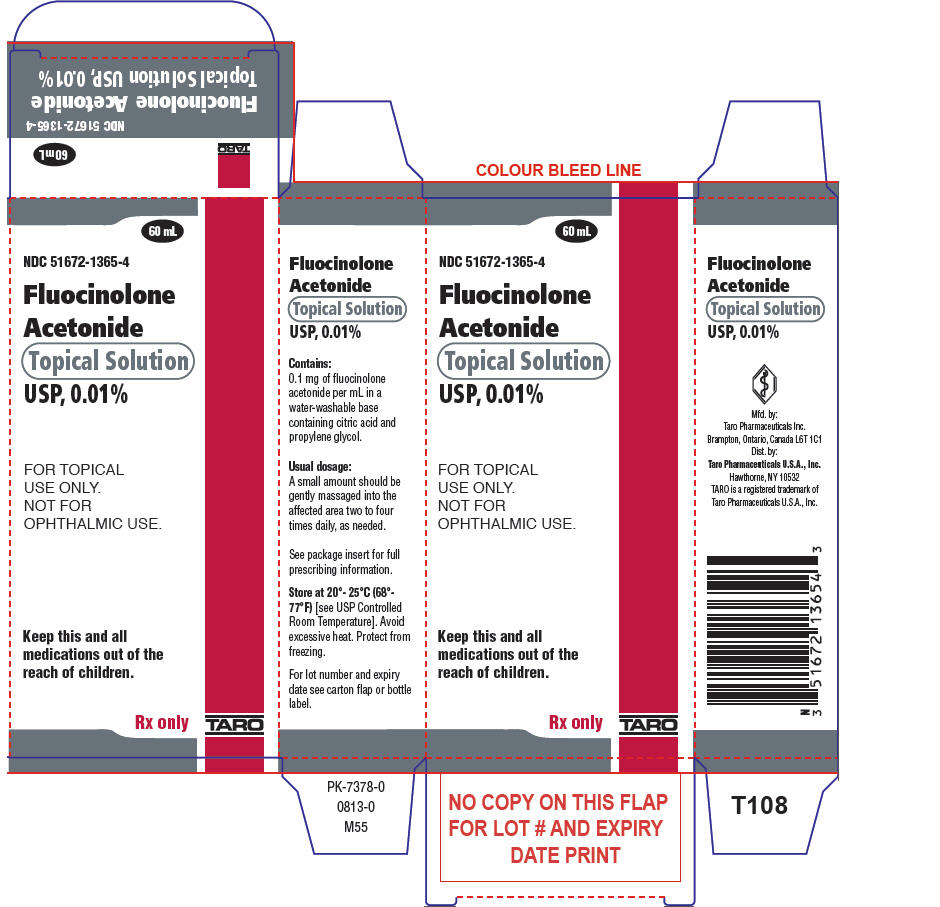
Fluocinolone Acetonide Solution label

Fluocinolone Acetonide Solution

Fluocinolone Acetonide Solution Recall

Get an alert when a recall is issued.

Side Effects & Adverse Reactions

There is currently no warning information available for this product. We apologize for any inconvenience.

FDA Safety Alerts

There are currently no FDA safety alerts available for this drug.

Manufacturer Warnings

There is currently no manufacturer warning information available for this drug.

FDA Labeling Changes

There are currently no FDA labeling changes available for this drug.

Uses

Fluocinolone Acetonide Topical Solution is indicated for the relief of the inflammatory and pruritic manifestations of corticosteroid-responsive dermatoses.

History

There is currently no drug history available for this drug.

Other Information

Fluocinolone Acetonide Topical Solution USP, 0.01% is intended for topical administration. The active component is the corticosteroid fluocinolone acetonide, which has the chemical name pregna-1,4-diene-3,20-dione,6,9-difluoro-11,21dihydroxy-16,17-[(1-methylethylidene)bis (oxy)]-,(6α,11β,16α)-. It has the following chemical structure:

Chemical Structure

Fluocinolone Acetonide 0.01% Solution (each mL contains 0.1 mg Fluocinolone Acetonide) in a water-washable base containing citric acid and propylene glycol.

Fluocinolone Acetonide Solution Manufacturers

  • Taro Pharmaceuticals U.s.a., Inc.
    Fluocinolone Acetonide Solution | Taro Pharmaceuticals U.s.a., Inc.
    No Recall

    Fluocinolone Acetonide Solution | Taro Pharmaceuticals U.s.a., Inc.

    Fluocinolone Acetonide Solution | Taro Pharmaceuticals U.s.a., Inc.

    Fluocinolone Acetonide Solution is generally applied to the affected area as a thin film from two to four times daily depending on the severity of the condition. In hairy sites, the hair should be parted to allow direct contact with the lesion.

    Occlusive dressing may be used for the management of psoriasis or recalcitrant conditions. If an infection develops, the use of occlusive dressings should be discontinued and appropriate antimicrobial therapy instituted.

  • Physicians Total Care, Inc.
    Fluocinolone Acetonide Solution | Physicians Total Care, Inc.
    No Recall

    Fluocinolone Acetonide Solution | Physicians Total Care, Inc.

    Fluocinolone Acetonide Solution | Physicians Total Care, Inc.

    Topical corticosteroids are generally applied to the affected area as a thin film three or four times daily depending on the severity of the condition. Occlusive dressings may be used for the management of psoriasis or recalcitrant conditions. If an infection develops, the use of occlusive dressings should be discontinued and appropriate antimicrobial therapy instituted.

  • Fluocinolone Acetonide Solution | Igi Labs, Inc.
    No Recall

    Fluocinolone Acetonide Solution | Igi Labs, Inc.

    Fluocinolone Acetonide Solution | Igi Labs, Inc.

    Fluocinolone Acetonide Solution is generally applied to the affected area as a thin film from two to four times daily depending on the severity of the condition. In hairy sites, the hair should be parted to allow direct contact with the lesion.

    Occlusive dressing may be used for the management of psoriasis or recalcitrant conditions.

    If an infection develops, the use of occlusive dressings should be discontinued and appropriate antimicrobial therapy instituted.

  • E. Fougera & Co., A Division Of Fougera Pharmaceuticals Inc.
    Fluocinolone Acetonide Solution | E. Fougera & Co., A Division Of Fougera Pharmaceuticals Inc.
    No Recall

    Fluocinolone Acetonide Solution | E. Fougera & Co., A Division Of Fougera Pharmaceuticals Inc.

    Fluocinolone Acetonide Solution | E. Fougera & Co., A Division Of Fougera Pharmaceuticals Inc.

    Fluocinolone Acetonide Solution is generally applied to the affected area as a thin film two to four times daily depending on the severity of the condition. In hairy sites, the hair should be parted to allow direct contact with the lesion. Occlusive dressings may be used for the management of psoriasis or recalcitrant conditions. If an infection develops, the use of occlusive dressings should be discontinued and appropriate antimicrobial therapy instituted.