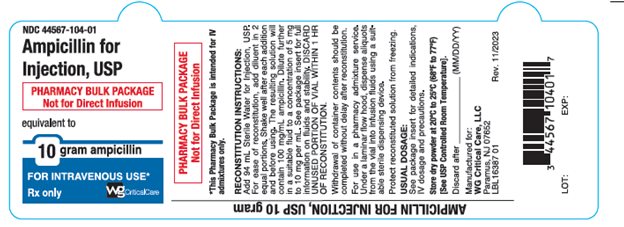
This insert is for the Pharmacy Bulk Package and is intended for preparing IV admixtures only. Dosage recommendations for intramuscular or direct intravenous injection are for informational purposes only.
Infections of the respiratory tract and soft tissues.
Patients weighing 40 kg (88 lbs) or more: 250 to 500 mg every 6 hours.
Patients weighing less than 40 kg (88 lbs): 25 to 50 mg/kg/day in equally divided doses at 6- to 8-hour intervals.
Infections of the gastrointestinal and genitourinary tracts (including those caused by Neisseria gonorrhoeae in females).
Patients weighing 40 kg (88 lbs) or more: 500 mg every 6 hours.
Patients weighing less than 40 kg (88 lbs): 50 mg/kg/day in equally divided doses at 6-to 8-hour intervals.
In the treatment of chronic urinary tract and intestinal infections, frequent bacteriological and clinical appraisal is necessary. Smaller doses than those recommended above should not be used. Higher doses should be used for stubborn or severe infections. In stubborn infections, therapy may be required for several weeks. It may be necessary to continue clinical and/or bacteriological follow-up for several months after cessation of therapy.
Urethritis in males due to N. gonorrhoeae:
Adults: Two doses of 500 mg each at an interval of 8 to 12 hours.
Treatment may be repeated if necessary or extended if required.
In the treatment of complications of gonorrheal urethritis, such as prostatitis and epididymitis, prolonged and intensive therapy is recommended. Cases of gonorrhea with a suspected primary lesion of syphilis should have darkfield examinations before receiving treatment. In all other cases where concomitant syphilis is suspected, monthly serological tests should be made for a minimum of four months.
The doses for the preceding infections may be given by either the intramuscular or intravenous route. A change to oral ampicillin may be made when appropriate.
Bacterial Meningitis.
Adults and children: 150 to 200 mg/kg/day in equally divided doses every 3 to 4 hours. (Treatment may be initiated with intravenous drip therapy and continued with intramuscular injections.) The doses for other infections may be given by either the intravenous or intramuscular route.
Septicemia.
Adults and children: 150 to 200 mg/kg/day. Start with intravenous administration for at least three days and continue with the intramuscular route every 3 to 4 hours.
Treatment of all infections should be continued for a minimum of 48 to 72 hours beyond the time that the patient becomes asymptomatic or evidence of bacterial eradication has been obtained. A minimum of 10-days treatment is recommended for any infection caused by Group A beta-hemolytic streptococci to help prevent the occurrence of acute rheumatic fever or acute glomerulonephritis.
For Administration by Intravenous Infusion
Reconstitute as directed below (Directions for Proper Use of Pharmacy Bulk Package) prior to diluting with an intravenous solution.
IMPORTANT: This chemical stability information in no way indicates that it would be acceptable practice to use this product well after the preparation time. Good professional practice suggests that compounded admixtures should be administered as soon after preparation as is feasible. Stability studies on ampicillin sodium at several concentrations in various intravenous solutions indicate the drug will lose less than 10% activity at the temperatures noted for the time periods stated.
Room Temperature (25°C)
Diluent
Concentrations
Stability Periods
Sterile Water for Injection
up to 30 mg/mL
8 hours
Sodium Chloride Injection, USP 0.9%
up to 30 mg/mL
8 hours
5% Dextrose in Water
10 to 20 mg/mL
1 hour
5% Dextrose in Water
up to 2 mg/mL
2 hours
5% Dextrose in 0.45% NaCl Inj.
up to 2 mg/mL
2 hours
Lactated Ringer’s Solution
up to 30 mg/mL
8 hours
Refrigerated (4°C)
Sterile Water for Injection
30 mg/mL
48 hours
Sterile Water for Injection
up to 20 mg/mL
72 hours
Sodium Chloride Injection, USP, 0.9%
30 mg/mL
24 hours
Sodium Chloride Injection, USP, 0.9%
up to 20 mg/mL
48 hours
Lactated Ringer’s Solution
up to 30 mg/mL
24 hours
5% Dextrose in Water
up to 20 mg/mL
1 hour
5% Dextrose in 0.45% NaCl Inj.
up to 10 mg/mL
1 hour
Only those solutions listed above should be used for the intravenous infusion of Ampicillin for Injection, USP. The concentrations should fall within the range specified. The drug concentration and the rate and volume of the infusion should be adjusted so that the total dose of Ampicillin for Injection, USP is administered before the drug loses its stability in the solution in use.
Directions for Proper Use of Pharmacy Bulk Package
This glass Pharmacy Bulk Package bottle contains 10 grams Ampicillin and is designed for use in the pharmacy in preparing IV admixtures.
a) Add 94 mL Sterile Water for Injection, USP. The resulting soluton will contain 100 milligrams ampicillin activity per mL, and is stable up to one hour at room temperature.
b) Dilute further within ONE HOUR to a concentration of 5 mg to 10 mg per mL. See TABLE for suitable fluid. Use promptly. This chemical stability information in no way indicates that it would be acceptable practice to use this product well after the preparation time. Good professional practice suggests that compounded admixtures should be administered as soon after preparation as is feasible.
c) Using aseptic technique under a laminar flow hood, the closure should be penetrated only one time after reconstitution using a suitable sterile dispensing set which allows measured dispensing of the contents. Use of a syringe and needle is not recommended as it may cause leakage.
d) After entry, use entire contents of Pharmacy Bulk Package bottle promptly. The entire contents of the Pharmacy Bulk Package bottle must be dispensed within ONE HOUR of reconstitution. This time limit should begin with the introduction of solvent in the Pharmacy Bulk Package Bottle.
e) The hanger label on the Pharmacy Bulk Package provides a suitable hanging device while dispensing contents. If the Pharmacy Bulk Package does not have a hanger label, a plastic bail band will provide a suitable hanging device.
Use of this product is restricted to a suitable work area, such as a laminar flow hood. Parenteral drug products should be inspected visually for particulate matter and discoloration prior to administration, whenever solution and container permit.