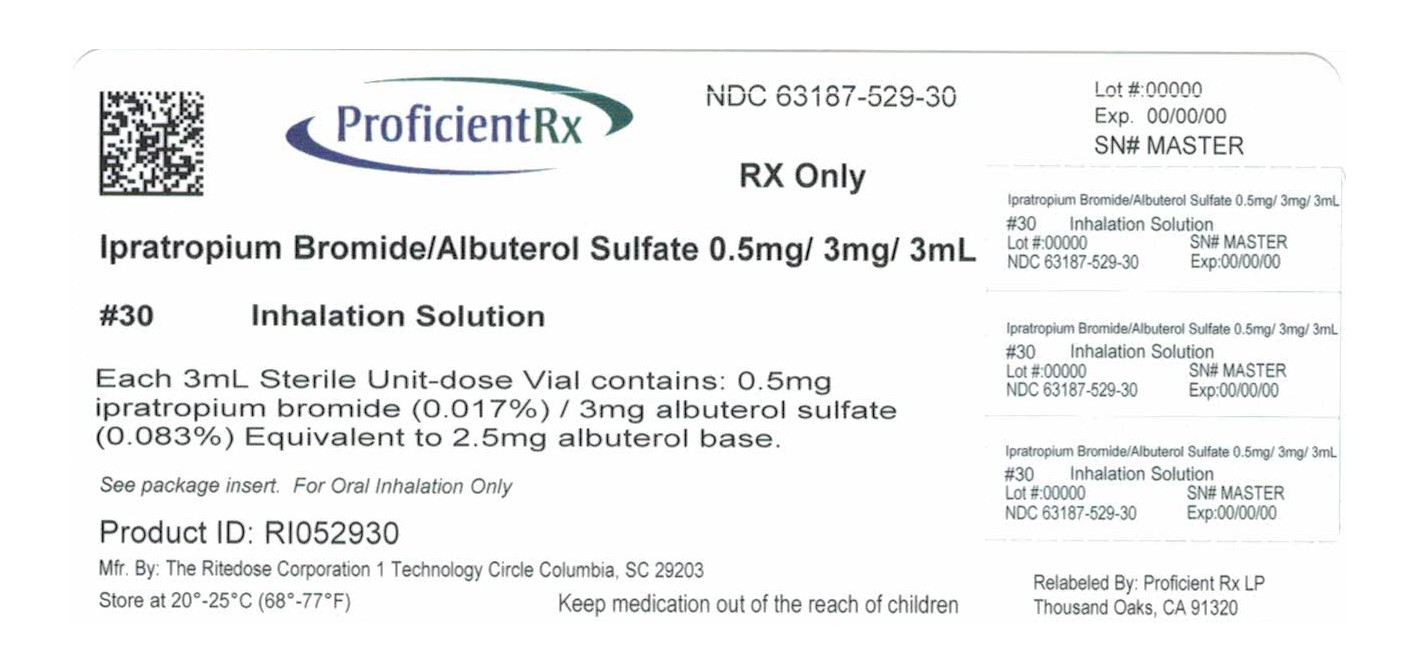
Ipratropium Bromide And Albuterol Sulfate Solution label

Ipratropium Bromide And Albuterol Sulfate Solution

Ipratropium Bromide And Albuterol Sulfate Solution Recall

Get an alert when a recall is issued.

Side Effects & Adverse Reactions

Paradoxical Bronchospasm

In the clinical study of Ipratropium Bromide and Albuterol Sulfate Inhalation Solution, paradoxical bronchospasm was not observed. However, paradoxical bronchospasm has been observed with both inhaled ipratropium bromide and albuterol products and can be life-threatening. If this occurs, Ipratropium Bromide and Albuterol Sulfate Inhalation Solution should be discontinued immediately and alternative therapy instituted.

Do Not Exceed Recommended Dose

Fatalities have been reported in association with excessive use of inhaled products containing sympathomimetic amines and with the home use of nebulizers.

Cardiovascular Effect

Ipratropium Bromide and Albuterol Sulfate Inhalation Solution, like other beta adrenergic agonists, can produce a clinically significant cardiovascular effect in some patients as measured by pulse rate, blood pressure, and/or symptoms. Although such effects are uncommon for Ipratropium Bromide and Albuterol Sulfate Inhalation Solution at recommended doses, if they occur, the drug may need to be discontinued. In addition, beta agonists have been reported to produce ECG changes, such as flattening of the T-wave, prolongation of the QTc interval, and ST segment depression. The clinical significance of these findings is unknown. Therefore, Ipratropium Bromide and Albuterol Sulfate Inhalation Solution, like other sympathomimetic amines, should be used with caution in patients with cardiovascular disorders, especially coronary insufficiency, cardiac arrhythmias, and hypertension.

Immediate Hypersensitivity Reactions

Immediate hypersensitivity reactions to albuterol and/or ipratropium bromide may occur after the administration of Ipratropium Bromide and Albuterol Sulfate Inhalation Solution as demonstrated by rare cases of urticaria, angioedema, rash, pruritus, oropharyngeal edema, bronchospasm, and anaphylaxis.

FDA Safety Alerts

There are currently no FDA safety alerts available for this drug.

Manufacturer Warnings

There is currently no manufacturer warning information available for this drug.

FDA Labeling Changes

There are currently no FDA labeling changes available for this drug.

Uses

Ipratropium Bromide and Albuterol Sulfate Inhalation Solution is indicated for the treatment of bronchospasm associated with COPD in patients requiring more than one bronchodilator.

History

There is currently no drug history available for this drug.

Other Information

The active components in Ipratropium Bromide and Albuterol Sulfate Inhalation Solution are albuterol sulfate and ipratropium bromide.

Albuterol sulfate, is a salt of racemic albuterol and a relatively selective β2-adrenergic bronchodilator chemically described as α1-[(tert-butylamino)methyl]-4-hydroxy-m-xylene-α, α’-diol sulfate (2:1) (salt). It has a molecular weight of 576.7 and the empirical formula is (C13H21NO3)2•H2SO4. It is a white crystalline powder, soluble in water and slightly soluble in ethanol. The World Health Organization recommended name for albuterol base is salbutamol.

Figure 3.1-1. Chemical structure of albuterol sulfate

Figure 3.1-1. Chemical structure of albuterol sulfate

Figure 3.1-1. Chemical structure of albuterol sulfate

Ipratropium bromide is an anticholinergic bronchodilator chemically described as 8-azoniabicyclo [3.2.1]-octane, 3-(3-hydroxy-1-oxo-2-phenylpropoxy)-8methyl-8-(1-methylethyl)-, bromide, monohydrate (endo, syn)-, (±)-; a synthetic quaternary ammonium compound, chemically related to atropine. It has a molecular weight of 430.4 and the empirical formula is C20H30BrNO3•H2O. It is a white crystalline substance, freely soluble in water and lower alcohols, and insoluble in lipophilic solvents such as ether, chloroform, and fluorocarbons.

chemical structure

Figure 3.1-2. Chemical structure of ipratropium bromide.

Figure 3.1-2. Chemical structure of ipratropium bromide.

Each 3 mL Sterile Unit-dose Vial contains 0.5 mg of ipratropium bromide (0.017%) and 3 mg* albuterol sulfate (0.083%) in an isotonic, sterile, aqueous solution containing sodium chloride and 1 N hydrochloric acid to adjust to pH 4.

*Equivalent to 2.5 mg albuterol base

Ipratropium Bromide and Albuterol Sulfate Inhalation Solution is a clear, colorless solution. It does not require dilution prior to administration by nebulization. For Ipratropium Bromide and Albuterol Sulfate Inhalation Solution, like all other nebulized treatments, the amount delivered to the lungs will depend on patient factors, the jet nebulizer utilized, and compressor performance. Using the Pari-LC-Plus™ nebulizer (with face mask or mouthpiece) connected to a PRONEB™ compressor system, under in vitro conditions, the mean delivered dose from the mouth piece (% nominal dose) was approximately 46% of albuterol and 42% of ipratropium bromide at a mean flow rate of 3.6 L/min. The mean nebulization time was 15 minutes or less. Ipratropium Bromide and Albuterol Sulfate Inhalation Solution should be administered from jet nebulizers at adequate flow rates, via face masks or mouthpieces (see DOSAGE AND ADMINISTRATION).

Ipratropium Bromide And Albuterol Sulfate Solution Manufacturers

  • Preferred Pharmaceuticals, Inc.
    Ipratropium Bromide And Albuterol Sulfate Solution | Preferred Pharmaceuticals, Inc.
    No Recall

    Ipratropium Bromide And Albuterol Sulfate Solution | Preferred Pharmaceuticals, Inc.

    Ipratropium Bromide And Albuterol Sulfate Solution | Preferred Pharmaceuticals, Inc.

    The recommended dose of Ipratropium Bromide and Albuterol Sulfate Inhalation Solution is one 3 mL vial administered 4 times per day via nebulization with up to 2 additional 3 mL doses allowed per day, if needed. Safety and efficacy of additional doses or increased frequency of administration of Ipratropium Bromide and Albuterol Sulfate Inhalation Solution beyond these guidelines has not been studied and the safety and efficacy of extra doses of albuterol sulfate or ipratropium bromide in addition to the recommended doses of Ipratropium Bromide and Albuterol Sulfate Inhalation Solution have not been studied.

    The use of Ipratropium Bromide and Albuterol Sulfate Inhalation Solution can be continued as medically indicated to control recurring bouts of bronchospasm. If a previously effective regimen fails to provide the usual relief, medical advice should be sought immediately, as this is often a sign of worsening COPD, which would require reassessment of therapy.

    A Pari-LC-Plus™ nebulizer (with face mask or mouthpiece) connected to a PRONEB™ compressor was used to deliver Ipratropium Bromide and Albuterol Sulfate Inhalation Solution to each patient in one U.S. clinical study. The safety and efficacy of Ipratropium Bromide and Albuterol Sulfate Inhalation Solution delivered by other nebulizers and compressors have not been established.

    Ipratropium Bromide and Albuterol Sulfate Inhalation Solution should be administered via jet nebulizer connected to an air compressor with an adequate air flow, equipped with a mouthpiece or suitable face mask.

  • Physicians Total Care, Inc.
    Ipratropium Bromide And Albuterol Sulfate Solution | Physicians Total Care, Inc.
    No Recall

    Ipratropium Bromide And Albuterol Sulfate Solution | Physicians Total Care, Inc.

    Ipratropium Bromide And Albuterol Sulfate Solution | Physicians Total Care, Inc.

    The recommended dose of Ipratropium Bromide and Albuterol Sulfate is one 3 mL vial administered 4 times per day via nebulization with up to 2 additional 3 mL doses allowed per day, if needed. Safety and efficacy of additional doses or increased frequency of administration of Ipratropium Bromide and Albuterol Sulfate beyond these guidelines has not been studied and the safety and efficacy of extra doses of albuterol sulfate or ipratropium bromide in addition to the recommended doses of Ipratropium Bromide and Albuterol Sulfate have not been studied.

    The use of Ipratropium Bromide and Albuterol Sulfate can be continued as medically indicated to control recurring bouts of bronchospasm. If a previously effective regimen fails to provide the usual relief, medical advice should be sought immediately, as this is often a sign of worsening COPD, which would require reassessment of therapy.

    A Pari-LC-Plus™ nebulizer (with face mask or mouthpiece) connected to a PRONEB™ compressor was used to deliver Ipratropium Bromide and Albuterol Sulfate to each patient in one U.S. clinical study. The safety and efficacy of Ipratropium Bromide and Albuterol Sulfate delivered by other nebulizers and compressors have not been established.

    Ipratropium Bromide and Albuterol Sulfate should be administered via jet nebulizer connected to an air compressor with an adequate air flow, equipped with a mouthpiece or suitable face mask.

  • Cobalt Laboratories
    Ipratropium Bromide And Albuterol Sulfate Solution | Cobalt Laboratories
    No Recall

    Ipratropium Bromide And Albuterol Sulfate Solution | Cobalt Laboratories

    Ipratropium Bromide And Albuterol Sulfate Solution | Cobalt Laboratories

    The recommended dose of Ipratropium Bromide and Albuterol Sulfate Inhalation Solution is one 3 mL vial administered 4 times per day via nebulization with up to 2 additional 3 mL doses allowed per day, if needed. Safety and efficacy of additional doses or increased frequency of administration of Ipratropium Bromide and Albuterol Sulfate Inhalation Solution beyond these guidelines had not been studied and the safety and efficacy of extra doses of albuterol sulfate or ipratropium bromide in addition to the recommended doses of Ipratropium Bromide and Albuterol Sulfate Inhalation Solution have not been studied.

    The use of Ipratropium Bromide and Albuterol Sulfate Inhalation Solution can be continued as medically indicated to control recurring bouts of bronchospasm. If a previously effective regimen fails to provide the usual relief, medical advice should be sought immediately, as this is often a sign of worsening COPD, which would require reassessment of therapy.

    A Pari-LC-Plus™ nebulizer (with face mask or mouthpiece) connected to a PRONEB™ compressor was used to deliver Ipratropium Bromide and Albuterol Sulfate Inhalation Solution to each patient in one U.S. clinical study. The safety and efficacy of Ipratropium Bromide and Albuterol Sulfate Inhalation Solution delivered by other nebulizers and compressors have not been established.

    Ipratropium Bromide and Albuterol Sulfate Inhalation Solution should be administered via jet nebulizer connected to an air compressor with an adequate air flow, equipped with a mouthpiece or suitable face mask.

  • Nephron Pharmaceuticals Corporation
    Ipratropium Bromide And Albuterol Sulfate Solution | Nephron Pharmaceuticals Corporation
    No Recall

    Ipratropium Bromide And Albuterol Sulfate Solution | Nephron Pharmaceuticals Corporation

    Ipratropium Bromide And Albuterol Sulfate Solution | Nephron Pharmaceuticals Corporation

    The recommended dose of Ipratropium Bromide and Albuterol Sulfate Inhalation Solution is one 3 mL vial administered 4 times per day via nebulization with up to 2 additional 3 mL doses allowed per day, if needed. Safety and efficacy of additional doses or increased frequency of administration of Ipratropium Bromide and Albuterol Sulfate Inhalation Solution beyond these guidelines has not been studied and the safety and efficacy of extra doses of albuterol sulfate or ipratropium bromide in addition to the recommended doses of Ipratropium Bromide and Albuterol Sulfate Inhalation Solution have not been studied.

    The use of Ipratropium Bromide and Albuterol Sulfate Inhalation Solution can be continued as medically indicated to control recurring bouts of bronchospasm. If a previously effective regimen fails to provide the usual relief, medical advice should be sought immediately, as this is often a sign of worsening COPD, which would require reassessment of therapy.

    A Pari-LC-Plus™ nebulizer (with face mask or mouthpiece) connected to a PRONEB™ compressor was used to deliver Ipratropium Bromide and Albuterol Sulfate Inhalation Solution to each patient in one U.S. clinical study. The safety and efficacy of Ipratropium Bromide and Albuterol Sulfate Inhalation Solution delivered by other nebulizers and compressors have not been established.

    Ipratropium Bromide and Albuterol Sulfate Inhalation Solution should be administered via jet nebulizer connected to an air compressor with an adequate air flow, equipped with a mouthpiece or suitable face mask.

  • Mylan Pharmaceuticals Inc.
    Ipratropium Bromide And Albuterol Sulfate Solution | Mylan Pharmaceuticals Inc.
    No Recall

    Ipratropium Bromide And Albuterol Sulfate Solution | Mylan Pharmaceuticals Inc.

    Ipratropium Bromide And Albuterol Sulfate Solution | Mylan Pharmaceuticals Inc.

    The recommended dose of Ipratropium Bromide and Albuterol Sulfate is one 3 mL vial administered 4 times per day via nebulization with up to 2 additional 3 mL doses allowed per day, if needed. Safety and efficacy of additional doses or increased frequency of administration of Ipratropium Bromide and Albuterol Sulfate beyond these guidelines has not been studied and the safety and efficacy of extra doses of albuterol sulfate or ipratropium bromide in addition to the recommended doses of Ipratropium Bromide and Albuterol Sulfate have not been studied.

    The use of Ipratropium Bromide and Albuterol Sulfate can be continued as medically indicated to control recurring bouts of bronchospasm. If a previously effective regimen fails to provide the usual relief, medical advice should be sought immediately, as this is often a sign of worsening COPD, which would require reassessment of therapy.

    A Pari-LC-Plus™ nebulizer (with face mask or mouthpiece) connected to a PRONEB™ compressor was used to deliver Ipratropium Bromide and Albuterol Sulfate to each patient in one U.S. clinical study. The safety and efficacy of Ipratropium Bromide and Albuterol Sulfate delivered by other nebulizers and compressors have not been established.

    Ipratropium Bromide and Albuterol Sulfate should be administered via jet nebulizer connected to an air compressor with an adequate air flow, equipped with a mouthpiece or suitable face mask.

  • Eon Labs, Inc.
    Ipratropium Bromide And Albuterol Sulfate Solution | Eon Labs, Inc.
    No Recall

    Ipratropium Bromide And Albuterol Sulfate Solution | Eon Labs, Inc.

    Ipratropium Bromide And Albuterol Sulfate Solution | Eon Labs, Inc.

    The recommended dose of Ipratropium Bromide and Albuterol Sulfate is one 3 mL vial administered 4 times per day via nebulization with up to 2 additional 3 mL doses allowed per day, if needed. Safety and efficacy of additional doses or increased frequency of administration of Ipratropium Bromide and Albuterol Sulfate beyond these guidelines has not been studied and the safety and efficacy of extra doses of albuterol sulfate or ipratropium bromide in addition to the recommended doses of Ipratropium Bromide and Albuterol Sulfate have not been studied.

    The use of Ipratropium Bromide and Albuterol Sulfate can be continued as medically indicated to control recurring bouts of bronchospasm. If a previously effective regimen fails to provide the usual relief, medical advice should be sought immediately, as this is often a sign of worsening COPD, which would require reassessment of therapy.

    A Pari-LC-Plus™ nebulizer (with face mask or mouthpiece) connected to a PRONEB™ compressor was used to deliver Ipratropium Bromide and Albuterol Sulfate to each patient in one U.S. clinical study. The safety and efficacy of Ipratropium Bromide and Albuterol Sulfate delivered by other nebulizers and compressors have not been established.

    Ipratropium Bromide and Albuterol Sulfate should be administered via jet nebulizer connected to an air compressor with an adequate air flow, equipped with a mouthpiece or suitable face mask.

  • Mylan Pharmaceuticals, Inc.
    Ipratropium Bromide And Albuterol Sulfate Solution | Mylan Pharmaceuticals, Inc.
    No Recall

    Ipratropium Bromide And Albuterol Sulfate Solution | Mylan Pharmaceuticals, Inc.

    Ipratropium Bromide And Albuterol Sulfate Solution | Mylan Pharmaceuticals, Inc.

    The recommended dose of Ipratropium Bromide and Albuterol Sulfate Inhalation Solution is one 3 mL vial administered 4 times per day via nebulization with up to 2 additional 3 mL doses allowed per day, if needed. Safety and efficacy of additional doses or increased frequency of administration of Ipratropium Bromide and Albuterol Sulfate Inhalation Solution beyond these guidelines has not been studied and the safety and efficacy of extra doses of albuterol sulfate or ipratropium bromide in addition to the recommended doses of Ipratropium Bromide and Albuterol Sulfate Inhalation Solution have not been studied.

    The use of Ipratropium Bromide and Albuterol Sulfate Inhalation Solution can be continued as medically indicated to control recurring bouts of bronchospasm. If a previously effective regimen fails to provide the usual relief, medical advice should be sought immediately, as this is often a sign of worsening COPD, which would require reassessment of therapy.

    A Pari-LC-Plus™ nebulizer (with face mask or mouthpiece) connected to a PRONEB™ compressor was used to deliver Ipratropium Bromide and Albuterol Sulfate Inhalation Solution to each patient in one U.S. clinical study. The safety and efficacy of Ipratropium Bromide and Albuterol Sulfate Inhalation Solution delivered by other nebulizers and compressors have not been established.

    Ipratropium Bromide and Albuterol Sulfate Inhalation Solution should be administered via jet nebulizer connected to an air compressor with an adequate air flow, equipped with a mouthpiece or suitable face mask.

  • Watson Laboratories, Inc.
    Ipratropium Bromide And Albuterol Sulfate Solution | Watson Laboratories, Inc.
    No Recall

    Ipratropium Bromide And Albuterol Sulfate Solution | Watson Laboratories, Inc.

    Ipratropium Bromide And Albuterol Sulfate Solution | Watson Laboratories, Inc.

    The recommended dose of Ipratropium Bromide and Albuterol Sulfate Inhalation Solution is one 3 mL vial administered 4 times per day via nebulization with up to 2 additional 3 mL doses allowed per day, if needed. Safety and efficacy of additional doses or increased frequency of administration of Ipratropium Bromide and Albuterol Sulfate Inhalation Solution beyond these guidelines has not been studied and the safety and efficacy of extra doses of albuterol sulfate or ipratropium bromide in addition to the recommended doses of Ipratropium Bromide and Albuterol Sulfate Inhalation Solution have not been studied.

    The use of Ipratropium Bromide and Albuterol Sulfate Inhalation Solution can be continued as medically indicated to control recurring bouts of bronchospasm. If a previously effective regimen fails to provide the usual relief, medical advice should be sought immediately, as this is often a sign of worsening COPD, which would require reassessment of therapy.

    A Pari-LC-Plus™ nebulizer (with face mask or mouthpiece) connected to a PRONEB™ compressor was used to deliver Ipratropium Bromide and Albuterol Sulfate Inhalation Solution to each patient in one U.S. clinical study. The safety and efficacy of Ipratropium Bromide and Albuterol Sulfate Inhalation Solution delivered by other nebulizers and compressors have not been established.

    Ipratropium Bromide and Albuterol Sulfate Inhalation Solution should be administered via jet nebulizer connected to an air compressor with an adequate air flow, equipped with a mouthpiece or suitable face mask.

  • Watson Laboratories, Inc.
    Ipratropium Bromide And Albuterol Sulfate Solution | Watson Laboratories, Inc.
    No Recall

    Ipratropium Bromide And Albuterol Sulfate Solution | Watson Laboratories, Inc.

    Ipratropium Bromide And Albuterol Sulfate Solution | Watson Laboratories, Inc.

    The recommended dose of ipratropium bromide and albuterol sulfate inhalation solution is one 3 mL vial administered 4 times per day via nebulization with up to 2 additional 3 mL doses allowed per day, if needed. Safety and efficacy of additional doses or increased frequency of administration of ipratropium bromide and albuterol sulfate inhalation solution beyond these guidelines has not been studied and the safety and efficacy of extra doses of albuterol sulfate or ipratropium bromide in addition to the recommended doses of ipratropium bromide and albuterol sulfate inhalation solution have not been studied.

    The use of ipratropium bromide and albuterol sulfate inhalation solution can be continued as medically indicated to control recurring bouts of bronchospasm. If a previously effective regimen fails to provide the usual relief, medical advice should be sought immediately, as this is often a sign of worsening COPD, which would require reassessment of therapy.

    A Pari-LC-Plus™ nebulizer (with face mask or mouthpiece) connected to a PRONEB™ compressor was used to deliver ipratropium bromide and albuterol sulfate inhalation solution to each patient in one U.S. clinical study. The safety and efficacy of ipratropium bromide and albuterol sulfate inhalation solution delivered by other nebulizers and compressors have not been established.

    Ipratropium bromide and albuterol sulfate inhalation solution should be administered via jet nebulizer connected to an air compressor with an adequate air flow, equipped with a mouthpiece or suitable face mask.

  • Sandoz Inc.
    Ipratropium Bromide And Albuterol Sulfate Solution | Sandoz Inc.
    No Recall

    Ipratropium Bromide And Albuterol Sulfate Solution | Sandoz Inc.

    Ipratropium Bromide And Albuterol Sulfate Solution | Sandoz Inc.

    The recommended dose of Ipratropium Bromide and Albuterol Sulfate Inhalation Solution is one 3 mL vial administered 4 times per day via nebulization with up to 2 additional 3 mL doses allowed per day, if needed. Safety and efficacy of additional doses or increased frequency of administration of Ipratropium Bromide and Albuterol Sulfate Inhalation Solution beyond these guidelines has not been studied and the safety and efficacy of extra doses of albuterol sulfate or ipratropium bromide in addition to the recommended doses of Ipratropium Bromide and Albuterol Sulfate Inhalation Solution have not been studied.

    The use of Ipratropium Bromide and Albuterol Sulfate Inhalation Solution can be continued as medically indicated to control recurring bouts of bronchospasm. If a previously effective regimen fails to provide the usual relief, medical advice should be sought immediately, as this is often a sign of worsening COPD, which would require reassessment of therapy.

    A Pari-LC-Plus™ nebulizer (with face mask or mouthpiece) connected to a PRONEB™ compressor was used to deliver Ipratropium Bromide and Albuterol Sulfate Inhalation Solution to each patient in one U.S. clinical study. The safety and efficacy of Ipratropium Bromide and Albuterol Sulfate Inhalation Solution delivered by other nebulizers and compressors have not been established.

    Ipratropium Bromide and Albuterol Sulfate Inhalation Solution should be administered via jet nebulizer connected to an air compressor with an adequate air flow, equipped with a mouthpiece or suitable face mask.

  • Ritedose Pharmaceuticals, Llc
    Ipratropium Bromide And Albuterol Sulfate Solution | Barr Laboratories, Inc.
    No Recall

    Ipratropium Bromide And Albuterol Sulfate Solution | Barr Laboratories, Inc.

    Ipratropium Bromide And Albuterol Sulfate Solution | Barr Laboratories, Inc.

    Claravis should be administered with a meal (see PRECAUTIONS, Information for Patients).

    The recommended dosage range for Claravis is 0.5 to 1 mg/kg/day given in two divided doses with food for 15 to 20 weeks. In studies comparing 0.1, 0.5, and 1 mg/kg/day,8 it was found that all dosages provided initial clearing of disease, but there was a greater need for retreatment with the lower dosages. During treatment, the dose may be adjusted according to response of the disease and/or the appearance of clinical side effects – some of which may be dose related. Adult patients whose disease is very severe with scarring or is primarily manifested on the trunk may require dose adjustments up to 2 mg/kg/day, as tolerated. Failure to take Claravis with food will significantly decrease absorption. Before upward dose adjustments are made, the patients should be questioned about their compliance with food instructions.

    The safety of once daily dosing with Claravis has not been established. Once daily dosing is not recommended.

    If the total nodule count has been reduced by more than 70% prior to completing 15 to 20 weeks of treatment, the drug may be discontinued. After a period of 2 months or more off therapy, and if warranted by persistent or recurring severe nodular acne, a second course of therapy may be initiated. The optimal interval before retreatment has not been defined for patients who have not completed skeletal growth. Long-term use of Claravis, even in low doses, has not been studied, and is not recommended. It is important that Claravis be given at the recommended doses for no longer than the recommended duration. The effect of long-term use of Claravis on bone loss is unknown (see WARNINGS, Skeletal, Bone Mineral Density, Hyperostosis and Premature Epiphyseal Closure).

    Contraceptive measures must be followed for any subsequent course of therapy (see PRECAUTIONS).

    Table 4. Claravis Dosing by Body Weight (Based on Administration With Food) * See DOSAGE AND ADMINISTRATION: the recommended dosage range is 0.5 to 1 mg/kg/day.

    Body Weight

    Total mg/day

    kilograms

    pounds

    0.5 mg/kg

    1 mg/kg

    2 mg/kg*

    40

    88

    20

    40

    80

    50

    110

    25

    50

    100

    60

    132

    30

    60

    120

    70

    154

    35

    70

    140

    80

    176

    40

    80

    160

    90

    198

    45

    90

    180

    100

    220

    50

    100

    200

    INFORMATION FOR PHARMACISTS

    Access the iPLEDGE system via the internet (www.ipledgeprogram.com) or telephone (1-866-495-0654) to obtain an authorization and the “do not dispense to patient after” date.  Claravis must only be dispensed in no more than a 30 day supply.

    REFILLS REQUIRE A NEW PRESCRIPTION AND A NEW AUTHORIZATION FROM THE iPLEDGE SYSTEM.

    A Claravis Medication Guide must be given to the patient each time Claravis is dispensed, as required by law. This Claravis Medication Guide is an important part of the risk management program for the patient.

  • Ipratropium Bromide And Albuterol Sulfate Solution | Teva Pharmaceuticals Usa Inc
    No Recall

    Ipratropium Bromide And Albuterol Sulfate Solution | Teva Pharmaceuticals Usa Inc

    Ipratropium Bromide And Albuterol Sulfate Solution | Teva Pharmaceuticals Usa Inc

    The recommended dose of ipratropium bromide and albuterol sulfate inhalation solution is one 3 mL vial administered 4 times per day via nebulization with up to 2 additional 3 mL doses allowed per day, if needed. Safety and efficacy of additional doses or increased frequency of administration of ipratropium bromide and albuterol sulfate inhalation solution beyond these guidelines has not been studied and the safety and efficacy of extra doses of albuterol sulfate or ipratropium bromide in addition to the recommended doses of ipratropium bromide and albuterol sulfate inhalation solution have not been studied.

    The use of ipratropium bromide and albuterol sulfate inhalation solution can be continued as medically indicated to control recurring bouts of bronchospasm. If a previously effective regimen fails to provide the usual relief, medical advice should be sought immediately, as this is often a sign of worsening COPD, which would require reassessment of therapy.

    A nebulizer (with face mask or mouthpiece) connected to a compressor was used to deliver ipratropium bromide and albuterol sulfate inhalation solution to each patient in one U.S. clinical study. The safety and efficacy of ipratropium bromide and albuterol sulfate inhalation solution delivered by other nebulizers and compressors have not been established.

    Ipratropium bromide and albuterol sulfate inhalation solution should be administered via jet nebulizer connected to an air compressor with an adequate air flow, equipped with a mouthpiece or suitable face mask.

  • Ipratropium Bromide And Albuterol Sulfate Solution | Cardinal Health
    No Recall

    Ipratropium Bromide And Albuterol Sulfate Solution | Cardinal Health

    Ipratropium Bromide And Albuterol Sulfate Solution | Cardinal Health

    The recommended dose of Ipratropium Bromide and Albuterol Sulfate Inhalation Solution is one 3 mL vial administered 4 times per day via nebulization with up to 2 additional 3 mL doses allowed per day, if needed. Safety and efficacy of additional doses or increased frequency of administration of Ipratropium Bromide and Albuterol Sulfate Inhalation Solution beyond these guidelines has not been studied and the safety and efficacy of extra doses of albuterol sulfate or ipratropium bromide in addition to the recommended doses of Ipratropium Bromide and Albuterol Sulfate Inhalation Solution have not been studied.

    The use of Ipratropium Bromide and Albuterol Sulfate Inhalation Solution can be continued as medically indicated to control recurring bouts of bronchospasm. If a previously effective regimen fails to provide the usual relief, medical advice should be sought immediately, as this is often a sign of worsening COPD, which would require reassessment of therapy.

    A Pari-LC-Plus™ nebulizer (with face mask or mouthpiece) connected to a PRONEB™ compressor was used to deliver Ipratropium Bromide and Albuterol Sulfate Inhalation Solution to each patient in one U.S. clinical study. The safety and efficacy of Ipratropium Bromide and Albuterol Sulfate Inhalation Solution delivered by other nebulizers and compressors have not been established.

    Ipratropium Bromide and Albuterol Sulfate Inhalation Solution should be administered via jet nebulizer connected to an air compressor with an adequate air flow, equipped with a mouthpiece or suitable face mask.

  • Ipratropium Bromide And Albuterol Sulfate Solution | Breckenridge Pharmaceutical, Inc
    No Recall

    Ipratropium Bromide And Albuterol Sulfate Solution | Breckenridge Pharmaceutical, Inc

    Ipratropium Bromide And Albuterol Sulfate Solution | Breckenridge Pharmaceutical, Inc
    2.1 Important Administration Instructions

    Quetiapine fumarate can be taken with or without food.

    2.2 Recommended Dosing

    The recommended initial dose, titration, dose range and maximum quetiapine fumarate dose for each approved indication is displayed in Table 1. After initial dosing, adjustments can be made upwards or downwards, if necessary, depending upon the clinical response and tolerability of the patient [see Clinical Studies (14.1 and 14.2)].


    Table 1: Recommended Dosing for Quetiapine Fumarate


    Indication
     
    Initial Dose and Titration
    Recommended Dose
    Maximum Dose
    Schizophrenia-Adults
    Day 1: 25 mg twice daily. Increase in increments of 25 mg to 50 mg divided two or three times on Days 2 and 3 to range of 300 to 400 mg by Day 4. Further adjustments can be made in increments of 25 to 50 mg twice a day, in intervals of not less than 2 days.
    150 to 750 mg/day
    750 mg/day
    Schizophrenia-Adolescents (13 to 17 years)
    Day 1:  25 mg twice daily.
    Day 2: Twice daily dosing totaling 100 mg.
    Day 3: Twice daily dosing totaling 200 mg.
    Day 4: Twice daily dosing totaling 300 mg.
    Day 5: Twice daily dosing totaling 400 mg.
    Further adjustments should be in increments no greater than 100 mg/day within the recommended dose range of 400 to 800 mg/day.
    Based on response and tolerability, may be administered three times daily.
    400 to 800 mg/day
    800 mg/day
    Schizophrenia-Maintenance
    N/A1
    400 to 800 mg/day
    800 mg/day
    Bipolar Mania-Adults Monotherapy or as an adjunct to lithium or divalproex
    Day 1: Twice daily dosing totaling 100 mg.
    Day 2: Twice daily dosing totaling 200 mg.
    Day 3: Twice daily dosing totaling300 mg.
    Day 4: Twice daily dosing totaling 400 mg.
    Further dosage adjustments up to 800 mg/day by Day 6 should be in increments of no greater than 200 mg/day.
    400 to 800 mg/day
    800 mg/day
    Bipolar Mania-Children and Adolescents (10 to 17 years), Monotherapy
    Day 1:  25 mg twice daily.
    Day 2: Twice daily dosing totaling 100 mg.
    Day 3: Twice daily dosing totaling 200 mg.
    Day 4: Twice daily dosing totaling 300 mg.
    Day 5: Twice daily dosing totaling 400 mg.
    Further adjustments should be in increments no greater than 100 mg/day within the recommended dose range of 400 to 600 mg/day. Based on response and tolerability, may be administered three times daily.
    400 to 600 mg/day
    600 mg/day
    Bipolar Depression-Adults
    Administer once daily at bedtime. 
    Day 1: 50 mg
    Day 2: 100 mg
    Day 3: 200 mg
    Day 4: 300 mg
    300 mg/day
    300 mg/day
    Bipolar I Disorder Maintenance Therapy-Adults
    Administer twice daily totaling 400 to 800 mg/day as adjunct to lithium or divalproex.  Generally, in the maintenance phase, patients continued on the same dose on which they were stabilized.
    400 to 800 mg/day
    800 mg/day

    1 N/A Not applicable


    Maintenance Treatment for Schizophrenia and Bipolar I Disorder
    Maintenance Treatment – Patients should be periodically reassessed to determine the need for maintenance treatment and the appropriate dose for such treatment [see Clinical Studies (14.2)].

    2.3 Dose Modifications in Elderly Patients

    Consideration should be given to a slower rate of dose titration and a lower target dose in the elderly and in patients who are debilitated or who have a predisposition to hypotensive reactions [see Clinical Pharmacology (12.3)]. When indicated, dose escalation should be performed with caution in these patients.

    Elderly patients should be started on quetiapine fumarate 50 mg/day and the dose can be increased in increments of 50 mg/day depending on the clinical response and tolerability of the individual patient.

    2.4 Dose Modifications in Hepatically Impaired Patients

    Patients with hepatic impairment should be started on 25 mg/day. The dose should be increased daily in increments of 25 mg/day  to 50 mg/day to an effective dose, depending on the clinical response and tolerability of the patient.

    2.5 Dose Modifications when used with CYP3A4 Inhibitors

    Quetiapine fumarate dose should be reduced to one sixth of original dose when co-medicated with a potent CYP3A4 inhibitor (e.g., ketoconazole, itraconazole, indinavir, ritonavir, nefazodone, etc.). When the CYP3A4 inhibitor is discontinued, the dose of quetiapine fumarate  should be increased by 6 fold [see Clinical Pharmacology (12.3) and Drug Interactions (7.1)].

    2.6 Dose Modifications when used with CYP3A4 Inducers

    Quetiapine fumarate dose should be increased up to 5 fold of the original dose when used in combination with a chronic treatment (e.g., greater than 7 to 14 days) of a potent CYP3A4 inducer (e.g., phenytoin, carbamazepine, rifampin, avasimibe, St. John’s wort etc.). The dose should be titrated based on the clinical response and tolerability of the individual patient. When the CYP3A4 inducer is discontinued, the dose of quetiapine fumarate should be reduced to the original level within 7 to 14 days [see Clinical Pharmacology (12.3) and Drug Interactions (7.1)].

    2.7 Reinitiation of Treatment in Patients Previously Discontinued

    Although there are no data to specifically address re-initiation of treatment, it is recommended that when restarting therapy of patients who have been off quetiapine fumarate for more than one week, the initial dosing schedule should be followed. When restarting patients who have been off quetiapine fumarate for less than one week, gradual dose escalation may not be required and the maintenance dose may be reinitiated.

    2.8 Switching from Antipsychotics

    There are no systematically collected data to specifically address switching patients with schizophrenia from antipsychotics to quetiapine fumarate, or concerning concomitant administration with antipsychotics. While immediate discontinuation of the previous antipsychotic treatment may be acceptable for some patients with schizophrenia, more gradual discontinuation may be most appropriate for others. In all cases, the period of overlapping antipsychotic administration should be minimized. When switching patients with schizophrenia from depot antipsychotics, if medically appropriate, initiate quetiapine fumarate  therapy in place of the next scheduled injection. The need for continuing existing EPS medication should be re-evaluated periodically.

  • Proficient Rx Lp
    Ipratropium Bromide And Albuterol Sulfate Solution | Proficient Rx Lp
    No Recall

    Ipratropium Bromide And Albuterol Sulfate Solution | Proficient Rx Lp

    Ipratropium Bromide And Albuterol Sulfate Solution | Proficient Rx Lp

    The recommended dose of Ipratropium Bromide and Albuterol Sulfate Inhalation Solution is one 3 mL vial administered 4 times per day via nebulization with up to 2 additional 3 mL doses allowed per day, if needed. Safety and efficacy of additional doses or increased frequency of administration of Ipratropium Bromide and Albuterol Sulfate Inhalation Solution beyond these guidelines has not been studied and the safety and efficacy of extra doses of albuterol sulfate or ipratropium bromide in addition to the recommended doses of Ipratropium Bromide and Albuterol Sulfate Inhalation Solution have not been studied.

    The use of Ipratropium Bromide and Albuterol Sulfate Inhalation Solution can be continued as medically indicated to control recurring bouts of bronchospasm. If a previously effective regimen fails to provide the usual relief, medical advice should be sought immediately, as this is often a sign of worsening COPD, which would require reassessment of therapy.

    A Pari-LC-Plus™ nebulizer (with face mask or mouthpiece) connected to a PRONEB™ compressor was used to deliver Ipratropium Bromide and Albuterol Sulfate Inhalation Solution to each patient in one U.S. clinical study. The safety and efficacy of Ipratropium Bromide and Albuterol Sulfate Inhalation Solution delivered by other nebulizers and compressors have not been established.

    Ipratropium Bromide and Albuterol Sulfate Inhalation Solution should be administered via jet nebulizer connected to an air compressor with an adequate air flow, equipped with a mouthpiece or suitable face mask.