
Kcentra label

Kcentra

Kcentra Recall

Get an alert when a recall is issued.

Side Effects & Adverse Reactions

There is currently no warning information available for this product. We apologize for any inconvenience.

FDA Safety Alerts

There are currently no FDA safety alerts available for this drug.

Manufacturer Warnings

There is currently no manufacturer warning information available for this drug.

FDA Labeling Changes

There are currently no FDA labeling changes available for this drug.

Uses

Kcentra, (Prothrombin Complex Concentrate (Human)), is a blood coagulation factor replacement product indicated for the urgent reversal of acquired coagulation factor deficiency induced by Vitamin K antagonist (VKA, e.g., warfarin) therapy in adult patients with:

  • acute major bleeding or
  • need for an urgent surgery/invasive procedure.

History

There is currently no drug history available for this drug.

Other Information

Kcentra is a purified, heat-treated, nanofiltered and lyophilized non-activated four-factor Prothrombin Complex Concentrate (Human) prepared from human U.S. Source Plasma (21 CFR 640.60). It contains the Vitamin K dependent Coagulation Factors II, VII, IX and X, and the antithrombotic Proteins C and S. Factor IX is the lead factor for the potency of the preparation as stated on the vial label. The excipients are human antithrombin III, heparin, human albumin, sodium chloride, and sodium citrate. Kcentra is sterile, pyrogen-free, and does not contain preservatives.

The product contents are shown in Table 7 and listed as ranges for the blood coagulation factors.

Table 7: Composition per Vial of Kcentra *
Ingredient Kcentra 500 units Kcentra 1000 units
*
Exact potency of coagulant and antithrombotic proteins are listed on the carton
Total protein 120–280 mg 240–560 mg
  Factor II 380–800 units 760–1600 units
  Factor VII 200–500 units 400–1000 units
  Factor IX 400–620 units 800–1240 units
  Factor X 500–1020 units 1000–2040 units
  Protein C 420–820 units 840–1640 units
  Protein S 240–680 units 480–1360 units
Heparin 8–40 units 16–80 units
Antithrombin III 4–30 units 8–60 units
Human albumin 40–80 mg 80–160 mg
Sodium chloride 60–120 mg 120–240 mg
Sodium citrate 40–80 mg 80–160 mg
HCl Small amounts Small amounts
NaOH Small amounts Small amounts

All plasma used in the manufacture of Kcentra is obtained from US donors and is tested using serological assays for hepatitis B surface antigen and antibodies to HIV-1/2 and HCV. The plasma is tested with Nucleic Acid Testing (NAT) for HCV, HIV-1, HAV, and HBV, and found to be non-reactive (negative), and the plasma is also tested by NAT for human parvovirus B19 (B19V) in order to exclude donations with high titers. The limit for B19V in the fractionation pool is set not to exceed 104 units of B19V DNA per mL. Only plasma that passed virus screening is used for production.

The Kcentra manufacturing process includes various steps, which contribute towards the reduction/ inactivation of viruses. Kcentra is manufactured from cryo-depleted plasma that is adsorbed via ion exchange chromatography, heat treated in aqueous solution for 10 hours at 60°C, precipitated, adsorbed to calcium phosphate, virus filtered, and lyophilized.

Manufacturing steps were independently validated in a series of in-vitro experiments for their virus inactivation / reduction capacity for both enveloped and non-enveloped viruses. Table 8 shows the virus clearance during the manufacturing process for Kcentra, expressed as the mean log10 reduction factor.

Table 8: Mean Virus Reduction Factors [log10] of Kcentra
Virus Studied Manufacturing Steps
Heat treatment (“Pasteurization”) Ammonium sulphate precipitation followed by Ca Phosphate adsorption 2 × 20nm Virus Filtration Overall Virus Reduction
[log10]
HIV Human immunodeficiency virus, a model for HIV-1 and HIV-2
BVDV Bovine viral diarrhea virus, model for HCV
PRV Pseudorabies virus, a model for large enveloped DNA viruses
WNV West Nile virus
HAV Hepatitis A virus
CPV Canine parvovirus, model for B19V
n.d. not determined
*
Reduction factor below 1 log
10 was not considered in calculating the overall virus reduction. Studies using human parvovirus B19, which are considered experimental in nature, have demonstrated a virus reduction factor of 3.5 log
10 by heat treatment.
Enveloped Viruses
HIV ≥ 5.9 ≥ 5.9 ≥ 6.6 ≥ 18.4
BVDV ≥ 8.5 2.2 ≥ 6.0 ≥ 16.7
PRV 3.8 7.2 ≥ 6.6 ≥ 17.6
WNV ≥ 7.4 n.d. ≥ 8.1 ≥ 15.5
Non-Enveloped Viruses
HAV 4.0 1.8 ≥ 6.1 ≥ 11.9
CPV [0.5]* 1.5 6.5 8.0

Kcentra Manufacturers

  • Kcentra | Csl Behring Gmbh
    No Recall

    Kcentra | Csl Behring Gmbh

    Kcentra | Csl Behring Gmbh

    For intravenous use only.

    2.1 Dosage Measurement of INR prior to treatment and close to the time of dosing is important because coagulation factors may be unstable in patients with acute major bleeding or an urgent need for surgery and other invasive procedures. Individualize Kcentra dosing based on the patient's current pre-dose International Normalized Ratio (INR) value, and body weight (see Table 1). The actual potency per vial of Factors II, VII, IX and X, Proteins C and S is stated on the carton. Administer Vitamin K concurrently to patients receiving Kcentra. Vitamin K is administered to maintain Vitamin K-dependent clotting factor levels once the effects of Kcentra have diminished. The safety and effectiveness of repeat dosing have not been established and it is not recommended. Dose ranging within pre-treatment INR groups has not been studied in randomized clinical trials of Kcentra. Table 1: Dosage Required for Reversal of VKA Anticoagulation in Patients with acute major bleeding or need for an urgent surgery/invasive procedure Pre-treatment INR 2–< 4 4–6 > 6 * Dosing is based on body weight. Dose based on actual potency as stated on the carton, which will vary from 20–31 Factor IX units/mL after reconstitution. Nominal potency is 500 or 1000 units per vial, approximately 25 units per mL after reconstitution. † Units refer to International Units. ‡ Dose is based on body weight up to but not exceeding 100 kg. For patients weighing more than 100 kg, maximum dose should not be exceeded. Dose* of Kcentra (units† of Factor IX) / kg body weight 25 35 50 Maximum dose‡
    (units of Factor IX) Not to exceed 2500 Not to exceed 3500 Not to exceed 5000

    Example dosing calculation for 80 kg patient

    For example, an 80 kg patient with a baseline of INR of 5.0, the dose would be 2,800 Factor IX units of Kcentra, calculated as follows based on INR range of 4–6, see Table 1:

    * For a vial with an actual potency of 30 units/mL Factor IX, 93 mL would be given (2,800 U/30 U per mL = 93 mL). 35 units of Factor IX/kg    נ   80 kg = 2,800 units of Factor IX required*

    Monitor INR and clinical response during and after treatment. In clinical trials, Kcentra decreased the INR to ≤ 1.3 within 30 minutes in most subjects. The relationship between this or other INR values and clinical hemostasis in patients has not been established [see Clinical Studies (14)].

    2.2 Preparation and Reconstitution Reconstitute using aseptic technique with 20 mL (500 U kit) or 40 mL (1000 U kit) of diluent provided with the kit. Visually inspect parenteral drug products for particulate matter and discoloration prior to administration whenever solution and container permit. Reconstituted Kcentra solution should be colorless, clear to slightly opalescent, and free from visible particles. Do not use solutions that are cloudy or have deposits. Kcentra is for single use only. Contains no preservatives. Discard partially used vials.

    The procedures provided in Table 2 are general guidelines for the preparation and reconstitution of Kcentra.

    Reconstitute at room temperature as follows:

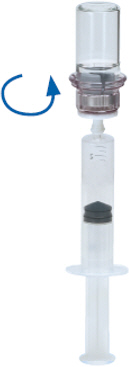
    Table 2: Kcentra Reconstitution Instructions 1. Ensure that the Kcentra vial and diluent vial are at room temperature. Prepare and administer using aseptic technique. 2. Place the Kcentra vial, diluent vial, and Mix2Vial ® transfer set on a flat surface. 3. Remove Kcentra and diluent vial flip caps. Wipe the stoppers with the alcohol swab provided and allow to dry prior to opening the Mix2Vial transfer set package. 4. Open the Mix2Vial transfer set package by peeling away the lid. [ Fig. 1] Leave the Mix2Vial transfer set in the clear package. Fig. 1 5. Place the diluent vial on a flat surface and hold the vial tightly. Grip the Mix2Vial transfer set together with the clear package and push the plastic spike at the blue end of the Mix2Vial transfer set firmly through the center of the stopper of the diluent vial. [ Fig. 2] Fig. 2 6. Carefully remove the clear package from the Mix2Vial transfer set. Make sure that you pull up only the clear package, not the Mix2Vial transfer set. [ Fig. 3] Fig. 3 7. With the Kcentra vial placed firmly on a flat surface, invert the diluent vial with the Mix2Vial transfer set attached and push the plastic spike of the transparent adapter firmly through the center of the stopper of the Kcentra vial. [ Fig. 4] The diluent will automatically transfer into the Kcentra vial. Fig. 4 8. With the diluent and Kcentra vial still attached to the Mix2Vial transfer set, gently swirl the Kcentra vial to ensure that the Kcentra is fully dissolved. [ Fig. 5] Do not shake the vial. Fig. 5 9. With one hand, grasp the Kcentra side of the Mix2Vial transfer set and with the other hand grasp the blue diluent-side of the Mix2Vial transfer set, and unscrew the set into two pieces. [ Fig. 6] Fig. 6 10. Draw air into an empty, sterile syringe. While the Kcentra vial is upright, screw the syringe to the Mix2Vial transfer set. Inject air into the Kcentra vial. While keeping the syringe plunger pressed, invert the system upside down and draw the concentrate into the syringe by pulling the plunger back slowly. [ Fig. 7] Fig. 7 11. Now that the concentrate has been transferred into the syringe, firmly grasp the barrel of the syringe (keeping the plunger facing down) and unscrew the syringe from the Mix2Vial transfer set. [ Fig. 8] Attach the syringe to a suitable intravenous administration set. Fig. 8 12. After reconstitution, administration should begin promptly or within 4 hours. 13. If the same patient is to receive more than one vial, you may pool the contents of multiple vials. Use a separate unused Mix2Vial transfer set for each product vial. 2.3 Administration Do not mix Kcentra with other medicinal products; administer through a separate infusion line. Use aseptic technique when administering Kcentra. Administer at room temperature. Administer by intravenous infusion at a rate of 0.12 mL/kg/min (~3 units/kg/min), up to a maximum rate of 8.4 mL/min (~210 units/min). No blood should enter the syringe, as there is a possibility of fibrin clot formation.