Montelukast label

Montelukast

Montelukast Recall

Get an alert when a recall is issued.

Side Effects & Adverse Reactions

There is currently no warning information available for this product. We apologize for any inconvenience.

FDA Safety Alerts

There are currently no FDA safety alerts available for this drug.

Manufacturer Warnings

There is currently no manufacturer warning information available for this drug.

FDA Labeling Changes

There are currently no FDA labeling changes available for this drug.

Uses

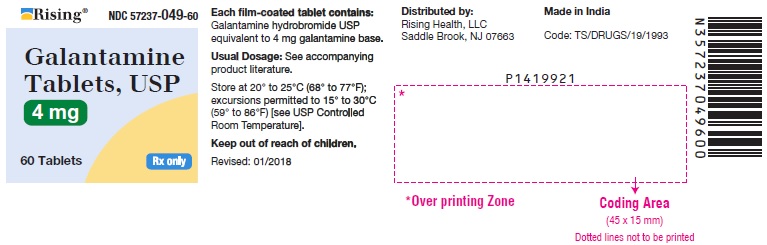
Galantamine tablets USP are indicated for the treatment of mild to moderate dementia of the Alzheimer’s type.

History

There is currently no drug history available for this drug.

Other Information

Galantamine tablets, USP contain galantamine, a reversible, competitive acetylcholinesterase inhibitor as the hydrobromide salt. Galantamine hydrobromide is known chemically as (4aS,6R,8aS)-4a,5,9,10,11,12-hexahydro-3-methoxy-11-methyl-6H-benzofuro[3a,3,2-ef][2]benzazepin-6-ol hydrobromide. It has a molecular formula of C17H21NO3•HBr and a molecular weight of 368.27. Galantamine hydrobromide is a white or almost white powder and is sparingly soluble in water. The structural formula for galantamine hydrobromide is:

Structure

Galantamine tablets, USP contain 4 mg, 8 mg, and 12 mg galantamine as 5.126 mg, 10.252 mg, and 15.378 mg of galantamine hydrobromide USP, respectively. Inactive ingredients include colloidal silicon dioxide, hypromellose, magnesium stearate, microcrystalline cellulose, pregelatinized starch (maize), propylene glycol, talc, and titanium dioxide. The 4 mg tablets contain iron oxide yellow. The 8 mg tablets contain iron oxide red. The 12 mg tablets contain iron oxide red and FD&C yellow #6 aluminum lake.

Montelukast Manufacturers

  • Montelukast | Citron Pharma Llc
    No Recall

    Montelukast | Citron Pharma Llc

    Montelukast | Citron Pharma Llc
    2.2 Galantamine Immediate-Release Tablets


    The dosage of galantamine tablets shown to be effective in controlled clinical trials is 16 to 32 mg/day given as twice daily dosing. As the dosage of 32 mg/day is less well tolerated than lower dosages and does not provide increased effectiveness, the recommended dosage range is 16 to 24 mg/day given twice daily. The dosage of 24 mg/day did not provide a statistically significant greater clinical benefit than 16 mg/day. It is possible, however, that a daily dosage of 24 mg of galantamine tablets might provide additional benefit for some patients.

    The recommended starting dosage of galantamine tablets is 4 mg twice a day (8 mg/day). The dosage should be increased to the initial maintenance dosage of 8 mg twice a day (16 mg/day) after a minimum of 4 weeks. A further increase to 12 mg twice a day (24 mg/day) should be attempted after a minimum of 4 weeks at 8 mg twice a day (16 mg/day).

    Dosage increases should be based upon assessment of clinical benefit and tolerability of the previous dose.

    Galantamine tablets should be administered twice a day, preferably with morning and evening meals.

    Patients and caregivers should be advised to ensure adequate fluid intake during treatment. If therapy has been interrupted for more than three days, the patient should be restarted at the lowest dosage and the dosage escalated to the current dose.

    The abrupt withdrawal of galantamine tablets in those patients who had been receiving dosages in the effective range was not associated with an increased frequency of adverse events in comparison with those continuing to receive the same dosages of that drug. The beneficial effects of galantamine tablets are lost, however, when the drug is discontinued.

    2.3 Dosage in Patients with Hepatic Impairment

    In patients with moderate hepatic impairment (Child-Pugh score of 7 to 9), the dosage should generally not exceed 16 mg/day. The use of galantamine tablets in patients with severe hepatic impairment (Child-Pugh score of 10 to 15) is not recommended [see Clinical Pharmacology (12.3)].

    2.4 Dosage in Patients with Renal Impairment

    In patients with creatinine clearance of 9 to 59 mL/min, the dosage should generally not exceed 16 mg/day. In patients with creatinine clearance less than 9 mL/min, the use of and galantamine tablets is not recommended [see Clinical Pharmacology (12.3)].

  • West Ward Pharmaceutical Corp
    Montelukast | Hyvee Inc
    No Recall

    Montelukast | Hyvee Inc

    Montelukast | Hyvee Inc
    • do not take more than directed (see overdose warning)

    adults

    • take 2 caplets every 8 hours with water • swallow whole; do not crush, chew, split or dissolve • do not take more than 6 caplets in 24 hours • do not use for more than 10 days unless directed by a doctor

    under 18 years of age

    • ask a doctor
  • Clinical Solutions Wholesale
    Montelukast | Clinical Solutions Wholesale
    No Recall

    Montelukast | Clinical Solutions Wholesale

    Montelukast | Clinical Solutions Wholesale
    2.1 Asthma

    Montelukast sodium should be taken once daily in the evening. The following doses are recommended:

    For adults and adolescents 15 years of age and older: one 10 mg tablet.

    For pediatric patients 6 to 14 years of age: one 5 mg chewable tablet.

    For pediatric patients 2 to 5 years of age: one 4 mg chewable tablet

    Safety and effectiveness in pediatric patients less than 12 months of age with asthma have not been established.

    There have been no clinical trials in patients with asthma to evaluate the relative efficacy of morning versus evening dosing. The pharmacokinetics of montelukast are similar whether dosed in the morning or evening. Efficacy has been demonstrated for asthma when montelukast was administered in the evening without regard to time of food ingestion.

    2.2 Exercise-Induced Bronchoconstriction (EIB) in Patients 15 Years of Age and Older

    For prevention of EIB, a single 10 mg dose of montelukast should be taken at least 2 hours before exercise.

    An additional dose of montelukast should not be taken within 24 hours of a previous dose. Patients already taking montelukast sodium daily for another indication (including chronic asthma) should not take an additional dose to prevent EIB. All patients should have available for rescue a short-acting β-agonist. Safety and effectiveness in patients younger than 15 years of age have not been established. Daily administration of montelukast sodium for the chronic treatment of asthma has not been established to prevent acute episodes of EIB.

    Pediatric use information for patients ages 6 to 14 years of age for acute prevention of exercise-induced bronchoconstriction (EIB) is approved for Merck Sharp & Dohme Corp’s montelukast tablet products. However, due to Merck Sharp & Dohme Corp’s marketing exclusivity rights, this drug product is not labeled with that pediatric information.

    2.3 Allergic Rhinitis

    For allergic rhinitis, montelukast sodium should be taken once daily. Efficacy was demonstrated for seasonal allergic rhinitis when montelukast was administered in the morning or the evening without regard to time of food ingestion. The time of administration may be individualized to suit patient needs.

    The following doses for the treatment of symptoms of seasonal allergic rhinitis are recommended:

    For adults and adolescents 15 years of age and older: one 10 mg tablet.

    For pediatric patients 6 to 14 years of age: one 5 mg chewable tablet.

    For pediatric patients 2 to 5 years of age: one 4 mg chewable tablet

    Safety and effectiveness in pediatric patients younger than 2 years of age with seasonal allergic rhinitis have not been established.

    The following doses for the treatment of symptoms of perennial allergic rhinitis are recommended:

    For adults and adolescents 15 years of age and older: one 10 mg tablet.

    For pediatric patients 6 to 14 years of age: one 5 mg chewable tablet.

    For pediatric patients 2 to 5 years of age: one 4 mg chewable tablet

    Safety and effectiveness in pediatric patients younger than 6 months of age with perennial allergic rhinitis have not been established.

    2.4 Asthma and Allergic Rhinitis

    Patients with both asthma and allergic rhinitis should take only one montelukast sodium dose daily in the evening.

  • Sandoz Inc
    Montelukast | Sagent Pharmaceuticals
    No Recall

    Montelukast | Sagent Pharmaceuticals

    Montelukast | Sagent Pharmaceuticals

    Infections of the respiratory tract and soft tissues.

    Patients weighing 40 kg (88 lbs) or more: 250 to 500 mg every 6 hours.

    Patients weighing less than 40 kg (88 lbs): 25 to 50 mg/kg/day in equally divided doses at 6- to 8-hour intervals.

    Infections of the gastrointestinal and genitourinary tracts (including those caused by Neisseria gonorrhoeae in females).

    Patients weighing 40 kg (88 lbs) or more: 500 mg every 6 hours.

    Patients weighing less than 40 kg (88 lbs): 50 mg/kg/day in equally divided doses at 6- to 8- hour intervals.

    In the treatment of chronic urinary tract and intestinal infections, frequent bacteriological and clinical appraisal is necessary. Smaller doses than those recommended above should not be used. Higher doses should be used for stubborn or severe infections. In stubborn infections, therapy may be required for several weeks. It may be necessary to continue clinical and/or bacteriological follow-up for several months after cessation of therapy.

    Urethritis in males due to N. gonorrhoeae.

    Adults - Two doses of 500 mg each at an interval of 8 to 12 hours. Treatment may be repeated if necessary or extended if required.

    In the treatment of complications of gonorrheal urethritis, such as prostatitis and epididymitis, prolonged and intensive therapy is recommended. Cases of gonorrhea with a suspected primary lesion of syphilis should have darkfield examinations before receiving treatment. In all other cases where concomitant syphilis is suspected, monthly serological tests should be made for a minimum of four months.

    The doses for the preceding infections may be given by either the intramuscular or intravenous route. A change to oral ampicillin may be made when appropriate.

    Bacterial Meningitis

    Adults and children - 150 to 200 mg/kg/day in equally divided doses every 3 to 4 hours. (Treatment may be initiated with intravenous drip therapy and continued with intramuscular injections.) The doses for other infections may be given by either the intravenous or intramuscular route.

    Septicemia

    Adults and children - 150 to 200 mg/kg/day. Start with intravenous administration for at least three days and continue with the intramuscular route every 3 to 4 hours.

    Treatment of all infections should be continued for a minimum of 48 to 72 hours beyond the time that the patient becomes asymptomatic or evidence of bacterial eradication has been obtained. A minimum of 10-days treatment is recommended for any infection caused by Group A beta-hemolytic streptococci to help prevent the occurrence of acute rheumatic fever or acute glomerulonephritis.

  • Montelukast | Amneal Pharmaceuticals Of New York, Llc
    No Recall

    Montelukast | Amneal Pharmaceuticals Of New York, Llc

    Montelukast | Amneal Pharmaceuticals Of New York, Llc

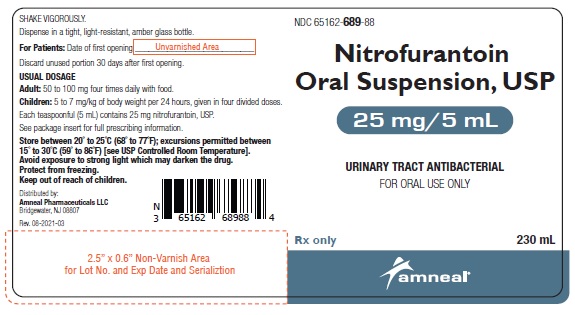
    Nitrofurantoin oral suspension, USP should be given with food to improve drug absorption and, in some patients, tolerance.

    Adults

    50 to 100 mg four times a day - the lower dosage level is recommended for uncomplicated urinary tract infections.

    Pediatric Patients

    5 to 7 mg/kg of body weight per 24 hours, given in four divided doses (contraindicated under one month of age).

    The following table is based on an average weight in each range receiving 5 to 6 mg/kg of body weight per 24 hours, given in four divided doses. It can be used to calculate an average dose of nitrofurantoinoral suspension, USP (25 mg/5 mL) for pediatric patients.

    Table 3: Pediatric Dosing Table

    Weight in Kilograms (kg)

    Pediatric Doses (milliliters) and Frequency


    7 kg to 11 kg

    2.5 mL Four times Daily


    12 kg to 21 kg

    5 mL Four times Daily

     22 kg to 30 kg

    7.5 mL Four times Daily

     31 kg to 41 kg

    10 mL Four times Daily

    42 kg or greater

    See Adult Dose


    Therapy should be continued for one week or for at least 3 days after sterility of the urine is obtained. Continued infection indicates the need for reevaluation.

    For long-term suppressive therapy in adults, a reduction of dosage to 50 to 100 mg at bedtime may be adequate. For long-term suppressive therapy in pediatric patients, doses as low as 1 mg/kg per 24 hours, given in a single dose or in two divided doses, may be adequate. SEE WARNINGS SECTION REGARDING RISKS ASSOCIATED WITH LONG TERM THERAPY.

  • Bryant Ranch Prepack
    Montelukast | Bryant Ranch Prepack
    No Recall

    Montelukast | Bryant Ranch Prepack

    Montelukast | Bryant Ranch Prepack
    2.1 Asthma

    Montelukast sodium should be taken once daily in the evening. The following doses are recommended:

    For adults and adolescents 15 years of age and older: one 10 mg tablet.

    For pediatric patients 6 to 14 years of age: one 5 mg chewable tablet.

    For pediatric patients 2 to 5 years of age: one 4 mg chewable tablet

    Safety and effectiveness in pediatric patients less than 12 months of age with asthma have not been established.

    There have been no clinical trials in patients with asthma to evaluate the relative efficacy of morning versus evening dosing. The pharmacokinetics of montelukast are similar whether dosed in the morning or evening. Efficacy has been demonstrated for asthma when montelukast was administered in the evening without regard to time of food ingestion.

    2.2 Exercise-Induced Bronchoconstriction (EIB) in Patients 15 Years of Age and Older

    For prevention of EIB, a single 10 mg dose of montelukast should be taken at least 2 hours before exercise.

    An additional dose of montelukast should not be taken within 24 hours of a previous dose. Patients already taking montelukast sodium daily for another indication (including chronic asthma) should not take an additional dose to prevent EIB. All patients should have available for rescue a short-acting β-agonist. Safety and effectiveness in patients younger than 15 years of age have not been established. Daily administration of montelukast sodium for the chronic treatment of asthma has not been established to prevent acute episodes of EIB.

    Pediatric use information for patients ages 6 to 14 years of age for acute prevention of exercise-induced bronchoconstriction (EIB) is approved for Merck Sharp & Dohme Corp’s montelukast tablet products. However, due to Merck Sharp & Dohme Corp’s marketing exclusivity rights, this drug product is not labeled with that pediatric information.

    2.3 Allergic Rhinitis

    For allergic rhinitis, montelukast sodium should be taken once daily. Efficacy was demonstrated for seasonal allergic rhinitis when montelukast was administered in the morning or the evening without regard to time of food ingestion. The time of administration may be individualized to suit patient needs.

    The following doses for the treatment of symptoms of seasonal allergic rhinitis are recommended:

    For adults and adolescents 15 years of age and older: one 10 mg tablet.

    For pediatric patients 6 to 14 years of age: one 5 mg chewable tablet.

    For pediatric patients 2 to 5 years of age: one 4 mg chewable tablet

    Safety and effectiveness in pediatric patients younger than 2 years of age with seasonal allergic rhinitis have not been established.

    The following doses for the treatment of symptoms of perennial allergic rhinitis are recommended:

    For adults and adolescents 15 years of age and older: one 10 mg tablet.

    For pediatric patients 6 to 14 years of age: one 5 mg chewable tablet.

    For pediatric patients 2 to 5 years of age: one 4 mg chewable tablet

    Safety and effectiveness in pediatric patients younger than 6 months of age with perennial allergic rhinitis have not been established.

    2.4 Asthma and Allergic Rhinitis

    Patients with both asthma and allergic rhinitis should take only one montelukast sodium dose daily in the evening.

  • Macleods Pharmaceuticals Limited
    Montelukast | Blenheim Pharmacal, Inc.
    No Recall

    Montelukast | Blenheim Pharmacal, Inc.

    Montelukast | Blenheim Pharmacal, Inc.

    Adults and Children over 10 years of age: Usual dose is one 100 mg, 150 mg or 200 mg capsule three times a day as needed for cough. If necessary to control cough, up to 600 mg daily in three divided doses may be given. Benzonatate should be swallowed whole. Benzonatate capsules are not to be broken, chewed, dissolved, cut or crushed.

  • Camber Pharmaceuticals, Inc.
    Montelukast | Camber Pharmaceuticals, Inc.
    No Recall

    Montelukast | Camber Pharmaceuticals, Inc.

    Montelukast | Camber Pharmaceuticals, Inc.
    2.1 Asthma

    Montelukast sodium tablet should be taken once daily in the evening. The following doses are recommended:

    For adults and adolescents15 years of age and older: one 10 mg tablet.

    Safety and effectiveness in pediatric patients less than 12 months of age with asthma have not been established.

        There have been no clinical trials in patients with asthma to evaluate the relative efficacy of morning versus evening dosing. The pharmacokinetics of montelukast are similar whether dosed in the morning or evening. Efficacy has been demonstrated for asthma when montelukast was administered in the evening without regard to time of food ingestion.

    2.2 Exercise-lnduced Bronchoconstriction (EIB)

    For prevention of EIB, a single 10 mg dose of montelukast sodium tablet should be taken at least 2 hours before exercise.

    The following doses are recommended:

    For adults and adolescents 15 years of age and older: one 10 mg tablet.

    An additional dose of montelukast sodium tablet should not be taken within 24 hours of a previous dose. Patients already taking montelukast sodium tablet daily for another indication (including chronic asthma) should not take an additional dose to prevent EIB. All patients should have available for rescue a short-acting β-agonist. Safety and efficacy in patients younger than 15 years of age have not been established. Daily administration of montelukast sodium tablet for the chronic treatment of asthma has not been established to prevent acute episodes of EIB.

             Pediatric use information for patients ages 6 to 14 years of age for acute prevention of  exercise-induced bronchoconstriction (EIB)  is approved for Merck Sharp & Dohme Corp's montelukast tablet products. However, due to Merck Sharp & Dohme Corp's marketing exclusivity rights, this drug product is not labeled with that pediatric information.

    2.3 Allergic Rhinitis

    For allergic rhinitis, montelukast sodium tablet should be taken once daily. Efficacy was demonstrated for seasonal allergic rhinitis when montelukast was administered in the morning or the evening without regard to time of food ingestion. The time of administration may be individualized to suit patient needs.


    The following doses for the treatment of symptoms of seasonal allergic rhinitis are recommended:


    For adults and adolescents 15 years of age and older: one 10 mg tablet.


    Safety and effectiveness in pediatric patients younger than 2 years of age with seasonal allergic rhinitis have not been established.


    The following doses for the treatment of symptoms of perennial allergic rhinitis are recommended:

    For adults and adolescents 15 years of age and older: one 10 mg tablet.

    Safety and effectiveness in pediatric patients younger than 6 months of age with perennial allergic rhinitis have not been established.

    2.4 Asthma and Allergic Rhinitis

    Patients with both asthma and allergic rhinitis should take only one montelukast sodium tablet dose daily in the evening.