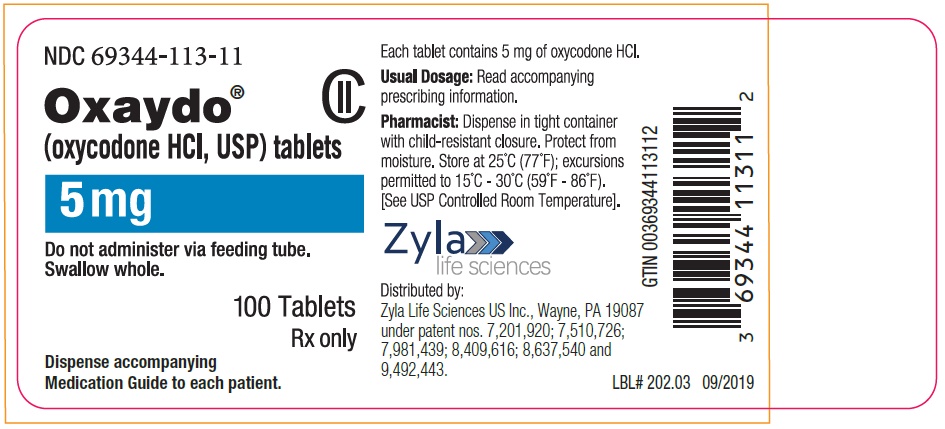
Selection of patients for treatment with OXAYDO should be governed by the same principles that apply to the use of other potent opioid analgesics. Opioid analgesics given on a fixed-dosage schedule have a narrow therapeutic index in certain patient populations, especially when combined with other drugs, and should be reserved for cases where the benefits of opioid analgesia outweigh the known risks of respiratory depression, altered mental state, and postural hypotension. Healthcare providers should individualize treatment in every case, using non-opioid analgesics, opioids and/or combination products when necessary, and chronic opioid therapy with drugs such as OXAYDO in a progressive plan of pain management such as outlined by the World Health Organization, the Agency for Health Care Policy and Research, and the American Pain Society.
OXAYDO must be swallowed whole. Take each tablet with enough water to ensure complete swallowing immediately after placing in the mouth [see Patient Counseling Information (17)]. OXAYDO is not amenable to crushing and dissolution. Do not administer OXAYDO via nasogastric, gastric or other feeding tubes as it may cause obstruction of feeding tubes.
2.1 Individualization of Dose
The dose of OXAYDO should be individually adjusted according to severity of pain, and the patient’s response, weight, age, and prior analgesic treatment experience. Although it is not possible to list every condition that is important to the selection of the initial dose of OXAYDO, attention must be given to:
the daily dose, potency and characteristics of a pure agonist or mixed agonist/antagonist the patient has been taking previously
the reliability of the relative potency estimate to calculate the dose of oxycodone HCl needed
the degree of opioid tolerance
the general condition and medical status of the patient
the balance between pain management and adverse reactions
the type and severity of the patient’s pain
risk factors for abuse or addiction, including a prior history of abuse or addiction
2.2 Initiation of Therapy
Patients who have not been receiving opioid analgesics should be started on OXAYDO in a dosing range of 5 mg to 15 mg every 4 to 6 hours as needed for pain. The dose should be titrated based upon the individual patient’s response to their initial dose of OXAYDO.
Patients with chronic pain may need to be dosed at the lowest dosage level that will achieve acceptable analgesia and tolerable adverse reactions, on an around-the-clock basis rather than on an as needed basis.
Hepatic Impairment
Since oxycodone is extensively metabolized in the liver, its clearance may decrease in patients with hepatic impairment. Dose initiation in such patients should follow a conservative approach. Dosages should be adjusted according to the clinical situation [see Use in Specific Populations (8.6)].
Renal Impairment
Published data reported that elimination of oxycodone was impaired in patients with end-stage renal failure. The mean elimination half-life was prolonged in uremic patients due to increased volume of distribution and reduced clearance.
Dose initiation in such patients should follow a conservative approach. Dosages should be adjusted according to the clinical situation [see Use in Specific Populations (8.7)].
2.3 Conversion to OXAYDO
Conversion from Fixed-Ratio Oral Opioid/Non-Opioid Combinations
When converting patients from fixed-ratio opioid/non-opioid drug regimens to OXAYDO, determine whether or not to continue the non-opioid analgesic. Titrate the dose of OXAYDO in response to the level of analgesia and adverse reactions afforded by the dosing regimen regardless of whether the non-opioid is continued.
Conversion from Other Oral Opioid Therapy to OXAYDO
If a patient has been receiving opioid-containing medications prior to taking OXAYDO, factor the potency of the prior opioid relative to oxycodone into the selection of the total daily dose of oxycodone.
In converting patients from other opioids to OXAYDO, close observation and adjustment of dosage based upon the patient's response to OXAYDO is imperative.
2.4 Maintenance of Therapy
Continual re-evaluation of the patient receiving OXAYDO is important, with special attention to the maintenance of pain management and the relative incidence of adverse reactions associated with therapy. If the level of pain increases, effort should be made to identify the source of the increased pain, while adjusting the dose as described above to decrease the level of pain.
During chronic therapy, especially for non-cancer-related pain (or pain associated with other terminal illnesses), the continued need for the use of opioid analgesics must be re-assessed as appropriate.
2.5 Cessation of Therapy
When a patient no longer requires therapy with OXAYDO after chronic use, it is important that therapy be gradually tapered over time to prevent the development of an opioid abstinence syndrome (narcotic withdrawal). In general, therapy can be decreased by 25% to 50% per day with careful monitoring for signs and symptoms of withdrawal [see Drug Abuse and Dependence (9.3) for a description of the signs and symptoms of withdrawal]. If the patient develops these signs or symptoms, the dose should be raised to the previous level and tapered more slowly, either by increasing the interval between decreases, decreasing the amount of change in dose, or both. It is not known at what dose of OXAYDO that treatment may be discontinued without risk of the opioid abstinence syndrome occurring.