
WARNING - FDA records indicate that this drug has been recalled.
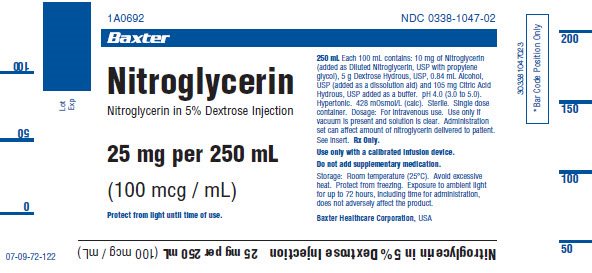
Nitroglycerin In Dextrose label

Nitroglycerin In Dextrose

Nitroglycerin In Dextrose Recall

Get an alert when a recall is issued.

Baxter Healthcare Corp.
Product Description: 50 mg Nitroglycerin in 5% Dextrose Injection (200 mcg/mL), 250 mL glass containers, Baxter Healthcare Corp., Deerfield, IL — NDC 0338-1049-02
Status: Ongoing
City: Deerfield
State: IL
Country: US
Voluntary/Mandated: Voluntary: Firm Initiated
Initial Firm Notification: Letter
Distribution Pattern: Nationwide, Saudi Arabia and Colombia
Classification: Class I
Product Quantity: 49,932 glass containers
Reason For Recall: Presence of Particulate Matter; particulate matter in one vial identified as silicone rubber and EPDM rubber from the vial stopper.
Recall Initiation Date: 20131118
Report Date: 20140212

Side Effects & Adverse Reactions

Nitroglycerin readily migrates into many plastics, including the polyvinyl chloride (PVC) plastics commonly used for intravenous administration sets. Nitroglycerin absorption by PVC tubing is increased when the tubing is long, the flow rates are low, and the nitroglycerin concentration of the solution is high. The delivered fraction of the solution’s original nitroglycerin content has been 20-60% in published studies using PVC tubing; the fraction varies with time during a single infusion, and no simple correction factor can be used. PVC tubing has been used in most published studies of intravenous nitroglycerin, but the reported doses have been calculated by simply multiplying the flow rate of the solution by the solution’s original concentration of nitroglycerin. The actual doses delivered have been less, sometimes much less, than those reported.

Relatively nonabsorptive intravenous administration sets are available. If intravenous nitroglycerin is administered through nonabsorptive tubing, doses based upon published reports will generally be too high.

Some in-line intravenous filters also absorb nitroglycerin; these filters should be avoided.

Solutions containing dextrose without electrolytes should not be administered through the same administration set as blood, as this may result in pseudoagglutination or hemolysis.

The intravenous administration of solutions may cause fluid overloading resulting in dilution of serum electrolyte concentrations, overhydration and congested states of pulmonary edema. The risk of dilutional states is inversely proportional to the electrolyte concentrations of the injections. The risk of solute overload causing congested states with peripheral and pulmonary edema is directly proportional to the electrolyte concentration of the injections.

FDA Safety Alerts

There are currently no FDA safety alerts available for this drug.

Manufacturer Warnings

There is currently no manufacturer warning information available for this drug.

FDA Labeling Changes

There are currently no FDA labeling changes available for this drug.

Uses

Nitroglycerin in 5% Dextrose Injection is indicated for treatment of peri-operative hypertension; for control of congestive heart failure in the setting of acute myocardial infarction; for treatment of angina pectoris in patients who have not responded to sublingual nitroglycerin and β-blockers; and for induction of intraoperative hypotension.

History

There is currently no drug history available for this drug.

Other Information

Nitroglycerin is 1,2,3-propanetriol trinitrate, an organic nitrate whose structural formula is:

Nitroglycerin Formula

whose molecular formula is C3H5N3O9, and whose molecular weight is 227.09. The organic nitrates are vasodilators, active on both arteries and veins.

Dextrose, USP is chemically designated D-glucose monohydrate C6H12O2 • H2O, a hexose sugar freely soluble in water whose structural formula is:

Dextrose Formula

The molecular weight is 198.17.

Nitroglycerin in 5% Dextrose Injection is a sterile, nonpyrogenic solution of nitroglycerin and dextrose in water for injection. The solution is clear and practically colorless. Each mL of 100 mcg/mL Nitroglycerin in 5% Dextrose Injection contains nitroglycerin 100 mcg; propylene glycol 0.9 mg and dextrose, hydrous 50 mg in water for injection. May contain nitric acid for pH adjustment. The pH is 4.0 (3.0 to 6.5) and the calculated osmolarity is 265 mOsmol/L.*

Each mL of 200 mcg/mL Nitroglycerin in 5% Dextrose Injection contains nitroglycerin 200 mcg, propylene glycol 1.80 mg and dextrose, hydrous 50 mg in water for injection. May contain nitric acid for pH adjustment. The pH is 4.0 (3.0 to 6.5) and the calculated osmolarity is 277 mOsmol/L.*

Each mL of 400 mcg/mL Nitroglycerin in 5% Dextrose Injection contains nitroglycerin 400 mcg, propylene glycol 3.60 mg and dextrose, hydrous 50 mg in water for injection. May contain nitric acid for pH adjustment. The pH is 4.0 (3.0 to 6.5) and the calculated osmolarity is 301 mOsmol/L.*

*Normal physiologic osmolarity range is approximately 280 to 310 mOsmol/L. Administration of substantially hypertonic solutions (≥600 mOsmol/L) may cause vein damage.

Although dry nitroglycerin is explosive, nitroglycerin in 5% dextrose is not.
Nitroglycerin In Dextrose Manufacturers

  • Nitroglycerin In Dextrose | Hospira, Inc.
    No Recall

    Nitroglycerin In Dextrose | Hospira, Inc.

    Nitroglycerin In Dextrose | Hospira, Inc.

    Nitroglycerin in 5% Dextrose Injection is intended for intravenous administration using sterile equipment. It should be administered only via an infusion pump that can maintain a constant infusion rate. A container which has lost its vacuum, or one in which particulate matter is visible, should not be used.

    Dosage is affected by the type of infusion set used (see WARNINGS). Although the usual adult starting dose in published studies has been 25 mcg/min or more, these studies used PVC tubing, so the delivered doses were less than those reported. When nonabsorptive tubing is used, doses must be reduced.

    Even using nonabsorptive tubing, the dose necessary to achieve a given response will vary greatly from patient to patient. Patients with normal or low left-ventricular filling pressure (e.g., patients with uncomplicated angina pectoris) may respond fully to as little as 5 mcg/min, while other patients may require a dose that is one or even two orders of magnitude higher. Continuous monitoring of blood pressure and heart rate is necessary in all patients receiving this medication; in many cases, invasive monitoring of pulmonary capillary wedge pressure will also be indicated.

    Lower concentrations of Nitroglycerin in 5% Dextrose Injection increase the potential precision of dosing, but these concentrations increase the total fluid volume that must be delivered to the patient. Total fluid load may be a dominant consideration in patients with compromised function of the heart, liver, and/or kidneys. The necessary flow rates to achieve various dose rates with the available concentrations are shown in the following table.

    Using nonabsorptive tubing, the initial adult dosage of Nitroglycerin in 5% Dextrose Injection should be 5 mcg/min. Subsequent titration must be guided by the clinical results, with dose increments becoming more cautious as partial response is seen. Initial titration should be in 5 mcg/min increments at intervals of 3 to 5 minutes. If no response is seen at 20 mcg/min, increments of 10 and even 20 mcg/min can be used. Once some hemodynamic response is observed, dosage increments should be smaller and less frequent.

    When the concentration is changed, the tubing must be disconnected from the patient and flushed with the new solution before therapy is continued. If this precaution is not taken, then depending upon the tubing, pump, and flow rate used, it might be several hours before nitroglycerin is delivered at the desired rate.

    Parenteral drug products should be inspected visually for particulate matter and discoloration prior to administration, whenever solution and container permit.

    Do not add supplementary medication to Nitroglycerin in 5% Dextrose Injection.

    Do not use unless vacuum is present and solution is clear.

    Table 2 Necessary Flow Rates (mL/hr*) * With a set that produces 60 drops/mL, 1 mL/hr = 1 drop/min.

     
    Solution Concentration (mcg/mL)

    Desired Dose (mcg/min)

    100

    200

    400

    5

    3

    1.5

    0.8

    10

    6

    3.0

    1.5

    15

    9

    4.5

    2.3

    20

    12

    6

    3

    30

    18

    9

    4.5

    40

    24

    12

    6

    50

    30

    15

    7.5

    60

    36

    18

    9

    80

    48

    24

    12

    100

    60

    30

    15

    120

    72

    36

    18

    140

    84

    42

    21

    160

    96

    48

    24

    180

    108

    54

    27

    200

    120

    60

    30

    240

    144

    72

    36

    280

    168

    84

    42

    320

    192

    96

    48

    500

    300

    150

    75

  • Nitroglycerin In Dextrose | Baxter Healthcare Company
    No Recall

    Nitroglycerin In Dextrose | Baxter Healthcare Company

    Nitroglycerin In Dextrose | Baxter Healthcare Company

    Nitroglycerin in 5% Dextrose Injection is intended for intravenous administration using sterile equipment. It should be administered only via an infusion pump that can maintain a constant infusion rate. A container which has lost its vacuum, or one in which particulate matter is visible, should not be used.

    Dosage is affected by the type of infusion set used (see Warnings). Although the usual adult starting dose in published studies has been 25 mcg/min or more, these studies used PVC tubing, so the delivered doses were less than those reported. When nonabsorptive tubing is used, doses must be reduced. Even using nonabsorptive tubing, the dose necessary to achieve a given response will vary greatly from patient to patient. Patients with normal or low left-ventricular filling pressure (e.g., patients with uncomplicated angina pectoris) may respond fully to as little as 5 mcg/min, while other patients may require a dose that is one or even two orders of magnitude higher. Continuous monitoring of blood pressure and heart rate is necessary in all patients receiving this medication; in many cases, invasive monitoring of pulmonary capillary wedge pressure will also be indicated. Lower concentrations of Nitroglycerin in 5% Dextrose Injection increase the potential precision of dosing, but these concentrations increase the total fluid volume that must be delivered to the patient. Total fluid load may be a dominant consideration in patients with compromised function of the heart, liver, and/or kidneys. The necessary flow rates to achieve various dose rates with the available concentrations are shown in the following table. Using nonabsorptive tubing, the initial adult dosage of Nitroglycerin in 5% Dextrose Injection should be 5 mcg/min. Subsequent titration must be guided by the clinical results, with dose increments becoming more cautious as partial response is seen. Initial titration should be in 5 mcg/min increments at intervals of 3 to 5 minutes. If no response is seen at 20 mcg/min, increments of 10 and even 20 mcg/min can be used. Once some hemodynamic response is observed, dosage increments should be smaller and less frequent. When the concentration is changed, the tubing must be disconnected from the patient and flushed with the new solution before therapy is continued. If this precaution is not taken, then depending upon the tubing, pump, and flow rate used, it might be several hours before nitroglycerin is delivered at the desired rate. Parenteral drug products should be inspected visually for particulate matter and discoloration prior to administration, whenever solution and container permit. Do not add supplementary medication to Nitroglycerin in 5% Dextrose Injection. Table 3 *With a set that produces 60 drops/mL, 1mL/hr = 1 drop/min.

    Necessary Flow Rates (mL/hr*)

    Desired

    Dose (mcg/min)

    Solution Concentration (mcg/mL)

    100

    200

    400

    5

    3

    1.5

    0.8

    10

    6

    3.0

    1.5

    15

    9

    4.5

    2.3

    20

    12

    6

    3

    30

    18

    9

    4.5

    40

    24

    12

    6

    50

    30

    15

    7.5

    60

    36

    18

    9

    80

    48

    24

    12

    100

    60

    30

    15

    120

    72

    36

    18

    140

    84

    42

    21

    160

    96

    48

    24

    180

    108

    54

    27

    200

    120

    60

    30

    240

    144

    72

    36

    280

    168

    84

    42

    320

    192

    96

    48

    500

    300

    150

    75