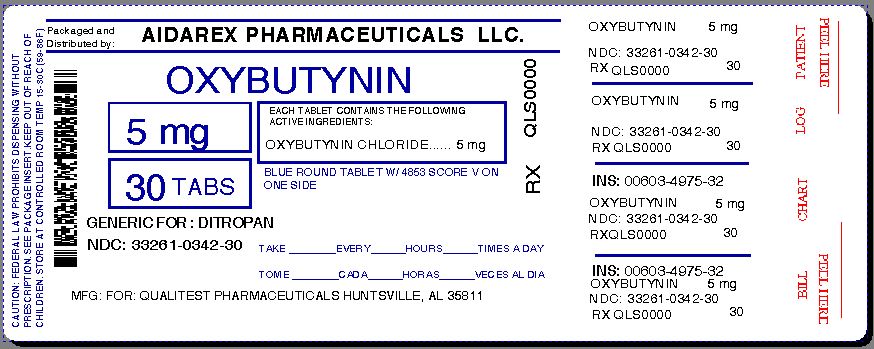
Oxybutynin Chloride label

Oxybutynin Chloride

Oxybutynin Chloride Recall

Get an alert when a recall is issued.

Side Effects & Adverse Reactions

Angioedema of the face, lips, tongue and/or larynx has been reported with oxybutynin. In some cases, angioedema occurred after the first dose. Angioedema associated with upper airway swelling may be life-threatening. If involvement of the tongue, hypopharynx, or larynx occurs, oxybutynin should be promptly discontinued and appropriate therapy and/or measures necessary to ensure a patent airway should be promptly provided.

FDA Safety Alerts

There are currently no FDA safety alerts available for this drug.

Manufacturer Warnings

There is currently no manufacturer warning information available for this drug.

FDA Labeling Changes

There are currently no FDA labeling changes available for this drug.

Uses

Oxybutynin chloride tablets are indicated for the relief of symptoms of bladder instability associated with voiding in patients with uninhibited neurogenic or reflex neurogenic bladder (i.e., urgency, frequency, urinary leakage, urge incontinence, dysuria).

History

There is currently no drug history available for this drug.

Other Information

Each scored oxybutynin chloride tablet contains 5 mg of oxybutynin chloride. Chemically, oxybutynin chloride is d,l (racemic) 4-diethylamino-2-butynyl phenylcyclohexylglycolate hydrochloride. The empirical formula of oxybutynin chloride is C22H31NO3•HCl. The structural formula appears below:

This is an image of the structural formula for Oxybutynin Chloride.

Oxybutynin chloride is a white crystalline solid with a molecular weight of 393.95. It is readily soluble in water and acids, but relatively insoluble in alkalis.

Oxybutynin Chloride Tablets also contain: FD&C Blue #1 aluminum lake, magnesium stearate, microcrystalline cellulose, and pregelatinized starch.

Oxybutynin Chloride Tablets are for oral administration.

Therapeutic Category: Antispasmodic, anticholinergic

Oxybutynin Chloride Manufacturers

  • Oxybutynin Chloride | Cardinal Health
    No Recall

    Oxybutynin Chloride | Cardinal Health

    Oxybutynin Chloride | Cardinal Health
    Adults

    The usual dose is one 5-mg tablet two to three times a day. The maximum recommended dose is one 5-mg tablet four times a day. A lower starting dose of 2.5 mg two or three times a day is recommended for the frail elderly.

    Pediatric patients over 5 years of age

    The usual dose is one 5-mg tablet two times a day. The maximum recommended dose is one 5-mg tablet three times a day.

  • Remedyrepack Inc.
    Oxybutynin Chloride | Remedyrepack Inc.
    No Recall

    Oxybutynin Chloride | Remedyrepack Inc.

    Oxybutynin Chloride | Remedyrepack Inc.

    Adults: The usual dose is one 5-mg tablet two to three times a day. The maximum recommended dose is one 5-mg tablet four times a day. A lower starting dose of 2.5 mg two or three times a day is recommended for the frail elderly.


    Pediatric patients over 5 years of age: The usual dose is one 5-mg tablet two times a day. The maximum recommended dose is one 5-mg tablet three times a day.


  • Bryant Ranch Prepack
    Oxybutynin Chloride | Bryant Ranch Prepack
    No Recall

    Oxybutynin Chloride | Bryant Ranch Prepack

    Oxybutynin Chloride | Bryant Ranch Prepack

    Oxybutynin chloride extended-release tablets must be swallowed whole with the aid of liquids, and must not be chewed, divided, or crushed.

    Oxybutynin chloride extended-release tablets may be administered with or without food.

    2.1 Adults

    The recommended starting dose of oxybutynin chloride extended-release tablets is 5 or 10 mg once daily at approximately the same time each day. Dosage may be adjusted in 5-mg increments to achieve a balance of efficacy and tolerability (up to a maximum of 30 mg/day). In general, dosage adjustment may proceed at approximately weekly intervals.

    2.2 Pediatric Patients Aged 6 Years of Age and Older

    The recommended starting dose of oxybutynin chloride extended-release tablets is 5 mg once daily at approximately the same time each day. Dosage may be adjusted in 5-mg increments to achieve a balance of efficacy and tolerability (up to a maximum of 20 mg/day).

  • Blenheim Pharmacal, Inc.
    Oxybutynin Chloride | Blenheim Pharmacal, Inc.
    No Recall

    Oxybutynin Chloride | Blenheim Pharmacal, Inc.

    Oxybutynin Chloride | Blenheim Pharmacal, Inc.
    Adults

    The usual dose is one 5 mg tablet two to three times a day. The maximum recommended dose is one 5 mg tablet four times a day. A lower starting dose of 2.5 mg two or three times a day is recommended for the frail elderly.

    Pediatric Patients Over 5 Years of Age

    The usual dose is one 5 mg tablet two times a day. The maximum recommended dose is one 5 mg tablet three times a day.

  • Oxybutynin Chloride | Mylan Pharmaceuticals Inc.
    No Recall

    Oxybutynin Chloride | Mylan Pharmaceuticals Inc.

    Oxybutynin Chloride | Mylan Pharmaceuticals Inc.
    2.1 Recommended Dosing

    Dosage of prednisolone sodium phosphate orally disintegrating tablets should be individualized according to the severity of the disease and the response of the patient. For pediatric patients, the recommended dosage should be governed by the same considerations rather than strict adherence to the ratio indicated by age or body weight.

    Do not break or use partial prednisolone sodium phosphate orally disintegrating tablets. Use an appropriate formulation of prednisolone if indicated dose cannot be obtained using prednisolone sodium phosphate orally disintegrating tablets. This may become important in the treatment of conditions that require tapering doses that cannot be adequately accommodated by prednisolone sodium phosphate orally disintegrating tablets, e.g., tapering the dose below 10 mg.

    The initial dose of prednisolone sodium phosphate orally disintegrating tablets may vary from 10 mg to 60 mg (prednisolone base) per day, depending on the specific disease entity being treated. In situations of less severity, lower doses will generally suffice while in selected patients higher initial doses may be required. The initial dosage should be maintained or adjusted until a satisfactory response is noted. If after a reasonable period of time, there is a lack of satisfactory clinical response, prednisolone sodium phosphate orally disintegrating tablets should be discontinued and the patient placed on other appropriate therapy. IT SHOULD BE EMPHASIZED THAT DOSAGE REQUIREMENTS ARE VARIABLE AND MUST BE INDIVIDUALIZED ON THE BASIS OF THE DISEASE UNDER TREATMENT AND THE RESPONSE OF THE PATIENT. After a favorable response is noted, the proper maintenance dosage should be determined by decreasing the initial drug dosage in small decrements at appropriate time intervals until the lowest dosage that will maintain an adequate clinical response is reached. It should be kept in mind that constant monitoring is needed in regard to drug dosage. Included in the situations which may make dosage adjustments necessary are changes in clinical status secondary to remissions or exacerbations in the disease process, the patient’s individual drug responsiveness, and the effect of patient exposure to stressful situations not directly related to the disease entity under treatment; in this latter situation it may be necessary to increase the dosage of prednisolone sodium phosphate orally disintegrating tablets for a period of time consistent with the patient’s condition. If after long-term therapy the drug is to be stopped, it is recommended that it be withdrawn gradually rather than abruptly.

    Prednisolone sodium phosphate orally disintegrating tablets are packaged in a bottle. For patients dispensed a bottle, they should be instructed not to remove the tablet from the bottle until just prior to dosing. The bottle should then be opened, and the orally disintegrating tablet placed on the tongue, where tablets may be swallowed whole as any conventional tablet, or allowed to dissolve in the mouth, with or without the assistance of water. Orally disintegrating tablet dosage forms are friable and are not intended to be cut, split or broken.

    Multiple Sclerosis

    In the treatment of acute exacerbations of multiple sclerosis, daily doses of 200 mg of prednisolone for a week followed by 80 mg every other day for one month have been shown to be effective.

    Pediatric

    In pediatric patients, the initial dose of prednisolone sodium phosphate orally disintegrating tablets may vary depending on the specific disease entity being treated. The range of initial doses is 0.14 to 2 mg/kg/day in three or four divided doses (4 to 60 mg/m2bsa/day).

    Nephrotic Syndrome

    The standard regimen used to treat nephrotic syndrome in pediatric patients is 60 mg/m2/day given in three divided doses for 4 weeks, followed by 4 weeks of single dose alternate-day therapy at 40 mg/m2/day.

    Asthma

    The National Heart, Lung, and Blood Institute (NHLBI) recommended dosing for systemic prednisone, prednisolone or methylprednisolone in children whose asthma is uncontrolled by inhaled corticosteroids and long-acting bronchodilators is 1 to 2 mg/kg/day in single or divided doses.

    It is further recommended that short course, or “burst” therapy, be continued until a child achieves a peak expiratory flow rate of 80% of his or her personal best or symptoms resolve. This usually requires 3 to 10 days of treatment, although it can take longer. There is no evidence that tapering the dose after improvement will prevent a relapse.

    2.2 Recommended Monitoring

    Blood pressure, body weight, routine laboratory studies, including serum potassium and fasting blood glucose, should be obtained at regular intervals during prolonged therapy. Appropriate diagnostic studies should be performed in patients with known or suspected peptic ulcer disease and in patients at risk for reactivation of latent tuberculosis infections.

    2.3 Corticosteroid Comparison Chart

    For the purpose of comparison, one 10 mg prednisolone sodium phosphate orally disintegrating tablet (13.4 mg prednisolone sodium phosphate) is equivalent to the following milligram dosage of the various glucocorticoids:

    Betamethasone 1.75 mg

    Paramethasone 4 mg

    Cortisone 50 mg

    Prednisolone 10 mg

    Dexamethasone 1.75 mg

    Prednisone 10 mg

    Hydrocortisone 40 mg

    Triamcinolone 8 mg

    Methylprednisolone 8 mg

    These dose relationships apply only to oral or intravenous administration of these compounds. When these substances or their derivatives are injected intramuscularly or into joint spaces, their relative properties may be greatly altered.

  • Oxybutynin Chloride | Kroger Company
    No Recall

    Oxybutynin Chloride | Kroger Company

    Oxybutynin Chloride | Kroger Company
    • do not take more than directed (see overdose warning)

    adults and children 12 years and over

    • take 2 gelcaps every 6 hours while symptoms last • do not take more than 6 gelcaps in 24 hours, unless directed by a doctor • do not use for more than 10 days unless directed by a doctor

    children under 12 years

    ask a doctor

  • Rebel Distributors Corp.
    Oxybutynin Chloride | Rebel Distributors Corp.
    No Recall

    Oxybutynin Chloride | Rebel Distributors Corp.

    Oxybutynin Chloride | Rebel Distributors Corp.
    Adults:

    The usual dose is one 5-mg tablet two to three times a day. The maximum recommended dose is one 5-mg tablet four times a day. A lower starting dose of 2.5 mg two or three times a day is recommended for the frail elderly.

    Pediatric patients over 5 years of age:

    The usual dose is one 5-mg tablet two times a day. The maximum recommended dose is one 5-mg tablet three times a day.

  • Physicians Total Care, Inc.
    Oxybutynin Chloride | Physicians Total Care, Inc.
    No Recall

    Oxybutynin Chloride | Physicians Total Care, Inc.

    Oxybutynin Chloride | Physicians Total Care, Inc.

    Oxybutynin chloride extended-release tablets must be swallowed whole with the aid of liquids, and must not be chewed, divided, or crushed.

    Oxybutynin chloride extended-release tablets may be administered with or without food.

    Adults

    The recommended starting dose of oxybutynin chloride extended-release tablets is 5 mg or 10 mg once daily at approximately the same time each day. Dosage may be adjusted in 5 mg increments to achieve a balance of efficacy and tolerability (up to a maximum of 30 mg/day). In general, dosage adjustment may proceed at approximately weekly intervals.

    Pediatric Patients

    Dosing information for pediatric patients aged 6 years and older is approved for Alza Corporation’s oxybutynin chloride extended-release tablets. However, due to Alza Corporation’s marketing exclusivity rights, this drug product is not labeled for pediatric use.

  • Physicians Total Care, Inc.
    Oxybutynin Chloride | Physicians Total Care, Inc.
    No Recall

    Oxybutynin Chloride | Physicians Total Care, Inc.

    Oxybutynin Chloride | Physicians Total Care, Inc.

    Oxybutynin Chloride Extended Release Tablets must be swallowed whole with the aid of liquids, and must not be chewed, divided, or crushed.

    Oxybutynin Chloride Extended Release Tablets may be administered with or without food.

    Adults

    The recommended starting dose of Oxybutynin Chloride Extended Release Tablets is 5 or 10 mg once daily at approximately the same time each day. Dosage may be adjusted in 5-mg increments to achieve a balance of efficacy and tolerability (up to a maximum of 30 mg/day). In general, dosage adjustment may proceed at approximately weekly intervals.

    Pediatric Patients Aged 6 Years of Age and Older

    The recommended starting dose of Oxybutynin Chloride Extended Release Tablets is 5 mg once daily at approximately the same time each day. Dosage may be adjusted in 5-mg increments to achieve a balance of efficacy and tolerability (up to a maximum of 20 mg/day).

  • State Of Florida Doh Central Pharmacy
    Oxybutynin Chloride | State Of Florida Doh Central Pharmacy
    No Recall

    Oxybutynin Chloride | State Of Florida Doh Central Pharmacy

    Oxybutynin Chloride | State Of Florida Doh Central Pharmacy

    Adults: The usual dose is one 5 mg tablet two to three times a day. The maximum recommended dose is one tablet (5 mg) four times a day.

    Children over 5 years of age: The usual dose is one 5 mg tablet two times a day. The maximum recommended dose is one tablet (5 mg) three times a day.

  • State Of Florida Doh Central Pharmacy
    Oxybutynin Chloride | State Of Florida Doh Central Pharmacy
    No Recall

    Oxybutynin Chloride | State Of Florida Doh Central Pharmacy

    Oxybutynin Chloride | State Of Florida Doh Central Pharmacy
    Adults:

    The usual dose is one 5-mg tablet two to three times a day. The maximum recommended dose is one 5-mg tablet four times a day. A lower starting dose of 2.5 mg two or three times a day is recommended for the frail elderly.

    Pediatric patients over 5 years of age:

    The usual dose is one 5-mg tablet two times a day. The maximum recommended dose is one 5-mg tablet three times a day.

  • Oxybutynin Chloride | Cardinal Health
    No Recall

    Oxybutynin Chloride | Cardinal Health

    Oxybutynin Chloride | Cardinal Health

    Oxybutynin chloride extended-release tablets must be swallowed whole with the aid of liquids, and must not be chewed, divided, or crushed.

    Oxybutynin chloride extended-release tablets may be administered with or without food.

    Adults

    The recommended starting dose of oxybutynin chloride extended-release tablets is 5 mg or 10 mg once daily at approximately the same time each day. Dosage may be adjusted in 5 mg increments to achieve a balance of efficacy and tolerability (up to a maximum of 30 mg/day). In general, dosage adjustment may proceed at approximately weekly intervals.

    Pediatric Patients Aged 6 Years of Age and Older

    The recommended starting dose of oxybutynin chloride extended-release tablets is 5 mg once daily at approximately the same time each day. Dosage may be adjusted in 5 mg increments to achieve a balance of efficacy and tolerability (up to a maximum of 20 mg/day).

  • Udl Laboratories, Inc.
    Oxybutynin Chloride | Udl Laboratories, Inc.
    No Recall

    Oxybutynin Chloride | Udl Laboratories, Inc.

    Oxybutynin Chloride | Udl Laboratories, Inc.

    Adults: The usual dose is one 5-mg tablet two to three times a day. The maximum recommended dose is one 5-mg tablet four times a day. A lower starting dose of 2.5 mg two or three times a day is recommended for the frail elderly.

    Pediatric patients over 5 years of age: The usual dose is one 5-mg tablet two times a day. The maximum recommended dose is one 5-mg tablet three times a day.

  • Oxybutynin Chloride | Cardinal Health
    No Recall

    Oxybutynin Chloride | Cardinal Health

    Oxybutynin Chloride | Cardinal Health
    Adults:

    The usual dose is one 5-mg tablet two to three times a day. The maximum recommended dose is one 5-mg tablet four times a day. A lower starting dose of 2.5 mg two or three times a day is recommended for the frail elderly.

    Pediatric patients over 5 years of age:

    The usual dose is one 5-mg tablet two times a day. The maximum recommended dose is one 5-mg tablet three times a day.

  • Bryant Ranch Prepack
    Oxybutynin Chloride | Bryant Ranch Prepack
    No Recall

    Oxybutynin Chloride | Bryant Ranch Prepack

    Oxybutynin Chloride | Bryant Ranch Prepack
    Adults:

    The usual dose is one 5-mg tablet two to three times a day. The maximum recommended dose is one 5-mg tablet four times a day. A lower starting dose of 2.5 mg two or three times a day is recommended for the frail elderly.

    Pediatric patients over 5 years of age:

    The usual dose is one 5-mg tablet two times a day. The maximum recommended dose is one 5-mg tablet three times a day.

  • Remedyrepack Inc.
    Oxybutynin Chloride | Remedyrepack Inc.
    No Recall

    Oxybutynin Chloride | Remedyrepack Inc.

    Oxybutynin Chloride | Remedyrepack Inc.
    Adults: The usual dose is one 5 mg tablet two to three times a day. The maximum recommended dose is one 5 mg tablet four times a day. A lower starting dose of 2.5 mg two or three times a day is recommended for the frail elderly.
    Pediatric patients over 5 years of age: The usual dose is one 5 mg tablet two times a day. The maximum recommended dose is one 5 mg tablet three times a day.

  • Pd-rx Pharmaceuticals, Inc.
    Oxybutynin Chloride | Pd-rx Pharmaceuticals, Inc.
    No Recall

    Oxybutynin Chloride | Pd-rx Pharmaceuticals, Inc.

    Oxybutynin Chloride | Pd-rx Pharmaceuticals, Inc.
    Adults:

    The usual dose is one 5-mg tablet two to three times a day. The maximum recommended dose is one 5-mg tablet four times a day. A lower starting dose of 2.5 mg two or three times a day is recommended for the frail elderly.

    Pediatric patients over 5 years of age:

    The usual dose is one 5-mg tablet two times a day. The maximum recommended dose is one 5-mg tablet three times a day.

  • Aphena Pharma Solutions – Tennessee, Inc.
    Oxybutynin Chloride | Aphena Pharma Solutions - Tennessee, Inc.
    No Recall

    Oxybutynin Chloride | Aphena Pharma Solutions - Tennessee, Inc.

    Oxybutynin Chloride | Aphena Pharma Solutions - Tennessee, Inc.

    Oxybutynin chloride extended-release tablets must be swallowed whole with the aid of liquids, and must not be chewed, divided, or crushed. Oxybutynin chloride extended-release tablets may be administered with or without food.

    Adults

    The recommended starting dose of Oxybutynin chloride extended-release tablets is 5 or 10 mg once daily at approximately the same time each day. Dosage may be adjusted in 5-mg increments to achieve a balance of efficacy and tolerability (up to a maximum of 30 mg/day). In general, dosage adjustment may proceed at approximately weekly intervals.

    Pediatric patients aged 6 years of age and older

    The recommended starting dose of Oxybutynin chloride extended-release tablets is 5 mg once daily at approximately the same time each day. Dosage may be adjusted in 5-mg increments to achieve a balance of efficacy and tolerability (up to a maximum of 20 mg/day).

  • Oxybutynin Chloride | Cardinal Health
    No Recall

    Oxybutynin Chloride | Cardinal Health

    Oxybutynin Chloride | Cardinal Health

    Adults: The usual dose is one 5-mg tablet two to three times a day. The maximum recommended dose is one 5-mg tablet four times a day. A lower starting dose of 2.5 mg two or three times a day is recommended for the frail elderly.

    Pediatric patients over 5 years of age: The usual dose is one 5-mg tablet two times a day. The maximum recommended dose is one 5-mg tablet three times a day.

  • Mckesson Contract Packaging
    Oxybutynin Chloride | Mckesson Contract Packaging
    No Recall

    Oxybutynin Chloride | Mckesson Contract Packaging

    Oxybutynin Chloride | Mckesson Contract Packaging

    Oxybutynin chloride extended-release tablets must be swallowed whole with the aid of liquids, and must not be chewed, divided, or crushed.

    Oxybutynin chloride extended-release tablets may be administered with or without food.

    Adults

    The recommended starting dose of oxybutynin chloride extended-release tablets is 5 mg or 10 mg once daily at approximately the same time each day. Dosage may be adjusted in 5 mg increments to achieve a balance of efficacy and tolerability (up to a maximum of 30 mg/day). In general, dosage adjustment may proceed at approximately weekly intervals.

    Pediatric Patients Aged 6 Years of Age and Older

    The recommended starting dose of oxybutynin chloride extended-release tablets is 5 mg once daily at approximately the same time each day. Dosage may be adjusted in 5 mg increments to achieve a balance of efficacy and tolerability (up to a maximum of 20 mg/day).

  • Mckesson Contract Packaging
    Oxybutynin Chloride | Mckesson Contract Packaging
    No Recall

    Oxybutynin Chloride | Mckesson Contract Packaging

    Oxybutynin Chloride | Mckesson Contract Packaging
    Adults:

    The usual dose is one 5-mg tablet two to three times a day. The maximum recommended dose is one 5-mg tablet four times a day. A lower starting dose of 2.5 mg two or three times a day is recommended for the frail elderly.

    Pediatric patients over 5 years of age:

    The usual dose is one 5-mg tablet two times a day. The maximum recommended dose is one 5-mg tablet three times a day.

  • Upsher-smith Laboratories, Inc.
    Oxybutynin Chloride | Upsher-smith Laboratories, Inc.
    No Recall

    Oxybutynin Chloride | Upsher-smith Laboratories, Inc.

    Oxybutynin Chloride | Upsher-smith Laboratories, Inc.

    Adults: The usual dose is one 5-mg tablet two to three times a day. The maximum recommended dose is one 5-mg tablet four times a day. A lower starting dose of 2.5 mg two or three times a day is recommended for the frail elderly.

    Pediatric patients over 5 years of age: The usual dose is one 5-mg tablet two times a day. The maximum recommended dose is one 5-mg tablet three times a day.

  • Major Pharmaceuticals
    Oxybutynin Chloride | Major Pharmaceuticals
    No Recall

    Oxybutynin Chloride | Major Pharmaceuticals

    Oxybutynin Chloride | Major Pharmaceuticals
    Adults

    The usual dose is one 5 mg tablet two to three times a day. The maximum recommended dose is one 5 mg tablet four times a day. A lower starting dose of 2.5 mg two or three times a day is recommended for the frail elderly.

    Pediatric Patients Over 5 Years of Age

    The usual dose is one 5 mg tablet two times a day. The maximum recommended dose is one 5 mg tablet three times a day.

  • Pliva Inc.
    Oxybutynin Chloride | Pliva Inc.
    No Recall

    Oxybutynin Chloride | Pliva Inc.

    Oxybutynin Chloride | Pliva Inc.
    Adults

    The usual dose is one 5 mg tablet two to three times a day. The maximum recommended dose is one 5 mg tablet four times a day. A lower starting dose of 2.5 mg two or three times a day is recommended for the frail elderly.

    Pediatric Patients Over 5 Years of Age

    The usual dose is one 5 mg tablet two times a day. The maximum recommended dose is one 5 mg tablet three times a day.

  • Ncs Healthcare Of Ky, Inc Dba Vangard Labs
    Oxybutynin Chloride | Ncs Healthcare Of Ky, Inc Dba Vangard Labs
    No Recall

    Oxybutynin Chloride | Ncs Healthcare Of Ky, Inc Dba Vangard Labs

    Oxybutynin Chloride | Ncs Healthcare Of Ky, Inc Dba Vangard Labs

    Adults

    The usual dose is one 5-mg tablet two to three times a day. The maximum recommended dose is one 5-mg tablet four times a day. A lower starting dose of 2.5 mg two or three times a day is recommended for the frail elderly.

    Pediatric patients over 5 years of age

    The usual dose is one 5-mg tablet two times a day. The maximum recommended dose is one 5-mg tablet three times a day.

  • Ncs Healthcare Of Ky, Inc Dba Vangard Labs
    Oxybutynin Chloride | Ncs Healthcare Of Ky, Inc Dba Vangard Labs
    No Recall

    Oxybutynin Chloride | Ncs Healthcare Of Ky, Inc Dba Vangard Labs

    Oxybutynin Chloride | Ncs Healthcare Of Ky, Inc Dba Vangard Labs

    Oxybutynin chloride extended-release tablets must be swallowed whole with the aid of liquids, and must not be chewed, divided, or crushed.

    Oxybutynin chloride extended-release tablets may be administered with or without food.

    Adults

    The recommended starting dose of oxybutynin chloride extended-release tablets is 5 mg or 10 mg once daily at approximately the same time each day. Dosage may be adjusted in 5 mg increments to achieve a balance of efficacy and tolerability (up to a maximum of 30 mg/day). In general, dosage adjustment may proceed at approximately weekly intervals.

    Pediatric Patients

    The recommended starting dose of oxybutynin chloride extended-release tablets is 5 mg once daily at approximately the same time each day. Dosage may be adjusted in 5 mg increments to achieve a balance of efficacy and tolerability (up to a maximum of 20 mg/day).

  • Remedyrepack Inc.
    Oxybutynin Chloride | Remedyrepack Inc.
    No Recall

    Oxybutynin Chloride | Remedyrepack Inc.

    Oxybutynin Chloride | Remedyrepack Inc.

    Oxybutynin chloride extended release tablets must be swallowed whole with the aid of liquids, and must not be chewed, divided, or crushed.

    Oxybutynin chloride extended release tablets may be administered with or without food.


    The recommended starting dose of oxybutynin chloride extended release tablets is 5 or 10 mg once daily at approximately the same time each day. Dosage may be adjusted in 5-mg increments to achieve a balance of efficacy and tolerability (up to a maximum of 30 mg/day). In general, dosage adjustment may proceed at approximately weekly intervals.


    Dosing information for pediatric patients aged 6 years and older is approved for Alza Corporation's oxybutynin chloride extended release tablets. However, due to Alza Corporation's marketing exclusivity rights, this drug product is not labeled for pediatric use.


  • Ncs Healthcare Of Ky, Inc Dba Vangard Labs
    Oxybutynin Chloride | Ncs Healthcare Of Ky, Inc Dba Vangard Labs
    No Recall

    Oxybutynin Chloride | Ncs Healthcare Of Ky, Inc Dba Vangard Labs

    Oxybutynin Chloride | Ncs Healthcare Of Ky, Inc Dba Vangard Labs

    Oxybutynin Chloride Extended Release Tablets must be swallowed whole with the aid of liquids, and must not be chewed, divided, or crushed.

    Oxybutynin Chloride Extended Release Tablets may be administered with or without food.

    Adults

    The recommended starting dose of Oxybutynin Chloride Extended Release Tablets is 5 or 10 mg once daily at approximately the same time each day. Dosage may be adjusted in 5-mg increments to achieve a balance of efficacy and tolerability (up to a maximum of 30 mg/day). In general, dosage adjustment may proceed at approximately weekly intervals.

    Pediatric Patients Aged 6 Years of Age and Older

    The recommended starting dose of Oxybutynin Chloride Extended Release Tablets is 5 mg once daily at approximately the same time each day. Dosage may be adjusted in 5-mg increments to achieve a balance of efficacy and tolerability (up to a maximum of 20 mg/day).

  • Physicians Total Care, Inc.
    Oxybutynin Chloride | Physicians Total Care, Inc.
    No Recall

    Oxybutynin Chloride | Physicians Total Care, Inc.

    Oxybutynin Chloride | Physicians Total Care, Inc.
    Adults

    The usual dose is one 5 mg tablet two to three times a day. The maximum recommended dose is one 5 mg tablet four times a day. A lower starting dose of 2.5 mg two or three times a day is recommended for the frail elderly.

    Pediatric Patients Over 5 Years of Age

    The usual dose is one 5 mg tablet two times a day. The maximum recommended dose is one 5 mg tablet three times a day.

  • Remedyrepack Inc.
    Oxybutynin Chloride | Remedyrepack Inc.
    No Recall

    Oxybutynin Chloride | Remedyrepack Inc.

    Oxybutynin Chloride | Remedyrepack Inc.

    The usual dose is one 5 mg tablet two to three times a day. The maximum recommended dose is one 5 mg tablet four times a day. A lower starting dose of 2.5 mg two or three times a day is recommended for the frail elderly.


    The usual dose is one 5 mg tablet two times a day. The maximum recommended dose is one 5 mg tablet three times a day.


  • St Marys Medical Park Pharmacy
    Oxybutynin Chloride | St Marys Medical Park Pharmacy
    No Recall

    Oxybutynin Chloride | St Marys Medical Park Pharmacy

    Oxybutynin Chloride | St Marys Medical Park Pharmacy

    Lisinopril is an effective treatment of hypertension in once-daily doses of 10 to 80 mg, while hydrochlorothiazide is effective in doses of 12.5 to 50 mg. In clinical trials of lisinopril/hydrochlorothiazide combination therapy using lisinopril doses of 10 to 80 mg and hydrochlorothiazide doses of 6.25 to 50 mg, the antihypertensive response rates generally increased with increasing dose of either component.

    The side effects (see WARNINGS) of lisinopril are generally rare and apparently independent of dose; those of hydrochlorothiazide are a mixture of dose-dependent phenomena (primarily hypokalemia) and dose-independent phenomena (e.g., pancreatitis), the former much more common than the latter. Therapy with any combination of lisinopril and hydrochlorothiazide will be associated with both sets of dose-independent side effects, but addition of lisinopril in clinical trials blunted the hypokalemia normally seen with diuretics.

    To minimize dose-independent side effects, it is usually appropriate to begin combination therapy only after a patient has failed to achieve the desired effect with monotherapy.

    Dose Titration Guided by Clinical Effect

    A patient whose blood pressure is not adequately controlled with either lisinopril or hydrochlorothiazide monotherapy may be switched to lisinopril and hydrochlorothiazide tablets 10 mg/12.5 mg or lisinopril and hydrochlorothiazide tablets 20 mg/12.5 mg. Further increases of either or both components could depend on clinical response. The hydrochlorothiazide dose should generally not be increased until 2-3 weeks have elapsed. Patients whose blood pressures are adequately controlled with 25 mg of daily hydrochlorothiazide, but who experience significant potassium loss with this regimen, may achieve similar or greater blood pressure control with less potassium loss if they are switched to lisinopril and hydrochlorothiazide tablets 10 mg/12.5 mg. Dosage higher than lisinopril 80 mg and hydrochlorothiazide  50 mg should not be used.

    Replacement Therapy

    The combination may be substituted for the titrated individual components.

    Use in Renal Impairment

    The usual regimens of therapy with lisinopril and hydrochlorothiazide tablets need not be adjusted as long as the patient's creatinine clearance is >30 mL/min/1.73 m2 (serum creatinine approximately (3 mg/dL or 265 µmol/L). In patients with more severe renal impairment, loop diuretics are preferred to thiazides, so lisinopril and hydrochlorothiazide tablets are not recommended (see WARNINGS, Anaphylactoid reactions during membrane exposure).

  • Remedyrepack Inc.
    Oxybutynin Chloride | Remedyrepack Inc.
    No Recall

    Oxybutynin Chloride | Remedyrepack Inc.

    Oxybutynin Chloride | Remedyrepack Inc.

    Adults: The usual dose is one 5-mg tablet two to three times a day. The maximum recommended dose is one 5-mg tablet four times a day. A lower starting dose of 2.5 mg two or three times a day is recommended for the frail elderly.


    Pediatric patients over 5 years of age: The usual dose is one 5-mg tablet two times a day. The maximum recommended dose is one 5-mg tablet three times a day.


  • Qualitest Pharmaceuticals
    Oxybutynin Chloride | Qualitest Pharmaceuticals
    No Recall

    Oxybutynin Chloride | Qualitest Pharmaceuticals

    Oxybutynin Chloride | Qualitest Pharmaceuticals
    Adults

    The usual dose is one 5-mg tablet two to three times a day. The maximum recommended dose is one 5-mg tablet four times a day. A lower starting dose of 2.5 mg two or three times a day is recommended for the frail elderly.

    Pediatric patients over 5 years of age

    The usual dose is one 5-mg tablet two times a day. The maximum recommended dose is one 5-mg tablet three times a day.

  • Lake Erie Medical Dba Quality Care Products Llc
    Oxybutynin Chloride | Lake Erie Medical Dba Quality Care Products Llc
    No Recall

    Oxybutynin Chloride | Lake Erie Medical Dba Quality Care Products Llc

    Oxybutynin Chloride | Lake Erie Medical Dba Quality Care Products Llc
    Adults

    The usual dose is one 5 mg tablet two to three times a day. The maximum recommended dose is one 5 mg tablet four times a day. A lower starting dose of 2.5 mg two or three times a day is recommended for the frail elderly.

    Pediatric Patients Over 5 Years of Age

    The usual dose is one 5 mg tablet two times a day. The maximum recommended dose is one 5 mg tablet three times a day.

  • Lake Erie Medical Dba Quality Care Products Llc
    Oxybutynin Chloride | Lake Erie Medical Dba Quality Care Products Llc
    No Recall

    Oxybutynin Chloride | Lake Erie Medical Dba Quality Care Products Llc

    Oxybutynin Chloride | Lake Erie Medical Dba Quality Care Products Llc

    Oxybutynin chloride extended release tablets must be swallowed whole with the aid of liquids, and must not be chewed, divided, or crushed.

    Oxybutynin chloride extended release tablets may be administered with or without food.

    Adults

    The recommended starting dose of oxybutynin chloride extended release tablets is 5 or 10 mg once daily at approximately the same time each day. Dosage may be adjusted in 5-mg increments to achieve a balance of efficacy and tolerability (up to a maximum of 30 mg/day). In general, dosage adjustment may proceed at approximately weekly intervals.

    Pediatric patients

    Dosing information for pediatric patients aged 6 years and older is approved for Alza Corporation's oxybutynin chloride extended release tablets. However, due to Alza Corporation's marketing exclusivity rights, this drug product is not labeled for pediatric use.

  • Mylan Pharmaceuticals Inc.
    Oxybutynin Chloride | Mylan Pharmaceuticals Inc.
    No Recall

    Oxybutynin Chloride | Mylan Pharmaceuticals Inc.

    Oxybutynin Chloride | Mylan Pharmaceuticals Inc.

    Oxybutynin Chloride Extended Release Tablets must be swallowed whole with the aid of liquids, and must not be chewed, divided, or crushed.

    Oxybutynin Chloride Extended Release Tablets may be administered with or without food.

    2.1 Adults

    The recommended starting dose of Oxybutynin Chloride Extended Release Tablets are 5 or 10 mg once daily at approximately the same time each day. Dosage may be adjusted in 5-mg increments to achieve a balance of efficacy and tolerability (up to a maximum of 30 mg/day). In general, dosage adjustment may proceed at approximately weekly intervals.

    2.2 Pediatric Patients Aged 6 Years of Age and Older

    The recommended starting dose of Oxybutynin Chloride Extended Release Tablets are 5 mg once daily at approximately the same time each day. Dosage may be adjusted in 5-mg increments to achieve a balance of efficacy and tolerability (up to a maximum of 20 mg/day).

  • Remedyrepack Inc.
    Oxybutynin Chloride | Remedyrepack Inc.
    No Recall

    Oxybutynin Chloride | Remedyrepack Inc.

    Oxybutynin Chloride | Remedyrepack Inc.

    Adults: The usual dose is one 5-mg tablet two to three times a day. The maximum recommended dose is one 5-mg tablet four times a day. A lower starting dose of 2.5 mg two or three times a day is recommended for the frail elderly.


    Pediatric patients over 5 years of age: The usual dose is one 5-mg tablet two times a day. The maximum recommended dose is one 5-mg tablet three times a day.


  • Oxybutynin Chloride | A-s Medication Solutions Llc
    No Recall

    Oxybutynin Chloride | A-s Medication Solutions Llc

    Oxybutynin Chloride | A-s Medication Solutions Llc
    Adults

    The usual dose is one 5-mg tablet two to three times a day. The maximum recommended dose is one 5-mg tablet four times a day. A lower starting dose of 2.5 mg two or three times a day is recommended for the frail elderly.

    Pediatric patients over 5 years of age

    The usual dose is one 5-mg tablet two times a day. The maximum recommended dose is one 5-mg tablet three times a day.

  • Dispensing Solutions, Inc.
    Oxybutynin Chloride | Dispensing Solutions, Inc.
    No Recall

    Oxybutynin Chloride | Dispensing Solutions, Inc.

    Oxybutynin Chloride | Dispensing Solutions, Inc.

    Oxybutynin chloride extended release tablets must be swallowed whole with the aid of liquids, and must not be chewed, divided, or crushed.

    Oxybutynin chloride extended release tablets may be administered with or without food.

    Adults

    The recommended starting dose of oxybutynin chloride extended release tablets is 5 or 10 mg once daily at approximately the same time each day. Dosage may be adjusted in 5-mg increments to achieve a balance of efficacy and tolerability (up to a maximum of 30 mg/day). In general, dosage adjustment may proceed at approximately weekly intervals.

    Pediatric patients

    Dosing information for pediatric patients aged 6 years and older is approved for Alza Corporation's oxybutynin chloride extended release tablets. However, due to Alza Corporation's marketing exclusivity rights, this drug product is not labeled for pediatric use.

  • Oxybutynin Chloride | Teva Pharmaceuticals Usa Inc
    No Recall

    Oxybutynin Chloride | Teva Pharmaceuticals Usa Inc

    Oxybutynin Chloride | Teva Pharmaceuticals Usa Inc

    Oxybutynin chloride extended-release tablets must be swallowed whole with the aid of liquids, and must not be chewed, divided, or crushed.

    Oxybutynin chloride extended-release tablets may be administered with or without food.

    2.1 Adults

    The recommended starting dose of oxybutynin chloride extended-release tablets is 5 or 10 mg once daily at approximately the same time each day. Dosage may be adjusted in 5-mg increments to achieve a balance of efficacy and tolerability (up to a maximum of 30 mg/day). In general, dosage adjustment may proceed at approximately weekly intervals.

    2.2 Pediatric Patients Aged 6 Years of Age and Older

    The recommended starting dose of oxybutynin chloride extended-release tablets is 5 mg once daily at approximately the same time each day. Dosage may be adjusted in 5-mg increments to achieve a balance of efficacy and tolerability (up to a maximum of 20 mg/day).

  • Oxybutynin Chloride | Cardinal Health
    No Recall

    Oxybutynin Chloride | Cardinal Health

    Oxybutynin Chloride | Cardinal Health

    Oxybutynin chloride extended-release tablets must be swallowed whole with the aid of liquids, and must not be chewed, divided, or crushed.

    Oxybutynin chloride extended-release tablets may be administered with or without food.

    Adults

    The recommended starting dose of oxybutynin chloride extended-release tablets is 5 mg or 10 mg once daily at approximately the same time each day. Dosage may be adjusted in 5 mg increments to achieve a balance of efficacy and tolerability (up to a maximum of 30 mg/day). In general, dosage adjustment may proceed at approximately weekly intervals.

    Pediatric Patients Aged 6 Years of Age and Older

    The recommended starting dose of oxybutynin chloride extended-release tablets is 5 mg once daily at approximately the same time each day. Dosage may be adjusted in 5 mg increments to achieve a balance of efficacy and tolerability (up to a maximum of 20 mg/day).

  • Aidarex Pharmaceuticals Llc
    Oxybutynin Chloride | Aidarex Pharmaceuticals Llc
    No Recall

    Oxybutynin Chloride | Aidarex Pharmaceuticals Llc

    Oxybutynin Chloride | Aidarex Pharmaceuticals Llc
    Adults

    The usual dose is one 5-mg tablet two to three times a day. The maximum recommended dose is one 5-mg tablet four times a day. A lower starting dose of 2.5 mg two or three times a day is recommended for the frail elderly.

    Pediatric patients over 5 years of age

    The usual dose is one 5-mg tablet two times a day. The maximum recommended dose is one 5-mg tablet three times a day.

  • Oxybutynin Chloride | American Health Packaging
    No Recall

    Oxybutynin Chloride | American Health Packaging

    Oxybutynin Chloride | American Health Packaging
    Adults

    The usual dose is one 5-mg tablet two to three times a day. The maximum recommended dose is one 5-mg tablet four times a day. A lower starting dose of 2.5 mg two or three times a day is recommended for the frail elderly.

    Pediatric patients over 5 years of age

    The usual dose is one 5-mg tablet two times a day. The maximum recommended dose is one 5-mg tablet three times a day.

  • Mylan Institutional Inc.
    Oxybutynin Chloride | Mylan Institutional Inc.
    No Recall

    Oxybutynin Chloride | Mylan Institutional Inc.

    Oxybutynin Chloride | Mylan Institutional Inc.

    Oxybutynin chloride extended-release tablets must be swallowed whole with the aid of liquids, and must not be chewed, divided, or crushed.

    Oxybutynin chloride extended-release tablets may be administered with or without food.

    2.1 Adults

    The recommended starting dose of oxybutynin chloride extended-release tablets is 5 mg or 10 mg once daily at approximately the same time each day. Dosage may be adjusted in 5 mg increments to achieve a balance of efficacy and tolerability (up to a maximum of 30 mg/day). In general, dosage adjustment may proceed at approximately weekly intervals.

    2.2 Pediatric Patients Aged 6 Years of Age and Older

    The recommended starting dose of oxybutynin chloride extended-release tablets is 5 mg once daily at approximately the same time each day. Dosage may be adjusted in 5 mg increments to achieve a balance of efficacy and tolerability (up to a maximum of 20 mg/day).

  • Oxybutynin Chloride | Unit Dose Services
    No Recall

    Oxybutynin Chloride | Unit Dose Services

    Oxybutynin Chloride | Unit Dose Services
    Adults

    The usual dose is one 5 mg tablet two to three times a day. The maximum recommended dose is one 5 mg tablet four times a day. A lower starting dose of 2.5 mg two or three times a day is recommended for the frail elderly.

    Pediatric Patients Over 5 Years of Age

    The usual dose is one 5 mg tablet two times a day. The maximum recommended dose is one 5 mg tablet three times a day.

  • Mylan Pharmaceuticals Inc.
    Oxybutynin Chloride | Heritage Pharmaceuticals Inc.
    No Recall

    Oxybutynin Chloride | Heritage Pharmaceuticals Inc.

    Oxybutynin Chloride | Heritage Pharmaceuticals Inc.

    The dosage of nifedipine needed to suppress angina and that can be tolerated by the patient must be established by titration. Excessive doses can result in hypotension.

    Therapy should be initiated with the 10 mg capsule. The starting dose is one 10 mg capsule, swallowed whole, 3 times/day. The usual effective dose range is 10–20 mg three times daily. Some patients, especially those with evidence of coronary artery spasm, respond only to higher doses, more frequent administration, or both. In such patients, doses of 20–30 mg three or four times daily may be effective. Doses above 120 mg daily are rarely necessary. More than 180 mg per day is not recommended.

    In most cases, nifedipine titration should proceed over a 7–14 day period so that the physician can assess the response to each dose level and monitor the blood pressure before proceeding to higher doses.

    If symptoms so warrant, titration may proceed more rapidly provided that the patient is assessed frequently. Based on the patient's physical activity level, attack frequency, and sublingual nitroglycerin consumption, the dose of nifedipine may be increased from 10 mg t.i.d. to 20 mg t.i.d. and then to 30 mg t.i.d. over a three-day period.

    In hospitalized patients under close observation, the dose may be increased in 10 mg increments over four- to six-hour periods as required to control pain and arrhythmias due to ischemia. A single dose should rarely exceed 30 mg.

    Avoid co-administration of nifedipine with grapefruit juice (see CLINICAL PHARMACOLOGY and PRECAUTIONS: Other Interactions).

    No "rebound effect" has been observed upon discontinuation of nifedipine. However, if discontinuation of nifedipine is necessary, sound clinical practice suggests that the dosage should be decreased gradually with close physician supervision.

    Co-Administration with Other Antianginal Drugs

    Sublingual nitroglycerin may be taken as required for the control of acute manifestations of angina, particularly during nifedipine titration. See PRECAUTIONS, Drug Interactions, for information on co-administration of nifedipine with beta blockers or long-acting nitrates.

  • Oxybutynin Chloride | Cardinal Health
    No Recall

    Oxybutynin Chloride | Cardinal Health

    Oxybutynin Chloride | Cardinal Health
    Adults

    The usual dose is one 5 mg tablet two to three times a day. The maximum recommended dose is one 5 mg tablet four times a day. A lower starting dose of 2.5 mg two or three times a day is recommended for the frail elderly.

    Pediatric Patients Over 5 Years of Age

    The usual dose is one 5 mg tablet two times a day. The maximum recommended dose is one 5 mg tablet three times a day.

  • State Of Florida Doh Central Pharmacy
    Oxybutynin Chloride | State Of Florida Doh Central Pharmacy
    No Recall

    Oxybutynin Chloride | State Of Florida Doh Central Pharmacy

    Oxybutynin Chloride | State Of Florida Doh Central Pharmacy

    Adults: The usual dose is one 5-mg tablet two to three times a day. The maximum recommended dose is one 5-mg tablet four times a day. A lower starting dose of 2.5 mg two or three times a day is recommended for the frail elderly.

    Pediatric patients over 5 years of age: The usual dose is one 5-mg tablet two times a day. The maximum recommended dose is one 5-mg tablet three times a day.

  • Aphena Pharma Solutions – Tennessee, Llc
    Oxybutynin Chloride | Aphena Pharma Solutions - Tennessee, Llc
    No Recall

    Oxybutynin Chloride | Aphena Pharma Solutions - Tennessee, Llc

    Oxybutynin Chloride | Aphena Pharma Solutions - Tennessee, Llc
    Adults

    The usual dose is one 5-mg tablet two to three times a day. The maximum recommended dose is one 5-mg tablet four times a day. A lower starting dose of 2.5 mg two or three times a day is recommended for the frail elderly.

    Pediatric patients over 5 years of age

    The usual dose is one 5-mg tablet two times a day. The maximum recommended dose is one 5-mg tablet three times a day.

  • Oxybutynin Chloride | Carilion Materials Management
    No Recall

    Oxybutynin Chloride | Carilion Materials Management

    Oxybutynin Chloride | Carilion Materials Management

    Oxybutynin chloride extended-release tablets must be swallowed whole with the aid of liquids, and must not be chewed, divided, or crushed.

    Oxybutynin chloride extended-release tablets may be administered with or without food.

    2.1 Adults

    The recommended starting dose of oxybutynin chloride extended-release tablets is 5 or 10 mg once daily at approximately the same time each day. Dosage may be adjusted in 5-mg increments to achieve a balance of efficacy and tolerability (up to a maximum of 30 mg/day). In general, dosage adjustment may proceed at approximately weekly intervals.

    2.2 Pediatric Patients Aged 6 Years of Age and Older

    The recommended starting dose of oxybutynin chloride extended-release tablets is 5 mg once daily at approximately the same time each day. Dosage may be adjusted in 5-mg increments to achieve a balance of efficacy and tolerability (up to a maximum of 20 mg/day).

  • Oxybutynin Chloride | Cardinal Health
    No Recall

    Oxybutynin Chloride | Cardinal Health

    Oxybutynin Chloride | Cardinal Health
    Adults

    The usual dose is one 5-mg tablet two to three times a day. The maximum recommended dose is one 5-mg tablet four times a day. A lower starting dose of 2.5 mg two or three times a day is recommended for the frail elderly.

    Pediatric patients over 5 years of age

    The usual dose is one 5-mg tablet two times a day. The maximum recommended dose is one 5-mg tablet three times a day.

  • Oxybutynin Chloride | Kaiser Foundation Hospitals
    No Recall

    Oxybutynin Chloride | Kaiser Foundation Hospitals

    Oxybutynin Chloride | Kaiser Foundation Hospitals

    Oxybutynin chloride extended-release tablets must be swallowed whole with the aid of liquids, and must not be chewed, divided, or crushed.

    Oxybutynin chloride extended-release tablets may be administered with or without food.

    2.1 Adults

    The recommended starting dose of oxybutynin chloride extended-release tablets is 5 or 10 mg once daily at approximately the same time each day. Dosage may be adjusted in 5-mg increments to achieve a balance of efficacy and tolerability (up to a maximum of 30 mg/day). In general, dosage adjustment may proceed at approximately weekly intervals.

    2.2 Pediatric Patients Aged 6 Years of Age and Older

    The recommended starting dose of oxybutynin chloride extended-release tablets is 5 mg once daily at approximately the same time each day. Dosage may be adjusted in 5-mg increments to achieve a balance of efficacy and tolerability (up to a maximum of 20 mg/day).