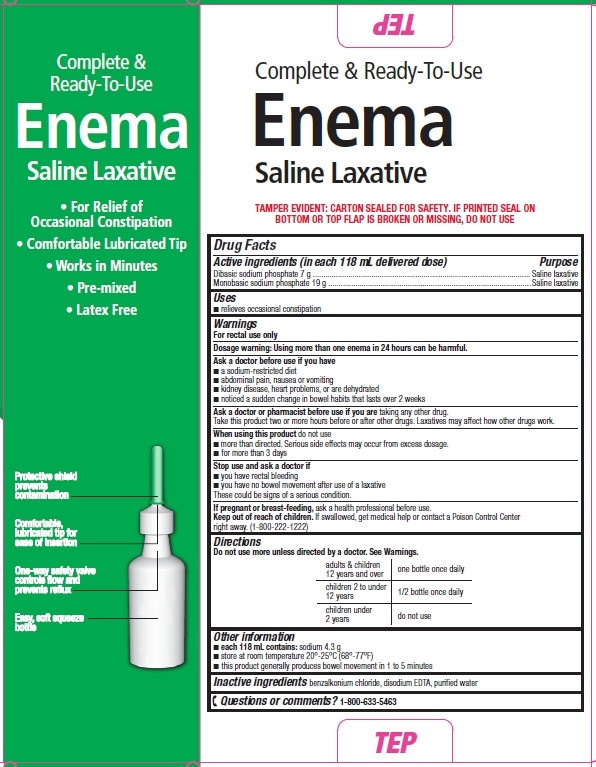
Saline Laxative label

Saline Laxative

Saline Laxative Recall

Get an alert when a recall is issued.

Side Effects & Adverse Reactions

For rectal use only

Dosage warning: Using more than one enema in 24 hours can be harmful.

Ask a doctor before use if you have

  • a sodium-restricted diet
  • abdominal pain, nausea or vomiting
  • kidney disease, heart problems, or are dehydrated
  • noticed a sudden change in bowel habits that lasts over 2 weeks

Ask a doctor or pharmacist before use if you are

taking any other drug. Take this product two or more hours before or after other drugs. Laxatives may affect how other drugs work.

When using this product

  • do not use more than directed. Serious side effects may occur from excess dosage.
  • do not use for more than 3 days

Stop use and ask a doctor if

  • you have rectal bleeding
  • you have no bowel movement after use of a laxative

These may be signs of a serious condition.

If pregnant or breastfeeding, ask a health professional before use.

Keep out of reach of children.

If swallowed, get medical help or contact a Poison Control Center right away. (1-800-222-1222)

Ask a doctor before use if you have

  • a sodium-restricted diet
  • abdominal pain, nausea or vomiting
  • kidney disease, heart problems, or are dehydrated
  • noticed a sudden change in bowel habits that lasts over 2 weeks

Ask a doctor or pharmacist before use if you are

taking any other drug. Take this product two or more hours before or after other drugs. Laxatives may affect how other drugs work.

Stop use and ask a doctor if

  • you have rectal bleeding
  • you have no bowel movement after use of a laxative

These may be signs of a serious condition.

FDA Safety Alerts

There are currently no FDA safety alerts available for this drug.

Manufacturer Warnings

There is currently no manufacturer warning information available for this drug.

FDA Labeling Changes

There are currently no FDA labeling changes available for this drug.

Uses

  • relieves occasional constipation

History

There is currently no drug history available for this drug.

Other Information

There are no additional details available for this product.

Saline Laxative Manufacturers

  • Saline Laxative | Amerisource Bergen
    No Recall

    Saline Laxative | Amerisource Bergen

    Saline Laxative | Amerisource Bergen

    Do not use more unless directed by a doctor. See Warnings.

    adults & children

    12 years and over

    one bottle once daily

    children 2 to under

    12 years

    1/2 bottle once daily

    children under

    2 years

    do not use

    CAUTION:

    Remove green protective shield before inserting. Hold bottle upright, grasping bottle cap with fingers. Grasp protective shield with other hand and pull gently to remove.

    Positioning:

    Left-side position: lie on left side with knee bent and arms at rest.

    Knee-chest position: kneel, then lower head and chest forward until left side of face is resting on surface. Position arms comfortably.

    Administering enema:

    with steady pressure, gently insert enema with tip pointing toward navel. squeeze bottle until recommended dose is expelled (it is not necessary to empty unit completely. Bottle contains more liquid than needed for effective use. A small amount of liquid will remain in bottle after squeezing). remove tip from rectum stop using if tip is hard to insert. Forcing the tip into the rectum can cause injury (especially if you have hemorrhoids). If enema tip causes rectal bleeding or pain, get immediate medical care. maintain position until urge to evacuate is strong (usually 1 to 5 minutes) if no urge is felt after 5 minutes of using, try to empty bowel. Call a doctor promptly if no liquid comes out of the rectum after 30 minutes because dehydration could occur.
  • Saline Laxative | Mckesson
    No Recall

    Saline Laxative | Mckesson

    Saline Laxative | Mckesson

    Do not use more unless directed by a doctor. See Warnings.

    adults & children

    12 years and over

    one bottle once daily

    children 2 to under

    12 years

    1/2 bottle once daily

    children under

    2 years

    do not use

    CAUTION:

    Remove green protective shield before inserting. Hold bottle upright, grasping bottle cap with fingers. Grasp protective shield with other hand and pull gently to remove.

    Positioning:

    Left-side position: lie on left side with knee bent and arms at rest.

    Knee-chest position: kneel, then lower head and chest forward until left side of face is resting on surface. Position arms comfortably.

    Administering enema:

    with steady pressure, gently insert enema with tip pointing toward navel. squeeze bottle until recommended dose is expelled (it is not necessary to empty unit completely. Bottle contains more liquid than needed for effective use. A small amount of liquid will remain in bottle after squeezing). remove tip from rectum stop using if tip is hard to insert. Forcing the tip into the rectum can cause injury (especially if you have hemorrhoids). If enema tip causes rectal bleeding or pain, get immediate medical care. maintain position until urge to evacuate is strong (usually 1 to 5 minutes) if no urge is felt after 5 minutes of using, try to empty bowel. Call a doctor promptly if no liquid comes out of the rectum after 30 minutes because dehydration could occur.
  • Saline Laxative | Cardinal Health
    No Recall

    Saline Laxative | Cardinal Health

    Saline Laxative | Cardinal Health
    Table 1. Recommended Daily Dosage by Indication


     Initial Dose

     Titration (Increments)

     Target Dose

     Effective Dose Range

     Schizophrenia: 
    adults (2.1)

     2 mg

     1 to 2 mg

     4 to 8 mg

     4 to 16 mg

     Schizophrenia: 
    adolescents (2.2

     0.5 mg

     0.5 to 1 mg

     3 mg

     1 to 6 mg

     Bipolar mania: 
    adults (2.2)

     2 to 3 mg

     1mg

     1 to 6mg

     1 to 6 mg

     Bipolar mania: 
    children and adolescents (2.2)

     0.5 mg

     0.5 to 1mg

     1 to 2.5 mg

     1 to 6 mg

     Irritability in autistic disorder (2.3)

     0.25 mg Can increase to 0.5 mg by Day 4: (body weight less than 20 kg)
     
    0.5 mg Can increase to 1 mg by Day 4: (body weight greater than or equal to 20 kg)

     After Day 4, at intervals of > 2 weeks: 0.25 mg (body weight less than 20 kg)

    0.5 mg (body weight greater than or equal to 20 kg)

     0.5 mg: (body weight less than 20 kg)

    1 mg: (body weight greater than or equal to 20 kg)

     0.5 to 3 mg

    Severe Renal and Hepatic Impairment in Adults: use a lower starting dose of 0.5 mg twice daily. May increase to dosages above 1.5 mg twice daily at intervals of at one week or longer

    2.1 Schizophrenia

    Adults

    Usual Initial Dose

    Risperidone tablets can be administered once or twice daily. Initial dosing is 2 mg per day. May increase the dose at intervals of 24 hours or greater, in increments of 1 to 2 mg per day, as tolerated, to a recommended dose of 4 to 8 mg per day. In some patients, slower titration may be appropriate. Efficacy has been demonstrated in a range of 4 mg to 16 mg per. However, doses above 6 mg per day for twice daily dosing were not demonstrated to be more efficacious than lower doses, were associated with more extrapyramidal symptoms and other adverse effects, and are generally not recommended. In a single study supporting once-daily dosing, the efficacy results were generally stronger for 8 mg than for 4 mg. The safety of doses above 16 mg per day has not been evaluated in clinical trials [see Clinical Studies (14.1)].

    Adolescents

    The initial dose is 0.5 mg once daily, administered as a single-daily dose in the morning or evening. The dose may be adjusted at intervals of 24 hours or greater, in increments of 0.5 mg or 1 mg per day, as tolerated, to a recommended dose of 3 mg per day. Although efficacy has been demonstrated in studies of adolescent patients with schizophrenia at doses between 1 mg to 6 mg per day, no additional benefit was observed above 3 mg per day, and higher doses were associated with more adverse events. Doses higher than 6 mg per day have not been studied.

    Patients experiencing persistent somnolence may benefit from administering half the daily dose twice daily.

    Maintenance Therapy

    While it is unknown how long a patient with schizophrenia should remain on risperidone tablets, the effectiveness of risperidone tablets 2 mg per day to 8 mg per day at delaying relapse was demonstrated in a controlled trial in adult patients who had been clinically stable for at least 4 weeks and were then followed for a period of 1 to 2 years [see Clinical Studies (14.1)]. Both adult and adolescent patients who respond acutely should generally be maintained on their effective dose beyond the acute episode. Patients should be periodically reassessed to determine the need for maintenance treatment.

    Reinitiation of Treatment in Patients Previously Discontinued

    Although there are no data to specifically address reinitiation of treatment, it is recommended that after an interval off risperidone tablets, the initial titration schedule should be followed.

    Switching From Other Antipsychotics

    There are no systematically collected data to specifically address switching schizophrenic patients from other antipsychotics to risperidone tablets, or treating patients with concomitant antipsychotics.

    2.2 Bipolar Mania

    Usual Dose

    Adults

    The initial dose range is 2 mg to 3 mg per day. The dose may be adjusted at intervals of 24 hours or greater, in increments of 1 mg per day. The effective dose range is 1 mg to 6 mg per day, as studied in the short-term, placebo-controlled trials. In these trials, short-term (3 week) anti-manic efficacy was demonstrated in a flexible dosage range of 1 mg to 6 mg per day [see Clinical Studies (14.2, 14.3)]. Risperidone tablet doses higher than 6 mg per day were not studied.

    Pediatrics

    The initial dose is 0.5 mg once daily, administered as a single-daily dose in the morning or evening. The dose may be adjusted at intervals of 24 hours or greater, in increments of 0.5 mg or 1 mg per day, as tolerated, to the recommended target dose of 1mg to 2.5 mg per day. Although efficacy has been demonstrated in studies of pediatric patients with bipolar mania at doses between 0.5 mg and 6 mg per day, no additional benefit was observed above 2.5 mg per day, and higher doses were associated with more adverse events. Doses higher than 6 mg per day have not been studied.

    Patients experiencing persistent somnolence may benefit from administering half the daily dose twice daily.

    Maintenance Therapy

    There is no body of evidence available from controlled trials to guide a clinician in the longer-term management of a patient who improves during treatment of an acute manic episode with risperidone tablets. While it is generally agreed that pharmacological treatment beyond an acute response in mania is desirable, both for maintenance of the initial response and for prevention of new manic episodes, there are no systematically obtained data to support the use of risperidone tablets in such longer-term treatment (i.e., beyond 3 weeks). The physician who elects to use risperidone tablets for extended periods should periodically re-evaluate the long-term risks and benefits of the drug for the individual patient.

    2.3 Irritability Associated with Autistic Disorder – Pediatrics (Children and Adolescents)

    The dosage of risperidone tablets should be individualized according to the response and tolerability of the patient. The total daily dose of risperidone tablets can be administered once daily, or half the total daily dose can be administered twice daily.

    For patients with body weight less than 20 kg, initiate dosing at 0.25 mg per day. For patients with body weight greater than or equal to 20 kg, initiate dosing at 0.5 mg per day. After a minimum of four days, the dose may be increased to the recommended dose of 0.5 mg per day for patients less than 20 kg and 1.0 mg per day for patients greater than or equal to 20 kg. Maintain this dose for a minimum of 14 days. In patients not achieving sufficient clinical response, the dose may be increased at intervals of 2 weeks or greater, in increments of 0.25 mg per day for patients less than 20 kg, or increments of 0.5 mg per day for patients greater than or equal to 20 kg. The effective dose range is 0.5 mg to 3 mg per day. No dosing data are available for children who weigh less than 15 kg.

    Once sufficient clinical response has been achieved and maintained, consider gradually lowering the dose to achieve the optimal balance of efficacy and safety. The physician who elects to use risperidone tablets for extended periods should periodically re-evaluate the long-term risks and benefits of the drug for the individual patient.

    Patients experiencing persistent somnolence may benefit from a once-daily dose administered at bedtime or administering half the daily dose twice daily, or a reduction of the dose.

    2.4 Dosing in Patients with Severe Renal or Hepatic Impairment

    For patients with severe renal impairment (CLcr < 30 mL/min) or hepatic impairment (10-15 points on Child Pugh System), the initial starting dose is 0.5 mg twice daily. The dose may be increased in increments of 0.5 mg or less, administered twice daily. For doses above 1.5 mg twice daily, increase in intervals of one week or greater [see Use in Specific Populations (8.6 and8.7)].

    2.5 Dose Adjustments for Specific Drug Interactions

    When risperidone tablets are co-administered with enzyme inducers (e.g., carbamazepine), the dose of risperidone tablets should be increased up to double the patient's usual dose. It may be necessary to decrease the risperidone tablets dose when enzyme inducers such as carbamazepine are discontinued [see Drug Interactions (7.1)]. Similar effect may be expected with co-administration of risperidone tablets with other enzyme inducers (e.g., phenytoin, rifampin, and phenobarbital).

    When fluoxetine or paroxetine is co-administered with risperidone tablets, the dose of risperidone tablets should be reduced. The risperidone tablets dose should not exceed 8 mg per day in adults when co-administered with these drugs. When initiating therapy, risperidone tablets should be titrated slowly. It may be necessary to increase the risperidone tablets dose when enzyme inhibitors such as fluoxetine or paroxetine are discontinued [see Drug Interactions (7.1)].

  • Saline Laxative | Mckesson
    No Recall

    Saline Laxative | Mckesson

    Saline Laxative | Mckesson

    Do not use more unless directed by a doctor. See Warnings.

    adults & children

    12 years and over

    one bottle once daily

    children 2 to under

    12 years

    1/2 bottle once daily

    children under

    2 years

    do not use

    CAUTION:

    Remove green protective shield before inserting. Hold bottle upright, grasping bottle cap with fingers. Grasp protective shield with other hand and pull gently to remove.

    Positioning:

    Left-side position: lie on left side with knee bent and arms at rest.

    Knee-chest position: kneel, then lower head and chest forward until left side of face is resting on surface. Position arms comfortably.

    Administering enema:

    • with steady pressure, gently insert enema with tip pointing toward navel. • squeeze bottle until recommended dose is expelled (it is not necessary to empty unit completely. Bottle contains more liquid than needed for effective use. A small amount of liquid will remain in bottle after squeezing). • remove tip from rectum • stop using if tip is hard to insert. Forcing the tip into the rectum can cause injury (especially if you have hemorrhoids). If enema tip causes rectal bleeding or pain, get immediate medical care. • maintain position until urge to evacuate is strong (usually 1 to 5 minutes) • if no urge is felt after 5 minutes of using, try to empty bowel. Call a doctor promptly if no liquid comes out of the rectum after 30 minutes because dehydration could occur.
  • Saline Laxative | Apotex Corp.
    No Recall

    Saline Laxative | Apotex Corp.

    Saline Laxative | Apotex Corp.
    2.1 Administration Information

    Administer gabapentin orally with or without food.

    Gabapentin capsules should be swallowed whole with water.

    Inform patients that, should they break the scored 600 mg or 800 mg gabapentin tablet in order to administer a half-tablet, they should take the unused half-tablet as the next dose. Half-tablets not used within 28 days of breaking the scored tablet should be discarded.

    If the gabapentin dose is reduced, discontinued, or substituted with an alternative medication, this should be done gradually over a minimum of 1 week (a longer period may be needed at the discretion of the prescriber).

    2.2 Dosage for Postherpetic Neuralgia

    In adults with postherpetic neuralgia, gabapentin may be initiated on Day 1 as a single 300 mg dose, on Day 2 as 600 mg/day (300 mg two times a day), and on Day 3 as 900 mg/day (300 mg three times a day). The dose can subsequently be titrated up as needed for pain relief to a dose of 1800 mg/day (600 mg three times a day). In clinical studies, efficacy was demonstrated over a range of doses from 1800 mg/day to 3600 mg/day with comparable effects across the dose range; however, in these clinical studies, the additional benefit of using doses greater than 1800 mg/day was not demonstrated. 

    2.3 Dosage for Epilepsy with Partial Onset Seizures

    Patients 12 years of age and above

    The starting dose is 300 mg three times a day. The recommended maintenance dose of gabapentin is 300 mg to 600 mg three times a day. Dosages up to 2400 mg/day have been well tolerated in long-term clinical studies. Doses of 3600 mg/day have also been administered to a small number of patients for a relatively short duration, and have been well tolerated. Administer gabapentin three times a day using 300 mg or 400 mg capsules, or 600 mg or 800 mg tablets. The maximum time between doses should not exceed 12 hours.

    Pediatric Patients Age 3 to 11 years

    The starting dose range is 10 mg/kg/day to 15 mg/kg/day, given in three divided doses, and the recommended maintenance dose reached by upward titration over a period of approximately 3 days. The recommended maintenance dose of gabapentin in patients 3 to 4 years of age is 40 mg/kg/day, given in three divided doses. The recommended maintenance dose of gabapentin in patients 5 to 11 years of age is 25 mg/kg/day to 35 mg/kg/day, given in three divided doses. Gabapentin may be administered as the capsule, or tablet, or using combinations of these formulations. Dosages up to 50 mg/kg/day have been well tolerated in a long-term clinical study. The maximum time interval between doses should not exceed 12 hours.

    2.4 Dosage Adjustment in Patients with Renal Impairment

    Dosage adjustment in patients 12 years of age and older with renal impairment or undergoing hemodialysis is recommended, as follows (see dosing recommendations above for effective doses in each indication):

    Table 1. Gabapentin Dosage Based on Renal Function Renal Function Renal Function Creatinine Clearance
    (mL/min) Total Daily Dose Range
    (mg/day) Dose Regimen
    (mg) ≥ 60 900 to 3600 300 TID 400 TID 600 TID 800 TID 1200 TID >30 to 59 400 to 1400 200 BID 300 BID 400 BID 500 BID 700 BID >15 to 29 200 to 700 200 QD 300 QD 400 QD 500 QD 700 QD 15a 100 to 300 100 QD 125 QD 150 QD 200 QD 300 QD Post-Hemodialysis Supplemental Dose (mg)b Hemodialysis 125b 150b 200b 250b 350b

    TID = Three times a day; BID = Two times a day; QD = Single daily dose

    a For patients with creatinine clearance <15 mL/min, reduce daily dose in proportion to creatinine clearance (e.g., patients with a creatinine clearance of 7.5 mL/min should receive one-half the daily dose that patients with a creatinine clearance of 15 mL/min receive).

    b Patients on hemodialysis should receive maintenance doses based on estimates of creatinine clearance as indicated in the upper portion of the table and a supplemental post-hemodialysis dose administered after each 4 hours of hemodialysis as indicated in the lower portion of the table.

    Creatinine clearance (CLCr) is difficult to measure in outpatients. In patients with stable renal function, creatinine clearance can be reasonably well estimated using the equation of Cockcroft and Gault:

    The use of gabapentin in patients less than 12 years of age with compromised renal function has not been studied.

    2.5 Dosage in Elderly

    Because elderly patients are more likely to have decreased renal function, care should be taken in dose selection, and dose should be adjusted based on creatinine clearance values in these patients.

  • Supervalu Inc
    Saline Laxative | Cardinal Health
    No Recall

    Saline Laxative | Cardinal Health

    Saline Laxative | Cardinal Health
    adults: take one tablet 30 minutes before going to bed; take once daily or as directed by a doctor do not give to children under 12 years of age
  • Family Dollar Stores, Inc.
    Saline Laxative | Family Dollar Stores, Inc.
    No Recall

    Saline Laxative | Family Dollar Stores, Inc.

    Saline Laxative | Family Dollar Stores, Inc.

    Do not use more unless directed by a doctor. See Warnings.

    adults & children

    12 years and over

    one bottle once daily

    children 2 to under

    12 years

    1/2 bottle once daily

    children under

    2 years

    do not use

    CAUTION:

    Remove green protective shield before inserting. Hold bottle upright, grasping bottle cap with fingers. Grasp protective shield with other hand and pull gently to remove.

    Positioning:

    Left-side position: lie on left side with knee bent and arms at rest.

    Knee-chest position: kneel, then lower head and chest forward until left side of face is resting on surface. Position arms comfortably.

    Administering enema:

    • with steady pressure, gently insert enema with tip pointing toward navel. • squeeze bottle until recommended dose is expelled (it is not necessary to empty unit completely. Bottle contains more liquid than needed for effective use. A small amount of liquid will remain in bottle after squeezing). • remove tip from rectum • stop using if tip is hard to insert. Forcing the tip into the rectum can cause injury (especially if you have hemorrhoids). If enema tip causes rectal bleeding or pain, get immediate medical care. • maintain position until urge to evacuate is strong (usually 1 to 5 minutes) • if no urge is felt after 5 minutes of using, try to empty bowel. Call a doctor promptly if no liquid comes out of the rectum after 30 minutes because dehydration could occur.
  • Safeway
    Saline Laxative | Safeway
    No Recall

    Saline Laxative | Safeway

    Saline Laxative | Safeway

    Do not use more unless directed by a doctor. See Warnings.

    adults & children

    12 years and over

    one bottle once daily

    children 2 to under

    12 years

    1/2 bottle once daily

    children under

    2 years

    do not use

    CAUTION:

    Remove green protective shield before inserting. Hold bottle upright, grasping bottle cap with fingers. Grasp protective shield with other hand and pull gently to remove.

    Positioning:

    Left-side position: lie on left side with knee bent and arms at rest.

    Knee-chest position: kneel, then lower head and chest forward until left side of face is resting on surface. Position arms comfortably.

    Administering enema:

    • with steady pressure, gently insert enema with tip pointing toward navel. • squeeze bottle until recommended dose is expelled (it is not necessary to empty unit completely. Bottle contains more liquid than needed for effective use. A small amount of liquid will remain in bottle after squeezing). • remove tip from rectum • stop using if tip is hard to insert. Forcing the tip into the rectum can cause injury (especially if you have hemorrhoids). If enema tip causes rectal bleeding or pain, get immediate medical care. • maintain position until urge to evacuate is strong (usually 1 to 5 minutes) • if no urge is felt after 5 minutes of using, try to empty bowel. Call a doctor promptly if no liquid comes out of the rectum after 30 minutes because dehydration could occur.
  • American Sales Company
    Saline Laxative | Boca Pharmacal, Llc
    No Recall

    Saline Laxative | Boca Pharmacal, Llc

    Saline Laxative | Boca Pharmacal, Llc

    Dosage should be adjusted according to severity of the pain and the response of the patient. However, it should be kept in mind that tolerance to hydrocodone can develop with continued use and that the incidence of untoward effects is dose related.

    The usual adult dosage is one tablespoonful every 4 to 6 hours as needed for pain. The total daily dosage for adults should not exceed 6 tablespoonfuls.

    The usual dosages for children are given by the table on the next page, and are to be given every 4 to 6 hours as needed for pain. These dosages correspond to an average individual dose of 0.27 mL/kg of hydrocodone bitartrate and acetaminophen oral solution (providing 0.135 mg/kg of hydrocodone bitartrate and 5.85 mg/kg of acetaminophen). Dosing should be based on the weight whenever possible.

    The total daily dosage for children should not exceed 6 doses per day.

    It is of utmost importance that the dose of hydrocodone bitartrate and acetaminophen oral solution be administered accurately. A household teaspoon or tablespoon is not an adequate measuring device, especially when one-half or three-fourths of a teaspoonful is to be measured. Given the inexactitude of the household spoon measure and the possibility of using a tablespoon instead of a teaspoon, which could lead to overdosage, it is strongly recommended that caregivers obtain and use a calibrated measuring device. Health care providers should recommend a dropper that can measure and deliver the prescribed dose accurately, and instruct caregivers to use extreme caution in measuring the dosage.

  • Saline Laxative | Mckesson
    No Recall

    Saline Laxative | Mckesson

    Saline Laxative | Mckesson

    Do not use more unless directed by a doctor. See Warnings.

    adults & children

    12 years and over

    one bottle once daily

    children 2 to under

    12 years

    1/2 bottle once daily

    children under

    2 years

    do not use

    CAUTION:

    Remove green protective shield before inserting. Hold bottle upright, grasping bottle cap with fingers. Grasp protective shield with other hand and pull gently to remove.

    Positioning:

    Left-side position: lie on left side with knee bent and arms at rest.

    Knee-chest position: kneel, then lower head and chest forward until left side of face is resting on surface. Position arms comfortably.

    Administering enema:

    • with steady pressure, gently insert enema with tip pointing toward navel. • squeeze bottle until recommended dose is expelled (it is not necessary to empty unit completely. Bottle contains more liquid than needed for effective use. A small amount of liquid will remain in bottle after squeezing). • remove tip from rectum • stop using if tip is hard to insert. Forcing the tip into the rectum can cause injury (especially if you have hemorrhoids). If enema tip causes rectal bleeding or pain, get immediate medical care. • maintain position until urge to evacuate is strong (usually 1 to 5 minutes) • if no urge is felt after 5 minutes of using, try to empty bowel. Call a doctor promptly if no liquid comes out of the rectum after 30 minutes because dehydration could occur.
  • Walgreen Company
    Saline Laxative | Walgreen Co.
    No Recall

    Saline Laxative | Walgreen Co.

    Saline Laxative | Walgreen Co.
    do not take more than directed
    (see overdose warning) adults and children 12 years and over take 2 tablets every 6 hours while symptoms last do not take more than 6 tablets in 24 hours unless directed by a doctor
    do not take for more than 10 days unless directed by a doctor children under 12 years: do not use this adult extra strength product in children under 12 years of age; this will provide more than the recommended dose (overdose) of acetaminophen and may cause liver damage
  • Saline Laxative | Cvs Pharmacy
    No Recall

    Saline Laxative | Cvs Pharmacy

    Saline Laxative | Cvs Pharmacy
    do not take more than directed (see Overdose warning) do not take more than 4 doses in 24 hours adults and children 12 years and over: take 2 softgels with water every 4 hours swallow whole; do not crush, chew, or dissolve children under 12 years: do not use when using other Daytime or Nighttime products, carefully read each label to ensure correct dosing