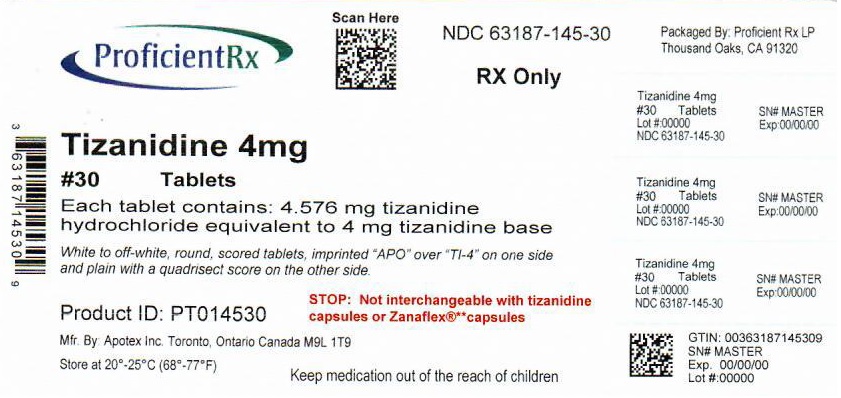
Tizanidine label

Tizanidine

Tizanidine Recall

Get an alert when a recall is issued.

Side Effects & Adverse Reactions

There is currently no warning information available for this product. We apologize for any inconvenience.

FDA Safety Alerts

There are currently no FDA safety alerts available for this drug.

Manufacturer Warnings

There is currently no manufacturer warning information available for this drug.

FDA Labeling Changes

There are currently no FDA labeling changes available for this drug.

Uses

TizanidineTablets, USP is a central alpha-2-adrenergic agonist indicated for themanagement of spasticity. Because of the short duration of therapeutic effect,treatment with Tizanidine Tablets, USP should be reserved for those dailyactivities and times when relief of spasticity is most important [see Dosage andAdministration(2.1)].

History

There is currently no drug history available for this drug.

Other Information

Tizanidine Tablets, USP  (tizanidine hydrochloride) is a central alpha2-adrenergic agonist. Tizanidine HCl is a white to off-white, fine crystalline powder, which is odorless or with a faint characteristic odor. Tizanidine is slightly soluble in water and methanol; solubility in water decreases as the pH increases. Its chemical name is 5-chloro-4-(2-imidazolin-2-ylamino)-2,1,3-benzothiadiazole monohydrochloride. Tizanidine’s molecular formula is C9H8ClN5S-HCl, its molecular weight is 290.2 and its structural formula is:
Tizanidine-structure

Tizanidine Tablets, USP are supplied as 2 mg and 4 mg tablets for oral administration. Tizanidine Tablets, USP contain the active ingredient, tizanidine hydrochloride (2.288 mg equivalent to 2 mg tizanidine base and  4.576 mg equivalent to 4 mg tizanidine base), and the inactive ingredients, colloidal silicon dioxide, stearic acid, microcrystalline cellulose, lactose monohydrate and anhydrous lactose.

Tizanidine Manufacturers

  • Avkare, Inc.
    Tizanidine | Medsource Pharmaceuticals
    No Recall

    Tizanidine | Medsource Pharmaceuticals

    Tizanidine | Medsource Pharmaceuticals

    Gabapentin Capsules, USP are given orally with or without food.

    Gabapentin capsules should be swallowed whole with plenty of water.

    If gabapentin dose is reduced, discontinued, or submitted with an alternative medication, this should be done gradually over a minimum of 1 week (a longer period may be needed at the discretion of the prescriber).

    2.1 Postherpetic Neuralgia

    In adults with postherpetic neuralgia, gabapentin therapy may be initiated on Day 1 as a single 300 mg dose, on Day 2 as 600 mg/day (300 mg two times a day), and on Day 3 as 900 mg/day (300 mg three times a day). The dose can subsequently be titrated up as needed for pain relief to a dose of 1800 mg/day (600 mg three times a day). In clinical studies, efficacy was demonstrated over a range of doses from 1800 mg/day to 3600 mg/day with comparable effects across the dose range; however, in these clinical studies, the additional benefit of using doses greater than 1800 mg/day was not demonstrated.

    2.2 Epilepsy with Partial Onset Seizures

    Gabapentin is recommended for add-on therapy in patients 3 years of age and older. Effectiveness in pediatric patients below the age of 3 years has not been established.

    Patients 12 years of age and above: The starting dose is 300 mg three times a day. The effective dose of gabapentin Capsules is 300 mg to 600 mg three times a day. Dosages up to 2400 mg/day have been well tolerated in long-term clinical studies. Doses of 3600 mg/day have also been administered to a small number of patients for a relatively short duration, and have been well tolerated. Gabapentin Capsules should be administered three times a day using 300 mg or 400 mg capsules. The maximum time between doses should not exceed 12 hours.

    Pediatric Patients Age 3 to 11 years: The starting dose range is 10 mg/kg/day to 15 mg/kg/day, given in three divided doses, and the effective dose reached by upward titration over a period of approximately 3 days. The effective dose of gabapentin in patients 3 to 4 years of age is 40 mg/kg/day, given in three divided doses. The effective dose of gabapentin in patients 5 to 11 years of age is 25 mg/kg/day to 35 mg/kg/day, given in three divided doses. Gabapentin may be administered as the oral solution, capsule, or tablet, or using combinations of these formulations. Dosages up to 50 mg/kg/day have been well tolerated in a long-term clinical study. The maximum time interval between doses should not exceed 12 hours.

    It is not necessary to monitor gabapentin plasma concentrations to optimize gabapentin therapy. Further, because there are no significant pharmacokinetic interactions among gabapentin and other commonly used antiepileptic drugs, the addition of gabapentin does not alter the plasma levels of these drugs appreciably.

    If gabapentin is discontinued and/or an alternate anticonvulsant medication is added to the therapy, this should be done gradually over a minimum of 1 week.

    2.3 Patients with Renal Impairment

    Dosage adjustment in patients 12 years of age and older with compromised renal function or undergoing hemodialysis is recommended as follows (see dosing recommendations above for effective doses in each indication).

    2.4 Dosage in Elderly

    Because elderly patients are more likely to have decreased renal function, care should be taken in dose selection, and dose should be adjusted based on creatinine clearance values in these patients.

  • Proficient Rx Lp
    Tizanidine | Bioresource Inc.
    No Recall

    Tizanidine | Bioresource Inc.

    Tizanidine | Bioresource Inc.

    Unless otherwise prescribed, adults take 17 drops in water or herbal tea, 3-4 times per day, at least 15 minutes before meals. For pediatric dosages, consult your practitioner.

  • Blenheim Pharmacal, Inc.
    Tizanidine | Mckesson
    No Recall

    Tizanidine | Mckesson

    Tizanidine | Mckesson
    • do not take more than directed unless advised by your doctor • the bottle top is a measuring cap marked to contain 17 grams of powder when filled to the indicated line (white section in cap) • adults and children 17 years of age and older: • fill to top of white section in cap which is marked to indicate the correct dose (17 g) • stir and dissolve in any 4 to 8 ounces of beverage (cold, hot or room temperature) then drink • use once a day • use no more than 7 days • children 16 years of age or under: ask a doctor
  • Remedyrepack Inc.
    Tizanidine | Remedyrepack Inc.
    No Recall

    Tizanidine | Remedyrepack Inc.

    Tizanidine | Remedyrepack Inc.

    A single dose of 8 mg of tizanidine reduces muscle tone in patients with spasticity for a period of several hours. The effect peaks at approximately 1 to 2 hours and dissipates between 3 to 6 hours. Effects are dose-related. 

    Although single doses of less than 8 mg have not been demonstrated to be effective in controlled clinical studies, the dose-related nature of tizanidine’s common adverse events make it prudent to begin treatment with single oral doses of 4 mg. Increase the dose gradually (2 to 4 mg steps) to optimum effect (satisfactory reduction of muscle tone at a tolerated dose).

    The dose can be repeated at 6 to 8 hour intervals, as needed, to a maximum of three doses in 24 hours. The total daily dose should not exceed 36 mg. 

    Experience with single doses exceeding 8 mg and daily doses exceeding 24 mg is limited.  There is essentially no experience with repeated, single, daytime doses greater than 12 mg or total daily doses greater than 36 mg (see WARNINGS).

     Food has complex effects on tizanidine pharmacokinetics, which differ with the different formulations. These pharmacokinetic differences may result in clinically significant differences when switching administration of the tablet between the fed or fasted state. These changes may result in increased adverse events or delayed/more rapid onset of activity, depending upon the nature of the switch. For this reason, the prescriber should be thoroughly familiar with the changes in kinetics associated with these different conditions (see CLINICAL PHARMACOLOGY: Pharmacokinetics).


  • Dr.reddy’s Laboratories Limited
    Tizanidine | Cardinal Health
    No Recall

    Tizanidine | Cardinal Health

    Tizanidine | Cardinal Health

    While the recommended usual adult dose is 15 mg before retiring, 7.5 mg may be sufficient for some patients, and others may need 30 mg. In transient insomnia, a 7.5 mg dose may be sufficient to improve sleep latency. In elderly or debilitated patients, it is recommended that therapy be initiated with 7.5 mg until individual responses are determined.

  • Tizanidine | Altura Pharmaceuticals, Inc.
    No Recall

    Tizanidine | Altura Pharmaceuticals, Inc.

    Tizanidine | Altura Pharmaceuticals, Inc.

    A single dose of 8 mg of tizanidine reduces muscle tone in patients with spasticity for a period of several hours. The effect peaks at approximately 1 to 2 hours and dissipates between 3 to 6 hours. Effects are dose-related. 

    Although single doses of less than 8 mg have not been demonstrated to be effective in controlled clinical studies, the dose-related nature of tizanidine’s common adverse events make it prudent to begin treatment with single oral doses of 4 mg. Increase the dose gradually (2 to 4 mg steps) to optimum effect (satisfactory reduction of muscle tone at a tolerated dose).

    The dose can be repeated at 6 to 8 hour intervals, as needed, to a maximum of three doses in 24 hours. The total daily dose should not exceed 36 mg. 

    Experience with single doses exceeding 8 mg and daily doses exceeding 24 mg is limited.  There is essentially no experience with repeated, single, daytime doses greater than 12 mg or total daily doses greater than 36 mg (see WARNINGS).

     Food has complex effects on tizanidine pharmacokinetics, which differ with the different formulations. These pharmacokinetic differences may result in clinically significant differences when switching administration of the tablet between the fed or fasted state. These changes may result in increased adverse events or delayed/more rapid onset of activity, depending upon the nature of the switch. For this reason, the prescriber should be thoroughly familiar with the changes in kinetics associated with these different conditions (see CLINICAL PHARMACOLOGY: Pharmacokinetics).

  • Udl Laboratories, Inc.
    Tizanidine | Ncs Healthcare Of Ky, Inc Dba Vangard Labs
    No Recall

    Tizanidine | Ncs Healthcare Of Ky, Inc Dba Vangard Labs

    Tizanidine | Ncs Healthcare Of Ky, Inc Dba Vangard Labs
    Hypertension

    In patients who are currently being treated with a diuretic, symptomatic hypotension occasionally may occur following the initial dose of enalapril maleate tablets. The diuretic should, if possible, be discontinued for 2 to 3 days before beginning therapy with enalapril maleate tablets to reduce the likelihood of hypotension. (See WARNINGS.) If the patient's blood pressure is not controlled with enalapril maleate tablets alone, diuretic therapy may be resumed.

    If the diuretic cannot be discontinued an initial dose of 2.5 mg should be used under medical supervision for at least 2 hours and until blood pressure has stabilized for at least an additional hour. (See WARNINGS and PRECAUTIONS: Drug Interactions.)

    The recommended initial dose in patients not on diuretics is 5 mg once a day. Dosage should be adjusted according to blood pressure response. The usual dosage range is 10 mg to 40 mg per day administered in a single dose or two divided doses. In some patients treated once daily, the antihypertensive effect may diminish toward the end of the dosing interval. In such patients, an increase in dosage or twice daily administration should be considered. If blood pressure is not controlled with enalapril maleate tablets alone, a diuretic may be added. Concomitant administration of enalapril maleate tablets with potassium supplements, potassium salt substitutes, or potassium-sparing diuretics may lead to increases of serum potassium (see PRECAUTIONS).

    Dosage Adjustment in Hypertensive Patients with Renal Impairment

    The usual dose of enalapril maleate tablets is recommended for patients with a creatinine clearance > 30 mL/min (serum creatinine of up to approximately 3 mg/dL). For patients with creatinine clearance ≤ 30 mL/min (serum creatinine ≥ 3 mg/dL), the first dose is 2.5 mg once daily. The dosage may be titrated upward until blood pressure is controlled or to a maximum of 40 mg daily.

    * See WARNINGS: Anaphylactoid Reactions During Membrane Exposure. † Dosage on nondialysis days should be adjusted depending on the blood pressure response.  

    Renal Status


    Creatinine-Clearance
    mL/min


    Initial Dose
    mg/day


    Normal Renal Function


    > 80 mL/min


    5 mg


    Mild Impairment


    ≤ 80 > 30 mL/min


    5 mg


    Moderate to Severe Impairment


    ≤ 30 mL/min


    2.5 mg


    Dialysis Patients*


    —


    2.5 mg on dialysis days†

    Heart Failure

    Enalapril maleate tablets are indicated for the treatment of symptomatic heart failure, usually in combination with diuretics and digitalis. In the placebo-controlled studies that demonstrated improved survival, patients were titrated as tolerated up to 40 mg, administered in two divided doses.

    The recommended initial dose is 2.5 mg. The recommended dosing range is 2.5 mg to 20 mg given twice a day. Doses should be titrated upward, as tolerated, over a period of a few days or weeks. The maximum daily dose administered in clinical trials was 40 mg in divided doses.

    After the initial dose of enalapril maleate tablets, the patient should be observed under medical supervision for at least 2 hours and until blood pressure has stabilized for at least an additional hour. (See WARNINGS and PRECAUTIONS: Drug Interactions.) If possible, the dose of any concomitant diuretic should be reduced which may diminish the likelihood of hypotension. The appearance of hypotension after the initial dose of enalapril maleate tablets does not preclude subsequent careful dose titration with the drug, following effective management of the hypotension.

    Asymptomatic Left Ventricular Dysfunction

    In the trial that demonstrated efficacy, patients were started on 2.5 mg twice daily and were titrated as tolerated to the targeted daily dose of 20 mg (in divided doses).

    After the initial dose of enalapril maleate tablets, the patient should be observed under medical supervision for at least 2 hours and until blood pressure has stabilized for at least an additional hour. (See WARNINGS and PRECAUTIONS: Drug Interactions.) If possible, the dose of any concomitant diuretic should be reduced which may diminish the likelihood of hypotension. The appearance of hypotension after the initial dose of enalapril maleate tablets does not preclude subsequent careful dose titration with the drug, following effective management of the hypotension.

    Dosage Adjustment in Patients with Heart Failure and Renal Impairment or Hyponatremia

    In patients with heart failure who have hyponatremia (serum sodium less than 130 mEq/L) or with serum creatinine greater than 1.6 mg/dL, therapy should be initiated at 2.5 mg daily under close medical supervision. (See DOSAGE AND ADMINISTRATION: Heart Failure, WARNINGS and PRECAUTIONS: Drug Interactions.) The dose may be increased to 2.5 mg b.i.d., then 5 mg b.i.d. and higher as needed, usually at intervals of 4 days or more if at the time of dosage adjustment there is not excessive hypotension or significant deterioration of renal function. The maximum daily dose is 40 mg.

    Pediatric Hypertensive Patients

    The usual recommended starting dose is 0.08 mg/kg (up to 5 mg) once daily. Dosage should be adjusted according to blood pressure response. Doses above 0.58 mg/kg (or in excess of 40 mg) have not been studied in pediatric patients (see CLINICAL PHARMACOLOGY: Clinical Pharmacology in Pediatric Patients).

    Enalapril maleate tablets are not recommended in neonates and in pediatric patients with glomerular filtration rate <30 mL/min/1.73 m2, as no data are available.

    Preparation of Suspension (for 200 mL of a 1 mg/mL suspension)

    Add 50 mL of Bicitra®† to a polyethylene terephthalate (PET) bottle containing ten 20 mg tablets of enalapril maleate and shake for at least 2 minutes. Let concentrate stand for 60 minutes. Following the 60 minute hold time, shake the concentrate for an additional minute. Add 150 mL of Ora-Sweet SF™† to the concentrate in the PET bottle and shake the suspension to disperse the ingredients. The suspension should be refrigerated at 2° to 8°C (36° to 46°F) and can be stored for up to 30 days. Shake the suspension before each use.

  • Bryant Ranch Prepack
    Tizanidine | Bryant Ranch Prepack
    No Recall

    Tizanidine | Bryant Ranch Prepack

    Tizanidine | Bryant Ranch Prepack

    A single dose of 8 mg of tizanidine reduces muscle tone in patients with spasticity for a period of several hours. The effect peaks at approximately 1 to 2 hours and dissipates between 3 to 6 hours. Effects are dose-related. 

    Although single doses of less than 8 mg have not been demonstrated to be effective in controlled clinical studies, the dose-related nature of tizanidine’s common adverse events make it prudent to begin treatment with single oral doses of 4 mg. Increase the dose gradually (2 to 4 mg steps) to optimum effect (satisfactory reduction of muscle tone at a tolerated dose).

    The dose can be repeated at 6 to 8 hour intervals, as needed, to a maximum of three doses in 24 hours. The total daily dose should not exceed 36 mg. 

    Experience with single doses exceeding 8 mg and daily doses exceeding 24 mg is limited.  There is essentially no experience with repeated, single, daytime doses greater than 12 mg or total daily doses greater than 36 mg (see WARNINGS).

     Food has complex effects on tizanidine pharmacokinetics, which differ with the different formulations. These pharmacokinetic differences may result in clinically significant differences when switching administration of the tablet between the fed or fasted state. These changes may result in increased adverse events or delayed/more rapid onset of activity, depending upon the nature of the switch. For this reason, the prescriber should be thoroughly familiar with the changes in kinetics associated with these different conditions (see CLINICAL PHARMACOLOGY: Pharmacokinetics).

  • Tizanidine | Cardinal Health
    No Recall

    Tizanidine | Cardinal Health

    Tizanidine | Cardinal Health

    A single oral dose of 8 mg of tizanidine reduces muscle tone in patients with spasticity for a period of several hours. The effect peaks at approximately 1 to 2 hours and dissipates between 3 to 6 hours. Effects are dose-related.

    Although single doses of less than 8 mg have not been demonstrated to be effective in controlled clinical studies, the dose-related nature of tizanidine's common adverse events make it prudent to begin treatment with single oral doses of 4 mg. Increase the dose gradually (2 to 4 mg steps) to optimum effect (satisfactory reduction of muscle tone at a tolerated dose).

    The dose can be repeated at 6 to 8 hour intervals, as needed, to a maximum of three doses in 24 hours. The total daily dose should not exceed 36 mg.

    Experience with single doses exceeding 8 mg and daily doses exceeding 24 mg is limited. There is essentially no experience with repeated, single, daytime doses greater than 12 mg or total daily doses greater than 36 mg (see WARNINGS).

  • Tizanidine | H.j. Harkins Company, Inc.
    No Recall

    Tizanidine | H.j. Harkins Company, Inc.

    Tizanidine | H.j. Harkins Company, Inc.

    A single dose of 8 mg of tizanidine reduces muscle tone in patients with spasticity for a period of several hours. The effect peaks at approximately 1 to 2 hours and dissipates between 3 to 6 hours. Effects are dose-related. 

    Although single doses of less than 8 mg have not been demonstrated to be effective in controlled clinical studies, the dose-related nature of tizanidine’s common adverse events make it prudent to begin treatment with single oral doses of 4 mg. Increase the dose gradually (2 to 4 mg steps) to optimum effect (satisfactory reduction of muscle tone at a tolerated dose).

    The dose can be repeated at 6 to 8 hour intervals, as needed, to a maximum of three doses in 24 hours. The total daily dose should not exceed 36 mg. 

    Experience with single doses exceeding 8 mg and daily doses exceeding 24 mg is limited.  There is essentially no experience with repeated, single, daytime doses greater than 12 mg or total daily doses greater than 36 mg (see WARNINGS).

     Food has complex effects on tizanidine pharmacokinetics, which differ with the different formulations. These pharmacokinetic differences may result in clinically significant differences when switching administration of the tablet between the fed or fasted state. These changes may result in increased adverse events or delayed/more rapid onset of activity, depending upon the nature of the switch. For this reason, the prescriber should be thoroughly familiar with the changes in kinetics associated with these different conditions (see CLINICAL PHARMACOLOGY: Pharmacokinetics).

  • Tizanidine | Unit Dose Services
    No Recall

    Tizanidine | Unit Dose Services

    Tizanidine | Unit Dose Services

    A single dose of 8 mg of tizanidine reduces muscle tone in patients with spasticity for a period of several hours. The effect peaks at approximately 1 to 2 hours and dissipates between 3 to 6 hours. Effects are dose-related. 

    Although single doses of less than 8 mg have not been demonstrated to be effective in controlled clinical studies, the dose-related nature of tizanidine’s common adverse events make it prudent to begin treatment with single oral doses of 4 mg. Increase the dose gradually (2 to 4 mg steps) to optimum effect (satisfactory reduction of muscle tone at a tolerated dose).

    The dose can be repeated at 6 to 8 hour intervals, as needed, to a maximum of three doses in 24 hours. The total daily dose should not exceed 36 mg. 

    Experience with single doses exceeding 8 mg and daily doses exceeding 24 mg is limited.  There is essentially no experience with repeated, single, daytime doses greater than 12 mg or total daily doses greater than 36 mg (see ). WARNINGS

     Food has complex effects on tizanidine pharmacokinetics, which differ with the different formulations. These pharmacokinetic differences may result in clinically significant differences when switching administration of the tablet between the fed or fasted state. These changes may result in increased adverse events or delayed/more rapid onset of activity, depending upon the nature of the switch. For this reason, the prescriber should be thoroughly familiar with the changes in kinetics associated with these different conditions (see ). CLINICAL PHARMACOLOGY: Pharmacokinetics

  • Mckesson Contract Packaging
    Tizanidine | Mckesson Contract Packaging
    No Recall

    Tizanidine | Mckesson Contract Packaging

    Tizanidine | Mckesson Contract Packaging

    A single dose of 8 mg of tizanidine reduces muscle tone in patients with spasticity for a period of several hours. The effect peaks at approximately 1 to 2 hours and dissipates between 3 to 6 hours. Effects are dose-related. 

    Although single doses of less than 8 mg have not been demonstrated to be effective in controlled clinical studies, the dose-related nature of tizanidine’s common adverse events make it prudent to begin treatment with single oral doses of 4 mg. Increase the dose gradually (2 to 4 mg steps) to optimum effect (satisfactory reduction of muscle tone at a tolerated dose).

    The dose can be repeated at 6 to 8 hour intervals, as needed, to a maximum of three doses in 24 hours. The total daily dose should not exceed 36 mg. 

    Experience with single doses exceeding 8 mg and daily doses exceeding 24 mg is limited.  There is essentially no experience with repeated, single, daytime doses greater than 12 mg or total daily doses greater than 36 mg (see WARNINGS).

     Food has complex effects on tizanidine pharmacokinetics, which differ with the different formulations. These pharmacokinetic differences may result in clinically significant differences when switching administration of the tablet between the fed or fasted state. These changes may result in increased adverse events or delayed/more rapid onset of activity, depending upon the nature of the switch. For this reason, the prescriber should be thoroughly familiar with the changes in kinetics associated with these different conditions (see CLINICAL PHARMACOLOGY: Pharmacokinetics).

  • Caraco Pharmaceutical Laboratories, Ltd.
    Tizanidine | Phibro Animal Health
    No Recall

    Tizanidine | Phibro Animal Health

    Tizanidine | Phibro Animal Health

    Mixing Directions

    Stafac 20 Type A Medicated Article must be thoroughly mixed in the feed to assure even distribution. Determine the appropriate amount of Stafac 20 required from the table below. Dilute Stafac 20 with a portion of one of the feed ingredients (enough to make a quantity equal to 10 lb per ton) before final mixing.

    Swine

    Required level of virginiamycin activity per ton of Type C Medicated Feed (complete feed)

    Required amount of Stafac 20 per ton of Type C Medicated Feed (complete feed)

    Amount of virginiamycin activity provided to animal per lb of body weight per day

    Continuous Feed Programs From Weaning to Market Weight

    Weaning to 120 lb

    Increased rate of weight gain and improved feed efficiency

    10 g

    0.50 lb

    120 lb to market weight

    Increased rate of weight gain

    Improved feed efficiency

    5-10 g

    5 g

    0.25-0.50 lb

    0.25 g

    Treatment of swine dysentery in nonbreeding swine weighing over 120 lb

    100 g for

    2 weeks

    5.00 lb

    2.27 mg

    Treatment and control of swine dysentery in swine weighing up to 120 lb

    100 g for

    2 weeks followed by 50g

    5.00 lb

    2.50 lb

    2.27 mg

    1.14 mg

    Aid in control of swine dysentery in swine weighing up to 120 lb

    For use in animals or on premises with a history of swine dysentery but where symptoms have not yet occurred

    25 g

    1.25 lb

    0.57 mg

    CAUTION: Not for use in breeding swine over 120 lbs.

    Poultry

    Required level of virginiamycin activity per ton of Type C Medicated Feed (complete feed)

    Required amount of Stafac 20 per ton of Type C Medicated Feed (complete feed)

    For use in broiler chickens

    Increased rate of weight gain

    Improved feed efficiency

    Prevention of necrotic enteritis caused by Clostridium perfringens susceptible to virginiamycin

    Not for Use in Laying Chickens

    5-15 g

    5 g

    20 g

    0.25-0.75 lb

    0.25 lb

    1.00 lb

    For use in growing turkeys Increased rate of weight gain and improved feed efficiency

    10-20 g

    0.50-1.00 lb

    Feed Continuously as Sole Ration

  • Medsource Pharmaceuticals
    Tizanidine | Medsource Pharmaceuticals
    No Recall

    Tizanidine | Medsource Pharmaceuticals

    Tizanidine | Medsource Pharmaceuticals

    A single dose of 8 mg of tizanidine reduces muscle tone in patients with spasticity for a period of several hours. The effect peaks at approximately 1 to 2 hours and dissipates between 3 to 6 hours. Effects are dose-related. 

    Although single doses of less than 8 mg have not been demonstrated to be effective in controlled clinical studies, the dose-related nature of tizanidine’s common adverse events make it prudent to begin treatment with single oral doses of 4 mg. Increase the dose gradually (2 to 4 mg steps) to optimum effect (satisfactory reduction of muscle tone at a tolerated dose).

    The dose can be repeated at 6 to 8 hour intervals, as needed, to a maximum of three doses in 24 hours. The total daily dose should not exceed 36 mg. 

    Experience with single doses exceeding 8 mg and daily doses exceeding 24 mg is limited.  There is essentially no experience with repeated, single, daytime doses greater than 12 mg or total daily doses greater than 36 mg (see WARNINGS).

     Food has complex effects on tizanidine pharmacokinetics, which differ with the different formulations. These pharmacokinetic differences may result in clinically significant differences when switching administration of the tablet between the fed or fasted state. These changes may result in increased adverse events or delayed/more rapid onset of activity, depending upon the nature of the switch. For this reason, the prescriber should be thoroughly familiar with the changes in kinetics associated with these different conditions (see CLINICAL PHARMACOLOGY: Pharmacokinetics).

  • Stat Rx Usa Llc
    Tizanidine | Stat Rx Usa Llc
    No Recall

    Tizanidine | Stat Rx Usa Llc

    Tizanidine | Stat Rx Usa Llc
    DOSAGE AND ADMINISTRATION

    A single dose of 8 mg of tizanidine reduces muscle tone in patients with spasticity for a period of several hours. The effect peaks at approximately 1 to 2 hours and dissipates between 3 to 6 hours. Effects are dose-related. 

    Although single doses of less than 8 mg have not been demonstrated to be effective in controlled clinical studies, the dose-related nature of tizanidine’s common adverse events make it prudent to begin treatment with single oral doses of 4 mg. Increase the dose gradually (2 to 4 mg steps) to optimum effect (satisfactory reduction of muscle tone at a tolerated dose).

    The dose can be repeated at 6 to 8 hour intervals, as needed, to a maximum of three doses in 24 hours. The total daily dose should not exceed 36 mg. 

    Experience with single doses exceeding 8 mg and daily doses exceeding 24 mg is limited.  There is essentially no experience with repeated, single, daytime doses greater than 12 mg or total daily doses greater than 36 mg (see WARNINGS).

     Food has complex effects on tizanidine pharmacokinetics, which differ with the different formulations. These pharmacokinetic differences may result in clinically significant differences when switching administration of the tablet between the fed or fasted state. These changes may result in increased adverse events or delayed/more rapid onset of activity, depending upon the nature of the switch. For this reason, the prescriber should be thoroughly familiar with the changes in kinetics associated with these different conditions (see CLINICAL PHARMACOLOGY: Pharmacokinetics).

  • Aidarex Pharmaceuticals Llc
    Tizanidine | Aidarex Pharmaceuticals Llc
    No Recall

    Tizanidine | Aidarex Pharmaceuticals Llc

    Tizanidine | Aidarex Pharmaceuticals Llc

    A single dose of 8 mg of tizanidine reduces muscle tone in patients with spasticity for a period of several hours. The effect peaks at approximately 1 to 2 hours and dissipates between 3 to 6 hours. Effects are dose-related. 

    Although single doses of less than 8 mg have not been demonstrated to be effective in controlled clinical studies, the dose-related nature of tizanidine’s common adverse events make it prudent to begin treatment with single oral doses of 4 mg. Increase the dose gradually (2 to 4 mg steps) to optimum effect (satisfactory reduction of muscle tone at a tolerated dose).

    The dose can be repeated at 6 to 8 hour intervals, as needed, to a maximum of three doses in 24 hours. The total daily dose should not exceed 36 mg. 

    Experience with single doses exceeding 8 mg and daily doses exceeding 24 mg is limited.  There is essentially no experience with repeated, single, daytime doses greater than 12 mg or total daily doses greater than 36 mg (see WARNINGS).

     Food has complex effects on tizanidine pharmacokinetics, which differ with the different formulations. These pharmacokinetic differences may result in clinically significant differences when switching administration of the tablet between the fed or fasted state. These changes may result in increased adverse events or delayed/more rapid onset of activity, depending upon the nature of the switch. For this reason, the prescriber should be thoroughly familiar with the changes in kinetics associated with these different conditions (see CLINICAL PHARMACOLOGY: Pharmacokinetics).

  • Ncs Healthcare Of Ky, Inc Dba Vangard Labs
    Tizanidine | Ncs Healthcare Of Ky, Inc Dba Vangard Labs
    No Recall

    Tizanidine | Ncs Healthcare Of Ky, Inc Dba Vangard Labs

    Tizanidine | Ncs Healthcare Of Ky, Inc Dba Vangard Labs
    2.1 Dosing Information

    Tizanidine tablets may be prescribed with or without food. Once the formulation has been selected and the decision to take with or without food has been made, this regimen should not be altered.

    Food has complex effects on tizanidine pharmacokinetics, which differ with the  different formulations. Tizanidine capsules and tizanidine tablets are bioequivalent to each other under fasting conditions (more than 3 hours after a meal), but not under fed conditions (within 30 minutes of a meal). These pharmacokinetic differences may result in clinically significant differences when switching administration of tablet and capsules and when switching administration between the fed or fasted state. These changes may result in increased adverse events, or delayed or more rapid onset of activity, depending upon the nature of the switch. For this reason, the prescriber should be thoroughly familiar with the changes in kinetics associated with these different conditions [see Clincial Pharmacology (12.3)].

    The recommended starting dose is 2 mg. Because the effect of tizanidine tablets peaks at approximately 1 to 2 hours post-dose and dissipates between 3 to 6 hours post-dose, treatment can be repeated at 6 to 8 hour intervals, as needed, to a maximum of three doses in 24 hours.

    Dosage can be gradually increased by 2 mg to 4 mg at each dose, with 1 to 4 days between dosage increases, until a satisfactory reduction of muscle tone is acheived. The total daily dose should not exceed 36 mg. Single doses greater than 16 mg have not been studied.

    2.2 Dosing in Patients with Renal Impairment

    Tizanidine tablets should be used with caution in patients with renal insufficiency (creatinine clearance < 25 mL/min), as clearance is reduced by more than 50%. In these, patients, during titration, the individual doses should be reduced. If higher doses are required, individual doses rather than dosing frequency should be increased [see Warning and Precautions (5.7)].

    2.3 Dosing in Patients with Hepatic Impairment

    Tizanidine tablets should be used with caution in patients with any hepatic impairment. In these patients, during titration, the individual doses should be reduced. If higher doses are required, indiviual doses rather than dosing frequency should be increased. Monitoring of aminotransferase levels is recommended for baseline and 1 month after maximum dose is achieved, or if hepatic injury is suspected [see Use in Specific Populations (8.7)]. 

    2.4 Drug Discontinuation

    If therapy needs to be discontinued, particularly in patients who have been receiving high doses (20 mg to 36 mg daily) for long periods (9 weeks or more) or who may be on concomitant treatment with narcotics, the dose should be decreased slowly (2 mg to 4 mg per day) to minimize the risk of withdrawal and rebound hypertension, tachycardia, and hypertonia [see Drug Abuse and Dependence (9.3)]. 

  • Tizanidine | Golden State Medical Supply, Inc.
    No Recall

    Tizanidine | Golden State Medical Supply, Inc.

    Tizanidine | Golden State Medical Supply, Inc.

    A single dose of 8 mg of tizanidine reduces muscle tone in patients with spasticity for a period of several hours. The effect peaks at approximately 1 to 2 hours and dissipates between 3 to 6 hours. Effects are dose-related. 

    Although single doses of less than 8 mg have not been demonstrated to be effective in controlled clinical studies, the dose-related nature of tizanidine’s common adverse events make it prudent to begin treatment with single oral doses of 4 mg. Increase the dose gradually (2 to 4 mg steps) to optimum effect (satisfactory reduction of muscle tone at a tolerated dose). 

    The dose can be repeated at 6 to 8 hour intervals, as needed, to a maximum of three doses in 24 hours. The total daily dose should not exceed 36 mg. 

    Experience with single doses exceeding 8 mg and daily doses exceeding 24 mg is limited. There is essentially no experience with repeated, single, daytime doses greater than 12 mg or total daily doses greater than 36 mg (see WARNINGS). 

    Food has complex effects on tizanidine tablet pharmacokinetics. These pharmacokinetic differences may result in clinically significant differences when switching administration of the tablet between the fed or fasted state. These changes may result in increased adverse events or delayed/more rapid onset of activity, depending upon the nature of the switch. For this reason, the prescriber should be thoroughly familiar with the changes in kinetics associated with these different conditions (see CLINICAL PHARMACOLOGY: Pharmacokinetics).

  • Remedyrepack Inc.
    Tizanidine | Remedyrepack Inc.
    No Recall

    Tizanidine | Remedyrepack Inc.

    Tizanidine | Remedyrepack Inc.

    A single dose of 8 mg of tizanidine reduces muscle tone in patients with spasticity for a period of several hours. The effect peaks at approximately 1 to 2 hours and dissipates between 3 to 6 hours. Effects are dose-related. 

    Although single doses of less than 8 mg have not been demonstrated to be effective in controlled clinical studies, the dose-related nature of tizanidine’s common adverse events make it prudent to begin treatment with single oral doses of 4 mg. Increase the dose gradually (2 to 4 mg steps) to optimum effect (satisfactory reduction of muscle tone at a tolerated dose).

    The dose can be repeated at 6 to 8 hour intervals, as needed, to a maximum of three doses in 24 hours. The total daily dose should not exceed 36 mg. 

    Experience with single doses exceeding 8 mg and daily doses exceeding 24 mg is limited.  There is essentially no experience with repeated, single, daytime doses greater than 12 mg or total daily doses greater than 36 mg (see WARNINGS).

     Food has complex effects on tizanidine pharmacokinetics, which differ with the different formulations. These pharmacokinetic differences may result in clinically significant differences when switching administration of the tablet between the fed or fasted state. These changes may result in increased adverse events or delayed/more rapid onset of activity, depending upon the nature of the switch. For this reason, the prescriber should be thoroughly familiar with the changes in kinetics associated with these different conditions (see CLINICAL PHARMACOLOGY: Pharmacokinetics).


  • Dispensing Solutions, Inc.
    Tizanidine | Dispensing Solutions, Inc.
    No Recall

    Tizanidine | Dispensing Solutions, Inc.

    Tizanidine | Dispensing Solutions, Inc.

    A single dose of 8 mg of tizanidine reduces muscle tone in patients with spasticity for a period of several hours. The effect peaks at approximately 1 to 2 hours and dissipates between 3 to 6 hours. Effects are dose-related.

    Although single doses of less than 8 mg have not been demonstrated to be effective in controlled clinical studies, the dose-related nature of tizanidine’s common adverse events make it prudent to begin treatment with single oral doses of 4 mg. Increase the dose gradually (2 to 4 mg steps) to optimum effect (satisfactory reduction of muscle tone at a tolerated dose).

    The dose can be repeated at 6 to 8 hour intervals, as needed, to a maximum of three doses in 24 hours. The total daily dose should not exceed 36 mg.

    Experience with single doses exceeding 8 mg and daily doses exceeding 24 mg is limited. There is essentially no experience with repeated, single, daytime doses greater than 12 mg or total daily doses greater than 36 mg (see WARNINGS).

    Food has complex effects on tizanidine pharmacokinetics, which differ with the different formulations. These pharmacokinetic differences may result in clinically significant differences when switching administration of the tablet between the fed or fasted state. These changes may result in increased adverse events or delayed/more rapid onset of activity, depending upon the nature of the switch. For this reason, the prescriber should be thoroughly familiar with the changes in kinetics associated with these different conditions (see CLINICAL PHARMACOLOGY: Pharmacokinetics).

  • Tizanidine | Cardinal Health
    No Recall

    Tizanidine | Cardinal Health

    Tizanidine | Cardinal Health

    A single dose of 8 mg of tizanidine reduces muscle tone in patients with spasticity for a period of several hours. The effect peaks at approximately 1 to 2 hours and dissipates between 3 to 6 hours. Effects are dose related.

    Although single doses of less than 8 mg have not been demonstrated to be effective in controlled clinical studies, the dose related nature of tizanidine’s common adverse events make it prudent to begin treatment with single oral doses of 4 mg. Increase the dose gradually (2 mg to 4 mg steps) to optimum effect (satisfactory reduction of muscle tone at a tolerated dose).

    The dose can be repeated at 6 to 8 hour intervals, as needed, to a maximum of three doses in 24 hours. The total daily dose should not exceed 36 mg.

    Experience with single doses exceeding 8 mg and daily doses exceeding 24 mg is limited. There is essentially no experience with repeated, single, daytime doses greater than 12 mg or total daily doses greater than 36 mg (see WARNINGS).

    Food has complex effects on tizanidine pharmacokinetics, which differ with the different formulations. These pharmacokinetic differences may result in clinically significant differences when [1] switching administration of the tablet between the fed or fasted state, [2] switching administration of the capsule between the fed or fasted state, [3] switching between the tablet and capsule in the fed state, or [4] switching between the intact capsule and sprinkling the contents of the capsule on applesauce. These changes may result in increased adverse events or delayed/more rapid onset of activity, depending upon the nature of the switch. For this reason, the prescriber should be thoroughly familiar with the changes in kinetics associated with these different conditions (see CLINICAL PHARMACOLOGY: Pharmacokinetics).

  • Pd-rx Pharmaceuticals, Inc.
    Tizanidine | Aurobindo Pharma Limited
    No Recall

    Tizanidine | Aurobindo Pharma Limited

    Tizanidine | Aurobindo Pharma Limited
    2.1 Adults

    The usual initial antihypertensive oral dose of amlodipine besylate tablets is 5 mg once daily, and the maximum dose is 10 mg once daily.

    Small, fragile, or elderly patients, or patients with hepatic insufficiency may be started on  2.5 mg once daily and this dose may be used when adding amlodipine besylate tablets to other antihypertensive therapy.

    Adjust dosage according to blood pressure goals. In general, wait 7 to 14 days between titration steps. Titrate more rapidly, however, if clinically warranted, provided the patient is assessed frequently.

    Angina: The recommended dose for chronic stable or vasospastic angina is 5 to 10 mg, with the lower dose suggested in the elderly and in patients with hepatic insufficiency. Most patients will require 10 mg for adequate effect.

    Coronary artery disease: The recommended dose range for patients with coronary artery disease is 5 to 10 mg once daily. In clinical studies, the majority of patients required 10 mg [see Clinical Studies (14.4)].

    2.2 Children

    The effective antihypertensive oral dose in pediatric patients ages 6 to 17 years is 2.5 mg to  5 mg once daily. Doses in excess of 5 mg daily have not been studied in pediatric patients [see Clinical Pharmacology (12.4), Clinical Studies (14.1)].

  • Physicians Total Care, Inc.
    Tizanidine | Physicians Total Care, Inc.
    No Recall

    Tizanidine | Physicians Total Care, Inc.

    Tizanidine | Physicians Total Care, Inc.

    A single dose of 8 mg of tizanidine reduces muscle tone in patients with spasticity for a period of several hours. The effect peaks at approximately 1 to 2 hours and dissipates between 3 to 6 hours. Effects are dose-related. 

    Although single doses of less than 8 mg have not been demonstrated to be effective in controlled clinical studies, the dose-related nature of tizanidine’s common adverse events make it prudent to begin treatment with single oral doses of 4 mg. Increase the dose gradually (2 to 4 mg steps) to optimum effect (satisfactory reduction of muscle tone at a tolerated dose).

    The dose can be repeated at 6 to 8 hour intervals, as needed, to a maximum of three doses in 24 hours. The total daily dose should not exceed 36 mg. 

    Experience with single doses exceeding 8 mg and daily doses exceeding 24 mg is limited.  There is essentially no experience with repeated, single, daytime doses greater than 12 mg or total daily doses greater than 36 mg (see WARNINGS).

     Food has complex effects on tizanidine pharmacokinetics, which differ with the different formulations. These pharmacokinetic differences may result in clinically significant differences when switching administration of the tablet between the fed or fasted state. These changes may result in increased adverse events or delayed/more rapid onset of activity, depending upon the nature of the switch. For this reason, the prescriber should be thoroughly familiar with the changes in kinetics associated with these different conditions (see CLINICAL PHARMACOLOGY: Pharmacokinetics).

  • Clinical Solutions Wholesale
    Tizanidine | Clinical Solutions Wholesale
    No Recall

    Tizanidine | Clinical Solutions Wholesale

    Tizanidine | Clinical Solutions Wholesale

    A single dose of 8 mg of tizanidine reduces muscle tone in patients with spasticity for a period of several hours. The effect peaks at approximately 1 to 2 hours and dissipates between 3 to 6 hours. Effects are dose-related. 

    Although single doses of less than 8 mg have not been demonstrated to be effective in controlled clinical studies, the dose-related nature of tizanidine’s common adverse events make it prudent to begin treatment with single oral doses of 4 mg. Increase the dose gradually (2 to 4 mg steps) to optimum effect (satisfactory reduction of muscle tone at a tolerated dose).

    The dose can be repeated at 6 to 8 hour intervals, as needed, to a maximum of three doses in 24 hours. The total daily dose should not exceed 36 mg. 

    Experience with single doses exceeding 8 mg and daily doses exceeding 24 mg is limited.  There is essentially no experience with repeated, single, daytime doses greater than 12 mg or total daily doses greater than 36 mg (see WARNINGS).

     Food has complex effects on tizanidine pharmacokinetics, which differ with the different formulations. These pharmacokinetic differences may result in clinically significant differences when switching administration of the tablet between the fed or fasted state. These changes may result in increased adverse events or delayed/more rapid onset of activity, depending upon the nature of the switch. For this reason, the prescriber should be thoroughly familiar with the changes in kinetics associated with these different conditions (see CLINICAL PHARMACOLOGY: Pharmacokinetics).

  • New Horizon Rx Group, Llc
    Tizanidine | New Horizon Rx Group, Llc
    No Recall

    Tizanidine | New Horizon Rx Group, Llc

    Tizanidine | New Horizon Rx Group, Llc

    A single oral dose of 8 mg of tizanidine reduces muscle tone in patients with spasticity for a period of several hours. The effect peaks at approximately 1 to 2 hours and dissipates between 3 to 6 hours. Effects are dose-related.

    Although single doses of less than 8 mg have not been demonstrated to be effective in controlled clinical studies, the dose-related nature of tizanidine's common adverse events make it prudent to begin treatment with single oral doses of 4 mg. Increase the dose gradually (2 to 4 mg steps) to optimum effect (satisfactory reduction of muscle tone at a tolerated dose).

    The dose can be repeated at 6 to 8 hour intervals, as needed, to a maximum of three doses in 24 hours. The total daily dose should not exceed 36 mg.

    Experience with single doses exceeding 8 mg and daily doses exceeding 24 mg is limited. There is essentially no experience with repeated, single, daytime doses greater than 12 mg or total daily doses greater than 36 mg (see WARNINGS).

    Food has complex effects on tizanidine pharmacokinetics. These pharmacokinetic differences may result in clinically significant differences when [1] switching administration of the tablet between the fed or fasted state, [2] switching administration of the capsule between the fed or fasted state, [3] switching between the tablet and capsule in the fed state, or [4] switching between the intact capsule and sprinkling the contents of the capsule on applesauce. These changes may result in increased adverse events or delayed/more rapid onset of activity, depending upon the nature of the switch. For this reason, the prescriber should be thoroughly familiar with the changes in kinetics associated with these different conditions (see PHARMACOKINETICS).

  • Tizanidine | Apotex Corp.
    No Recall

    Tizanidine | Apotex Corp.

    Tizanidine | Apotex Corp.
    2.1 Dosing Information

    Tizanidine tablets may be prescribed with or without food. Once the formulation has been selected and the decision to take with or without food has been made, this regimen should not be altered. 

    Food has complex effects on tizanidine pharmacokinetics, which differ with the different formulations. Tizanidine capsules and tizanidine tablets are bioequivalent to each other under fasting conditions (more than 3 hours after a meal), but not under fed conditions (within 30 minutes of a meal). These pharmacokinetic differences may result in clinically significant differences when switching administration of tablet and capsules and when switching administration between the fed or fasted state. These changes may result in increased adverse events, or delayed or more rapid onset of activity, depending upon the nature of the switch. For this reason, the prescriber should be thoroughly familiar with the changes in kinetics associated with these different conditions [see Clinical Pharmacology (12.3)]. 

    The recommended starting dose is 2 mg. Because the effect of tizanidine peaks at approximately 1 to 2 hours post-dose and dissipates between 3 to 6 hours post-dose, treatment can be repeated at 6 to 8 hour intervals, as needed, to a maximum of three doses in 24 hours. 

    Dosage can be gradually increased by 2 mg to 4 mg at each dose, with 1 to 4 days between dosage increases, until a satisfactory reduction of muscle tone is achieved. The total daily dose should not exceed 36 mg. Single doses greater than 16 mg have not been studied.

    2.2 Dosing in Patients with Renal Impairment

    Tizanidine should be used with caution in patients with renal insufficiency (creatinine clearance < 25 mL/min), as clearance is reduced by more than 50%. In these patients, during titration, the individual doses should be reduced. If higher doses are required, individual doses rather than dosing frequency should be increased [see Warnings and Precautions (5.7)].

    2.3 Dosing in Patients with Hepatic Impairment

    Tizanidine should be used with caution in patients with any hepatic impairment. In these patients, during titration, the individual doses should be reduced. If higher doses are required, individual doses rather than dosing frequency should be increased. Monitoring of aminotransferase levels is recommended for baseline and 1 month after maximum dose is achieved, or if hepatic injury is suspected [see Use in Specific Populations (8.7)].

    2.4 Drug Discontinuation

    If therapy needs to be discontinued, particularly in patients who have been receiving high doses (20 mg to 36 mg daily) for long periods (9 weeks or more) or who may be on concomitant treatment with narcotics, the dose should be decreased slowly (2 mg to 4 mg per day) to minimize the risk of withdrawal and rebound hypertension, tachycardia, and hypertonia [see Drug Abuse and Dependence (9.3)].

  • Mylan Pharmaceuticals Inc.
    Tizanidine | Mylan Pharmaceuticals Inc.
    No Recall

    Tizanidine | Mylan Pharmaceuticals Inc.

    Tizanidine | Mylan Pharmaceuticals Inc.
    2.1 Dosing Information

    Tizanidine tablets may be prescribed with or without food. Once the formulation has been selected and the decision to take with or without food has been made, this regimen should not be altered.

    Food has complex effects on tizanidine pharmacokinetics, which differ with the different formulations. Tizanidine capsules and tizanidine tablets are bioequivalent to each other under fasting conditions (more than 3 hours after a meal), but not under fed conditions (within 30 minutes of a meal). These pharmacokinetic differences may result in clinically significant differences when switching administration of tablet and capsules and when switching administration between the fed or fasted state. These changes may result in increased adverse events, or delayed or more rapid onset of activity, depending upon the nature of the switch. For this reason, the prescriber should be thoroughly familiar with the changes in kinetics associated with these different conditions [see Clinical Pharmacology (12.3)].

    The recommended starting dose is 2 mg. Because the effect of tizanidine peaks at approximately 1 to 2 hours post-dose and dissipates between 3 to 6 hours post-dose, treatment can be repeated at 6 to 8 hour intervals, as needed, to a maximum of three doses in 24 hours.

    Dosage can be gradually increased by 2 mg to 4 mg at each dose, with 1 to 4 days between dosage increases, until a satisfactory reduction of muscle tone is achieved. The total daily dose should not exceed 36 mg. Single doses greater than 16 mg have not been studied.

    2.2 Dosing in Patients with Renal Impairment

    Tizanidine tablets should be used with caution in patients with renal insufficiency (creatinine clearance < 25 mL/min), as clearance is reduced by more than 50%. In these patients, during titration, the individual doses should be reduced. If higher doses are required, individual doses rather than dosing frequency should be increased [see Warnings and Precautions (5.7)].

    2.3 Dosing in Patients with Hepatic Impairment

    Tizanidine tablets should be used with caution in patients with any hepatic impairment. In these patients, during titration, the individual doses should be reduced. If higher doses are required, individual doses rather than dosing frequency should be increased. Monitoring of aminotransferase levels is recommended for baseline and one month after maximum dose is achieved, or if hepatic injury is suspected [see Use in Specific Populations (8.7)].

    2.4 Drug Discontinuation

    If therapy needs to be discontinued, particularly in patients who have been receiving high doses (20 mg to 36 mg daily) for long periods (9 weeks or more) or who may be on concomitant treatment with narcotics, the dose should be decreased slowly (2 mg to 4 mg per day) to minimize the risk of withdrawal and rebound hypertension, tachycardia, and hypertonia [see Drug Abuse and Dependence (9.3)].

  • Preferred Pharmaceuticals, Inc
    Tizanidine | Preferred Pharmaceuticals, Inc
    No Recall

    Tizanidine | Preferred Pharmaceuticals, Inc

    Tizanidine | Preferred Pharmaceuticals, Inc

    A single dose of 8 mg of tizanidine reduces muscle tone in patients with spasticity for a period of several hours. The effect peaks at approximately 1 to 2 hours and dissipates between 3 to 6 hours. Effects are dose-related. 

    Although single doses of less than 8 mg have not been demonstrated to be effective in controlled clinical studies, the dose-related nature of tizanidine’s common adverse events make it prudent to begin treatment with single oral doses of 4 mg. Increase the dose gradually (2 to 4 mg steps) to optimum effect (satisfactory reduction of muscle tone at a tolerated dose).

    The dose can be repeated at 6 to 8 hour intervals, as needed, to a maximum of three doses in 24 hours. The total daily dose should not exceed 36 mg. 

    Experience with single doses exceeding 8 mg and daily doses exceeding 24 mg is limited.  There is essentially no experience with repeated, single, daytime doses greater than 12 mg or total daily doses greater than 36 mg (see WARNINGS).

     Food has complex effects on tizanidine pharmacokinetics, which differ with the different formulations. These pharmacokinetic differences may result in clinically significant differences when switching administration of the tablet between the fed or fasted state. These changes may result in increased adverse events or delayed/more rapid onset of activity, depending upon the nature of the switch. For this reason, the prescriber should be thoroughly familiar with the changes in kinetics associated with these different conditions (see CLINICAL PHARMACOLOGY: Pharmacokinetics).

  • Unichem Pharmaceuticals (Usa), Inc.
    Tizanidine | Unichem Pharmaceuticals (usa), Inc.
    No Recall

    Tizanidine | Unichem Pharmaceuticals (usa), Inc.

    Tizanidine | Unichem Pharmaceuticals (usa), Inc.

    A single dose of 8 mg of tizanidine reduces muscle tone in patients with spasticity for a period of several hours. The effect peaks at approximately 1 to 2 hours and dissipates between 3 to 6 hours. Effects are dose-related.

    Although single doses of less than 8 mg have not been demonstrated to be effective in controlled clinical studies, the dose-related nature of tizanidine's common adverse events make it prudent to begin treatment with single oral doses of 4 mg. Increase the dose gradually (2 to 4 mg steps) to optimum effect (satisfactory reduction of muscle tone at a tolerated dose).

    The dose can be repeated at 6 to 8 hour intervals, as needed, to a maximum of three doses in 24 hours. The total daily dose should not exceed 36 mg.

    Experience with single doses exceeding 8 mg and daily doses exceeding 24 mg is limited. There is essentially no experience with repeated, single, daytime doses greater than 12 mg or total daily doses greater than 36 mg (see WARNINGS).

    Food has complex effects on tizanidine pharmacokinetics, which differ with the different formulations. These pharmacokinetic differences may result in clinically significant differences when [1] switching administration of the tablet between the fed or fasted state, [2] switching administration of the capsule between the fed or fasted state, [3] switching between the tablet and capsule in the fed state, or [4] switching between the intact capsule and sprinkling the contents of the capsule on applesauce. These changes may result in increased adverse events or delayed/more rapid onset of activity, depending upon the nature of the switch. For this reason, the prescriber should be thoroughly familiar with the changes in kinetics associated with these different conditions (see CLINICAL PHARMACOLOGY: Pharmacokinetics).

  • Direct Rx
    Tizanidine | Direct Rx
    No Recall

    Tizanidine | Direct Rx

    Tizanidine | Direct Rx

    2.1 Dosing Information

    Tizanidine tablets may be prescribed with or without food. Once the formulation has been selected and the decision to take with or without food has been made, this regimen should not be altered.

    Food has complex effects on tizanidine pharmacokinetics, which differ with the different formulations. Tizanidine capsules and tizanidine tablets are bioequivalent to each other under fasting conditions (more than 3 hours after a meal), but not under fed conditions (within 30 minutes of a meal). These pharmacokinetic differences may result in clinically significant differences when switching administration of tablet and capsules and when switching administration between the fed or fasted state. These changes may result in increased adverse events, or delayed or more rapid onset of activity, depending upon the nature of the switch. For this reason, the prescriber should be thoroughly familiar with the changes in kinetics associated with these different conditions [see Clinical Pharmacology (12.3)].

    The recommended starting dose is 2 mg. Because the effect of tizanidine peaks at approximately 1 to 2 hours post-dose and dissipates between 3 to 6 hours post-dose, treatment can be repeated at 6 to 8 hour intervals, as needed, to a maximum of three doses in 24 hours.

    Dosage can be gradually increased by 2 mg to 4 mg at each dose, with 1 to 4 days between dosage increases, until a satisfactory reduction of muscle tone is achieved. The total daily dose should not exceed 36 mg. Single doses greater than 16 mg have not been studied.

    2.2 Dosing in Patients with Renal Impairment

    Tizanidine should be used with caution in patients with renal insufficiency (creatinine clearance < 25 mL/min), as clearance is reduced by more than 50%. In these patients, during titration, the individual doses should be reduced. If higher doses are required, individual doses rather than dosing frequency should be increased [see Warnings and Precautions (5.7)].

    2.3 Dosing in Patients with Hepatic Impairment

    Tizanidine should be used with caution in patients with any hepatic impairment. In these patients, during titration, the individual doses should be reduced. If higher doses are required, individual doses rather than dosing frequency should be increased. Monitoring of aminotransferase levels is recommended for baseline and 1 month after maximum dose is achieved, or if hepatic injury is suspected [see Use in Specific Populations (8.7)].

    2.4 Drug Discontinuation

    If therapy needs to be discontinued, particularly in patients who have been receiving high doses (20 mg to 36 mg daily) for long periods (9 weeks or more) or who may be on concomitant treatment with narcotics, the dose should be decreased slowly (2 mg to 4 mg per day) to minimize the risk of withdrawal and rebound hypertension, tachycardia, and hypertonia [see Drug Abuse and Dependence (9.3)].

  • Preferred Pharmaceuticals, Inc.
    Tizanidine | Preferred Pharmaceuticals, Inc.
    No Recall

    Tizanidine | Preferred Pharmaceuticals, Inc.

    Tizanidine | Preferred Pharmaceuticals, Inc.
    2.1 Dosing Information

    Tizanidine tablets may be prescribed with or without food. Once the formulation has been selected and the decision to take with or without food has been made, this regimen should not be altered. 

    Food has complex effects on tizanidine pharmacokinetics, which differ with the different formulations. Tizanidine capsules and tizanidine tablets are bioequivalent to each other under fasting conditions (more than 3 hours after a meal), but not under fed conditions (within 30 minutes of a meal). These pharmacokinetic differences may result in clinically significant differences when switching administration of tablet and capsules and when switching administration between the fed or fasted state. These changes may result in increased adverse events, or delayed or more rapid onset of activity, depending upon the nature of the switch. For this reason, the prescriber should be thoroughly familiar with the changes in kinetics associated with these different conditions [see Clinical Pharmacology (12.3)]. 

    The recommended starting dose is 2 mg. Because the effect of tizanidine peaks at approximately 1 to 2 hours post-dose and dissipates between 3 to 6 hours post-dose, treatment can be repeated at 6 to 8 hour intervals, as needed, to a maximum of three doses in 24 hours. 

    Dosage can be gradually increased by 2 mg to 4 mg at each dose, with 1 to 4 days between dosage increases, until a satisfactory reduction of muscle tone is achieved. The total daily dose should not exceed 36 mg. Single doses greater than 16 mg have not been studied.

    2.2 Dosing in Patients with Renal Impairment

    Tizanidine should be used with caution in patients with renal insufficiency (creatinine clearance < 25 mL/min), as clearance is reduced by more than 50%. In these patients, during titration, the individual doses should be reduced. If higher doses are required, individual doses rather than dosing frequency should be increased [see Warnings and Precautions (5.7)].

    2.3 Dosing in Patients with Hepatic Impairment

    Tizanidine should be used with caution in patients with any hepatic impairment. In these patients, during titration, the individual doses should be reduced. If higher doses are required, individual doses rather than dosing frequency should be increased. Monitoring of aminotransferase levels is recommended for baseline and 1 month after maximum dose is achieved, or if hepatic injury is suspected [see Use in Specific Populations (8.7)].

    2.4 Drug Discontinuation

    If therapy needs to be discontinued, particularly in patients who have been receiving high doses (20 mg to 36 mg daily) for long periods (9 weeks or more) or who may be on concomitant treatment with narcotics, the dose should be decreased slowly (2 mg to 4 mg per day) to minimize the risk of withdrawal and rebound hypertension, tachycardia, and hypertonia [see Drug Abuse and Dependence (9.3)].

  • Proficient Rx Lp
    Tizanidine | Proficient Rx Lp
    No Recall

    Tizanidine | Proficient Rx Lp

    Tizanidine | Proficient Rx Lp

    A single dose of 8 mg of tizanidine reduces muscle tone in patients with spasticity for a period of several hours. The effect peaks at approximately 1 to 2 hours and dissipates between 3 to 6 hours. Effects are dose-related. 

    Although single doses of less than 8 mg have not been demonstrated to be effective in controlled clinical studies, the dose-related nature of tizanidine’s common adverse events make it prudent to begin treatment with single oral doses of 4 mg. Increase the dose gradually (2 to 4 mg steps) to optimum effect (satisfactory reduction of muscle tone at a tolerated dose).

    The dose can be repeated at 6 to 8 hour intervals, as needed, to a maximum of three doses in 24 hours. The total daily dose should not exceed 36 mg. 

    Experience with single doses exceeding 8 mg and daily doses exceeding 24 mg is limited.  There is essentially no experience with repeated, single, daytime doses greater than 12 mg or total daily doses greater than 36 mg (see WARNINGS).

     Food has complex effects on tizanidine pharmacokinetics, which differ with the different formulations. These pharmacokinetic differences may result in clinically significant differences when switching administration of the tablet between the fed or fasted state. These changes may result in increased adverse events or delayed/more rapid onset of activity, depending upon the nature of the switch. For this reason, the prescriber should be thoroughly familiar with the changes in kinetics associated with these different conditions (see CLINICAL PHARMACOLOGY: Pharmacokinetics).

  • Aphena Pharma Solutions – Tennessee, Llc
    Tizanidine | Aphena Pharma Solutions - Tennessee, Llc
    No Recall

    Tizanidine | Aphena Pharma Solutions - Tennessee, Llc

    Tizanidine | Aphena Pharma Solutions - Tennessee, Llc
    2.1 Dosing Information

    Tizanidine tablets may be prescribed with or without food. Once the formulation has been selected and the decision to take with or without food has been made, this regimen should not be altered.

    Food has complex effects on tizanidine pharmacokinetics, which differ with the different formulations. Tizanidine capsules and tizanidine tablets are bioequivalent to each other under fasting conditions (more than 3 hours after a meal), but not under fed conditions (within 30 minutes of a meal). These pharmacokinetic differences may result in clinically significant differences when switching administration of tablet and capsules and when switching administration between the fed or fasted state. These changes may result in increased adverse events, or delayed or more rapid onset of activity, depending upon the nature of the switch. For this reason, the prescriber should be thoroughly familiar with the changes in kinetics associated with these different conditions [see Clinical Pharmacology (12.3)].

    The recommended starting dose is 2 mg. Because the effect of tizanidine peaks at approximately 1 to 2 hours post-dose and dissipates between 3 to 6 hours post-dose, treatment can be repeated at 6 to 8 hour intervals, as needed, to a maximum of three doses in 24 hours.

    Dosage can be gradually increased by 2 mg to 4 mg at each dose, with 1 to 4 days between dosage increases, until a satisfactory reduction of muscle tone is achieved. The total daily dose should not exceed 36 mg. Single doses greater than 16 mg have not been studied.

    2.2 Dosing in Patients with Renal Impairment

    Tizanidine tablets should be used with caution in patients with renal insufficiency (creatinine clearance < 25 mL/min), as clearance is reduced by more than 50%. In these patients, during titration, the individual doses should be reduced. If higher doses are required, individual doses rather than dosing frequency should be increased [see Warnings and Precautions (5.7)].

    2.3 Dosing in Patients with Hepatic Impairment

    Tizanidine tablets should be used with caution in patients with any hepatic impairment. In these patients, during titration, the individual doses should be reduced. If higher doses are required, individual doses rather than dosing frequency should be increased. Monitoring of aminotransferase levels is recommended for baseline and one month after maximum dose is achieved, or if hepatic injury is suspected [see Use in Specific Populations (8.7)].

    2.4 Drug Discontinuation

    If therapy needs to be discontinued, particularly in patients who have been receiving high doses (20 mg to 36 mg daily) for long periods (9 weeks or more) or who may be on concomitant treatment with narcotics, the dose should be decreased slowly (2 mg to 4 mg per day) to minimize the risk of withdrawal and rebound hypertension, tachycardia, and hypertonia [see Drug Abuse and Dependence (9.3)].

  • Remedyrepack Inc.
    Tizanidine | Remedyrepack Inc.
    No Recall

    Tizanidine | Remedyrepack Inc.

    Tizanidine | Remedyrepack Inc.

    A single dose of 8 mg of tizanidine reduces muscle tone in patients with spasticity for a period of several hours. The effect peaks at approximately 1 to 2 hours and dissipates between 3 to 6 hours. Effects are dose-related. 

    Although single doses of less than 8 mg have not been demonstrated to be effective in controlled clinical studies, the dose-related nature of tizanidine’s common adverse events make it prudent to begin treatment with single oral doses of 4 mg. Increase the dose gradually (2 to 4 mg steps) to optimum effect (satisfactory reduction of muscle tone at a tolerated dose).

    The dose can be repeated at 6 to 8 hour intervals, as needed, to a maximum of three doses in 24 hours. The total daily dose should not exceed 36 mg. 

    Experience with single doses exceeding 8 mg and daily doses exceeding 24 mg is limited.  There is essentially no experience with repeated, single, daytime doses greater than 12 mg or total daily doses greater than 36 mg (see WARNINGS).

     Food has complex effects on tizanidine pharmacokinetics, which differ with the different formulations. These pharmacokinetic differences may result in clinically significant differences when switching administration of the tablet between the fed or fasted state. These changes may result in increased adverse events or delayed/more rapid onset of activity, depending upon the nature of the switch. For this reason, the prescriber should be thoroughly familiar with the changes in kinetics associated with these different conditions (see CLINICAL PHARMACOLOGY: Pharmacokinetics).


  • Blenheim Pharmacal, Inc.
    Tizanidine | Blenheim Pharmacal, Inc.
    No Recall

    Tizanidine | Blenheim Pharmacal, Inc.

    Tizanidine | Blenheim Pharmacal, Inc.
    2.1 Dosing Information

    Tizanidine tablets may be prescribed with or without food. Once the formulation has been selected and the decision to take with or without food has been made, this regimen should not be altered. 

    Food has complex effects on tizanidine pharmacokinetics, which differ with the different formulations. Tizanidine capsules and tizanidine tablets are bioequivalent to each other under fasting conditions (more than 3 hours after a meal), but not under fed conditions (within 30 minutes of a meal). These pharmacokinetic differences may result in clinically significant differences when switching administration of tablet and capsules and when switching administration between the fed or fasted state. These changes may result in increased adverse events, or delayed or more rapid onset of activity, depending upon the nature of the switch. For this reason, the prescriber should be thoroughly familiar with the changes in kinetics associated with these different conditions [see Clinical Pharmacology (12.3)]. 

    The recommended starting dose is 2 mg. Because the effect of tizanidine peaks at approximately 1 to 2 hours post-dose and dissipates between 3 to 6 hours post-dose, treatment can be repeated at 6 to 8 hour intervals, as needed, to a maximum of three doses in 24 hours. 

    Dosage can be gradually increased by 2 mg to 4 mg at each dose, with 1 to 4 days between dosage increases, until a satisfactory reduction of muscle tone is achieved. The total daily dose should not exceed 36 mg. Single doses greater than 16 mg have not been studied.

    2.2 Dosing in Patients with Renal Impairment

    Tizanidine should be used with caution in patients with renal insufficiency (creatinine clearance < 25 mL/min), as clearance is reduced by more than 50%. In these patients, during titration, the individual doses should be reduced. If higher doses are required, individual doses rather than dosing frequency should be increased [see Warnings and Precautions (5.7)].

    2.3 Dosing in Patients with Hepatic Impairment

    Tizanidine should be used with caution in patients with any hepatic impairment. In these patients, during titration, the individual doses should be reduced. If higher doses are required, individual doses rather than dosing frequency should be increased. Monitoring of aminotransferase levels is recommended for baseline and 1 month after maximum dose is achieved, or if hepatic injury is suspected [see Use in Specific Populations (8.7)].

    2.4 Drug Discontinuation

    If therapy needs to be discontinued, particularly in patients who have been receiving high doses (20 mg to 36 mg daily) for long periods (9 weeks or more) or who may be on concomitant treatment with narcotics, the dose should be decreased slowly (2 mg to 4 mg per day) to minimize the risk of withdrawal and rebound hypertension, tachycardia, and hypertonia [see Drug Abuse and Dependence (9.3)].

  • Major Pharmaceuticals
    Tizanidine | Major Pharmaceuticals
    No Recall

    Tizanidine | Major Pharmaceuticals

    Tizanidine | Major Pharmaceuticals
    2.1 Dosing Information

    Tizanidine tablets may be prescribed with or without food. Once the formulation has been selected and the decision to take with or without food has been made, this regimen should not be altered. 

    Food has complex effects on tizanidine pharmacokinetics, which differ with the different formulations. Tizanidine capsules and tizanidine tablets are bioequivalent to each other under fasting conditions (more than 3 hours after a meal), but not under fed conditions (within 30 minutes of a meal). These pharmacokinetic differences may result in clinically significant differences when switching administration of tablet and capsules and when switching administration between the fed or fasted state. These changes may result in increased adverse events, or delayed or more rapid onset of activity, depending upon the nature of the switch. For this reason, the prescriber should be thoroughly familiar with the changes in kinetics associated with these different conditions [see Clinical Pharmacology (12.3)]. 

    The recommended starting dose is 2 mg. Because the effect of tizanidine peaks at approximately 1 to 2 hours post-dose and dissipates between 3 to 6 hours post-dose, treatment can be repeated at 6 to 8 hour intervals, as needed, to a maximum of three doses in 24 hours. 

    Dosage can be gradually increased by 2 mg to 4 mg at each dose, with 1 to 4 days between dosage increases, until a satisfactory reduction of muscle tone is achieved. The total daily dose should not exceed 36 mg. Single doses greater than 16 mg have not been studied.

    2.2 Dosing in Patients with Renal Impairment

    Tizanidine should be used with caution in patients with renal insufficiency (creatinine clearance < 25 mL/min), as clearance is reduced by more than 50%. In these patients, during titration, the individual doses should be reduced. If higher doses are required, individual doses rather than dosing frequency should be increased [see Warnings and Precautions (5.7)].

    2.3 Dosing in Patients with Hepatic Impairment

    Tizanidine should be used with caution in patients with any hepatic impairment. In these patients, during titration, the individual doses should be reduced. If higher doses are required, individual doses rather than dosing frequency should be increased. Monitoring of aminotransferase levels is recommended for baseline and 1 month after maximum dose is achieved, or if hepatic injury is suspected [see Use in Specific Populations (8.7)].

    2.4 Drug Discontinuation

    If therapy needs to be discontinued, particularly in patients who have been receiving high doses (20 mg to 36 mg daily) for long periods (9 weeks or more) or who may be on concomitant treatment with narcotics, the dose should be decreased slowly (2 mg to 4 mg per day) to minimize the risk of withdrawal and rebound hypertension, tachycardia, and hypertonia [see Drug Abuse and Dependence (9.3)].

  • Proficient Rx Lp
    Tizanidine | Proficient Rx Lp
    No Recall

    Tizanidine | Proficient Rx Lp

    Tizanidine | Proficient Rx Lp

    A single dose of 8 mg of tizanidine reduces muscle tone in patients with spasticity for a period of several hours. The effect peaks at approximately 1 to 2 hours and dissipates between 3 to 6 hours. Effects are dose-related. 

    Although single doses of less than 8 mg have not been demonstrated to be effective in controlled clinical studies, the dose-related nature of tizanidine’s common adverse events make it prudent to begin treatment with single oral doses of 4 mg. Increase the dose gradually (2 to 4 mg steps) to optimum effect (satisfactory reduction of muscle tone at a tolerated dose). 

    The dose can be repeated at 6 to 8 hour intervals, as needed, to a maximum of three doses in 24 hours. The total daily dose should not exceed 36 mg. 

    Experience with single doses exceeding 8 mg and daily doses exceeding 24 mg is limited. There is essentially no experience with repeated, single, daytime doses greater than 12 mg or total daily doses greater than 36 mg (see WARNINGS). 

    Food has complex effects on tizanidine tablet pharmacokinetics. These pharmacokinetic differences may result in clinically significant differences when switching administration of the tablet between the fed or fasted state. These changes may result in increased adverse events or delayed/more rapid onset of activity, depending upon the nature of the switch. For this reason, the prescriber should be thoroughly familiar with the changes in kinetics associated with these different conditions (see CLINICAL PHARMACOLOGY: Pharmacokinetics).

  • Remedyrepack Inc.
    Tizanidine | Remedyrepack Inc.
    No Recall

    Tizanidine | Remedyrepack Inc.

    Tizanidine | Remedyrepack Inc.

    Recommended starting dose: 2 mg; dose can be repeated at 6 to 8 hour intervals, up to a maximum of 3 doses in 24 hours (2.1)   Dosage can be increased by 2 mg to 4 mg per dose, with 1 to 4 days between increases; total daily dose should not exceed 36 mg (2.1) Tizanidine pharmacokinetics differs between tablets and capsules, and when taken with or without food. These differences could result in a change in tolerability and control of symptoms (2.1, 12.3) To discontinue tizanidine, decrease dose slowly to minimize the risk of withdrawal and rebound hypertension, tachycardia, and hypertonia (2.2)


    Tizanidine tablets may be prescribed with or without food. Once the formulation has been selected and the decision to take with or without food has been made, this regimen should not be altered. 

    Food has complex effects on tizanidine pharmacokinetics, which differ with the different formulations. Tizanidine capsules and tizanidine tablets are bioequivalent to each other under fasting conditions (more than 3 hours after a meal), but not under fed conditions (within 30 minutes of a meal). These pharmacokinetic differences may result in clinically significant differences when switching administration of tablet and capsules and when switching administration between the fed or fasted state. These changes may result in increased adverse events, or delayed or more rapid onset of activity, depending upon the nature of the switch. For this reason, the prescriber should be thoroughly familiar with the changes in kinetics associated with these different conditions [see Clinical Pharmacology (12.3)]. 

    The recommended starting dose is 2 mg. Because the effect of tizanidine peaks at approximately 1 to 2 hours post-dose and dissipates between 3 to 6 hours post-dose, treatment can be repeated at 6 to 8 hour intervals, as needed, to a maximum of three doses in 24 hours. 

    Dosage can be gradually increased by 2 mg to 4 mg at each dose, with 1 to 4 days between dosage increases, until a satisfactory reduction of muscle tone is achieved. The total daily dose should not exceed 36 mg. Single doses greater than 16 mg have not been studied.


    Tizanidine should be used with caution in patients with renal insufficiency (creatinine clearance < 25 mL/min), as clearance is reduced by more than 50%. In these patients, during titration, the individual doses should be reduced. If higher doses are required, individual doses rather than dosing frequency should be increased [see Warnings and Precautions (5.7)].


    Tizanidine should be used with caution in patients with any hepatic impairment. In these patients, during titration, the individual doses should be reduced. If higher doses are required, individual doses rather than dosing frequency should be increased. Monitoring of aminotransferase levels is recommended for baseline and 1 month after maximum dose is achieved, or if hepatic injury is suspected [see Use in Specific Populations (8.7)].


    If therapy needs to be discontinued, particularly in patients who have been receiving high doses (20 mg to 36 mg daily) for long periods (9 weeks or more) or who may be on concomitant treatment with narcotics, the dose should be decreased slowly (2 mg to 4 mg per day) to minimize the risk of withdrawal and rebound hypertension, tachycardia, and hypertonia [see Drug Abuse and Dependence (9.3)].


  • St. Mary’s Medical Park Pharmacy
    Tizanidine | St. Mary's Medical Park Pharmacy
    No Recall

    Tizanidine | St. Mary's Medical Park Pharmacy

    Tizanidine | St. Mary's Medical Park Pharmacy

    A single dose of 8 mg of tizanidine reduces muscle tone in patients with spasticity for a period of several hours. The effect peaks at approximately 1 to 2 hours and dissipates between 3 to 6 hours. Effects are dose-related.Although single doses of less than 8 mg have not been demonstrated to be effective in controlled clinical studies, the dose-related nature of tizanidine's common adverse events make it prudent to begin treatment with single oral doses of 4 mg. Increase the dose gradually (2 to 4 mg steps) to optimum effect (satisfactory reduction of muscle tone at a tolerated dose).

    The dose can be repeated at 6 to 8 hour intervals, as needed, to a maximum of three doses in 24 hours. The total daily dose should not exceed 36 mg.

    Experience with single doses exceeding 8 mg and daily doses exceeding 24 mg is limited. There is essentially no experience with repeated, single, daytime doses greater than 12 mg or total daily doses greater than 36 mg (see WARNINGS).

    Food has complex effects on tizanidine pharmacokinetics, which differ with the different formulations. These pharmacokinetic differences may result in clinically significant differences when [1] switching administration of the tablet between the fed or fasted state, [2] switching administration of the capsule between the fed or fasted state, [3] switching between the tablet and capsule in the fed state, or [4] switching between the intact capsule and sprinkling the contents of the capsule on applesauce. These changes may result in increased adverse events or delayed/more rapid onset of activity, depending upon the nature of the switch. For this reason, the prescriber should be thoroughly familiar with the changes in kinetics associated with these different conditions (see CLINICAL PHARMACOLOGY: Pharmacokinetics).

  • Blenheim Pharmacal, Inc.
    Tizanidine | Blenheim Pharmacal, Inc.
    No Recall

    Tizanidine | Blenheim Pharmacal, Inc.

    Tizanidine | Blenheim Pharmacal, Inc.
    2.1 Dosing Information

    Tizanidine tablets may be prescribed with or without food. Once the formulation has been selected and the decision to take with or without food has been made, this regimen should not be altered. 

    Food has complex effects on tizanidine pharmacokinetics, which differ with the different formulations. Tizanidine capsules and tizanidine tablets are bioequivalent to each other under fasting conditions (more than 3 hours after a meal), but not under fed conditions (within 30 minutes of a meal). These pharmacokinetic differences may result in clinically significant differences when switching administration of tablet and capsules and when switching administration between the fed or fasted state. These changes may result in increased adverse events, or delayed or more rapid onset of activity, depending upon the nature of the switch. For this reason, the prescriber should be thoroughly familiar with the changes in kinetics associated with these different conditions [see Clinical Pharmacology (12.3)]. 

    The recommended starting dose is 2 mg. Because the effect of tizanidine peaks at approximately 1 to 2 hours post-dose and dissipates between 3 to 6 hours post-dose, treatment can be repeated at 6 to 8 hour intervals, as needed, to a maximum of three doses in 24 hours. 

    Dosage can be gradually increased by 2 mg to 4 mg at each dose, with 1 to 4 days between dosage increases, until a satisfactory reduction of muscle tone is achieved. The total daily dose should not exceed 36 mg. Single doses greater than 16 mg have not been studied.

    2.2 Dosing in Patients with Renal Impairment

    Tizanidine should be used with caution in patients with renal insufficiency (creatinine clearance < 25 mL/min), as clearance is reduced by more than 50%. In these patients, during titration, the individual doses should be reduced. If higher doses are required, individual doses rather than dosing frequency should be increased [see Warnings and Precautions (5.7)].

    2.3 Dosing in Patients with Hepatic Impairment

    Tizanidine should be used with caution in patients with any hepatic impairment. In these patients, during titration, the individual doses should be reduced. If higher doses are required, individual doses rather than dosing frequency should be increased. Monitoring of aminotransferase levels is recommended for baseline and 1 month after maximum dose is achieved, or if hepatic injury is suspected [see Use in Specific Populations (8.7)].

    2.4 Drug Discontinuation

    If therapy needs to be discontinued, particularly in patients who have been receiving high doses (20 mg to 36 mg daily) for long periods (9 weeks or more) or who may be on concomitant treatment with narcotics, the dose should be decreased slowly (2 mg to 4 mg per day) to minimize the risk of withdrawal and rebound hypertension, tachycardia, and hypertonia [see Drug Abuse and Dependence (9.3)].