Traumeel label

Traumeel

Traumeel Recall

Get an alert when a recall is issued.

Side Effects & Adverse Reactions

There is currently no warning information available for this product. We apologize for any inconvenience.

FDA Safety Alerts

There are currently no FDA safety alerts available for this drug.

Manufacturer Warnings

There is currently no manufacturer warning information available for this drug.

FDA Labeling Changes

There are currently no FDA labeling changes available for this drug.

Uses

Traumeel® Injection Solution is an anti-inflammatory, analgesic, anti-edematous, anti-exudative combination formulation of 12 botanical ingredients, 1 mineral substance and 1 animal derived substance. Traumeel® Injection Solution is officially classified as a homeopathic combination drug.

Botanical ingredients:
Arnica montana. radix (Mountain arnica), Calendula officinalis (Marigold), Hamamelis virginina (Witch hazel), Millefolium (Milfoil), Belladonna (Deadly nightshade), Aconitum napellus (Monkshood), Chamomilla (Chamomile), Symphytum officinale (Comfrey), Bellis perennis (Daisy), Echinacea (Narrow-leaf coneflower), Echinacea purpurea (Purple coneflower), Hypericum perforatum (St. John’s Wort)

Mineral Ingredients:
Mercurius solubilis (Hahnemann’s soluble mercury)

Animal derived ingredient:
Hepar sulphuris calcareum (calcium sulfide-made from oyster shells)

Traumeel ® Injection Solution is indicated for the treatment of symptoms associated with inflammatory, exudative, and degenerative processes due to acute trauma (such as contusions, leacerations, fractures, sprains, post-operative wounds, etc.), repetitive or overuse injuries (such as tendonitis, bursitis, epicondylitis, etc.) and for minor aches and pains associated with such conditions. Traumeel ® Injection Solution is also indicated for the treatment of minor aches and the minor pain from rheumatoid arthritis, osteoarthritis, gouty arthritis, and ankylosing spondylitits.

History

There is currently no drug history available for this drug.

Other Information

Injection Solution Ingredient Information: Each 2.2ml ampule contains: Arnica montana, radix 2X, Belladonna 2X, Calendula officinalis 2X, Chamomilla 3X, Millefolium 3X, Hepar sulphuris calcareum 6X, Symphytum officinale 6X 2.2 mcl each; Aconitum napellus 2X 1.32 mcl; Bellis perennis 2X, Mercurius solubilis 6X, 1.1 mcl each; Hypericum perforatum 2X, 0.66 mcl each; Echinacea 2X, Echinacea purpurea 2X 0.55 mcl each; Hamamelis virginiana 1X 0.22 mcl. Inactive ingredient: sterile isotonic sodium chloride solution.

Traumeel Manufacturers

  • Traumeel | Hameln Pharma Gmbh
    No Recall

    Traumeel | Hameln Pharma Gmbh

    Traumeel | Hameln Pharma Gmbh

    The dosage schedule listed below can be used as a general guide for the administration of Traumeel® Injection Solution. Traumeel® Injection Solution shows individual differences in clinical response. Therefore, the dosage for each patient should be individualized according to the patient's response therapy. For best results, treatment with Traumeel® Injection Solution should be initiated immediately following injury or at the first signs of symptoms. Traumeel® Injection Solution may be administered until symptoms disappear.

    Adults and children 7 years and older: In acute disorders, 1 ampule per day, otherwise 1 ampule, 1 to 3 times per week IM/SC/IV/ID or periarticular. Children ages 2 to 6 receive 1/2 the adult dosage. Discard unused solution.


    Traumeel ® Injection Solution may be administered intravenously, intramuscularly, subcutaneously, or intradermally. Traumeel ® Injection Solution is indicated for intra-articular use under sterile conditions. If coadministration with local anesthetic is desired, Traumeel ® Injection Solution may be mixed in a 1:1 ratio with 1% or 2% lidocaine hydrochloride. Similar local anesthetics may also be used. the required dose of Traumeel ® Injection Solution is first withdrawn from the ampule into the syringe, and the syringe is then shaken briefly. Normally about 0.5 to 1.0 milliliters of each drug is withdrawn into the syringe. Traumeel ® Injection Solution should be administered using a narrow gauge needle (e.g. 22 to 30 gauge). Note: Parental drug products like Traumeel ® Injection Solution should be inspected visually for particulate matter and discoloration prior to administration when ever solution and container permit. Traumeel ® Injection Solution is a clear, colorless solution. Discolored solutions should be discarded.


  • Heel Inc
    Traumeel | Heel Inc
    No Recall

    Traumeel | Heel Inc

    Traumeel | Heel Inc
    Directions: Adults, children and infants: Apply generously to affected areas 2 to 3 times daily, or as needed. Rub gently into the skin. Traumeel may be applied using mild compression bandaging and/or occlusive bandaging.
  • Biologische Heilmittel Heel
    Traumeel | Biologische Heilmittel Heel
    No Recall

    Traumeel | Biologische Heilmittel Heel

    Traumeel | Biologische Heilmittel Heel
    Directions: Adults, children and infants: Apply generously to affected areas 2 to 3 times daily, or as needed. Rub gently into the skin. Traumeel may be applied using mild compression bandaging and/or occlusive bandaging.
  • Heel Inc
    Traumeel | Heel Inc
    No Recall

    Traumeel | Heel Inc

    Traumeel | Heel Inc
    Adults and children 6 years and over: pour contents of 1 vial directly into the affected ear up to 3 times daily. Infants and children under 6 years: pour 1/2 of the contents of 1 vial into the affected ear up to 3 times daily.
  • Heel Inc
    Traumeel | Heel Inc
    No Recall

    Traumeel | Heel Inc

    Traumeel | Heel Inc

    Directions: Adults and children 4 years and older: Apply generously to affected areas 2 - 3 times daily, or more often if necessary. Massage thoroughly into the skin. If appropriate, mild compression or occlusive bandaging may be applied. For children under 4, consult your healthcare provider.

  • Heel Inc
    Traumeel | Mylan Pharmaceuticals Inc.
    No Recall

    Traumeel | Mylan Pharmaceuticals Inc.

    Traumeel | Mylan Pharmaceuticals Inc.

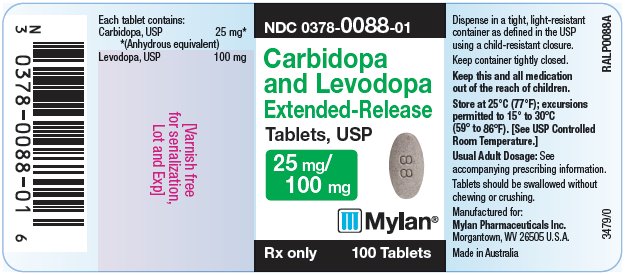
    Carbidopa and levodopa extended-release tablets contain carbidopa and levodopa in a 1:4 ratio as either the 50 mg/200 mg tablet or the 25 mg/100 mg tablet. The daily dosage of carbidopa and levodopa extended-release tablets must be determined by careful titration. Patients should be monitored closely during the dose adjustment period, particularly with regard to appearance or worsening of involuntary movements, dyskinesias or nausea. Carbidopa and levodopa extended-release tablets should not be chewed or crushed.

    Standard drugs for Parkinson’s disease, other than levodopa without a decarboxylase inhibitor, may be used concomitantly while carbidopa and levodopa extended-release tablets are being administered, although their dosage may have to be adjusted.

    Since carbidopa prevents the reversal of levodopa effects caused by pyridoxine, carbidopa and levodopa extended-release tablets can be given to patients receiving supplemental pyridoxine (vitamin B6).

    Initial Dosage Patients Currently Treated with Conventional Carbidopa-Levodopa Preparations

    Studies show that peripheral dopa-decarboxylase is saturated by the bioavailable carbidopa at doses of 70 mg a day and greater. Because the bioavailabilities of carbidopa and levodopa in carbidopa and levodopa immediate-release tablets and carbidopa and levodopa extended-release tablets are different, appropriate adjustments should be made, as shown in Table 2.

    Table 2: Approximate Bioavailabilities at Steady-State* * This table is only a guide to bioavailabilities since other factors such as food, drugs, and inter-patient variabilities may affect the bioavailability of carbidopa and levodopa. † The extent of availability of levodopa from carbidopa and levodopa extended-release tablets was about 70% to 75% relative to intravenous levodopa or standard carbidopa and levodopa immediate-release tablets in the elderly. ‡ The extent of availability of levodopa from carbidopa and levodopa immediate-release tablets was 99% relative to intravenous levodopa in the healthy elderly.

    Tablet

    Amount of Levodopa
    (mg) in Each Tablet

    Approximate
    Bioavailability

    Approximate Amount
    of Bioavailable Levodopa
    (mg) in Each Tablet

    Carbidopa and Levodopa
    Extended-release Tablets
    50 mg/200 mg

    200

    0.70 to 0.75†

    140 to 150

    Carbidopa and Levodopa
    Immediate-release Tablets
    25 mg/100 mg

    100

    0.99‡

    99

    Dosage with carbidopa and levodopa extended-release tablets should be substituted at an amount that provides approximately 10% more levodopa per day, although this may need to be increased to a dosage that provides up to 30% more levodopa per day depending on clinical response (see DOSAGE AND ADMINISTRATION: Titration with Carbidopa and Levodopa Extended-release Tablets). The interval between doses of carbidopa and levodopa extended-release tablets should be 4 to 8 hours during the waking day (see CLINICAL PHARMACOLOGY: Pharmacodynamics).

    A guideline for initiation of carbidopa and levodopa extended-release tablets is shown in Table 3.

    Table 3: Guidelines for Initial Conversion from Carbidopa and Levodopa Immediate-release Tablets to Carbidopa and Levodopa Extended-release Tablets * For dosing ranges not shown in the table see DOSAGE AND ADMINISTRATION: Initial Dosage: Patients Currently Treated with Conventional Carbidopa and Levodopa Preparations.

    Carbidopa and Levodopa Immediate-release Tablets

    Carbidopa and Levodopa Extended-release Tablets

    Total Daily Dose* Levodopa (mg)

    Suggested Dosage Regimen

    300–400

    200 mg b.i.d.

    500–600

    300 mg b.i.d. or
    200 mg t.i.d.

    700–800

    A total of 800 mg in 3 or more divided doses (e.g., 300 mg a.m., 300 mg early p.m. and 200 mg later p.m.)

    900–1000

    A total of 1000 mg in 3 or more divided doses (e.g., 400 mg a.m., 400 mg early p.m., and 200 mg later p.m.)

    Patients Currently Treated with Levodopa Without a Decarboxylase Inhibitor

    Levodopa must be discontinued at least 12 hours before therapy with carbidopa and levodopa extended-release tablets is started. Carbidopa and levodopa extended-release tablets should be substituted at a dosage that will provide approximately 25% of the previous levodopa dosage. In patients with mild to moderate disease, the initial dose is usually one tablet of 50 mg/200 mg carbidopa and levodopa extended-release tablets b.i.d.

    Patients Not Receiving Levodopa

    In patients with mild to moderate disease, the initial recommended dose is one tablet of 50 mg/200 mg carbidopa and levodopa extended-release tablets b.i.d. Initial dosage should not be given at intervals of less than 6 hours.

    Titration with Carbidopa and Levodopa Extended-release Tablets

    Following initiation of therapy, doses and dosing intervals may be increased or decreased depending upon therapeutic response. Most patients have been adequately treated with doses of carbidopa and levodopa extended-release tablets that provide 400 mg to 1600 mg of levodopa per day, administered as divided doses at intervals ranging from 4 to 8 hours during the waking day. Higher doses of carbidopa and levodopa extended-release tablets (2400 mg or more of levodopa per day) and shorter intervals (less than 4 hours) have been used, but are not usually recommended.

    When doses of carbidopa and levodopa extended-release tablets are given at intervals of less than 4 hours, and/or if the divided doses are not equal, it is recommended that the smaller doses be given at the end of the day.

    An interval of at least 3 days between dosage adjustments is recommended.

    Maintenance

    Because Parkinson's disease is progressive, periodic clinical evaluations are recommended; adjustment of the dosage regimen of carbidopa and levodopa extended-release tablets may be required.

    Addition of Other Antiparkinson Medications

    Anticholinergic agents, dopamine agonists, and amantadine can be given with carbidopa and levodopa extended-release tablets. Dosage adjustment of carbidopa and levodopa extended-release tablets may be necessary when these agents are added.

    A dose of carbidopa and levodopa immediate-release tablets 25 mg/100 mg or 10 mg/100 mg (one half or a whole tablet) can be added to the dosage regimen of carbidopa and levodopa extended-release tablets in selected patients with advanced disease who need additional immediate-release levodopa for a brief time during daytime hours.

    Interruption of Therapy

    Sporadic cases of hyperpyrexia and confusion have been associated with dose reductions and withdrawal of carbidopa and levodopa immediate-release tablets or carbidopa and levodopa extended-release tablets.

    Patients should be observed carefully if abrupt reduction or discontinuation of carbidopa and levodopa extended-release tablets is required, especially if the patient is receiving neuroleptics (see WARNINGS).

    If general anesthesia is required, carbidopa and levodopa extended-release tablets may be continued as long as the patient is permitted to take oral medication. If therapy is interrupted temporarily, the patient should be observed for symptoms resembling NMS, and the usual dosage should be administered as soon as the patient is able to take oral medication.

  • Heel Inc.
    Traumeel | Heel Inc.
    No Recall

    Traumeel | Heel Inc.

    Traumeel | Heel Inc.

    Standard Dosage:

    Adults and children 12 years and older: 3 tablets per day, taking 1 tablet every 4 to 6 hours.

    Children 4 to 11 years: 2 tablets per day, taking 1 tablet every 6 to 8 hours.

    Children under 4 years, consult your healthcare provider.

    Initial Dosage:

    Adults and children 12 years and older: 1 tablet every 1/2 to 1 hour, until symptoms lessen, then continue with standard dosage. Do not exceeed 12 tablets in 24 hours.

    Children 4 to 11 years: 1 tablet every 1/2 to 1 hour, until symptoms lessen, then continue with standard dosage. Do not exceed 8 tablets in 24 hours.

    Children under 4 years, consult your healthcare provider.

    Allow tablets to dissolve completely in the mouth, do not swallow.