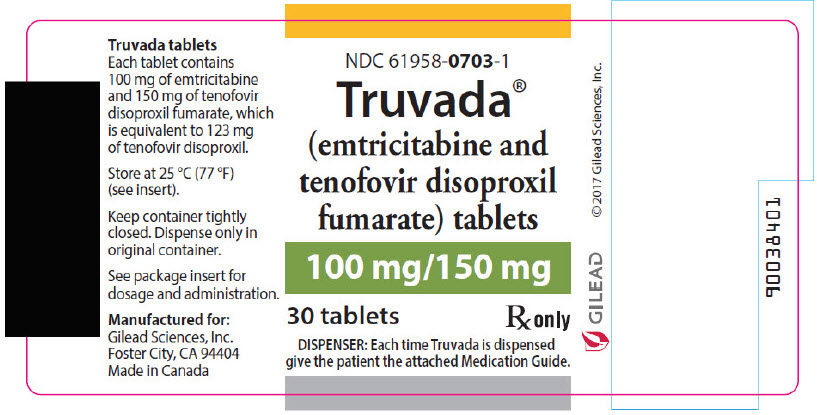
Truvada label

Truvada

Truvada Recall

Get an alert when a recall is issued.

Side Effects & Adverse Reactions

There is currently no warning information available for this product. We apologize for any inconvenience.

FDA Safety Alerts

There are currently no FDA safety alerts available for this drug.

Manufacturer Warnings

There is currently no manufacturer warning information available for this drug.

FDA Labeling Changes

There are currently no FDA labeling changes available for this drug.

Uses

TRUVADA®, a combination of EMTRIVA® and VIREAD®, is indicated in combination with other antiretroviral agents (such as non-nucleoside reverse transcriptase inhibitors or protease inhibitors) for the treatment of HIV-1 infection in adults.

The following points should be considered when initiating therapy with TRUVADA for the treatment of HIV-1 infection:

  • It is not recommended that TRUVADA be used as a component of a triple nucleoside regimen.
  • TRUVADA should not be coadministered with ATRIPLA®, EMTRIVA, VIREAD or lamivudine-containing products [See Warnings and Precautions (5.4)].
  • In treatment experienced patients, the use of TRUVADA should be guided by laboratory testing and treatment history [See Clinical Pharmacology (12.4)].

History

There is currently no drug history available for this drug.

Other Information

TRUVADA tablets are fixed dose combination tablets containing emtricitabine and tenofovir disoproxil fumarate. EMTRIVA is the brand name for emtricitabine, a synthetic nucleoside analog of cytidine. Tenofovir disoproxil fumarate (tenofovir DF) is converted in vivo to tenofovir, an acyclic nucleoside phosphonate (nucleotide) analog of adenosine 5′-monophosphate. Both emtricitabine and tenofovir exhibit inhibitory activity against HIV-1 reverse transcriptase.

Emtricitabine: The chemical name of emtricitabine is 5-fluoro-1-(2R,5S)-[2-(hydroxymethyl)-1,3-oxathiolan-5-yl]cytosine. Emtricitabine is the (-) enantiomer of a thio analog of cytidine, which differs from other cytidine analogs in that it has a fluorine in the 5-position.

It has a molecular formula of C8H10FN3O3S and a molecular weight of 247.24. It has the following structural formula:

Chemical Structure

Emtricitabine is a white to off-white crystalline powder with a solubility of approximately 112 mg/mL in water at 25 °C. The partition coefficient (log p) for emtricitabine is -0.43 and the pKa is 2.65.

Tenofovir Disoproxil Fumarate: Tenofovir disoproxil fumarate is a fumaric acid salt of the bis-isopropoxycarbonyloxymethyl ester derivative of tenofovir. The chemical name of tenofovir disoproxil fumarate is 9-[(R)-2 [[bis[[(isopropoxycarbonyl)oxy]- methoxy]phosphinyl]methoxy]propyl]adenine fumarate (1:1). It has a molecular formula of C19H30N5O10P • C4H4O4 and a molecular weight of 635.52. It has the following structural formula:

Chemical Structure

Tenofovir disoproxil fumarate is a white to off-white crystalline powder with a solubility of 13.4 mg/mL in water at 25 °C. The partition coefficient (log p) for tenofovir disoproxil is 1.25 and the pKa is 3.75. All dosages are expressed in terms of tenofovir disoproxil fumarate except where otherwise noted.

TRUVADA tablets are for oral administration. Each film-coated tablet contains 200 mg of emtricitabine and 300 mg of tenofovir disoproxil fumarate, (which is equivalent to 245 mg of tenofovir disoproxil), as active ingredients. The tablets also include the following inactive ingredients: croscarmellose sodium, lactose monohydrate, magnesium stearate, microcrystalline cellulose, and pregelatinized starch (gluten free). The tablets are coated with Opadry II Blue Y-30-10701, which contains FD&C Blue #2 aluminum lake, hydroxypropyl methylcellulose 2910, lactose monohydrate, titanium dioxide, and triacetin.

Truvada Manufacturers

  • State Of Florida Doh Central Pharmacy
    Truvada | State Of Florida Doh Central Pharmacy
    No Recall

    Truvada | State Of Florida Doh Central Pharmacy

    Truvada | State Of Florida Doh Central Pharmacy
    2.1 Recommended Dose

    The dose of TRUVADA is one tablet (containing 200 mg of emtricitabine and 300 mg of tenofovir disoproxil fumarate) once daily taken orally with or without food.

    2.2 Dose Adjustment for Renal Impairment

    Significantly increased drug exposures occurred when EMTRIVA or VIREAD were administered to subjects with moderate to severe renal impairment [see EMTRIVA or VIREAD Package Insert]. Therefore, the dosing interval of TRUVADA should be adjusted in patients with baseline creatinine clearance 30–49 mL/min using the recommendations in Table 1. These dosing interval recommendations are based on modeling of single-dose pharmacokinetic data in non-HIV infected subjects. The safety and effectiveness of these dosing interval adjustment recommendations have not been clinically evaluated in patients with moderate renal impairment, therefore clinical response to treatment and renal function should be closely monitored in these patients [See Warnings and Precautions (5.3)].

    No dose adjustment is necessary for patients with mild renal impairment (creatinine clearance 50–80 mL/min). Routine monitoring of calculated creatinine clearance and serum phosphorus should be performed in patients with mild renal impairment [See Warnings and Precautions (5.3)].

    Table 1 Dosage Adjustment for Patients with Altered Creatinine Clearance Creatinine Clearance (mL/min)* ≥50 30–49 <30
    (Including Patients Requiring Hemodialysis) * Calculated using ideal (lean) body weight Recommended Dosing Interval Every 24 hours Every 48 hours TRUVADA should not be administered.
  • Truvada | H.j. Harkins Company, Inc.
    No Recall

    Truvada | H.j. Harkins Company, Inc.

    Truvada | H.j. Harkins Company, Inc.
    2.1 Recommended Dose

    The dose of TRUVADA for adults and pediatric patients 12 years of age and older with body weight greater than or equal to 35 kg (greater than or equal to 77 lb) is one tablet (containing 200 mg of emtricitabine and 300 mg of tenofovir disoproxil fumarate) once daily taken orally with or without food.

    2.2 Dose Adjustment for Renal Impairment

    Significantly increased drug exposures occurred when EMTRIVA or VIREAD were administered to subjects with moderate to severe renal impairment [see EMTRIVA or VIREAD Package Insert]. Therefore, the dosing interval of TRUVADA should be adjusted in patients with baseline creatinine clearance 30–49 mL/min using the recommendations in Table 1. These dosing interval recommendations are based on modeling of single-dose pharmacokinetic data in non-HIV infected subjects. The safety and effectiveness of these dosing interval adjustment recommendations have not been clinically evaluated in patients with moderate renal impairment, therefore clinical response to treatment and renal function should be closely monitored in these patients [See Warnings and Precautions (5.3)].

    No dose adjustment is necessary for patients with mild renal impairment (creatinine clearance 50–80 mL/min). Routine monitoring of calculated creatinine clearance and serum phosphorus should be performed in patients with mild renal impairment [See Warnings and Precautions (5.3)].

    Table 1 Dosage Adjustment for Patients with Altered Creatinine Clearance Creatinine Clearance (mL/min)* ≥50 30–49 <30
    (Including Patients Requiring Hemodialysis) * Calculated using ideal (lean) body weight Recommended Dosing Interval Every 24 hours Every 48 hours TRUVADA should not be administered.

    No data are available to make dose recommendations in pediatric patients 12 years of age and older with renal impairment.

  • Physicians Total Care, Inc.
    Truvada | Physicians Total Care, Inc.
    No Recall

    Truvada | Physicians Total Care, Inc.

    Truvada | Physicians Total Care, Inc.
    2.1 Recommended Dose for Treatment of HIV-1 Infection

    The recommended dose of TRUVADA in adults and in pediatric patients 12 years of age and older with body weight greater than or equal to 35 kg (greater than or equal to 77 lb) is one tablet (containing 200 mg of emtricitabine and 300 mg of tenofovir disoproxil fumarate) once daily taken orally with or without food.

    2.2 Recommended Dose for Pre-exposure Prophylaxis

    The dose of TRUVADA in HIV-1 uninfected adults is one tablet (containing 200 mg of emtricitabine and 300 mg of tenofovir disoproxil fumarate) once daily taken orally with or without food.

    2.3 Dose Adjustment for Renal Impairment

    Treatment of HIV-1 infection

    Significantly increased drug exposures occurred when EMTRIVA or VIREAD were administered to subjects with moderate to severe renal impairment [see EMTRIVA or VIREAD Package Insert]. Therefore, adjust the dosing interval of TRUVADA in HIV-1 infected adult patients with baseline creatinine clearance 30–49 mL/min using the recommendations in Table 1. These dosing interval recommendations are based on modeling of single-dose pharmacokinetic data in non-HIV infected subjects. The safety and effectiveness of these dosing interval adjustment recommendations have not been clinically evaluated in patients with moderate renal impairment, therefore clinical response to treatment and renal function should be closely monitored in these patients [See Warnings and Precautions (5.3)].

    No dose adjustment is necessary for HIV-1 infected patients with mild renal impairment (creatinine clearance 50–80 mL/min). No data are available to make dose recommendations in pediatric patients with renal impairment.

    Table 1 Dosage Adjustment for HIV-1 Infected Adult Patients with Altered Creatinine Clearance Creatinine Clearance (mL/min)* ≥50 30–49 <30
    (Including Patients Requiring Hemodialysis) * Calculated using ideal (lean) body weight Recommended Dosing Interval Every 24 hours Every 48 hours TRUVADA should not be administered.

    Routine monitoring of calculated creatinine clearance and serum phosphorus should be performed in all individuals with mild renal impairment [See Warnings and Precautions (5.3)].

    Pre-exposure Prophylaxis

    Do not use TRUVADA for a PrEP indication in HIV-1 uninfected individuals with creatinine clearance below 60 mL/min [See Warnings and Precautions (5.3)].

    Routine monitoring of calculated creatinine clearance and serum phosphorus should be performed in all individuals with mild renal impairment. If a decrease in creatinine clearance is observed in uninfected individuals while using TRUVADA for PrEP, evaluate potential causes and re-assess potential risks and benefits of continued use [See Warnings and Precautions (5.3)].

  • Remedyrepack Inc.
    Truvada | Remedyrepack Inc.
    No Recall

    Truvada | Remedyrepack Inc.

    Truvada | Remedyrepack Inc.

    Treatment of HIV-1 Infection (2.1)

    Recommended dose in adults and pediatric patients (12 years of age and older and weighing greater than or equal to 35 kg): One tablet once daily taken orally with or without food. (2.1) Recommended dose in renally impaired HIV-1 infected adult patients: Creatinine clearance 30–49 mL/min: 1 tablet every 48 hours. (2.3) CrCl below 30 mL/min or hemodialysis: Do not use TRUVADA. (2.3)

    Pre-exposure Prophylaxis (2.2)

    Recommended dose in HIV-1 uninfected adults: One tablet once daily taken orally with or without food. (2.2) Recommended dose in renally impaired HIV-uninfected individuals: Do not use TRUVADA in HIV-uninfected individuals if CrCl is below 60 mL/min. If a decrease in CrCl is observed in uninfected individuals while using TRUVADA for PrEP, evaluate potential causes and re-assess potential risks and benefits of continued use. (2.3)


    The recommended dose of TRUVADA in adults and in pediatric patients 12 years of age and older with body weight greater than or equal to 35 kg (greater than or equal to 77 lb) is one tablet (containing 200 mg of emtricitabine and 300 mg of tenofovir disoproxil fumarate) once daily taken orally with or without food.


    The dose of TRUVADA in HIV-1 uninfected adults is one tablet (containing 200 mg of emtricitabine and 300 mg of tenofovir disoproxil fumarate) once daily taken orally with or without food.


    Treatment of HIV-1 infection

    Significantly increased drug exposures occurred when EMTRIVA or VIREAD were administered to subjects with moderate to severe renal impairment [see EMTRIVA or VIREAD Package Insert]. Therefore, adjust the dosing interval of TRUVADA in HIV-1 infected adult patients with baseline creatinine clearance 30–49 mL/min using the recommendations in Table 1. These dosing interval recommendations are based on modeling of single-dose pharmacokinetic data in non-HIV infected subjects. The safety and effectiveness of these dosing interval adjustment recommendations have not been clinically evaluated in patients with moderate renal impairment, therefore clinical response to treatment and renal function should be closely monitored in these patients [See Warnings and Precautions (5.3)].

    No dose adjustment is necessary for HIV-1 infected patients with mild renal impairment (creatinine clearance 50–80 mL/min). No data are available to make dose recommendations in pediatric patients with renal impairment.

    Table 1 Dosage Adjustment for HIV-1 Infected Adult Patients with Altered Creatinine Clearance Creatinine Clearance (mL/min)* ≥50 30–49 <30
    (Including Patients Requiring Hemodialysis) Recommended Dosing Interval Every 24 hours Every 48 hours TRUVADA should not be administered.

    1

    Routine monitoring of calculated creatinine clearance and serum phosphorus should be performed in all individuals with mild renal impairment [See Warnings and Precautions (5.3)].


    Pre-exposure Prophylaxis

    Do not use TRUVADA for a PrEP indication in HIV-1 uninfected individuals with creatinine clearance below 60 mL/min [See Warnings and Precautions (5.3)].

    Routine monitoring of calculated creatinine clearance and serum phosphorus should be performed in all individuals with mild renal impairment. If a decrease in creatinine clearance is observed in uninfected individuals while using TRUVADA for PrEP, evaluate potential causes and re-assess potential risks and benefits of continued use [See Warnings and Precautions (5.3)].


    1


    1


    1 Calculated using ideal (lean) body weight
  • Truvada | Cardinal Health
    No Recall

    Truvada | Cardinal Health

    Truvada | Cardinal Health
    2.1 Recommended Dose for Treatment of HIV-1 Infection

    The recommended dose of TRUVADA in adults and in pediatric patients 12 years of age and older with body weight greater than or equal to 35 kg (greater than or equal to 77 lb) is one tablet (containing 200 mg of emtricitabine and 300 mg of tenofovir disoproxil fumarate) once daily taken orally with or without food.

    2.2 Recommended Dose for Pre-exposure Prophylaxis

    The dose of TRUVADA in HIV-1 uninfected adults is one tablet (containing 200 mg of emtricitabine and 300 mg of tenofovir disoproxil fumarate) once daily taken orally with or without food.

    2.3 Dose Adjustment for Renal Impairment

    Treatment of HIV-1 infection

    Significantly increased drug exposures occurred when EMTRIVA or VIREAD were administered to subjects with moderate to severe renal impairment [see EMTRIVA or VIREAD Package Insert]. Therefore, adjust the dosing interval of TRUVADA in HIV-1 infected adult patients with baseline creatinine clearance 30–49 mL/min using the recommendations in Table 1. These dosing interval recommendations are based on modeling of single-dose pharmacokinetic data in non-HIV infected subjects. The safety and effectiveness of these dosing interval adjustment recommendations have not been clinically evaluated in patients with moderate renal impairment, therefore clinical response to treatment and renal function should be closely monitored in these patients [See Warnings and Precautions (5.3)].

    No dose adjustment is necessary for HIV-1 infected patients with mild renal impairment (creatinine clearance 50–80 mL/min). No data are available to make dose recommendations in pediatric patients with renal impairment.

    Table 1 Dosage Adjustment for HIV-1 Infected Adult Patients with Altered Creatinine Clearance Creatinine Clearance (mL/min)* ≥50 30–49 <30
    (Including Patients Requiring Hemodialysis) * Calculated using ideal (lean) body weight Recommended Dosing Interval Every 24 hours Every 48 hours TRUVADA should not be administered.

    Routine monitoring of calculated creatinine clearance and serum phosphorus should be performed in all individuals with mild renal impairment [See Warnings and Precautions (5.3)].

    Pre-exposure Prophylaxis

    Do not use TRUVADA for a PrEP indication in HIV-1 uninfected individuals with creatinine clearance below 60 mL/min [See Warnings and Precautions (5.3)].

    Routine monitoring of calculated creatinine clearance and serum phosphorus should be performed in all individuals with mild renal impairment. If a decrease in creatinine clearance is observed in uninfected individuals while using TRUVADA for PrEP, evaluate potential causes and re-assess potential risks and benefits of continued use [See Warnings and Precautions (5.3)].

  • Truvada | Cardinal Health
    No Recall

    Truvada | Cardinal Health

    Truvada | Cardinal Health

    TOPROL-XL is an extended-release tablet intended for once daily administration. For treatment of hypertension and angina, when switching from immediate-release metoprolol to TOPROL-XL, use the same total daily dose of TOPROL-XL. Individualize the dosage of TOPROL-XL. Titration may be needed in some patients.

    TOPROL-XL tablets are scored and can be divided; however, do not crush or chew the whole or half tablet.

    2.1 Hypertension

    Adults: The usual initial dosage is 25 to 100 mg daily in a single dose. The dosage may be increased at weekly (or longer) intervals until optimum blood pressure reduction is achieved. In general, the maximum effect of any given dosage level will be apparent after 1 week of therapy. Dosages above 400 mg per day have not been studied.

    Pediatric Hypertensive Patients ≥ 6 Years of age: A pediatric clinical hypertension study in patients 6 to 16 years of age did not meet its primary endpoint (dose response for reduction in SBP); however some other endpoints demonstrated effectiveness [see Use in Specific Populations (8.4)]. If selected for treatment, the recommended starting dose of TOPROL-XL is 1 mg/kg once daily, but the maximum initial dose should not exceed 50 mg once daily. Dosage should be adjusted according to blood pressure response. Doses above 2 mg/kg (or in excess of 200 mg) once daily have not been studied in pediatric patients [see Clinical Pharmacology (12.3)].

    TOPROL-XL is not recommended in pediatric patients < 6 years of age [see Use in Specific Populations (8.4)].

    2.2 Angina Pectoris

    Individualize the dosage of TOPROL-XL. The usual initial dosage is 100 mg daily, given in a single dose. Gradually increase the dosage at weekly intervals until optimum clinical response has been obtained or there is a pronounced slowing of the heart rate. Dosages above 400 mg per day have not been studied. If treatment is to be discontinued, reduce the dosage gradually over a period of 1 - 2 weeks [see Warnings and Precautions (5)].

    2.3 Heart Failure

    Dosage must be individualized and closely monitored during up-titration. Prior to initiation of TOPROL-XL, stabilize the dose of other heart failure drug therapy. The recommended starting dose of TOPROL-XL is 25 mg once daily for two weeks in patients with NYHA Class II heart failure and 12.5 mg once daily in patients with more severe heart failure. Double the dose every two weeks to the highest dosage level tolerated by the patient or up to 200 mg of TOPROL-XL. Initial difficulty with titration should not preclude later attempts to introduce TOPROL-XL. If patients experience symptomatic bradycardia, reduce the dose of TOPROL-XL. If transient worsening of heart failure occurs, consider treating with increased doses of diuretics, lowering the dose of TOPROL-XL or temporarily discontinuing it. The dose of TOPROL-XL should not be increased until symptoms of worsening heart failure have been stabilized.

  • Gilead Sciences, Inc
    Truvada | Gilead Sciences, Inc
    No Recall

    Truvada | Gilead Sciences, Inc

    Truvada | Gilead Sciences, Inc
    2.1 Recommended Dose for Treatment of HIV-1 Infection

    The recommended dose of TRUVADA in adults and in pediatric patients 12 years of age and older with body weight greater than or equal to 35 kg (greater than or equal to 77 lb) is one tablet (containing 200 mg of emtricitabine and 300 mg of tenofovir disoproxil fumarate) once daily taken orally with or without food.

    2.2 Recommended Dose for Pre-exposure Prophylaxis

    The dose of TRUVADA in HIV-1 uninfected adults is one tablet (containing 200 mg of emtricitabine and 300 mg of tenofovir disoproxil fumarate) once daily taken orally with or without food.

    2.3 Dose Adjustment for Renal Impairment

    Treatment of HIV-1 Infection

    Significantly increased drug exposures occurred when EMTRIVA or VIREAD were administered to subjects with moderate to severe renal impairment [See EMTRIVA or VIREAD Package Insert]. Therefore, adjust the dosing interval of TRUVADA in HIV-1 infected adult patients with baseline creatinine clearance 30–49 mL/min using the recommendations in Table 1. These dosing interval recommendations are based on modeling of single-dose pharmacokinetic data in non-HIV infected subjects. The safety and effectiveness of these dosing interval adjustment recommendations have not been clinically evaluated in patients with moderate renal impairment, therefore clinical response to treatment and renal function should be closely monitored in these patients [See Warnings and Precautions (5.3)].

    No dose adjustment is necessary for HIV-1 infected patients with mild renal impairment (creatinine clearance 50–80 mL/min). No data are available to make dose recommendations in pediatric patients with renal impairment.

    Table 1 Dosage Adjustment for HIV-1 Infected Adult Patients with Altered Creatinine Clearance Creatinine Clearance (mL/min)* ≥50 30–49 <30
    (Including Patients Requiring Hemodialysis) * Calculated using ideal (lean) body weight Recommended Dosing Interval Every 24 hours Every 48 hours TRUVADA should not be administered.

    Routine monitoring of estimated creatinine clearance, serum phosphorus, urine glucose, and urine protein should be performed in all individuals with mild renal impairment [See Warnings and Precautions (5.3)].

    Pre-exposure Prophylaxis

    Do not use TRUVADA for a PrEP indication in HIV-1 uninfected individuals with estimated creatinine clearance below 60 mL/min [See Warnings and Precautions (5.3)].

    Routine monitoring of estimated creatinine clearance, serum phosphorus, urine glucose, and urine protein should be performed in all individuals with mild renal impairment. If a decrease in estimated creatinine clearance is observed in uninfected individuals while using TRUVADA for PrEP, evaluate potential causes and re-assess potential risks and benefits of continued use [See Warnings and Precautions (5.3)].