WARNINGS
Cardiovascular Effects
Cardiovascular Thrombotic Events
Clinical trials of several COX – 2 selective and nonselective NSAIDs of up to three years duration have
shown an increased risk of serious cardiovascular (CV) thrombotic events, myocardial infarction, and stroke,
which can be fatal. All NSAIDs, both COX – 2 selective and nonselective, may have a similar risk.
Patients with a known CV disease or risk factors for CV disease may be at greater risk. To minimize the
potential risk for an adverse CV event in patients treated with an NSAID, the lowest effective dose should be used for the shortest
duration possible. Physicians and patients should remain alert for the
development of such events, even in the absence of previous CV symptoms. Patients should be
informed about the signs and/or symptoms of serious CV events and the steps to take if they occur.
There is not consistent evidence that concurrent use of aspirin mitigates the increased risk of serious
CV thrombotic events associated with NSAID use. The concurrent use of aspirin and an NSAID does
increase the risk of serious GI events (see WARNINGS, GASTROINTESTINAL EFFECTS -RISK OF
ULCERATION, BLEEDING AND PERFORATION).
Two large, controlled clinical trials of a COX-2 selective NSAID for the treatment of pain in the first
10 – 14 days following CABG surgery found an increased incidence of myocardial infarction and stroke (see
CONTRAINDICATIONS).
Hypertension
NSAIDs including ibuprofen tablets, can lead to onset of new hypertension or worsening of
pre-existing hypertension, either of which may contribute to the increased incidence of CV events. Patients
taking thiazides or loop diuretics may have impaired response to these therapies when taking NSAIDs.
NSAIDs, including ibuprofen tablets, should be used with caution in patients with hypertension. Blood
pressure (BP) should be monitored closely during the initiation of NSAID treatment and throughout the course
of therapy.
Congestive Heart Failure and Edema.
Fluid retention and edema have been observed in some patients taking NSAIDs. Ibuprofen tablets
should be used with caution in patients with fluid rentention or heart failure.
Gastrointestinal Effects – Risk of Ulceration, Bleeding and Perforation
NSAIDs, including ibuprofen tablets, can cause serious gastrointestinal (GI) adverse events including inflammation, bleeding, ulceration, and perforation of
the stomach, small intestine, or large intestine, which can be fatal. These serious adverse events can occur at any time, with or without warning symptoms, in
patients treated with NSAIDs. Only one in five patients, who develop a serious upper GI adverse event on NSAID therapy, is symptomatic. Upper GI ulcers,
gross bleeding, or perforation caused by NSAIDs occur in approximately 1 % of patients treated for 3 – 6 months, and in about 2 – 4 % of patients treated for one
year. These trends continue with longer duration of use, increasing the likelihood of developing a serious GI event at some time during the course of
therapy. However, even short – term therapy is not without risk. NSAIDs should be prescribed with extreme caution in those with a prior history of ulcer
disease or gastrointestinal bleeding. Patients with a prior history of peptic ulcer disease and / or gastrointestinal bleeding who use NSAIDs have a greater
than 10 – fold increased risk for developing a GI bleed compared to patients treated with neither of these risk factors. Other factors that increase the risk of
GI bleeding in patients treated with NSAIDs include concomitant use of oral corticosteroids or anticoagulants, longer duration of NSAID therapy,
smoking, use of alcohol, older age, and poor general health status. Most spontaneous reports of fatal GI events are in elderly or debilitated
patients and therefore, special care should be taken in treating this population.
To minimize the potential risk for an adverse GI event in patients treated with an NSAID, the lowest effective dose should be used for the shortest
possible duration. Patients and physicians should remain alert for signs and symptoms of GI ulcerations and bleeding during NSAID therapy and
promptly initiate additional evaluation and treatment is a serious GI event is suspected. This should include discontinuation of the NSAID until a
serious GI adverse event is ruled out. For high – risk patients, alternate therapies that do not involve NSAIDs should be considered.
Renal Effects
Long – term administration of NSAIDs has resulted in renal papillary necrosis and other renal injury. Renal toxicity has also been seen in patients
in whom renal prostaglandins have a compensatory role in the maintenance of renal perfusion. In these patients, administration of a NSAID
may cause a dose – dependent reduction in prostaglandin formation and, secondarily, in renal blood flow, which may precipitate overt renal decomposition.
Patients at greatest risk of this reaction are those with impaired renal function, heart failure, liver dysfunction, those taking diuretics and ACE inhibitors,
and the elderly. Discontinuation of NSAID therapy is usually followed by recovery to the pretreatment state.
Advanced Renal Disease
No information is available from controlled clinical studies regarding the use of ibuprofen tablets in patients with advanced renal disease. Therefore,
treatment with ibuprofen tablets is not recommended in those patients with advanced renal disease. If ibuprofen tablet therapy must be initiated,
close monitoring of the patients renal function is advisable.
Anaphylactoid Reactions
As with other NSAIDs, anaphylactoid reactions may occur in patients without known prior exposure to ibuprofen tablets. Ibuprofen tablets should not
be given to patients with the aspirin triad. This symptom complex typically occurs in asthmatic patients who experience rhinitis with or without nasal
polyps, or who exhibit severe, potentially fatal bronchospasm after taking aspirin or other NSAIDs (see CONTRAINDICATIONS and PRECAUTIONS,
Preexisting Asthma). Emergency help should be sought in cases where an anaphylactoid reaction occurs.
Skin Reactions
NSAIDs, including ibuprofen tablets, can cause serious skin adverse events such as exfoliative dermatitis. Stevens – Johnson Syndrome (SJS), and
toxic epidermal necrolysis (TEN), which can be fatal. These serious events may occur without warning. Patients should be informed about the signs
and symptoms of serious skin manifestations and use of the drug should be discontinued at the first appearance of skin rash or any other
sign of hypersensitivity.
Pregnancy
In late pregnancy, as with other NSAIDs, ibuprofen tablets should be avoided because it may cause premature closure of the ductus arteriosus.
There is currently no manufacturer warning information available for this drug.
INDICATIONS AND USAGE
Carefully consider the potential benefits and risks of ibuprofen tablets and other treatment options
before deciding to use ibuprofen tablets. Use the lowest effective dose for the shortest duration
consistent with individual patient treatment goals (see WARNINGS).
Ibuprofen tablets are indicated for relief of the signs and symptoms of rheumatoid arthritis and
osteoarthritis.
Ibuprofen tablets are indicated for the relief of mild to moderate pain.
Ibuprofen tablets are also indicated for the treatment of primary dysmenorrhea.
Controlled clinical trials to establish the safety and effectiveness of ibuprofen tablets in children have
not been conducted.
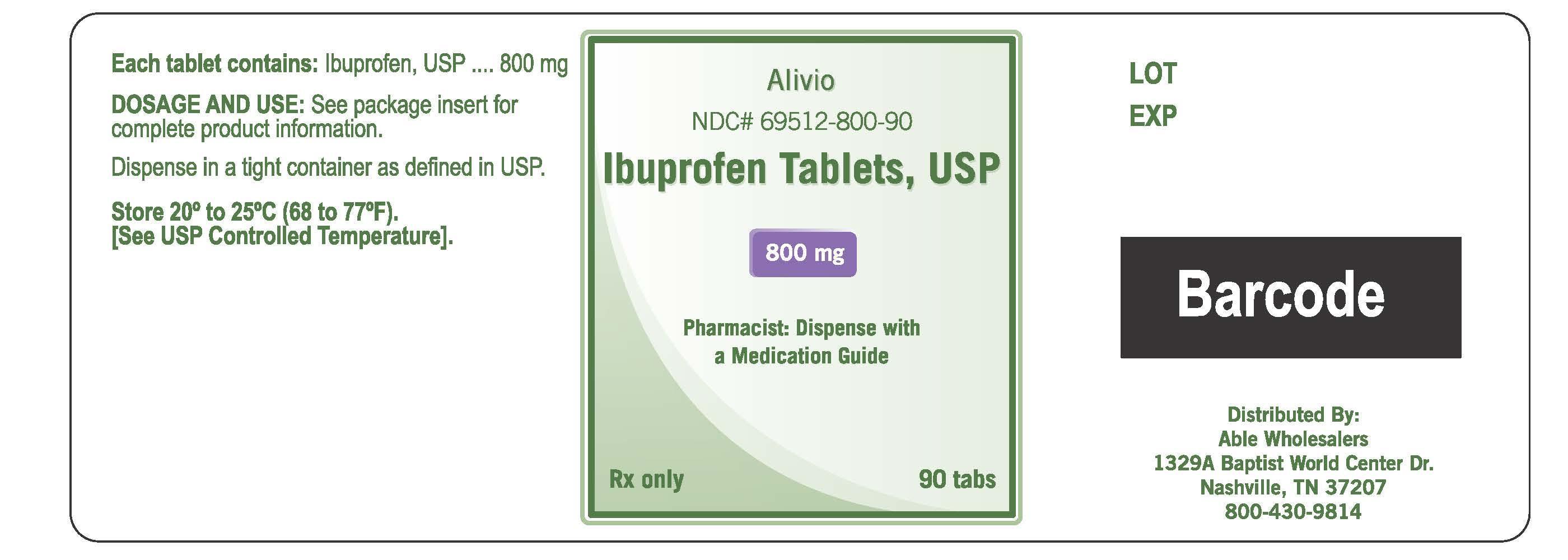
Each tablet contains: Ibuprofen, USP ……800 mg
Ibuprofen tablets contain the active ingredient ibuprofen, which is (+/-) – 2 – (p – isobutylphenyl)
propionic acid. Ibuprofen is a white powder with a melting point of 74 – 77 C and is very slightly soluble
in water (less than 1 mg / mL) and readily soluble in organic solvents such as ethanol and acetone.
Ibuprofen tablets, a nonsteroidal anti – inflammatory drug (NSAID), are available in 400 mg, 600 mg and
800 mg tablets for oral administration. Inactive ingredients: colloidal silicon dioxide, croscarmellose
sodium, magnesium stearate, microcrystalline cellulose, polyethylene glycol, polyvinyl alcohol,
pregelatinized starch, talc and titanium dioxide.