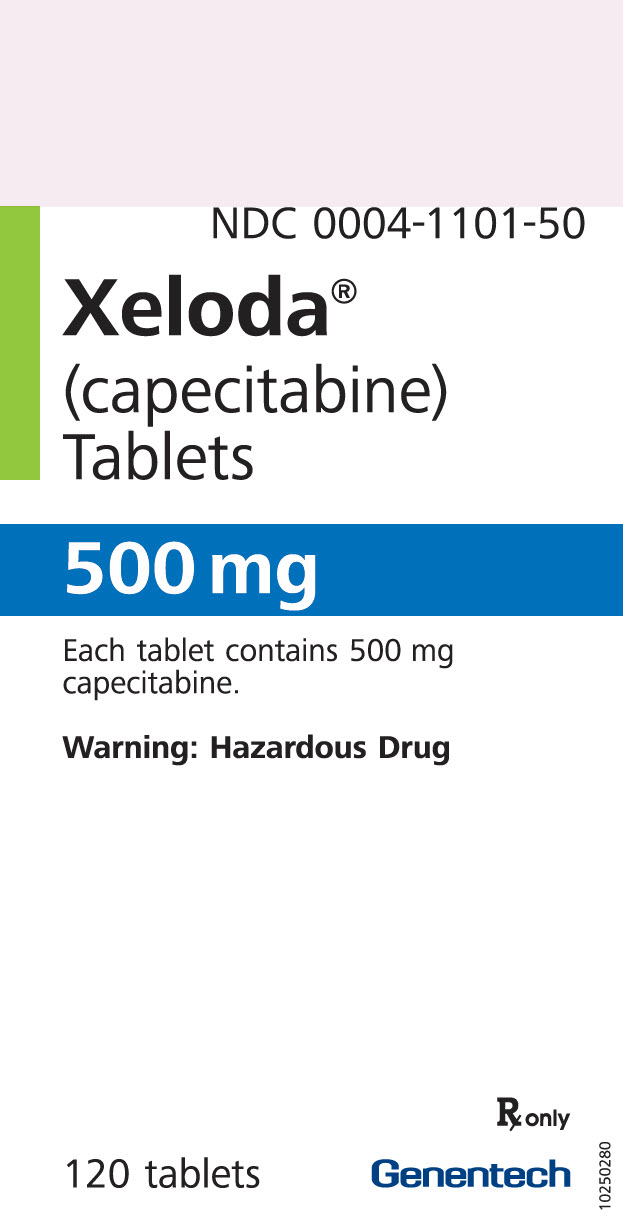
The recommended dose of XELODA is 1250 mg/m2 administered orally twice daily (morning and evening; equivalent to 2500 mg/m2 total daily dose) for 2 weeks followed by a 1-week rest period given as 3-week cycles. XELODA tablets should be swallowed with water within 30 minutes after a meal. In combination with docetaxel, the recommended dose of XELODA is 1250 mg/m2 twice daily for 2 weeks followed by a 1-week rest period, combined with docetaxel at 75 mg/m2 as a 1-hour intravenous infusion every 3 weeks. Pre-medication, according to the docetaxel labeling, should be started prior to docetaxel administration for patients receiving the XELODA plus docetaxel combination. Table 17 displays the total daily dose by body surface area and the number of tablets to be taken at each dose.
Adjuvant treatment in patients with Dukes' C colon cancer is recommended for a total of 6 months, ie, XELODA 1250 mg/m2 orally twice daily for 2 weeks followed by a 1-week rest period, given as 3-week cycles for a total of 8 cycles (24 weeks).
Table 17 XELODA Dose Calculation According to Body Surface Area
Dose Level 1250 mg/m2
Twice a Day
Number of Tablets to be Taken at
Each Dose (Morning and Evening)
Surface Area
(m2)
Total Daily
Dose* (mg)
150 mg
500 mg
*
Total Daily Dose divided by 2 to allow equal morning and evening doses
≤ 1.25
3000
0
3
1.26-1.37
3300
1
3
1.38-1.51
3600
2
3
1.52-1.65
4000
0
4
1.66-1.77
4300
1
4
1.78-1.91
4600
2
4
1.92-2.05
5000
0
5
2.06-2.17
5300
1
5
≥ 2.18
5600
2
5
Dose Management Guidelines
XELODA dosage may need to be individualized to optimize patient management. Patients should be carefully monitored for toxicity and doses of XELODA should be modified as necessary to accommodate individual patient tolerance to treatment (see CLINICAL STUDIES). Toxicity due to XELODA administration may be managed by symptomatic treatment, dose interruptions and adjustment of XELODA dose. Once the dose has been reduced it should not be increased at a later time.
The dose of phenytoin and the dose of coumarin-derivative anticoagulants may need to be reduced when either drug is administered concomitantly with XELODA (see PRECAUTIONS: Drug-Drug Interactions).
XELODA dose modification scheme as described below (see Table 18 and Table 19) is recommended for the management of adverse events.
Table 18 XELODA in Combination With Docetaxel Dose Reduction Schedule
Toxicity
NCIC Grades*
Grade 2
Grade 3
Grade 4
*
National Cancer Institute of Canada Common Toxicity Criteria were used except for hand-and-foot syndrome (see
PRECAUTIONS).
1st appearance
Grade 2 occurring during the 14 days of XELODA treatment: interrupt XELODA treatment until resolved to grade 0-1. Treatment may be resumed during the cycle at the same dose of XELODA. Doses of XELODA missed during a treatment cycle are not to be replaced. Prophylaxis for toxicities should be implemented where possible.
Grade 2 persisting at the time the next XELODA/docetaxel treatment is due: delay treatment until resolved to grade 0-1, then continue at 100% of the original XELODA and docetaxel dose. Prophylaxis for toxicities should be implemented where possible.
Grade 3 occurring during the 14 days of XELODA treatment: interrupt the XELODA treatment until resolved to grade 0-1. Treatment may be resumed during the cycle at 75% of the XELODA dose. Doses of XELODA missed during a treatment cycle are not to be replaced. Prophylaxis for toxicities should be implemented where possible.
Grade 3 persisting at the time the next XELODA/docetaxel treatment is due: delay treatment until resolved to grade 0-1.
For patients developing grade 3 toxicity at any time during the treatment cycle, upon resolution to grade 0-1, subsequent treatment cycles should be continued at 75% of the original XELODA dose and at 55 mg/m2 of docetaxel. Prophylaxis for toxicities should be implemented where possible.
Discontinue treatment unless treating physician considers it to be in the best interest of the patient to continue with XELODA at 50% of original dose.
2nd appearance of same toxicity
Grade 2 occurring during the 14 days of XELODA treatment: interrupt XELODA treatment until resolved to grade 0-1. Treatment may be resumed during the cycle at 75% of original XELODA dose. Doses of XELODA missed during a treatment cycle are not to be replaced. Prophylaxis for toxicities should be implemented where possible.
Grade 2 persisting at the time the next XELODA/docetaxel treatment is due: delay treatment until resolved to grade 0-1.
For patients developing 2nd occurrence of grade 2 toxicity at any time during the treatment cycle, upon resolution to grade 0-1, subsequent treatment cycles should be continued at 75% of the original XELODA dose and at 55 mg/m2 of docetaxel. Prophylaxis for toxicities should be implemented where possible.
Grade 3 occurring during the 14 days of XELODA treatment: interrupt the XELODA treatment until resolved to grade 0-1. Treatment may be resumed during the cycle at 50% of the XELODA dose. Doses of XELODA missed during a treatment cycle are not to be replaced. Prophylaxis for toxicities should be implemented where possible.
Grade 3 persisting at the time the next XELODA/docetaxel treatment is due: delay treatment until resolved to grade 0-1.
For patients developing grade 3 toxicity at any time during the treatment cycle, upon resolution to grade 0-1, subsequent treatment cycles should be continued at 50% of the original XELODA dose and the docetaxel discontinued. Prophylaxis for toxicities should be implemented where possible.
Discontinue treatment.
3rd appearance of same toxicity
Grade 2 occurring during the 14 days of XELODA treatment: interrupt XELODA treatment until resolved to grade 0-1. Treatment may be resumed during the cycle at 50% of the original XELODA dose. Doses of XELODA missed during a treatment cycle are not to be replaced. Prophylaxis for toxicities should be implemented where possible.
Grade 2 persisting at the time the next XELODA/docetaxel treatment is due: delay treatment until resolved to grade 0-1.
For patients developing 3rd occurrence of grade 2 toxicity at any time during the treatment cycle, upon resolution to grade 0-1, subsequent treatment cycles should be continued at 50% of the original XELODA dose and the docetaxel discontinued. Prophylaxis for toxicities should be implemented where possible.
Discontinue treatment.
4th appearance of same toxicity
Discontinue treatment.
Dose modification for the use of XELODA as monotherapy is shown in Table 19.
Table 19 Recommended Dose Modifications With XELODA Monotherapy
Toxicity
NCIC Grades*
During a Course of Therapy
Dose Adjustment for Next Treatment (% of starting dose)
*
National Cancer Institute of Canada Common Toxicity Criteria were used except for the hand-and-foot syndrome (see
PRECAUTIONS).
• Grade 1
Maintain dose level
Maintain dose level
• Grade 2
-1st appearance
Interrupt until resolved to grade 0-1
100%
-2nd appearance
Interrupt until resolved to grade 0-1
75%
-3rd appearance
Interrupt until resolved to grade 0-1
50%
-4th appearance
Discontinue treatment permanently
• Grade 3
-1st appearance
Interrupt until resolved to grade 0-1
75%
-2nd appearance
Interrupt until resolved to grade 0-1
50%
-3rd appearance
Discontinue treatment permanently
• Grade 4
-1st appearance
Discontinue permanently
OR
If physician deems it to be in the patient's best interest to continue, interrupt until resolved to grade 0-1
50%
Dosage modifications are not recommended for grade 1 events. Therapy with XELODA should be interrupted upon the occurrence of a grade 2 or 3 adverse experience. Once the adverse event has resolved or decreased in intensity to grade 1, then XELODA therapy may be restarted at full dose or as adjusted according to Table 18 and Table 19. If a grade 4 experience occurs, therapy should be discontinued or interrupted until resolved or decreased to grade 1, and therapy should be restarted at 50% of the original dose. Doses of XELODA omitted for toxicity are not replaced or restored; instead the patient should resume the planned treatment cycles.
Adjustment of Starting Dose in Special Populations
Hepatic Impairment
In patients with mild to moderate hepatic dysfunction due to liver metastases, no starting dose adjustment is necessary; however, patients should be carefully monitored. Patients with severe hepatic dysfunction have not been studied.
Renal Impairment
No adjustment to the starting dose of XELODA is recommended in patients with mild renal impairment (creatinine clearance = 51 to 80 mL/min [Cockroft and Gault, as shown below]). In patients with moderate renal impairment (baseline creatinine clearance = 30 to 50 mL/min), a dose reduction to 75% of the XELODA starting dose when used as monotherapy or in combination with docetaxel (from 1250 mg/m2 to 950 mg/m2 twice daily) is recommended (see CLINICAL PHARMACOLOGY: Special Populations). Subsequent dose adjustment is recommended as outlined in Table 18 and Table 19 if a patient develops a grade 2 to 4 adverse event (see WARNINGS). The starting dose adjustment recommendations for patients with moderate renal impairment apply both to XELODA monotherapy and XELODA in combination use with docetaxel.
Cockroft and Gault Equation:
(140 - age [yrs]) (body wt [kg])
Creatinine clearance for males = —————————————
(72) (serum creatinine [mg/dL])
Creatinine clearance for females = 0.85 × male value
Geriatrics
Physicians should exercise caution in monitoring the effects of XELODA in the elderly. Insufficient data are available to provide a dosage recommendation.