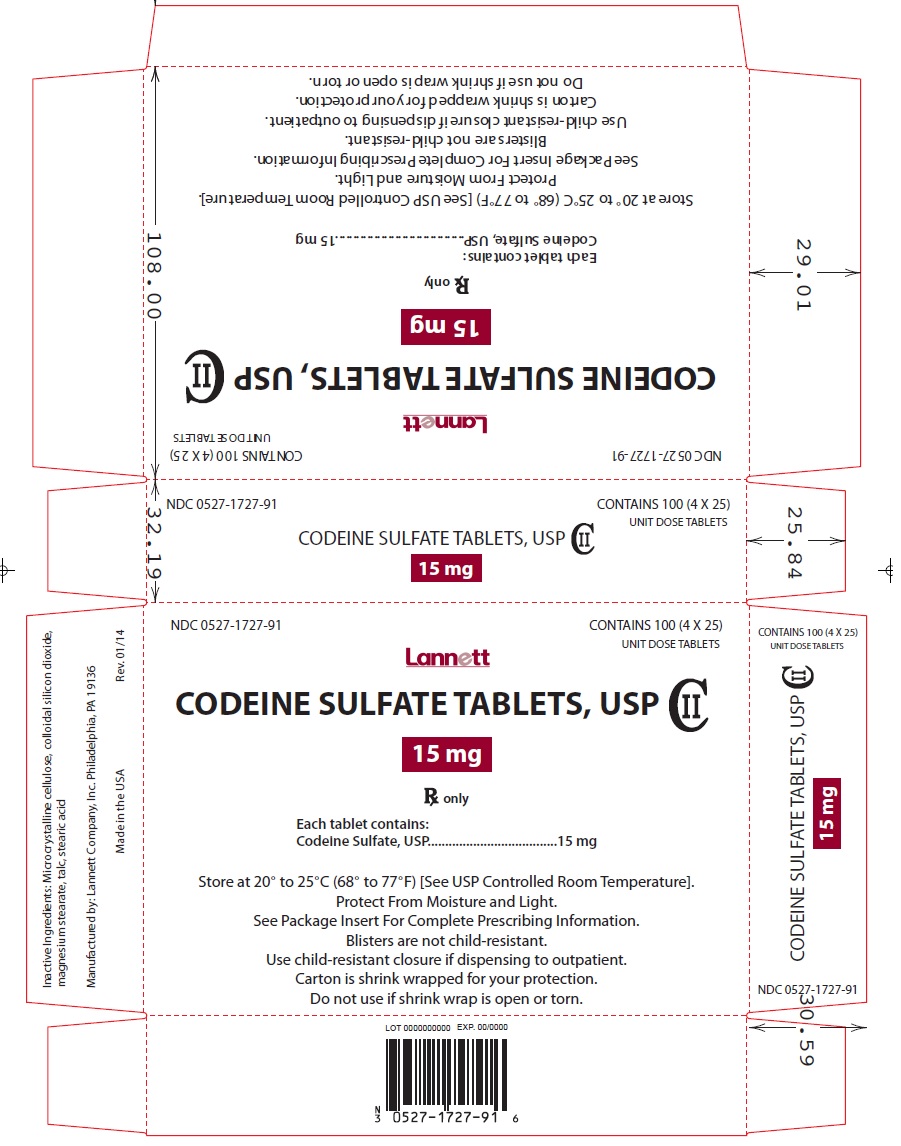
Codeine Sulfate label

Codeine Sulfate

Codeine Sulfate Recall

Get an alert when a recall is issued.

Side Effects & Adverse Reactions

There is currently no warning information available for this product. We apologize for any inconvenience.

FDA Safety Alerts

There are currently no FDA safety alerts available for this drug.

Manufacturer Warnings

There is currently no manufacturer warning information available for this drug.

FDA Labeling Changes

There are currently no FDA labeling changes available for this drug.

Uses

Codeine sulfate is an opioid analgesic indicated for the relief of mild to moderately severe pain where the use of an opioid analgesic is appropriate.

History

There is currently no drug history available for this drug.

Other Information

Chemically, codeine is Morphinan-6-ol,7,8-didehydro-4,5-epoxy-3-methoxy-17-methyl-(5α,6α)-, sulfate (2:1) (salt), trihydrate. Its empirical formula is C18H21NO3 and its molecular weight is 299.36.

Its structure is as follows:

image of chemical structure

Each tablet contains 15, 30, or 60 mg of codeine sulfate and the following inactive ingredients: colloidal silicon dioxide, microcrystalline cellulose, pregelatinized starch, and stearic acid.

Codeine Sulfate Manufacturers

  • Physicians Total Care, Inc.
    Codeine Sulfate | Physicians Total Care, Inc.
    No Recall

    Codeine Sulfate | Physicians Total Care, Inc.

    Codeine Sulfate | Physicians Total Care, Inc.

    Selection of patients for treatment with codeine sulfate should be governed by the same principles that apply to the use of similar opioid analgesics. Physicians should individualize treatment in every case, using non-opioid analgesics, opioids on an as needed basis and/or combination products, and chronic opioid therapy in a progressive plan of pain management.

    2.1 Individualization of Dosage

    As with any opioid drug product, adjust the dosing regimen for each patient individually, taking into account the patient’s prior analgesic treatment experience. In the selection of the initial dose of codeine sulfate, attention should be given to the following:

    • the total daily dose, potency and specific characteristics of the opioid the patient has been taking previously;

    • the reliability of the relative potency estimate used to calculate the equivalent codeine sulfate dose needed;

    • the patient’s degree of opioid tolerance;

    • the general condition and medical status of the patient;

    • concurrent medications;

    • the type and severity of the patient’s pain;

    • risk factors for abuse, addiction or diversion, including a prior history of abuse, addiction or diversion.

    The following dosing recommendations, therefore, can only be considered suggested approaches to what is actually a series of clinical decisions over time in the management of the pain of each individual patient.

    Continual re-evaluation of the patient receiving codeine sulfate is important, with special attention to the maintenance of pain control and the relative incidence of side effects associated with therapy. During chronic therapy, especially for noncancer-related pain, the continued need for the use of opioid analgesics should be re-assessed as appropriate.

    During periods of changing analgesic requirements, including initial titration, frequent contact is recommended between physician, other members of the healthcare team, the patient, and the caregiver/family.

    2.2 Initiation of Therapy

    The usual adult dosage for tablets is 15 mg to 60 mg repeated up to every four hours as needed for pain. The maximum 24 hour dose is 360 mg.

    The initial dose should be titrated based upon the individual patient’s response to their initial dose of codeine. This dose can then be adjusted to an acceptable level of analgesia taking into account the improvement in pain intensity and the tolerability of the codeine by the patient.

    It should be kept in mind, however, that tolerance to codeine sulfate can develop with continued use and that the incidence of untoward effects is dose-related. Adult doses of codeine higher than 60 mg fail to give commensurate relief of pain and are associated with an appreciably increased incidence of undesirable side effects.

    2.3 Cessation of Therapy

    When the patient no longer requires therapy with codeine sulfate, doses should be tapered gradually to prevent signs and  symptoms of withdrawal in the physically dependent patient.

  • Roxane Laboratories, Inc
    Codeine Sulfate | Hospira, Inc.
    No Recall

    Codeine Sulfate | Hospira, Inc.

    Codeine Sulfate | Hospira, Inc.

    Ciprofloxacin should be administered intravenously at dosages described in the appropriate Dosage Guidelines tables.

    2.1 Dosage in Adults

    The determination of dosage and duration for any particular patient must take into consideration the severity and nature of the infection, the susceptibility of the causative microorganism, the integrity of the patient’s host-defense mechanisms, and the status of renal function.

    Table 1: Adult Dosage Guidelines 1   Due to the designated pathogens (see Indications and Usage).
    2   Used in conjunction with metronidazole.
    3   Begin administration as soon as possible after suspected or confirmed exposure.

    Infection1

    Dose

    Frequency

    Usual Duration

    Urinary Tract

    200 mg to 400 mg

    every 12 to every 8 hours

    7 to 14 days

    Lower Respiratory Tract

    400 mg

    every 12 to every 8 hours

    7 to 14 days

    Nosocomial Pneumonia

    400 mg

    every 8 hours

    10 to 14 days

    Skin and Skin Structure

    400 mg

    every 12 to every 8 hours

    7 to 14 days

    Bone and Joint

    400 mg

    every 12 to every 8 hours

    4 to 8 weeks

    Complicated Intra-Abdominal2

    400 mg

    every 12 hours

    7 to 14 days

    Acute Sinusitis

    400 mg

    every 12 hours

    10 days

    Chronic Bacterial Prostatitis

    400 mg

    every 12 hours

    28 days

    Empirical Therapy In Febrile Neutropenic Patients

    Ciprofloxacin

    400 mg

    and

    Piperacillin

    50 mg/kg

    every 8 hours

    ___________

    every 4 hours

    7 to 14 days

    Inhalational anthrax (post-exposure)3

    400 mg

    every 12 hours

    60 days

    Plague3

    400 mg

    every 12 to 8 hours

    14 days

    Conversion of Intravenous to Oral Dosing in Adults

    Patients whose therapy is started with ciprofloxacin injection may be switched to CIPRO Tablets or Oral Suspension when clinically indicated at the discretion of the physician (Table 2) [see Clinical Pharmacology (12.3)].

    Table 2: Equivalent AUC Dosing Regimens

    Ciprofloxacin Oral Dosage

    Equivalent Ciprofloxacin Injection Dosage

    250 mg Tablet every 12 hours

    200 mg intravenous every 12 hours

    500 mg Tablet every 12 hours

    400 mg intravenous every 12 hours

    750 mg Tablet every 12 hours

    400 mg intravenous every 8 hours

    2.2 Dosage in Pediatric Patients

    Dosing and initial route of therapy (that is, IV or oral) for cUTI or pyelonephritis should be determined by the severity of the infection.

    Table 3: Pediatric Dosage Guidelines 1   The total duration of therapy for cUTI and pyelonephritis in the clinical trial was determined by the physician. The mean duration of treatment was 11 days (range 10 to 21 days).
    2   Begin drug administration as soon as possible after suspected or confirmed exposure.
    3   Begin drug administration as soon as possible after suspected or confirmed exposure to Y. pestis.

    Infection

    Route of Administration

    Dose (mg/kg)

    Frequency

    Total Duration

    Complicated Urinary Tract or Pyelonephritis (patients from 1 to 17 years of age)1

    Intravenous

    6 mg/kg to 10 mg/kg (maximum 400 mg per dose; not to be exceeded even in patients weighing >51 kg)

    Every 8 hours

    10 to 21 days1

    Inhalational Anthrax

    (Post-Exposure)2

    Intravenous

    10 mg/kg

    (maximum 400 mg per dose)

    Every 12 hours

    60 days

    Plague2,3

    Intravenous

    10 mg/kg

    (maximum 400 mg per dose)

    Every 12 to 8 hours

    10 to 21 days

    2.3 Dosage Modifications in Patients with Renal Impairment

    Ciprofloxacin is eliminated primarily by renal excretion; however, the drug is also metabolized and partially cleared through the biliary system of the liver and through the intestine. These alternative pathways of drug elimination appear to compensate for the reduced renal excretion in patients with renal impairment. Nonetheless, some modification of dosage is recommended, particularly for patients with severe renal dysfunction. Dosage guidelines for use in patients with renal impairment are shown in Table 4.

    Table 4: Recommended Starting and Maintenance Doses for Adult Patients with Impaired Renal Function

    Creatinine Clearance (mL/min)

    Dose

    > 30

    See Usual Dosage

    5 to 29

    200 to 400 mg every 18 to 24 hours

    When only the serum creatinine concentration is known, the following formulas may be used to estimate creatinine clearance:

    Men - Creatinine clearance (mL/min) = Weight (kg) x (140 – age)
                                                                72 x serum creatinine (mg/dL)

    Women - 0.85 x the value calculated for men.

    The serum creatinine should represent a steady state of renal function.

    In patients with severe infections and severe renal impairment and hepatic insufficiency, careful monitoring is suggested.

    Pediatric patients with moderate to severe renal insufficiency were excluded from the clinical trial of cUTI and pyelonephritis. No information is available on dosing adjustments necessary for pediatric patients with moderate to severe renal insufficiency (that is, creatinine clearance of < 50 mL/min/1.73m2).

    2.4 Preparation of Ciprofloxacin for Administration

    Vials (Injection Concentrate)

    THIS PREPARATION MUST BE DILUTED BEFORE USE. The intravenous dose should be prepared by aseptically withdrawing the concentrate from the vial of Ciprofloxacin Injection. This should be diluted with a suitable intravenous solution to a final concentration of 1 to 2 mg/mL (see COMPATIBILITY AND STABILITY). The resulting solution should be infused over a period of 60 minutes by direct infusion or through a Y-type intravenous infusion set which may already be in place.

    If the Y-type or “piggyback” method of administration is used, it is advisable to discontinue temporarily the administration of any other solutions during the infusion of Ciprofloxacin Injection. If the concomitant use of Ciprofloxacin Injection and another drug is necessary each drug should be given separately in accordance with the recommended dosage and route of administration for each drug.

    COMPATIBILITY AND STABILITY

    Ciprofloxacin Injection 1% (10 mg/mL), when diluted with the following intravenous solutions to concentrations of 0.5 to 2.0 mg/mL, is stable for up to 14 days at refrigerated or room temperature storage.

    0.9% Sodium Chloride Injection, USP
    5% Dextrose Injection, USP
    Sterile Water for Injection
    10% Dextrose for Injection
    5% Dextrose and 0.225% Sodium Chloride for Injection
    5% Dextrose and 0.45% Sodium Chloride for Injection
    Lactated Ringer’s for Injection

    2.5 Important Administration Instructions

    Intravenous Infusion

    Ciprofloxacin should be administered to by intravenous infusion over a period of 60 minutes. Slow infusion of a dilute solution into a larger vein will minimize patient discomfort and reduce the risk of venous irritation.

    Hydration of Patients Receiving Ciprofloxacin

    Adequate hydration of patients receiving ciprofloxacin should be maintained to prevent the formation of highly concentrated urine. Crystalluria has been reported with quinolones [see Warnings and Precautions (5.12), Adverse Reactions (6.1), Nonclinical Toxicology (13.2) and Patient Counseling Information (17)].

  • Lannett Company, Inc.
    Codeine Sulfate | Lannett Company, Inc.
    No Recall

    Codeine Sulfate | Lannett Company, Inc.

    Codeine Sulfate | Lannett Company, Inc.

    Selection of patients for treatment with codeine sulfate should be governed by the same principles that apply to the use of similar opioid analgesics. Physicians should individualize treatment in every case, using non-opioid analgesics, opioids on an as needed basis and/or combination products, and chronic opioid therapy in a progressive plan of pain management.

    2.1 Individualization of Dosage

    As with any opioid drug product, adjust the dosing regimen for each patient individually, taking into account the patient’s prior analgesic treatment experience. In the selection of the initial dose of codeine sulfate, attention should be given to the following:

    The total daily dose, potency and specific characteristics of the opioid the patient has been taking previously; the reliability of the relative potency estimate used to calculate the equivalent codeine sulfate dose needed; the patient’s degree of opioid tolerance; the general condition and medical status of the patient; concurrent medications; the type and severity of the patient’s pain; risk factors for abuse, addiction or diversion, including a prior history of abuse, addiction or diversion.

    The following dosing recommendations, therefore, can only be considered suggested approaches to what is actually a series of clinical decisions over time in the management of the pain of each individual patient.

    Continual reevaluation of the patient receiving codeine sulfate is important, with special attention to the maintenance of pain control and the relative incidence of side effects associated with therapy. During chronic therapy, especially for noncancer-related pain, the continued need for the use of opioid analgesics should be reassessed as appropriate.

    During periods of changing analgesic requirements, including initial titration, frequent contact is recommended between physician, other members of the healthcare team, the patient, and the caregiver/family.

    2.2 Initiation of Therapy

    The usual adult dosage for tablets is 15 mg to 60 mg repeated up to every four hours as needed for pain. The maximum 24 hour dose is 360 mg.

    The initial dose should be titrated based upon the individual patient’s response to their initial dose of codeine. This dose can then be adjusted to an acceptable level of analgesia taking into account the improvement in pain intensity and the tolerability of the codeine by the patient.

    It should be kept in mind, however, that tolerance to codeine sulfate can develop with continued use and that the incidence of untoward effects is dose-related. Adult doses of codeine higher than 60 mg fail to give commensurate relief of pain and are associated with an appreciably increased incidence of undesirable side effects.

    2.3 Cessation of Therapy

    When the patient no longer requires therapy with codeine sulfate, doses should be tapered gradually to prevent signs and symptoms of withdrawal in the physically dependent patient.