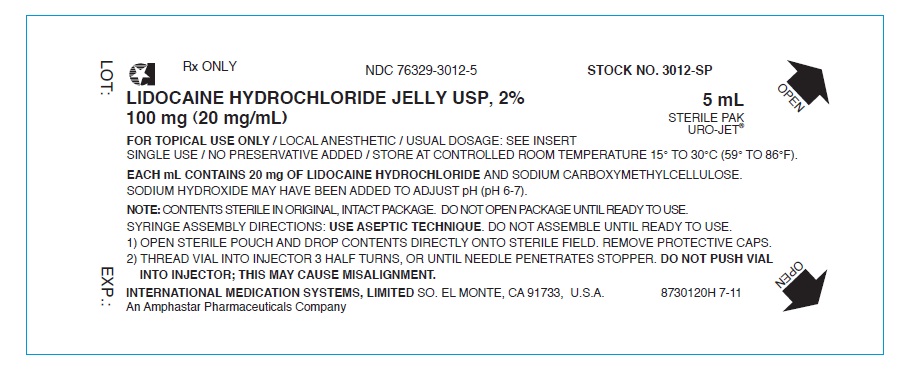
Lidocaine Hydrochloride Jelly label

Lidocaine Hydrochloride Jelly

Lidocaine Hydrochloride Jelly Recall

Get an alert when a recall is issued.

Side Effects & Adverse Reactions

EXCESSIVE DOSAGE, OR SHORT INTERVALS BETWEEN DOSES, CAN RESULT IN HIGH PLASMA LEVELS AND SERIOUS ADVERSE EFFECTS. PATIENTS SHOULD BE INSTRUCTED TO STRICTLY ADHERE TO THE RECOMMENDED DOSAGE AND ADMINISTRATION GUIDELINES AS SET FORTH IN THIS PACKAGE INSERT.

THE MANAGEMENT OF SERIOUS ADVERSE REACTIONS MAY REQUIRE THE USE OF RESUSCITATIVE EQUIPMENT, OXYGEN, AND OTHER RESUSCITATIVE DRUGS.

Lidocaine Hydrochloride Jelly USP, 2% should be used with extreme caution in the presence of sepsis or severely traumatized mucosa in the area of application, since under such conditions there is the potential for rapid systemic absorption.

When used for endotracheal tube lubrication, care should be taken to avoid introducing the product into the lumen of the tube. Do not use the jelly to lubricate the endotracheal stylettes. lf allowed into the inner lumen, the jelly may dry on the inner surface leaving a residue which tends to clump with flexion, narrowing the lumen. There have been rare reports in which this residue has caused the lumen to occlude. See also ADVERSE REACTIONS and DOSAGE AND ADMINISTRATION.

FDA Safety Alerts

There are currently no FDA safety alerts available for this drug.

Manufacturer Warnings

There is currently no manufacturer warning information available for this drug.

FDA Labeling Changes

There are currently no FDA labeling changes available for this drug.

Uses

Lidocaine Hydrochloride Jelly USP, 2% is indicated for prevention and control of pain in procedures involving the male and female urethra for topical treatment of painful urethritis, and as an anesthetic lubricant for endotracheal intubation (oral and nasal).

History

There is currently no drug history available for this drug.

Other Information

Lidocaine Hydrochloride Jelly USP, 2% is a sterile aqueous product that contains a local anesthetic agent and is administered topically. See INDICATIONS for specific uses.

Lidocaine Hydrochloride Jelly USP, 2% contains lidocaine hydrochloride which is chemically designated as acetamide, 2-(diethylamino)-N-(2,6-dimethylphenyl)-, monohydrochloride and has the following structural formula:

Chemical Structure

Composition of Lidocaine Hydrochloride Jelly USP, 2%

Each mL contains 20 mg of lidocaine hydrochloride, and sodium carboxymethylcellulose as a viscosity-increasing agent. Sodium hydroxide may have been added to adjust pH to meet USP limits of 6 to 7. Carboxymethylcellulose sodium adjusts the resulting mixture to a suitable consistency, to enhance contact with mucosa and provide lubrication for instrumentation. This product contains no preservative and any unused portion should be discarded after initial use.

Lidocaine Hydrochloride Jelly Manufacturers

  • Lidocaine Hydrochloride Jelly | Amphastar Pharmaceuticals, Inc.
    No Recall

    Lidocaine Hydrochloride Jelly | Amphastar Pharmaceuticals, Inc.

    Lidocaine Hydrochloride Jelly | Amphastar Pharmaceuticals, Inc.

    When Lidocaine Hydrochloride Jelly USP, 2% is used concomitantly with other products containing lidocaine, the total dose contributed by all formulations must be kept in mind.

    The dosage varies and depends upon the area to be anesthetized, vascularity of the tissues, individual tolerance, and the technique of anesthesia. The lowest dosage needed to provide effective anesthesia should be administered. Dosages should be reduced for children and for elderly and debilitated patients. Although the incidence of adverse effects with Lidocaine Hydrochloride Jelly USP, 2% is quite low, caution should be exercised, particularly when employing large amounts, since the incidence of adverse effects is directly proportional to the total dose of local anesthetic agent administered.

    For surface anesthesia of the male adult urethra

    The outer orifice is washed and disinfected. The plastic tip is introduced into the orifice, where it is firmly held in position. The jelly is instilled by an easy syringe-like action, until the patient has a feeling of tension or until about 15 mL (i.e., 300 mg of lidocaine hydrochloride) is instilled. A penile clamp is then applied for several minutes at the corona and then additional jelly (about 15 mL) is instilled. To save time, the injection is performed against the resistance of the sphincter, possibly assisted by asking the patient to strain as for defecation or to press as in voiding. The jelly will then pass into the posterior urethra. Prior to sounding or cystoscopy, a penile clamp should be applied for 5 to 10 minutes to obtain adequate anesthesia. If the instrument is introduced immediately, a lubricant is unnecessary. Otherwise some jelly can be expressed from the vial and applied to the instrument tip. About 30 mL (i.e., 600 mg) may be required to fill and dilate the male urethra. When it is desired to anesthetize only the anterior male urethra, as prior to catheterization, considerably smaller volumes, such as the contents from a 5 mL (i.e., 100 mg) or 10 mL (i.e., 200 mg) size vial, are usually adequate for lubrication.

    For surface anesthesia of the female adult urethra

    3 to 5 mL of the jelly is instilled slowly into the urethra by gently expressing the contents of the vial. If desired, some jelly may be deposited on a cotton swab and introduced into the urethra. In order to obtain adequate anesthesia, several minutes should be allowed prior to performing urological procedures.

    Lubrication for endotracheal intubation

    Apply a moderate amount of jelly to the external surface of the endotracheal tube shortly before use. Care should be taken to avoid introducing the product into the lumen of the tube. Do not use the jelly to lubricate endotracheal stylettes. See WARNINGS and ADVERSE REACTIONS concerning rare reports of inner lumen occlusion. It is also recommended that use of endotracheal tubes with dried jelly on the external surface be avoided for lack of lubricating effect.

    MAXIMUM DOSAGE

    No more than 600 mg of lidocaine hydrochloride should be given in any 12 hour period.

    Children

    It is difficult to recommend a maximum dose of any drug for children since this varies as a function of age and weight. For children less than ten years who have a normal lean body mass and a normal lean body development, the maximum dose may be determined by the application of one of the standard pediatric drug formulas (e.g., Clark's rule). For example, in a child of five years weighing 50 lbs., the dose of lidocaine hydrochloride should not exceed 75–100 mg when calculated according to Clark's rule. In any case, the maximum amount of lidocaine administered should not exceed 4.5 mg / kg (2 mg / lb) of body weight.

  • Lidocaine Hydrochloride Jelly | Hi-tech Pharmacal Co., Inc.
    No Recall

    Lidocaine Hydrochloride Jelly | Hi-tech Pharmacal Co., Inc.

    Lidocaine Hydrochloride Jelly | Hi-tech Pharmacal Co., Inc.

    When lidocaine hydrochloride jelly USP, 2% is used concomitantly with other products containing lidocaine, the total dose contributed by all formulations must be kept in mind. The dosage varies and depends upon the area to be anesthetized, vascularity of the tissues, individual tolerance, and the technique of anesthesia. The lowest dosage needed to provide effective anesthesia should be administered. Dosages should be reduced for children and for elderly and debilitated patients. Although the incidence of adverse effects with lidocaine hydrochloride jelly USP, 2% is quite low, caution should be exercised, particularly when employing large amounts, since the incidence of adverse effects is directly proportional to the total dose of local anesthetic agent administered.

    For Surface Anesthesia of the Male Adult Urethra: When using lidocaine hydrochloride jelly USP, 2% 30 mL tubes, sterilize the plastic cone for 5 minutes in boiling water, cool, and attach to the tube. The cone may be gas sterilized or cold sterilized, as preferred. Slowly instill approximately 15 mL (300 mg of lidocaine hydrochloride) into the urethra or until the patient has a feeling of tension. A penile clamp is then applied for several minutes at the corona. An additional dose of not more than 15 mL (300 mg) can be instilled for adequate anesthesia.

    Prior to sounding or cystoscopy, a penile clamp should be applied for 5 to 10 minutes to obtain adequate anesthesia. A total dose of 30 mL (600 mg) is usually required to fill and dilate the male urethra.

    Prior to catheterization, smaller volumes of 5 to 10 mL (100 to 200 mg) are usually adequate for lubrication.

    For Surface Anesthesia of the Female Adult Urethra: When using lidocaine hydrochloride jelly USP, 2% 30 mL tubes, sterilize the plastic cone for 5 minutes in boiling water, cool, and attach to the tube. The cone may be gas sterilized or cold sterilized, as preferred. Slowly instill 3 to 5 mL (60 to 100 mg of lidocaine hydrochloride) of the jelly into the urethra. If desired, some jelly may be deposited on a cotton swab and introduced into the urethra. In order to obtain adequate anesthesia, several minutes should be allowed prior to performing urological procedures.

    Lubrication for Endotracheal Intubation: Apply a moderate amount of jelly to the external surface of the endotracheal tube shortly before use. Care should be taken to avoid introducing the product into the lumen of the tube. Do not use the jelly to lubricate endotracheal stylettes. SeeWARNINGS andADVERSE REACTIONS concerning rare reports of inner lumen occlusion. It is also recommended that use of endotracheal tubes with dried jelly on the external surface be avoided for lack of lubricating effect.

    MAXIMUM DOSAGE: No more than 600 mg of lidocaine hydrochloride should be given in any 12 hour period.

    Children: It is difficult to recommend a maximum dose of any drug for children since this varies as a function of age and weight. For children less than ten years who have a normal lean body mass and a normal lean body development, the maximum dose may be determined by the application of one of the standard pediatric drug formulas (e.g., Clark’s rule). For example, in a child of five years weighing 50 lbs, the dose of lidocaine hydrochloride should not exceed 75 to 100 mg when calculated according to Clark’s rule. In any case, the maximum amount of lidocaine administered should not exceed 4.5 mg/kg (2 mg/lb) of body weight.

  • General Injectables & Vaccines, Inc
    Lidocaine Hydrochloride Jelly | General Injectables & Vaccines, Inc
    No Recall

    Lidocaine Hydrochloride Jelly | General Injectables & Vaccines, Inc

    Lidocaine Hydrochloride Jelly | General Injectables & Vaccines, Inc

    When Lidocaine Hydrochloride Jelly USP, 2% is used concomitantly with other products containing lidocaine, the total dose contributed by all formulations must be kept in mind.
    The dosage varies and depends upon the area to be anesthetized, vascularity of the tissues, individual tolerance, and the tehnique of anesthesia. The lowest dosage needed to provide effective anesthesia should be administered. Dosages should be reduced for children and for elderly and debilitated patients. Although the incidence of adverse effects with Lidocaine Hydrochloride Jelly USP, 2% is quite low, caution should be exercised, particularly when employing large amounts, since the incidence of adverse effects is directly proportional to the total dose of local anesthetic agent administered.

    For surface anesthesia of the male adult urethra
    The outer orifice is washed and disinfected. The plastic tip is introduced into the orifice, where it is firmly held in position. The jelly is instilled by an easy syringe-like action, until the patient has a feeling of tension or until about 15 mL (i.e., 300 mg of lidocaine hydrochloride) is instilled. A penile clamp is then applied for several minutes at the corona and then additional jelly (about 15 mL) is instilled. To save time, the injection is performed against the resistance of the sphincter, possibly assisted by asking the patient to strain as for defecation or to press as in voiding. The jelly will then pass into the posterior urethra. Prior to sounding or cystoscopy, a penile clamp should be applied for 5 to 10 minutes to obtain adequate anesthesia. If the instrument is introduced immediately, a lubricant is unnecessary. Otherwise some jelly can be expressed from the vial and applied to the instrument tip. About 30 mL (i.e., 600 mg) may be required to fill and dilate the male urethra. When it is desired to anesthetize only the anterior male urethra, as prior to catheterization, considerably smaller volumes, such as the contents from a 5 mL (i.e., 100 mg) or 10 mL (i.e., 200 mg) size vial, are usually adequate for lubrication.

    For surface anesthesia of the female adult urethra
    3 to 5 mL of the jelly is instilled slowly into the urethra by gently expressing the contents of the vial. If desired, some jelly may be deposited on a cotton swab and introduced into the urethra. In order to obtain adequate anesthesia, several minutes should be allowed prior to performing urological procedures.

    Lubrication for endotracheal intubation
    Apply a moderate amount of jelly to the external surface of the endotracheal tube shortly before use. Care should be taken to avoid introducing the product into the lumen of the tube. Do not use the jelly to lubricate endotracheal stylettes. See WARNINGS and ADVERSE REACTIONS concerning rare reports of inner lumen occlusion. It is also recommended that use of endotracheal tubes with dried jelly on the external surface be avoided for lack of lubricating effect.

    MAXIMUM DOSAGE
    No more than 600 mg of lidocaine hydrochloride should be given in any 12 hour period.

    Children
    It is difficult to recommend a maximum dose of any drug for children since this varies as a function of age and weight. For children less than ten years who have a normal lean body mass and a normal lean body development, the maximum dose may be determined by the application of one of the standard pediatric drug formulas (e.g., Clark's rule). For example, in a child of five years weighing 50 lbs., the dose of lidocaine hydrochloride should not exceed 75–100 mg when calculated according to Clark's rule. In any case, the maximum amount of lidocaine administered should not exceed 4.5 mg / kg (2 mg / lb) of body weight.

  • General Injectables & Vaccines, Inc
    Lidocaine Hydrochloride Jelly | General Injectables & Vaccines, Inc
    No Recall

    Lidocaine Hydrochloride Jelly | General Injectables & Vaccines, Inc

    Lidocaine Hydrochloride Jelly | General Injectables & Vaccines, Inc

    When Lidocaine Hydrochloride Jelly USP, 2% is used concomitantly with other products containing lidocaine, the total dose contributed by all formulations must be kept in mind.

    The dosage varies and depends upon the area to be anesthetized, vascularity of the tissues, individual tolerance, and the technique of anesthesia. The lowest dosage needed to provide effective anesthesia should be administered. Dosages should be reduced for children and for elderly and debilitated patients. Although the incidence of adverse effects with Lidocaine Hydrochloride Jelly USP, 2% is quite low, caution should be exercised, particularly when employing large amounts, since the incidence of adverse effects is directly proportional to the total dose of local anesthetic agent administered.

    For surface anesthesia of the male adult urethra: The outer orifice is washed and disinfected. The plastic tip is introduced into the orifice, where it is firmly held in position. The jelly is instilled by an easy syringe-like action, until the patient has a feeling of tension or until about 15 mL (i.e., 300 mg of lidocaine hydrochloride) is instilled. A penile clamp is then applied for several minutes at the corona and then additional jelly (about 15 mL) is instilled. To save time, the injection is performed against the resistance of the sphincter, possibly assisted by asking the patient to strain as for defecation or to press as in voiding. The jelly will then pass into the posterior urethra. Prior to sounding or cystoscopy, a penile clamp should be applied for 5 to 10 minutes to obtain adequate anesthesia. If the instrument is introduced immediately, a lubricant is unnecessary. Otherwise some jelly can be expressed from the vial and applied to the instrument tip. About 30 mL (i.e., 600 mg) may be required to fill and dilate the male urethra. When it is desired to anesthetize only the anterior male urethra, as prior to catherization, considerably smaller volumes, such as the contents from a 5 mL (i.e., 100 mg) or 10 mL (i.e., 200 mg) size vial, are usually adequate for lubrication.

    For surface anesthesia of the female adult urethra: 3 to 5 mL of the jelly is instilled slowly into the urethra by gently expressing the contents of the vial. If desired, some jelly may be deposited on a cotton swab and introduced into the urethra. In order to obtain adequate anesthesia, several minutes should be allowed prior to performing urological procedures.

    Lubrication for endotracheal intubation: Apply a moderate amount of jelly to the external surface of the endotracheal tube shortly before use. Care should be taken to avoid introducing the product into the lumen of the tube. Do not use the jelly to lubricate endotracheal stylettes. See WARNINGS and ADVERSE REACTIONS concerning rare reports of inner lumen occlusion. It is also recommended that use of endotracheal tubes with dried jelly on the external surface be avoided for lack of lubricating effect.

    MAXIMUM DOSAGE: No more than 600 mg of lidocaine hydrochloride should be given in any 12 hour period.

    Children: It is difficult to recommend a maximum dose of any drug for children since this varies as a function of age and weight. For children less than ten years who have a normal lean body mass and a normal lean body development, the maximum dose may be determined by the application of one of the standard pediatric drug formulas (e.g., Clark's rule). For example, in a child of five years weighing 50 lbs., the dose of lidocaine hydrochloride should not exceed 75-100 mg when calculated according to Clark's rule. In any case, the maximum amount of lidocaine administered should not exceed 4.5 mg / kg (2 mg / lb) of body weight.

  • Lidocaine Hydrochloride Jelly | Cardinal Health
    No Recall

    Lidocaine Hydrochloride Jelly | Cardinal Health

    Lidocaine Hydrochloride Jelly | Cardinal Health

    When Lidocaine Hydrochloride Jelly USP, 2% is used concomitantly with other products containing lidocaine, the total dose contributed by all formulations must be kept in mind.

    The dosage varies and depends upon the area to be anesthetized, vascularity of the tissues, individual tolerance, and the technique of anesthesia. The lowest dosage needed to provide effective anesthesia should be administered. Dosages should be reduced for children and for elderly and debilitated patients. Although the incidence of adverse effects with Lidocaine Hydrochloride Jelly USP, 2% is quite low, caution should be exercised, particularly when employing large amounts, since the incidence of adverse effects is directly proportional to the total dose of local anesthetic agent administered.

    For surface anesthesia of the male adult urethra

    The outer orifice is washed and disinfected. The plastic tip is introduced into the orifice, where it is firmly held in position. The jelly is instilled by an easy syringe-like action, until the patient has a feeling of tension or until about 15 mL (i.e., 300 mg of lidocaine hydrochloride) is instilled. A penile clamp is then applied for several minutes at the corona and then additional jelly (about 15 mL) is instilled. To save time, the injection is performed against the resistance of the sphincter, possibly assisted by asking the patient to strain as for defecation or to press as in voiding. The jelly will then pass into the posterior urethra. Prior to sounding or cystoscopy, a penile clamp should be applied for 5 to 10 minutes to obtain adequate anesthesia. If the instrument is introduced immediately, a lubricant is unnecessary. Otherwise some jelly can be expressed from the vial and applied to the instrument tip. About 30 mL (i.e., 600 mg) may be required to fill and dilate the male urethra. When it is desired to anesthetize only the anterior male urethra, as prior to catheterization, considerably smaller volumes, such as the contents from a 5 mL (i.e., 100 mg) or 10 mL (i.e., 200 mg) size vial, are usually adequate for lubrication.

    For surface anesthesia of the female adult urethra

    3 to 5 mL of the jelly is instilled slowly into the urethra by gently expressing the contents of the vial. If desired, some jelly may be deposited on a cotton swab and introduced into the urethra. In order to obtain adequate anesthesia, several minutes should be allowed prior to performing urological procedures.

    Lubrication for endotracheal intubation

    Apply a moderate amount of jelly to the external surface of the endotracheal tube shortly before use. Care should be taken to avoid introducing the product into the lumen of the tube. Do not use the jelly to lubricate endotracheal stylettes. See WARNINGS and ADVERSE REACTIONS concerning rare reports of inner lumen occlusion. It is also recommended that use of endotracheal tubes with dried jelly on the external surface be avoided for lack of lubricating effect.

    MAXIMUM DOSAGE

    No more than 600 mg of lidocaine hydrochloride should be given in any 12 hour period.

    Children

    It is difficult to recommend a maximum dose of any drug for children since this varies as a function of age and weight. For children less than ten years who have a normal lean body mass and a normal lean body development, the maximum dose may be determined by the application of one of the standard pediatric drug formulas (e.g., Clark's rule). For example, in a child of five years weighing 50 lbs., the dose of lidocaine hydrochloride should not exceed 75–100 mg when calculated according to Clark's rule. In any case, the maximum amount of lidocaine administered should not exceed 4.5 mg / kg (2 mg / lb) of body weight.

  • General Injectables & Vaccines, Inc
    Lidocaine Hydrochloride Jelly | General Injectables & Vaccines, Inc
    No Recall

    Lidocaine Hydrochloride Jelly | General Injectables & Vaccines, Inc

    Lidocaine Hydrochloride Jelly | General Injectables & Vaccines, Inc

    When Lidocaine Hydrochloride Jelly USP, 2% is used concomitantly with other products containing lidocaine, the total dose contributed by all formulations must be kept in mind.

    The dosage varies and depends upon the area to be anesthetized, vascularity of the tissues, individual tolerance, and the technique of anesthesia. The lowest dosage needed to provide effective anesthesia should be administered. Dosages should be reduced for children and for elderly and debilitated patients. Although the incidence of adverse effects with Lidocaine Hydrochloride Jelly USP, 2% is quite low, caution should be exercised, particularly when employing large amounts, since the incidence of adverse effects is directly proportional to the total dose of local anesthetic agent administered.

    For surface anesthesia of the male adult urethra: The outer orifice is washed and disinfected. The plastic tip is introduced into the orifice, where it is firmly held in position. The jelly is instilled by an easy syringe-like action, until the patient has a feeling of tension or until about 15 mL (i.e., 300 mg of lidocaine hydrochloride) is instilled. A penile clamp is then applied for several minutes at the corona and then additional jelly (about 15 mL) is instilled. To save time, the injection is performed against the resistance of the sphincter, possibly assisted by asking the patient to strain as for defecation or to press as in voiding. The jelly will then pass into the posterior urethra. Prior to sounding or cystoscopy, a penile clamp should be applied for 5 to 10 minutes to obtain adequate anesthesia. If the instrument is introduced immediately, a lubricant is unnecessary. Otherwise some jelly can be expressed from the vial and applied to the instrument tip. About 30 mL (i.e., 600 mg) may be required to fill and dilate the male urethra. When it is desired to anesthetize only the anterior male urethra, as prior to catheterization, considerably smaller volumes, such as the contents from a 5 mL (i.e., 100 mg) or 10 mL (i.e., 200 mg) size vial, are usually adequate for lubrication.

    For surface anesthesia of the female adult urethra: 3 to 5 mL of the jelly is instilled slowly into the urethra by gently expressing the contents of the vial. If desired, some jelly may be deposited on a cotton swab and introduced into the urethra. In order to obtain adequate anesthesia, several minutes should be allowed prior to performing urological procedures.

    Lubrication for endotracheal intubation: Apply a moderate amount of jelly to the external surface of the endotracheal tube shortly before use. Care should be taken to avoid introducing the product into the lumen of the tube. Do not use the jelly to lubricate endotracheal stylettes. See WARNINGS and ADVERSE REACTIONS concerning rare reports of inner lumen occlusion. It is also recommended that use of endotracheal tubes with dried jelly on the external surface be avoided for lack of lubricating effect.

    MAXIMUM DOSAGE: No more than 600 mg of lidocaine hydrochloride should be given in any 12 hour period.

    Children: It is difficult to recommend a maximum dose of any drug for children since this varies as a function of age and weight. For children less than ten years who have a normal lean body mass and a normal lean body development, the maximum dose may be determined by the application of one of the standard pediatric drug formulas (e.g., Clark's rule). For example, in a child of five years weighing 50 lbs., the dose of lidocaine hydrochloride should not exceed 75–100 mg when calculated according to Clark's rule. In any case, the maximum amount of lidocaine administered should not exceed 4.5 mg / kg (2 mg / lb) of body weight.

  • Lidocaine Hydrochloride Jelly | International Medication Systems, Limited
    No Recall

    Lidocaine Hydrochloride Jelly | International Medication Systems, Limited

    Lidocaine Hydrochloride Jelly | International Medication Systems, Limited

    When Lidocaine Hydrochloride Jelly USP, 2% is used concomitantly with other products containing lidocaine, the total dose contributed by all formulations must be kept in mind.

    The dosage varies and depends upon the area to be anesthetized, vascularity of the tissues, individual tolerance, and the technique of anesthesia. The lowest dosage needed to provide effective anesthesia should be administered. Dosages should be reduced for children and for elderly and debilitated patients. Although the incidence of adverse effects with Lidocaine Hydrochloride Jelly USP, 2% is quite low, caution should be exercised, particularly when employing large amounts, since the incidence of adverse effects is directly proportional to the total dose of local anesthetic agent administered.

    For surface anesthesia of the male adult urethra

    The outer orifice is washed and disinfected. The plastic tip is introduced into the orifice, where it is firmly held in position. The jelly is instilled by an easy syringe-like action, until the patient has a feeling of tension or until about 15 mL (i.e., 300 mg of lidocaine hydrochloride) is instilled. A penile clamp is then applied for several minutes at the corona and then additional jelly (about 15 mL) is instilled. To save time, the injection is performed against the resistance of the sphincter, possibly assisted by asking the patient to strain as for defecation or to press as in voiding. The jelly will then pass into the posterior urethra. Prior to sounding or cystoscopy, a penile clamp should be applied for 5 to 10 minutes to obtain adequate anesthesia. If the instrument is introduced immediately, a lubricant is unnecessary. Otherwise some jelly can be expressed from the vial and applied to the instrument tip. About 30 mL (i.e., 600 mg) may be required to fill and dilate the male urethra. When it is desired to anesthetize only the anterior male urethra, as prior to catheterization, considerably smaller volumes, such as the contents from a 5 mL (i.e., 100 mg) or 10 mL (i.e., 200 mg) size vial, are usually adequate for lubrication.

    For surface anesthesia of the female adult urethra

    3 to 5 mL of the jelly is instilled slowly into the urethra by gently expressing the contents of the vial. If desired, some jelly may be deposited on a cotton swab and introduced into the urethra. In order to obtain adequate anesthesia, several minutes should be allowed prior to performing urological procedures.

    Lubrication for endotracheal intubation

    Apply a moderate amount of jelly to the external surface of the endotracheal tube shortly before use. Care should be taken to avoid introducing the product into the lumen of the tube. Do not use the jelly to lubricate endotracheal stylettes. See WARNINGS and ADVERSE REACTIONS concerning rare reports of inner lumen occlusion. It is also recommended that use of endotracheal tubes with dried jelly on the external surface be avoided for lack of lubricating effect.

    MAXIMUM DOSAGE

    No more than 600 mg of lidocaine hydrochloride should be given in any 12 hour period.

    Children

    It is difficult to recommend a maximum dose of any drug for children since this varies as a function of age and weight. For children less than ten years who have a normal lean body mass and a normal lean body development, the maximum dose may be determined by the application of one of the standard pediatric drug formulas (e.g., Clark's rule). For example, in a child of five years weighing 50 lbs., the dose of lidocaine hydrochloride should not exceed 75–100 mg when calculated according to Clark's rule. In any case, the maximum amount of lidocaine administered should not exceed 4.5 mg / kg (2 mg / lb) of body weight.

  • Lidocaine Hydrochloride Jelly | Cardinal Health
    No Recall

    Lidocaine Hydrochloride Jelly | Cardinal Health

    Lidocaine Hydrochloride Jelly | Cardinal Health

    When Lidocaine Hydrochloride Jelly USP, 2% is used concomitantly with other products containing lidocaine, the total dose contributed by all formulations must be kept in mind.

    The dosage varies and depends upon the area to be anesthetized, vascularity of the tissues, individual tolerance, and the technique of anesthesia. The lowest dosage needed to provide effective anesthesia should be administered. Dosages should be reduced for children and for elderly and debilitated patients. Although the incidence of adverse effects with Lidocaine Hydrochloride Jelly USP, 2% is quite low, caution should be exercised, particularly when employing large amounts, since the incidence of adverse effects is directly proportional to the total dose of local anesthetic agent administered.

    For surface anesthesia of the male adult urethra

    The outer orifice is washed and disinfected. The plastic tip is introduced into the orifice, where it is firmly held in position. The jelly is instilled by an easy syringe-like action, until the patient has a feeling of tension or until about 15 mL (i.e., 300 mg of lidocaine hydrochloride) is instilled. A penile clamp is then applied for several minutes at the corona and then additional jelly (about 15 mL) is instilled. To save time, the injection is performed against the resistance of the sphincter, possibly assisted by asking the patient to strain as for defecation or to press as in voiding. The jelly will then pass into the posterior urethra. Prior to sounding or cystoscopy, a penile clamp should be applied for 5 to 10 minutes to obtain adequate anesthesia. If the instrument is introduced immediately, a lubricant is unnecessary. Otherwise some jelly can be expressed from the vial and applied to the instrument tip. About 30 mL (i.e., 600 mg) may be required to fill and dilate the male urethra. When it is desired to anesthetize only the anterior male urethra, as prior to catheterization, considerably smaller volumes, such as the contents from a 5 mL (i.e., 100 mg) or 10 mL (i.e., 200 mg) size vial, are usually adequate for lubrication.

    For surface anesthesia of the female adult urethra

    3 to 5 mL of the jelly is instilled slowly into the urethra by gently expressing the contents of the vial. If desired, some jelly may be deposited on a cotton swab and introduced into the urethra. In order to obtain adequate anesthesia, several minutes should be allowed prior to performing urological procedures.

    Lubrication for endotracheal intubation

    Apply a moderate amount of jelly to the external surface of the endotracheal tube shortly before use. Care should be taken to avoid introducing the product into the lumen of the tube. Do not use the jelly to lubricate endotracheal stylettes. See WARNINGS and ADVERSE REACTIONS concerning rare reports of inner lumen occlusion. It is also recommended that use of endotracheal tubes with dried jelly on the external surface be avoided for lack of lubricating effect.

    MAXIMUM DOSAGE

    No more than 600 mg of lidocaine hydrochloride should be given in any 12 hour period.

    Children

    It is difficult to recommend a maximum dose of any drug for children since this varies as a function of age and weight. For children less than ten years who have a normal lean body mass and a normal lean body development, the maximum dose may be determined by the application of one of the standard pediatric drug formulas (e.g., Clark's rule). For example, in a child of five years weighing 50 lbs., the dose of lidocaine hydrochloride should not exceed 75–100 mg when calculated according to Clark's rule. In any case, the maximum amount of lidocaine administered should not exceed 4.5 mg / kg (2 mg / lb) of body weight.