Aciphex label

Aciphex

Aciphex Recall

Get an alert when a recall is issued.

Side Effects & Adverse Reactions

There is currently no warning information available for this product. We apologize for any inconvenience.

FDA Safety Alerts

There are currently no FDA safety alerts available for this drug.

Manufacturer Warnings

There is currently no manufacturer warning information available for this drug.

FDA Labeling Changes

There are currently no FDA labeling changes available for this drug.

Uses

Enter section text here

1.1 Healing of Erosive or Ulcerative GERD

ACIPHEX is indicated for short-term (4 to 8 weeks) treatment in the healing and symptomatic relief of erosive or ulcerative gastroesophageal reflux disease (GERD). For those patients who have not healed after 8 weeks of treatment, an additional 8-week course of ACIPHEX may be considered.

1.2 Maintenance of Healing of Erosive of Ulcerative GERD

ACIPHEX is indicated for maintaining healing and reduction in relapse rates of heartburn symptoms in patients with erosive or ulcerative gastroesophageal reflux disease (GERD Maintenance). Controlled studies do not extend beyond 12 months.

1.3 Treatment of Symptomatic GERD

ACIPHEX is indicated for the treatment of daytime and nighttime heartburn and other symptoms associated with GERD in adults and adolescents 12 years of age and above.

1.4 Healing of Duodenal Ulcers

ACIPHEX is indicated for short-term (up to four weeks) treatment in the healing and symptomatic relief of duodenal ulcers. Most patients heal within four weeks.

1.5 Helicobacter pylori Eradication to Reduce the Risk of Duodenal Ulcer Recurrence

ACIPHEX in combination with amoxicillin and clarithromycin as a three drug regimen, is indicated for the treatment of patients with H. pylori infection and duodenal ulcer disease (active or history within the past 5 years) to eradicate H. pylori. Eradication of H. pylori has been shown to reduce the risk of duodenal ulcer recurrence. {See CLINICAL STUDIES (14.5) and DOSAGE AND ADMINISTRATION (2.5)}

In patients who fail therapy, susceptibility testing should be done. If resistance to clarithromycin is demonstrated or susceptibility testing is not possible, alternative antimicrobial therapy should be instituted. {See CLINICAL PHARMACOLOGY, Microbiology (12.2) and the clarithromycin package insert, CLINICAL PHARMACOLOGY, Microbiology}

1.6 Treatment of Pathological Hypersecretory Conditions, Including Zollinger-Ellison Syndrome

ACIPHEX is indicated for the long-term treatment of pathological hypersecretory conditions, including Zollinger-Ellison syndrome.

History

There is currently no drug history available for this drug.

Other Information

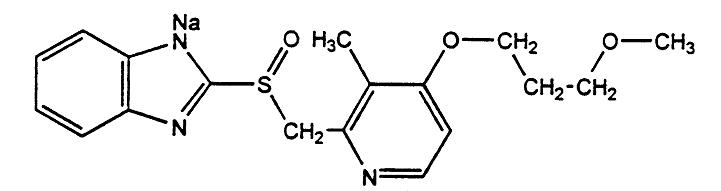
The active ingredient in ACIPHEX Delayed-Release Tablets is rabeprazole sodium, a substituted benzimidazole that inhibits gastric acid secretion. Rabeprazole sodium is known chemically as 2-[[[4-(3-methoxypropoxy)-3-methyl-2-pyridinyl]-methyl]sulfinyl]-1H-benzimidazole sodium salt. It has an empirical formula of C18H20N3NaO3S and a molecular weight of 381.43. Rabeprazole sodium is a white to slightly yellowish-white solid. It is very soluble in water and methanol, freely soluble in ethanol, chloroform and ethyl acetate and insoluble in ether and n-hexane. The stability of rabeprazole sodium is a function of pH; it is rapidly degraded in acid media, and is more stable under alkaline conditions. The structural formula is:

image of chemical structure

ACIPHEX is available for oral administration as delayed-release, enteric-coated tablets containing 20 mg of rabeprazole sodium.

Inactive ingredients of the 20 mg tablet are carnauba wax, crospovidone, diacetylated monoglycerides, ethylcellulose, hydroxypropyl cellulose, hypromellose phthalate, magnesium stearate, mannitol, propylene glycol, sodium hydroxide, sodium stearyl fumarate, talc, and titanium dioxide. Iron oxide yellow is the coloring agent for the tablet coating. Iron oxide red is the ink pigment.

Aciphex Manufacturers

  • Physicians Total Care, Inc.
    Aciphex | Physicians Total Care, Inc.
    No Recall

    Aciphex | Physicians Total Care, Inc.

    Aciphex | Physicians Total Care, Inc.

    ACIPHEX tablets should be swallowed whole. The tablets should not be chewed, crushed, or split. ACIPHEX can be taken with or without food.

    2.1 Healing of Erosive or Ulcerative GERD

    The recommended adult oral dose is one ACIPHEX 20 mg delayed-release tablet to be taken once daily for four to eight weeks {See INDICATIONS AND USAGE.(1.1)}. For those patients who have not healed after 8 weeks of treatment, an additional 8-week course of ACIPHEX may be considered.

    2.2 Maintenance of Healing of Erosive or Ulcerative GERD

    The recommended adult oral dose is one ACIPHEX 20 mg delayed-release tablet to be taken once daily. {See INDICATIONS AND USAGE (1.2)}.

    2.3 Treatment of Symptomatic GERD

    The recommended adult oral dose is one ACIPHEX 20 mg delayed-release tablet to be taken once daily for 4 weeks. {See INDICATIONS AND USAGE (1.3)} If symptoms do not resolve completely after 4 weeks, an additional course of treatment may be considered. The recommended adolescent dosing is listed in Section 2.7.

    2.4 Healing of Duodenal Ulcers

    The recommended adult oral dose is one ACIPHEX 20 mg delayed-release tablet to be taken once daily after the morning meal for a period up to four weeks. {See INDICATIONS AND USAGE (1.4)}. Most patients with duodenal ulcer heal within four weeks. A few patients may require additional therapy to achieve healing.

    2.5 Helicobacter pylori Eradication to Reduce the Risk of Duodenal Ulcer Recurrence TABLE 1 THREE DRUG REGIMENa: Aciphex 20 mg Twice Daily for 7 Days Amoxicillin 1000 mg Twice Daily for 7 Days Clarithromycin 500 mg Twice Daily for 7 Days All three medications should be taken twice daily with the morning and evening meals.
    a It is important that patients comply with the full 7-day regimen. {See CLINICAL STUDIES section.(14.5)}.
    2.6 Treatment of Pathological Hypersecretory Conditions Including Zollinger-Ellison Syndrome

    The dosage of ACIPHEX in patients with pathologic hypersecretory conditions varies with the individual patient. The recommended adult oral starting dose is 60 mg once a day. Doses should be adjusted to individual patient needs and should continue for as long as clinically indicated. Some patients may require divided doses. Doses up to 100 mg QD and 60 mg BID have been administered. Some patients with Zollinger-Ellison syndrome have been treated continuously with ACIPHEX for up to one year.

    2.7 Short-term Treatment of GERD in Adolescent Patients 12 Years of Age and Above

    The recommended oral dose for adolescents 12 years of age and above is 20 mg once daily for up to 8 weeks {See Pediatric Use (8.4)}.

    2.8 Elderly, Renal and Hepatic Impaired Patients

    No dosage adjustment is necessary in elderly patients, in patients with renal disease or in patients with mild to moderate hepatic impairment. Administration of rabeprazole to patients with mild to moderate liver impairment resulted in increased exposure and decreased elimination. Due to the lack of clinical data on rabeprazole in patients with severe hepatic impairment, caution should be exercised in those patients.

  • Lake Erie Medical & Surgical Supply Dba Quality Care Produtcs Llc
    Aciphex | Lake Erie Medical & Surgical Supply Dba Quality Care Produtcs Llc
    No Recall

    Aciphex | Lake Erie Medical & Surgical Supply Dba Quality Care Produtcs Llc

    Aciphex | Lake Erie Medical & Surgical Supply Dba Quality Care Produtcs Llc

    ACIPHEX tablets should be swallowed whole. The tablets should not be chewed, crushed, or split. ACIPHEX can be taken with or without food.

    2.1. Healing of Erosive or Ulcerative GERD

    The recommended adult oral dose is one ACIPHEX 20 mg delayed-release tablet to be taken once daily for four to eight weeks. {See INDICATIONS AND USAGE (1.1)}. For those patients who have not healed after 8 weeks of treatment, an additional 8-week course of ACIPHEX may be considered.

    2.2. Maintenance of Healing of Erosive or Ulcerative GERD

    The recommended adult oral dose is one ACIPHEX 20 mg delayed-release tablet to be taken once daily. {See INDICATIONS AND USAGE (1.2)}.

    2.3. Treatment of Symptomatic GERD

    The recommended adult oral dose is one ACIPHEX 20 mg delayed-release tablet to be taken once daily for 4 weeks. {See INDICATIONS AND USAGE (1.3)}. If symptoms do not resolve completely after 4 weeks, an additional course of treatment may be considered. The recommended adolescent dosing is listed in Section 2.7.

    2.4. Healing of Duodenal Ulcers

    The recommended adult oral dose is one ACIPHEX 20 mg delayed-release tablet to be taken once daily after the morning meal for a period up to four weeks. {See INDICATIONS AND USAGE (1.4)}. Most patients with duodenal ulcer heal within four weeks. A few patients may require additional therapy to achieve healing.

    2.5. Helicobacter pylori Eradication to Reduce the Risk of Duodenal Ulcer Recurrence TABLE 1 THREE DRUG REGIMENa All three medications should be taken twice daily with the morning and evening meals.
    a It is important that patients comply with the full 7-day regimen. {See CLINICAL STUDIES section (14.5)}. ACIPHEX 20 mg Twice Daily for 7 Days Amoxicillin 1000 mg Twice Daily for 7 Days Clarithromycin 500 mg Twice Daily for 7 Days

    2.6. Treatment of Pathological Hypersecretory Conditions, Including Zollinger-Ellison Syndrome

    The dosage of ACIPHEX in patients with pathologic hypersecretory conditions varies with the individual patient. The recommended adult oral starting dose is 60 mg once a day. Doses should be adjusted to individual patient needs and should continue for as long as clinically indicated. Some patients may require divided doses. Doses up to 100 mg QD and 60 mg BID have been administered. Some patients with Zollinger-Ellison syndrome have been treated continuously with ACIPHEX for up to one year.

    2.7. Short-term Treatment of GERD in Adolescent Patients 12 Years of Age and Above

    The recommended oral dose for adolescents 12 years of age and above is 20 mg once daily for up to 8 weeks {See Pediatric Use (8.4)}.

    2.8. Elderly, Renal and Hepatic Impaired Patients

    No dosage adjustment is necessary in elderly patients, in patients with renal disease or in patients with mild to moderate hepatic impairment. Administration of rabeprazole to patients with mild to moderate liver impairment resulted in increased exposure and decreased elimination. Due to the lack of clinical data on rabeprazole in patients with severe hepatic impairment, caution should be exercised in those patients.

  • Lake Erie Medical & Surgical Supplies Dba Quality Care Products Llc
    Aciphex | Lake Erie Medical & Surgical Supplies Dba Quality Care Products Llc
    No Recall

    Aciphex | Lake Erie Medical & Surgical Supplies Dba Quality Care Products Llc

    Aciphex | Lake Erie Medical & Surgical Supplies Dba Quality Care Products Llc

    ACIPHEX tablets should be swallowed whole. The tablets should not be chewed, crushed, or split. ACIPHEX can be taken with or without food.

    2.1. Healing of Erosive or Ulcerative GERD

    The recommended adult oral dose is one ACIPHEX 20 mg delayed-release tablet to be taken once daily for four to eight weeks. {See INDICATIONS AND USAGE (1.1)}. For those patients who have not healed after 8 weeks of treatment, an additional 8-week course of ACIPHEX may be considered.

    2.2. Maintenance of Healing of Erosive or Ulcerative GERD

    The recommended adult oral dose is one ACIPHEX 20 mg delayed-release tablet to be taken once daily. {See INDICATIONS AND USAGE (1.2)}.

    2.3. Treatment of Symptomatic GERD

    The recommended adult oral dose is one ACIPHEX 20 mg delayed-release tablet to be taken once daily for 4 weeks. {See INDICATIONS AND USAGE (1.3)}. If symptoms do not resolve completely after 4 weeks, an additional course of treatment may be considered. The recommended adolescent dosing is listed in Section 2.7.

    2.4. Healing of Duodenal Ulcers

    The recommended adult oral dose is one ACIPHEX 20 mg delayed-release tablet to be taken once daily after the morning meal for a period up to four weeks. {See INDICATIONS AND USAGE (1.4)}. Most patients with duodenal ulcer heal within four weeks. A few patients may require additional therapy to achieve healing.

    2.5. Helicobacter pylori Eradication to Reduce the Risk of Duodenal Ulcer Recurrence TABLE 1 THREE DRUG REGIMENa All three medications should be taken twice daily with the morning and evening meals.
    a It is important that patients comply with the full 7-day regimen. {See CLINICAL STUDIES section (14.5)}. ACIPHEX 20 mg Twice Daily for 7 Days Amoxicillin 1000 mg Twice Daily for 7 Days Clarithromycin 500 mg Twice Daily for 7 Days

    2.6. Treatment of Pathological Hypersecretory Conditions, Including Zollinger-Ellison Syndrome

    The dosage of ACIPHEX in patients with pathologic hypersecretory conditions varies with the individual patient. The recommended adult oral starting dose is 60 mg once a day. Doses should be adjusted to individual patient needs and should continue for as long as clinically indicated. Some patients may require divided doses. Doses up to 100 mg QD and 60 mg BID have been administered. Some patients with Zollinger-Ellison syndrome have been treated continuously with ACIPHEX for up to one year.

    2.7. Short-term Treatment of GERD in Adolescent Patients 12 Years of Age and Above

    The recommended oral dose for adolescents 12 years of age and above is 20 mg once daily for up to 8 weeks {See Pediatric Use (8.4)}.

    2.8. Elderly, Renal and Hepatic Impaired Patients

    No dosage adjustment is necessary in elderly patients, in patients with renal disease or in patients with mild to moderate hepatic impairment. Administration of rabeprazole to patients with mild to moderate liver impairment resulted in increased exposure and decreased elimination. Due to the lack of clinical data on rabeprazole in patients with severe hepatic impairment, caution should be exercised in those patients.

  • Aciphex | Cardinal Health
    No Recall

    Aciphex | Cardinal Health

    Aciphex | Cardinal Health

    ACIPHEX tablets should be swallowed whole. The tablets should not be chewed, crushed, or split. ACIPHEX can be taken with or without food.

    2.1 Healing of Erosive or Ulcerative GERD

    The recommended adult oral dose is one ACIPHEX 20 mg delayed-release tablet to be taken once daily for four to eight weeks. {See INDICATIONS AND USAGE (1.1)}. For those patients who have not healed after 8 weeks of treatment, an additional 8-week course of ACIPHEX may be considered.

    2.2 Maintenance of Healing of Erosive or Ulcerative GERD

    The recommended adult oral dose is one ACIPHEX 20 mg delayed-release tablet to be taken once daily. {See INDICATIONS AND USAGE (1.2)}.

    2.3 Treatment of Symptomatic GERD

    The recommended adult oral dose is one ACIPHEX 20 mg delayed-release tablet to be taken once daily for 4 weeks. {See INDICATIONS AND USAGE (1.3)}. If symptoms do not resolve completely after 4 weeks, an additional course of treatment may be considered. The recommended adolescent dosing is listed in Section 2.7.

    2.4 Healing of Duodenal Ulcers

    The recommended adult oral dose is one ACIPHEX 20 mg delayed-release tablet to be taken once daily after the morning meal for a period up to four weeks. {See INDICATIONS AND USAGE (1.4)}. Most patients with duodenal ulcer heal within four weeks. A few patients may require additional therapy to achieve healing.

    2.5 Helicobacter pylori Eradication to Reduce the Risk of Duodenal Ulcer Recurrence TABLE 1 THREE DRUG REGIMEN a All three medications should be taken twice daily with the morning and evening meals.
    a It is important that patients comply with the full 7-day regimen. {See CLINICAL STUDIES section (14.5)}. ACIPHEX 20 mg Twice Daily for 7 Days Amoxicillin 1000 mg Twice Daily for 7 Days Clarithromycin 500 mg Twice Daily for 7 Days 2.6 Treatment of Pathological Hypersecretory Conditions, Including Zollinger-Ellison Syndrome

    The dosage of ACIPHEX in patients with pathologic hypersecretory conditions varies with the individual patient. The recommended adult oral starting dose is 60 mg once a day. Doses should be adjusted to individual patient needs and should continue for as long as clinically indicated. Some patients may require divided doses. Doses up to 100 mg QD and 60 mg BID have been administered. Some patients with Zollinger-Ellison syndrome have been treated continuously with ACIPHEX for up to one year.

    2.7 Short-term Treatment of GERD in Adolescent Patients 12 Years of Age and Above

    The recommended oral dose for adolescents 12 years of age and above is 20 mg once daily for up to 8 weeks {See Pediatric Use (8.4)}.

    2.8 Elderly, Renal and Hepatic Impaired Patients

    No dosage adjustment is necessary in elderly patients, in patients with renal disease or in patients with mild to moderate hepatic impairment. Administration of rabeprazole to patients with mild to moderate liver impairment resulted in increased exposure and decreased elimination. Due to the lack of clinical data on rabeprazole in patients with severe hepatic impairment, caution should be exercised in those patients.

  • Bryant Ranch Prepack
    Aciphex | Bryant Ranch Prepack
    No Recall

    Aciphex | Bryant Ranch Prepack

    Aciphex | Bryant Ranch Prepack

    ACIPHEX tablets should be swallowed whole. The tablets should not be chewed, crushed, or split. ACIPHEX can be taken with or without food.

    2.1 Healing of Erosive or Ulcerative GERD

    The recommended adult oral dose is one ACIPHEX 20 mg delayed-release tablet to be taken once daily for four to eight weeks. {See INDICATIONS AND USAGE (1.1)}. For those patients who have not healed after 8 weeks of treatment, an additional 8-week course of ACIPHEX may be considered.

    2.2 Maintenance of Healing of Erosive or Ulcerative GERD

    The recommended adult oral dose is one ACIPHEX 20 mg delayed-release tablet to be taken once daily. {See INDICATIONS AND USAGE (1.2)}.

    2.3 Treatment of Symptomatic GERD

    The recommended adult oral dose is one ACIPHEX 20 mg delayed-release tablet to be taken once daily for 4 weeks. {See INDICATIONS AND USAGE (1.3)}. If symptoms do not resolve completely after 4 weeks, an additional course of treatment may be considered. The recommended adolescent dosing is listed in Section 2.7.

    2.4 Healing of Duodenal Ulcers

    The recommended adult oral dose is one ACIPHEX 20 mg delayed-release tablet to be taken once daily after the morning meal for a period up to four weeks. {See INDICATIONS AND USAGE (1.4)}. Most patients with duodenal ulcer heal within four weeks. A few patients may require additional therapy to achieve healing.

    2.5 Helicobacter pylori Eradication to Reduce the Risk of Duodenal Ulcer Recurrence TABLE 1 THREE DRUG REGIMEN a All three medications should be taken twice daily with the morning and evening meals.
    a It is important that patients comply with the full 7-day regimen. {See CLINICAL STUDIES section (14.5)}. ACIPHEX Delayed Release Tablets 20 mg Twice Daily for 7 Days Amoxicillin 1000 mg Twice Daily for 7 Days Clarithromycin 500 mg Twice Daily for 7 Days 2.6 Treatment of Pathological Hypersecretory Conditions, Including Zollinger-Ellison Syndrome

    The dosage of ACIPHEX in patients with pathologic hypersecretory conditions varies with the individual patient. The recommended adult oral starting dose is 60 mg once a day. Doses should be adjusted to individual patient needs and should continue for as long as clinically indicated. Some patients may require divided doses. Doses up to 100 mg QD and 60 mg BID have been administered. Some patients with Zollinger-Ellison syndrome have been treated continuously with ACIPHEX for up to one year.

    2.7 Short-term Treatment of GERD in Adolescent Patients 12 Years of Age and Above

    The recommended oral dose for adolescents 12 years of age and above is 20 mg once daily for up to 8 weeks {See Pediatric Use (8.4)}.

    2.8 Elderly, Renal and Hepatic Impaired Patients

    No dosage adjustment is necessary in elderly patients, in patients with renal disease or in patients with mild to moderate hepatic impairment. Administration of rabeprazole to patients with mild to moderate liver impairment resulted in increased exposure and decreased elimination. Due to the lack of clinical data on rabeprazole in patients with severe hepatic impairment, caution should be exercised in those patients.

  • Aciphex | Carilion Materials Management
    No Recall

    Aciphex | Carilion Materials Management

    Aciphex | Carilion Materials Management
    2.1 Healing of Erosive or Ulcerative GERD in Adults

    The recommended adult oral dose is one ACIPHEX 20 mg Delayed-Release tablet to be taken once daily for four to eight weeks [ ]. For those patients who have not healed after 8 weeks of treatment, an additional 8-week course of ACIPHEX may be considered. see Indications and Usage ( ) 1.1

    2.2 Maintenance of Healing of Erosive or Ulcerative GERD in Adults

    The recommended adult oral dose is one ACIPHEX 20 mg Delayed-Release tablet to be taken once daily [ ]. see Indications and Usage ( ) 1.2

    2.3 Treatment of Symptomatic GERD in Adults

    The recommended adult oral dose is one ACIPHEX 20 mg Delayed-Release tablet to be taken once daily for 4 weeks [ ]. If symptoms do not resolve completely after 4 weeks, an additional course of treatment may be considered. The recommended adolescent dosing is one ACIPHEX 20 mg Delayed-Release tablet to be taken once daily for 8 weeks. see Indications and Usage ( ) 1.3

    2.4 Healing of Duodenal Ulcers in Adults

    The recommended adult oral dose is one ACIPHEX 20 mg Delayed-Release tablet to be taken once daily after the morning meal for a period up to four weeks [ ]. Most patients with duodenal ulcer heal within four weeks. A few patients may require additional therapy to achieve healing. see Indications and Usage ( ) 1.5

    2.5 Eradication to Reduce the Risk of Duodenal Ulcer Recurrence in Adults Helicobacter pylori TABLE 1 THREE DRUG REGIMEN a All three medications should be taken twice daily with the morning and evening meals. It is important that patients comply with the full 7-day regimen [ ].
    asee Clinical Studies ( ) 14.5 ACIPHEX Delayed-Release Tablet

    20 mg Twice Daily for 7 Days Amoxicillin 1000 mg Twice Daily for 7 Days Clarithromycin 500 mg Twice Daily for 7 Days 2.6 Treatment of Pathological Hypersecretory Conditions, Including Zollinger-Ellison Syndrome in Adults

    The dosage of ACIPHEX in patients with pathologic hypersecretory conditions varies with the individual patient. The recommended adult oral starting dose is 60 mg once daily. Doses should be adjusted to individual patient needs and should continue for as long as clinically indicated. Some patients may require divided doses. Doses up to 100 mg QD and 60 mg BID have been administered. Some patients with Zollinger-Ellison syndrome have been treated continuously with ACIPHEX for up to one year.

    2.7 Short-term Treatment of Symptomatic GERD in Adolescent Patients 12 Years of Age and Older

    The recommended oral dose for adolescents 12 years of age and older is one 20 mg Delayed-Release Tablet once daily for up to 8 weeks [ and ]. see Use in Specific Populations ( ) 8.4Clinical Studies ( ) 14.7

    2.8 Treatment of GERD in Pediatric Patients 1 to 11 Years of Age

    The recommended dosage of ACIPHEX Sprinkle for pediatric patients 1 to 11 years of age by body weight is:

    Less than 15 kg: 5 mg once daily for up to 12 weeks with the option to increase to 10 mg if inadequate response [ ]. see Clinical Studies ( ) 14.7 15 kg or more: 10 mg once daily for up to 12 weeks [ ]. see Clinical Studies ( ) 14.7 2.9 Elderly, Renal and Hepatic Impaired Patients

    No dosage adjustment is necessary in elderly patients, in patients with renal disease or in patients with mild to moderate hepatic impairment. Administration of rabeprazole to patients with mild to moderate liver impairment resulted in increased exposure and decreased elimination. Due to the lack of clinical data on rabeprazole in patients with severe hepatic impairment, caution should be exercised in those patients.

    2.10 Administration Recommendations TABLE 2 Administration Recommendations Formulation Population Instructions Delayed-Release Tablet Adults and adolescents 12 years of age and older Swallow tablets whole. Do not chew, crush or split tablets. Tablets can be taken with or without food.
    Delayed-Release Capsule Pediatric patients 1 to 11 years of age The dose should be taken 30 minutes before a meal. The granules should not be chewed or crushed. Open capsule and sprinkle entire contents on a small amount of soft food (e.g. applesauce, fruit or vegetable based baby food, or yogurt) or empty contents into a small amount of liquid (e.g. infant formula, apple juice, or pediatric electrolyte solution). The whole dose should be taken within 15 minutes of preparation. Food or liquid should be at or below room temperature. Do not store mixture for future use.


  • Eisai Inc.
    Aciphex | Us Pharmaceutical Corporation
    No Recall

    Aciphex | Us Pharmaceutical Corporation

    Aciphex | Us Pharmaceutical Corporation

    Adults (persons over 12 years of age), one (1) capsule daily, between meals, or as prescribed by a physician. Do not exceed recommended dosage. Do not administer to children under the age of 12.