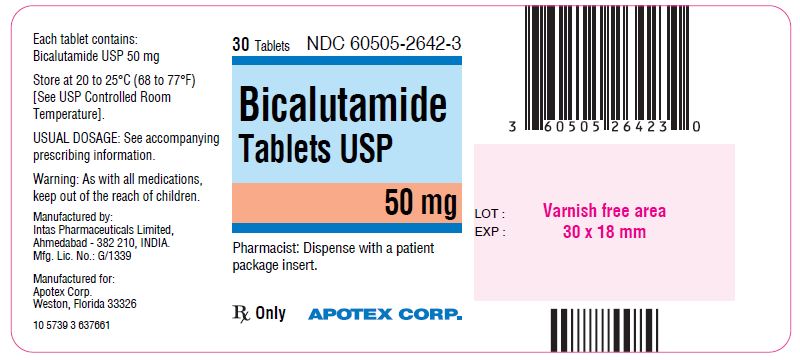
Bicalutamide label

Bicalutamide

Bicalutamide Recall

Get an alert when a recall is issued.

Side Effects & Adverse Reactions

There is currently no warning information available for this product. We apologize for any inconvenience.

FDA Safety Alerts

There are currently no FDA safety alerts available for this drug.

Manufacturer Warnings

There is currently no manufacturer warning information available for this drug.

FDA Labeling Changes

There are currently no FDA labeling changes available for this drug.

Uses

Bicalutamide tablets, USP 50 mg daily are indicated for use in combination therapy with a luteinizing hormone-releasing hormone (LHRH) analog for the treatment of Stage D2 metastatic carcinoma of the prostate.

Bicalutamide tablets, USP 150 mg daily are not approved for use alone or with other treatments [see Clinical Studies (14.2)].

History

There is currently no drug history available for this drug.

Other Information

Bicalutamide tablets contain 50 mg of bicalutamide USP, a non-steroidal androgen receptor inhibitor with no other known endocrine activity. The chemical name is propanamide, N [4 cyano-3-(trifluoromethyl)phenyl]-3-[(4-fluorophenyl)sulfonyl]-2-hydroxy-2-methyl-,(+-). The structural and molecular formulas are:
bicalutamide-structure

Bicalutamide has a molecular weight of 430.37. The pKa’ is approximately 12. Bicalutamide is a fine white to off white powder which is practically insoluble in water at 37°C (5 mg per 1000 mL), slightly soluble in chloroform and absolute ethanol, sparingly soluble in methanol, and soluble in acetone and tetrahydrofuran.

Bicalutamide tablet is a racemate with its antiandrogenic activity being almost exclusively exhibited by the R-enantiomer of bicalutamide; the S-enantiomer is essentially inactive.

The inactive ingredients of bicalutamide tablets are lactose monohydrate, sodium starch glycolate type A, povidone, magnesium stearate, hypromellose, polyethylene glycol, and titanium dioxide.

Bicalutamide Manufacturers

  • Sun Pharma Global Fze
    Bicalutamide | Sun Pharma Global Fze
    No Recall

    Bicalutamide | Sun Pharma Global Fze

    Bicalutamide | Sun Pharma Global Fze

    The recommended dose for bicalutamide tablets therapy in combination with an LHRH analog is one 50 mg tablet once daily (morning or evening), with or without food. It is recommended that bicalutamide tablets be taken at the same time each day. Treatment with bicalutamide tablets should be started at the same time as treatment with an LHRH analog.

    2.1. Dosage Adjustment in Renal Impairment

    No dosage adjustment is necessary for patients with renal impairment [see Use in Specific Populations (8.7)].

    2.2. Dosage Adjustment in Hepatic Impairment

    No dosage adjustment is necessary for patients with mild to moderate hepatic impairment. In patients with severe liver impairment (n=4), although there was a 76% increase in the half-life (5.9 and 10.4 days for normal and impaired patients, respectively) of the active enantiomer of bicalutamide no dosage adjustment is necessary [see Use in Specific Populations (8.6)].

  • Bicalutamide | Golden State Medical Supply, Inc.
    No Recall

    Bicalutamide | Golden State Medical Supply, Inc.

    Bicalutamide | Golden State Medical Supply, Inc.

    The recommended dose for bicalutamide tablets therapy in combination with an LHRH analog is one 50 mg tablet once daily (morning or evening), with or without food. It is recommended that bicalutamide tablets be taken at the same time each day. Treatment with bicalutamide tablets should be started at the same time as treatment with an LHRH analog.

    2.1. Dosage Adjustment in Renal Impairment

    No dosage adjustment is necessary for patients with renal impairment [see Use in Specific Populations (8.7)].

    2.2. Dosage Adjustment in Hepatic Impairment

    No dosage adjustment is necessary for patients with mild to moderate hepatic impairment. In patients with severe liver impairment (n=4), although there was a 76% increase in the half-life (5.9 and 10.4 days for normal and impaired patients, respectively) of the active enantiomer of bicalutamide no dosage adjustment is necessary [see Use in Specific Populations (8.6)].

  • Dava Pharmaceuticals, Inc.
    Bicalutamide | Dava Pharmaceuticals, Inc.
    No Recall

    Bicalutamide | Dava Pharmaceuticals, Inc.

    Bicalutamide | Dava Pharmaceuticals, Inc.

    The recommended dose for Bicalutamide Tablets, USP therapy in combination with an LHRH analog is one 50 mg tablet once daily (morning or evening), with or without food. It is recommended that Bicalutamide Tablets, USP be taken at the same time each day. Treatment with Bicalutamide Tablets, USP should be started at the same time as treatment with an LHRH analog.

    2.1. Dosage Adjustment in Renal Impairment

    No dosage adjustment is necessary for patients with renal impairment [see Use in Specific Populations (8.7)].

    2.2. Dosage Adjustment in Hepatic Impairment

    No dosage adjustment is necessary for patients with mild to moderate hepatic impairment. In patients with severe liver impairment (n=4), although there was a 76% increase in the half-life (5.9 and 10.4 days for normal and impaired patients, respectively) of the active enantiomer of bicalutamide no dosage adjustment is necessary [see Use in Specific Populations (8.6)].

  • Major Pharmaceuticals
    Bicalutamide | Major Pharmaceuticals
    No Recall

    Bicalutamide | Major Pharmaceuticals

    Bicalutamide | Major Pharmaceuticals

    The recommended dose for bicalutamide therapy in combination with an LHRH analog is one 50 mg tablet once daily (morning or evening), with or without food. It is recommended that bicalutamide tablets be taken at the same time each day. Treatment with bicalutamide should be started at the same time as treatment with an LHRH analog.

    2.1. Dosage Adjustment in Renal Impairment

    No dosage adjustment is necessary for patients with renal impairment [see Use in Specific Populations (8.7)].

    2.2. Dosage Adjustment in Hepatic Impairment

    No dosage adjustment is necessary for patients with mild to moderate hepatic impairment. In patients with severe liver impairment (n=4), although there was a 76% increase in the half-life (5.9 and 10.4 days for normal and impaired patients, respectively) of the active enantiomer of bicalutamide no dosage adjustment is necessary [see Use in Specific Populations (8.6)].

  • Physicians Total Care, Inc.
    Bicalutamide | Physicians Total Care, Inc.
    No Recall

    Bicalutamide | Physicians Total Care, Inc.

    Bicalutamide | Physicians Total Care, Inc.

    The recommended dose for bicalutamide therapy in combination with an LHRH analog is one 50 mg tablet once daily (morning or evening), with or without food. It is recommended that bicalutamide tablets be taken at the same time each day. Treatment with bicalutamide should be started at the same time as treatment with an LHRH analog.

    2.1 Dosage Adjustment in Renal Impairment

    No dosage adjustment is necessary for patients with renal impairment [see Use in Specific Populations (8.7)].

    2.2 Dosage Adjustment in Hepatic Impairment

    No dosage adjustment is necessary for patients with mild to moderate hepatic impairment. In patients with severe liver impairment (n = 4), although there was a 76% increase in the half-life (5.9 and 10.4 days for normal and impaired patients, respectively) of the active enantiomer of bicalutamide no dosage adjustment is necessary [see Use in Specific Populations (8.6)].

  • Synthon Pharmaceuticals, Inc.
    Bicalutamide | Synthon Pharmaceuticals, Inc.
    No Recall

    Bicalutamide | Synthon Pharmaceuticals, Inc.

    Bicalutamide | Synthon Pharmaceuticals, Inc.

    The recommended dose for Bicalutamide Tablets, USP therapy in combination with an LHRH analog is one 50 mg tablet once daily (morning or evening), with or without food. It is recommended that Bicalutamide Tablets, USP be taken at the same time each day. Treatment with Bicalutamide Tablets, USP should be started at the same time as treatment with an LHRH analog.

    2.1. Dosage Adjustment in Renal Impairment

    No dosage adjustment is necessary for patients with renal impairment [see Use in Specific Populations (8.7)].

    2.2. Dosage Adjustment in Hepatic Impairment

    No dosage adjustment is necessary for patients with mild to moderate hepatic impairment. In patients with severe liver impairment (n=4), although there was a 76% increase in the half-life (5.9 and 10.4 days for normal and impaired patients, respectively) of the active enantiomer of bicalutamide no dosage adjustment is necessary [see Use in Specific Populations (8.6)].

  • Bicalutamide | Breckenridge Pharmaceutical, Inc.
    No Recall

    Bicalutamide | Breckenridge Pharmaceutical, Inc.

    Bicalutamide | Breckenridge Pharmaceutical, Inc.

    The recommended dose for Bicalutamide Tablets, USP therapy in combination with an LHRH analog is one 50 mg tablet once daily (morning or evening), with or without food. It is recommended that Bicalutamide Tablets, USP be taken at the same time each day. Treatment with Bicalutamide Tablets, USP should be started at the same time as treatment with an LHRH analog.

    2.1. Dosage Adjustment in Renal Impairment

    No dosage adjustment is necessary for patients with renal impairment [see Use in Specific Populations (8.7)].

    2.2. Dosage Adjustment in Hepatic Impairment

    No dosage adjustment is necessary for patients with mild to moderate hepatic impairment. In patients with severe liver impairment (n=4), although there was a 76% increase in the half-life (5.9 and 10.4 days for normal and impaired patients, respectively) of the active enantiomer of bicalutamide no dosage adjustment is necessary [see Use in Specific Populations (8.6)].

  • Udl Laboratories, Inc.
    Bicalutamide | Udl Laboratories, Inc.
    No Recall

    Bicalutamide | Udl Laboratories, Inc.

    Bicalutamide | Udl Laboratories, Inc.

    The recommended dose for bicalutamide tablets therapy in combination with an LHRH analog is one 50 mg tablet once daily (morning or evening), with or without food. It is recommended that bicalutamide tablets be taken at the same time each day. Treatment with bicalutamide tablets should be started at the same time as treatment with an LHRH analog.

    2.1 Dosage Adjustment in Renal Impairment

    No dosage adjustment is necessary for patients with renal impairment [see Use in Specific Populations (8.7)].

    2.2 Dosage Adjustment in Hepatic Impairment

    No dosage adjustment is necessary for patients with mild to moderate hepatic impairment. In patients with severe liver impairment (n = 4), although there was a 76% increase in the half-life (5.9 and 10.4 days for normal and impaired patients, respectively) of the active enantiomer of bicalutamide no dosage adjustment is necessary [see Use in Specific Populations (8.6)].

  • Bicalutamide | American Health Packaging
    No Recall

    Bicalutamide | American Health Packaging

    Bicalutamide | American Health Packaging

    The recommended dose for bicalutamide tablets therapy in combination with an LHRH analog is one 50 mg tablet once daily (morning or evening), with or without food. It is recommended that bicalutamide tablets be taken at the same time each day. Treatment with bicalutamide tablets should be started at the same time as treatment with an LHRH analog.

    2.1 Dosage Adjustment in Renal Impairment

    No dosage adjustment is necessary for patients with renal impairment [see Use in Specific Populations (8.7)].

    2.2 Dosage Adjustment in Hepatic Impairment

    No dosage adjustment is necessary for patients with mild to moderate hepatic impairment. In patients with severe liver impairment (n=4), although there was a 76% increase in the half-life (5.9 and 10.4 days for normal and impaired patients, respectively) of the active enantiomer of bicalutamide no dosage adjustment is necessary [see Use in Specific Populations (8.6)].

  • Northstar Rx Llc
    Bicalutamide | Reckitt Benckiser Llc
    No Recall

    Bicalutamide | Reckitt Benckiser Llc

    Bicalutamide | Reckitt Benckiser Llc
    shake bottle well before use measure only with dosing cup provided. Do not use dosing cup with other products. dose as follows or as directed by a doctor mL = milliliter adults and children 12 years of age and over 10 mL every 12 hours,
    not to exceed 20 mL in 24 hours children 6 to under 12 years of age 5 mL every 12 hours,
    not to exceed 10 mL in 24 hours children 4 to under 6 years of age 2.5 mL every 12 hours,
    not to exceed 5 mL in 24 hours children under 4 years of age do not use
  • Bicalutamide | Cadila Healthcare Limited
    No Recall

    Bicalutamide | Cadila Healthcare Limited

    Bicalutamide | Cadila Healthcare Limited

    The recommended dose for bicalutamide tablets therapy in combination with an LHRH analog is one 50 mg tablet once daily (morning or evening), with or without food. It is recommended that bicalutamide tablets be taken at the same time each day. Treatment with bicalutamide tablets should be started at the same time as treatment with an LHRH analog.

    2.1 Dosage Adjustment in Renal Impairment

    No dosage adjustment is necessary for patients with renal impairment [see Use in Specific Populations (8.7)].

    2.2 Dosage Adjustment in Hepatic Impairment

    No dosage adjustment is necessary for patients with mild to moderate hepatic impairment. In patients with severe liver impairment (n=4), although there was a 76% increase in the half-life (5.9 and 10.4 days for normal and impaired patients, respectively) of the active enantiomer of bicalutamide no dosage adjustment is necessary [see Use in Specific Populations (8.6)].

  • Accord Healthcare Inc
    Bicalutamide | Johnson & Johnson Consumer Inc.
    No Recall

    Bicalutamide | Johnson & Johnson Consumer Inc.

    Bicalutamide | Johnson & Johnson Consumer Inc.
    Clean the skin thoroughly before applying this product. Cover the entire affected area with a thin layer one to three times daily. Because excessive drying of the skin may occur, start with one application daily, then gradually increase to two or three times daily if needed or as directed by a doctor. If bothersome dryness or peeling occurs, reduce application to once a day or every other day. If going outside, apply sunscreen after using this product. If irritation or sensitivity develops, stop use of both products and ask a doctor.
  • Bicalutamide | Pd-rx Pharmaceuticals, Inc.
    No Recall

    Bicalutamide | Pd-rx Pharmaceuticals, Inc.

    Bicalutamide | Pd-rx Pharmaceuticals, Inc.

    Dosage should be individualized for maximum beneficial effect. While the usual daily dosages given below will meet the needs of most patients, there will be some who may require higher doses. In such cases dosage should be increased cautiously to avoid adverse effects.

    ADULTS: USUAL DAILY DOSE: Management of Anxiety Disorders and Relief
    of Symptoms of Anxiety Depending upon severity of symptoms - 2mg
    to 10 mg, 2 or 4 times daily Symptomatic Relief in Acute Alcohol
    Withdrawal 10 mg, 3 or 4 times during the first 24 hours,
    reducing to 5 mg, 3 or 4 times daily as needed Adjunctively for Relief of Skeletal Muscle
    Spasm 2 mg to 10 mg, 3 or 4 times daily
    Adjunctively in Convulsive Disorders 2 mg to 10 mg, 2 to 4 times daily Geriatric Patients, or in the presence of
    debilitating disease 2 mg to 2.5 mg, 1 or 2 times daily initially;
    increase gradually as needed and tolerated PEDIATRIC PATIENTS: Because of varied responses to CNS-acting
    drugs, initiate therapy with lowest dose and
    increase as required. Not for use in pediatric
    patients under 6 months 1 mg to 2.5 mg, 3 or 4 times daily initially;
    increase gradually as needed and tolerated

  • Bicalutamide | Golden State Medical Supply, Inc.
    No Recall

    Bicalutamide | Golden State Medical Supply, Inc.

    Bicalutamide | Golden State Medical Supply, Inc.

    The recommended dose for Bicalutamide Tablets, USP therapy in combination with an LHRH analog is one 50 mg tablet once daily (morning or evening), with or without food. It is recommended that Bicalutamide Tablets, USP be taken at the same time each day. Treatment with Bicalutamide Tablets, USP should be started at the same time as treatment with an LHRH analog.

    2.1. Dosage Adjustment in Renal Impairment

    No dosage adjustment is necessary for patients with renal impairment [see Use in Specific Populations (8.7)].

    2.2. Dosage Adjustment in Hepatic Impairment

    No dosage adjustment is necessary for patients with mild to moderate hepatic impairment. In patients with severe liver impairment (n=4), although there was a 76% increase in the half-life (5.9 and 10.4 days for normal and impaired patients, respectively) of the active enantiomer of bicalutamide no dosage adjustment is necessary [see Use in Specific Populations (8.6)].

  • Bicalutamide | Apotex Corp.
    No Recall

    Bicalutamide | Apotex Corp.

    Bicalutamide | Apotex Corp.

    The recommended dose for bicalutamide tablets therapy in combination with an LHRH analog is one 50 mg tablet once daily (morning or evening), with or without food. It is recommended that bicalutamide tablets be taken at the same time each day. Treatment with bicalutamide tablets should be started at the same time as treatment with an LHRH analog.

    2.1. Dosage Adjustment in Renal Impairment

    No dosage adjustment is necessary for patients with renal impairment [see Use in Specific Populations (8.7)].

    2.2. Dosage Adjustment in Hepatic Impairment

    No dosage adjustment is necessary for patients with mild to moderate hepatic impairment. In patients with severe liver impairment (n=4), although there was a 76% increase in the half-life (5.9 and 10.4 days for normal and impaired patients, respectively) of the active enantiomer of bicalutamide no dosage adjustment is necessary [see Use in Specific Populations (8.6)].

  • Sandoz Inc
    Bicalutamide | Sandoz Inc
    No Recall

    Bicalutamide | Sandoz Inc

    Bicalutamide | Sandoz Inc
    2.1 Recommended Dose and Schedule

    The recommended dose for bicalutamide therapy in combination with an LHRH analog is one 50 mg tablet once daily (morning or evening), with or without food. It is recommended that bicalutamide be taken at the same time each day. Treatment with bicalutamide should be started at the same time as treatment with an LHRH analog. If a dose of bicalutamide is missed, take the next dose at the scheduled time. Do not take the missed dose and do not double the next dose.

    2.2 Dosage Adjustment in Renal Impairment

    No dosage adjustment is necessary for patients with renal impairment [see Use in Specific Populations (8.7)].

    2.3 Dosage Adjustment in Hepatic Impairment

    No dosage adjustment is necessary for patients with mild to moderate hepatic impairment. In patients with severe liver impairment (n=4), although there was a 76% increase in the half-life (5.9 and 10.4 days for normal and impaired patients, respectively) of the active enantiomer of bicalutamide no dosage adjustment is necessary [see Use in Specific Populations (8.6)].

  • Bicalutamide | Hyvee Inc
    No Recall

    Bicalutamide | Hyvee Inc

    Bicalutamide | Hyvee Inc
    • take only as directed – see overdose warning • do not exceed 4 doses per 24 hrs

    adults & children 12 yrs & over

    2 softgels with water every 6 hrs

    children 4 to under 12 yrs

    ask a doctor

    children under 4 yrs

    do not use

  • Remedyrepack Inc.
    Bicalutamide | Remedyrepack Inc.
    No Recall

    Bicalutamide | Remedyrepack Inc.

    Bicalutamide | Remedyrepack Inc.

    The recommended dose for bicalutamide tablets therapy in combination with an LHRH analog is one 50 mg tablet once daily (morning or evening), with or without food. It is recommended that bicalutamide tablets be taken at the same time each day. Treatment with bicalutamide tablets should be started at the same time as treatment with an LHRH analog.


    No dosage adjustment is necessary for patients with renal impairment [see Use in Specific Populations(8.7)].


    No dosage adjustment is necessary for patients with mild to moderate hepatic impairment. In patients with severe liver impairment (n=4), although there was a 76% increase in the half-life (5.9 and 10.4 days for normal and impaired patients, respectively) of the active enantiomer of bicalutamide no dosage adjustment is necessary [see Use in Specific Populations (8.6)].


  • Sun Pharma Global Inc.
    Bicalutamide | Sun Pharma Global Inc.
    No Recall

    Bicalutamide | Sun Pharma Global Inc.

    Bicalutamide | Sun Pharma Global Inc.

    The recommended dose for bicalutamide tablets therapy in combination with an LHRH analog is one 50 mg tablet once daily (morning or evening), with or without food. It is recommended that bicalutamide tablets be taken at the same time each day. Treatment with bicalutamide tablets should be started at the same time as treatment with an LHRH analog.

    2.1. Dosage Adjustment in Renal Impairment

    No dosage adjustment is necessary for patients with renal impairment [see Use in Specific Populations (8.7)].

    2.2. Dosage Adjustment in Hepatic Impairment

    No dosage adjustment is necessary for patients with mild to moderate hepatic impairment. In patients with severe liver impairment (n=4), although there was a 76% increase in the half-life (5.9 and 10.4 days for normal and impaired patients, respectively) of the active enantiomer of bicalutamide no dosage adjustment is necessary [see Use in Specific Populations (8.6)].

  • Avkare, Inc.
    Bicalutamide | Avkare, Inc.
    No Recall

    Bicalutamide | Avkare, Inc.

    Bicalutamide | Avkare, Inc.

    The recommended dose for bicalutamide therapy in combination with an LHRH analog is one 50 mg tablet once daily (morning or evening), with or without food. It is recommended that bicalutamide tablets USP be taken at the same time each day. Treatment with bicalutamide tablets USP should be started at the same time as treatment with an LHRH analog.

    2.1 Dosage Adjustment in Renal Impairment

    No dosage adjustment is necessary for patients with renal impairment [see Use in Specific Populations (8.7)].

    2.2 Dosage Adjustment in Hepatic Impairment

    No dosage adjustment is necessary for patients with mild to moderate hepatic impairment. In patients with severe liver impairment (n = 4), although there was a 76% increase in the half-life (5.9 and 10.4 days for normal and impaired patients, respectively) of the active enantiomer of bicalutamide no dosage adjustment is necessary [see Use in Specific Populations (8.6)].

  • Bicalutamide | Zydus Pharmaceuticals (usa) Inc.
    No Recall

    Bicalutamide | Zydus Pharmaceuticals (usa) Inc.

    Bicalutamide | Zydus Pharmaceuticals (usa) Inc.

    The recommended dose for bicalutamide tablets therapy in combination with an LHRH analog is one 50 mg tablet once daily (morning or evening), with or without food. It is recommended that bicalutamide tablets be taken at the same time each day. Treatment with bicalutamide tablets should be started at the same time as treatment with an LHRH analog.

    2.1 Dosage Adjustment in Renal Impairment

    No dosage adjustment is necessary for patients with renal impairment [see Use in Specific Populations (8.7)].

    2.2 Dosage Adjustment in Hepatic Impairment

    No dosage adjustment is necessary for patients with mild to moderate hepatic impairment. In patients with severe liver impairment (n=4), although there was a 76% increase in the half-life (5.9 and 10.4 days for normal and impaired patients, respectively) of the active enantiomer of bicalutamide no dosage adjustment is necessary [see Use in Specific Populations (8.6)].

  • Bryant Ranch Prepack
    Bicalutamide | Bryant Ranch Prepack
    No Recall

    Bicalutamide | Bryant Ranch Prepack

    Bicalutamide | Bryant Ranch Prepack

    The recommended dose for bicalutamide tablets therapy in combination with an LHRH analog is one 50 mg tablet once daily (morning or evening), with or without food. It is recommended that bicalutamide tablets be taken at the same time each day. Treatment with bicalutamide tablets should be started at the same time as treatment with an LHRH analog.

    2.1. Dosage Adjustment in Renal Impairment

    No dosage adjustment is necessary for patients with renal impairment [see Use in Specific Populations(8.7)].

    2.2. Dosage Adjustment in Hepatic Impairment

    No dosage adjustment is necessary for patients with mild to moderate hepatic impairment. In patients with severe liver impairment (n=4), although there was a 76% increase in the half-life (5.9 and 10.4 days for normal and impaired patients, respectively) of the active enantiomer of bicalutamide no dosage adjustment is necessary [see Use in Specific Populations (8.6)].

  • Mylan Pharmaceuticals Inc
    Bicalutamide | Mylan Pharmaceuticals Inc
    No Recall

    Bicalutamide | Mylan Pharmaceuticals Inc

    Bicalutamide | Mylan Pharmaceuticals Inc
    2.1 Recommended Dose and Schedule

    The recommended dose for bicalutamide tablets therapy in combination with an LHRH analog is one 50 mg tablet once daily (morning or evening), with or without food. It is recommended that bicalutamide tablets be taken at the same time each day. Treatment with bicalutamide tablets should be started at the same time as treatment with an LHRH analog. If a dose of bicalutamide tablets is missed, take the next dose at the scheduled time. Do not take the missed dose and do not double the next dose.

    2.2 Dosage Adjustment in Renal Impairment

    No dosage adjustment is necessary for patients with renal impairment [see Use in Specific Populations (8.7)].

    2.3 Dosage Adjustment in Hepatic Impairment

    No dosage adjustment is necessary for patients with mild to moderate hepatic impairment. In patients with severe liver impairment (n = 4), although there was a 76% increase in the half-life (5.9 and 10.4 days for normal and impaired patients, respectively) of the active enantiomer of bicalutamide no dosage adjustment is necessary [see Use in Specific Populations (8.6)].