Bumetanide label

Bumetanide

Bumetanide Recall

Get an alert when a recall is issued.

Side Effects & Adverse Reactions

Volume and Electrolyte Depletion

The dose of bumetanide should be adjusted to the patient’s need. Excessive doses or too frequent administration can lead to profound water loss, electrolyte depletion, dehydration, reduction in blood volume and circulatory collapse with the possibility of vascular thrombosis and embolism, particularly in elderly patients.

Hypokalemia

Hypokalemia can occur as a consequence of bumetanide administration. Prevention of hypokalemia requires particular attention in the following conditions: patients receiving digitalis and diuretics for congestive heart failure, hepatic cirrhosis and ascites, states of aldosterone excess with normal renal function, potassium-losing nephropathy, certain diarrheal states, or other states where hypokalemia is thought to represent particular added risks to the patient, i.e., history of ventricular arrhythmias.

In patients with hepatic cirrhosis and ascites, sudden alterations of electrolyte balance may precipitate hepatic encephalopathy and coma. Treatment in such patients is best initiated in the hospital with small doses and careful monitoring of the patient’s clinical status and electrolyte balance. Supplemental potassium and/or spironolactone may prevent hypokalemia and metabolic alkalosis in these patients.

Ototoxicity

In cats, dogs and guinea pigs, bumetanide has been shown to produce ototoxicity. In these test animals bumetanide was 5 to 6 times more potent than furosemide and, since the diuretic potency of bumetanide is about 40 to 60 times furosemide, it is anticipated that blood levels necessary to produce ototoxicity will rarely be achieved. The potential exists, however, and must be considered a risk of intravenous therapy, especially at high doses, repeated frequently in the face of renal excretory function impairment. Potentiation of aminoglycoside ototoxicity has not been tested for bumetanide. Like other members of this class of diuretics, bumetanide probably shares this risk.

Allergy to Sulfonamides

Patients allergic to sulfonamides may show hypersensitivity to bumetanide.

Thrombocytopenia

Since there have been rare spontaneous reports of thrombocytopenia from postmarketing experience, patients should be observed regularly for possible occurrence of thrombocytopenia.

FDA Safety Alerts

There are currently no FDA safety alerts available for this drug.

Manufacturer Warnings

There is currently no manufacturer warning information available for this drug.

FDA Labeling Changes

There are currently no FDA labeling changes available for this drug.

Uses

Bumetanide Injection is indicated for the treatment of edema associated with congestive heart failure, hepatic and renal disease, including the nephrotic syndrome.

Almost equal diuretic response occurs after oral and parenteral administration of bumetanide. Therefore, if impaired gastrointestinal absorption is suspected or oral administration is not practical, bumetanide should be given by the intramuscular or intravenous route.

Successful treatment with bumetanide following instances of allergic reactions to furosemide suggests a lack of cross-sensitivity.

History

There is currently no drug history available for this drug.

Other Information

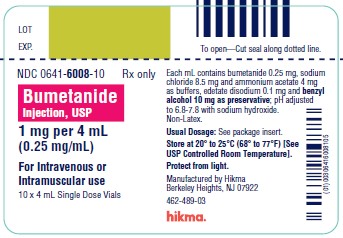
Bumetanide is a loop diuretic, available as 4 mL vials and 10 mL vials (0.25 mg/mL) for intravenous or intramuscular injection as a sterile solution.

Each mL contains bumetanide 0.25 mg, sodium chloride 8.5 mg and ammonium acetate 4 mg as buffers, edetate disodium 0.1 mg and benzyl alcohol 10 mg as preservative in Water for Injection. pH adjusted to 6.8 – 7.8 with sodium hydroxide.

Chemically, bumetanide is 3-(butylamino)-4-phenoxy-5-sulfamoylbenzoic acid. It is a practically white powder, slightly soluble in water, soluble in alkaline solutions, having the following structural formula:

Structural formula

C17H20N2O5S      Molecular weight: 364.42

Bumetanide Manufacturers

  • West-ward Pharmaceutical Corp.
    Bumetanide | West-ward Pharmaceutical Corp.
    No Recall

    Bumetanide | West-ward Pharmaceutical Corp.

    Bumetanide | West-ward Pharmaceutical Corp.

    Dosage should be individualized with careful monitoring of patient response.

    Parenteral Administration

    Bumetanide Injection may be administered parenterally (IV or IM) to patients in whom gastrointestinal absorption may be impaired or in whom oral administration is not practical.

    Parenteral treatment should be terminated and oral treatment instituted as soon as possible.

    The usual initial dose is 0.5 to 1 mg intravenously or intramuscularly. Intravenous administration should be given over a period of 1 to 2 minutes. If the response to an initial dose is deemed insufficient, a second or third dose may be given at intervals of 2 to 3 hours, but should not exceed a daily dosage of 10 mg.

    Miscibility and Parenteral Solutions

    The compatibility tests of bumetanide injection with 5% Dextrose Injection in Water, 0.9% Sodium Chloride Injection, and Lactated Ringer’s Injection in both glass and plasticized PVC (Viaflex) containers have shown no significant absorption effect with either containers, nor a measurable loss of potency due to degradation of the drug. However, solutions should be freshly prepared and used within 24 hours.

    Parenteral drug products should be inspected visually for particulate matter and discoloration prior to administration, whenever solution and container permit.

  • Avkare, Inc.
    Bumetanide | Meijer
    No Recall

    Bumetanide | Meijer

    Bumetanide | Meijer
    dissolve in mouth or chew before swallowing take every 4 to 6 hours do not take more than 6 doses in 24 hours children under 2 years of age do not use  children 2 to under 6 years of age

    do not use unless
    directed by a doctor 

    children 6 to under 12 years of age  1 to 2 tablets 

    adults and children 12 years of age
    and over

    2 to 4 tablets
  • Baxter Healthcare Corporation
    Bumetanide | Baxter Healthcare Corporation
    No Recall

    Bumetanide | Baxter Healthcare Corporation

    Bumetanide | Baxter Healthcare Corporation

    Dosage should be individualized with careful monitoring of patient response.

    Parenteral Administration

    Bumetanide Injection may be administered parenterally (IV or IM) to patients in whom gastrointestinal absorption may be impaired or in whom oral administration is not practical.

    Parenteral treatment should be terminated and oral treatment instituted as soon as possible.

    The usual initial dose is 0.5 to 1 mg intravenously or intramuscularly. Intravenous administration should be given over a period of 1 to 2 minutes. If the response to an initial dose is deemed insufficient, a second or third dose may be given at intervals of 2 to 3 hours, but should not exceed a daily dosage of 10 mg.

    Miscibility and Parenteral Solutions

    The compatibility tests of bumetanide injection with 5% Dextrose Injection, 0.9% Sodium Chloride Injection, and Lactated Ringer’s Injection in both glass and plasticized PVC (Viaflex) containers have shown no significant absorption effect with either containers, nor a measurable loss of potency due to degradation of the drug. However, solutions should be freshly prepared and used within 24 hours.

    Parenteral drug products should be inspected visually for particulate matter and discoloration prior to administration, whenever solution and container permit.

  • Eon Labs, Inc.
    Bumetanide | Eon Labs, Inc.
    No Recall

    Bumetanide | Eon Labs, Inc.

    Bumetanide | Eon Labs, Inc.

    Dosage should be individualized with careful monitoring of patient response.

    Oral Administration

     The usual total daily dosage of bumetanide tablets is 0.5 mg to 2 mg and in most patients is given as a single dose.

    If the diuretic response to an initial dose of bumetanide tablets is not adequate, in view of its rapid onset and short duration of action, a second or third dose may be given at 4 to 5 hour intervals up to a maximum daily dose of 10 mg. An intermittent dose schedule, whereby bumetanide tablets is given on alternate days or for 3 to 4 days with rest periods of 1 to 2 days in between, is recommended as the safest and most effective method for the continued control of edema. In patients with hepatic failure, the dosage should be kept to a minimum, and if necessary, dosage increased very carefully.

    Because cross-sensitivity with furosemide has rarely been observed, bumetanide tablets can be substituted at approximately a 1:40 ratio of bumetanide tablets to furosemide in patients allergic to furosemide.

    Parenteral Administration: Bumetanide injection may be administered parenterally (IV or IM) to patients in whom gastrointestinal absorption may be impaired or in whom oral administration is not practical.

    Parenteral treatment should be terminated and oral treatment instituted as soon as possible.

  • Bumetanide | Cardinal Health
    No Recall

    Bumetanide | Cardinal Health

    Bumetanide | Cardinal Health

    Dosage should be individualized with careful monitoring of patient response.

    Parenteral Administration

    Bumetanide injection may be administered parenterally (IV or IM) to patients in whom gastrointestinal absorption may be impaired or in whom oral administration is not practical.

    Parenteral treatment should be terminated and oral treatment instituted as soon as possible.

    The usual initial dose is 0.5 to 1 mg intravenously or intramuscularly. Intravenous administration should be given over a period of 1 to 2 minutes. If the response to an initial dose is deemed insufficient, a second or third dose may be given at intervals of 2 to 3 hours, but should not exceed a daily dosage of 10 mg.

    Miscibility and Parenteral Solutions

    The compatibility tests of bumetanide injection with 5% Dextrose Injection in Water, 0.9% Sodium Chloride Injection, and Lactated Ringer’s Injection in both glass and plasticized PVC (Viaflex) containers have shown no significant absorption effect with either containers, nor a measurable loss of potency due to degradation of the drug. However, solutions should be freshly prepared and used within 24 hours.

    Parenteral drug products should be inspected visually for particulate matter and discoloration prior to administration whenever solution and container permit.

  • Bumetanide | Cardinal Health
    No Recall

    Bumetanide | Cardinal Health

    Bumetanide | Cardinal Health

    Dosage should be individualized with careful monitoring of patient response.

    Parenteral Administration

    Bumetanide Injection may be administered parenterally (IV or IM) to patients in whom gastrointestinal absorption may be impaired or in whom oral administration is not practical.

    Parenteral treatment should be terminated and oral treatment instituted as soon as possible.

    The usual initial dose is 0.5 to 1 mg intravenously or intramuscularly. Intravenous administration should be given over a period of 1 to 2 minutes. If the response to an initial dose is deemed insufficient, a second or third dose may be given at intervals of 2 to 3 hours, but should not exceed a daily dosage of 10 mg.

    Miscibility and Parenteral Solutions

    The compatibility tests of bumetanide injection with 5% Dextrose Injection, 0.9% Sodium Chloride Injection, and Lactated Ringer’s Injection in both glass and plasticized PVC (Viaflex) containers have shown no significant absorption effect with either containers, nor a measurable loss of potency due to degradation of the drug. However, solutions should be freshly prepared and used within 24 hours.

    Parenteral drug products should be inspected visually for particulate matter and discoloration prior to administration, whenever solution and container permit.

  • West-ward Pharmaceutical Corp.
    Bumetanide | West-ward Pharmaceutical Corp.
    No Recall

    Bumetanide | West-ward Pharmaceutical Corp.

    Bumetanide | West-ward Pharmaceutical Corp.

    Dosage should be individualized with careful monitoring of patient response.

    Parenteral Administration

    Bumetanide Injection may be administered parenterally (IV or IM) to patients in whom gastrointestinal absorption may be impaired or in whom oral administration is not practical.

    Parenteral treatment should be terminated and oral treatment instituted as soon as possible.

    The usual initial dose is 0.5 to 1 mg intravenously or intramuscularly. Intravenous administration should be given over a period of 1 to 2 minutes. If the response to an initial dose is deemed insufficient, a second or third dose may be given at intervals of 2 to 3 hours, but should not exceed a daily dosage of 10 mg.

    Miscibility and Parenteral Solutions

    The compatibility tests of bumetanide injection with 5% Dextrose Injection in Water, 0.9% Sodium Chloride Injection, and Lactated Ringer’s Injection in both glass and plasticized PVC (Viaflex) containers have shown no significant absorption effect with either containers, nor a measurable loss of potency due to degradation of the drug. However, solutions should be freshly prepared and used within 24 hours.

    Parenteral drug products should be inspected visually for particulate matter and discoloration prior to administration, whenever solution and container permit.

  • Physicians Total Care, Inc.
    Bumetanide | Physicians Total Care, Inc.
    No Recall

    Bumetanide | Physicians Total Care, Inc.

    Bumetanide | Physicians Total Care, Inc.

    Dosage should be individualized with careful monitoring of patient response.

    Oral Administration

     The usual total daily dosage of bumetanide tablets is 0.5 mg to 2 mg and in most patients is given as a single dose.

    If the diuretic response to an initial dose of bumetanide tablets is not adequate, in view of its rapid onset and short duration of action, a second or third dose may be given at 4 to 5 hour intervals up to a maximum daily dose of 10 mg. An intermittent dose schedule, whereby bumetanide tablets is given on alternate days or for 3 to 4 days with rest periods of 1 to 2 days in between, is recommended as the safest and most effective method for the continued control of edema. In patients with hepatic failure, the dosage should be kept to a minimum, and if necessary, dosage increased very carefully.

    Because cross-sensitivity with furosemide has rarely been observed, bumetanide tablets can be substituted at approximately a 1:40 ratio of bumetanide tablets to furosemide in patients allergic to furosemide.

    Parenteral Administration: Bumetanide injection may be administered parenterally (IV or IM) to patients in whom gastrointestinal absorption may be impaired or in whom oral administration is not practical.

    Parenteral treatment should be terminated and oral treatment instituted as soon as possible.

  • Ncs Healthcare Of Ky, Inc Dba Vangard Labs
    Bumetanide | Ncs Healthcare Of Ky, Inc Dba Vangard Labs
    No Recall

    Bumetanide | Ncs Healthcare Of Ky, Inc Dba Vangard Labs

    Bumetanide | Ncs Healthcare Of Ky, Inc Dba Vangard Labs

    Dosage should be individualized with careful monitoring of patient response.

    Oral Administration

    The usual total daily dosage of bumetanide is 0.5 to 2 mg and in most patients is given as a single dose.

    If the diuretic response to an initial dose of bumetanide is not adequate, in view of its rapid onset and short duration of action, a second or third dose may be given at 4- to 5-hour intervals up to a maximum daily dose of 10 mg. An intermittent dose schedule, whereby bumetanide is given on alternate days or for 3 to 4 days with rest periods of 1 to 2 days in between, is recommended as the safest and most effective method for the continued control of edema. In patients with hepatic failure, the dosage should be kept to a minimum, and if necessary, dosage increased very carefully. Because cross-sensitivity with furosemide has rarely been observed, bumetanide can be substituted at approximately a 1:40 ratio of bumetanide to furosemide in patients allergic to furosemide.

    Parenteral Administration

    Bumetanide Injection may be administered parenterally (IV or IM) to patients in whom gastrointestinal absorption may be impaired or in whom oral administration is not practical.

    Parenteral treatment should be terminated and oral treatment instituted as soon as possible.

  • Bumetanide | Unit Dose Services
    No Recall

    Bumetanide | Unit Dose Services

    Bumetanide | Unit Dose Services

    Dosage should be individualized with careful monitoring of patient response.

    Oral Administration

    The usual total daily dosage of bumetanide is 0.5 to 2 mg and in most patients is given as a single dose.

    If the diuretic response to an initial dose of bumetanide is not adequate, in view of its rapid onset and short duration of action, a second or third dose may be given at 4- to 5-hour intervals up to a maximum daily dose of 10 mg. An intermittent dose schedule, whereby bumetanide is given on alternate days or for 3 to 4 days with rest periods of 1 to 2 days in between, is recommended as the safest and most effective method for the continued control of edema. In patients with hepatic failure, the dosage should be kept to a minimum, and if necessary, dosage increased very carefully. Because cross-sensitivity with furosemide has rarely been observed, bumetanide can be substituted at approximately a 1:40 ratio of bumetanide to furosemide in patients allergic to furosemide.

    Parenteral Administration

    Bumetanide Injection may be administered parenterally (IV or IM) to patients in whom gastrointestinal absorption may be impaired or in whom oral administration is not practical.

    Parenteral treatment should be terminated and oral treatment instituted as soon as possible.

  • Mylan Institutional Inc.
    Bumetanide | Mylan Institutional Inc.
    No Recall

    Bumetanide | Mylan Institutional Inc.

    Bumetanide | Mylan Institutional Inc.

    Dosage should be individualized with careful monitoring of patient response.

    Oral Administration

     The usual total daily dosage of bumetanide tablets is 0.5 mg to 2 mg and in most patients is given as a single dose.

    If the diuretic response to an initial dose of bumetanide tablets is not adequate, in view of its rapid onset and short duration of action, a second or third dose may be given at 4 to 5 hour intervals up to a maximum daily dose of 10 mg. An intermittent dose schedule, whereby bumetanide tablets is given on alternate days or for 3 to 4 days with rest periods of 1 to 2 days in between, is recommended as the safest and most effective method for the continued control of edema. In patients with hepatic failure, the dosage should be kept to a minimum, and if necessary, dosage increased very carefully.

    Because cross-sensitivity with furosemide has rarely been observed, bumetanide tablets can be substituted at approximately a 1:40 ratio of bumetanide tablets to furosemide in patients allergic to furosemide.

    Parenteral Administration: Bumetanide injection may be administered parenterally (IV or IM) to patients in whom gastrointestinal absorption may be impaired or in whom oral administration is not practical.

    Parenteral treatment should be terminated and oral treatment instituted as soon as possible.

  • Lake Erie Medical Dba Quality Care Products Llc
    Bumetanide | Lake Erie Medical Dba Quality Care Products Llc
    No Recall

    Bumetanide | Lake Erie Medical Dba Quality Care Products Llc

    Bumetanide | Lake Erie Medical Dba Quality Care Products Llc

    Dosage should be individualized with careful monitoring of patient response.

    Oral Administration

    The usual total daily dosage of bumetanide is 0.5 to 2 mg and in most patients is given as a single dose.

    If the diuretic response to an initial dose of bumetanide is not adequate, in view of its rapid onset and short duration of action, a second or third dose may be given at 4- to 5-hour intervals up to a maximum daily dose of 10 mg. An intermittent dose schedule, whereby bumetanide is given on alternate days or for 3 to 4 days with rest periods of 1 to 2 days in between, is recommended as the safest and most effective method for the continued control of edema. In patients with hepatic failure, the dosage should be kept to a minimum, and if necessary, dosage increased very carefully. Because cross-sensitivity with furosemide has rarely been observed, bumetanide can be substituted at approximately a 1:40 ratio of bumetanide to furosemide in patients allergic to furosemide.

    Parenteral Administration

    Bumetanide Injection may be administered parenterally (IV or IM) to patients in whom gastrointestinal absorption may be impaired or in whom oral administration is not practical.

    Parenteral treatment should be terminated and oral treatment instituted as soon as possible.

  • Bumetanide | Cardinal Health
    No Recall

    Bumetanide | Cardinal Health

    Bumetanide | Cardinal Health

    Dosage should be individualized with careful monitoring of patient response.

    Parenteral Administration:

    Bumetanide injection may be administered parenterally (IV or IM) to patients in whom gastrointestinal absorption may be impaired or in whom oral administration is not practical.

    Parenteral treatment should be terminated and oral treatment instituted as soon as possible.

    The usual initial dose is 0.5 mg to 1 mg intravenously or intramuscularly. Intravenous administration should be given over a period of 1 to 2 minutes. If the response to an initial dose is deemed insufficient, a second or third dose may be given at intervals of 2 to 3 hours, but should not exceed a daily dosage of 10 mg.

    Miscibility and Parenteral Solutions:

    The compatibility tests of bumetanide injection with 5% Dextrose Injection, 0.9% Sodium Chloride Injection, and Lactated Ringer’s Injection in both glass and plasticized PVC (Viaflex) containers have shown no significant absorption effect with either containers, nor a measurable loss of potency due to degradation of the drug. However, solutions should be freshly prepared and used within 24 hours.

    Parenteral drug products should be inspected visually for particulate matter and discoloration prior to administration whenever solution and container permit.

  • Bumetanide | Teva Pharmaceuticals Usa Inc
    No Recall

    Bumetanide | Teva Pharmaceuticals Usa Inc

    Bumetanide | Teva Pharmaceuticals Usa Inc

    Dosage should be individualized with careful monitoring of patient response.

    Oral Administration

    The usual total daily dosage of bumetanide is 0.5 to 2 mg and in most patients is given as a single dose.

    If the diuretic response to an initial dose of bumetanide is not adequate, in view of its rapid onset and short duration of action, a second or third dose may be given at 4- to 5-hour intervals up to a maximum daily dose of 10 mg. An intermittent dose schedule, whereby bumetanide is given on alternate days or for 3 to 4 days with rest periods of 1 to 2 days in between, is recommended as the safest and most effective method for the continued control of edema. In patients with hepatic failure, the dosage should be kept to a minimum, and if necessary, dosage increased very carefully. Because cross-sensitivity with furosemide has rarely been observed, bumetanide can be substituted at approximately a 1:40 ratio of bumetanide to furosemide in patients allergic to furosemide.

    Parenteral Administration

    Bumetanide Injection may be administered parenterally (IV or IM) to patients in whom gastrointestinal absorption may be impaired or in whom oral administration is not practical.

    Parenteral treatment should be terminated and oral treatment instituted as soon as possible.

  • Bumetanide | Cardinal Health
    No Recall

    Bumetanide | Cardinal Health

    Bumetanide | Cardinal Health

    Dosage should be individualized with careful monitoring of patient response.

    Oral Administration

     The usual total daily dosage of bumetanide tablets is 0.5 mg to 2 mg and in most patients is given as a single dose.

    If the diuretic response to an initial dose of bumetanide tablets is not adequate, in view of its rapid onset and short duration of action, a second or third dose may be given at 4 to 5 hour intervals up to a maximum daily dose of 10 mg. An intermittent dose schedule, whereby bumetanide tablets is given on alternate days or for 3 to 4 days with rest periods of 1 to 2 days in between, is recommended as the safest and most effective method for the continued control of edema. In patients with hepatic failure, the dosage should be kept to a minimum, and if necessary, dosage increased very carefully.

    Because cross-sensitivity with furosemide has rarely been observed, bumetanide tablets can be substituted at approximately a 1:40 ratio of bumetanide tablets to furosemide in patients allergic to furosemide.

    Parenteral Administration: Bumetanide injection may be administered parenterally (IV or IM) to patients in whom gastrointestinal absorption may be impaired or in whom oral administration is not practical.

    Parenteral treatment should be terminated and oral treatment instituted as soon as possible.

  • Aidarex Pharmaceuticals Llc
    Bumetanide | Aidarex Pharmaceuticals Llc
    No Recall

    Bumetanide | Aidarex Pharmaceuticals Llc

    Bumetanide | Aidarex Pharmaceuticals Llc

    Dosage should be individualized with careful monitoring of patient response.

    Oral Administration

    The usual total daily dosage of bumetanide is 0.5 to 2 mg and in most patients is given as a single dose.

    If the diuretic response to an initial dose of bumetanide is not adequate, in view of its rapid onset and short duration of action, a second or third dose may be given at 4- to 5-hour intervals up to a maximum daily dose of 10 mg. An intermittent dose schedule, whereby bumetanide is given on alternate days or for 3 to 4 days with rest periods of 1 to 2 days in between, is recommended as the safest and most effective method for the continued control of edema. In patients with hepatic failure, the dosage should be kept to a minimum, and if necessary, dosage increased very carefully. Because cross-sensitivity with furosemide has rarely been observed, bumetanide can be substituted at approximately a 1:40 ratio of bumetanide to furosemide in patients allergic to furosemide.

    Parenteral Administration

    Bumetanide Injection may be administered parenterally (IV or IM) to patients in whom gastrointestinal absorption may be impaired or in whom oral administration is not practical.

    Parenteral treatment should be terminated and oral treatment instituted as soon as possible.

  • Bumetanide | Cardinal Health
    No Recall

    Bumetanide | Cardinal Health

    Bumetanide | Cardinal Health

    Dosage should be individualized with careful monitoring of patient response.

    Parenteral Administration:

    Bumetanide injection may be administered parenterally (IV or IM) to patients in whom gastrointestinal absorption may be impaired or in whom oral administration is not practical.

    Parenteral treatment should be terminated and oral treatment instituted as soon as possible.

    The usual initial dose is 0.5 mg to 1 mg intravenously or intramuscularly. Intravenous administration should be given over a period of 1 to 2 minutes. If the response to an initial dose is deemed insufficient, a second or third dose may be given at intervals of 2 to 3 hours, but should not exceed a daily dosage of 10 mg.

    Miscibility and Parenteral Solutions:

    The compatibility tests of bumetanide injection with 5% Dextrose Injection, 0.9% Sodium Chloride Injection, and Lactated Ringer’s Injection in both glass and plasticized PVC (Viaflex) containers have shown no significant absorption effect with either containers, nor a measurable loss of potency due to degradation of the drug. However, solutions should be freshly prepared and used within 24 hours.

    Parenteral drug products should be inspected visually for particulate matter and discoloration prior to administration whenever solution and container permit.

  • St Marys Medical Park Pharmacy
    Bumetanide | St Marys Medical Park Pharmacy
    No Recall

    Bumetanide | St Marys Medical Park Pharmacy

    Bumetanide | St Marys Medical Park Pharmacy

    Dosage should be individualized with careful monitoring of patient response.

    Oral Administration

    The usual total daily dosage of bumetanide is 0.5 to 2 mg and in most patients is given as a single dose.

    If the diuretic response to an initial dose of bumetanide is not adequate, in view of its rapid onset and short duration of action, a second or third dose may be given at 4- to 5-hour intervals up to a maximum daily dose of 10 mg. An intermittent dose schedule, whereby bumetanide is given on alternate days or for 3 to 4 days with rest periods of 1 to 2 days in between, is recommended as the safest and most effective method for the continued control of edema. In patients with hepatic failure, the dosage should be kept to a minimum, and if necessary, dosage increased very carefully. Because cross-sensitivity with furosemide has rarely been observed, bumetanide can be substituted at approximately a 1:40 ratio of bumetanide to furosemide in patients allergic to furosemide.

    Parenteral Administration

    Bumetanide Injection may be administered parenterally (IV or IM) to patients in whom gastrointestinal absorption may be impaired or in whom oral administration is not practical.

    Parenteral treatment should be terminated and oral treatment instituted as soon as possible.

  • Bryant Ranch Prepack
    Bumetanide | Bryant Ranch Prepack
    No Recall

    Bumetanide | Bryant Ranch Prepack

    Bumetanide | Bryant Ranch Prepack

    Dosage should be individualized with careful monitoring of patient response.

    Oral Administration

    The usual total daily dosage of bumetanide is 0.5 to 2 mg and in most patients is given as a single dose.

    If the diuretic response to an initial dose of bumetanide is not adequate, in view of its rapid onset and short duration of action, a second or third dose may be given at 4- to 5-hour intervals up to a maximum daily dose of 10 mg. An intermittent dose schedule, whereby bumetanide is given on alternate days or for 3 to 4 days with rest periods of 1 to 2 days in between, is recommended as the safest and most effective method for the continued control of edema. In patients with hepatic failure, the dosage should be kept to a minimum, and if necessary, dosage increased very carefully. Because cross-sensitivity with furosemide has rarely been observed, bumetanide can be substituted at approximately a 1:40 ratio of bumetanide to furosemide in patients allergic to furosemide.

    Parenteral Administration

    Bumetanide Injection may be administered parenterally (IV or IM) to patients in whom gastrointestinal absorption may be impaired or in whom oral administration is not practical.

    Parenteral treatment should be terminated and oral treatment instituted as soon as possible.

  • Bumetanide | Hospira, Inc.
    No Recall

    Bumetanide | Hospira, Inc.

    Bumetanide | Hospira, Inc.

    Dosage should be individualized with careful monitoring of patient response.

    Parenteral Administration:

    Bumetanide injection may be administered parenterally (IV or IM) to patients in whom gastrointestinal absorption may be impaired or in whom oral administration is not practical.

    Parenteral treatment should be terminated and oral treatment instituted as soon as possible.

    The usual initial dose is 0.5 mg to 1 mg intravenously or intramuscularly. Intravenous administration should be given over a period of 1 to 2 minutes. If the response to an initial dose is deemed insufficient, a second or third dose may be given at intervals of 2 to 3 hours, but should not exceed a daily dosage of 10 mg.

    Miscibility and Parenteral Solutions:

    The compatibility tests of bumetanide injection with 5% Dextrose Injection, 0.9% Sodium Chloride Injection, and Lactated Ringer’s Injection in both glass and plasticized PVC (Viaflex) containers have shown no significant absorption effect with either containers, nor a measurable loss of potency due to degradation of the drug. However, solutions should be freshly prepared and used within 24 hours.

    Parenteral drug products should be inspected visually for particulate matter and discoloration prior to administration whenever solution and container permit.
  • Bumetanide | Hospira, Inc.
    No Recall

    Bumetanide | Hospira, Inc.

    Bumetanide | Hospira, Inc.

    Dosage should be individualized with careful monitoring of patient response.

    Parenteral Administration: 
    Bumetanide injection may be administered parenterally (IV or IM) to patients in whom gastrointestinal absorption may be impaired or in whom oral administration is not practical.

    Parenteral treatment should be terminated and oral treatment instituted as soon as possible.

    The usual initial dose is 0.5 mg to 1 mg intravenously or intramuscularly. Intravenous administration should be given over a period of 1 to 2 minutes. If the response to an initial dose is deemed insufficient, a second or third dose may be given at intervals of 2 to 3 hours, but should not exceed a daily dosage of 10 mg.

    Miscibility and Parenteral Solutions:
    The compatibility tests of bumetanide injection with 5% Dextrose Injection, 0.9% Sodium Chloride Injection, and Lactated Ringer’s Injection in both glass and plasticized PVC (Viaflex) containers have shown no significant absorption effect with either containers, nor a measurable loss of potency due to degradation of the drug. However, solutions should be freshly prepared and used within 24 hours.

    Parenteral drug products should be inspected visually for particulate matter and discoloration prior to administration whenever solution and container permit.

  • St Marys Medical Park Pharmacy
    Bumetanide | St Marys Medical Park Pharmacy
    No Recall

    Bumetanide | St Marys Medical Park Pharmacy

    Bumetanide | St Marys Medical Park Pharmacy

    Dosage should be individualized with careful monitoring of patient response.

    Oral Administration

    The usual total daily dosage of bumetanide is 0.5 to 2 mg and in most patients is given as a single dose.

    If the diuretic response to an initial dose of bumetanide is not adequate, in view of its rapid onset and short duration of action, a second or third dose may be given at 4- to 5-hour intervals up to a maximum daily dose of 10 mg. An intermittent dose schedule, whereby bumetanide is given on alternate days or for 3 to 4 days with rest periods of 1 to 2 days in between, is recommended as the safest and most effective method for the continued control of edema. In patients with hepatic failure, the dosage should be kept to a minimum, and if necessary, dosage increased very carefully. Because cross-sensitivity with furosemide has rarely been observed, bumetanide can be substituted at approximately a 1:40 ratio of bumetanide to furosemide in patients allergic to furosemide.

    Parenteral Administration

    Bumetanide Injection may be administered parenterally (IV or IM) to patients in whom gastrointestinal absorption may be impaired or in whom oral administration is not practical.

    Parenteral treatment should be terminated and oral treatment instituted as soon as possible.

  • Bumetanide | Cardinal Health
    No Recall

    Bumetanide | Cardinal Health

    Bumetanide | Cardinal Health

    Dosage should be individualized with careful monitoring of patient response.

    Parenteral Administration:

    Bumetanide injection may be administered parenterally (IV or IM) to patients in whom gastrointestinal absorption may be impaired or in whom oral administration is not practical.

    Parenteral treatment should be terminated and oral treatment instituted as soon as possible.

    The usual initial dose is 0.5 mg to 1 mg intravenously or intramuscularly. Intravenous administration should be given over a period of 1 to 2 minutes. If the response to an initial dose is deemed insufficient, a second or third dose may be given at intervals of 2 to 3 hours, but should not exceed a daily dosage of 10 mg.

    Miscibility and Parenteral Solutions:

    The compatibility tests of bumetanide injection with 5% Dextrose Injection, 0.9% Sodium Chloride Injection, and Lactated Ringer’s Injection in both glass and plasticized PVC (Viaflex) containers have shown no significant absorption effect with either containers, nor a measurable loss of potency due to degradation of the drug. However, solutions should be freshly prepared and used within 24 hours.

    Parenteral drug products should be inspected visually for particulate matter and discoloration prior to administration whenever solution and container permit.

  • Bumetanide | Edenbridge Pharmaceuticals, Llc
    No Recall

    Bumetanide | Edenbridge Pharmaceuticals, Llc

    Bumetanide | Edenbridge Pharmaceuticals, Llc

    Dosage should be individualized with careful monitoring of patient response.

    Oral Administration

    The usual total daily dosage of bumetanide tablets is 0.5 mg to 2 mg and in most patients is given as a single dose.

    If the diuretic response to an initial dose of bumetanide tablets is not adequate, in view of its rapid onset and short duration of action, a second or third dose may be given at 4- to 5-hour intervals up to a maximum daily dose of 10 mg. An intermittent dose schedule, whereby bumetanide tablets is given on alternate days or for 3 to 4 days with rest periods of 1 to 2 days in between, is recommended as the safest and most effective method for the continued control of edema. In patients with hepatic failure, the dosage should be kept to a minimum and, if necessary, dosage increased very carefully.

    Because cross-sensitivity with furosemide has rarely been observed, bumetanide can be substituted at approximately a 1:40 ratio of bumetanide in proportion to furosemide in patients allergic to furosemide.

    Parenteral Administration

    Bumetanide injection may be administered parenterally (IV or IM) to patients in whom gastrointestinal absorption may be impaired or in whom oral administration is not practical.

    Parenteral treatment should be terminated and oral treatment instituted as soon as possible.