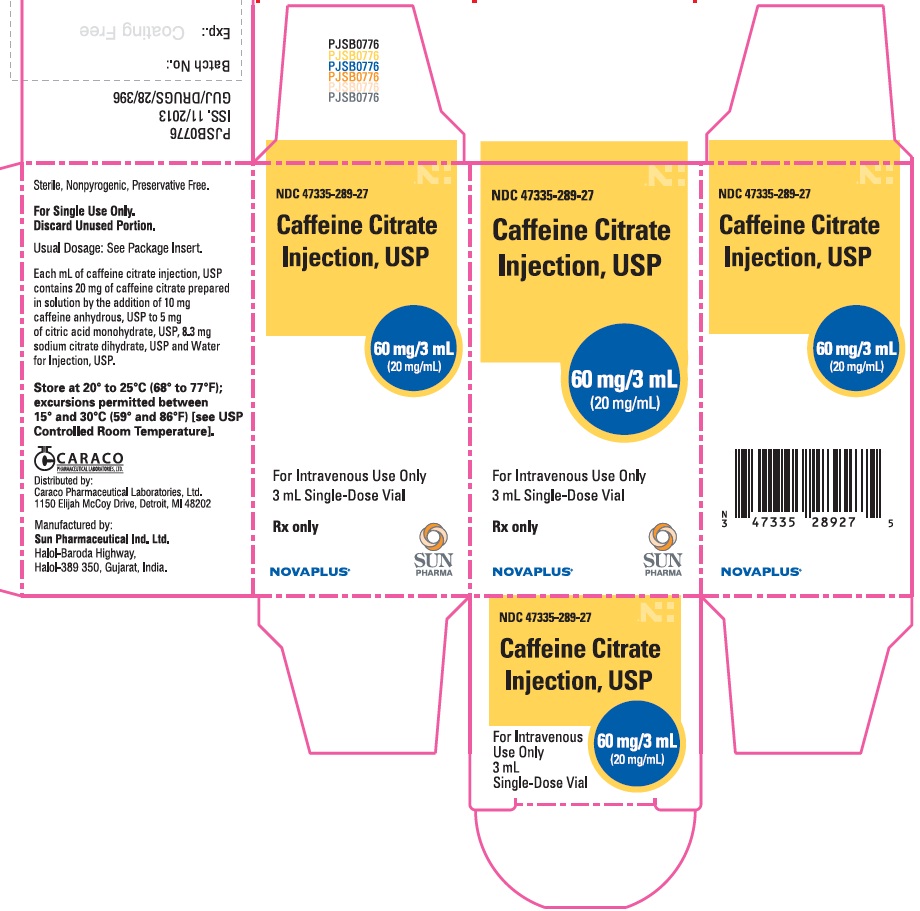
Caffeine Citrate label

Caffeine Citrate

Caffeine Citrate Recall

Get an alert when a recall is issued.

Side Effects & Adverse Reactions

For external use only

When using this product

• use only as directed • do not bandage tightly • do not use with a heating pad • avoid contact with eyes and mucous membranes • do not apply to wounds, damaged, broken or irritated skin • a slight burning sensation may occur upon application but generally disappears in several days • if severe burning occurs, discontinue use • do not expose the treated area to heat or direct sunlight • do not use if allergic to capsicum or chili peppers

Stop use and ask a doctor if

• condition worsens • symptoms persist for more than 7 days or clear up and occur again within a few days • redness is present • irritation develops

If pregnant or breast-feeding,

ask a health professional before use.

Keep out of reach of children.

In case of accidental ingestion, get medical help or contact a Poison Control Center right away.

Stop use and ask a doctor if

• condition worsens • symptoms persist for more than 7 days or clear up and occur again within a few days • redness is present • irritation develops

FDA Safety Alerts

There are currently no FDA safety alerts available for this drug.

Manufacturer Warnings

There is currently no manufacturer warning information available for this drug.

FDA Labeling Changes

There are currently no FDA labeling changes available for this drug.

Uses

for the temporary relief of minor pain associated with: • arthritis • simple backache • muscle strains • sprains • bruises

History

There is currently no drug history available for this drug.

Other Information

There are no additional details available for this product.

Caffeine Citrate Manufacturers

  • Exela Pharma Sciences, Llc
    Caffeine Citrate | Mccure Health Solutions Inc.
    No Recall

    Caffeine Citrate | Mccure Health Solutions Inc.

    Caffeine Citrate | Mccure Health Solutions Inc.

    Adults and children over 18 years: • apply generously to affected area not more than 3 to 4 times daily • massage into painful area until thoroughly absorted • wash hands with soap and water after use • close cap tightly after use Children 18 years or younger: Ask a doctor

  • Exela Pharma Sciences, Llc
    Caffeine Citrate | Remedyrepack Inc.
    No Recall

    Caffeine Citrate | Remedyrepack Inc.

    Caffeine Citrate | Remedyrepack Inc.

    Benztropine mesylate tablets should be used when patients are able to take oral medication.

    Because of cumulative action, therapy should be initiated with a low dose which is increased gradually at five or six-day intervals to the smallest amount necessary for optimal relief. Increases should be made in increments of 0.5 mg. to a maximum of 6 mg. or until optimal results are obtained without excessive adverse reactions.


    The usual daily dose is 1 to 2 mg, with a range of 0.5 to 6 mg orally.

    As with any agent used in parkinsonism, dosage must be individualized according to age and weight. and the type of parkinsonism being treated. Generally, older patients, and thin patients cannot tolerate large doses. Most patients with postencephalitic parkinsonism need fairly large doses and tolerate them well. Patients with a poor mental outlook are usually poor candidates for therapy.

    In idiopathic parkinsonism, therapy may be initiated with a single daily dose of 0.5 to 1 mg at bedtime. In some patients, this will be adequate; in others 4 to 6 mg a day may be required.

    In postencephalitic parkinsonism, therapy may be initiated in most patients with 2 mg a day in one or more doses. In highly sensitive patients, therapy may be initiated with 0.5 mg at bedtime, and increased as necessary.

    Some patients experience greatest relief by taking the entire dose at bedtime; others react more favorably to divided doses, two to four times a day. Frequently, one dose a day is sufficient, and divided doses may be unnecessary or undesirable.

    The long duration of action of this drug makes it particularly suitable for bedtime medication when its effects may last throughout the night, enabling patients to turn in bed during the night more easily, and to rise in the morning.

    When benztropine mesylate is started, do not terminate therapy with other antiparkinsonian agents abruptly. If the other agents are to be reduced or discontinued, it must be done gradually. Many patients obtain greatest relief with combination therapy.

    Benztropine mesylate may be used concomitantly with Carbidopa-Levodopa, or with levodopa, in which case periodic dosage adjustment may be required in order to maintain optimum response.


    In treating extrapyramidal disorders due to neuroleptic drugs (e.g., phenothiazines), the recommended dosage is 1 to 4 mg once or twice a day orally. Dosage must be individualized according to the need of the patient. Some patients require more than recommended; others do not need as much.

    In acute dystonic reactions, 1 to 2 mL of the injection usually relieves the condition quickly. After that, the tablets 1 to 2 mg twice a day, usually prevents recurrence.

    When extrapyramidal disorders develop soon after initiation of treatment with neuroleptic drugs (e.g., phenothiazines), they are likely to be transient. One to 2 mg of benztropine mesylate tablets two or three times a day usually provides relief within one or two days.

    After one or two weeks the drug should be withdrawn to determine the continued need for it. If such disorders recur, benztropine mesylate can be reinstituted.

    Certain drug-induced extrapyramidal disorders that develop slowly may not respond to benztropine mesylate.


  • Sun Pharmaceutical Industries Ltd
    Caffeine Citrate | Sun Pharmaceutical Industries Ltd
    No Recall

    Caffeine Citrate | Sun Pharmaceutical Industries Ltd

    Caffeine Citrate | Sun Pharmaceutical Industries Ltd

    Prior to initiation of caffeine citrate, baseline serum levels of caffeine should be measured in infants previously treated with theophylline, since preterm infants metabolize theophylline to caffeine. Likewise, baseline serum levels of caffeine should be measured in infants born to mothers who consumed caffeine prior to delivery, since caffeine readily crosses the placenta.

    The recommended loading dose and maintenance doses of caffeine citrate follow.


    Dose of Caffeine Citrate
    Volume
    Dose of Caffeine Citrate
    mg/kg
    Route
    Frequency
    Loading Dose
    1 mL/kg
    20 mg/kg
    Intravenous* (over 30 minutes)
    One Time
    Maintenance Dose
    0.25 mL/kg
    5 mg/kg
    Intravenous* (over 10 minutes) or Orally
    Every 24 hours**
    * using a syringe infusion pump
    ** beginning 24 hours after the loading dose

    NOTE THAT THE DOSE OF CAFFEINE BASE IS ONE-HALF THE DOSE WHEN EXPRESSED AS CAFFEINE CITRATE (e.g., 20 mg of caffeine citrate is equivalent to 10 mg of caffeine base).

    Serum concentrations of caffeine may need to be monitored periodically throughout treatment to avoid toxicity. Serious toxicity has been associated with serum levels greater than 50 mg/L.

    Caffeine citrate injection and caffeine citrate oral solution should be inspected visually for particulate matter and discoloration prior to administration. Vials containing discolored solution or visible particulate matter should be discarded.

    Drug Compatibility

    To test for drug compatibility with common intravenous solutions or medications, 20 mL of caffeine citrate injection were combined with 20 mL of a solution or medication, with the exception of an Intralipid® admixture, which was combined as 80 mL/80 mL. The physical appearance of the combined solutions was evaluated for precipitation. The admixtures were mixed for 10 minutes and then assayed for caffeine. The admixtures were then continually mixed for 24 hours, with further sampling for caffeine assays at 2, 4, 8, and 24 hours.

    Based on this testing, caffeine citrate injection, 60 mg/3 mL is chemically stable for 24 hours at room temperature when combined with the following test products.

    Dextrose Injection, USP 5% 50% Dextrose Injection USP Intralipid® 20% IV Fat Emulsion Aminosyn® 8.5% Crystalline Amino Acid Solution Dopamine HCI Injection, USP 40 mg/mL diluted to 0.6 mg/mL with Dextrose Injection, USP 5% Calcium Gluconate Injection, USP 10% (0.465 mEq/Ca+2/mL) Heparin Sodium Injection, USP 1000 units/mL diluted to 1 unit/mL with Dextrose Injection, USP 5% Fentanyl Citrate Injection, USP 50 µg/mL diluted to 10 µg/mL with Dextrose Injection, USP 5%
  • App Pharmaceuticals, Llc
    Caffeine Citrate | G&w Laboratories, Inc.
    No Recall

    Caffeine Citrate | G&w Laboratories, Inc.

    Caffeine Citrate | G&w Laboratories, Inc.

    Fluticasone Propionate Cream may be used in adult and pediatric patients 3 months of age or older. Safety and efficacy of Fluticasone Propionate Cream in pediatric patients for more than 4 weeks of use have not been established (see PRECAUTIONS: Pediatric Use). The safety and efficacy of Fluticasone Propionate Cream in pediatric patients below 3 months of age have not been established.

    Atopic Dermatitis: Apply a thin film of Fluticasone Propionate Cream to the affected skin areas once or twice daily. Rub in gently.

    Other Corticosteroid-Responsive Dermatoses: Apply a thin film of Fluticasone Propionate Cream to the affected skin areas twice daily. Rub in gently.

    As with other corticosteroids, therapy should be discontinued when control is achieved. If no improvement is seen within 2 weeks, reassessment of diagnosis may be necessary.

    Fluticasone Propionate Cream should not be used with occlusive dressings. Fluticasone Propionate Cream should not be applied in the diaper area, as diapers or plastic pants may constitute occlusive dressings.

    Geriatric Use: In studies where geriatric patients (65 years of age or older, see PRECAUTIONS) have been treated with Fluticasone Propionate Cream, safety did not differ from that in younger patients; therefore, no dosage adjustment is recommended.

  • Sun Pharma Global Fze
    Caffeine Citrate | Rite Aid
    No Recall

    Caffeine Citrate | Rite Aid

    Caffeine Citrate | Rite Aid
    do not take more than directed
    adults and children 12 years and over take 2 tablets every 6 hours while symptoms last do not take more than 6 tablets in 24 hours unless directed by a doctor do not take for more than 10 days unless directed by a doctor children under 12 years: ask a doctor
  • Caffeine Citrate | American Regent, Inc.
    No Recall

    Caffeine Citrate | American Regent, Inc.

    Caffeine Citrate | American Regent, Inc.

    Prior to initiation of caffeine citrate, baseline serum levels of caffeine should be measured in infants previously treated with theophylline, since preterm infants metabolize theophylline to caffeine. Likewise, baseline serum levels of caffeine should be measured in infants born to mothers who consumed caffeine prior to delivery, since caffeine readily crosses the placenta.

    The recommended loading dose and maintenance doses of caffeine citrate follow.

    Dose of
    Caffeine Citrate Dose of
    Caffeine Citrate Volume mg/kg Route Frequency * using a syringe infusion pump ** beginning 24 hours after the loading dose Loading Dose 1 mL/kg 20 mg/kg Intravenous* One Time (over 30 minutes) Maintenance 0.25 mL/kg 5 mg/kg Intravenous* Every 24 Dose (over 10 hours** minutes)

    NOTE THAT THE DOSE OF CAFFEINE BASE IS ONE-HALF THE DOSE WHEN EXPRESSED AS CAFFEINE CITRATE (e.g., 20 mg of caffeine citrate is equivalent to 10 mg of caffeine base).

    Serum concentrations of caffeine may need to be monitored periodically throughout treatment to avoid toxicity. Serious toxicity has been associated with serum levels greater than 50 mg/L.

    Caffeine citrate should be inspected visually for particulate matter and discoloration prior to administration. Vials containing discolored solution or visible particulate matter should be discarded.

    Drug Compatibility

    To test for drug compatibility with common intravenous solutions or medications, 20 mL of caffeine citrate injection were combined with 20 mL of a solution or medication, with the exception of an Intralipid® admixture, which was combined as 80 mL/80 mL. The physical appearance of the combined solutions was evaluated for precipitation. The admixtures were mixed for 10 minutes and then assayed for caffeine. The admixtures were then continually mixed for 24 hours, with further sampling for caffeine assays at 2, 4, 8, and 24 hours.

    Based on this testing, caffeine citrate injection, USP 60 mg/3 mL is chemically stable for 24 hours at room temperature when combined with the following test products.

    Dextrose Injection, USP 5% Dextrose Injection, USP 50% Intralipid® 20% IV Fat Emulsion Aminosyn® 8.5% Crystalline Amino Acid Solution Dopamine HCl Injection, USP 40 mg/mL diluted to 0.6 mg/mL with Dextrose Injection, USP 5% Calcium Gluconate Injection, USP 10% (0.465 mEq/Ca+2/mL) Heparin Sodium Injection, USP 1000 units/mL diluted to 1 unit/mL with Dextrose Injection, USP 5% Fentanyl Citrate Injection, USP 50 µg/mL diluted to 10 µg/mL with Dextrose Injection, USP 5%
  • Fresenius Kabi Usa, Llc
    Caffeine Citrate | Fresenius Kabi Usa, Llc
    No Recall

    Caffeine Citrate | Fresenius Kabi Usa, Llc

    Caffeine Citrate | Fresenius Kabi Usa, Llc

    Prior to initiation of caffeine citrate injection, baseline serum levels of caffeine should be measured in infants previously treated with theophylline, since preterm infants metabolize theophylline to caffeine.  Likewise, baseline serum levels of caffeine should be measured in infants born to mothers who consumed caffeine prior to delivery, since caffeine readily crosses the placenta.

    The recommended loading dose and maintenance doses of caffeine citrate follow.


    Dose of Caffeine Citrate

    Volume

    Dose of Caffeine Citrate

    mg/kg


    Route


    Frequency

    Loading Dose

    1 mL/kg

    20 mg/kg

    Intravenous* (over 30 minutes)

    One Time

    Maintenance Dose

    0.25 mL/kg

    5 mg/kg

    Intravenous* (over 10 minutes) or Orally

    Every 24 hours**

    *using a syringe infusion pump

    **beginning 24 hours after the loading dose


    NOTE THAT THE DOSE OF CAFFEINE BASE IS ONE-HALF THE DOSE WHEN EXPRESSED AS CAFFEINE CITRATE (e.g., 20 mg of caffeine citrate is equivalent to 10 mg of caffeine base).

    Serum concentrations of caffeine may need to be monitored periodically throughout treatment to avoid toxicity.  Serious toxicity has been associated with serum levels greater than 50 mg/L.

    Caffeine citrate injection should be inspected visually for particulate matter and discoloration prior to administration.  Vials containing discolored solution or visible particulate matter should be discarded.

    Drug Compatibility

    To test for drug compatibility with common intravenous solutions or medications, 20 mL of caffeine citrate injection were combined with 20 mL of a solution or medication, with the exception of an Intralipid® admixture, which was combined as 80 mL/80 mL.  The physical appearance of the combined solutions was evaluated for precipitation.  The admixtures were mixed for 10 minutes and then assayed for caffeine.  The admixtures were then continually mixed for 24 hours, with further sampling for caffeine assays at 2, 4, 8, and 24 hours.

    Based on this testing, caffeine citrate injection, 60 mg/3 mL is chemically stable for 24 hours at room temperature when combined with the following test products.

    • Dextrose Injection, USP 5%

    • 50% Dextrose Injection USP

    • Intralipid® 20% IV Fat Emulsion

    • Aminosyn® 8.5% Crystalline Amino Acid Solution

    • Dopamine HCI Injection, USP 40 mg/mL diluted to 0.6 mg/mL with Dextrose Injection, USP 5%

    • Calcium Gluconate Injection, USP 10% (0.465 mEq/Ca+2/mL)

    • Heparin Sodium Injection, USP 1,000 units/mL diluted to 1 unit/mL with Dextrose Injection, USP 5%

    • Fentanyl Citrate Injection, USP 50 mcg/mL diluted to 10 mcg/mL with Dextrose Injection, USP 5%

    Drug Compatibility

    To test for drug compatibility with common intravenous solutions or medications, 20 mL of caffeine citrate injection were combined with 20 mL of a solution or medication, with the exception of an Intralipid® admixture, which was combined as 80 mL/80 mL.  The physical appearance of the combined solutions was evaluated for precipitation.  The admixtures were mixed for 10 minutes and then assayed for caffeine.  The admixtures were then continually mixed for 24 hours, with further sampling for caffeine assays at 2, 4, 8, and 24 hours.

    Based on this testing, caffeine citrate injection, 60 mg/3 mL is chemically stable for 24 hours at room temperature when combined with the following test products.

    • Dextrose Injection, USP 5%

    • 50% Dextrose Injection USP

    • Intralipid® 20% IV Fat Emulsion

    • Aminosyn® 8.5% Crystalline Amino Acid Solution

    • Dopamine HCI Injection, USP 40 mg/mL diluted to 0.6 mg/mL with Dextrose Injection, USP 5%

    • Calcium Gluconate Injection, USP 10% (0.465 mEq/Ca+2/mL)

    • Heparin Sodium Injection, USP 1,000 units/mL diluted to 1 unit/mL with Dextrose Injection, USP 5%

    • Fentanyl Citrate Injection, USP 50 mcg/mL diluted to 10 mcg/mL with Dextrose Injection, USP 5%

  • Sun Pharma Global Fze
    Caffeine Citrate | Sun Pharma Global Fze
    No Recall

    Caffeine Citrate | Sun Pharma Global Fze

    Caffeine Citrate | Sun Pharma Global Fze

    Prior to initiation of caffeine citrate, baseline serum levels of caffeine should be measured in infants previously treated with theophylline, since preterm infants metabolize theophylline to caffeine. Likewise, baseline serum levels of caffeine should be measured in infants born to mothers who con­sumed caffeine prior to delivery, since caffeine readily crosses the placenta.


    The recommended loading dose and maintenance doses of caffeine citrate follow.


    * using a syringe infusion pump † beginning 24 hours after the loading dose  
    Dose of Caffeine Citrate
    Dose of Caffeine Citrate
    Route
    Frequency
     
    Volume
    mg/kg
     
     
    Loading Dose
    1 mL/kg
    20 mg/kg
    Intravenous*
    One Time


    (over 30


    minutes)
     
    Maintenance
    0.25 mL/kg
    5 mg/kg
    Intravenous*
    Every
    Dose
     
     
    (over 10
    24 hours†


    minutes) or


    Orally
     

    NOTE THAT THE DOSE OF CAFFEINE BASE IS ONE-HALF THE DOSE WHEN EXPRESSED AS CAFFEINE CITRATE (e.g., 20 mg of caffeine citrate is equiva­lent to 10 mg of caffeine base).


    Serum concentrations of caffeine may need to be monitored periodically throughout treatment to avoid toxicity. Serious toxicity has been associated with serum levels greater than 50 mg/L.


    Caffeine citrate injection and caffeine citrate oral solution should be inspected visually for particulate matter and discoloration prior to administration. Vials containing discolored solution or visible particulate matter should be discarded.


    Drug Compatibility

    To test for drug compatibility with common intravenous solutions or medica­tions, 20 mL of caffeine citrate injection were combined with 20 mL of a solution or medication, with the exception of an Intralipid® admixture, which was combined as 80 mL/80 mL. The physical appearance of the com­bined solutions was evaluated for precipitation. The admixtures were mixed for 10 minutes and then assayed for caffeine. The admixtures were then continu­ally mixed for 24 hours, with further sampling for caffeine assays at 2, 4, 8, and 24 hours.


    Based on this testing, caffeine citrate injection, 60 mg/3 mL is chemically stable for 24 hours at room temperature when combined with the following test products.

    Dextrose Injection, USP 5% 50% Dextrose Injection USP Intralipid® 20% IV Fat Emulsion Aminosyn® 8.5% Crystalline Amino Acid Solution Dopamine HCI Injection, USP 40 mg/mL diluted to 0.6 mg/mL with Dextrose Injection, USP 5% Calcium Gluconate Injection, USP 10% (0.465 mEq/Ca+2/mL) Heparin Sodium Injection, USP 1000 units/mL diluted to 1 unit/mL with Dextrose Injection, USP 5% Fentanyl Citrate Injection, USP 50 µg/mL diluted to 10 µg/mL with Dextrose Injection, USP 5%

  • Exela Pharma Sciences, Llc
    Caffeine Citrate | Exela Pharma Sciences, Llc
    No Recall

    Caffeine Citrate | Exela Pharma Sciences, Llc

    Caffeine Citrate | Exela Pharma Sciences, Llc

    Prior to initiation of caffeine citrate, baseline serum levels of caffeine should be measured in infants previously treated with theophylline, since preterm infants metabolize theophylline to caffeine. Likewise, baseline serum levels of caffeine should be measured in infants born to mothers who con­sumed caffeine prior to delivery, since caffeine readily crosses the placenta.

    The recommended loading dose and maintenance doses of caffeine citrate follow.

    * using a syringe infusion pump † beginning 24 hours after the loading dose Dose of Caffeine Citrate Volume Dose of Caffeine Citrate mg/kg Route Frequency Loading Dose 1 mL/kg 20 mg/kg Intravenous* (over 30 minutes) One Time Maintenance Dose 0.25 mL/kg 5 mg/kg Intravenous* (over 10 minutes) or Orally Every 24 hours†

    NOTE THAT THE DOSE OF CAFFEINE BASE IS ONE-HALF THE DOSE WHEN EXPRESSED AS CAFFEINE CITRATE (e.g., 20 mg of caffeine citrate is equiva­lent to 10 mg of caffeine base).

    Serum concentrations of caffeine may need to be monitored periodically throughout treatment to avoid toxicity. Serious toxicity has been associated with serum levels greater than 50 mg/L.

    Caffeine citrate injection and caffeine citrate oral solution should be inspected visually for particulate matter and discoloration prior to administration. Vials containing discolored solution or visible particulate matter should be discarded.


    Drug Compatibility

    To test for drug compatibility with common intravenous solutions or medica­tions, 20 mL of caffeine citrate injection were combined with 20 mL of a solution or medication, with the exception of an Intralipid® admixture, which was combined as 80 mL/80 mL. The physical appearance of the com­bined solutions was evaluated for precipitation. The admixtures were mixed for 10 minutes and then assayed for caffeine. The admixtures were then continu­ally mixed for 24 hours, with further sampling for caffeine assays at 2, 4, 8, and 24 hours.

    Based on this testing, caffeine citrate injection, 60 mg/3 mL is chemically stable for 24 hours at room temperature when combined with the following test products.

    Dextrose Injection, USP 5% 50% Dextrose Injection USP Intralipid® 20% IV Fat Emulsion Aminosyn® 8.5% Crystalline Amino Acid Solution Dopamine HCI Injection, USP 40 mg/mL diluted to 0.6 mg/mL with Dextrose Injection, USP 5% Calcium Gluconate Injection, USP 10% (0.465 mEq/Ca+2/mL) Heparin Sodium Injection, USP 1000 units/mL diluted to 1 unit/mL with Dextrose Injection, USP 5% Fentanyl Citrate Injection, USP 50 µg/mL diluted to 10 µg/mL with Dextrose Injection, USP 5%
  • Auromedics Pharma Llc
    Caffeine Citrate | Auromedics Pharma Llc
    No Recall

    Caffeine Citrate | Auromedics Pharma Llc

    Caffeine Citrate | Auromedics Pharma Llc

    Prior to initiation of caffeine citrate injection USP, baseline serum levels of caffeine should be measured in infants previously treated with theophylline, since preterm infants metabolize theophylline to caffeine. Likewise, baseline serum levels of caffeine should be measured in infants born to mothers who consumed caffeine prior to delivery, since caffeine readily crosses the placenta.


    The recommended loading dose and maintenance doses of caffeine citrate injection USP follow.


      Dose of  Caffeine Citrate Injection USP 
      Volume
      Dose of  Caffeine Citrate Injection USP 
      mg/kg
      Route
      Frequency
      Loading Dose
      1 mL/kg
      20 mg/kg
      Intravenous* (over 30 minutes)
      One Time
      Maintenance Dose
      0.25 mL/kg
      5 mg/kg
      Intravenous*
      (over 10 minutes) or Orally
      Every 24 hours**

    * using a syringe infusion pump

    ** beginning 24 hours after the loading dose


    NOTE THAT THE DOSE OF CAFFEINE BASE IS ONE-HALF THE DOSE WHEN EXPRESSED AS CAFFEINE CITRATE (e.g., 20 mg of caffeine citrate is equivalent to 10 mg of caffeine base).


    Serum concentrations of caffeine may need to be monitored periodically throughout treatment to avoid toxicity. Serious toxicity has been associated with serum levels greater than 50 mg/L.

    Caffeine citrate injection USP should be inspected visually for particulate matter and discoloration prior to administration. Vials containing discolored solution or visible particulate matter should be discarded.

    Drug Compatibility

    To test for drug compatibility with common intravenous solutions or medications, 20 mL of caffeine citrate injection USP were combined with 20 mL of a solution or medication, with the exception of an Intralipid® admixture, which was combined as 80 mL/80 mL. The physical appearance of the combined solutions was evaluated for precipitation. The admixtures were mixed for 10 minutes and then assayed for caffeine. The admixtures were then continually mixed for 24 hours, with further sampling for caffeine assays at 2, 4, 8, and 24 hours.

    Based on this testing, caffeine citrate injection USP, 60 mg/3 mL is chemically stable for 24 hours at room temperature when combined with the following test products.

    • Dextrose Injection, USP 5%

    • 50% Dextrose Injection USP

    • Intralipid® 20% IV Fat Emulsion

    • Aminosyn® 8.5% Crystalline Amino Acid Solution

    • Dopamine HCI Injection, USP 40 mg/mL diluted to 0.6 mg/mL with Dextrose Injection, USP 5%

    • Calcium Gluconate Injection, USP 10% (0.465 mEq/Ca+2/mL)

    • Heparin Sodium Injection, USP 1000 units/mL diluted to 1 unit/mL with Dextrose Injection, USP 5%

    • Fentanyl Citrate Injection, USP 50 mcg/mL diluted to 10 mcg/mL with Dextrose Injection, USP 5%