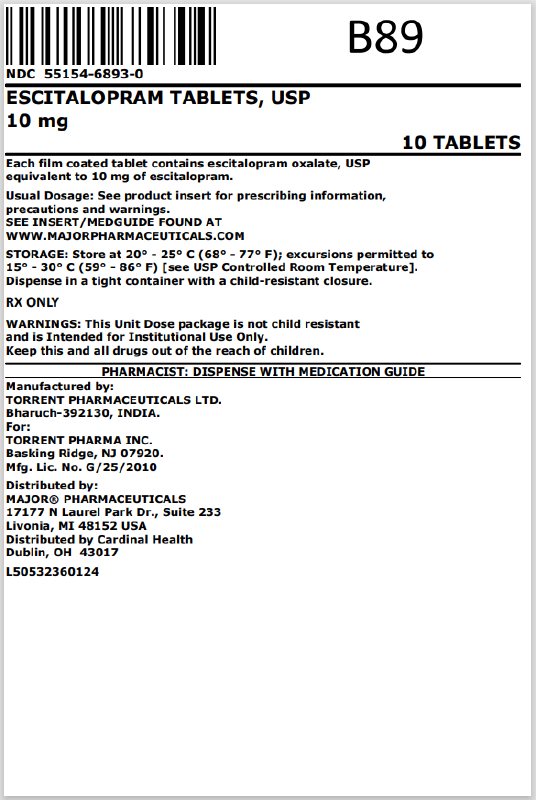
Escitalopram tablets, USP should be administered once daily, in the morning or evening, with or without food.
2.1 Major Depressive Disorder
Initial Treatment
Adolescents
The recommended dose of escitalopram tablets, USP is 10 mg once daily. A flexible-dose trial of escitalopram tablets, USP (10 to 20 mg/day) demonstrated the effectiveness of escitalopram tablets, USP [see Clinical Studies (14.1)]. If the dose is increased to 20 mg, this should occur after a minimum of three weeks.
Adults
The recommended dose of escitalopram tablets, USP is 10 mg once daily. A fixed-dose trial of escitalopram oxalate demonstrated the effectiveness of both 10 mg and 20 mg of escitalopram oxalate, but failed to demonstrate a greater benefit of 20 mg over 10 mg [see Clinical Studies (14.1)]. If the dose is increased to 20 mg, this should occur after a minimum of one week.
Maintenance Treatment
It is generally agreed that acute episodes of major depressive disorder require several months or longer of sustained pharmacological therapy beyond response to the acute episode. Systematic evaluation of continuing escitalopram oxalate 10 or 20 mg/day in adults patients with major depressive disorder who responded while taking escitalopram oxalate during an 8-week, acute-treatment phase demonstrated a benefit of such maintenance treatment [see Clinical Studies (14.1)]. Nevertheless, the physician who elects to use escitalopram oxalate for extended periods should periodically re-evaluate the long-term usefulness of the drug for the individual patient. Patients should be periodically reassessed to determine the need for maintenance treatment.
2.2 Generalized Anxiety Disorder
Initial Treatment
Adults
The recommended starting dose of escitalopram tablets, USP is 10 mg once daily. If the dose is increased to 20 mg, this should occur after a minimum of one week.
Maintenance Treatment
Generalized anxiety disorder is recognized as a chronic condition. The efficacy of escitalopram oxalate in the treatment of GAD beyond 8 weeks has not been systematically studied. The physician who elects to use escitalopram oxalate for extended periods should periodically re-evaluate the long-term usefulness of the drug for the individual patient.
2.3 Special Populations
10 mg/day is the recommended dose for most elderly patients and patients with hepatic impairment.
No dosage adjustment is necessary for patients with mild or moderate renal impairment. Escitalopram tablets, USP should be used with caution in patients with severe renal impairment.
2.4 Discontinuation of Treatment with Escitalopram Tablets, USP
Symptoms associated with discontinuation of escitalopram tablets, USP and other SSRIs and SNRIs have been reported [see Warnings and Precautions (5.3)]. Patients should be monitored for these symptoms when discontinuing treatment. A gradual reduction in the dose rather than abrupt cessation is recommended whenever possible. If intolerable symptoms occur following a decrease in the dose or upon discontinuation of treatment, then resuming the previously prescribed dose may be considered. Subsequently, the physician may continue decreasing the dose but at a more gradual rate.
2.5 Switching a Patient To or From a Monoamine Oxidase Inhibitor (MAOI) Intended to Treat Psychiatric Disorders
At least 14 days should elapse between discontinuation of an MAOI intended to treat psychiatric disorders and initiation of therapy with escitalopram tablets, USP. Conversely, at least 14 days should be allowed after stopping escitalopram tablets, USP before starting an MAOI intended to treat psychiatric disorders [see Contraindications (4.1)].
2.6 Use of Escitalopram Tablet, USP with Other MAOIs such as Linezolid or Methylene Blue
Do not start escitalopram tablets, USP in a patient who is being treated with linezolid or intravenous methylene blue because there is an increased risk of serotonin syndrome. In a patient who requires more urgent treatment of a psychiatric condition, other interventions, including hospitalization, should be considered [see Contraindications (4.1)].
In some cases, a patient already receiving escitalopram tablets, USP therapy may require urgent treatment with linezolid or intravenous methylene blue. If acceptable alternatives to linezolid or intravenous methylene blue treatment are not available and the potential benefits of linezolid or intravenous methylene blue treatment are judged to outweigh the risks of serotonin syndrome in a particular patient, escitalopram tablets, USP should be stopped promptly, and linezolid or intravenous methylene blue can be administered. The patient should be monitored for symptoms of serotonin syndrome for 2 weeks or until 24 hours after the last dose of linezolid or intravenous methylene blue, whichever comes first. Therapy with escitalopram tablets, USP may be resumed 24 hours after the last dose of linezolid or intravenous methylene blue [see Warnings and Precautions (5.2)].
The risk of administering methylene blue by non-intravenous routes (such as oral tablets or by local injection) or in intravenous doses much lower than 1 mg/kg with escitalopram tablets, USP is unclear. The clinician should, nevertheless, be aware of the possibility of emergent symptoms of serotonin syndrome with such use [see Warnings and Precautions (5.2)].