
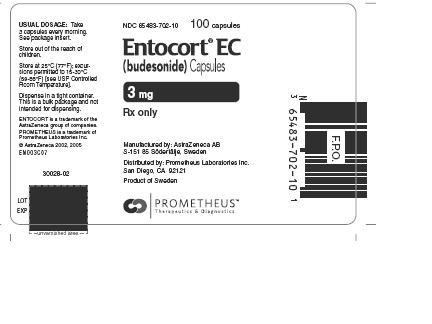
Entocort Ec label

Entocort Ec

Entocort Ec Recall

Get an alert when a recall is issued.

Side Effects & Adverse Reactions

Glucocorticosteroids can reduce the response of the hypothalamus-pituitary-adrenal (HPA) axis to stress. In situations where patients are subject to surgery or other stress situations, supplementation with a systemic glucocorticosteroid is recommended. Since ENTOCORT EC is a glucocorticosteroid, general warnings concerning glucocorticoids should be followed.

Care is needed in patients who are transferred from glucocorticosteroid treatment with high systemic effects to corticosteroids with lower systemic availability, since symptoms attributed to withdrawal of steroid therapy, including those of acute adrenal suppression or benign intracranial hypertension, may develop. Adrenocortical function monitoring may be required in these patients and the dose of systemic steroid should be reduced cautiously.

Patients who are on drugs that suppress the immune system are more susceptible to infection than healthy individuals. Chicken pox and measles, for example, can have a more serious or even fatal course in susceptible patients or patients on immunosuppressant doses of glucocorticosteroids. In patients who have not had these diseases, particular care should be taken to avoid exposure. How the dose, route and duration of glucocorticosteroid administration affect the risk of developing a disseminated infection is not known. The contribution of the underlying disease and/or prior glucocorticosteroid treatment to the risk is also not known. If exposed, therapy with varicella zoster immune globulin (VZIG) or pooled intravenous immunoglobulin (IVIG), as appropriate, may be indicated. If exposed to measles, prophylaxis with pooled intramuscular immunoglobulin (IG) may be indicated. (See the respective package insert for complete VZIG and IG prescribing information.) If chicken pox develops, treatment with antiviral agents may be considered.

FDA Safety Alerts

There are currently no FDA safety alerts available for this drug.

Manufacturer Warnings

There is currently no manufacturer warning information available for this drug.

FDA Labeling Changes

There are currently no FDA labeling changes available for this drug.

Uses

ENTOCORT EC is indicated for

  • the treatment of mild to moderate active Crohn’s disease involving the iluem and/or the ascending colon and
  • the maintenance of clinical remission of mild to moderate Crohn’s disease involving the ileum and/or the ascending colon for up to 3 months.

History

There is currently no drug history available for this drug.

Other Information

Budesonide, the active ingredient of ENTOCORT® EC capsules, is a synthetic corticosteroid. It is designated chemically as (RS)-11β, 16α, 17,21-tetrahydroxypregna-1,4-diene-3,20-dione cyclic 16,17-acetal with butyraldehyde. Budesonide is provided as a mixture of two epimers (22R and 22S). The empirical formula of budesonide is C25H34O6 and its molecular weight is 430.5. Its structural formula is:

Structural Formula fir Epimer 22R if budesonide
Structural Formula for Epimer 22S of budesonide

Budesonide is a white to off-white, tasteless, odorless powder that is practically insoluble in water and heptane, sparingly soluble in ethanol, and freely soluble in chloroform. Its partition coefficient between octanol and water at pH 5 is 1.6 x 10³ ionic strength 0.01.

Each capsule contains 3 mg of micronized budesonide with the following inactive ingredients: ethylcellulose, acetyltributyl citrate, methacrylic acid copolymer type C, triethyl citrate, antifoam M, polysorbate 80, talc, and sugar spheres. The capsule shells have the following inactive ingredients: gelatin, iron oxide, and titanium dioxide.

Entocort Ec Manufacturers

  • Prometheus Laboratories Inc
    Entocort Ec | Prometheus Laboratories Inc
    No Recall

    Entocort Ec | Prometheus Laboratories Inc

    Entocort Ec | Prometheus Laboratories Inc

    The recommended adult dosage for the treatment of mild to moderate active Crohn's disease involving the ileum and/or the ascending colon is 9 mg taken once daily in the morning for up to 8 weeks.

    Repeated 8 week courses of ENTOCORT EC can be given for recurring episodes of active disease.

    Following an 8 week course(s) of treatment for active disease and once the patient’s symptoms are controlled (CDAI <150), ENTOCORT EC 6 mg is recommended once daily for maintenance of clinical remission up to 3 months. If symptom control is still maintained at 3 months an attempt to taper to complete cessation is recommended. Continued treatment with ENTOCORT EC 6 mg for more than 3 months has not been shown to provide substantial clinical benefit.

    Patients with mild to moderate active Crohn’s disease involving the ileum and/or ascending colon have been switched from oral prednisolone to ENTOCORT EC with no reported episodes of adrenal insufficiency. Since prednisolone should not be stopped abruptly, tapering should begin concomitantly with initiating ENTOCORT EC treatment.

    Hepatic Insufficiency: Patients with moderate to severe liver disease should be monitored for increased signs and/or symptoms of hypercorticism. Reducing the dose of ENTOCORT EC capsules should be considered in these patients.

    CYP3A4 inhibitors: If concomitant administration with ketoconazole, or any other CYP3A4 inhibitor, is indicated, patients should be closely monitored for increased signs and/or symptoms of hypercorticism. Reduction in the dose of ENTOCORT EC capsules should be considered.

    ENTOCORT EC capsules should be swallowed whole and not chewed or broken.

  • Physicians Total Care, Inc.
    Entocort Ec | Physicians Total Care, Inc.
    No Recall

    Entocort Ec | Physicians Total Care, Inc.

    Entocort Ec | Physicians Total Care, Inc.

    The recommended adult dosage for the treatment of mild to moderate active Crohn's disease involving the ileum and/or the ascending colon is 9 mg taken once daily in the morning for up to 8 weeks.

    Repeated 8 week courses of ENTOCORT EC can be given for recurring episodes of active disease.

    Following an 8 week course(s) of treatment for active disease and once the patient’s symptoms are controlled (CDAI <150), ENTOCORT EC 6 mg is recommended once daily for maintenance of clinical remission up to 3 months. If symptom control is still maintained at 3 months an attempt to taper to complete cessation is recommended. Continued treatment with ENTOCORT EC 6 mg for more than 3 months has not been shown to provide substantial clinical benefit.

    Patients with mild to moderate active Crohn’s disease involving the ileum and/or ascending colon have been switched from oral prednisolone to ENTOCORT EC with no reported episodes of adrenal insufficiency. Since prednisolone should not be stopped abruptly, tapering should begin concomitantly with initiating ENTOCORT EC treatment.

    Hepatic Insufficiency: Patients with moderate to severe liver disease should be monitored for increased signs and/or symptoms of hypercorticism. Reducing the dose of ENTOCORT EC capsules should be considered in these patients.

    CYP3A4 inhibitors: If concomitant administration with ketoconazole, or any other CYP3A4 inhibitor, is indicated, patients should be closely monitored for increased signs and/or symptoms of hypercorticism. Reduction in the dose of ENTOCORT EC capsules should be considered.

    ENTOCORT EC capsules should be swallowed whole and not chewed or broken.

  • Entocort Ec | Astrazeneca Lp
    No Recall

    Entocort Ec | Astrazeneca Lp

    Entocort Ec | Astrazeneca Lp
    2.1 Mild to Moderate Active Crohn’s Disease

    The recommended adult dosage for the treatment of mild to moderate active Crohn's disease involving the ileum and/or the ascending colon is 9 mg orally taken once daily in the morning for up to 8 weeks. Repeated 8 week courses of ENTOCORT EC can be given for recurring episodes of active disease.

    2.2 Maintenance of Clinical Remission of Mild to Moderate Crohn’s Disease

    Following an 8 week course(s) of treatment for active disease and once the patient’s symptoms are controlled (CDAI less than 150), ENTOCORT EC 6 mg orally is recommended once daily for maintenance of clinical remission up to 3 months. If symptom control is still maintained at 3 months an attempt to taper to complete cessation is recommended. Continued treatment with ENTOCORT EC 6 mg for more than 3 months has not been shown to provide substantial clinical benefit.

    Patients with mild to moderate active Crohn’s disease involving the ileum and/or ascending colon have been switched from oral prednisolone to ENTOCORT EC with no reported episodes of adrenal insufficiency. Since prednisolone should not be stopped abruptly, tapering should begin concomitantly with initiating ENTOCORT EC treatment.

    2.3 CYP3A4 inhibitors

    If concomitant administration with ketoconazole, or any other CYP3A4 inhibitor, is indicated, patients should be closely monitored for increased signs and/or symptoms of hypercorticism. Grapefruit juice, which is known to inhibit CYP3A4, should also be avoided when taking ENTOCORT EC. In these cases, reduction in the dose of ENTOCORT EC capsules should be considered [see Drug Interactions (7)and Clinical Pharmacology (12.3)].