
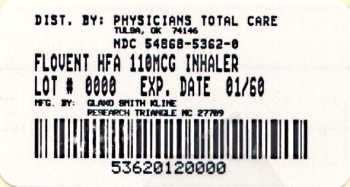
Flovent Hfa label

Flovent Hfa

Flovent Hfa Recall

Get an alert when a recall is issued.

Side Effects & Adverse Reactions

There is currently no warning information available for this product. We apologize for any inconvenience.

FDA Safety Alerts

There are currently no FDA safety alerts available for this drug.

Manufacturer Warnings

There is currently no manufacturer warning information available for this drug.

FDA Labeling Changes

There are currently no FDA labeling changes available for this drug.

Uses

FLOVENT® HFA Inhalation Aerosol is indicated for the maintenance treatment of asthma as prophylactic therapy in patients aged 4 years and older. It is also indicated for patients requiring oral corticosteroid therapy for asthma. Many of these patients may be able to reduce or eliminate their requirement for oral corticosteroids over time.

FLOVENT HFA Inhalation Aerosol is NOT indicated for the relief of acute bronchospasm.

History

There is currently no drug history available for this drug.

Other Information

The active component of FLOVENT HFA 44 mcg Inhalation Aerosol, FLOVENT HFA 110 mcg Inhalation Aerosol, and FLOVENT HFA 220 mcg Inhalation Aerosol is fluticasone propionate, a corticosteroid having the chemical name S-(fluoromethyl) 6α,9-difluoro-11β,17-dihydroxy-16α-methyl-3-oxoandrosta-1,4-diene-17β-carbothioate, 17-propionate and the following chemical structure:

fluticasone propionate chemical structure

Fluticasone propionate is a white powder with a molecular weight of 500.6, and the empirical formula is C25H31F3O5S. It is practically insoluble in water, freely soluble in dimethyl sulfoxide and dimethylformamide, and slightly soluble in methanol and 95% ethanol.

FLOVENT HFA 44 mcg Inhalation Aerosol, FLOVENT HFA 110 mcg Inhalation Aerosol, and FLOVENT HFA 220 mcg Inhalation Aerosol are pressurized metered-dose aerosol units fitted with a counter. FLOVENT HFA is intended for oral inhalation only. Each unit contains a microcrystalline suspension of fluticasone propionate (micronized) in propellant HFA-134a (1,1,1,2-tetrafluoroethane). It contains no other excipients.

After priming, each actuation of the inhaler delivers 50, 125, or 250 mcg of fluticasone propionate in 60 mg of suspension (for the 44-mcg product) or in 75 mg of suspension (for the 110- and 220-mcg products) from the valve. Each actuation delivers 44, 110, or 220 mcg of fluticasone propionate from the actuator. The actual amount of drug delivered to the lung may depend on patient factors, such as the coordination between the actuation of the device and inspiration through the delivery system.

Each 10.6-g canister (44 mcg) and each 12-g canister (110 and 220 mcg) provides 120 inhalations.

FLOVENT HFA should be primed before using for the first time by releasing 4 test sprays into the air away from the face, shaking well for 5 seconds before each spray. In cases where the inhaler has not been used for more than 7 days or when it has been dropped, prime the inhaler again by shaking well for 5 seconds and releasing 1 test spray into the air away from the face.

This product does not contain any chlorofluorocarbon (CFC) as the propellant.

Flovent Hfa Manufacturers

  • Physicians Total Care, Inc.
    Flovent Hfa | Physicians Total Care, Inc.
    No Recall

    Flovent Hfa | Physicians Total Care, Inc.

    Flovent Hfa | Physicians Total Care, Inc.

    FLOVENT HFA should be administered by the orally inhaled route only in patients aged 4 years and older. Individual patients will experience a variable time to onset and degree of symptom relief. Maximum benefit may not be achieved for 1 to 2 weeks or longer after starting treatment.

    After asthma stability has been achieved, it is always desirable to titrate to the lowest effective dosage to reduce the possibility of side effects. For patients who do not respond adequately to the starting dosage after 2 weeks of therapy, higher dosages may provide additional asthma control. The safety and efficacy of FLOVENT HFA when administered in excess of recommended dosages have not been established.

    The recommended starting dosage and the highest recommended dosage of FLOVENT HFA, based on prior asthma therapy, are listed in Table 1.

    Table 1. Recommended Dosages of FLOVENT HFA Inhalation Aerosol NOTE: In all patients, it is desirable to titrate to the lowest effective dosage once asthma stability is achieved. Previous Therapy Recommended Starting Dosage Highest Recommended Dosage Adult and adolescent patients (aged ≥12 years)

    88 mcg twice daily

    88-220 mcg twice dailya

    440 mcg twice daily

    440 mcg twice daily

    440 mcg twice daily

    880 mcg twice daily

    Bronchodilators alone

    Inhaled corticosteroids

    Oral corticosteroidsb Pediatric patients (aged 4-11 years)c 88 mcg twice daily 88 mcg twice daily

    a Starting dosages above 88 mcg twice daily may be considered for patients with poorer asthma control or those who have previously required doses of inhaled corticosteroids that are in the higher range for the specific agent.

    b For patients currently receiving chronic oral corticosteroid therapy, prednisone should be reduced no faster than 2.5 to 5 mg/day on a weekly basis beginning after at least 1 week of therapy with FLOVENT HFA. Patients should be carefully monitored for signs of asthma instability, including serial objective measures of airflow, and for signs of adrenal insufficiency [see Warnings and Precautions (5.4)]. Once prednisone reduction is complete, the dosage of FLOVENT HFA should be reduced to the lowest effective dosage.

    c Recommended pediatric dosage is 88 mcg twice daily regardless of prior therapy. A valved holding chamber and face mask may be used to deliver FLOVENT HFA to young patients.

    FLOVENT HFA should be primed before using for the first time by releasing 4 test sprays into the air away from the face, shaking well for 5 seconds before each spray. In cases where the inhaler has not been used for more than 7 days or when it has been dropped, prime the inhaler again by shaking well for 5 seconds and releasing 1 test spray into the air away from the face.

  • Lake Erie Medical & Surgical Supply Dba Quality Care Products Llc
    Flovent Hfa | Lake Erie Medical & Surgical Supply Dba Quality Care Products Llc
    No Recall

    Flovent Hfa | Lake Erie Medical & Surgical Supply Dba Quality Care Products Llc

    Flovent Hfa | Lake Erie Medical & Surgical Supply Dba Quality Care Products Llc

    FLOVENT HFA should be administered by the orally inhaled route only in patients aged 4 years and older. Individual patients will experience a variable time to onset and degree of symptom relief. Maximum benefit may not be achieved for 1 to 2 weeks or longer after starting treatment.

    After asthma stability has been achieved, it is always desirable to titrate to the lowest effective dosage to reduce the possibility of side effects. For patients who do not respond adequately to the starting dosage after 2 weeks of therapy, higher dosages may provide additional asthma control. The safety and efficacy of FLOVENT HFA when administered in excess of recommended dosages have not been established.

    The recommended starting dosage and the highest recommended dosage of FLOVENT HFA, based on prior asthma therapy, are listed in Table 1.

    Table 1. Recommended Dosages of FLOVENT HFA Inhalation Aerosol NOTE: In all patients, it is desirable to titrate to the lowest effective dosage once asthma stability is achieved. Previous Therapy Recommended Starting Dosage Highest Recommended Dosage Adult and adolescent patients (aged ≥12 years)

    88 mcg twice daily

    88-220 mcg twice dailya

    440 mcg twice daily

    440 mcg twice daily

    440 mcg twice daily

    880 mcg twice daily

    Bronchodilators alone

    Inhaled corticosteroids

    Oral corticosteroidsb Pediatric patients (aged 4-11 years)c 88 mcg twice daily 88 mcg twice daily

    a Starting dosages above 88 mcg twice daily may be considered for patients with poorer asthma control or those who have previously required doses of inhaled corticosteroids that are in the higher range for the specific agent.

    b For patients currently receiving chronic oral corticosteroid therapy, prednisone should be reduced no faster than 2.5 to 5 mg/day on a weekly basis beginning after at least 1 week of therapy with FLOVENT HFA. Patients should be carefully monitored for signs of asthma instability, including serial objective measures of airflow, and for signs of adrenal insufficiency [see Warnings and Precautions (5.4)]. Once prednisone reduction is complete, the dosage of FLOVENT HFA should be reduced to the lowest effective dosage.

    c Recommended pediatric dosage is 88 mcg twice daily regardless of prior therapy. A valved holding chamber and face mask may be used to deliver FLOVENT HFA to young patients.

    FLOVENT HFA should be primed before using for the first time by releasing 4 test sprays into the air away from the face, shaking well for 5 seconds before each spray. In cases where the inhaler has not been used for more than 7 days or when it has been dropped, prime the inhaler again by shaking well for 5 seconds and releasing 1 test spray into the air away from the face.

  • Flovent Hfa | Astrazeneca Pharmaceuticals Lp
    No Recall

    Flovent Hfa | Astrazeneca Pharmaceuticals Lp

    Flovent Hfa | Astrazeneca Pharmaceuticals Lp
    2.1 Hypertension

    Initial Therapy in adults:The recommended initial dose is 10 mg once a day. Dosage should be adjusted according to blood pressure response. The usual dosage range is 20 to 40 mg per day administered in a single daily dose. Doses up to 80 mg have been used but do not appear to give greater effect.

    Use with diuretics in adults

    If blood pressure is not controlled with Zestril alone, a low dose of a diuretic may be added (eg, hydrochlorothiazide, 12.5 mg). After the addition of a diuretic, it may be possible to reduce the dose of Zestril.

    The recommended starting dose in adult patients with hypertension taking diuretics is 5 mg once per day.

    Pediatric Patients 6 years of age and older with hypertension

    For pediatric patients with glomerular filtration rate > 30 mL/min/1.73m2, the recommended starting dose is 0.07 mg per kg once daily (up to 5 mg total). Dosage should be adjusted according to blood pressure response up to a maximum of 0.61 mg per kg (up to 40 mg) once daily. Doses above 0.61 mg per kg (or in excess of 40 mg) have not been studied in pediatric patients [seeClinical Pharmacology (12.3)].

    Zestril is not recommended in pediatric patients < 6 years or in pediatric patients with glomerular filtration rate < 30 mL/min/1.73m2 [seeUse in Specific Populations (8.4)andClinical Studies (14.1)].

    2.2 Heart Failure

    The recommended starting dose for Zestril, when used with diuretics and (usually) digitalis as adjunctive therapy for systolic heart failure, is 5 mg once daily. The recommended starting dose in these patients with hyponatremia (serum sodium < 130 mEq/L) is 2.5 mg once daily. Increase as tolerated to a maximum of 40 mg once daily.

    Diuretic dose may need to be adjusted to help minimize hypovolemia, which may contribute to hypotension [seeWarnings and Precautions (5.4), andDrug Interactions (7.1)]. The appearance of hypotension after the initial dose of Zestril does not preclude subsequent careful dose titration with the drug, following effective management of the hypotension.

    2.3 Reduction of Mortality in Acute Myocardial Infarction

    In hemodynamically stable patients within 24 hours of the onset of symptoms of acute myocardial infarction, give Zestril 5 mg orally, followed by 5 mg after 24 hours, 10 mg after 48 hours and then 10 mg once daily. Dosing should continue for at least six weeks.

    Initiate therapy with 2.5 mg in patients with a low systolic blood pressure (≤ 120 mmHg and > 100 mm Hg) during the first 3 days after the infarct [seeWarnings and Precautions (5.4)]. If hypotension occurs (systolic blood pressure ≤ 100 mmHg) a daily maintenance dose of 5 mg may be given with temporary reductions to 2.5 mg if needed. If prolonged hypotension occurs (systolic blood pressure < 90 mmHg for more than 1 hour) Zestril should be withdrawn.

    2.4 Dose in Patients with Renal Impairment

    No dose adjustment of Zestril is required in patients with creatinine clearance > 30 mL/min. In patients with creatinine clearance ≥ 10 mL/min and ≤ 30 mL/min, reduce the initial dose of Zestril to half of the usual recommended dose i.e., hypertension, 5 mg; systolic heart failure, 2.5 mg and acute MI, 2.5 mg. Up titrate as tolerated to a maximum of 40 mg daily. For patients on hemodialysis or creatinine clearance < 10 mL/min, the recommended initial dose is 2.5 mg once daily [seeUse in Specific Populations (8.7)andClinical Pharmacology (12.3)].