Fludarabine Phosphate label

Fludarabine Phosphate

Fludarabine Phosphate Recall

Get an alert when a recall is issued.

Side Effects & Adverse Reactions

There is currently no warning information available for this product. We apologize for any inconvenience.

FDA Safety Alerts

There are currently no FDA safety alerts available for this drug.

Manufacturer Warnings

There is currently no manufacturer warning information available for this drug.

FDA Labeling Changes

There are currently no FDA labeling changes available for this drug.

Uses

Fludarabine phosphate is indicated as a single agent for the treatment of adult patients with B-cell chronic lymphocytic leukemia (CLL) whose disease has not responded to or has progressed during or after treatment with at least one standard alkylating-agent containing regimen. Studies demonstrating clinical benefit such as prolongation of survival or relief of symptoms have not been performed. Studies providing a direct comparison of the clinical efficacy and safety of orally administered fludarabine phosphate relative to intravenously administered fludarabine phosphate have not been performed.

History

There is currently no drug history available for this drug.

Other Information

The chemical name for fludarabine phosphate is 9H-Purin-6-amine, 2-fluoro-9-(5-O-phosphono-ß-D-arabinofuranosyl)(2-fluoro-ara-AMP). The molecular formula of fludarabine phosphate is C10H13FN5O7P (MW 365.2) and the structure is provided in Figure 1

Image from Drug Label Content

Fludarabine phosphate film-coated tablets for oral administration contain fludarabine phosphate, a fluorinated nucleotide analog of the antiviral agent vidarabine, 9-beta -D-arabinofuranosyladenine (ara-A) that is relatively resistant to deamination by adenosine deaminase. Each tablet contains 10 mg of the active ingredient fludarabine phosphate. The tablet core consists of microcrystalline cellulose, lactose monohydrate, colloidal anhydrous silicon dioxide, croscarmellose sodium and magnesium stearate. The film-coat contains hypromellose, talc, titanium dioxide (E171) and ferric oxide pigment (red/E172, yellow/E172).

Fludarabine Phosphate Manufacturers

  • Fludarabine Phosphate | Antisoma Research Limited
    No Recall

    Fludarabine Phosphate | Antisoma Research Limited

    Fludarabine Phosphate | Antisoma Research Limited

    2.1 Chronic Lymphocytic Leukemia (CLL)

    The oral dose is different than the intravenous dose.

    The recommended adult dose of fludarabine phosphate is 40 mg/m2 administered by mouth daily for five consecutive days. Each 5-day course of treatment should commence every 28 days. Dosage may be decreased or delayed based on evidence of hematologic or nonhematologic toxicity. Physicians should consider delaying or discontinuing the drug if neurotoxicity occurs. Fludarabine phosphate film-coated tablets can be taken either on an empty stomach or with food. The tablets have to be swallowed whole with water; they should not be chewed or broken.

    The following table provides guidance for determining the number of tablets of fludarabine phosphate to be administered based on body surface area (BSA):

    TABLE 1: SUGGESTED NUMBER OF TABLETS TO BE ADMINISTERED Body Surface Area (BSA) Calculated Total Dose Equivalent to
    40 mg/m2 BSA (rounded up or down
    to nearest 10 mg) Total Number of Tablets 0.75 – 0.88 30 mg 3 0.89 – 1.13 40 mg 4 1.14 – 1.38 50 mg 5 1.39 – 1.63 60 mg 6 1.64 – 1.88 70 mg 7 1.89 – 2.13 80 mg 8 2.14 – 2.38 90 mg 9 2.39 – 2.50 100 mg 10

    A number of clinical settings may predispose to increased toxicity from fludarabine phosphate. These include advanced age, renal insufficiency, and bone marrow impairment. Such patients should be monitored closely for excessive toxicity and the dose modified accordingly. The optimal duration of treatment has not been clearly established. It is recommended that three additional cycles of fludarabine phosphate be administered following the achievement of a maximal response and then the drug should be discontinued.

    2.2 Renal Impairment

    Reduce dose by 20% in patients with mild to moderate renal impairment (creatinine clearance 30 to 70 mL/min/1.73 m2). [See Warnings and Precautions (5.7)]

    Reduce dose by 50% in patients with severe renal impairment (creatinine clearance < 30 mL/min/1.73 m2). [See Warnings and Precautions (5.7)]

  • Sandoz Inc
    Fludarabine Phosphate | Sandoz Inc
    No Recall

    Fludarabine Phosphate | Sandoz Inc

    Fludarabine Phosphate | Sandoz Inc
    2.1 Chronic Lymphocytic Leukemia (CLL)

    The recommended adult dose of Fludarabine Phosphate Injection is 25 mg/m2 diluted in 100 to 125 cc of 5% dextrose injection USP or 0.9% sodium chloride USP administered intravenously over a period of approximately 30 minutes daily for five consecutive days. Each 5-day course of treatment should commence every 28 days. Dosage may be decreased or delayed based on evidence of hematologic or nonhematologic toxicity. Physicians should consider delaying or discontinuing the drug if neurotoxicity occurs.

    A number of clinical settings may predispose to increased toxicity from Fludarabine Phosphate Injection. These include advanced age, renal insufficiency, and bone marrow impairment. Such patients should be monitored closely for excessive toxicity and the dose modified accordingly.

    The optimal duration of treatment has not been clearly established. It is recommended that three additional cycles of Fludarabine Phosphate Injection be administered following the achievement of a maximal response and then the drug should be discontinued.

    2.2 Renal Impairment

    Adult patients with moderate impairment of renal function (creatinine clearance 30 to 70 mL/min/1.73 m2) should have a 20% dose reduction of Fludarabine Phosphate Injection. [See Warnings and Precautions (5.7)]

    2.3 Use of Infusion Solutions

    Fludarabine Phosphate Injection contains no antimicrobial preservative and should be used within 8 hours of opening. Care must be taken to assure sterility of infusion solutions. Parenteral drug products should be inspected visually for particulate matter and discoloration prior to administration, whenever solution and container permit.

  • Pfizer Laboratories Div Pfizer Inc.
    Fludarabine Phosphate | Pfizer Laboratories Div Pfizer Inc.
    No Recall

    Fludarabine Phosphate | Pfizer Laboratories Div Pfizer Inc.

    Fludarabine Phosphate | Pfizer Laboratories Div Pfizer Inc.
    Usual Dose

    The recommended adult dose of fludarabine phosphate injection is 25 mg/m2 administered intravenously over a period of approximately 30 minutes daily for five consecutive days. Each 5 day course of treatment should commence every 28 days. Dosage may be decreased or delayed based on evidence of hematologic or nonhematologic toxicity. Physicians should consider delaying or discontinuing the drug if neurotoxicity occurs.

    A number of clinical settings may predispose to increased toxicity from fludarabine phosphate injection. These include advanced age, renal impairment, and bone marrow impairment. Such patients should be monitored closely for excessive toxicity and the dose modified accordingly.

    The optimal duration of treatment has not been clearly established. It is recommended that three additional cycles of fludarabine phosphate injection be administered following the achievement of a maximal response and then the drug should be discontinued.

    Renal Impairment

    Adjustments to the starting dose are recommended to provide appropriate drug exposure in patients with creatinine clearance 30-79 mL/min, as estimated by the Cockroft-Gault equations. These adjustments are based on a pharmacokinetic study in patients with renal impairment. Fludarabine Phosphate Injection, should not be administered to patients with creatinine clearance less than 30 mL/min.

    Starting Dose Adjustment for Renal Impairment Creatinine Clearance
    Starting Dose
    ≥ 80 mL/min
    25 mg/m2 (full dose)
    50 - 79 mL/min
    20 mg/m2
    30 - 49 mL/min
    15 mg/m2
    < 30 mL/min
    do not administer

    Renally impaired patients should be monitored closely for excessive toxicity and the dose modified accordingly.

    Preparation of Solutions

    Fludarabine Phosphate Injection; Each mL contains 25 mg fludarabine phosphate, 25 mg mannitol, water for injection, qs; and sodium hydroxide to adjust the pH to 6.8. The pH range for the final product is 6.0–7.1. In clinical studies, the product has been diluted in 100 cc or 125 cc of 5% dextrose injection USP, or 0.9% sodium chloride USP.

    Fludarabine Phosphate Injection, contains no antimicrobial preservative and thus should be used within 8 hours of initial entry. Care must be taken to assure the sterility of prepared solutions. Parenteral drug products should be inspected visually for particulate matter and discoloration prior to administration.

    Fludarabine Phosphate Injection, should not be mixed with other drugs.

    Handling and Disposal

    Procedures for proper handling and disposal should be considered. Consideration should be given to handling and disposal according to guidelines issued for cytotoxic drugs. Several guidelines on this subject have been published. 1-4

    Caution should be exercised in the handling of fludarabine phosphate injection. The use of latex gloves and safety glasses is recommended to avoid exposure in case of breakage of the vial or other accidental spillage. If the solution contacts the skin or mucous membranes, wash thoroughly with soap and water; rinse eyes thoroughly with plain water. Avoid exposure by inhalation or by direct contact of the skin or mucous membranes.

  • Sagent Pharmaceutical, Inc.
    Fludarabine Phosphate | Sagent Pharmaceuticals
    No Recall

    Fludarabine Phosphate | Sagent Pharmaceuticals

    Fludarabine Phosphate | Sagent Pharmaceuticals
    Usual Dose

    The recommended adult dose of Fludarabine Phosphate for Injection, USP is 25 mg/m2 administered intravenously over a period of approximately 30 minutes daily for five consecutive days. Each 5 day course of treatment should commence every 28 days. Dosage may be decreased or delayed based on evidence of hematologic or nonhematologic toxicity. Physicians should consider delaying or discontinuing the drug if neurotoxicity occurs.

    A number of clinical settings may predispose to increased toxicity from Fludarabine Phosphate for Injection, USP. These include advanced age, renal impairment, and bone marrow impairment. Such patients should be monitored closely for excessive toxicity and the dose modified accordingly.

    The optimal duration of treatment has not been clearly established. It is recommended that three additional cycles of Fludarabine Phosphate for Injection, USP be administered following the achievement of a maximal response and then the drug should be discontinued.

    Renal Impairment

    Adjustments to the starting dose are recommended to provide appropriate drug exposure in patients with creatinine clearance 30 to 79 mL/min, as estimated by the Cockroft-Gault equations. These adjustments are based on a pharmacokinetic study in patients with renal impairment. Fludarabine Phosphate for Injection, USP should not be administered to patients with creatinine clearance less than 30 mL/min.

    Starting Dose Adjustment for Renal Impairment Creatinine Clearance Starting Dose ≥ 80 mL/min 25 mg/m2 (full dose) 50 to 79 mL/min 20 mg/m2 30 to 49 mL/min 15 mg/m2 < 30 mL/min do not administer

    Renally impaired patients should be monitored closely for excessive toxicity and the dose modified accordingly.

    Preparation of Solutions

    Fludarabine Phosphate for Injection, USP should be prepared for parenteral use by aseptically adding Sterile Water for Injection, USP. When reconstituted with 2 mL of Sterile Water for Injection, USP, the solid cake should fully dissolve in 15 seconds or less; each mL of the resulting solution will contain 25 mg of fludarabine phosphate, 25 mg of mannitol, and sodium hydroxide to adjust the pH to 7.7. The pH range for the final product is 7.2 to 8.2. In clinical studies, the product has been diluted in 100 cc or 125 cc of 5% Dextrose Injection, USP, or 0.9% Sodium Chloride, USP.

    Reconstituted Fludarabine Phosphate for Injection, USP contains no antimicrobial preservative and thus should be used within 8 hours of reconstitution. Care must be taken to assure the sterility of prepared solutions. Parenteral drug products should be inspected visually for particulate matter and discoloration prior to administration.

    Fludarabine Phosphate for Injection, USP should not be mixed with other drugs.

    Handling and Disposal

    Procedures for proper handling and disposal should be considered. Consideration should be given to handling and disposal according to guidelines issued for cytotoxic drugs. Several guidelines on this subject have been published.1-4

    Caution should be exercised in the handling and preparation of Fludarabine Phosphate for Injection, USP solution. The use of latex gloves and safety glasses is recommended to avoid exposure in case of breakage of the vial or other accidental spillage. If the solution contacts the skin or mucous membranes, wash thoroughly with soap and water; rinse eyes thoroughly with plain water. Avoid exposure by inhalation or by direct contact of the skin or mucous membranes.

  • Teva Parenteral Medicines, Inc.
    Fludarabine Phosphate | Mallinckrodt, Inc
    No Recall

    Fludarabine Phosphate | Mallinckrodt, Inc

    Fludarabine Phosphate | Mallinckrodt, Inc

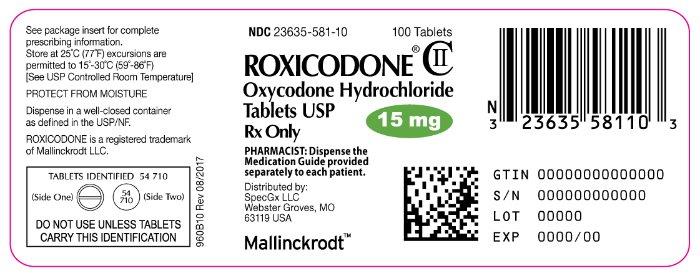
    ROXICODONE® is intended for the management of moderate to severe pain in patients who require treatment with an oral opioid analgesic. The dose should be individually adjusted according to severity of pain, patient response and patient size. If the pain increases in severity, if analgesia is not adequate, or if tolerance occurs, a gradual increase in dosage may be required.

    Patients who have not been receiving opioid analgesics should be started on ROXICODONE® in a dosing range of 5 to 15 mg every 4 to 6 hours as needed for pain. The dose should be titrated based upon the individual patient’s response to their initial dose of ROXICODONE®. Patients with chronic pain should have their dosage given on an around-the-clock basis to prevent the reoccurrence of pain rather than treating the pain after it has occurred. This dose can then be adjusted to an acceptable level of analgesia taking into account side effects experienced by the patient.

    For control of severe chronic pain, ROXICODONE® should be administered on a regularly scheduled basis, every 4 to 6 hours, at the lowest dosage level that will achieve adequate analgesia.

    As with any potent opioid, it is critical to adjust the dosing regimen for each patient individually, taking into account the patient’s prior analgesic treatment experience. Although it is not possible to list every condition that is important to the selection of the initial dose of ROXICODONE®, attention should be given to: 1) the daily dose, potency, and characteristics of a pure agonist or mixed agonist/antagonist the patient has been taking previously, 2) the reliability of the relative potency estimate to calculate the dose of oxycodone needed, 3) the degree of opioid tolerance, 4) the general condition and medical status of the patient, and 5) the balance between pain control and adverse experiences.

    Conversion From Fixed-Ratio Opioid/Acetaminophen, Opioid/Aspirin, or Opioid/Nonsteroidal Combination Drugs:

    When converting patients from fixed ratio opioid/non-opioid drug regimens a decision should be made whether or not to continue the non-opioid analgesic. If a decision is made to discontinue the use of non-opioid analgesic, it may be necessary to titrate the dose of ROXICODONE® in response to the level of analgesia and adverse effects afforded by the dosing regimen. If the non-opioid regimen is continued as a separate single entity agent, the starting dose ROXICODONE® should be based upon the most recent dose of opioid as a baseline for further titration of oxycodone. Incremental increases should be gauged according to side effects to an acceptable level of analgesia.

    Patients Currently on Opioid Therapy:

    If a patient has been receiving opioid-containing medications prior to taking ROXICODONE®, the potency of the prior opioid relative to oxycodone should be factored into the selection of the total daily dose (TDD) of oxycodone.

    In converting patients from other opioids to ROXICODONE® close observation and adjustment of dosage based upon the patient’s response to ROXICODONE® is imperative. Administration of supplemental analgesia for breakthrough or incident pain and titration of the total daily dose of ROXICODONE® may be necessary, especially in patients who have disease states that are changing rapidly.

    Maintenance of Therapy:

    Continual re-evaluation of the patient receiving ROXICODONE® is important, with special attention to the maintenance of pain control and the relative incidence of side effects associated with therapy. If the level of pain increases, effort should be made to identify the source of increased pain, while adjusting the dose as described above to decrease the level of pain.

    During chronic therapy, especially for non-cancer-related pain (or pain associated with other terminal illnesses), the continued need for the use of opioid analgesics should be re-assessed as appropriate.

    Cessation of Therapy:

    When a patient no longer requires therapy with ROXICODONE® or other opioid analgesics for the treatment of their pain, it is important that therapy be gradually discontinued over time to prevent the development of an opioid abstinence syndrome (narcotic withdrawal). In general, therapy can be decreased by 25% to 50% per day with careful monitoring for signs and symptoms of withdrawal (see DRUG ABUSE AND DEPENDENCE section for description of the signs and symptoms of withdrawal). If the patient develops these signs or symptoms, the dose should be raised to the previous level and titrated down more slowly, either by increasing the interval between decreases, decreasing the amount of change in dose, or both. It is not known at what dose of ROXICODONE® that treatment may be discontinued without risk of the opioid abstinence syndrome.


  • Teva Parenteral Medicines, Inc.
    Fludarabine Phosphate | Teva Parenteral Medicines, Inc.
    No Recall

    Fludarabine Phosphate | Teva Parenteral Medicines, Inc.

    Fludarabine Phosphate | Teva Parenteral Medicines, Inc.
    2.1 Recommended Dose

    The recommended adult dose of fludarabine phosphate injection is 25 mg/m2 administered intravenously over a period of approximately 30 minutes daily for five consecutive days. Each 5-day course of treatment should commence every 28 days. Dosage may be decreased or delayed based on evidence of hematologic or nonhematologic toxicity. Physicians should consider delaying or discontinuing the drug if neurotoxicity occurs.

    A number of clinical settings may predispose to increased toxicity from fludarabine phosphate injection. These include advanced age, renal impairment, and bone marrow impairment. Such patients should be monitored closely for excessive toxicity and the dose modified accordingly.

    The optimal duration of treatment has not been clearly established. It is recommended that three additional cycles of fludarabine phosphate injection be administered following the achievement of a maximal response and then the drug should be discontinued.

    2.2 Renal Impairment

    Adjustments to the starting dose are recommended to provide appropriate drug exposure in patients with creatinine clearance 30 to 79 mL/min, as estimated by the Cockroft-Gault equations. These adjustments are based on a pharmacokinetic study in patients with renal impairment. Fludarabine phosphate injection should not be administered to patients with creatinine clearance less than 30 mL/min.

    Starting Dose Adjustment for Renal Impairment

    Creatinine Clearance

    Starting Dose

    > 80 mL/min

    25 mg/m2 (full dose)

    50 to 79 mL/min

    20 mg/m2

    30 to 49 mL/min

    15 mg/m2

    < 30 mL/min

    Do not administer

    Renally impaired patients should be monitored closely for excessive toxicity and the dose modified accordingly.

    2.3 Use of Infusion Solutions

    Fludarabine phosphate injection contains no antimicrobial preservative and should be used within 8 hours of opening. Care must be taken to assure sterility of infusion solutions. Parenteral drug products should be inspected visually for particulate matter and discoloration prior to administration, whenever solution and container permit.

    Fludarabine phosphate injection should not be mixed with other drugs.

  • Mylan Institutional Llc
    Fludarabine Phosphate | Mylan Institutional Llc
    No Recall

    Fludarabine Phosphate | Mylan Institutional Llc

    Fludarabine Phosphate | Mylan Institutional Llc
    Usual Dose

    The recommended adult dose of fludarabine phosphate injection, USP is 25 mg/m2 administered intravenously over a period of approximately 30 minutes daily for five consecutive days. Each 5 day course of treatment should commence every 28 days. Dosage may be decreased or delayed based on evidence of hematologic or nonhematologic toxicity. Physicians should consider delaying or discontinuing the drug if neurotoxicity occurs.

    A number of clinical settings may predispose to increased toxicity from fludarabine phosphate injection, USP. These include advanced age, renal impairment, and bone marrow impairment. Such patients should be monitored closely for excessive toxicity and the dose modified accordingly.

    The optimal duration of treatment has not been clearly established. It is recommended that three additional cycles of fludarabine phosphate injection, USP be administered following the achievement of a maximal response and then the drug should be discontinued.

    Renal Impairment

    Adjustments to the starting dose are recommended to provide appropriate drug exposure in patients with creatinine clearance 30-79 mL/min, as estimated by the Cockroft-Gault equations. These adjustments are based on a pharmacokinetic study in patients with renal impairment. Fludarabine phosphate injection, USP should not be administered to patients with creatinine clearance less than 30 mL/min.

    Starting Dose Adjustment for Renal Impairment

    Creatinine Clearance

    Starting Dose

    ≥ 80 mL/min

    25 mg/m2 (full dose)

    50 - 79 mL/min

    20 mg/m2

    30 - 49 mL/min

    15 mg/m2

    30 mL/min

    do not administer

    Renally impaired patients should be monitored closely for excessive toxicity and the dose modified accordingly.

    Preparation of Solutions

    Fludarabine phosphate injection, USP: Each mL contains 25 mg fludarabine phosphate, 25 mg mannitol, water for injection, qs; and sodium hydroxide to adjust the pH to 6.8. The pH range for the final product is 6.0 to 7.1. In clinical studies, the product has been diluted in 100 cc or 125 cc of 5% dextrose injection USP or 0.9% sodium chloride USP.

    Fludarabine phosphate injection, USP contains no antimicrobial preservative and thus should be used within 8 hours of initial entry. Care must be taken to assure the sterility of prepared solutions. Parenteral drug products should be inspected visually for particulate matter and discoloration prior to administration.

    Handling and Disposal

    Parenteral drug products should be inspected visually for particulate matter and discoloration prior to administration.

    Procedures for proper handling and disposal should be considered. Consideration should be given to handling and disposal according to guidelines issued for cytotoxic drugs. Several guidelines on this subject have been published.1-4

    Caution should be exercised in the handling of fludarabine phosphate injection, USP. The use of latex gloves and safety glasses is recommended to avoid exposure in case of breakage of the vial or other accidental spillage. If the solution contacts the skin or mucous membranes, wash thoroughly with soap and water; rinse eyes thoroughly with plain water. Avoid exposure by inhalation or by direct contact of the skin or mucous membranes.

  • Fludarabine Phosphate | Hospira Worldwide, Inc.
    No Recall

    Fludarabine Phosphate | Hospira Worldwide, Inc.

    Fludarabine Phosphate | Hospira Worldwide, Inc.

    Usual Dose:

    The recommended adult dose of Fludarabine Phosphate for Injection, USP is 25 mg/m2 administered intravenously over a period of approximately 30 minutes daily for five consecutive days. Each 5 day course of treatment should commence every 28 days. Dosage may be decreased or delayed based on evidence of hematologic or nonhematologic toxicity. Physicians should consider delaying or discontinuing the drug if neurotoxicity occurs.

    A number of clinical settings may predispose to increased toxicity from fludarabine phosphate, USP. These include advanced age, renal insufficiency, and bone marrow impairment. Such patients should be monitored closely for excessive toxicity and the dose modified accordingly.

    The optimal duration of treatment has not been clearly established. It is recommended that three additional cycles of fludarabine phosphate, USP be administered following the achievement of a maximal response and then the drug should be discontinued.

    Renal Insufficiency

    Adult patients with moderate impairment of renal function (creatinine clearance 30 to 70 mL/min/1.73 m2) should have a 20% dose reduction of fludarabine phosphate, USP. Fludarabine phosphate, USP should not be administered to patients with severely impaired renal function (creatinine clearance less than 30 mL/min/1.73 m2).

    Preparation of Solutions:

    Fludarabine Phosphate for Injection, USP should be prepared for parenteral use by aseptically adding Sterile Water for Injection, USP. When reconstituted with 2 mL of Sterile Water for Injection, USP, the solid cake should fully dissolve in 15 seconds or less; each mL of the resulting solution will contain 25 mg of fludarabine phosphate, USP, 25 mg of mannitol, and sodium hydroxide to adjust the pH to 7.7. The pH range for the final product is 7.2 to 8.2. In clinical studies, the product has been diluted in 100 cc or 125 cc of 5% Dextrose Injection, USP or 0.9% Sodium Chloride, USP.

    Reconstituted Fludarabine Phosphate for Injection, USP contains no antimicrobial preservative and thus should be used within 8 hours of reconstitution. Care must be taken to assure the sterility of prepared solutions. Parenteral drug products should be inspected visually for particulate matter and discoloration prior to administration.

    Fludarabine Phosphate for Injection, USP should not be mixed with other drugs.

    Handling and Disposal:

    Procedures for proper handling and disposal should be considered. Consideration should be given to handling and disposal according to guidelines issued for cytotoxic drugs. Several guidelines on this subject have been published.1-4

    Caution should be exercised in the handling and preparation of Fludarabine Phosphate for Injection, USP solution. The use of latex gloves and safety glasses is recommended to avoid exposure in case of breakage of the vial or other accidental spillage. If the solution contacts the skin or mucous membranes, wash thoroughly with soap and water; rinse eyes thoroughly with plain water. Avoid exposure by inhalation or by direct contact of the skin or mucous membranes.

  • Mylan Institutional Llc
    Fludarabine Phosphate | Mylan Institutional Llc
    No Recall

    Fludarabine Phosphate | Mylan Institutional Llc

    Fludarabine Phosphate | Mylan Institutional Llc
    Usual Dose

    The recommended adult dose of fludarabine phosphate injection is 25 mg/m2 administered intravenously over a period of approximately 30 minutes daily for five consecutive days. Each 5 day course of treatment should commence every 28 days. Dosage may be decreased or delayed based on evidence of hematologic or nonhematologic toxicity. Physicians should consider delaying or discontinuing the drug if neurotoxicity occurs.

    A number of clinical settings may predispose to increased toxicity from fludarabine phosphate injection. These include advanced age, renal impairment, and bone marrow impairment. Such patients should be monitored closely for excessive toxicity and the dose modified accordingly.

    The optimal duration of treatment has not been clearly established. It is recommended that three additional cycles of fludarabine phosphate injection be administered following the achievement of a maximal response and then the drug should be discontinued.

    Renal Impairment

    Adjustments to the starting dose are recommended to provide appropriate drug exposure in patients with creatinine clearance 30-79 mL/min, as estimated by the Cockroft-Gault equations. These adjustments are based on a pharmacokinetic study in patients with renal impairment. Fludarabine Phosphate Injection, should not be administered to patients with creatinine clearance less than 30 mL/min.

    Starting Dose Adjustment for Renal Impairment Creatinine Clearance
    Starting Dose
    ≥ 80 mL/min
    25 mg/m2 (full dose)
    50 - 79 mL/min
    20 mg/m2
    30 - 49 mL/min
    15 mg/m2
    < 30 mL/min
    do not administer

    Renally impaired patients should be monitored closely for excessive toxicity and the dose modified accordingly.

    Preparation of Solutions

    Fludarabine Phosphate Injection; Each mL contains 25 mg fludarabine phosphate, 25 mg mannitol, water for injection, qs; and sodium hydroxide to adjust the pH to 6.8. The pH range for the final product is 6.0–7.1. In clinical studies, the product has been diluted in 100 cc or 125 cc of 5% dextrose injection USP, or 0.9% sodium chloride USP.

    Fludarabine Phosphate Injection, contains no antimicrobial preservative and thus should be used within 8 hours of initial entry. Care must be taken to assure the sterility of prepared solutions. Parenteral drug products should be inspected visually for particulate matter and discoloration prior to administration.

    Fludarabine Phosphate Injection, should not be mixed with other drugs.

    Handling and Disposal

    Procedures for proper handling and disposal should be considered. Consideration should be given to handling and disposal according to guidelines issued for cytotoxic drugs. Several guidelines on this subject have been published. 1-4

    Caution should be exercised in the handling of fludarabine phosphate injection. The use of latex gloves and safety glasses is recommended to avoid exposure in case of breakage of the vial or other accidental spillage. If the solution contacts the skin or mucous membranes, wash thoroughly with soap and water; rinse eyes thoroughly with plain water. Avoid exposure by inhalation or by direct contact of the skin or mucous membranes.