2.1 General Dosage and Administration
The recommended dosage for ZYVOX formulations for the treatment of infections is described in Table 1.
Table 1. Dosage Guidelines for ZYVOX
Dosage and Route of Administration
Recommended Duration of Treatment (consecutive days)
Infection*
Pediatric Patients† (Birth through 11 Years of Age)
Adults and Adolescents
(12 Years and Older)
*
Due to the designated pathogens [
see Indications and Usage (1)]
†
Neonates less than7
days: Most pre-term neonates less than 7 days of age (gestational age less than 34 weeks) have lower systemic linezolid clearance values and larger AUC values than many full-term neonates and older infants. These neonates should be initiated with a dosing regimen of 10 mg/kg every 12 hours. Consideration may be given to the use of 10 mg/kg every 8 hours regimen in neonates with a sub-optimal clinical response. All neonatal patients should receive 10 mg/kg every 8 hours by 7 days of life [
see Use in Specific Populations (8.4) and Clinical Pharmacology (12.3)].
‡
Oral dosing using either ZYVOX Tablets or ZYVOX for Oral Suspension [
see How Supplied/Storage and Handling (16)].
Nosocomial pneumonia
10 mg/kg intravenously or oral‡ every 8 hours
600 mg intravenously or oral‡ every 12 hours
10 to 14
Community-acquired pneumonia, including concurrent bacteremia
Complicated skin and skin structure infections
Vancomycin-resistant Enterococcus faecium infections, including concurrent bacteremia
10 mg/kg intravenously or oral‡ every 8 hours
600 mg intravenously or oral‡ every 12 hours
14 to 28
Uncomplicated skin and skin structure infections
less than 5 yrs: 10 mg/kg oral‡ every 8 hours
5–11 yrs: 10 mg/kg oral‡ every
12 hours
Adults: 400 mg oral‡ every 12 hours
Adolescents: 600 mg oral‡ every 12 hours
10 to 14
No dose adjustment is necessary when switching from intravenous to oral administration.
2.2 Intravenous Administration
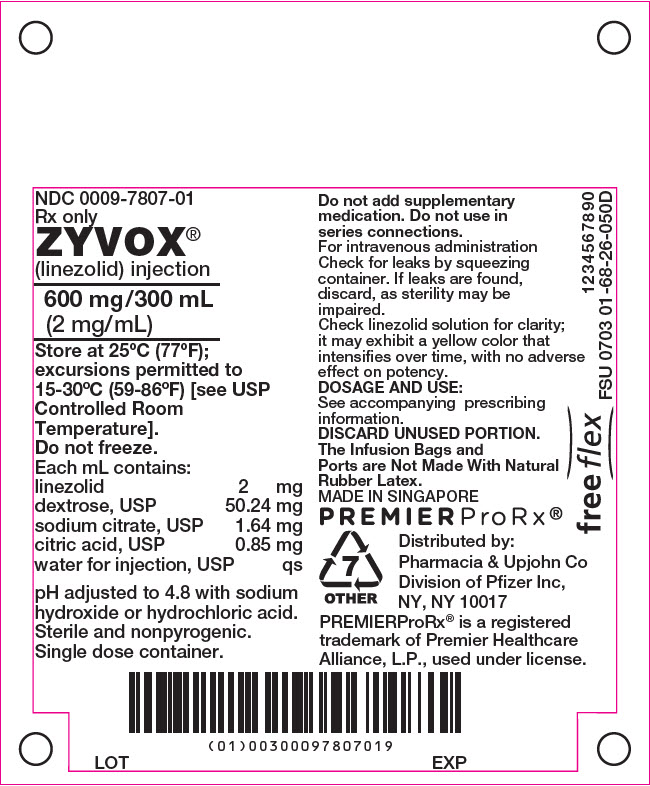
ZYVOX I.V. Injection is supplied in single-use, ready-to-use infusion bags. Parenteral drug products should be inspected visually for particulate matter prior to administration. Check for minute leaks by firmly squeezing the bag. If leaks are detected, discard the solution, as sterility may be impaired. Keep the infusion bags in the overwrap until ready to use. Store at room temperature. Protect from freezing. ZYVOX I.V. Injection may exhibit a yellow color that can intensify over time without adversely affecting potency.
ZYVOX I.V. Injection should be administered by intravenous infusion over a period of 30 to 120 minutes. Do not use this intravenous infusion bag in series connections. Additives should not be introduced into this solution. If ZYVOX I.V. Injection is to be given concomitantly with another drug, each drug should be given separately in accordance with the recommended dosage and route of administration for each product.
If the same intravenous line is used for sequential infusion of several drugs, the line should be flushed before and after infusion of ZYVOX I.V. Injection with an infusion solution compatible with ZYVOX I.V. Injection and with any other drug(s) administered via this common line.
2.3 Compatibilities
Compatible intravenous solutions include 0.9% Sodium Chloride Injection, USP, 5% Dextrose Injection, USP, and Lactated Ringer's Injection, USP.
2.4 Incompatibilities
Physical incompatibilities resulted when ZYVOX I.V. Injection was combined with the following drugs during simulated Y-site administration: amphotericin B, chlorpromazine HCl, diazepam, pentamidine isothionate, erythromycin lactobionate, phenytoin sodium, and trimethoprim-sulfamethoxazole. Additionally, chemical incompatibility resulted when ZYVOX I.V. Injection was combined with ceftriaxone sodium.