
Micardis label

Micardis

Micardis Recall

Get an alert when a recall is issued.

Side Effects & Adverse Reactions

There is currently no warning information available for this product. We apologize for any inconvenience.

FDA Safety Alerts

There are currently no FDA safety alerts available for this drug.

Manufacturer Warnings

There is currently no manufacturer warning information available for this drug.

FDA Labeling Changes

There are currently no FDA labeling changes available for this drug.

Uses

1.1  Hypertension

MICARDIS is indicated for the treatment of hypertension.  It may be used alone or in combination with other antihypertensive agents [see Clinical Studies (14.1)].

1.2  Cardiovascular Risk Reduction

MICARDIS is indicated for reduction of the risk of myocardial infarction, stroke, or death from cardiovascular causes in patients 55 years of age or older at high risk of developing major cardiovascular events who are unable to take ACE inhibitors.

High risk for cardiovascular events can be evidenced by a history of coronary artery disease, peripheral arterial disease, stroke, transient ischemic attack, or high-risk diabetes (insulin-dependent or non-insulin dependent) with evidence of end-organ damage [see Clinical Studies (14.2)].  MICARDIS can be used in addition to other needed treatment (such as antihypertensive, antiplatelet or lipid-lowering therapy) [see Clinical Studies (14.2)].

Studies of telmisartan in this setting do not exclude that it may not preserve a meaningful fraction of the effect of the ACE inhibitor to which it was compared. Consider using the ACE inhibitor first, and, if it is stopped for cough only, consider re-trying the ACE inhibitor after the cough resolves.

Use of telmisartan with an ACE inhibitor is not recommended [see Warnings and Precautions (5.6)].

History

There is currently no drug history available for this drug.

Other Information

MICARDIS is a non-peptide angiotensin II receptor (type AT1) antagonist.

Telmisartan is chemically described as 4′-[(1,4′-dimethyl-2′-propyl [2,6′-bi-1H-benzimidazol]-1′-yl)methyl]-[1,1′-biphenyl]-2-carboxylic acid. Its empirical formula is C33H30N4O2, its molecular weight is 514.63, and its structural formula is:
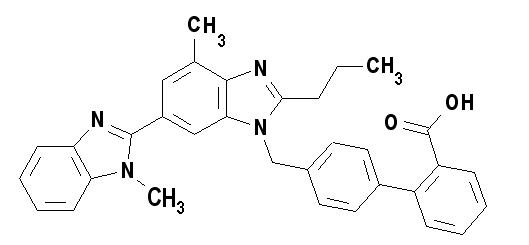
Micardis structure

Telmisartan is a white to slightly yellowish solid. It is practically insoluble in water and in the pH range of 3 to 9, sparingly soluble in strong acid (except insoluble in hydrochloric acid), and soluble in strong base.

MICARDIS is available as tablets for oral administration, containing 20 mg, 40 mg or 80 mg of telmisartan. The tablets contain the following inactive ingredients: sodium hydroxide, meglumine, povidone, sorbitol, and magnesium stearate. MICARDIS tablets are hygroscopic and require protection from moisture.

Micardis Manufacturers

  • Physicians Total Care, Inc.
    Micardis | Physicians Total Care, Inc.
    No Recall

    Micardis | Physicians Total Care, Inc.

    Micardis | Physicians Total Care, Inc.
    2.1  Hypertension

    Dosage must be individualized.  The usual starting dose of MICARDIS tablets is 40 mg once a day.  Blood pressure response is dose-related over the range of 20 to 80 mg [see Clinical Studies (14.1)].

    Most of the antihypertensive effect is apparent within 2 weeks and maximal reduction is generally attained after 4 weeks.  When additional blood pressure reduction beyond that achieved with 80 mg MICARDIS is required, a diuretic may be added.

    No initial dosage adjustment is necessary for elderly patients or patients with renal impairment, including those on hemodialysis. Patients on dialysis may develop orthostatic hypotension; their blood pressure should be closely monitored.

    MICARDIS tablets may be administered with other antihypertensive agents.

    MICARDIS tablets may be administered with or without food.

    2.2  Cardiovascular Risk Reduction

    The recommended dose of MICARDIS tablets is 80 mg once a day and can be administered with or without food. It is not known whether doses lower than 80 mg of telmisartan are effective in reducing the risk of cardiovascular morbidity and mortality.

    When initiating MICARDIS therapy for cardiovascular risk reduction, monitoring of blood pressure is recommended, and if appropriate, adjustment of medications that lower blood pressure may be necessary.

  • Lake Erie Medical & Surgical Supply Dba Quality Care Products Llc
    Micardis | Lake Erie Medical & Surgical Supply Dba Quality Care Products Llc
    No Recall

    Micardis | Lake Erie Medical & Surgical Supply Dba Quality Care Products Llc

    Micardis | Lake Erie Medical & Surgical Supply Dba Quality Care Products Llc
    2.1  Hypertension

    Dosage must be individualized.  The usual starting dose of MICARDIS tablets is 40 mg once a day.  Blood pressure response is dose-related over the range of 20 to 80 mg [see Clinical Studies (14.1)].

    Most of the antihypertensive effect is apparent within 2 weeks and maximal reduction is generally attained after 4 weeks.  When additional blood pressure reduction beyond that achieved with 80 mg MICARDIS is required, a diuretic may be added.

    No initial dosage adjustment is necessary for elderly patients or patients with renal impairment, including those on hemodialysis. Patients on dialysis may develop orthostatic hypotension; their blood pressure should be closely monitored.

    MICARDIS tablets may be administered with other antihypertensive agents.

    MICARDIS tablets may be administered with or without food.

    2.2  Cardiovascular Risk Reduction

    The recommended dose of MICARDIS tablets is 80 mg once a day and can be administered with or without food. It is not known whether doses lower than 80 mg of telmisartan are effective in reducing the risk of cardiovascular morbidity and mortality.

    When initiating MICARDIS therapy for cardiovascular risk reduction, monitoring of blood pressure is recommended, and if appropriate, adjustment of medications that lower blood pressure may be necessary.

  • Micardis | Boehringer Ingelheim Pharmaceuticals, Inc.
    No Recall

    Micardis | Boehringer Ingelheim Pharmaceuticals, Inc.

    Micardis | Boehringer Ingelheim Pharmaceuticals, Inc.
    2.1  Hypertension

    Dosage must be individualized.  The usual starting dose of MICARDIS tablets is 40 mg once a day.  Blood pressure response is dose-related over the range of 20 to 80 mg [see Clinical Studies (14.1)].

    Most of the antihypertensive effect is apparent within 2 weeks and maximal reduction is generally attained after 4 weeks.  When additional blood pressure reduction beyond that achieved with 80 mg MICARDIS is required, a diuretic may be added.

    No initial dosage adjustment is necessary for elderly patients or patients with renal impairment, including those on hemodialysis. Patients on dialysis may develop orthostatic hypotension; their blood pressure should be closely monitored.

    MICARDIS tablets may be administered with other antihypertensive agents.

    MICARDIS tablets may be administered with or without food.

    2.2  Cardiovascular Risk Reduction

    The recommended dose of MICARDIS tablets is 80 mg once a day and can be administered with or without food. It is not known whether doses lower than 80 mg of telmisartan are effective in reducing the risk of cardiovascular morbidity and mortality.

    When initiating MICARDIS therapy for cardiovascular risk reduction, monitoring of blood pressure is recommended, and if appropriate, adjustment of medications that lower blood pressure may be necessary.