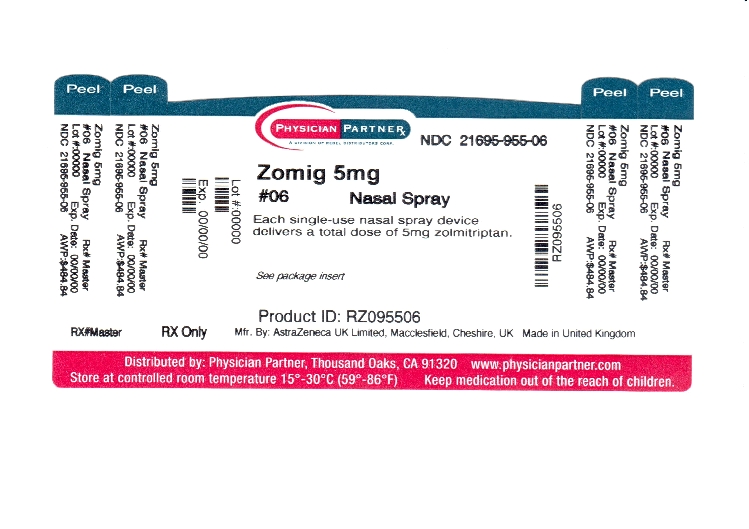
Zomig label

Zomig

Zomig Recall

Get an alert when a recall is issued.

Side Effects & Adverse Reactions

There is currently no warning information available for this product. We apologize for any inconvenience.

FDA Safety Alerts

There are currently no FDA safety alerts available for this drug.

Manufacturer Warnings

There is currently no manufacturer warning information available for this drug.

FDA Labeling Changes

There are currently no FDA labeling changes available for this drug.

Uses

1.1 Acute Treatment of Migraine Attacks

ZOMIG Nasal Spray is indicated for the acute treatment of migraine with or without aura in adults.

1.2 Important Limitations

ZOMIG should only be used where a clear diagnosis of migraine has been established. If a patient has no response for the first migraine attack treated with ZOMIG, the diagnosis of migraine should be reconsidered before ZOMIG is administered to treat any subsequent attacks.

ZOMIG is not intended for the prophylactic therapy of migraine or for use in the management of hemiplegic or basilar migraine [see Contraindications (4.6)].

Safety and effectiveness of ZOMIG have not been established for cluster headache, which is present in an older, predominantly male population.

History

There is currently no drug history available for this drug.

Other Information

ZOMIG® (zolmitriptan) Nasal Spray contains zolmitriptan, which is a selective 5-hydroxytryptamine 1B/1D (5-HT1B/1D) receptor agonist. Zolmitriptan is chemically designated as (S)-4-[[3-[2-(dimethylamino)ethyl]-1H-indol-5-yl]methyl]-2-oxazolidinone and has the following chemical structure:

chemical structure

The empirical formula is C16H21N3O2, representing a molecular weight of 287.36. Zolmitriptan is a white to almost white powder that is readily soluble in water. ZOMIG Nasal Spray is supplied as a clear to pale yellow solution of zolmitriptan, buffered to a pH 5.0. Each ZOMIG Nasal Spray contains 5 mg of zolmitriptan in a 100-μL unit dose aqueous buffered solution containing citric acid, anhydrous, USP, disodium phosphate dodecahydrate USP and purified water USP.

ZOMIG Nasal Spray is hypertonic. The osmolarity of ZOMIG Nasal Spray 5 mg is 420 to 470 mOsmol.

Zomig Manufacturers

  • Zomig | Rebel Distributors Corp
    No Recall

    Zomig | Rebel Distributors Corp

    Zomig | Rebel Distributors Corp
    2.1 Acute Treatment of Migraine Attacks

    Administer one dose of ZOMIG Nasal Spray 5 mg for the treatment of acute migraine. If the headache returns, the dose may be repeated after 2 hours. The effectiveness of a second dose has not been established in placebo-controlled trials. The maximum daily dose should not exceed 10 mg in any 24-hour period.

    In controlled clinical trials, single doses of 5 mg of zolmitriptan nasal spray were administered into one nostril and were effective for the treatment of acute migraines in adults.

    Individuals may vary in response to ZOMIG Nasal Spray. The pharmacokinetics of a 5 mg nasal spray dose is similar to the 5 mg oral formulations. Doses lower than 5 mg can only be achieved through the use of an oral formulation. The choice of dose, and route of administration should therefore be made on an individual basis.

    The safety of treating an average of more than four headaches in a 30-day period has not been established.

    2.2 Hepatic Impairment

    Patients with moderate to severe hepatic impairment have decreased clearance of zolmitriptan and significant elevation in blood pressure was observed in some patients. Use of doses less than 2.5mg of an alternate formulation with blood pressure monitoring is recommended [see Clinical Pharmacology (12.3) and Warnings and Precautions (5.6)].

  • Dispensing Solutions, Inc.
    Zomig | Dispensing Solutions, Inc.
    No Recall

    Zomig | Dispensing Solutions, Inc.

    Zomig | Dispensing Solutions, Inc.
    ZOMIG Tablets

    In controlled clinical trials, single doses of 1, 2.5 and 5 mg of ZOMIG Tablets were effective for the acute treatment of migraines in adults. A greater proportion of patients had headache response following a 2.5 or 5 mg dose than following a 1 mg dose (see Table 1). In the only direct comparison of 2.5 and 5 mg, there was little added benefit from the larger dose but side effects are generally increased at 5 mg (see Table 2). Patients should, therefore, be started on 2.5 mg or lower. A dose lower than 2.5 mg can be achieved by manually breaking the scored 2.5 mg tablet in half.

    If the headache returns, the dose may be repeated after 2 hours, not to exceed 10 mg within a 24-hour period. Controlled trials have not adequately established the effectiveness of a second dose if the initial dose is ineffective.

    The safety of treating an average of more than three headaches in a 30-day period has not been established.

    ZOMIG-ZMT Orally Disintegrating Tablets

    In a controlled clinical trial, a single dose of 2.5 mg of ZOMIG-ZMT Tablets was effective for the acute treatment of migraines in adults.

    If the headache returns, the dose may be repeated after 2 hours, not to exceed 10 mg within a 24-hour period. Controlled trials have not adequately established the effectiveness of a second dose if the initial dose is ineffective.

    The safety of treating an average of more than three headaches in a 30-day period has not been established.

    Administration with liquid is not necessary. The orally disintegrating tablet is packaged in a blister. Patients should be instructed not to remove the tablet from the blister until just prior to dosing. The blister pack should then be peeled open, and the orally disintegrating tablet placed on the tongue, where it will dissolve and be swallowed with the saliva. It is not recommended to break the orally disintegrating tablet.

    Hepatic Impairment:

    Patients with moderate to severe hepatic impairment have decreased clearance of zolmitriptan and significant elevation in blood pressure was observed in some patients. Use of a low dose with blood pressure monitoring is recommended (see CLINICAL PHARMACOLOGY AND WARNINGS).

  • Astrazeneca Pharmaceuticals Lp
    Zomig | Astrazeneca Pharmaceuticals Lp
    No Recall

    Zomig | Astrazeneca Pharmaceuticals Lp

    Zomig | Astrazeneca Pharmaceuticals Lp
    2.1 Acute Treatment of Migraine Attacks

    Administer one dose of ZOMIG Nasal Spray 5 mg for the treatment of acute migraine. If the headache returns, the dose may be repeated after 2 hours. The effectiveness of a second dose has not been established in placebo-controlled trials. The maximum daily dose should not exceed 10 mg in any 24-hour period.

    In controlled clinical trials, single doses of 5 mg of zolmitriptan nasal spray were administered into one nostril and were effective for the treatment of acute migraines in adults.

    Individuals may vary in response to ZOMIG Nasal Spray. The pharmacokinetics of a 5 mg nasal spray dose is similar to the 5 mg oral formulations. Doses lower than 5 mg can only be achieved through the use of an oral formulation. The choice of dose, and route of administration should therefore be made on an individual basis.

    The safety of treating an average of more than four headaches in a 30-day period has not been established.

    2.2 Hepatic Impairment

    Patients with moderate to severe hepatic impairment have decreased clearance of zolmitriptan and significant elevation in blood pressure was observed in some patients. Use of doses less than 2.5mg of an alternate formulation with blood pressure monitoring is recommended [see Clinical Pharmacology (12.3) and Warnings and Precautions (5.6)].

  • Impax Laboratories, Inc.
    Zomig | Impax Laboratories, Inc.
    No Recall

    Zomig | Impax Laboratories, Inc.

    Zomig | Impax Laboratories, Inc.
    2.1 Dosing Information

    The recommended starting dose of ZOMIG is 1.25 mg or 2.5 mg. The 1.25 mg dose can be achieved by manually breaking the functionally-scored 2.5 mg tablet in half. The maximum recommended single dose of ZOMIG is 5 mg.

    In controlled clinical trials, a greater proportion of patients had headache response following a 2.5 mg or 5 mg dose than following a 1 mg dose. There was little added benefit from the 5 mg dose compared to the 2.5 mg dose, but adverse reactions were more frequent with the 5 mg dose.

    If the migraine has not resolved by 2 hours after taking ZOMIG, or returns after a transient improvement, a second dose may be administered at least 2 hours after the first dose. The maximum daily dose is 10 mg in any 24-hour period.

    The safety of ZOMIG in the treatment of an average of more than three migraines in a 30-day period has not been established.

    2.2 Administration of ZOMIG-ZMT Orally Disintegrating Tablets

    Instruct patients not to break ZOMIG-ZMT orally disintegrating tablets because they are not functionally-scored. Administration with liquid is not necessary.

    Orally disintegrating tablets are packaged in a blister pack. Instruct patients not to remove the tablet from the blister until just prior to dosing. Subsequently, instruct patients to peel the blister pack open, and to place the orally disintegrating tablet on the tongue, where it will dissolve and it will be swallowed with the saliva.

    2.3 Dosing in Patients with Hepatic Impairment

    The recommended dose of ZOMIG in patients with moderate to severe hepatic impairment is 1.25 mg (one-half of one 2.5 mg ZOMIG tablet) because of increased zolmitriptan blood levels in these patients and elevation of blood pressure in some of these patients. Limit the total daily dose in patients with severe hepatic impairment to no more than 5 mg per day.

    The use of ZOMIG-ZMT orally disintegrating tablets is not recommended in patients with moderate or severe hepatic impairment because these orally disintegrating tablets should not be broken in half [see Use in Specific Populations (8.6), and Clinical Pharmacology (12.3)].

    2.4 Dosing in Patients taking Cimetidine

    If ZOMIG is co-administered with cimetidine, limit the maximum single dose of ZOMIG to 2.5 mg, not to exceed 5 mg in any 24-hour period [see Drug Interactions (7.5), Clinical Pharmacology (12.3)].

  • Impax Laboratories, Inc.
    Zomig | Pd-rx Pharmaceuticals, Inc.
    No Recall

    Zomig | Pd-rx Pharmaceuticals, Inc.

    Zomig | Pd-rx Pharmaceuticals, Inc.

    Dosage should be adjusted according to the severity of the pain and the response of the patient. It may occasionally be necessary to exceed the usual dosage recommended below in cases of more severe pain or in those patients who have become tolerant to the analgesic effect of opioids. If pain is constant, the opioid analgesic should be given at regular intervals on an around-the-clock schedule. Oxycodone and acetaminophen tablets are given orally.

    Oxycodone and Acetaminophen Tablets 2.5 mg/325 mg

    The usual adult dosage is one or 2 tablets every 6 hours. The total daily dose of acetaminophen should not exceed 4 grams.

    Oxycodone and Acetaminophen Tablets 5 mg/325 mg

    The usual adult dosage is one tablet every 6 hours as needed for pain. The total daily dose of acetaminophen should not exceed 4 grams.

    Oxycodone and Acetaminophen Tablets 7.5 mg/325 mg; Oxycodone and Acetaminophen Tablets 10 mg/325 mg

    The usual adult dosage is one tablet every 6 hours as needed for pain. The total daily dose of acetaminophen should not exceed 4 grams.

    Strength Maximal Daily Dose  Oxycodone and Acetaminophen Tablets  12 Tablets  2.5 mg/325 mg  Oxycodone and Acetaminophen Tablets  12 Tablets  5 mg/325 mg  Oxycodone and Acetaminophen Tablets  8 Tablets  7.5 mg/325 mg  Oxycodone and Acetaminophen Tablets  6 Tablets  10 mg/325 mg Cessation of Therapy

    In patients treated with oxycodone and acetaminophen tablets for more than a few weeks who no longer require therapy, doses should be tapered gradually to prevent signs and symptoms of withdrawal in the physically dependent patient.