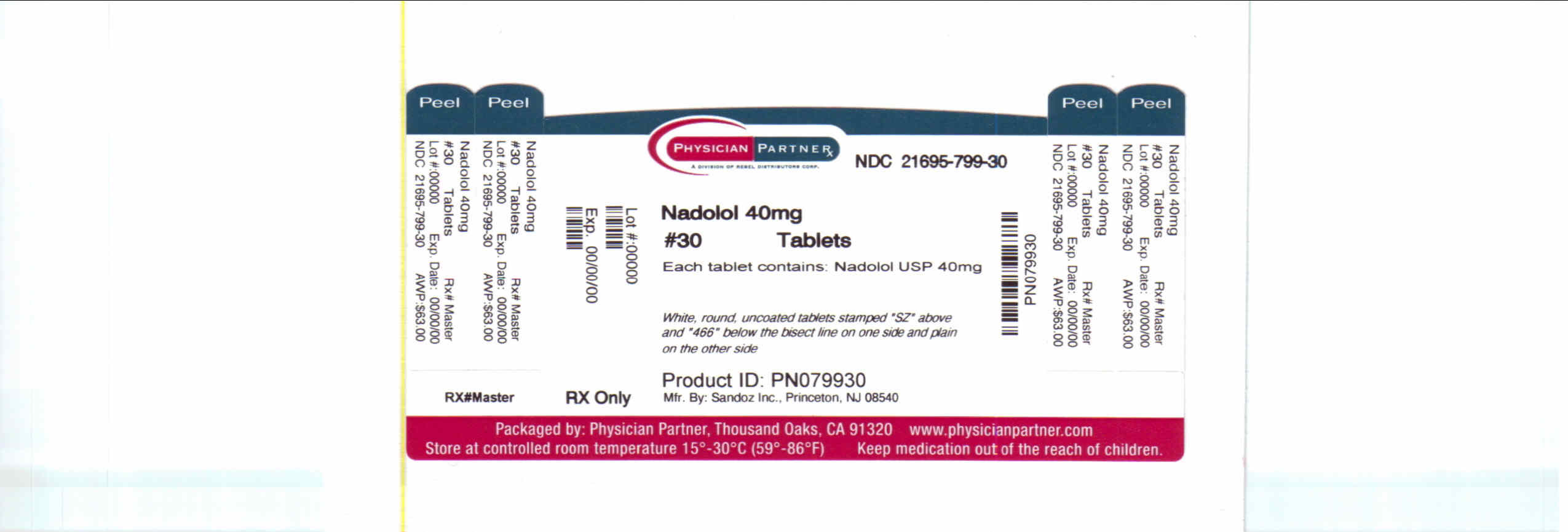
Nadolol label

Nadolol

Nadolol Recall

Get an alert when a recall is issued.

Side Effects & Adverse Reactions

Cardiac Failure

Sympathetic stimulation may be a vital component supporting circulatory function in patients with congestive heart failure, and its inhibition by beta-blockade may precipitate more severe failure. Although beta-blockers should be avoided in overt congestive heart failure, if necessary, they can be used with caution in patients with a history of failure who are well-compensated, usually with digitalis and diuretics. Beta-adrenergic blocking agents do not abolish the inotropic action of digitalis on heart muscle.

IN PATIENTS WITHOUT A HISTORY OF HEART FAILURE, continued use of beta-blockers can, in some cases, lead to cardiac failure. Therefore, at the first sign or symptom of heart failure, the patient should be digitalized and/or treated with diuretics, and the response observed closely, or nadolol should be discontinued (gradually, if possible).

Exacerbation of Ischemia Heart Disease Following Abrupt Withdrawal

Hypersensitivity to catecholamines has been observed in patients withdrawn from beta-blocker therapy; exacerbation of angina and, in some cases, myocardial infarction have occurred after abrupt discontinuation of such therapy. When discontinuing chronically administered nadolol, particularly in patients with ischemic heart disease, the dosage should be gradually reduced over a period of one to two weeks and the patient should be carefully monitored. If angina markedly worsens or acute coronary insufficiency develops, nadolol administration should be reinstituted promptly, at least temporarily, and other measures appropriate for the management of unstable angina should be taken. Patients should be warned against interruption or discontinuation of therapy without the physician’s advice. Because coronary artery disease is common and may be unrecognized, it may be prudent not to discontinue nadolol therapy abruptly even in patients treated only for hypertension.

Nonallergic Bronchospasm (e.g., chronic bronchitis, emphysema)

PATIENTS WITH BRONCHOSPASTIC DISEASES SHOULD IN GENERAL NOT RECEIVE BETA-BLOCKERS. Nadolol should be administered with caution since it may block bronchodilation produced by endogenous or exogenous catecholamine stimulation of beta2 receptors.

Major Surgery

Because beta-blockade impairs the ability of the heart to respond to reflex stimuli and may increase the risks of general anesthesia and surgical procedures, resulting in protracted hypotension or low cardiac output, it has generally been suggested that such therapy should be withdrawn several days prior to surgery. Recognition of the increased sensitivity to catecholamines of patients recently withdrawn from beta-blocker therapy, however, has made this recommendation controversial. If possible, beta-blockers should be withdrawn well before surgery takes place. In the event of emergency surgery, the anesthesiologist should be informed that the patient is on beta-blocker therapy. The effects of nadolol can be reversed by administration of beta-receptor agonists such as isoproterenol, dopamine, dobutamine, or levarterenol. Difficulty in restarting and maintaining the heart beat has also been reported with beta-adrenergic receptor blocking agents.

Diabetes and Hypoglycemia

Beta-adrenergic blockade may prevent the appearance of premonitory signs and symptoms (e.g., tachycardia and blood pressure changes) of acute hypoglycemia. This is especially important with labile diabetics. Beta-blockade also reduces the release of insulin in response to hyperglycemia; therefore, it may be necessary to adjust the dose of antidiabetic drugs.

Thyrotoxicosis

Beta-adrenergic blockade may mask certain clinical signs (e.g., tachycardia) of hyperthyroidism. Patients suspected of developing thyrotoxicosis should be managed carefully to avoid abrupt withdrawal of beta-adrenergic blockade which might precipitate a thyroid storm.

FDA Safety Alerts

There are currently no FDA safety alerts available for this drug.

Manufacturer Warnings

There is currently no manufacturer warning information available for this drug.

FDA Labeling Changes

There are currently no FDA labeling changes available for this drug.

Uses

Angina Pectoris

Nadolol tablets are indicated for the long-term management of patients with angina pectoris.

Hypertension

Nadolol tablets are indicated in the management of hypertension; they may be used alone or in combination with other antihypertensive agents, especially thiazide-type diuretics,

History

There is currently no drug history available for this drug.

Other Information

Nadolol tablets are synthetic nonselective beta-adrenergic receptor blocking agents designated chemically as 1-(tert-butylamino)-3-[(5, 6, 7, 8-tetrahydro-cis-6, 7-dihydroxy-1-naphthyl)oxy]-2-propanol. Structural formula:

Nadolol Chemical Structure

C17H27NO4 M.W. 309.40

Nadolol is a white crystalline powder. It is freely soluble in ethanol, soluble in hydrochloric acid, slightly soluble in water and in chloroform, and very slightly soluble in sodium hydroxide.

Nadolol tablets are available for oral administration as 20 mg, 40 mg and 80 mg tablets. Inactive ingredients: lactose monohydrate, microcrystalline cellulose, pregelatinized starch, croscarmellose sodium, hydroxypropyl cellulose, silicon dioxide, magnesium stearate, and purified water.

Nadolol Manufacturers

  • Nadolol | Rebel Distributors Corp
    No Recall

    Nadolol | Rebel Distributors Corp

    Nadolol | Rebel Distributors Corp

    DOSAGE MUST BE INDIVIDUALIZED. NADOLOL TABLETS MAY BE ADMINISTERED WITHOUT REGARD TO MEALS.

    Angina Pectoris

    The usual initial dose is 40 mg nadolol tablets once daily. Dosage may be gradually increased in 40 to 80 mg increments at 3 to 7 day intervals until optimum clinical response is obtained or there is pronounced slowing of the heart rate. The usual maintenance dose is 40 or 80 mg administered once daily. Doses up to 160 or 240 mg administered once daily may be needed.

    The usefulness and safety in angina pectoris of dosage exceeding 240 mg per day have not been established. If treatment is to be discontinued, reduce the dosage gradually over a period of one to two weeks (see WARNINGS).

    Hypertension

    The usual initial dose is 40 mg nadolol tablets once daily, whether it is used alone or in addition to diuretic therapy. Dosage may be gradually increased in 40 to 80 mg increments until optimum blood pressure reduction is achieved. The usual maintenance dose is 40 or 80 mg administered once daily. Doses up to 240 or 320 mg administered once daily may be needed.

    Dosage Adjustment in Renal Failure

    Absorbed nadolol is excreted principally by the kidneys and, although nonrenal elimination does occur, dosage adjustments are necessary in patients with renal impairment. The following dose intervals are recommended:


    Creatinine Clearance

    (mL/min/1.73m2)

    Dosage Interval

    (hours) >50 24 31-50 24-36 10-30 24-48 <10 40-60
  • Udl Laboratories, Inc.
    Nadolol | Mylan Institutional Inc.
    No Recall

    Nadolol | Mylan Institutional Inc.

    Nadolol | Mylan Institutional Inc.

    DOSAGE MUST BE INDIVIDUALIZED. NADOLOL TABLETS MAY BE ADMINISTERED WITHOUT REGARD TO MEALS.

    Angina Pectoris

    The usual initial dose is 40 mg nadolol once daily. Dosage may be gradually increased in 40 mg to 80 mg increments at 3 to 7 day intervals until optimum clinical response is obtained or there is pronounced slowing of the heart rate. The usual maintenance dose is 40 mg or 80 mg administered once daily. Doses up to 160 mg or 240 mg administered once daily may be needed.

    The usefulness and safety in angina pectoris of dosages exceeding 240 mg per day have not been established. If treatment is to be discontinued, reduce the dosage gradually over a period of 1 to 2 weeks (see WARNINGS).

    Hypertension

    The usual initial dose is 40 mg nadolol once daily, whether it is used alone or in addition to diuretic therapy. Dosage may be gradually increased in 40 mg to 80 mg increments until optimum blood pressure reduction is achieved. The usual maintenance dose is 40 mg or 80 mg administered once daily. Doses up to 240 mg or 320 mg administered once daily may be needed.

    Dosage Adjustment in Renal Failure

    Absorbed nadolol is excreted principally by the kidneys and, although nonrenal elimination does occur, dosage adjustments are necessary in patients with renal impairment. The following dose intervals are recommended:

    Creatinine
    Clearance
    (mL/min/1.73m2) Dosage
    Interval
    (hours)

    > 50

    24

    31 to 50

    24 to 36

    10 to 30

    24 to 48

    < 10

    40 to 60

  • Dispensing Solutions, Inc.
    Nadolol | Dispensing Solutions, Inc.
    No Recall

    Nadolol | Dispensing Solutions, Inc.

    Nadolol | Dispensing Solutions, Inc.

    DOSAGE MUST BE INDIVIDUALIZED. NADOLOL TABLETS MAY BE ADMINISTERED WITHOUT REGARD TO MEALS.

    Angina Pectoris

    The usual initial dose is 40 mg nadolol tablets once daily. Dosage may be gradually increased in 40 to 80 mg increments at 3 to 7 day intervals until optimum clinical response is obtained or there is pronounced slowing of the heart rate. The usual maintenance dose is 40 or 80 mg administered once daily. Doses up to 160 or 240 mg administered once daily may be needed.

    The usefulness and safety in angina pectoris of dosage exceeding 240 mg per day have not been established. If treatment is to be discontinued, reduce the dosage gradually over a period of one to two weeks (see WARNINGS).

    Hypertension

    The usual initial dose is 40 mg nadolol tablets once daily, whether it is used alone or in addition to diuretic therapy. Dosage may be gradually increased in 40 to 80 mg increments until optimum blood pressure reduction is achieved. The usual maintenance dose is 40 or 80 mg administered once daily. Doses up to 240 or 320 mg administered once daily may be needed.

    Dosage Adjustment in Renal Failure

    Absorbed nadolol is excreted principally by the kidneys and, although nonrenal elimination does occur, dosage adjustments are necessary in patients with renal impairment. The following dose intervals are recommended:

    Creatinine Clearance

    (mL/min/1.73m2)

    Dosage Interval

    (hours) >50 24 31-50 24-36 10-30 24-48 <10 40-60
  • Nadolol | Rebel Distributors Corp
    No Recall

    Nadolol | Rebel Distributors Corp

    Nadolol | Rebel Distributors Corp

    DOSAGE MUST BE INDIVIDUALIZED. NADOLOL MAY BE ADMINISTERED WITHOUT REGARD TO MEALS.

    Angina Pectoris

    The usual initial dose is 40 mg nadolol once daily. Dosage may be gradually increased in 40 to 80 mg increments at 3 to 7 day intervals until optimum clinical response is obtained or there is pronounced slowing of the heart rate. The usual maintenance dose is 40 or 80 mg administered once daily. Doses up to 160 or 240 mg administered once daily may be needed.

    The usefulness and safety in angina pectoris of dosage exceeding 240 mg per day have not been established. If treatment is to be discontinued, reduce the dosage gradually over a period of one to two weeks (see WARNINGS).

    Hypertension

    The usual initial dose is 40 mg nadolol once daily, whether it is used alone or in addition to diuretic therapy. Dosage may be gradually increased in 40 to 80 mg increments until optimum blood pressure reduction is achieved. The usual maintenance dose is 40 or 80 mg administered once daily. Doses up to 240 or 320 mg administered once daily may be needed.

    Dosage Adjustment in Renal Failure

    Absorbed nadolol is excreted principally by the kidneys and, although nonrenal elimination does occur, dosage adjustments are necessary in patients with renal impairment. The following dose intervals are recommended:

    Creatinine Clearance (mL/min/1.73m2) Dosage Interval (hours) > 50 24 31 to 50 24 to 36 10 to 30 24 to 48 < 10 40 to 60
  • Physicians Total Care, Inc.
    Nadolol | Physicians Total Care, Inc.
    No Recall

    Nadolol | Physicians Total Care, Inc.

    Nadolol | Physicians Total Care, Inc.

    DOSAGE MUST BE INDIVIDUALIZED. NADOLOL MAY BE ADMINISTERED WITHOUT REGARD TO MEALS.

    Angina Pectoris

    The usual initial dose is 40 mg nadolol once daily. Dosage may be gradually increased in 40 to 80 mg increments at 3 to 7 day intervals until optimum clinical response is obtained or there is pronounced slowing of the heart rate. The usual maintenance dose is 40 or 80 mg administered once daily. Doses up to 160 or 240 mg administered once daily may be needed.

    The usefulness and safety in angina pectoris of dosages exceeding 240 mg per day have not been established. If treatment is to be discontinued, reduce the dosage gradually over a period of 1 to 2 weeks (see WARNINGS).

    Hypertension

    The usual initial dose is 40 mg nadolol once daily, whether it is used alone or in addition to diuretic therapy. Dosage may be gradually increased in 40 to 80 mg increments until optimum blood pressure reduction is achieved. The usual maintenance dose is 40 or 80 mg administered once daily. Doses up to 240 or 320 mg administered once daily may be needed.

    Dosage Adjustment in Renal Failure

    Absorbed nadolol is excreted principally by the kidneys and, although nonrenal elimination does occur, dosage adjustments are necessary in patients with renal impairment. The following dose intervals are recommended:

    Creatinine
    Clearance
    (mL/min/1.732) Dosage
    Interval
    (hours) Greater Than 50 24 31 to 50 24 to 36 10 to 30 24 to 48 Less Than 10 40 to 60
  • Remedyrepack Inc.
    Nadolol | Remedyrepack Inc.
    No Recall

    Nadolol | Remedyrepack Inc.

    Nadolol | Remedyrepack Inc.

    DOSAGE MUST BE INDIVIDUALIZED. NADOLOL MAY BE ADMINISTERED WITHOUT REGARD TO MEALS.


    The usual initial dose is 40 mg nadolol once daily. Dosage may be gradually increased in 40 to 80 mg increments at 3 to 7 day intervals until optimum clinical response is obtained or there is pronounced slowing of the heart rate. The usual maintenance dose is 40 or 80 mg administered once daily. Doses up to 160 or 240 mg administered once daily may be needed.

    The usefulness and safety in angina pectoris of dosage exceeding 240 mg per day have not been established. If treatment is to be discontinued, reduce the dosage gradually over a period of one to two weeks (see WARNINGS).


    The usual initial dose is 40 mg nadolol once daily, whether it is used alone or in addition to diuretic therapy. Dosage may be gradually increased in 40 to 80 mg increments until optimum blood pressure reduction is achieved. The usual maintenance dose is 40 or 80 mg administered once daily. Doses up to 240 or 320 mg administered once daily may be needed.


    Absorbed nadolol is excreted principally by the kidneys and, although nonrenal elimination does occur, dosage adjustments are necessary in patients with renal impairment. The following dose intervals are recommended:

    Creatinine Clearance (mL/min/1.73m2) Dosage Interval (hours) > 50 24 31 to 50 24 to 36 10 to 30 24 to 48 < 10 40 to 60


  • Nadolol | Teva Pharmaceuticals Usa Inc
    No Recall

    Nadolol | Teva Pharmaceuticals Usa Inc

    Nadolol | Teva Pharmaceuticals Usa Inc

    DOSAGE MUST BE INDIVIDUALIZED. NADOLOL TABLETS MAY BE ADMINISTERED WITHOUT REGARD TO MEALS.

    Angina Pectoris

    The usual initial dose is 40 mg nadolol tablets once daily. Dosage may be gradually increased in 40 to 80 mg increments at 3 to 7 day intervals until optimum clinical response is obtained or there is pronounced slowing of the heart rate. The usual maintenance dose is 40 or 80 mg administered once daily. Doses up to 160 or 240 mg administered once daily may be needed.

    The usefulness and safety in angina pectoris of dosage exceeding 240 mg per day have not been established. If treatment is to be discontinued, reduce the dosage gradually over a period of one to two weeks (see WARNINGS).

    Hypertension

    The usual initial dose is 40 mg nadolol tablets once daily, whether it is used alone or in addition to diuretic therapy. Dosage may be gradually increased in 40 to 80 mg increments until optimum blood pressure reduction is achieved. The usual maintenance dose is 40 or 80 mg administered once daily. Doses up to 240 or 320 mg administered once daily may be needed.

    Dosage Adjustment in Renal Failure

    Absorbed nadolol is excreted principally by the kidneys and, although nonrenal elimination does occur, dosage adjustments are necessary in patients with renal impairment. The following dose intervals are recommended:

    Creatinine Clearance (mL/min/1.73m2) Dosage Interval (hours) > 50 24 31 to 50 24 to 36 10 to 30 24 to 48 < 10 40 to 60
  • Sandoz Inc
    Nadolol | Sandoz Inc
    No Recall

    Nadolol | Sandoz Inc

    Nadolol | Sandoz Inc

    DOSAGE MUST BE INDIVIDUALIZED. NADOLOL TABLETS MAY BE ADMINISTERED WITHOUT REGARD TO MEALS.

    Angina Pectoris

    The usual initial dose is 40 mg nadolol tablets once daily. Dosage may be gradually increased in 40 to 80 mg increments at 3 to 7 day intervals until optimum clinical response is obtained or there is pronounced slowing of the heart rate. The usual maintenance dose is 40 or 80 mg administered once daily. Doses up to 160 or 240 mg administered once daily may be needed.

    The usefulness and safety in angina pectoris of dosage exceeding 240 mg per day have not been established. If treatment is to be discontinued, reduce the dosage gradually over a period of one to two weeks (see WARNINGS).

    Hypertension

    The usual initial dose is 40 mg nadolol tablets once daily, whether it is used alone or in addition to diuretic therapy. Dosage may be gradually increased in 40 to 80 mg increments until optimum blood pressure reduction is achieved. The usual maintenance dose is 40 or 80 mg administered once daily. Doses up to 240 or 320 mg administered once daily may be needed.

    Dosage Adjustment in Renal Failure

    Absorbed nadolol is excreted principally by the kidneys and, although nonrenal elimination does occur, dosage adjustments are necessary in patients with renal impairment. The following dose intervals are recommended:

    Creatinine Clearance

    (mL/min/1.73m2)

    Dosage Interval

    (hours)

    >50

    24

    31-50

    24-36

    10-30

    24-48

    <10

    40-60

  • Mylan Pharmaceuticals Inc.
    Nadolol | Mylan Pharmaceuticals Inc.
    No Recall

    Nadolol | Mylan Pharmaceuticals Inc.

    Nadolol | Mylan Pharmaceuticals Inc.

    DOSAGE MUST BE INDIVIDUALIZED. NADOLOL TABLETS MAY BE ADMINISTERED WITHOUT REGARD TO MEALS.

    Angina Pectoris

    The usual initial dose is 40 mg nadolol once daily. Dosage may be gradually increased in 40 mg to 80 mg increments at 3 to 7 day intervals until optimum clinical response is obtained or there is pronounced slowing of the heart rate. The usual maintenance dose is 40 mg or 80 mg administered once daily. Doses up to 160 mg or 240 mg administered once daily may be needed.

    The usefulness and safety in angina pectoris of dosages exceeding 240 mg per day have not been established. If treatment is to be discontinued, reduce the dosage gradually over a period of 1 to 2 weeks (see WARNINGS).

    Hypertension

    The usual initial dose is 40 mg nadolol once daily, whether it is used alone or in addition to diuretic therapy. Dosage may be gradually increased in 40 mg to 80 mg increments until optimum blood pressure reduction is achieved. The usual maintenance dose is 40 mg or 80 mg administered once daily. Doses up to 240 mg or 320 mg administered once daily may be needed.

    Dosage Adjustment in Renal Failure

    Absorbed nadolol is excreted principally by the kidneys and, although nonrenal elimination does occur, dosage adjustments are necessary in patients with renal impairment. The following dose intervals are recommended:

    Creatinine
    Clearance
    (mL/min/1.73m2) Dosage
    Interval
    (hours)

    > 50

    24

    31 to 50

    24 to 36

    10 to 30

    24 to 48

    < 10

    40 to 60

  • Nadolol | Cardinal Health
    No Recall

    Nadolol | Cardinal Health

    Nadolol | Cardinal Health

    The recommended starting dose of Toviaz is 4 mg once daily. Based upon individual response and tolerability, the dose may be increased to 8 mg once daily.

    The daily dose of Toviaz should not exceed 4 mg in the following populations:

    • Patients with severe renal impairment (CL CR <30 mL/min). • Patients taking potent CYP3A4 inhibitors, such as ketoconazole, itraconazole, and clarithromycin.

    Toviaz is not recommended for use in patients with severe hepatic impairment (Child-Pugh C) [see Warnings and Precautions (5.6, 5.8, 5.9); Use in Specific Populations (8.6, 8.7); and Drug Interactions (7.2)].

    Toviaz should be taken with liquid and swallowed whole. Toviaz can be administered with or without food, and should not be chewed, divided, or crushed.

  • Nadolol | American Health Packaging
    No Recall

    Nadolol | American Health Packaging

    Nadolol | American Health Packaging

    DOSAGE MUST BE INDIVIDUALIZED. NADOLOL TABLETS MAY BE ADMINISTERED WITHOUT REGARD TO MEALS.

    Angina Pectoris

    The usual initial dose is 40 mg nadolol tablets once daily. Dosage may be gradually increased in 40 to 80 mg increments at 3 to 7 day intervals until optimum clinical response is obtained or there is pronounced slowing of the heart rate. The usual maintenance dose is 40 or 80 mg administered once daily. Doses up to 160 or 240 mg administered once daily may be needed.

    The usefulness and safety in angina pectoris of dosage exceeding 240 mg per day have not been established. If treatment is to be discontinued, reduce the dosage gradually over a period of one to two weeks (see WARNINGS).

    Hypertension

    The usual initial dose is 40 mg nadolol tablets once daily, whether it is used alone or in addition to diuretic therapy. Dosage may be gradually increased in 40 to 80 mg increments until optimum blood pressure reduction is achieved. The usual maintenance dose is 40 or 80 mg administered once daily. Doses up to 240 or 320 mg administered once daily may be needed.

    Dosage Adjustment in Renal Failure

    Absorbed nadolol is excreted principally by the kidneys and, although nonrenal elimination does occur, dosage adjustments are necessary in patients with renal impairment. The following dose intervals are recommended:

    Creatinine Clearance

    (mL/min/1.73m2)

    Dosage Interval

    (hours)

    >50

    24

    31-50

    24-36

    10-30

    24-48

    <10

    40-60

  • Nadolol | Greenstone Llc
    No Recall

    Nadolol | Greenstone Llc

    Nadolol | Greenstone Llc

    DOSAGE MUST BE INDIVIDUALIZED. NADOLOL TABLET MAY BE ADMINISTERED WITHOUT REGARD TO MEALS.

    Angina Pectoris

    The usual initial dose is 40 mg nadolol tablet once daily. Dosage may be gradually increased in 40 to 80 mg increments at 3 to 7 day intervals until optimum clinical response is obtained or there is pronounced slowing of the heart rate. The usual maintenance dose is 40 or 80 mg administered once daily. Doses up to 160 or 240 mg administered once daily may be needed.

    The usefulness and safety in angina pectoris of dosage exceeding 240 mg per day have not been established. If treatment is to be discontinued, reduce the dosage gradually over a period of one to two weeks (see WARNINGS).

    Hypertension

    The usual initial dose is 40 mg nadolol tablet once daily, whether it is used alone or in addition to diuretic therapy. Dosage may be gradually increased in 40 to 80 mg increments until optimum blood pressure reduction is achieved. The usual maintenance dose is 40 or 80 mg administered once daily. Doses up to 240 or 320 mg administered once daily may be needed.

    Dosage Adjustment in Renal Failure

    Absorbed nadolol is excreted principally by the kidneys and, although nonrenal elimination does occur, dosage adjustments are necessary in patients with renal impairment. The following dose intervals are recommended:

    Creatinine Clearance
    (mL/min/1.73m2) Dosage Interval
    (hours) >50 24 31–50 24–36 10–30 24–48 <10 40–60
  • Nadolol | Hospira, Inc.
    No Recall

    Nadolol | Hospira, Inc.

    Nadolol | Hospira, Inc.

    The volume of the preparation to be used for diluting or dissolving any drug for injection is dependent on the vehicle concentration, dose and route of administration as recommended by the manufacturer.

    This parenteral should be inspected visually for particulate matter and discoloration prior to administration, whenever solution and container permit.

  • Nadolol | American Health Packaging
    No Recall

    Nadolol | American Health Packaging

    Nadolol | American Health Packaging

    DOSAGE MUST BE INDIVIDUALIZED. NADOLOL TABLETS MAY BE ADMINISTERED WITHOUT REGARD TO MEALS.

    Angina Pectoris:

    The usual initial dose is 40 mg nadolol tablets once daily. Dosage may be gradually increased in 40 to 80 mg increments at 3 to 7 day intervals until optimum clinical response is obtained or there is pronounced slowing of the heart rate. The usual maintenance dose is 40 or 80 mg administered once daily. Doses up to 160 or 240 mg administered once daily may be needed.

    The usefulness and safety in angina pectoris of dosage exceeding 240 mg per day have not been established. If treatment is to be discontinued, reduce the dosage gradually over a period of one to two weeks (see WARNINGS).

    Hypertension:

    The usual initial dose is 40 mg nadolol tablets once daily, whether it is used alone or in addition to diuretic therapy. Dosage may be gradually increased in 40 to 80 mg increments until optimum blood pressure reduction is achieved. The usual maintenance dose is 40 or 80 mg administered once daily. Doses up to 240 or 320 mg administered once daily may be needed.

    Dosage Adjustment in Renal Failure:

    Absorbed nadolol is excreted principally by the kidneys and, although nonrenal elimination does occur, dosage adjustments are necessary in patients with renal impairment. The following dose intervals are recommended:

    Creatinine Clearance

    (mL/min/1.73m2)

    Dosage Interval

    (hours)

    >50

    24

    31-50

    24-36

    10-30

    24-48

    <10

    40-60