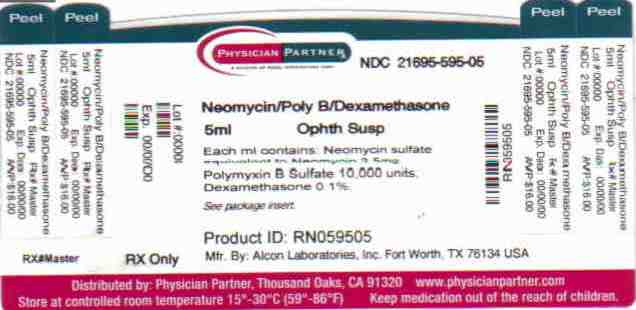
Neomycin And Polymyxin B Sulfates And Dexamethasone label

Neomycin And Polymyxin B Sulfates And Dexamethasone

Neomycin And Polymyxin B Sulfates And Dexamethasone Recall

Get an alert when a recall is issued.

Side Effects & Adverse Reactions

NOT FOR INJECTION. Do not touch dropper tip to any surface, as this may contaminate the contents. Prolonged use may result in glaucoma, with damage to the optic nerve, defects in visual acuity and fields of vision, and posterior subcapsular cataract formation. Prolonged use may suppress the host response and thus increase the hazard of secondary ocular infections. In those diseases causing thinning of the cornea or sclera, perforations have been known to occur with the use of topical corticosteroids. In acute purulent conditions of the eye, corticosteroids may mask infection or enhance existing infection. If this product is used for 10 days or longer, intraocular pressure should be routinely monitored even though it may be difficult in children and uncooperative patients.

Products containing neomycin sulfate may cause cutaneous sensitization.

Employment of corticosteroid medication in the treatment of herpes simplex requires great caution.

FDA Safety Alerts

There are currently no FDA safety alerts available for this drug.

Manufacturer Warnings

There is currently no manufacturer warning information available for this drug.

FDA Labeling Changes

There are currently no FDA labeling changes available for this drug.

Uses

For steroid-responsive inflammatory ocular conditions for which a corticosteroid is indicated and where bacterial infection or a risk of bacterial ocular infection exists.

Ocular corticosteroids are indicated in inflammatory conditions of the palpebral and bulbar conjunctiva, cornea, and anterior segment of the globe where the inherent risk of corticosteroids use in certain infective conjunctivitides is accepted to obtain a diminution in edema and inflammation. They are also indicated in chronic anterior uveitis and corneal injury from chemical, radiation or thermal burns; or penetration of foreign bodies.

The use of a combination drug with an anti-infective component is indicated where the risk of infection is high or where there is an expectation that potentially dangerous numbers of bacteria will be present in the eye.

The particular anti-infective drug in this product is active against the following common bacterial eye pathogens: Staphylococcus aureus, Escherichia coli, Haemophilus influenzae, Klebsiella/Enterobacter species, Neisseria species, and Pseudomonas aeruginosa.

This product does not provide adequate coverage against: Serratia marcescens and streptococci, including Streptococcus pneumoniae.

History

There is currently no drug history available for this drug.

Other Information

Neomycin and polymyxin B sulfates and dexamethasone ophthalmic suspension is a multiple dose anti-infective steroid combination in sterile suspension form for topical application. The chemical structure for the active ingredient, dexamethasone, is:

Chemical Structure

Established Name:

dexamethasone

Chemical Name:

pregna-1, 4-diene-3, 20-dione, 9-fluoro-11,17, 21-trihydroxy-16-methyl-, (11β, 16α)-.

The other active ingredients are neomycin sulfate and polymyxin B sulfate.

Each mL contains: Actives: neomycin sulfate equivalent to neomycin 3.5 mg, polymyxin B sulfate 10,000 units, dexamethasone 0.1%. Preservative: benzalkonium chloride 0.004%. Vehicle: hypromellose 2910 0.5%. Inactives: sodium chloride, polysorbate 20, hydrochloric acid and/or sodium hydroxide (to adjust pH), purified water.

Neomycin And Polymyxin B Sulfates And Dexamethasone Manufacturers

  • Neomycin And Polymyxin B Sulfates And Dexamethasone | Rebel Distributors Corp
    No Recall

    Neomycin And Polymyxin B Sulfates And Dexamethasone | Rebel Distributors Corp

    Neomycin And Polymyxin B Sulfates And Dexamethasone | Rebel Distributors Corp

    One to two drops topically in the conjunctival sac(s). In severe disease, drops may be used hourly, being tapered to discontinuation as the inflammation subsides. In mild disease, drops may be used up to four to six times daily.

    Not more than 20 mL should be prescribed initially and the prescription should not be refilled without further evaluation as outlined in PRECAUTIONS above.

    FOR TOPICAL OPHTHALMIC USE ONLY.

  • Major Pharmaceuticals
    Neomycin And Polymyxin B Sulfates And Dexamethasone | Major Pharmaceuticals
    No Recall

    Neomycin And Polymyxin B Sulfates And Dexamethasone | Major Pharmaceuticals

    Neomycin And Polymyxin B Sulfates And Dexamethasone | Major Pharmaceuticals

    Apply a small amount into the conjunctival sac(s) up to three or four times daily, or may be used adjunctively with Neomycin and Polymyxin B Sulfates and Dexamethasone Ophthalmic Suspension at bedtime.

    How to apply Neomycin and Polymyxin B Sulfates and Dexamethasone Ophthalmic Ointment:

    1. Tilt your head back.

    2. Place a finger on your cheek just under your eye and gently pull down until a "V" pocket is formed between your eyeball and your lower lid.

    3. Place a small amount (about 1/2 inch) of Neomycin and Polymyxin B Sulfates and Dexamethasone Ophthalmic Ointment in the "V" pocket. Do not let the tip of the tube touch your eye.

    4. Look downward before closing your eye.

    Not more than 8 grams should be prescribed initially and the prescription should not be refilled without further evaluation as outlined in PRECAUTIONS above.

  • Rxv
    Neomycin And Polymyxin B Sulfates And Dexamethasone | Rxv
    No Recall

    Neomycin And Polymyxin B Sulfates And Dexamethasone | Rxv

    Neomycin And Polymyxin B Sulfates And Dexamethasone | Rxv

    Apply a small amount into the conjunctival sac(s) up to three or four times daily, or may be used adjunctively with Neomycin and Polymyxin B Sulfates and Dexamethasone Ophthalmic Suspension at bedtime.

    How to apply Neomycin and Polymyxin B Sulfates and Dexamethasone Ophthalmic Ointment:

    1. Tilt your head back.

    2. Place a finger on your cheek just under your eye and gently pull down until a "V" pocket is formed between your eyeball and your lower lid.

    3. Place a small amount (about 1/2 inch) of Neomycin and Polymyxin B Sulfates and Dexamethasone Ophthalmic Ointment in the "V" pocket. Do not let the tip of the tube touch your eye.

    4. Look downward before closing your eye.

    Not more than 8 grams should be prescribed initially and the prescription should not be refilled without further evaluation as outlined in PRECAUTIONS above.

  • Falcon Pharmaceuticals, Ltd.
    Neomycin And Polymyxin B Sulfates And Dexamethasone | Falcon Pharmaceuticals, Ltd.
    No Recall

    Neomycin And Polymyxin B Sulfates And Dexamethasone | Falcon Pharmaceuticals, Ltd.

    Neomycin And Polymyxin B Sulfates And Dexamethasone | Falcon Pharmaceuticals, Ltd.

    One to two drops in the conjunctival sac(s). In severe disease, drops may be used hourly, being tapered to discontinuation as the inflammation subsides. In mild disease, drops may be used up to four to six times daily.

    Not more than 20 mL should be prescribed initially and the prescription should not be refilled without further evaluation as outlined in PRECAUTIONS above.

    FOR TOPICAL OPHTHALMIC USE ONLY.

  • Preferred Pharmaceuticals, Inc
    Neomycin And Polymyxin B Sulfates And Dexamethasone | Upsher-smith Laboratories, Inc
    No Recall

    Neomycin And Polymyxin B Sulfates And Dexamethasone | Upsher-smith Laboratories, Inc

    Neomycin And Polymyxin B Sulfates And Dexamethasone | Upsher-smith Laboratories, Inc

    (SEE TABLE BELOW)

    Monitoring of blood levels has increased the efficacy and safety of anticonvulsants (see PRECAUTIONS, Laboratory Tests). Dosage should be adjusted to the needs of the individual patient. A low initial daily dosage with a gradual increase is advised. As soon as adequate control is achieved, the dosage may be reduced very gradually to the minimum effective level. Medication should be taken with meals.

    Conversion of patients from oral carbamazepine tablets to carbamazepine suspension: Patients should be converted by administering the same number of mg per day in smaller, more frequent doses (i.e., b.i.d. tablets to t.i.d. suspension).

    Epilepsy

    (SEE INDICATIONS AND USAGE)

    Adults and children over 12 years of age Initial

    200 mg b.i.d. for tablets (400 mg/day). Increase at weekly intervals by adding up to 200 mg/day using a t.i.d. or q.i.d. regimen until the optimal response is obtained. Dosage generally should not exceed 1000 mg daily in children 12 to 15 years of age, and 1200 mg daily in patients above 15 years of age. Doses up to 1600 mg daily have been used in adults in rare instances.

    Maintenance

    Adjust dosage to the minimum effective level, usually 800 to 1200 mg daily.

    Children 6 to 12 years of age Initial

    100 mg b.i.d. for tablets (200 mg/day). Increase at weekly intervals by adding up to 100 mg/day using a t.i.d. or q.i.d. regimen until the optimal response is obtained. Dosage generally should not exceed 1000 mg daily.

    Maintenance

    Adjust dosage to the minimum effective level, usually 400 to 800 mg daily.

    Children under 6 years of age Initial

    10 to 20 mg/kg/day b.i.d. or t.i.d. as tablets. Increase weekly to achieve optimal clinical response administered t.i.d. or q.i.d.

    Maintenance

    Ordinarily, optimal clinical response is achieved at daily doses below 35 mg/kg. If satisfactory clinical response has not been achieved, plasma levels should be measured to determine whether or not they are in the therapeutic range. No recommendation regarding the safety of carbamazepine for use at doses above 35 mg/kg/24 hours can be made.

    Combination Therapy

    Carbamazepine may be used alone or with other anticonvulsants. When added to existing anticonvulsant therapy, the drug should be added gradually while the other anticonvulsants are maintained or gradually decreased, except phenytoin, which may have to be increased (see PRECAUTIONS, Drug Interactions, and Pregnancy Category D).

    Trigeminal Neuralgia

    (SEE INDICATIONS AND USAGE)

    Initial

    On the first day, either 100 mg b.i.d. for tablets, for a total daily dose of 200 mg. This daily dose may be increased by up to 200 mg/day using increments of 100 mg every 12 hours for tablets, only as needed to achieve freedom from pain. Do not exceed 1200 mg daily.

    Maintenance

    Control of pain can be maintained in most patients with 400 to 800 mg daily. However, some patients may be maintained on as little as 200 mg daily, while others may require as much as 1200 mg daily. At least once every 3 months throughout the treatment period, attempts should be made to reduce the dose to the minimum effective level or even to discontinue the drug.

    Dosage Information Initial Dose Subsequent Dose Maximum Daily Dose Indication Tablet* * Tablet = conventional tablets Epilepsy Under 6 yr 10 to 20 mg/kg/day b.i.d. or t.i.d. Increase weekly to achieve optimal clinical response, t.i.d. or q.i.d. 35 mg/kg/24 hr (see Dosage and Administration section above) 6 to 12 yr 100 mg b.i.d. (200 mg/day) Add up to 100 mg/day at weekly intervals, t.i.d. or q.i.d. 1000 mg/24 hr Over 12 yr 200 mg b.i.d. (400 mg/day) Add up to 200 mg/day at weekly intervals, t.i.d. or q.i.d. 1000 mg/24 hr (12 to 15 yr) 1200 mg/24 hr (> 15 yr) 1600 mg/24 hr (adults, in rare instances) Trigeminal Neuralgia 100 mg b.i.d. (200 mg/day) Add up to 200 mg/day in increments of 100 mg every 12 hr 1200 mg/24 hr

  • Physicians Total Care, Inc.
    Neomycin And Polymyxin B Sulfates And Dexamethasone | Physicians Total Care, Inc.
    No Recall

    Neomycin And Polymyxin B Sulfates And Dexamethasone | Physicians Total Care, Inc.

    Neomycin And Polymyxin B Sulfates And Dexamethasone | Physicians Total Care, Inc.

    One to two drops in the conjunctival sac(s). In severe disease, drops may be used hourly, being tapered to discontinuation as the inflammation subsides. In mild disease, drops may be used up to four to six times daily.

    Not more than 20 mL should be prescribed initially and the prescription should not be refilled without further evaluation as outlined in PRECAUTIONS above.

    FOR TOPICAL OPHTHALMIC USE ONLY.

  • Lake Erie Medical & Surgical Supply Dba Quality Care Products Llc
    Neomycin And Polymyxin B Sulfates And Dexamethasone | Lake Erie Medical & Surgical Supply Dba Quality Care Products Llc
    No Recall

    Neomycin And Polymyxin B Sulfates And Dexamethasone | Lake Erie Medical & Surgical Supply Dba Quality Care Products Llc

    Neomycin And Polymyxin B Sulfates And Dexamethasone | Lake Erie Medical & Surgical Supply Dba Quality Care Products Llc

    One to two drops in the conjunctival sac(s). In severe disease, drops may be used hourly, being tapered to discontinuation as the inflammation subsides. In mild disease, drops may be used up to four to six times daily.

    Not more than 20 mL should be prescribed initially and the prescription should not be refilled without further evaluation as outlined in PRECAUTIONS above.

    FOR TOPICAL OPHTHALMIC USE ONLY.

  • Neomycin And Polymyxin B Sulfates And Dexamethasone | Kvk-tech, Inc.
    No Recall

    Neomycin And Polymyxin B Sulfates And Dexamethasone | Kvk-tech, Inc.

    Neomycin And Polymyxin B Sulfates And Dexamethasone | Kvk-tech, Inc.

    Dosage should be individualized according to the needs and responses of the patient.

    Adults

    Methylphenidate hydrochloride extended-release tablets have a duration of action of approximately 8 hours. Therefore, methylphenidate hydrochloride extended-release tablets may be used in place of methylphenidate hydrochloride tablets when the 8-hour dosage of methylphenidate hydrochloride extended-release tablets corresponds to the titrated 8-hour dosage of methylphenidate hydrochloride tablets. Methylphenidate hydrochloride extended-release tablets must be swallowed whole and never crushed or chewed.

    Children (6 years and over)

    Methylphenidate hydrochloride should be initiated in small doses, with gradual weekly increments. Daily dosage above 60 mg is not recommended.

    If improvement is not observed after appropriate dosage adjustment over a 1-month period, the drug should be discontinued.

    Methylphenidate hydrochloride extended-release tablets have a duration of action of approximately 8 hours. Therefore, extended-release tablets may be used in place of methylphenidate hydrochloride tablets when the 8-hour dosage of methylphenidate hydrochloride extended-release tablets corresponds to the titrated 8-hour dosage of methylphenidate hydrochloride tablets. Methylphenidate hydrochloride extended-release tablets must be swallowed whole and never crushed or chewed.

    If paradoxical aggravation of symptoms or other adverse effects occur, reduce dosage, or, if necessary, discontinue the drug.

    Methylphenidate hydrochloride should be periodically discontinued to assess the child’s condition. Improvement may be sustained when the drug is either temporarily or permanently discontinued.

    Drug treatment should not and need not be indefinite and usually may be discontinued after puberty.

  • Mwi/vetone
    Neomycin And Polymyxin B Sulfates And Dexamethasone | Mwi/vetone
    No Recall

    Neomycin And Polymyxin B Sulfates And Dexamethasone | Mwi/vetone

    Neomycin And Polymyxin B Sulfates And Dexamethasone | Mwi/vetone

    Apply a small amount into the conjunctival sac(s) up to three or four times daily, or may be used adjunctively with Neomycin and Polymyxin B Sulfates and Dexamethasone Ophthalmic Suspension at bedtime.

    How to apply Neomycin and Polymyxin B Sulfates and Dexamethasone Ophthalmic Ointment:

    1. Tilt your head back.

    2. Place a finger on your cheek just under your eye and gently pull down until a "V" pocket is formed between your eyeball and your lower lid.

    3. Place a small amount (about 1/2 inch) of Neomycin and Polymyxin B Sulfates and Dexamethasone Ophthalmic Ointment in the "V" pocket. Do not let the tip of the tube touch your eye.

    4. Look downward before closing your eye.

    Not more than 8 grams should be prescribed initially and the prescription should not be refilled without further evaluation as outlined in PRECAUTIONS above.

  • Paddock Laboratories, Llc
    Neomycin And Polymyxin B Sulfates And Dexamethasone | Paddock Laboratories, Llc
    No Recall

    Neomycin And Polymyxin B Sulfates And Dexamethasone | Paddock Laboratories, Llc

    Neomycin And Polymyxin B Sulfates And Dexamethasone | Paddock Laboratories, Llc

    Apply a small amount into the conjunctival sac(s) up to three or four times daily.

    How to Apply neomycin and polymyxin B sulfates and dexamethasone ophthalmic ointment:

    1. Tilt your head back. 2. Place a finger on your cheek just under your eye and gently pull down until a "V" pocket is formed between your eyeball and your lower lid. 3. Place a small amount (about 1/2 inch) of neomycin and polymyxin B sulfates and dexamethasone ophthalmic ointment in the "V" pocket. Do not let the tip of the tube touch your eye. 4. Look downward before closing your eye.

    Not more than 8 g should be prescribed initially and the prescription should not be refilled without further evaluation as outlined in PRECAUTIONS above.

  • Preferred Pharmaceuticals, Inc.
    Neomycin And Polymyxin B Sulfates And Dexamethasone | Preferred Pharmaceuticals, Inc.
    No Recall

    Neomycin And Polymyxin B Sulfates And Dexamethasone | Preferred Pharmaceuticals, Inc.

    Neomycin And Polymyxin B Sulfates And Dexamethasone | Preferred Pharmaceuticals, Inc.

    Apply a small amount into the conjunctival sac(s) up to three or four times daily.

    How to Apply neomycin and polymyxin B sulfates and dexamethasone ophthalmic ointment:

    1. Tilt your head back. 2. Place a finger on your cheek just under your eye and gently pull down until a "V" pocket is formed between your eyeball and your lower lid. 3. Place a small amount (about 1/2 inch) of neomycin and polymyxin B sulfates and dexamethasone ophthalmic ointment in the "V" pocket. Do not let the tip of the tube touch your eye. 4. Look downward before closing your eye.

    Not more than 8 g should be prescribed initially and the prescription should not be refilled without further evaluation as outlined in PRECAUTIONS above.