Seroquel label

Seroquel

Seroquel Recall

Get an alert when a recall is issued.

Side Effects & Adverse Reactions

There is currently no warning information available for this product. We apologize for any inconvenience.

FDA Safety Alerts

There are currently no FDA safety alerts available for this drug.

Manufacturer Warnings

There is currently no manufacturer warning information available for this drug.

FDA Labeling Changes

There are currently no FDA labeling changes available for this drug.

Uses

1.1 Schizophrenia

SEROQUEL is indicated for the treatment of schizophrenia. The efficacy of SEROQUEL in schizophrenia was established in three 6-week trials in adults and one 6–week trial in adolescents (13–17 years). The effectiveness of SEROQUEL for the maintenance treatment of schizophrenia has not been systematically evaluated in controlled clinical trials [see Clinical Studies (14.1)]

1.2 Bipolar Disorder

SEROQUEL is indicated for the acute treatment of manic episodes associated with bipolar I disorder, both as monotherapy and as an adjunct to lithium or divalproex. Efficacy was established in two 12-week monotherapy trials in adults, in one 3-week adjunctive trial in adults, and in one 3-week monotherapy trial in pediatric patients (10-17 years) [see Clinical Studies (14.2)].

SEROQUEL is indicated as monotherapy for the acute treatment of depressive episodes associated with bipolar disorder. Efficacy was established in two 8-week monotherapy trials in adult patients with bipolar I and bipolar II disorder [see Clinical Studies (14.2)].

SEROQUEL is indicated for the maintenance treatment of bipolar I disorder, as an adjunct to lithium or divalproex. Efficacy was established in two maintenance trials in adults. The effectiveness of SEROQUEL as monotherapy for the maintenance treatment of bipolar disorder has not been systematically evaluated in controlled clinical trials [see Clinical Studies (14.2)].

1.3 Special Considerations in Treating Pediatric Schizophrenia and Bipolar I Disorder

Pediatric schizophrenia and bipolar I disorder are serious mental disorders, however, diagnosis can be challenging. For pediatric schizophrenia, symptom profiles can be variable, and for bipolar I disorder, patients may have variable patterns of periodicity of manic or mixed symptoms. It is recommended that medication therapy for pediatric schizophrenia and bipolar I disorder be initiated only after a thorough diagnostic evaluation has been performed and careful consideration given to the risks associated with medication treatment. Medication treatment for both pediatric schizophrenia and bipolar I disorder is indicated as part of a total treatment program that often includes psychological, educational and social interventions.

History

There is currently no drug history available for this drug.

Other Information

SEROQUEL® (quetiapine fumarate) is a psychotropic agent belonging to a chemical class, the dibenzothiazepine derivatives. The chemical designation is 2-[2-(4-dibenzo [b,f ] [1,4]thiazepin-11-yl-1-piperazinyl)ethoxy]-ethanol fumarate (2:1) (salt). It is present in tablets as the fumarate salt. All doses and tablet strengths are expressed as milligrams of base, not as fumarate salt. Its molecular formula is C42H50N6O4S2•C4H4O4 and it has a molecular weight of 883.11 (fumarate salt). The structural formula is:

chemstructure

Quetiapine fumarate is a white to off-white crystalline powder which is moderately soluble in water.

SEROQUEL is supplied for oral administration as 25 mg (round, peach), 50 mg (round, white), 100 mg (round, yellow), 200 mg (round, white), 300 mg (capsule-shaped, white), and 400 mg (capsule-shaped, yellow) tablets.

Inactive ingredients are povidone, dibasic dicalcium phosphate dihydrate, microcrystalline cellulose, sodium starch glycolate, lactose monohydrate, magnesium stearate, hypromellose, polyethylene glycol and titanium dioxide.

The 25 mg tablets contain red ferric oxide and yellow ferric oxide and the 100 mg and 400 mg tablets contain only yellow ferric oxide.

Seroquel Manufacturers

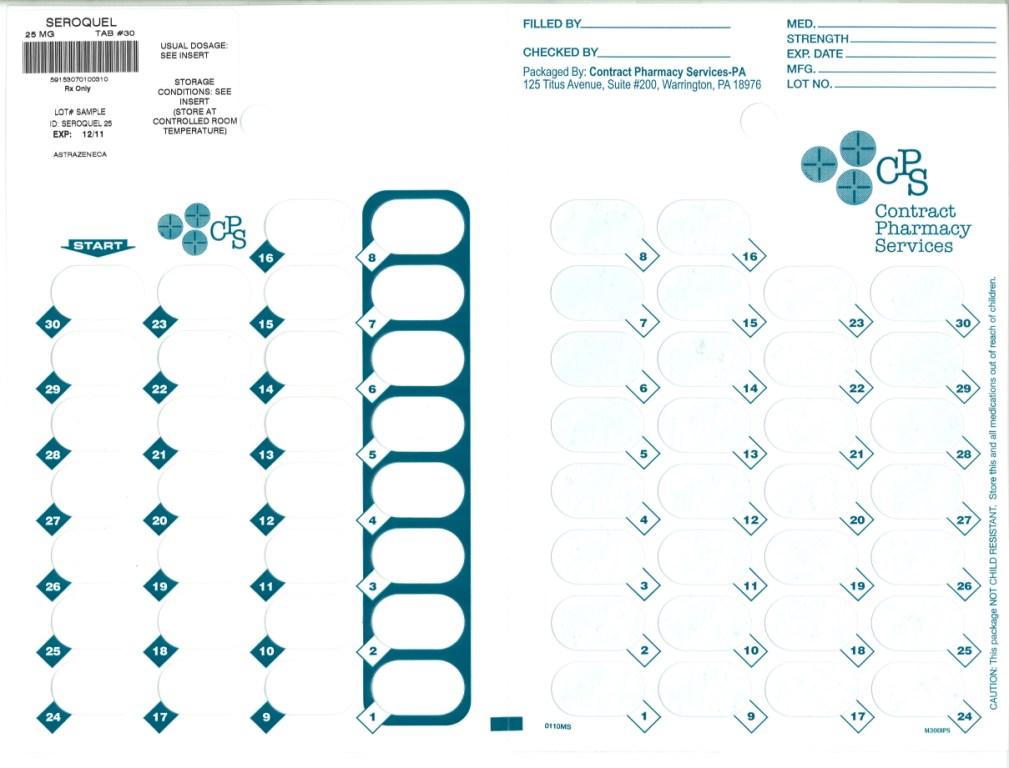
  • Contract Pharmacy Services-pa
    Seroquel | Contract Pharmacy Services-pa
    No Recall

    Seroquel | Contract Pharmacy Services-pa

    Seroquel | Contract Pharmacy Services-pa

    SEROQUEL can be taken with or without food.

    2.1 Schizophrenia

    Adults

    Dose Selection— SEROQUEL should generally be administered with an initial dose of 25 mg twice daily, with increases in total daily dose of 25 mg - 50 mg divided in two or three doses on the second and third day, as tolerated, to a total dose range of 300 mg to 400 mg daily by the fourth day. Further dosage adjustments, if indicated, should generally occur at intervals of not less than 2 days, as steady-state for SEROQUEL would not be achieved for approximately 1-2 days in the typical patient. When dosage adjustments are necessary, dose increments/decrements of 25 mg - 50 mg divided twice daily are recommended. Most efficacy data with SEROQUEL were obtained using three times daily dosing regimens, but in one controlled trial 225 mg given twice per day was also effective.

    Efficacy in schizophrenia was demonstrated in a dose range of 150 mg/day to 750 mg/day in the clinical trials supporting the effectiveness of SEROQUEL. In a dose response study, doses above 300 mg/day were not demonstrated to be more efficacious than the 300 mg/day dose. In other studies, however, doses in the range of 400 mg/day - 500 mg/day appeared to be needed. The safety of doses above 800 mg/day has not been evaluated in clinical trials.

    Maintenance Treatment—The effectiveness of SEROQUEL for longer than 6 weeks has not been evaluated in controlled clinical trials. While there is no body of evidence available to answer the question of how long the patient treated with SEROQUEL should be maintained, it is generally recommended that responding patients be continued beyond the acute response, but at the lowest dose needed to maintain remission. Patients should be periodically reassessed to determine the need for maintenance treatment.

    Adolescents (13-17 years)

    Dose Selection—SEROQUEL should be administered twice daily. However, based on response and tolerability SEROQUEL may be administered three times daily where needed.

    The total daily dose for the initial five days of therapy is 50 mg (Day 1), 100 mg (Day 2), 200 mg (Day 3), 300 mg (Day 4) and 400 mg (Day 5). After Day 5, the dose should be adjusted within the recommended dose range of 400 mg/day to 800 mg/day based on response and tolerability. Dosage adjustments should be in increments of no greater than 100 mg/day. Efficacy was demonstrated with SEROQUEL at both 400 mg and 800 mg; however, no additional benefit was seen in the 800 mg group.

    Maintenance Treatment—The effectiveness of SEROQUEL for longer than 6 weeks has not been evaluated in controlled clinical trials. While there is no body of evidence available to answer the question of how long the patient treated with SEROQUEL should be maintained, it is generally recommended that responding patients be continued beyond the acute response, but at the lowest dose needed to maintain remission. Patients should be periodically reassessed to determine the need for maintenance treatment.

    2.2 Bipolar Disorder

    Adults

    Acute Treatment of Manic Episodes in Bipolar I Disorder

    Dose Selection—When used as monotherapy or adjunct therapy (with lithium or divalproex), SEROQUEL should be initiated in twice daily doses totaling 100 mg/day on Day 1, increased to 400 mg/day on Day 4 in increments of up to 100 mg/day in twice daily divided doses. Further dosage adjustments up to 800 mg/day by Day 6 should be in increments of no greater than 200 mg/day. Data indicate that the majority of patients responded between 400 mg/day to 800 mg/day. The safety of doses above 800 mg/day has not been evaluated in clinical trials.

    Acute Treatment of Depressive Episodes in Bipolar Disorder

    Dose Selection—SEROQUEL should be administered once daily at bedtime to reach 300 mg/day by Day 4.

    Recommended Dosing Schedule Day Day 1 Day 2 Day 3 Day 4

    SEROQUEL

    50 mg

    100 mg

    200 mg

    300 mg

    In these clinical trials supporting effectiveness, the dosing schedule was 50 mg, 100 mg, 200 mg and 300 mg/day for Days 1-4 respectively. Patients receiving 600 mg increased to 400 mg on Day 5 and 600 mg on Day 8 (Week 1). Antidepressant efficacy was demonstrated with SEROQUEL at both 300 mg and 600 mg; however, no additional benefit was seen in the 600 mg group.

    Maintenance Treatment of Bipolar I Disorder

    Maintenance of efficacy in bipolar I disorder was demonstrated with SEROQUEL (administered twice daily totaling 400 to 800 mg per day) as adjunct therapy to lithium or divalproex. Generally, in the maintenance phase, patients continued on the same dose on which they were stabilized during the stabilization phase [see Clinical Studies (14.2)].

    Children and Adolescents (10 to 17 years)

    Acute Treatment of Manic Episodes in Bipolar I Disorder

    Dose Selection—SEROQUEL should be administered twice daily. However, based on response and tolerability SEROQUEL may be administered three times daily where needed.

    The total daily dose for the initial five days of therapy is 50 mg (Day 1), 100 mg (Day 2), 200 mg (Day 3), 300 mg (Day 4) and 400 mg (Day 5). After Day 5, the dose should be adjusted within the recommended dose range of 400 to 600 mg/day based on response and tolerability. Dosage adjustments should be in increments of no greater than 100 mg/day. Efficacy was demonstrated with SEROQUEL at both 400 mg and 600 mg; however, no additional benefit was seen in the 600 mg group.

    Maintenance Treatment of Bipolar I Disorder

    The effectiveness of SEROQUEL for longer than 3 weeks has not been evaluated in controlled clinical trials of children and adolescents. While there is no body of evidence available to answer the question of how long the patient treated with SEROQUEL should be maintained, it is generally recommended that responding patients be continued beyond the acute response, but at the lowest dose needed to maintain remission. Patients should be periodically reassessed to determine the need for maintenance treatment.

    2.3 Dosing in Special Populations

    Consideration should be given to a slower rate of dose titration and a lower target dose in the elderly and in patients who are debilitated or who have a predisposition to hypotensive reactions [see Clinical Pharmacology (12)]. When indicated, dose escalation should be performed with caution in these patients.

    Patients with hepatic impairment should be started on 25 mg/day. The dose should be increased daily in increments of 25 mg/day – 50 mg/day to an effective dose, depending on the clinical response and tolerability of the patient.

    2.4 Reinitiation of Treatment in Patients Previously Discontinued

    Although there are no data to specifically address reinitiation of treatment, it is recommended that when restarting patients who have had an interval of less than one week off SEROQUEL, titration of SEROQUEL is not required and the maintenance dose may be reinitiated. When restarting therapy of patients who have been off SEROQUEL for more than one week, the initial titration schedule should be followed.

    2.5 Switching from Antipsychotics

    There are no systematically collected data to specifically address switching patients with schizophrenia from antipsychotics to SEROQUEL, or concerning concomitant administration with antipsychotics. While immediate discontinuation of the previous antipsychotic treatment may be acceptable for some patients with schizophrenia, more gradual discontinuation may be most appropriate for others. In all cases, the period of overlapping antipsychotic administration should be minimized. When switching patients with schizophrenia from depot antipsychotics, if medically appropriate, initiate SEROQUEL therapy in place of the next scheduled injection. The need for continuing existing EPS medication should be re-evaluated periodically.

  • Lake Erie Medical Dba Quality Care Products Llc
    Seroquel | Lake Erie Medical Dba Quality Care Products Llc
    No Recall

    Seroquel | Lake Erie Medical Dba Quality Care Products Llc

    Seroquel | Lake Erie Medical Dba Quality Care Products Llc

    2 DOSAGE AND ADMINISTRATION

    SEROQUEL can be taken with or without food.

    2.1 Schizophrenia

    Adults

    Dose Selection— SEROQUEL should generally be administered with an initial dose of 25 mg twice daily, with increases in total daily dose of 25 mg - 50 mg divided in two or three doses on the second and third day, as tolerated, to a total dose range of 300 mg to 400 mg daily by the fourth day. Further dosage adjustments, if indicated, should generally occur at intervals of not less than 2 days, as steady-state for SEROQUEL would not be achieved for approximately 1-2 days in the typical patient. When dosage adjustments are necessary, dose increments/decrements of 25 mg - 50 mg divided twice daily are recommended. Most efficacy data with SEROQUEL were obtained using three times daily dosing regimens, but in one controlled trial 225 mg given twice per day was also effective.

    Efficacy in schizophrenia was demonstrated in a dose range of 150 mg/day to 750 mg/day in the clinical trials supporting the effectiveness of SEROQUEL. In a dose response study, doses above 300 mg/day were not demonstrated to be more efficacious than the 300 mg/day dose. In other studies, however, doses in the range of 400 mg/day - 500 mg/day appeared to be needed. The safety of doses above 800 mg/day has not been evaluated in clinical trials.

    Maintenance Treatment—The effectiveness of SEROQUEL for longer than 6 weeks has not been evaluated in controlled clinical trials. While there is no body of evidence available to answer the question of how long the patient treated with SEROQUEL should be maintained, it is generally recommended that responding patients be continued beyond the acute response, but at the lowest dose needed to maintain remission. Patients should be periodically reassessed to determine the need for maintenance treatment.

    Adolescents (13-17 years)

     Dose Selection—SEROQUEL should be administered twice daily. However, based on response and tolerability SEROQUEL may be administered three times daily where needed.

     The total daily dose for the initial five days of therapy is 50 mg (Day 1), 100 mg (Day 2), 200 mg (Day 3), 300 mg (Day 4) and 400 mg (Day 5). After Day 5, the dose should be adjusted within the recommended dose range of 400 mg/day to 800 mg/day based on response and tolerability. Dosage adjustments should be in increments of no greater than 100 mg/day. Efficacy was demonstrated with SEROQUEL at both 400 mg and 800 mg; however, no additional benefit was seen in the 800 mg group.

    Maintenance Treatment—The effectiveness of SEROQUEL for longer than 6 weeks has not been evaluated in controlled clinical trials. While there is no body of evidence available to answer the question of how long the patient treated with SEROQUEL should be maintained, it is generally recommended that responding patients be continued beyond the acute response, but at the lowest dose needed to maintain remission. Patients should be periodically reassessed to determine the need for maintenance treatment.

    2.2 Bipolar Disorder

    Adults

    Acute Treatment of Manic Episodes in Bipolar I Disorder

    Dose Selection—When used as monotherapy or adjunct therapy (with lithium or divalproex), SEROQUEL should be initiated in twice daily doses totaling 100 mg/day on Day 1, increased to 400 mg/day on Day 4 in increments of up to 100 mg/day in twice daily divided doses. Further dosage adjustments up to 800 mg/day by Day 6 should be in increments of no greater than 200 mg/day. Data indicate that the majority of patients responded between 400 mg/day to 800 mg/day. The safety of doses above 800 mg/day has not been evaluated in clinical trials.

    Acute Treatment of Depressive Episodes in Bipolar Disorder

    Dose Selection—SEROQUEL should be administered once daily at bedtime to reach 300 mg/day by Day 4.

    Recommended Dosing Schedule Day Day 1 Day 2 Day 3 Day 4

    SEROQUEL

    50 mg

    100 mg

    200 mg

    300 mg

    In these clinical trials supporting effectiveness, the dosing schedule was 50 mg, 100 mg, 200 mg and 300 mg/day for Days 1-4 respectively. Patients receiving 600 mg increased to 400 mg on Day 5 and 600 mg on Day 8 (Week 1). Antidepressant efficacy was demonstrated with SEROQUEL at both 300 mg and 600 mg; however, no additional benefit was seen in the 600 mg group.

    Maintenance Treatment of Bipolar I Disorder

    Maintenance of efficacy in bipolar I disorder was demonstrated with SEROQUEL (administered twice daily totaling 400 to 800 mg per day) as adjunct therapy to lithium or divalproex. Generally, in the maintenance phase, patients continued on the same dose on which they were stabilized during the stabilization phase [see Clinical Studies (14.2)].

     Children and Adolescents (10 to 17 years)

     Acute Treatment of Manic Episodes in Bipolar I Disorder


    Dose Selection—SEROQUEL should be administered twice daily. However, based on response and tolerability SEROQUEL may be administered three times daily where needed.

     The total daily dose for the initial five days of therapy is 50 mg (Day 1), 100 mg (Day 2), 200 mg (Day 3), 300 mg (Day 4) and 400 mg (Day 5). After Day 5, the dose should be adjusted within the recommended dose range of 400 to 600 mg/day based on response and tolerability. Dosage adjustments should be in increments of no greater than 100 mg/day. Efficacy was demonstrated with SEROQUEL at both 400 mg and 600 mg; however, no additional benefit was seen in the 600 mg group.

     Maintenance Treatment of Bipolar I Disorder

     The effectiveness of SEROQUEL for longer than 3 weeks has not been evaluated in controlled clinical trials of children and adolescents. While there is no body of evidence available to answer the question of how long the patient treated with SEROQUEL should be maintained, it is generally recommended that responding patients be continued beyond the acute response, but at the lowest dose needed to maintain remission. Patients should be periodically reassessed to determine the need for maintenance treatment.

    2.3 Dosing in Special Populations

    Consideration should be given to a slower rate of dose titration and a lower target dose in the elderly and in patients who are debilitated or who have a predisposition to hypotensive reactions [see Clinical Pharmacology (12)]. When indicated, dose escalation should be performed with caution in these patients.

    Patients with hepatic impairment should be started on 25 mg/day. The dose should be increased daily in increments of 25 mg/day – 50 mg/day to an effective dose, depending on the clinical response and tolerability of the patient.

    2.4 Reinitiation of Treatment in Patients Previously Discontinued

    Although there are no data to specifically address reinitiation of treatment, it is recommended that when restarting patients who have had an interval of less than one week off SEROQUEL, titration of SEROQUEL is not required and the maintenance dose may be reinitiated. When restarting therapy of patients who have been off SEROQUEL for more than one week, the initial titration schedule should be followed.

    2.5 Switching from Antipsychotics

    There are no systematically collected data to specifically address switching patients with schizophrenia from antipsychotics to SEROQUEL, or concerning concomitant administration with antipsychotics. While immediate discontinuation of the previous antipsychotic treatment may be acceptable for some patients with schizophrenia, more gradual discontinuation may be most appropriate for others. In all cases, the period of overlapping antipsychotic administration should be minimized. When switching patients with schizophrenia from depot antipsychotics, if medically appropriate, initiate SEROQUEL therapy in place of the next scheduled injection. The need for continuing existing EPS medication should be re-evaluated periodically.

  • Lake Erie Medical Dba Quality Care Products Llc
    Seroquel | Lake Erie Medical Dba Quality Care Products Llc
    No Recall

    Seroquel | Lake Erie Medical Dba Quality Care Products Llc

    Seroquel | Lake Erie Medical Dba Quality Care Products Llc
    DOSAGE AND ADMINISTRATION

    SEROQUEL can be taken with or without food.

    2.1 Schizophrenia

    Adults

    Dose Selection— SEROQUEL should generally be administered with an initial dose of 25 mg twice daily, with increases in total daily dose of 25 mg - 50 mg divided in two or three doses on the second and third day, as tolerated, to a total dose range of 300 mg to 400 mg daily by the fourth day. Further dosage adjustments, if indicated, should generally occur at intervals of not less than 2 days, as steady-state for SEROQUEL would not be achieved for approximately 1-2 days in the typical patient. When dosage adjustments are necessary, dose increments/decrements of 25 mg - 50 mg divided twice daily are recommended. Most efficacy data with SEROQUEL were obtained using three times daily dosing regimens, but in one controlled trial 225 mg given twice per day was also effective.

    Efficacy in schizophrenia was demonstrated in a dose range of 150 mg/day to 750 mg/day in the clinical trials supporting the effectiveness of SEROQUEL. In a dose response study, doses above 300 mg/day were not demonstrated to be more efficacious than the 300 mg/day dose. In other studies, however, doses in the range of 400 mg/day - 500 mg/day appeared to be needed. The safety of doses above 800 mg/day has not been evaluated in clinical trials.

    Maintenance Treatment—The effectiveness of SEROQUEL for longer than 6 weeks has not been evaluated in controlled clinical trials. While there is no body of evidence available to answer the question of how long the patient treated with SEROQUEL should be maintained, it is generally recommended that responding patients be continued beyond the acute response, but at the lowest dose needed to maintain remission. Patients should be periodically reassessed to determine the need for maintenance treatment.

    Adolescents (13-17 years)

    Dose Selection—SEROQUEL should be administered twice daily. However, based on response and tolerability SEROQUEL may be administered three times daily where needed.

    The total daily dose for the initial five days of therapy is 50 mg (Day 1), 100 mg (Day 2), 200 mg (Day 3), 300 mg (Day 4) and 400 mg (Day 5). After Day 5, the dose should be adjusted within the recommended dose range of 400 mg/day to 800 mg/day based on response and tolerability. Dosage adjustments should be in increments of no greater than 100 mg/day. Efficacy was demonstrated with SEROQUEL at both 400 mg and 800 mg; however, no additional benefit was seen in the 800 mg group.

    Maintenance Treatment—The effectiveness of SEROQUEL for longer than 6 weeks has not been evaluated in controlled clinical trials. While there is no body of evidence available to answer the question of how long the patient treated with SEROQUEL should be maintained, it is generally recommended that responding patients be continued beyond the acute response, but at the lowest dose needed to maintain remission. Patients should be periodically reassessed to determine the need for maintenance treatment.

    2.2 Bipolar Disorder

    Adults

    Acute Treatment of Manic Episodes in Bipolar I Disorder

    Dose Selection—When used as monotherapy or adjunct therapy (with lithium or divalproex), SEROQUEL should be initiated in twice daily doses totaling 100 mg/day on Day 1, increased to 400 mg/day on Day 4 in increments of up to 100 mg/day in twice daily divided doses. Further dosage adjustments up to 800 mg/day by Day 6 should be in increments of no greater than 200 mg/day. Data indicate that the majority of patients responded between 400 mg/day to 800 mg/day. The safety of doses above 800 mg/day has not been evaluated in clinical trials.

    Acute Treatment of Depressive Episodes in Bipolar Disorder

    Dose Selection—SEROQUEL should be administered once daily at bedtime to reach 300 mg/day by Day 4.

    Recommended Dosing Schedule Day Day 1 Day 2 Day 3 Day 4

    SEROQUEL

    50 mg

    100 mg

    200 mg

    300 mg

    In these clinical trials supporting effectiveness, the dosing schedule was 50 mg, 100 mg, 200 mg and 300 mg/day for Days 1-4 respectively. Patients receiving 600 mg increased to 400 mg on Day 5 and 600 mg on Day 8 (Week 1). Antidepressant efficacy was demonstrated with SEROQUEL at both 300 mg and 600 mg; however, no additional benefit was seen in the 600 mg group.

    Maintenance Treatment of Bipolar I Disorder

    Maintenance of efficacy in bipolar I disorder was demonstrated with SEROQUEL (administered twice daily totaling 400 to 800 mg per day) as adjunct therapy to lithium or divalproex. Generally, in the maintenance phase, patients continued on the same dose on which they were stabilized during the stabilization phase [ see Clinical Studies (14.2)].

    Children and Adolescents (10 to 17 years)

    Acute Treatment of Manic Episodes in Bipolar I Disorder

    Dose Selection—SEROQUEL should be administered twice daily. However, based on response and tolerability SEROQUEL may be administered three times daily where needed.

    The total daily dose for the initial five days of therapy is 50 mg (Day 1), 100 mg (Day 2), 200 mg (Day 3), 300 mg (Day 4) and 400 mg (Day 5). After Day 5, the dose should be adjusted within the recommended dose range of 400 to 600 mg/day based on response and tolerability. Dosage adjustments should be in increments of no greater than 100 mg/day. Efficacy was demonstrated with SEROQUEL at both 400 mg and 600 mg; however, no additional benefit was seen in the 600 mg group.

    Maintenance Treatment of Bipolar I Disorder

    The effectiveness of SEROQUEL for longer than 3 weeks has not been evaluated in controlled clinical trials of children and adolescents. While there is no body of evidence available to answer the question of how long the patient treated with SEROQUEL should be maintained, it is generally recommended that responding patients be continued beyond the acute response, but at the lowest dose needed to maintain remission. Patients should be periodically reassessed to determine the need for maintenance treatment.

    2.3 Dosing in Special Populations

    Consideration should be given to a slower rate of dose titration and a lower target dose in the elderly and in patients who are debilitated or who have a predisposition to hypotensive reactions [ see Clinical Pharmacology (12)]. When indicated, dose escalation should be performed with caution in these patients.

    Patients with hepatic impairment should be started on 25 mg/day. The dose should be increased daily in increments of 25 mg/day – 50 mg/day to an effective dose, depending on the clinical response and tolerability of the patient.

    2.4 Reinitiation of Treatment in Patients Previously Discontinued

    Although there are no data to specifically address reinitiation of treatment, it is recommended that when restarting patients who have had an interval of less than one week off SEROQUEL, titration of SEROQUEL is not required and the maintenance dose may be reinitiated. When restarting therapy of patients who have been off SEROQUEL for more than one week, the initial titration schedule should be followed.

    2.5 Switching from Antipsychotics

    There are no systematically collected data to specifically address switching patients with schizophrenia from antipsychotics to SEROQUEL, or concerning concomitant administration with antipsychotics. While immediate discontinuation of the previous antipsychotic treatment may be acceptable for some patients with schizophrenia, more gradual discontinuation may be most appropriate for others. In all cases, the period of overlapping antipsychotic administration should be minimized. When switching patients with schizophrenia from depot antipsychotics, if medically appropriate, initiate SEROQUEL therapy in place of the next scheduled injection. The need for continuing existing EPS medication should be re-evaluated periodically.


  • Remedyrepack Inc.
    Seroquel | Remedyrepack Inc.
    No Recall

    Seroquel | Remedyrepack Inc.

    Seroquel | Remedyrepack Inc.
    SEROQUEL XR tablets should be swallowed whole and not split, chewed or crushed.
    It is recommended that SEROQUEL XR be taken without food or with a light meal (approximately 300 calories) [see Clinical Pharmacology ( 12.3)].

    2.1 Schizophrenia
    Dose SelectionSEROQUEL XR should be administered once daily, preferably in the evening. The recommended initial dose is 300 mg/day. Patients should be titrated within a dose range of 400 mg/day800 mg/day depending on the response and tolerance of the individual patient [see Clinical Studies (14.1)]. Dose increases can be made at intervals as short as 1 day and in increments of up to 300 mg/day. The safety of doses above 800 mg/day has not been evaluated in clinical trials.
    Maintenance TreatmentA maintenance trial in adult patients with schizophrenia treated with SEROQUEL XR has shown this drug to be effective in delaying time to relapse in patients who were stabilized on SEROQUEL XR at doses of 400 mg/day to 800 mg/day for 16 weeks. Patients should be periodically reassessed to determine the need for maintenance treatment and the appropriate dose for such treatment [see Clinical Studies (14.1)].

    2.2 Bipolar Disorder
    Bipolar Mania
    Usual Dose for Acute Monotherapy or Adjunct Therapy (with lithium or divalproex)
    Dose SelectionWhen used as monotherapy or adjunct therapy (with lithium or divalproex), SEROQUEL XR should be administered once daily in the evening starting with 300 mg on Day 1 and 600 mg on Day 2. SEROQUEL XR can be adjusted between 400 mg and 800 mg beginning on Day 3 depending on the response and tolerance of the individual patient.
    Recommended Dosing Schedule
    DayDay 1Day 2Day 3SEROQUEL XR300 mg600 mg400 mg to 800 mgDepressive Episodes Associated with Bipolar Disorder
    Usual DoseSEROQUEL XR should be administered once daily in the evening to reach 300 mg/day by Day 4.
    Recommended Dosing Schedule
    DayDay 1Day 2Day 3Day 4SEROQUEL XR50 mg100 mg200 mg300 mgMaintenance Treatment for Bipolar I Disorder
    Maintenance TreatmentMaintenance of efficacy in bipolar I disorder was demonstrated with SEROQUEL (administered twice daily totaling 400 mg/day to 800 mg/day) as adjunct therapy to lithium or divalproex. Generally, in the maintenance phase, patients continued on the same dose on which they were stabilized during the stabilization phase. Patients should be periodically reassessed to determine the need for maintenance treatment and the appropriate dose for such treatment [see Clinical Studies (14.2)].

    2.3 Major Depressive Disorder, Adjunctive Therapy with Antidepressants
    Dose SelectionSEROQUEL XR in a dose range of 150 mg/day to 300 mg/day was demonstrated to be effective as adjunctive therapy to antidepressants. Begin with 50 mg once daily in the evening. On Day 3, the dose can be increased to 150 mg once daily in the evening. There were dose-dependent increases in adverse reactions in the recommended dose range of 150 mg/day to 300 mg/day. Doses above 300 mg/day were not studied [see Clinical Studies (14.3)].

    2.4 Dosing in Special Populations
    Consideration should be given to a slower rate of dose titration and a lower target dose in the elderly and in patients who are debilitated or who have a predisposition to hypotensive reactions [see Use in Specific Populations (8.5, 8.7) and Clinical Pharmacology (12)]. When indicated, dose escalation should be performed with caution in these patients.
    Elderly patients should be started on SEROQUEL XR 50 mg/day and the dose can be increased in increments of 50 mg/day depending on the response and tolerance of the individual patient.
    Patients with hepatic impairment should be started on SEROQUEL XR 50 mg/day. The dose can be increased daily in increments of 50 mg/day to an effective dose, depending on the clinical response and tolerance of the patient.
    The elimination of quetiapine was enhanced in the presence of phenytoin. Higher maintenance doses of quetiapine may be required when it is coadministered with phenytoin and other enzyme inducers such as carbamazepine and phenobarbital [see Drug Interactions (7.1)].

    2.5 Re-initiation of Treatment in Patients Previously Discontinued
    Although there are no data to specifically address reinitiation of treatment, it is recommended that when restarting therapy of patients who have been off SEROQUEL XR for more than one week, the initial dosing schedule should be followed. When restarting patients who have been off SEROQUEL XR for less than one week, gradual dose escalation may not be required and the maintenance dose may be reinitiated.

    2.6 Switching Patients from SEROQUEL Tablets to SEROQUEL XR Tablets
    Patients who are currently being treated with SEROQUEL (immediate release formulation) may be switched to SEROQUEL XR at the equivalent total daily dose taken once daily. Individual dosage adjustments may be necessary.

    2.7 Switching from Antipsychotics
    There are no systematically collected data to specifically address switching patients from other antipsychotics to SEROQUEL XR, or concerning concomitant administration with other antipsychotics. While immediate discontinuation of the previous antipsychotic treatment may be acceptable for some patients, more gradual discontinuation may be most appropriate for others. In all cases, the period of overlapping antipsychotic administration should be minimized. When switching patients from depot antipsychotics, if medically appropriate, initiate SEROQUEL XR therapy in place of the next scheduled injection. The need for continuing existing extrapyramidal syndrome medication should be re-evaluated periodically.

  • Seroquel | Rebel Distributors Corp
    No Recall

    Seroquel | Rebel Distributors Corp

    Seroquel | Rebel Distributors Corp

    SEROQUEL can be taken with or without food.

    2.1 Schizophrenia

    Adults

    Dose Selection— SEROQUEL should generally be administered with an initial dose of 25 mg twice daily, with increases in total daily dose of 25 mg - 50 mg divided in two or three doses on the second and third day, as tolerated, to a total dose range of 300 mg to 400 mg daily by the fourth day. Further dosage adjustments, if indicated, should generally occur at intervals of not less than 2 days, as steady-state for SEROQUEL would not be achieved for approximately 1-2 days in the typical patient. When dosage adjustments are necessary, dose increments/decrements of 25 mg - 50 mg divided twice daily are recommended. Most efficacy data with SEROQUEL were obtained using three times daily dosing regimens, but in one controlled trial 225 mg given twice per day was also effective.

    Efficacy in schizophrenia was demonstrated in a dose range of 150 mg/day to 750 mg/day in the clinical trials supporting the effectiveness of SEROQUEL. In a dose response study, doses above 300 mg/day were not demonstrated to be more efficacious than the 300 mg/day dose. In other studies, however, doses in the range of 400 mg/day - 500 mg/day appeared to be needed. The safety of doses above 800 mg/day has not been evaluated in clinical trials.

    Maintenance Treatment—The effectiveness of SEROQUEL for longer than 6 weeks has not been evaluated in controlled clinical trials. While there is no body of evidence available to answer the question of how long the patient treated with SEROQUEL should be maintained, it is generally recommended that responding patients be continued beyond the acute response, but at the lowest dose needed to maintain remission. Patients should be periodically reassessed to determine the need for maintenance treatment.

    Adolescents (13-17 years)

    Dose Selection—SEROQUEL should be administered twice daily. However, based on response and tolerability SEROQUEL may be administered three times daily where needed.

    The total daily dose for the initial five days of therapy is 50 mg (Day 1), 100 mg (Day 2), 200 mg (Day 3), 300 mg (Day 4) and 400 mg (Day 5). After Day 5, the dose should be adjusted within the recommended dose range of 400 mg/day to 800 mg/day based on response and tolerability. Dosage adjustments should be in increments of no greater than 100 mg/day. Efficacy was demonstrated with SEROQUEL at both 400 mg and 800 mg; however, no additional benefit was seen in the 800 mg group.

    Maintenance Treatment—The effectiveness of SEROQUEL for longer than 6 weeks has not been evaluated in controlled clinical trials. While there is no body of evidence available to answer the question of how long the patient treated with SEROQUEL should be maintained, it is generally recommended that responding patients be continued beyond the acute response, but at the lowest dose needed to maintain remission. Patients should be periodically reassessed to determine the need for maintenance treatment.

    2.2 Bipolar Disorder

    Adults

    Acute Treatment of Manic Episodes in Bipolar I Disorder

    Dose Selection—When used as monotherapy or adjunct therapy (with lithium or divalproex), SEROQUEL should be initiated in twice daily doses totaling 100 mg/day on Day 1, increased to 400 mg/day on Day 4 in increments of up to 100 mg/day in twice daily divided doses. Further dosage adjustments up to 800 mg/day by Day 6 should be in increments of no greater than 200 mg/day. Data indicate that the majority of patients responded between 400 mg/day to 800 mg/day. The safety of doses above 800 mg/day has not been evaluated in clinical trials.

    Acute Treatment of Depressive Episodes in Bipolar Disorder

    Dose Selection—SEROQUEL should be administered once daily at bedtime to reach 300 mg/day by Day 4.

    Recommended Dosing Schedule Day Day 1 Day 2 Day 3 Day 4

    SEROQUEL

    50 mg

    100 mg

    200 mg

    300 mg

    In these clinical trials supporting effectiveness, the dosing schedule was 50 mg, 100 mg, 200 mg and 300 mg/day for Days 1-4 respectively. Patients receiving 600 mg increased to 400 mg on Day 5 and 600 mg on Day 8 (Week 1). Antidepressant efficacy was demonstrated with SEROQUEL at both 300 mg and 600 mg; however, no additional benefit was seen in the 600 mg group.

    Maintenance Treatment of Bipolar I Disorder

    Maintenance of efficacy in bipolar I disorder was demonstrated with SEROQUEL (administered twice daily totaling 400 to 800 mg per day) as adjunct therapy to lithium or divalproex. Generally, in the maintenance phase, patients continued on the same dose on which they were stabilized during the stabilization phase [see Clinical Studies (14.2)].

    Children and Adolescents (10 to 17 years)

    Acute Treatment of Manic Episodes in Bipolar I Disorder

    Dose Selection—SEROQUEL should be administered twice daily. However, based on response and tolerability SEROQUEL may be administered three times daily where needed.

    The total daily dose for the initial five days of therapy is 50 mg (Day 1), 100 mg (Day 2), 200 mg (Day 3), 300 mg (Day 4) and 400 mg (Day 5). After Day 5, the dose should be adjusted within the recommended dose range of 400 to 600 mg/day based on response and tolerability. Dosage adjustments should be in increments of no greater than 100 mg/day. Efficacy was demonstrated with SEROQUEL at both 400 mg and 600 mg; however, no additional benefit was seen in the 600 mg group.

    Maintenance Treatment of Bipolar I Disorder

    The effectiveness of SEROQUEL for longer than 3 weeks has not been evaluated in controlled clinical trials of children and adolescents. While there is no body of evidence available to answer the question of how long the patient treated with SEROQUEL should be maintained, it is generally recommended that responding patients be continued beyond the acute response, but at the lowest dose needed to maintain remission. Patients should be periodically reassessed to determine the need for maintenance treatment.

    2.3 Dosing in Special Populations

    Consideration should be given to a slower rate of dose titration and a lower target dose in the elderly and in patients who are debilitated or who have a predisposition to hypotensive reactions [see Clinical Pharmacology (12)]. When indicated, dose escalation should be performed with caution in these patients.

    Patients with hepatic impairment should be started on 25 mg/day. The dose should be increased daily in increments of 25 mg/day – 50 mg/day to an effective dose, depending on the clinical response and tolerability of the patient.

    2.4 Reinitiation of Treatment in Patients Previously Discontinued

    Although there are no data to specifically address reinitiation of treatment, it is recommended that when restarting patients who have had an interval of less than one week off SEROQUEL, titration of SEROQUEL is not required and the maintenance dose may be reinitiated. When restarting therapy of patients who have been off SEROQUEL for more than one week, the initial titration schedule should be followed.

    2.5 Switching from Antipsychotics

    There are no systematically collected data to specifically address switching patients with schizophrenia from antipsychotics to SEROQUEL, or concerning concomitant administration with antipsychotics. While immediate discontinuation of the previous antipsychotic treatment may be acceptable for some patients with schizophrenia, more gradual discontinuation may be most appropriate for others. In all cases, the period of overlapping antipsychotic administration should be minimized. When switching patients with schizophrenia from depot antipsychotics, if medically appropriate, initiate SEROQUEL therapy in place of the next scheduled injection. The need for continuing existing EPS medication should be re-evaluated periodically.

  • Stat Rx Usa Llc
    Seroquel | Stat Rx Usa Llc
    No Recall

    Seroquel | Stat Rx Usa Llc

    Seroquel | Stat Rx Usa Llc

    SEROQUEL can be taken with or without food.

    2.1 Schizophrenia

    Adults

    Dose Selection— SEROQUEL should generally be administered with an initial dose of 25 mg twice daily, with increases in total daily dose of 25 mg - 50 mg divided in two or three doses on the second and third day, as tolerated, to a total dose range of 300 mg to 400 mg daily by the fourth day. Further dosage adjustments, if indicated, should generally occur at intervals of not less than 2 days, as steady-state for SEROQUEL would not be achieved for approximately 1-2 days in the typical patient. When dosage adjustments are necessary, dose increments/decrements of 25 mg - 50 mg divided twice daily are recommended. Most efficacy data with SEROQUEL were obtained using three times daily dosing regimens, but in one controlled trial 225 mg given twice per day was also effective.

    Efficacy in schizophrenia was demonstrated in a dose range of 150 mg/day to 750 mg/day in the clinical trials supporting the effectiveness of SEROQUEL. In a dose response study, doses above 300 mg/day were not demonstrated to be more efficacious than the 300 mg/day dose. In other studies, however, doses in the range of 400 mg/day - 500 mg/day appeared to be needed. The safety of doses above 800 mg/day has not been evaluated in clinical trials.

    Maintenance Treatment—The effectiveness of SEROQUEL for longer than 6 weeks has not been evaluated in controlled clinical trials. While there is no body of evidence available to answer the question of how long the patient treated with SEROQUEL should be maintained, it is generally recommended that responding patients be continued beyond the acute response, but at the lowest dose needed to maintain remission. Patients should be periodically reassessed to determine the need for maintenance treatment.

    Adolescents (13-17 years)

    Dose Selection—SEROQUEL should be administered twice daily. However, based on response and tolerability SEROQUEL may be administered three times daily where needed.

    The total daily dose for the initial five days of therapy is 50 mg (Day 1), 100 mg (Day 2), 200 mg (Day 3), 300 mg (Day 4) and 400 mg (Day 5). After Day 5, the dose should be adjusted within the recommended dose range of 400 mg/day to 800 mg/day based on response and tolerability. Dosage adjustments should be in increments of no greater than 100 mg/day. Efficacy was demonstrated with SEROQUEL at both 400 mg and 800 mg; however, no additional benefit was seen in the 800 mg group.

    Maintenance Treatment—The effectiveness of SEROQUEL for longer than 6 weeks has not been evaluated in controlled clinical trials. While there is no body of evidence available to answer the question of how long the patient treated with SEROQUEL should be maintained, it is generally recommended that responding patients be continued beyond the acute response, but at the lowest dose needed to maintain remission. Patients should be periodically reassessed to determine the need for maintenance treatment.

    2.2 Bipolar Disorder

    Adults

    Acute Treatment of Manic Episodes in Bipolar I Disorder

    Dose Selection—When used as monotherapy or adjunct therapy (with lithium or divalproex), SEROQUEL should be initiated in twice daily doses totaling 100 mg/day on Day 1, increased to 400 mg/day on Day 4 in increments of up to 100 mg/day in twice daily divided doses. Further dosage adjustments up to 800 mg/day by Day 6 should be in increments of no greater than 200 mg/day. Data indicate that the majority of patients responded between 400 mg/day to 800 mg/day. The safety of doses above 800 mg/day has not been evaluated in clinical trials.

    Acute Treatment of Depressive Episodes in Bipolar Disorder

    Dose Selection—SEROQUEL should be administered once daily at bedtime to reach 300 mg/day by Day 4.

    Recommended Dosing Schedule Day Day 1 Day 2 Day 3 Day 4

    SEROQUEL

    50 mg

    100 mg

    200 mg

    300 mg

    In the clinical trials supporting effectiveness, the dosing schedule was 50 mg, 100 mg, 200 mg and 300 mg/day for Days 1-4 respectively. Patients receiving 600 mg increased to 400 mg on Day 5 and 600 mg on Day 8 (Week 1). Antidepressant efficacy was demonstrated with SEROQUEL at both 300 mg and 600 mg; however, no additional benefit was seen in the 600 mg group.

    Maintenance Treatment of Bipolar I Disorder

    Maintenance of efficacy in bipolar I disorder was demonstrated with SEROQUEL (administered twice daily totaling 400 to 800 mg per day) as adjunct therapy to lithium or divalproex. Generally, in the maintenance phase, patients continued on the same dose on which they were stabilized during the stabilization phase [see Clinical Studies (14.2)].

    Children and Adolescents (10 to 17 years)

    Acute Treatment of Manic Episodes in Bipolar I Disorder

    Dose Selection—SEROQUEL should be administered twice daily. However, based on response and tolerability SEROQUEL may be administered three times daily where needed.

    The total daily dose for the initial five days of therapy is 50 mg (Day 1), 100 mg (Day 2), 200 mg (Day 3), 300 mg (Day 4) and 400 mg (Day 5). After Day 5, the dose should be adjusted within the recommended dose range of 400 to 600 mg/day based on response and tolerability. Dosage adjustments should be in increments of no greater than 100 mg/day. Efficacy was demonstrated with SEROQUEL at both 400 mg and 600 mg; however, no additional benefit was seen in the 600 mg group.

    Maintenance Treatment of Bipolar I Disorder

    The effectiveness of SEROQUEL for longer than 3 weeks has not been evaluated in controlled clinical trials of children and adolescents. While there is no body of evidence available to answer the question of how long the patient treated with SEROQUEL should be maintained, it is generally recommended that responding patients be continued beyond the acute response, but at the lowest dose needed to maintain remission. Patients should be periodically reassessed to determine the need for maintenance treatment.

    2.3 Dosing in Special Populations

    Consideration should be given to a slower rate of dose titration and a lower target dose in the elderly and in patients who are debilitated or who have a predisposition to hypotensive reactions [see Clinical Pharmacology (12)]. When indicated, dose escalation should be performed with caution in these patients.

    Patients with hepatic impairment should be started on 25 mg/day. The dose should be increased daily in increments of 25 mg/day – 50 mg/day to an effective dose, depending on the clinical response and tolerability of the patient.

    2.4 Reinitiation of Treatment in Patients Previously Discontinued

    Although there are no data to specifically address reinitiation of treatment, it is recommended that when restarting patients who have had an interval of less than one week off SEROQUEL, titration of SEROQUEL is not required and the maintenance dose may be reinitiated. When restarting therapy of patients who have been off SEROQUEL for more than one week, the initial titration schedule should be followed.

    2.5 Switching from Antipsychotics

    There are no systematically collected data to specifically address switching patients with schizophrenia from antipsychotics to SEROQUEL, or concerning concomitant administration with antipsychotics. While immediate discontinuation of the previous antipsychotic treatment may be acceptable for some patients with schizophrenia, more gradual discontinuation may be most appropriate for others. In all cases, the period of overlapping antipsychotic administration should be minimized. When switching patients with schizophrenia from depot antipsychotics, if medically appropriate, initiate SEROQUEL therapy in place of the next scheduled injection. The need for continuing existing EPS medication should be re-evaluated periodically.

  • Pd-rx Pharmaceuticals, Inc.
    Seroquel | Pd-rx Pharmaceuticals, Inc.
    No Recall

    Seroquel | Pd-rx Pharmaceuticals, Inc.

    Seroquel | Pd-rx Pharmaceuticals, Inc.

    SEROQUEL can be taken with or without food.

    2.1 Schizophrenia

    Adults

    Dose Selection— SEROQUEL should generally be administered with an initial dose of 25 mg twice daily, with increases in total daily dose of 25 mg - 50 mg divided in two or three doses on the second and third day, as tolerated, to a total dose range of 300 mg to 400 mg daily by the fourth day. Further dosage adjustments, if indicated, should generally occur at intervals of not less than 2 days, as steady-state for SEROQUEL would not be achieved for approximately 1-2 days in the typical patient. When dosage adjustments are necessary, dose increments/decrements of 25 mg - 50 mg divided twice daily are recommended. Most efficacy data with SEROQUEL were obtained using three times daily dosing regimens, but in one controlled trial 225 mg given twice per day was also effective.

    Efficacy in schizophrenia was demonstrated in a dose range of 150 mg/day to 750 mg/day in the clinical trials supporting the effectiveness of SEROQUEL. In a dose response study, doses above 300 mg/day were not demonstrated to be more efficacious than the 300 mg/day dose. In other studies, however, doses in the range of 400 mg/day - 500 mg/day appeared to be needed. The safety of doses above 800 mg/day has not been evaluated in clinical trials.

    Maintenance Treatment—The effectiveness of SEROQUEL for longer than 6 weeks has not been evaluated in controlled clinical trials. While there is no body of evidence available to answer the question of how long the patient treated with SEROQUEL should be maintained, it is generally recommended that responding patients be continued beyond the acute response, but at the lowest dose needed to maintain remission. Patients should be periodically reassessed to determine the need for maintenance treatment.

    Adolescents (13-17 years)

    Dose Selection—SEROQUEL should be administered twice daily. However, based on response and tolerability SEROQUEL may be administered three times daily where needed.

    The total daily dose for the initial five days of therapy is 50 mg (Day 1), 100 mg (Day 2), 200 mg (Day 3), 300 mg (Day 4) and 400 mg (Day 5). After Day 5, the dose should be adjusted within the recommended dose range of 400 mg/day to 800 mg/day based on response and tolerability. Dosage adjustments should be in increments of no greater than 100 mg/day. Efficacy was demonstrated with SEROQUEL at both 400 mg and 800 mg; however, no additional benefit was seen in the 800 mg group.

    Maintenance Treatment—The effectiveness of SEROQUEL for longer than 6 weeks has not been evaluated in controlled clinical trials. While there is no body of evidence available to answer the question of how long the patient treated with SEROQUEL should be maintained, it is generally recommended that responding patients be continued beyond the acute response, but at the lowest dose needed to maintain remission. Patients should be periodically reassessed to determine the need for maintenance treatment.

    2.2 Bipolar Disorder

    Adults

    Acute Treatment of Manic Episodes in Bipolar I Disorder

    Dose Selection—When used as monotherapy or adjunct therapy (with lithium or divalproex), SEROQUEL should be initiated in twice daily doses totaling 100 mg/day on Day 1, increased to 400 mg/day on Day 4 in increments of up to 100 mg/day in twice daily divided doses. Further dosage adjustments up to 800 mg/day by Day 6 should be in increments of no greater than 200 mg/day. Data indicate that the majority of patients responded between 400 mg/day to 800 mg/day. The safety of doses above 800 mg/day has not been evaluated in clinical trials.

    Acute Treatment of Depressive Episodes in Bipolar Disorder

    Dose Selection—SEROQUEL should be administered once daily at bedtime to reach 300 mg/day by Day 4.

    Recommended Dosing Schedule Day Day 1 Day 2 Day 3 Day 4

    SEROQUEL

    50 mg

    100 mg

    200 mg

    300 mg

    In the clinical trials supporting effectiveness, the dosing schedule was 50 mg, 100 mg, 200 mg and 300 mg/day for Days 1-4 respectively. Patients receiving 600 mg increased to 400 mg on Day 5 and 600 mg on Day 8 (Week 1). Antidepressant efficacy was demonstrated with SEROQUEL at both 300 mg and 600 mg; however, no additional benefit was seen in the 600 mg group.

    Maintenance Treatment of Bipolar I Disorder

    Maintenance of efficacy in bipolar I disorder was demonstrated with SEROQUEL (administered twice daily totaling 400 to 800 mg per day) as adjunct therapy to lithium or divalproex. Generally, in the maintenance phase, patients continued on the same dose on which they were stabilized during the stabilization phase [see Clinical Studies (14.2)].

    Children and Adolescents (10 to 17 years)

    Acute Treatment of Manic Episodes in Bipolar I Disorder

    Dose Selection—SEROQUEL should be administered twice daily. However, based on response and tolerability SEROQUEL may be administered three times daily where needed.

    The total daily dose for the initial five days of therapy is 50 mg (Day 1), 100 mg (Day 2), 200 mg (Day 3), 300 mg (Day 4) and 400 mg (Day 5). After Day 5, the dose should be adjusted within the recommended dose range of 400 to 600 mg/day based on response and tolerability. Dosage adjustments should be in increments of no greater than 100 mg/day. Efficacy was demonstrated with SEROQUEL at both 400 mg and 600 mg; however, no additional benefit was seen in the 600 mg group.

    Maintenance Treatment of Bipolar I Disorder

    The effectiveness of SEROQUEL for longer than 3 weeks has not been evaluated in controlled clinical trials of children and adolescents. While there is no body of evidence available to answer the question of how long the patient treated with SEROQUEL should be maintained, it is generally recommended that responding patients be continued beyond the acute response, but at the lowest dose needed to maintain remission. Patients should be periodically reassessed to determine the need for maintenance treatment.

    2.3 Dosing in Special Populations

    Consideration should be given to a slower rate of dose titration and a lower target dose in the elderly and in patients who are debilitated or who have a predisposition to hypotensive reactions [see Clinical Pharmacology (12)]. When indicated, dose escalation should be performed with caution in these patients.

    Patients with hepatic impairment should be started on 25 mg/day. The dose should be increased daily in increments of 25 mg/day – 50 mg/day to an effective dose, depending on the clinical response and tolerability of the patient.

    2.4 Reinitiation of Treatment in Patients Previously Discontinued

    Although there are no data to specifically address reinitiation of treatment, it is recommended that when restarting patients who have had an interval of less than one week off SEROQUEL, titration of SEROQUEL is not required and the maintenance dose may be reinitiated. When restarting therapy of patients who have been off SEROQUEL for more than one week, the initial titration schedule should be followed.

    2.5 Switching from Antipsychotics

    There are no systematically collected data to specifically address switching patients with schizophrenia from antipsychotics to SEROQUEL, or concerning concomitant administration with antipsychotics. While immediate discontinuation of the previous antipsychotic treatment may be acceptable for some patients with schizophrenia, more gradual discontinuation may be most appropriate for others. In all cases, the period of overlapping antipsychotic administration should be minimized. When switching patients with schizophrenia from depot antipsychotics, if medically appropriate, initiate SEROQUEL therapy in place of the next scheduled injection. The need for continuing existing EPS medication should be re-evaluated periodically.

  • Pd-rx Pharmaceuticals, Inc.
    Seroquel | Pd-rx Pharmaceuticals, Inc.
    No Recall

    Seroquel | Pd-rx Pharmaceuticals, Inc.

    Seroquel | Pd-rx Pharmaceuticals, Inc.

    SEROQUEL can be taken with or without food.

    2.1 Schizophrenia

    Adults

    Dose Selection— SEROQUEL should generally be administered with an initial dose of 25 mg twice daily, with increases in total daily dose of 25 mg - 50 mg divided in two or three doses on the second and third day, as tolerated, to a total dose range of 300 mg to 400 mg daily by the fourth day. Further dosage adjustments, if indicated, should generally occur at intervals of not less than 2 days, as steady-state for SEROQUEL would not be achieved for approximately 1-2 days in the typical patient. When dosage adjustments are necessary, dose increments/decrements of 25 mg - 50 mg divided twice daily are recommended. Most efficacy data with SEROQUEL were obtained using three times daily dosing regimens, but in one controlled trial 225 mg given twice per day was also effective.

    Efficacy in schizophrenia was demonstrated in a dose range of 150 mg/day to 750 mg/day in the clinical trials supporting the effectiveness of SEROQUEL. In a dose response study, doses above 300 mg/day were not demonstrated to be more efficacious than the 300 mg/day dose. In other studies, however, doses in the range of 400 mg/day - 500 mg/day appeared to be needed. The safety of doses above 800 mg/day has not been evaluated in clinical trials.

    Maintenance Treatment—The effectiveness of SEROQUEL for longer than 6 weeks has not been evaluated in controlled clinical trials. While there is no body of evidence available to answer the question of how long the patient treated with SEROQUEL should be maintained, it is generally recommended that responding patients be continued beyond the acute response, but at the lowest dose needed to maintain remission. Patients should be periodically reassessed to determine the need for maintenance treatment.

    Adolescents (13-17 years)

    Dose Selection—SEROQUEL should be administered twice daily. However, based on response and tolerability SEROQUEL may be administered three times daily where needed.

    The total daily dose for the initial five days of therapy is 50 mg (Day 1), 100 mg (Day 2), 200 mg (Day 3), 300 mg (Day 4) and 400 mg (Day 5). After Day 5, the dose should be adjusted within the recommended dose range of 400 mg/day to 800 mg/day based on response and tolerability. Dosage adjustments should be in increments of no greater than 100 mg/day. Efficacy was demonstrated with SEROQUEL at both 400 mg and 800 mg; however, no additional benefit was seen in the 800 mg group.

    Maintenance Treatment—The effectiveness of SEROQUEL for longer than 6 weeks has not been evaluated in controlled clinical trials. While there is no body of evidence available to answer the question of how long the patient treated with SEROQUEL should be maintained, it is generally recommended that responding patients be continued beyond the acute response, but at the lowest dose needed to maintain remission. Patients should be periodically reassessed to determine the need for maintenance treatment.

    2.2 Bipolar Disorder

    Adults

    Acute Treatment of Manic Episodes in Bipolar I Disorder

    Dose Selection—When used as monotherapy or adjunct therapy (with lithium or divalproex), SEROQUEL should be initiated in twice daily doses totaling 100 mg/day on Day 1, increased to 400 mg/day on Day 4 in increments of up to 100 mg/day in twice daily divided doses. Further dosage adjustments up to 800 mg/day by Day 6 should be in increments of no greater than 200 mg/day. Data indicate that the majority of patients responded between 400 mg/day to 800 mg/day. The safety of doses above 800 mg/day has not been evaluated in clinical trials.

    Acute Treatment of Depressive Episodes in Bipolar Disorder

    Dose Selection—SEROQUEL should be administered once daily at bedtime to reach 300 mg/day by Day 4.

    Recommended Dosing Schedule Day Day 1 Day 2 Day 3 Day 4

    SEROQUEL

    50 mg

    100 mg

    200 mg

    300 mg

    In the clinical trials supporting effectiveness, the dosing schedule was 50 mg, 100 mg, 200 mg and 300 mg/day for Days 1-4 respectively. Patients receiving 600 mg increased to 400 mg on Day 5 and 600 mg on Day 8 (Week 1). Antidepressant efficacy was demonstrated with SEROQUEL at both 300 mg and 600 mg; however, no additional benefit was seen in the 600 mg group.

    Maintenance Treatment of Bipolar I Disorder

    Maintenance of efficacy in bipolar I disorder was demonstrated with SEROQUEL (administered twice daily totaling 400 to 800 mg per day) as adjunct therapy to lithium or divalproex. Generally, in the maintenance phase, patients continued on the same dose on which they were stabilized during the stabilization phase [see Clinical Studies (14.2)].

    Children and Adolescents (10 to 17 years)

    Acute Treatment of Manic Episodes in Bipolar I Disorder

    Dose Selection—SEROQUEL should be administered twice daily. However, based on response and tolerability SEROQUEL may be administered three times daily where needed.

    The total daily dose for the initial five days of therapy is 50 mg (Day 1), 100 mg (Day 2), 200 mg (Day 3), 300 mg (Day 4) and 400 mg (Day 5). After Day 5, the dose should be adjusted within the recommended dose range of 400 to 600 mg/day based on response and tolerability. Dosage adjustments should be in increments of no greater than 100 mg/day. Efficacy was demonstrated with SEROQUEL at both 400 mg and 600 mg; however, no additional benefit was seen in the 600 mg group.

    Maintenance Treatment of Bipolar I Disorder

    The effectiveness of SEROQUEL for longer than 3 weeks has not been evaluated in controlled clinical trials of children and adolescents. While there is no body of evidence available to answer the question of how long the patient treated with SEROQUEL should be maintained, it is generally recommended that responding patients be continued beyond the acute response, but at the lowest dose needed to maintain remission. Patients should be periodically reassessed to determine the need for maintenance treatment.

    2.3 Dosing in Special Populations

    Consideration should be given to a slower rate of dose titration and a lower target dose in the elderly and in patients who are debilitated or who have a predisposition to hypotensive reactions [see Clinical Pharmacology (12)]. When indicated, dose escalation should be performed with caution in these patients.

    Patients with hepatic impairment should be started on 25 mg/day. The dose should be increased daily in increments of 25 mg/day – 50 mg/day to an effective dose, depending on the clinical response and tolerability of the patient.

    2.4 Reinitiation of Treatment in Patients Previously Discontinued

    Although there are no data to specifically address reinitiation of treatment, it is recommended that when restarting patients who have had an interval of less than one week off SEROQUEL, titration of SEROQUEL is not required and the maintenance dose may be reinitiated. When restarting therapy of patients who have been off SEROQUEL for more than one week, the initial titration schedule should be followed.

    2.5 Switching from Antipsychotics

    There are no systematically collected data to specifically address switching patients with schizophrenia from antipsychotics to SEROQUEL, or concerning concomitant administration with antipsychotics. While immediate discontinuation of the previous antipsychotic treatment may be acceptable for some patients with schizophrenia, more gradual discontinuation may be most appropriate for others. In all cases, the period of overlapping antipsychotic administration should be minimized. When switching patients with schizophrenia from depot antipsychotics, if medically appropriate, initiate SEROQUEL therapy in place of the next scheduled injection. The need for continuing existing EPS medication should be re-evaluated periodically.

  • Pd-rx Pharmaceuticals, Inc.
    Seroquel | Pd-rx Pharmaceuticals, Inc.
    No Recall

    Seroquel | Pd-rx Pharmaceuticals, Inc.

    Seroquel | Pd-rx Pharmaceuticals, Inc.

    SEROQUEL can be taken with or without food.

    2.1 Schizophrenia

    Adults

    Dose Selection— SEROQUEL should generally be administered with an initial dose of 25 mg twice daily, with increases in total daily dose of 25 mg - 50 mg divided in two or three doses on the second and third day, as tolerated, to a total dose range of 300 mg to 400 mg daily by the fourth day. Further dosage adjustments, if indicated, should generally occur at intervals of not less than 2 days, as steady-state for SEROQUEL would not be achieved for approximately 1-2 days in the typical patient. When dosage adjustments are necessary, dose increments/decrements of 25 mg - 50 mg divided twice daily are recommended. Most efficacy data with SEROQUEL were obtained using three times daily dosing regimens, but in one controlled trial 225 mg given twice per day was also effective.

    Efficacy in schizophrenia was demonstrated in a dose range of 150 mg/day to 750 mg/day in the clinical trials supporting the effectiveness of SEROQUEL. In a dose response study, doses above 300 mg/day were not demonstrated to be more efficacious than the 300 mg/day dose. In other studies, however, doses in the range of 400 mg/day - 500 mg/day appeared to be needed. The safety of doses above 800 mg/day has not been evaluated in clinical trials.

    Maintenance Treatment—The effectiveness of SEROQUEL for longer than 6 weeks has not been evaluated in controlled clinical trials. While there is no body of evidence available to answer the question of how long the patient treated with SEROQUEL should be maintained, it is generally recommended that responding patients be continued beyond the acute response, but at the lowest dose needed to maintain remission. Patients should be periodically reassessed to determine the need for maintenance treatment.

    Adolescents (13-17 years)

    Dose Selection—SEROQUEL should be administered twice daily. However, based on response and tolerability SEROQUEL may be administered three times daily where needed.

    The total daily dose for the initial five days of therapy is 50 mg (Day 1), 100 mg (Day 2), 200 mg (Day 3), 300 mg (Day 4) and 400 mg (Day 5). After Day 5, the dose should be adjusted within the recommended dose range of 400 mg/day to 800 mg/day based on response and tolerability. Dosage adjustments should be in increments of no greater than 100 mg/day. Efficacy was demonstrated with SEROQUEL at both 400 mg and 800 mg; however, no additional benefit was seen in the 800 mg group.

    Maintenance Treatment—The effectiveness of SEROQUEL for longer than 6 weeks has not been evaluated in controlled clinical trials. While there is no body of evidence available to answer the question of how long the patient treated with SEROQUEL should be maintained, it is generally recommended that responding patients be continued beyond the acute response, but at the lowest dose needed to maintain remission. Patients should be periodically reassessed to determine the need for maintenance treatment.

    2.2 Bipolar Disorder

    Adults

    Acute Treatment of Manic Episodes in Bipolar I Disorder

    Dose Selection—When used as monotherapy or adjunct therapy (with lithium or divalproex), SEROQUEL should be initiated in twice daily doses totaling 100 mg/day on Day 1, increased to 400 mg/day on Day 4 in increments of up to 100 mg/day in twice daily divided doses. Further dosage adjustments up to 800 mg/day by Day 6 should be in increments of no greater than 200 mg/day. Data indicate that the majority of patients responded between 400 mg/day to 800 mg/day. The safety of doses above 800 mg/day has not been evaluated in clinical trials.

    Acute Treatment of Depressive Episodes in Bipolar Disorder

    Dose Selection—SEROQUEL should be administered once daily at bedtime to reach 300 mg/day by Day 4.

    Recommended Dosing Schedule Day Day 1 Day 2 Day 3 Day 4

    SEROQUEL

    50 mg

    100 mg

    200 mg

    300 mg

    In the clinical trials supporting effectiveness, the dosing schedule was 50 mg, 100 mg, 200 mg and 300 mg/day for Days 1-4 respectively. Patients receiving 600 mg increased to 400 mg on Day 5 and 600 mg on Day 8 (Week 1). Antidepressant efficacy was demonstrated with SEROQUEL at both 300 mg and 600 mg; however, no additional benefit was seen in the 600 mg group.

    Maintenance Treatment of Bipolar I Disorder

    Maintenance of efficacy in bipolar I disorder was demonstrated with SEROQUEL (administered twice daily totaling 400 to 800 mg per day) as adjunct therapy to lithium or divalproex. Generally, in the maintenance phase, patients continued on the same dose on which they were stabilized during the stabilization phase [see Clinical Studies (14.2)].

    Children and Adolescents (10 to 17 years)

    Acute Treatment of Manic Episodes in Bipolar I Disorder

    Dose Selection—SEROQUEL should be administered twice daily. However, based on response and tolerability SEROQUEL may be administered three times daily where needed.

    The total daily dose for the initial five days of therapy is 50 mg (Day 1), 100 mg (Day 2), 200 mg (Day 3), 300 mg (Day 4) and 400 mg (Day 5). After Day 5, the dose should be adjusted within the recommended dose range of 400 to 600 mg/day based on response and tolerability. Dosage adjustments should be in increments of no greater than 100 mg/day. Efficacy was demonstrated with SEROQUEL at both 400 mg and 600 mg; however, no additional benefit was seen in the 600 mg group.

    Maintenance Treatment of Bipolar I Disorder

    The effectiveness of SEROQUEL for longer than 3 weeks has not been evaluated in controlled clinical trials of children and adolescents. While there is no body of evidence available to answer the question of how long the patient treated with SEROQUEL should be maintained, it is generally recommended that responding patients be continued beyond the acute response, but at the lowest dose needed to maintain remission. Patients should be periodically reassessed to determine the need for maintenance treatment.

    2.3 Dosing in Special Populations

    Consideration should be given to a slower rate of dose titration and a lower target dose in the elderly and in patients who are debilitated or who have a predisposition to hypotensive reactions [see Clinical Pharmacology (12)]. When indicated, dose escalation should be performed with caution in these patients.

    Patients with hepatic impairment should be started on 25 mg/day. The dose should be increased daily in increments of 25 mg/day – 50 mg/day to an effective dose, depending on the clinical response and tolerability of the patient.

    2.4 Reinitiation of Treatment in Patients Previously Discontinued

    Although there are no data to specifically address reinitiation of treatment, it is recommended that when restarting patients who have had an interval of less than one week off SEROQUEL, titration of SEROQUEL is not required and the maintenance dose may be reinitiated. When restarting therapy of patients who have been off SEROQUEL for more than one week, the initial titration schedule should be followed.

    2.5 Switching from Antipsychotics

    There are no systematically collected data to specifically address switching patients with schizophrenia from antipsychotics to SEROQUEL, or concerning concomitant administration with antipsychotics. While immediate discontinuation of the previous antipsychotic treatment may be acceptable for some patients with schizophrenia, more gradual discontinuation may be most appropriate for others. In all cases, the period of overlapping antipsychotic administration should be minimized. When switching patients with schizophrenia from depot antipsychotics, if medically appropriate, initiate SEROQUEL therapy in place of the next scheduled injection. The need for continuing existing EPS medication should be re-evaluated periodically.

  • Physicians Total Care, Inc.
    Seroquel | Physicians Total Care, Inc.
    No Recall

    Seroquel | Physicians Total Care, Inc.

    Seroquel | Physicians Total Care, Inc.

    SEROQUEL can be taken with or without food.

    2.1 Schizophrenia

    Adults

    Dose Selection— SEROQUEL should generally be administered with an initial dose of 25 mg twice daily, with increases in total daily dose of 25 mg - 50 mg divided in two or three doses on the second and third day, as tolerated, to a total dose range of 300 mg to 400 mg daily by the fourth day. Further dosage adjustments, if indicated, should generally occur at intervals of not less than 2 days, as steady-state for SEROQUEL would not be achieved for approximately 1-2 days in the typical patient. When dosage adjustments are necessary, dose increments/decrements of 25 mg - 50 mg divided twice daily are recommended. Most efficacy data with SEROQUEL were obtained using three times daily dosing regimens, but in one controlled trial 225 mg given twice per day was also effective.

    Efficacy in schizophrenia was demonstrated in a dose range of 150 mg/day to 750 mg/day in the clinical trials supporting the effectiveness of SEROQUEL. In a dose response study, doses above 300 mg/day were not demonstrated to be more efficacious than the 300 mg/day dose. In other studies, however, doses in the range of 400 mg/day - 500 mg/day appeared to be needed. The safety of doses above 800 mg/day has not been evaluated in clinical trials.

    Maintenance Treatment—The effectiveness of SEROQUEL for longer than 6 weeks has not been evaluated in controlled clinical trials. While there is no body of evidence available to answer the question of how long the patient treated with SEROQUEL should be maintained, it is generally recommended that responding patients be continued beyond the acute response, but at the lowest dose needed to maintain remission. Patients should be periodically reassessed to determine the need for maintenance treatment.

    Adolescents (13-17 years)

    Dose Selection—SEROQUEL should be administered twice daily. However, based on response and tolerability SEROQUEL may be administered three times daily where needed.

    The total daily dose for the initial five days of therapy is 50 mg (Day 1), 100 mg (Day 2), 200 mg (Day 3), 300 mg (Day 4) and 400 mg (Day 5). After Day 5, the dose should be adjusted within the recommended dose range of 400 mg/day to 800 mg/day based on response and tolerability. Dosage adjustments should be in increments of no greater than 100 mg/day. Efficacy was demonstrated with SEROQUEL at both 400 mg and 800 mg; however, no additional benefit was seen in the 800 mg group.

    Maintenance Treatment—The effectiveness of SEROQUEL for longer than 6 weeks has not been evaluated in controlled clinical trials. While there is no body of evidence available to answer the question of how long the patient treated with SEROQUEL should be maintained, it is generally recommended that responding patients be continued beyond the acute response, but at the lowest dose needed to maintain remission. Patients should be periodically reassessed to determine the need for maintenance treatment.

    2.2 Bipolar Disorder

    Adults

    Acute Treatment of Manic Episodes in Bipolar I Disorder

    Dose Selection—When used as monotherapy or adjunct therapy (with lithium or divalproex), SEROQUEL should be initiated in twice daily doses totaling 100 mg/day on Day 1, increased to 400 mg/day on Day 4 in increments of up to 100 mg/day in twice daily divided doses. Further dosage adjustments up to 800 mg/day by Day 6 should be in increments of no greater than 200 mg/day. Data indicate that the majority of patients responded between 400 mg/day to 800 mg/day. The safety of doses above 800 mg/day has not been evaluated in clinical trials.

    Acute Treatment of Depressive Episodes in Bipolar Disorder

    Dose Selection—SEROQUEL should be administered once daily at bedtime to reach 300 mg/day by Day 4.

    Recommended Dosing Schedule Day Day 1 Day 2 Day 3 Day 4

    SEROQUEL

    50 mg

    100 mg

    200 mg

    300 mg

    In the clinical trials supporting effectiveness, the dosing schedule was 50 mg, 100 mg, 200 mg and 300 mg/day for Days 1-4 respectively. Patients receiving 600 mg increased to 400 mg on Day 5 and 600 mg on Day 8 (Week 1). Antidepressant efficacy was demonstrated with SEROQUEL at both 300 mg and 600 mg; however, no additional benefit was seen in the 600 mg group.

    Maintenance Treatment of Bipolar I Disorder

    Maintenance of efficacy in bipolar I disorder was demonstrated with SEROQUEL (administered twice daily totaling 400 to 800 mg per day) as adjunct therapy to lithium or divalproex. Generally, in the maintenance phase, patients continued on the same dose on which they were stabilized during the stabilization phase [see Clinical Studies (14.2)].

    Children and Adolescents (10 to 17 years)

    Acute Treatment of Manic Episodes in Bipolar I Disorder

    Dose Selection—SEROQUEL should be administered twice daily. However, based on response and tolerability SEROQUEL may be administered three times daily where needed.

    The total daily dose for the initial five days of therapy is 50 mg (Day 1), 100 mg (Day 2), 200 mg (Day 3), 300 mg (Day 4) and 400 mg (Day 5). After Day 5, the dose should be adjusted within the recommended dose range of 400 to 600 mg/day based on response and tolerability. Dosage adjustments should be in increments of no greater than 100 mg/day. Efficacy was demonstrated with SEROQUEL at both 400 mg and 600 mg; however, no additional benefit was seen in the 600 mg group.

    Maintenance Treatment of Bipolar I Disorder

    The effectiveness of SEROQUEL for longer than 3 weeks has not been evaluated in controlled clinical trials of children and adolescents. While there is no body of evidence available to answer the question of how long the patient treated with SEROQUEL should be maintained, it is generally recommended that responding patients be continued beyond the acute response, but at the lowest dose needed to maintain remission. Patients should be periodically reassessed to determine the need for maintenance treatment.

    2.3 Dosing in Special Populations

    Consideration should be given to a slower rate of dose titration and a lower target dose in the elderly and in patients who are debilitated or who have a predisposition to hypotensive reactions [see Clinical Pharmacology (12)]. When indicated, dose escalation should be performed with caution in these patients.

    Patients with hepatic impairment should be started on 25 mg/day. The dose should be increased daily in increments of 25 mg/day – 50 mg/day to an effective dose, depending on the clinical response and tolerability of the patient.

    2.4 Reinitiation of Treatment in Patients Previously Discontinued

    Although there are no data to specifically address reinitiation of treatment, it is recommended that when restarting patients who have had an interval of less than one week off SEROQUEL, titration of SEROQUEL is not required and the maintenance dose may be reinitiated. When restarting therapy of patients who have been off SEROQUEL for more than one week, the initial titration schedule should be followed.

    2.5 Switching from Antipsychotics

    There are no systematically collected data to specifically address switching patients with schizophrenia from antipsychotics to SEROQUEL, or concerning concomitant administration with antipsychotics. While immediate discontinuation of the previous antipsychotic treatment may be acceptable for some patients with schizophrenia, more gradual discontinuation may be most appropriate for others. In all cases, the period of overlapping antipsychotic administration should be minimized. When switching patients with schizophrenia from depot antipsychotics, if medically appropriate, initiate SEROQUEL therapy in place of the next scheduled injection. The need for continuing existing EPS medication should be re-evaluated periodically.

  • Lake Erie Medical & Surgical Supply Dba Quality Care Products Llc
    Seroquel | Lake Erie Medical & Surgical Supply Dba Quality Care Products Llc
    No Recall

    Seroquel | Lake Erie Medical & Surgical Supply Dba Quality Care Products Llc

    Seroquel | Lake Erie Medical & Surgical Supply Dba Quality Care Products Llc

    SEROQUEL can be taken with or without food.

    2.1 Schizophrenia

    Adults

    Dose Selection— SEROQUEL should generally be administered with an initial dose of 25 mg twice daily, with increases in total daily dose of 25 mg - 50 mg divided in two or three doses on the second and third day, as tolerated, to a total dose range of 300 mg to 400 mg daily by the fourth day. Further dosage adjustments, if indicated, should generally occur at intervals of not less than 2 days, as steady-state for SEROQUEL would not be achieved for approximately 1-2 days in the typical patient. When dosage adjustments are necessary, dose increments/decrements of 25 mg - 50 mg divided twice daily are recommended. Most efficacy data with SEROQUEL were obtained using three times daily dosing regimens, but in one controlled trial 225 mg given twice per day was also effective.

    Efficacy in schizophrenia was demonstrated in a dose range of 150 mg/day to 750 mg/day in the clinical trials supporting the effectiveness of SEROQUEL. In a dose response study, doses above 300 mg/day were not demonstrated to be more efficacious than the 300 mg/day dose. In other studies, however, doses in the range of 400 mg/day - 500 mg/day appeared to be needed. The safety of doses above 800 mg/day has not been evaluated in clinical trials.

    Maintenance Treatment—The effectiveness of SEROQUEL for longer than 6 weeks has not been evaluated in controlled clinical trials. While there is no body of evidence available to answer the question of how long the patient treated with SEROQUEL should be maintained, it is generally recommended that responding patients be continued beyond the acute response, but at the lowest dose needed to maintain remission. Patients should be periodically reassessed to determine the need for maintenance treatment.

    Adolescents (13-17 years)

    Dose Selection—SEROQUEL should be administered twice daily. However, based on response and tolerability SEROQUEL may be administered three times daily where needed.

    The total daily dose for the initial five days of therapy is 50 mg (Day 1), 100 mg (Day 2), 200 mg (Day 3), 300 mg (Day 4) and 400 mg (Day 5). After Day 5, the dose should be adjusted within the recommended dose range of 400 mg/day to 800 mg/day based on response and tolerability. Dosage adjustments should be in increments of no greater than 100 mg/day. Efficacy was demonstrated with SEROQUEL at both 400 mg and 800 mg; however, no additional benefit was seen in the 800 mg group.

    Maintenance Treatment—The effectiveness of SEROQUEL for longer than 6 weeks has not been evaluated in controlled clinical trials. While there is no body of evidence available to answer the question of how long the patient treated with SEROQUEL should be maintained, it is generally recommended that responding patients be continued beyond the acute response, but at the lowest dose needed to maintain remission. Patients should be periodically reassessed to determine the need for maintenance treatment.

    2.2 Bipolar Disorder

    Adults

    Acute Treatment of Manic Episodes in Bipolar I Disorder

    Dose Selection—When used as monotherapy or adjunct therapy (with lithium or divalproex), SEROQUEL should be initiated in twice daily doses totaling 100 mg/day on Day 1, increased to 400 mg/day on Day 4 in increments of up to 100 mg/day in twice daily divided doses. Further dosage adjustments up to 800 mg/day by Day 6 should be in increments of no greater than 200 mg/day. Data indicate that the majority of patients responded between 400 mg/day to 800 mg/day. The safety of doses above 800 mg/day has not been evaluated in clinical trials.

    Acute Treatment of Depressive Episodes in Bipolar Disorder

    Dose Selection—SEROQUEL should be administered once daily at bedtime to reach 300 mg/day by Day 4.

    Recommended Dosing Schedule Day Day 1 Day 2 Day 3 Day 4

    SEROQUEL

    50 mg

    100 mg

    200 mg

    300 mg

    In the clinical trials supporting effectiveness, the dosing schedule was 50 mg, 100 mg, 200 mg and 300 mg/day for Days 1-4 respectively. Patients receiving 600 mg increased to 400 mg on Day 5 and 600 mg on Day 8 (Week 1). Antidepressant efficacy was demonstrated with SEROQUEL at both 300 mg and 600 mg; however, no additional benefit was seen in the 600 mg group.

    Maintenance Treatment of Bipolar I Disorder

    Maintenance of efficacy in bipolar I disorder was demonstrated with SEROQUEL (administered twice daily totaling 400 to 800 mg per day) as adjunct therapy to lithium or divalproex. Generally, in the maintenance phase, patients continued on the same dose on which they were stabilized during the stabilization phase [see Clinical Studies (14.2)].

    Children and Adolescents (10 to 17 years)

    Acute Treatment of Manic Episodes in Bipolar I Disorder

    Dose Selection—SEROQUEL should be administered twice daily. However, based on response and tolerability SEROQUEL may be administered three times daily where needed.

    The total daily dose for the initial five days of therapy is 50 mg (Day 1), 100 mg (Day 2), 200 mg (Day 3), 300 mg (Day 4) and 400 mg (Day 5). After Day 5, the dose should be adjusted within the recommended dose range of 400 to 600 mg/day based on response and tolerability. Dosage adjustments should be in increments of no greater than 100 mg/day. Efficacy was demonstrated with SEROQUEL at both 400 mg and 600 mg; however, no additional benefit was seen in the 600 mg group.

    Maintenance Treatment of Bipolar I Disorder

    The effectiveness of SEROQUEL for longer than 3 weeks has not been evaluated in controlled clinical trials of children and adolescents. While there is no body of evidence available to answer the question of how long the patient treated with SEROQUEL should be maintained, it is generally recommended that responding patients be continued beyond the acute response, but at the lowest dose needed to maintain remission. Patients should be periodically reassessed to determine the need for maintenance treatment.

    2.3 Dosing in Special Populations

    Consideration should be given to a slower rate of dose titration and a lower target dose in the elderly and in patients who are debilitated or who have a predisposition to hypotensive reactions [see Clinical Pharmacology (12)]. When indicated, dose escalation should be performed with caution in these patients.

    Patients with hepatic impairment should be started on 25 mg/day. The dose should be increased daily in increments of 25 mg/day – 50 mg/day to an effective dose, depending on the clinical response and tolerability of the patient.

    2.4 Reinitiation of Treatment in Patients Previously Discontinued

    Although there are no data to specifically address reinitiation of treatment, it is recommended that when restarting patients who have had an interval of less than one week off SEROQUEL, titration of SEROQUEL is not required and the maintenance dose may be reinitiated. When restarting therapy of patients who have been off SEROQUEL for more than one week, the initial titration schedule should be followed.

    2.5 Switching from Antipsychotics

    There are no systematically collected data to specifically address switching patients with schizophrenia from antipsychotics to SEROQUEL, or concerning concomitant administration with antipsychotics. While immediate discontinuation of the previous antipsychotic treatment may be acceptable for some patients with schizophrenia, more gradual discontinuation may be most appropriate for others. In all cases, the period of overlapping antipsychotic administration should be minimized. When switching patients with schizophrenia from depot antipsychotics, if medically appropriate, initiate SEROQUEL therapy in place of the next scheduled injection. The need for continuing existing EPS medication should be re-evaluated periodically.

  • Lake Erie Medical & Surgical Supply Dba Quality Care Products Llc
    Seroquel | Lake Erie Medical & Surgical Supply Dba Quality Care Products Llc
    No Recall

    Seroquel | Lake Erie Medical & Surgical Supply Dba Quality Care Products Llc

    Seroquel | Lake Erie Medical & Surgical Supply Dba Quality Care Products Llc

    SEROQUEL can be taken with or without food.

    2.1 Schizophrenia

    Adults

    Dose Selection— SEROQUEL should generally be administered with an initial dose of 25 mg twice daily, with increases in total daily dose of 25 mg - 50 mg divided in two or three doses on the second and third day, as tolerated, to a total dose range of 300 mg to 400 mg daily by the fourth day. Further dosage adjustments, if indicated, should generally occur at intervals of not less than 2 days, as steady-state for SEROQUEL would not be achieved for approximately 1-2 days in the typical patient. When dosage adjustments are necessary, dose increments/decrements of 25 mg - 50 mg divided twice daily are recommended. Most efficacy data with SEROQUEL were obtained using three times daily dosing regimens, but in one controlled trial 225 mg given twice per day was also effective.

    Efficacy in schizophrenia was demonstrated in a dose range of 150 mg/day to 750 mg/day in the clinical trials supporting the effectiveness of SEROQUEL. In a dose response study, doses above 300 mg/day were not demonstrated to be more efficacious than the 300 mg/day dose. In other studies, however, doses in the range of 400 mg/day - 500 mg/day appeared to be needed. The safety of doses above 800 mg/day has not been evaluated in clinical trials.

    Maintenance Treatment—The effectiveness of SEROQUEL for longer than 6 weeks has not been evaluated in controlled clinical trials. While there is no body of evidence available to answer the question of how long the patient treated with SEROQUEL should be maintained, it is generally recommended that responding patients be continued beyond the acute response, but at the lowest dose needed to maintain remission. Patients should be periodically reassessed to determine the need for maintenance treatment.

    Adolescents (13-17 years)

    Dose Selection—SEROQUEL should be administered twice daily. However, based on response and tolerability SEROQUEL may be administered three times daily where needed.

    The total daily dose for the initial five days of therapy is 50 mg (Day 1), 100 mg (Day 2), 200 mg (Day 3), 300 mg (Day 4) and 400 mg (Day 5). After Day 5, the dose should be adjusted within the recommended dose range of 400 mg/day to 800 mg/day based on response and tolerability. Dosage adjustments should be in increments of no greater than 100 mg/day. Efficacy was demonstrated with SEROQUEL at both 400 mg and 800 mg; however, no additional benefit was seen in the 800 mg group.

    Maintenance Treatment—The effectiveness of SEROQUEL for longer than 6 weeks has not been evaluated in controlled clinical trials. While there is no body of evidence available to answer the question of how long the patient treated with SEROQUEL should be maintained, it is generally recommended that responding patients be continued beyond the acute response, but at the lowest dose needed to maintain remission. Patients should be periodically reassessed to determine the need for maintenance treatment.

    2.2 Bipolar Disorder

    Adults

    Acute Treatment of Manic Episodes in Bipolar I Disorder

    Dose Selection—When used as monotherapy or adjunct therapy (with lithium or divalproex), SEROQUEL should be initiated in twice daily doses totaling 100 mg/day on Day 1, increased to 400 mg/day on Day 4 in increments of up to 100 mg/day in twice daily divided doses. Further dosage adjustments up to 800 mg/day by Day 6 should be in increments of no greater than 200 mg/day. Data indicate that the majority of patients responded between 400 mg/day to 800 mg/day. The safety of doses above 800 mg/day has not been evaluated in clinical trials.

    Acute Treatment of Depressive Episodes in Bipolar Disorder

    Dose Selection—SEROQUEL should be administered once daily at bedtime to reach 300 mg/day by Day 4.

    Recommended Dosing Schedule Day Day 1 Day 2 Day 3 Day 4

    SEROQUEL

    50 mg

    100 mg

    200 mg

    300 mg

    In the clinical trials supporting effectiveness, the dosing schedule was 50 mg, 100 mg, 200 mg and 300 mg/day for Days 1-4 respectively. Patients receiving 600 mg increased to 400 mg on Day 5 and 600 mg on Day 8 (Week 1). Antidepressant efficacy was demonstrated with SEROQUEL at both 300 mg and 600 mg; however, no additional benefit was seen in the 600 mg group.

    Maintenance Treatment of Bipolar I Disorder

    Maintenance of efficacy in bipolar I disorder was demonstrated with SEROQUEL (administered twice daily totaling 400 to 800 mg per day) as adjunct therapy to lithium or divalproex. Generally, in the maintenance phase, patients continued on the same dose on which they were stabilized during the stabilization phase [see Clinical Studies (14.2)].

    Children and Adolescents (10 to 17 years)

    Acute Treatment of Manic Episodes in Bipolar I Disorder

    Dose Selection—SEROQUEL should be administered twice daily. However, based on response and tolerability SEROQUEL may be administered three times daily where needed.

    The total daily dose for the initial five days of therapy is 50 mg (Day 1), 100 mg (Day 2), 200 mg (Day 3), 300 mg (Day 4) and 400 mg (Day 5). After Day 5, the dose should be adjusted within the recommended dose range of 400 to 600 mg/day based on response and tolerability. Dosage adjustments should be in increments of no greater than 100 mg/day. Efficacy was demonstrated with SEROQUEL at both 400 mg and 600 mg; however, no additional benefit was seen in the 600 mg group.

    Maintenance Treatment of Bipolar I Disorder

    The effectiveness of SEROQUEL for longer than 3 weeks has not been evaluated in controlled clinical trials of children and adolescents. While there is no body of evidence available to answer the question of how long the patient treated with SEROQUEL should be maintained, it is generally recommended that responding patients be continued beyond the acute response, but at the lowest dose needed to maintain remission. Patients should be periodically reassessed to determine the need for maintenance treatment.

    2.3 Dosing in Special Populations

    Consideration should be given to a slower rate of dose titration and a lower target dose in the elderly and in patients who are debilitated or who have a predisposition to hypotensive reactions [see Clinical Pharmacology (12)]. When indicated, dose escalation should be performed with caution in these patients.

    Patients with hepatic impairment should be started on 25 mg/day. The dose should be increased daily in increments of 25 mg/day – 50 mg/day to an effective dose, depending on the clinical response and tolerability of the patient.

    2.4 Reinitiation of Treatment in Patients Previously Discontinued

    Although there are no data to specifically address reinitiation of treatment, it is recommended that when restarting patients who have had an interval of less than one week off SEROQUEL, titration of SEROQUEL is not required and the maintenance dose may be reinitiated. When restarting therapy of patients who have been off SEROQUEL for more than one week, the initial titration schedule should be followed.

    2.5 Switching from Antipsychotics

    There are no systematically collected data to specifically address switching patients with schizophrenia from antipsychotics to SEROQUEL, or concerning concomitant administration with antipsychotics. While immediate discontinuation of the previous antipsychotic treatment may be acceptable for some patients with schizophrenia, more gradual discontinuation may be most appropriate for others. In all cases, the period of overlapping antipsychotic administration should be minimized. When switching patients with schizophrenia from depot antipsychotics, if medically appropriate, initiate SEROQUEL therapy in place of the next scheduled injection. The need for continuing existing EPS medication should be re-evaluated periodically.

  • Bryant Ranch Prepack
    Seroquel | Bryant Ranch Prepack
    No Recall

    Seroquel | Bryant Ranch Prepack

    Seroquel | Bryant Ranch Prepack

    SEROQUEL can be taken with or without food.

    2.1 Schizophrenia

    Adults

    Dose Selection— SEROQUEL should generally be administered with an initial dose of 25 mg twice daily, with increases in total daily dose of 25 mg - 50 mg divided in two or three doses on the second and third day, as tolerated, to a total dose range of 300 mg to 400 mg daily by the fourth day. Further dosage adjustments, if indicated, should generally occur at intervals of not less than 2 days, as steady-state for SEROQUEL would not be achieved for approximately 1-2 days in the typical patient. When dosage adjustments are necessary, dose increments/decrements of 25 mg - 50 mg divided twice daily are recommended. Most efficacy data with SEROQUEL were obtained using three times daily dosing regimens, but in one controlled trial 225 mg given twice per day was also effective.

    Efficacy in schizophrenia was demonstrated in a dose range of 150 mg/day to 750 mg/day in the clinical trials supporting the effectiveness of SEROQUEL. In a dose response study, doses above 300 mg/day were not demonstrated to be more efficacious than the 300 mg/day dose. In other studies, however, doses in the range of 400 mg/day - 500 mg/day appeared to be needed. The safety of doses above 800 mg/day has not been evaluated in clinical trials.

    Maintenance Treatment—The effectiveness of SEROQUEL for longer than 6 weeks has not been evaluated in controlled clinical trials. While there is no body of evidence available to answer the question of how long the patient treated with SEROQUEL should be maintained, it is generally recommended that responding patients be continued beyond the acute response, but at the lowest dose needed to maintain remission. Patients should be periodically reassessed to determine the need for maintenance treatment.

    Adolescents (13-17 years)

    Dose Selection—SEROQUEL should be administered twice daily. However, based on response and tolerability SEROQUEL may be administered three times daily where needed.

    The total daily dose for the initial five days of therapy is 50 mg (Day 1), 100 mg (Day 2), 200 mg (Day 3), 300 mg (Day 4) and 400 mg (Day 5). After Day 5, the dose should be adjusted within the recommended dose range of 400 mg/day to 800 mg/day based on response and tolerability. Dosage adjustments should be in increments of no greater than 100 mg/day. Efficacy was demonstrated with SEROQUEL at both 400 mg and 800 mg; however, no additional benefit was seen in the 800 mg group.

    Maintenance Treatment—The effectiveness of SEROQUEL for longer than 6 weeks has not been evaluated in controlled clinical trials. While there is no body of evidence available to answer the question of how long the patient treated with SEROQUEL should be maintained, it is generally recommended that responding patients be continued beyond the acute response, but at the lowest dose needed to maintain remission. Patients should be periodically reassessed to determine the need for maintenance treatment.

    2.2 Bipolar Disorder

    Adults

    Acute Treatment of Manic Episodes in Bipolar I Disorder

    Dose Selection—When used as monotherapy or adjunct therapy (with lithium or divalproex), SEROQUEL should be initiated in twice daily doses totaling 100 mg/day on Day 1, increased to 400 mg/day on Day 4 in increments of up to 100 mg/day in twice daily divided doses. Further dosage adjustments up to 800 mg/day by Day 6 should be in increments of no greater than 200 mg/day. Data indicate that the majority of patients responded between 400 mg/day to 800 mg/day. The safety of doses above 800 mg/day has not been evaluated in clinical trials.

    Acute Treatment of Depressive Episodes in Bipolar Disorder

    Dose Selection—SEROQUEL should be administered once daily at bedtime to reach 300 mg/day by Day 4.

    Recommended Dosing Schedule Day Day 1 Day 2 Day 3 Day 4

    SEROQUEL

    50 mg

    100 mg

    200 mg

    300 mg

    In the clinical trials supporting effectiveness, the dosing schedule was 50 mg, 100 mg, 200 mg and 300 mg/day for Days 1-4 respectively. Patients receiving 600 mg increased to 400 mg on Day 5 and 600 mg on Day 8 (Week 1). Antidepressant efficacy was demonstrated with SEROQUEL at both 300 mg and 600 mg; however, no additional benefit was seen in the 600 mg group.

    Maintenance Treatment of Bipolar I Disorder

    Maintenance of efficacy in bipolar I disorder was demonstrated with SEROQUEL (administered twice daily totaling 400 to 800 mg per day) as adjunct therapy to lithium or divalproex. Generally, in the maintenance phase, patients continued on the same dose on which they were stabilized during the stabilization phase [see Clinical Studies (14.2)].

    Children and Adolescents (10 to 17 years)

    Acute Treatment of Manic Episodes in Bipolar I Disorder

    Dose Selection—SEROQUEL should be administered twice daily. However, based on response and tolerability SEROQUEL may be administered three times daily where needed.

    The total daily dose for the initial five days of therapy is 50 mg (Day 1), 100 mg (Day 2), 200 mg (Day 3), 300 mg (Day 4) and 400 mg (Day 5). After Day 5, the dose should be adjusted within the recommended dose range of 400 to 600mg/day based on response and tolerability. Dosage adjustments should be in increments of no greater than 100 mg/day. Efficacy was demonstrated with SEROQUEL at both 400 mg and 600 mg; however, no additional benefit was seen in the 600 mg group.

    Maintenance Treatment of Bipolar I Disorder

    The effectiveness of SEROQUEL for longer than 3 weeks has not been evaluated in controlled clinical trials of children and adolescents. While there is no body of evidence available to answer the question of how long the patient treated with SEROQUEL should be maintained, it is generally recommended that responding patients be continued beyond the acute response, but at the lowest dose needed to maintain remission. Patients should be periodically reassessed to determine the need for maintenance treatment.

    2.3 Dosing in Special Populations

    Consideration should be given to a slower rate of dose titration and a lower target dose in the elderly and in patients who are debilitated or who have a predisposition to hypotensive reactions [see Clinical Pharmacology (12)]. When indicated, dose escalation should be performed with caution in these patients.

    Patients with hepatic impairment should be started on 25 mg/day. The dose should be increased daily in increments of 25 mg/day – 50 mg/day to an effective dose, depending on the clinical response and tolerability of the patient.

    2.4 Reinitiation of Treatment in Patients Previously Discontinued

    Although there are no data to specifically address reinitiation of treatment, it is recommended that when restarting patients who have had an interval of less than one week off SEROQUEL, titration of SEROQUEL is not required and the maintenance dose may be reinitiated. When restarting therapy of patients who have been off SEROQUEL for more than one week, the initial titration schedule should be followed.

    2.5 Switching from Antipsychotics

    There are no systematically collected data to specifically address switching patients with schizophrenia from antipsychotics to SEROQUEL, or concerning concomitant administration with antipsychotics. While immediate discontinuation of the previous antipsychotic treatment may be acceptable for some patients with schizophrenia, more gradual discontinuation may be most appropriate for others. In all cases, the period of overlapping antipsychotic administration should be minimized. When switching patients with schizophrenia from depot antipsychotics, if medically appropriate, initiate SEROQUEL therapy in place of the next scheduled injection. The need for continuing existing EPS medication should be re-evaluated periodically.

  • Bryant Ranch Prepack
    Seroquel | Bryant Ranch Prepack
    No Recall

    Seroquel | Bryant Ranch Prepack

    Seroquel | Bryant Ranch Prepack

    SEROQUEL can be taken with or without food.

    2.1 Schizophrenia

    Adults

    Dose Selection— SEROQUEL should generally be administered with an initial dose of 25 mg twice daily, with increases in total daily dose of 25 mg - 50 mg divided in two or three doses on the second and third day, as tolerated, to a total dose range of 300 mg to 400 mg daily by the fourth day. Further dosage adjustments, if indicated, should generally occur at intervals of not less than 2 days, as steady-state for SEROQUEL would not be achieved for approximately 1-2 days in the typical patient. When dosage adjustments are necessary, dose increments/decrements of 25 mg - 50 mg divided twice daily are recommended. Most efficacy data with SEROQUEL were obtained using three times daily dosing regimens, but in one controlled trial 225 mg given twice per day was also effective.

    Efficacy in schizophrenia was demonstrated in a dose range of 150 mg/day to 750 mg/day in the clinical trials supporting the effectiveness of SEROQUEL. In a dose response study, doses above 300 mg/day were not demonstrated to be more efficacious than the 300 mg/day dose. In other studies, however, doses in the range of 400 mg/day - 500 mg/day appeared to be needed. The safety of doses above 800 mg/day has not been evaluated in clinical trials.

    Maintenance Treatment—The effectiveness of SEROQUEL for longer than 6 weeks has not been evaluated in controlled clinical trials. While there is no body of evidence available to answer the question of how long the patient treated with SEROQUEL should be maintained, it is generally recommended that responding patients be continued beyond the acute response, but at the lowest dose needed to maintain remission. Patients should be periodically reassessed to determine the need for maintenance treatment.

    Adolescents (13-17 years)

    Dose Selection—SEROQUEL should be administered twice daily. However, based on response and tolerability SEROQUEL may be administered three times daily where needed.

    The total daily dose for the initial five days of therapy is 50 mg (Day 1), 100 mg (Day 2), 200 mg (Day 3), 300 mg (Day 4) and 400 mg (Day 5). After Day 5, the dose should be adjusted within the recommended dose range of 400 mg/day to 800 mg/day based on response and tolerability. Dosage adjustments should be in increments of no greater than 100 mg/day. Efficacy was demonstrated with SEROQUEL at both 400 mg and 800 mg; however, no additional benefit was seen in the 800 mg group.

    Maintenance Treatment—The effectiveness of SEROQUEL for longer than 6 weeks has not been evaluated in controlled clinical trials. While there is no body of evidence available to answer the question of how long the patient treated with SEROQUEL should be maintained, it is generally recommended that responding patients be continued beyond the acute response, but at the lowest dose needed to maintain remission. Patients should be periodically reassessed to determine the need for maintenance treatment.

    2.2 Bipolar Disorder

    Adults

    Acute Treatment of Manic Episodes in Bipolar I Disorder

    Dose Selection—When used as monotherapy or adjunct therapy (with lithium or divalproex), SEROQUEL should be initiated in twice daily doses totaling 100 mg/day on Day 1, increased to 400 mg/day on Day 4 in increments of up to 100 mg/day in twice daily divided doses. Further dosage adjustments up to 800 mg/day by Day 6 should be in increments of no greater than 200 mg/day. Data indicate that the majority of patients responded between 400 mg/day to 800 mg/day. The safety of doses above 800 mg/day has not been evaluated in clinical trials.

    Acute Treatment of Depressive Episodes in Bipolar Disorder

    Dose Selection—SEROQUEL should be administered once daily at bedtime to reach 300 mg/day by Day 4.

    Recommended Dosing Schedule Day Day 1 Day 2 Day 3 Day 4

    SEROQUEL

    50 mg

    100 mg

    200 mg

    300 mg

    In the clinical trials supporting effectiveness, the dosing schedule was 50 mg, 100 mg, 200 mg and 300 mg/day for Days 1-4 respectively. Patients receiving 600 mg increased to 400 mg on Day 5 and 600 mg on Day 8 (Week 1). Antidepressant efficacy was demonstrated with SEROQUEL at both 300 mg and 600 mg; however, no additional benefit was seen in the 600 mg group.

    Maintenance Treatment of Bipolar I Disorder

    Maintenance of efficacy in bipolar I disorder was demonstrated with SEROQUEL (administered twice daily totaling 400 to 800 mg per day) as adjunct therapy to lithium or divalproex. Generally, in the maintenance phase, patients continued on the same dose on which they were stabilized during the stabilization phase [see Clinical Studies (14.2)].

    Children and Adolescents (10 to 17 years)

    Acute Treatment of Manic Episodes in Bipolar I Disorder

    Dose Selection—SEROQUEL should be administered twice daily. However, based on response and tolerability SEROQUEL may be administered three times daily where needed.

    The total daily dose for the initial five days of therapy is 50 mg (Day 1), 100 mg (Day 2), 200 mg (Day 3), 300 mg (Day 4) and 400 mg (Day 5). After Day 5, the dose should be adjusted within the recommended dose range of 400 to 600mg/day based on response and tolerability. Dosage adjustments should be in increments of no greater than 100 mg/day. Efficacy was demonstrated with SEROQUEL at both 400 mg and 600 mg; however, no additional benefit was seen in the 600 mg group.

    Maintenance Treatment of Bipolar I Disorder

    The effectiveness of SEROQUEL for longer than 3 weeks has not been evaluated in controlled clinical trials of children and adolescents. While there is no body of evidence available to answer the question of how long the patient treated with SEROQUEL should be maintained, it is generally recommended that responding patients be continued beyond the acute response, but at the lowest dose needed to maintain remission. Patients should be periodically reassessed to determine the need for maintenance treatment.

    2.3 Dosing in Special Populations

    Consideration should be given to a slower rate of dose titration and a lower target dose in the elderly and in patients who are debilitated or who have a predisposition to hypotensive reactions [see Clinical Pharmacology (12)]. When indicated, dose escalation should be performed with caution in these patients.

    Patients with hepatic impairment should be started on 25 mg/day. The dose should be increased daily in increments of 25 mg/day – 50 mg/day to an effective dose, depending on the clinical response and tolerability of the patient.

    2.4 Reinitiation of Treatment in Patients Previously Discontinued

    Although there are no data to specifically address reinitiation of treatment, it is recommended that when restarting patients who have had an interval of less than one week off SEROQUEL, titration of SEROQUEL is not required and the maintenance dose may be reinitiated. When restarting therapy of patients who have been off SEROQUEL for more than one week, the initial titration schedule should be followed.

    2.5 Switching from Antipsychotics

    There are no systematically collected data to specifically address switching patients with schizophrenia from antipsychotics to SEROQUEL, or concerning concomitant administration with antipsychotics. While immediate discontinuation of the previous antipsychotic treatment may be acceptable for some patients with schizophrenia, more gradual discontinuation may be most appropriate for others. In all cases, the period of overlapping antipsychotic administration should be minimized. When switching patients with schizophrenia from depot antipsychotics, if medically appropriate, initiate SEROQUEL therapy in place of the next scheduled injection. The need for continuing existing EPS medication should be re-evaluated periodically.

  • Bryant Ranch Prepack
    Seroquel | Bryant Ranch Prepack
    No Recall

    Seroquel | Bryant Ranch Prepack

    Seroquel | Bryant Ranch Prepack

    SEROQUEL can be taken with or without food.

    2.1 Schizophrenia

    Adults

    Dose Selection— SEROQUEL should generally be administered with an initial dose of 25 mg twice daily, with increases in total daily dose of 25 mg - 50 mg divided in two or three doses on the second and third day, as tolerated, to a total dose range of 300 mg to 400 mg daily by the fourth day. Further dosage adjustments, if indicated, should generally occur at intervals of not less than 2 days, as steady-state for SEROQUEL would not be achieved for approximately 1-2 days in the typical patient. When dosage adjustments are necessary, dose increments/decrements of 25 mg - 50 mg divided twice daily are recommended. Most efficacy data with SEROQUEL were obtained using three times daily dosing regimens, but in one controlled trial 225 mg given twice per day was also effective.

    Efficacy in schizophrenia was demonstrated in a dose range of 150 mg/day to 750 mg/day in the clinical trials supporting the effectiveness of SEROQUEL. In a dose response study, doses above 300 mg/day were not demonstrated to be more efficacious than the 300 mg/day dose. In other studies, however, doses in the range of 400 mg/day - 500 mg/day appeared to be needed. The safety of doses above 800 mg/day has not been evaluated in clinical trials.

    Maintenance Treatment—The effectiveness of SEROQUEL for longer than 6 weeks has not been evaluated in controlled clinical trials. While there is no body of evidence available to answer the question of how long the patient treated with SEROQUEL should be maintained, it is generally recommended that responding patients be continued beyond the acute response, but at the lowest dose needed to maintain remission. Patients should be periodically reassessed to determine the need for maintenance treatment.

    Adolescents (13-17 years)

    Dose Selection—SEROQUEL should be administered twice daily. However, based on response and tolerability SEROQUEL may be administered three times daily where needed.

    The total daily dose for the initial five days of therapy is 50 mg (Day 1), 100 mg (Day 2), 200 mg (Day 3), 300 mg (Day 4) and 400 mg (Day 5). After Day 5, the dose should be adjusted within the recommended dose range of 400 mg/day to 800 mg/day based on response and tolerability. Dosage adjustments should be in increments of no greater than 100 mg/day. Efficacy was demonstrated with SEROQUEL at both 400 mg and 800 mg; however, no additional benefit was seen in the 800 mg group.

    Maintenance Treatment—The effectiveness of SEROQUEL for longer than 6 weeks has not been evaluated in controlled clinical trials. While there is no body of evidence available to answer the question of how long the patient treated with SEROQUEL should be maintained, it is generally recommended that responding patients be continued beyond the acute response, but at the lowest dose needed to maintain remission. Patients should be periodically reassessed to determine the need for maintenance treatment.

    2.2 Bipolar Disorder

    Adults

    Acute Treatment of Manic Episodes in Bipolar I Disorder

    Dose Selection—When used as monotherapy or adjunct therapy (with lithium or divalproex), SEROQUEL should be initiated in twice daily doses totaling 100 mg/day on Day 1, increased to 400 mg/day on Day 4 in increments of up to 100 mg/day in twice daily divided doses. Further dosage adjustments up to 800 mg/day by Day 6 should be in increments of no greater than 200 mg/day. Data indicate that the majority of patients responded between 400 mg/day to 800 mg/day. The safety of doses above 800 mg/day has not been evaluated in clinical trials.

    Acute Treatment of Depressive Episodes in Bipolar Disorder

    Dose Selection—SEROQUEL should be administered once daily at bedtime to reach 300 mg/day by Day 4.

    Recommended Dosing Schedule Day Day 1 Day 2 Day 3 Day 4

    SEROQUEL

    50 mg

    100 mg

    200 mg

    300 mg

    In the clinical trials supporting effectiveness, the dosing schedule was 50 mg, 100 mg, 200 mg and 300 mg/day for Days 1-4 respectively. Patients receiving 600 mg increased to 400 mg on Day 5 and 600 mg on Day 8 (Week 1). Antidepressant efficacy was demonstrated with SEROQUEL at both 300 mg and 600 mg; however, no additional benefit was seen in the 600 mg group.

    Maintenance Treatment of Bipolar I Disorder

    Maintenance of efficacy in bipolar I disorder was demonstrated with SEROQUEL (administered twice daily totaling 400 to 800 mg per day) as adjunct therapy to lithium or divalproex. Generally, in the maintenance phase, patients continued on the same dose on which they were stabilized during the stabilization phase [see Clinical Studies (14.2)].

    Children and Adolescents (10 to 17 years)

    Acute Treatment of Manic Episodes in Bipolar I Disorder

    Dose Selection—SEROQUEL should be administered twice daily. However, based on response and tolerability SEROQUEL may be administered three times daily where needed.

    The total daily dose for the initial five days of therapy is 50 mg (Day 1), 100 mg (Day 2), 200 mg (Day 3), 300 mg (Day 4) and 400 mg (Day 5). After Day 5, the dose should be adjusted within the recommended dose range of 400 to 600mg/day based on response and tolerability. Dosage adjustments should be in increments of no greater than 100 mg/day. Efficacy was demonstrated with SEROQUEL at both 400 mg and 600 mg; however, no additional benefit was seen in the 600 mg group.

    Maintenance Treatment of Bipolar I Disorder

    The effectiveness of SEROQUEL for longer than 3 weeks has not been evaluated in controlled clinical trials of children and adolescents. While there is no body of evidence available to answer the question of how long the patient treated with SEROQUEL should be maintained, it is generally recommended that responding patients be continued beyond the acute response, but at the lowest dose needed to maintain remission. Patients should be periodically reassessed to determine the need for maintenance treatment.

    2.3 Dosing in Special Populations

    Consideration should be given to a slower rate of dose titration and a lower target dose in the elderly and in patients who are debilitated or who have a predisposition to hypotensive reactions [see Clinical Pharmacology (12)]. When indicated, dose escalation should be performed with caution in these patients.

    Patients with hepatic impairment should be started on 25 mg/day. The dose should be increased daily in increments of 25 mg/day – 50 mg/day to an effective dose, depending on the clinical response and tolerability of the patient.

    2.4 Reinitiation of Treatment in Patients Previously Discontinued

    Although there are no data to specifically address reinitiation of treatment, it is recommended that when restarting patients who have had an interval of less than one week off SEROQUEL, titration of SEROQUEL is not required and the maintenance dose may be reinitiated. When restarting therapy of patients who have been off SEROQUEL for more than one week, the initial titration schedule should be followed.

    2.5 Switching from Antipsychotics

    There are no systematically collected data to specifically address switching patients with schizophrenia from antipsychotics to SEROQUEL, or concerning concomitant administration with antipsychotics. While immediate discontinuation of the previous antipsychotic treatment may be acceptable for some patients with schizophrenia, more gradual discontinuation may be most appropriate for others. In all cases, the period of overlapping antipsychotic administration should be minimized. When switching patients with schizophrenia from depot antipsychotics, if medically appropriate, initiate SEROQUEL therapy in place of the next scheduled injection. The need for continuing existing EPS medication should be re-evaluated periodically.

  • Bryant Ranch Prepack
    Seroquel | Bryant Ranch Prepack
    No Recall

    Seroquel | Bryant Ranch Prepack

    Seroquel | Bryant Ranch Prepack

    SEROQUEL can be taken with or without food.

    2.1 Schizophrenia

    Adults

    Dose Selection— SEROQUEL should generally be administered with an initial dose of 25 mg twice daily, with increases in total daily dose of 25 mg - 50 mg divided in two or three doses on the second and third day, as tolerated, to a total dose range of 300 mg to 400 mg daily by the fourth day. Further dosage adjustments, if indicated, should generally occur at intervals of not less than 2 days, as steady-state for SEROQUEL would not be achieved for approximately 1-2 days in the typical patient. When dosage adjustments are necessary, dose increments/decrements of 25 mg - 50 mg divided twice daily are recommended. Most efficacy data with SEROQUEL were obtained using three times daily dosing regimens, but in one controlled trial 225 mg given twice per day was also effective.

    Efficacy in schizophrenia was demonstrated in a dose range of 150 mg/day to 750 mg/day in the clinical trials supporting the effectiveness of SEROQUEL. In a dose response study, doses above 300 mg/day were not demonstrated to be more efficacious than the 300 mg/day dose. In other studies, however, doses in the range of 400 mg/day - 500 mg/day appeared to be needed. The safety of doses above 800 mg/day has not been evaluated in clinical trials.

    Maintenance Treatment—The effectiveness of SEROQUEL for longer than 6 weeks has not been evaluated in controlled clinical trials. While there is no body of evidence available to answer the question of how long the patient treated with SEROQUEL should be maintained, it is generally recommended that responding patients be continued beyond the acute response, but at the lowest dose needed to maintain remission. Patients should be periodically reassessed to determine the need for maintenance treatment.

    Adolescents (13-17 years)

    Dose Selection—SEROQUEL should be administered twice daily. However, based on response and tolerability SEROQUEL may be administered three times daily where needed.

    The total daily dose for the initial five days of therapy is 50 mg (Day 1), 100 mg (Day 2), 200 mg (Day 3), 300 mg (Day 4) and 400 mg (Day 5). After Day 5, the dose should be adjusted within the recommended dose range of 400 mg/day to 800 mg/day based on response and tolerability. Dosage adjustments should be in increments of no greater than 100 mg/day. Efficacy was demonstrated with SEROQUEL at both 400 mg and 800 mg; however, no additional benefit was seen in the 800 mg group.

    Maintenance Treatment—The effectiveness of SEROQUEL for longer than 6 weeks has not been evaluated in controlled clinical trials. While there is no body of evidence available to answer the question of how long the patient treated with SEROQUEL should be maintained, it is generally recommended that responding patients be continued beyond the acute response, but at the lowest dose needed to maintain remission. Patients should be periodically reassessed to determine the need for maintenance treatment.

    2.2 Bipolar Disorder

    Adults

    Acute Treatment of Manic Episodes in Bipolar I Disorder

    Dose Selection—When used as monotherapy or adjunct therapy (with lithium or divalproex), SEROQUEL should be initiated in twice daily doses totaling 100 mg/day on Day 1, increased to 400 mg/day on Day 4 in increments of up to 100 mg/day in twice daily divided doses. Further dosage adjustments up to 800 mg/day by Day 6 should be in increments of no greater than 200 mg/day. Data indicate that the majority of patients responded between 400 mg/day to 800 mg/day. The safety of doses above 800 mg/day has not been evaluated in clinical trials.

    Acute Treatment of Depressive Episodes in Bipolar Disorder

    Dose Selection—SEROQUEL should be administered once daily at bedtime to reach 300 mg/day by Day 4.

    Recommended Dosing Schedule Day Day 1 Day 2 Day 3 Day 4

    SEROQUEL

    50 mg

    100 mg

    200 mg

    300 mg

    In the clinical trials supporting effectiveness, the dosing schedule was 50 mg, 100 mg, 200 mg and 300 mg/day for Days 1-4 respectively. Patients receiving 600 mg increased to 400 mg on Day 5 and 600 mg on Day 8 (Week 1). Antidepressant efficacy was demonstrated with SEROQUEL at both 300 mg and 600 mg; however, no additional benefit was seen in the 600 mg group.

    Maintenance Treatment of Bipolar I Disorder

    Maintenance of efficacy in bipolar I disorder was demonstrated with SEROQUEL (administered twice daily totaling 400 to 800 mg per day) as adjunct therapy to lithium or divalproex. Generally, in the maintenance phase, patients continued on the same dose on which they were stabilized during the stabilization phase [see Clinical Studies (14.2)].

    Children and Adolescents (10 to 17 years)

    Acute Treatment of Manic Episodes in Bipolar I Disorder

    Dose Selection—SEROQUEL should be administered twice daily. However, based on response and tolerability SEROQUEL may be administered three times daily where needed.

    The total daily dose for the initial five days of therapy is 50 mg (Day 1), 100 mg (Day 2), 200 mg (Day 3), 300 mg (Day 4) and 400 mg (Day 5). After Day 5, the dose should be adjusted within the recommended dose range of 400 to 600mg/day based on response and tolerability. Dosage adjustments should be in increments of no greater than 100 mg/day. Efficacy was demonstrated with SEROQUEL at both 400 mg and 600 mg; however, no additional benefit was seen in the 600 mg group.

    Maintenance Treatment of Bipolar I Disorder

    The effectiveness of SEROQUEL for longer than 3 weeks has not been evaluated in controlled clinical trials of children and adolescents. While there is no body of evidence available to answer the question of how long the patient treated with SEROQUEL should be maintained, it is generally recommended that responding patients be continued beyond the acute response, but at the lowest dose needed to maintain remission. Patients should be periodically reassessed to determine the need for maintenance treatment.

    2.3 Dosing in Special Populations

    Consideration should be given to a slower rate of dose titration and a lower target dose in the elderly and in patients who are debilitated or who have a predisposition to hypotensive reactions [see Clinical Pharmacology (12)]. When indicated, dose escalation should be performed with caution in these patients.

    Patients with hepatic impairment should be started on 25 mg/day. The dose should be increased daily in increments of 25 mg/day – 50 mg/day to an effective dose, depending on the clinical response and tolerability of the patient.

    2.4 Reinitiation of Treatment in Patients Previously Discontinued

    Although there are no data to specifically address reinitiation of treatment, it is recommended that when restarting patients who have had an interval of less than one week off SEROQUEL, titration of SEROQUEL is not required and the maintenance dose may be reinitiated. When restarting therapy of patients who have been off SEROQUEL for more than one week, the initial titration schedule should be followed.

    2.5 Switching from Antipsychotics

    There are no systematically collected data to specifically address switching patients with schizophrenia from antipsychotics to SEROQUEL, or concerning concomitant administration with antipsychotics. While immediate discontinuation of the previous antipsychotic treatment may be acceptable for some patients with schizophrenia, more gradual discontinuation may be most appropriate for others. In all cases, the period of overlapping antipsychotic administration should be minimized. When switching patients with schizophrenia from depot antipsychotics, if medically appropriate, initiate SEROQUEL therapy in place of the next scheduled injection. The need for continuing existing EPS medication should be re-evaluated periodically.

  • Bryant Ranch Prepack
    Seroquel | Bryant Ranch Prepack
    No Recall

    Seroquel | Bryant Ranch Prepack

    Seroquel | Bryant Ranch Prepack

    SEROQUEL can be taken with or without food.

    2.1 Schizophrenia

    Adults

    Dose Selection— SEROQUEL should generally be administered with an initial dose of 25 mg twice daily, with increases in total daily dose of 25 mg - 50 mg divided in two or three doses on the second and third day, as tolerated, to a total dose range of 300 mg to 400 mg daily by the fourth day. Further dosage adjustments, if indicated, should generally occur at intervals of not less than 2 days, as steady-state for SEROQUEL would not be achieved for approximately 1-2 days in the typical patient. When dosage adjustments are necessary, dose increments/decrements of 25 mg - 50 mg divided twice daily are recommended. Most efficacy data with SEROQUEL were obtained using three times daily dosing regimens, but in one controlled trial 225 mg given twice per day was also effective.

    Efficacy in schizophrenia was demonstrated in a dose range of 150 mg/day to 750 mg/day in the clinical trials supporting the effectiveness of SEROQUEL. In a dose response study, doses above 300 mg/day were not demonstrated to be more efficacious than the 300 mg/day dose. In other studies, however, doses in the range of 400 mg/day - 500 mg/day appeared to be needed. The safety of doses above 800 mg/day has not been evaluated in clinical trials.

    Maintenance Treatment—The effectiveness of SEROQUEL for longer than 6 weeks has not been evaluated in controlled clinical trials. While there is no body of evidence available to answer the question of how long the patient treated with SEROQUEL should be maintained, it is generally recommended that responding patients be continued beyond the acute response, but at the lowest dose needed to maintain remission. Patients should be periodically reassessed to determine the need for maintenance treatment.

    Adolescents (13-17 years)

    Dose Selection—SEROQUEL should be administered twice daily. However, based on response and tolerability SEROQUEL may be administered three times daily where needed.

    The total daily dose for the initial five days of therapy is 50 mg (Day 1), 100 mg (Day 2), 200 mg (Day 3), 300 mg (Day 4) and 400 mg (Day 5). After Day 5, the dose should be adjusted within the recommended dose range of 400 mg/day to 800 mg/day based on response and tolerability. Dosage adjustments should be in increments of no greater than 100 mg/day. Efficacy was demonstrated with SEROQUEL at both 400 mg and 800 mg; however, no additional benefit was seen in the 800 mg group.

    Maintenance Treatment—The effectiveness of SEROQUEL for longer than 6 weeks has not been evaluated in controlled clinical trials. While there is no body of evidence available to answer the question of how long the patient treated with SEROQUEL should be maintained, it is generally recommended that responding patients be continued beyond the acute response, but at the lowest dose needed to maintain remission. Patients should be periodically reassessed to determine the need for maintenance treatment.

    2.2 Bipolar Disorder

    Adults

    Acute Treatment of Manic Episodes in Bipolar I Disorder

    Dose Selection—When used as monotherapy or adjunct therapy (with lithium or divalproex), SEROQUEL should be initiated in twice daily doses totaling 100 mg/day on Day 1, increased to 400 mg/day on Day 4 in increments of up to 100 mg/day in twice daily divided doses. Further dosage adjustments up to 800 mg/day by Day 6 should be in increments of no greater than 200 mg/day. Data indicate that the majority of patients responded between 400 mg/day to 800 mg/day. The safety of doses above 800 mg/day has not been evaluated in clinical trials.

    Acute Treatment of Depressive Episodes in Bipolar Disorder

    Dose Selection—SEROQUEL should be administered once daily at bedtime to reach 300 mg/day by Day 4.

    Recommended Dosing Schedule Day Day 1 Day 2 Day 3 Day 4

    SEROQUEL

    50 mg

    100 mg

    200 mg

    300 mg

    In the clinical trials supporting effectiveness, the dosing schedule was 50 mg, 100 mg, 200 mg and 300 mg/day for Days 1-4 respectively. Patients receiving 600 mg increased to 400 mg on Day 5 and 600 mg on Day 8 (Week 1). Antidepressant efficacy was demonstrated with SEROQUEL at both 300 mg and 600 mg; however, no additional benefit was seen in the 600 mg group.

    Maintenance Treatment of Bipolar I Disorder

    Maintenance of efficacy in bipolar I disorder was demonstrated with SEROQUEL (administered twice daily totaling 400 to 800 mg per day) as adjunct therapy to lithium or divalproex. Generally, in the maintenance phase, patients continued on the same dose on which they were stabilized during the stabilization phase [see Clinical Studies (14.2)].

    Children and Adolescents (10 to 17 years)

    Acute Treatment of Manic Episodes in Bipolar I Disorder

    Dose Selection—SEROQUEL should be administered twice daily. However, based on response and tolerability SEROQUEL may be administered three times daily where needed.

    The total daily dose for the initial five days of therapy is 50 mg (Day 1), 100 mg (Day 2), 200 mg (Day 3), 300 mg (Day 4) and 400 mg (Day 5). After Day 5, the dose should be adjusted within the recommended dose range of 400 to 600mg/day based on response and tolerability. Dosage adjustments should be in increments of no greater than 100 mg/day. Efficacy was demonstrated with SEROQUEL at both 400 mg and 600 mg; however, no additional benefit was seen in the 600 mg group.

    Maintenance Treatment of Bipolar I Disorder

    The effectiveness of SEROQUEL for longer than 3 weeks has not been evaluated in controlled clinical trials of children and adolescents. While there is no body of evidence available to answer the question of how long the patient treated with SEROQUEL should be maintained, it is generally recommended that responding patients be continued beyond the acute response, but at the lowest dose needed to maintain remission. Patients should be periodically reassessed to determine the need for maintenance treatment.

    2.3 Dosing in Special Populations

    Consideration should be given to a slower rate of dose titration and a lower target dose in the elderly and in patients who are debilitated or who have a predisposition to hypotensive reactions [see Clinical Pharmacology (12)]. When indicated, dose escalation should be performed with caution in these patients.

    Patients with hepatic impairment should be started on 25 mg/day. The dose should be increased daily in increments of 25 mg/day – 50 mg/day to an effective dose, depending on the clinical response and tolerability of the patient.

    2.4 Reinitiation of Treatment in Patients Previously Discontinued

    Although there are no data to specifically address reinitiation of treatment, it is recommended that when restarting patients who have had an interval of less than one week off SEROQUEL, titration of SEROQUEL is not required and the maintenance dose may be reinitiated. When restarting therapy of patients who have been off SEROQUEL for more than one week, the initial titration schedule should be followed.

    2.5 Switching from Antipsychotics

    There are no systematically collected data to specifically address switching patients with schizophrenia from antipsychotics to SEROQUEL, or concerning concomitant administration with antipsychotics. While immediate discontinuation of the previous antipsychotic treatment may be acceptable for some patients with schizophrenia, more gradual discontinuation may be most appropriate for others. In all cases, the period of overlapping antipsychotic administration should be minimized. When switching patients with schizophrenia from depot antipsychotics, if medically appropriate, initiate SEROQUEL therapy in place of the next scheduled injection. The need for continuing existing EPS medication should be re-evaluated periodically.

  • Remedyrepack Inc.
    Seroquel | Remedyrepack Inc.
    No Recall

    Seroquel | Remedyrepack Inc.

    Seroquel | Remedyrepack Inc.

    SEROQUEL can be taken with or without food.


    Adults

    Dose Selection— SEROQUEL should generally be administered with an initial dose of 25 mg twice daily, with increases in total daily dose of 25 mg - 50 mg divided in two or three doses on the second and third day, as tolerated, to a total dose range of 300 mg to 400 mg daily by the fourth day. Further dosage adjustments, if indicated, should generally occur at intervals of not less than 2 days, as steady-state for SEROQUEL would not be achieved for approximately 1-2 days in the typical patient. When dosage adjustments are necessary, dose increments/decrements of 25 mg - 50 mg divided twice daily are recommended. Most efficacy data with SEROQUEL were obtained using three times daily dosing regimens, but in one controlled trial 225 mg given twice per day was also effective.

    Efficacy in schizophrenia was demonstrated in a dose range of 150 mg/day to 750 mg/day in the clinical trials supporting the effectiveness of SEROQUEL. In a dose response study, doses above 300 mg/day were not demonstrated to be more efficacious than the 300 mg/day dose. In other studies, however, doses in the range of 400 mg/day - 500 mg/day appeared to be needed. The safety of doses above 800 mg/day has not been evaluated in clinical trials.

    Maintenance Treatment—The effectiveness of SEROQUEL for longer than 6 weeks has not been evaluated in controlled clinical trials. While there is no body of evidence available to answer the question of how long the patient treated with SEROQUEL should be maintained, it is generally recommended that responding patients be continued beyond the acute response, but at the lowest dose needed to maintain remission. Patients should be periodically reassessed to determine the need for maintenance treatment.

    Adolescents (13-17 years)

    Dose Selection—SEROQUEL should be administered twice daily. However, based on response and tolerability SEROQUEL may be administered three times daily where needed.

    The total daily dose for the initial five days of therapy is 50 mg (Day 1), 100 mg (Day 2), 200 mg (Day 3), 300 mg (Day 4) and 400 mg (Day 5). After Day 5, the dose should be adjusted within the recommended dose range of 400 mg/day to 800 mg/day based on response and tolerability. Dosage adjustments should be in increments of no greater than 100 mg/day. Efficacy was demonstrated with SEROQUEL at both 400 mg and 800 mg; however, no additional benefit was seen in the 800 mg group.

    Maintenance Treatment—The effectiveness of SEROQUEL for longer than 6 weeks has not been evaluated in controlled clinical trials. While there is no body of evidence available to answer the question of how long the patient treated with SEROQUEL should be maintained, it is generally recommended that responding patients be continued beyond the acute response, but at the lowest dose needed to maintain remission. Patients should be periodically reassessed to determine the need for maintenance treatment.


    Adults

    Acute Treatment of Manic Episodes in Bipolar I Disorder

    Dose Selection—When used as monotherapy or adjunct therapy (with lithium or divalproex), SEROQUEL should be initiated in twice daily doses totaling 100 mg/day on Day 1, increased to 400 mg/day on Day 4 in increments of up to 100 mg/day in twice daily divided doses. Further dosage adjustments up to 800 mg/day by Day 6 should be in increments of no greater than 200 mg/day. Data indicate that the majority of patients responded between 400 mg/day to 800 mg/day. The safety of doses above 800 mg/day has not been evaluated in clinical trials.

    Acute Treatment of Depressive Episodes in Bipolar Disorder

    Dose Selection—SEROQUEL should be administered once daily at bedtime to reach 300 mg/day by Day 4.

    Recommended Dosing Schedule Day Day 1 Day 2 Day 3 Day 4

    SEROQUEL

    50 mg

    100 mg

    200 mg

    300 mg

    In the clinical trials supporting effectiveness, the dosing schedule was 50 mg, 100 mg, 200 mg and 300 mg/day for Days 1-4 respectively. Patients receiving 600 mg increased to 400 mg on Day 5 and 600 mg on Day 8 (Week 1). Antidepressant efficacy was demonstrated with SEROQUEL at both 300 mg and 600 mg; however, no additional benefit was seen in the 600 mg group.

    Maintenance Treatment of Bipolar I Disorder

    Maintenance of efficacy in bipolar I disorder was demonstrated with SEROQUEL (administered twice daily totaling 400 to 800 mg per day) as adjunct therapy to lithium or divalproex. Generally, in the maintenance phase, patients continued on the same dose on which they were stabilized during the stabilization phase [see Clinical Studies (14.2)].

    Children and Adolescents (10 to 17 years)

    Acute Treatment of Manic Episodes in Bipolar I Disorder

    Dose Selection—SEROQUEL should be administered twice daily. However, based on response and tolerability SEROQUEL may be administered three times daily where needed.

    The total daily dose for the initial five days of therapy is 50 mg (Day 1), 100 mg (Day 2), 200 mg (Day 3), 300 mg (Day 4) and 400 mg (Day 5). After Day 5, the dose should be adjusted within the recommended dose range of 400 to 600mg/day based on response and tolerability. Dosage adjustments should be in increments of no greater than 100 mg/day. Efficacy was demonstrated with SEROQUEL at both 400 mg and 600 mg; however, no additional benefit was seen in the 600 mg group.

    Maintenance Treatment of Bipolar I Disorder

    The effectiveness of SEROQUEL for longer than 3 weeks has not been evaluated in controlled clinical trials of children and adolescents. While there is no body of evidence available to answer the question of how long the patient treated with SEROQUEL should be maintained, it is generally recommended that responding patients be continued beyond the acute response, but at the lowest dose needed to maintain remission. Patients should be periodically reassessed to determine the need for maintenance treatment.


    Consideration should be given to a slower rate of dose titration and a lower target dose in the elderly and in patients who are debilitated or who have a predisposition to hypotensive reactions [see Clinical Pharmacology (12)]. When indicated, dose escalation should be performed with caution in these patients.

    Patients with hepatic impairment should be started on 25 mg/day. The dose should be increased daily in increments of 25 mg/day – 50 mg/day to an effective dose, depending on the clinical response and tolerability of the patient.


    Although there are no data to specifically address reinitiation of treatment, it is recommended that when restarting patients who have had an interval of less than one week off SEROQUEL, titration of SEROQUEL is not required and the maintenance dose may be reinitiated. When restarting therapy of patients who have been off SEROQUEL for more than one week, the initial titration schedule should be followed.


    There are no systematically collected data to specifically address switching patients with schizophrenia from antipsychotics to SEROQUEL, or concerning concomitant administration with antipsychotics. While immediate discontinuation of the previous antipsychotic treatment may be acceptable for some patients with schizophrenia, more gradual discontinuation may be most appropriate for others. In all cases, the period of overlapping antipsychotic administration should be minimized. When switching patients with schizophrenia from depot antipsychotics, if medically appropriate, initiate SEROQUEL therapy in place of the next scheduled injection. The need for continuing existing EPS medication should be re-evaluated periodically.


  • Remedyrepack Inc.
    Seroquel | Remedyrepack Inc.
    No Recall

    Seroquel | Remedyrepack Inc.

    Seroquel | Remedyrepack Inc.

    SEROQUEL can be taken with or without food.


    Adults

    Dose Selection— SEROQUEL should generally be administered with an initial dose of 25 mg twice daily, with increases in total daily dose of 25 mg - 50 mg divided in two or three doses on the second and third day, as tolerated, to a total dose range of 300 mg to 400 mg daily by the fourth day. Further dosage adjustments, if indicated, should generally occur at intervals of not less than 2 days, as steady-state for SEROQUEL would not be achieved for approximately 1-2 days in the typical patient. When dosage adjustments are necessary, dose increments/decrements of 25 mg - 50 mg divided twice daily are recommended. Most efficacy data with SEROQUEL were obtained using three times daily dosing regimens, but in one controlled trial 225 mg given twice per day was also effective.

    Efficacy in schizophrenia was demonstrated in a dose range of 150 mg/day to 750 mg/day in the clinical trials supporting the effectiveness of SEROQUEL. In a dose response study, doses above 300 mg/day were not demonstrated to be more efficacious than the 300 mg/day dose. In other studies, however, doses in the range of 400 mg/day - 500 mg/day appeared to be needed. The safety of doses above 800 mg/day has not been evaluated in clinical trials.

    Maintenance Treatment—The effectiveness of SEROQUEL for longer than 6 weeks has not been evaluated in controlled clinical trials. While there is no body of evidence available to answer the question of how long the patient treated with SEROQUEL should be maintained, it is generally recommended that responding patients be continued beyond the acute response, but at the lowest dose needed to maintain remission. Patients should be periodically reassessed to determine the need for maintenance treatment.

    Adolescents (13-17 years)

    Dose Selection—SEROQUEL should be administered twice daily. However, based on response and tolerability SEROQUEL may be administered three times daily where needed.

    The total daily dose for the initial five days of therapy is 50 mg (Day 1), 100 mg (Day 2), 200 mg (Day 3), 300 mg (Day 4) and 400 mg (Day 5). After Day 5, the dose should be adjusted within the recommended dose range of 400 mg/day to 800 mg/day based on response and tolerability. Dosage adjustments should be in increments of no greater than 100 mg/day. Efficacy was demonstrated with SEROQUEL at both 400 mg and 800 mg; however, no additional benefit was seen in the 800 mg group.

    Maintenance Treatment—The effectiveness of SEROQUEL for longer than 6 weeks has not been evaluated in controlled clinical trials. While there is no body of evidence available to answer the question of how long the patient treated with SEROQUEL should be maintained, it is generally recommended that responding patients be continued beyond the acute response, but at the lowest dose needed to maintain remission. Patients should be periodically reassessed to determine the need for maintenance treatment.


    Adults

    Acute Treatment of Manic Episodes in Bipolar I Disorder

    Dose Selection—When used as monotherapy or adjunct therapy (with lithium or divalproex), SEROQUEL should be initiated in twice daily doses totaling 100 mg/day on Day 1, increased to 400 mg/day on Day 4 in increments of up to 100 mg/day in twice daily divided doses. Further dosage adjustments up to 800 mg/day by Day 6 should be in increments of no greater than 200 mg/day. Data indicate that the majority of patients responded between 400 mg/day to 800 mg/day. The safety of doses above 800 mg/day has not been evaluated in clinical trials.

    Acute Treatment of Depressive Episodes in Bipolar Disorder

    Dose Selection—SEROQUEL should be administered once daily at bedtime to reach 300 mg/day by Day 4.

    Recommended Dosing Schedule Day Day 1 Day 2 Day 3 Day 4

    SEROQUEL

    50 mg

    100 mg

    200 mg

    300 mg

    In the clinical trials supporting effectiveness, the dosing schedule was 50 mg, 100 mg, 200 mg and 300 mg/day for Days 1-4 respectively. Patients receiving 600 mg increased to 400 mg on Day 5 and 600 mg on Day 8 (Week 1). Antidepressant efficacy was demonstrated with SEROQUEL at both 300 mg and 600 mg; however, no additional benefit was seen in the 600 mg group.

    Maintenance Treatment of Bipolar I Disorder

    Maintenance of efficacy in bipolar I disorder was demonstrated with SEROQUEL (administered twice daily totaling 400 to 800 mg per day) as adjunct therapy to lithium or divalproex. Generally, in the maintenance phase, patients continued on the same dose on which they were stabilized during the stabilization phase [see Clinical Studies (14.2)].

    Children and Adolescents (10 to 17 years)

    Acute Treatment of Manic Episodes in Bipolar I Disorder

    Dose Selection—SEROQUEL should be administered twice daily. However, based on response and tolerability SEROQUEL may be administered three times daily where needed.

    The total daily dose for the initial five days of therapy is 50 mg (Day 1), 100 mg (Day 2), 200 mg (Day 3), 300 mg (Day 4) and 400 mg (Day 5). After Day 5, the dose should be adjusted within the recommended dose range of 400 to 600mg/day based on response and tolerability. Dosage adjustments should be in increments of no greater than 100 mg/day. Efficacy was demonstrated with SEROQUEL at both 400 mg and 600 mg; however, no additional benefit was seen in the 600 mg group.

    Maintenance Treatment of Bipolar I Disorder

    The effectiveness of SEROQUEL for longer than 3 weeks has not been evaluated in controlled clinical trials of children and adolescents. While there is no body of evidence available to answer the question of how long the patient treated with SEROQUEL should be maintained, it is generally recommended that responding patients be continued beyond the acute response, but at the lowest dose needed to maintain remission. Patients should be periodically reassessed to determine the need for maintenance treatment.


    Consideration should be given to a slower rate of dose titration and a lower target dose in the elderly and in patients who are debilitated or who have a predisposition to hypotensive reactions [see Clinical Pharmacology (12)]. When indicated, dose escalation should be performed with caution in these patients.

    Patients with hepatic impairment should be started on 25 mg/day. The dose should be increased daily in increments of 25 mg/day – 50 mg/day to an effective dose, depending on the clinical response and tolerability of the patient.


    Although there are no data to specifically address reinitiation of treatment, it is recommended that when restarting patients who have had an interval of less than one week off SEROQUEL, titration of SEROQUEL is not required and the maintenance dose may be reinitiated. When restarting therapy of patients who have been off SEROQUEL for more than one week, the initial titration schedule should be followed.


    There are no systematically collected data to specifically address switching patients with schizophrenia from antipsychotics to SEROQUEL, or concerning concomitant administration with antipsychotics. While immediate discontinuation of the previous antipsychotic treatment may be acceptable for some patients with schizophrenia, more gradual discontinuation may be most appropriate for others. In all cases, the period of overlapping antipsychotic administration should be minimized. When switching patients with schizophrenia from depot antipsychotics, if medically appropriate, initiate SEROQUEL therapy in place of the next scheduled injection. The need for continuing existing EPS medication should be re-evaluated periodically.


  • Remedyrepack Inc.
    Seroquel | Remedyrepack Inc.
    No Recall

    Seroquel | Remedyrepack Inc.

    Seroquel | Remedyrepack Inc.

    SEROQUEL can be taken with or without food.


    Adults

    Dose Selection— SEROQUEL should generally be administered with an initial dose of 25 mg twice daily, with increases in total daily dose of 25 mg - 50 mg divided in two or three doses on the second and third day, as tolerated, to a total dose range of 300 mg to 400 mg daily by the fourth day. Further dosage adjustments, if indicated, should generally occur at intervals of not less than 2 days, as steady-state for SEROQUEL would not be achieved for approximately 1-2 days in the typical patient. When dosage adjustments are necessary, dose increments/decrements of 25 mg - 50 mg divided twice daily are recommended. Most efficacy data with SEROQUEL were obtained using three times daily dosing regimens, but in one controlled trial 225 mg given twice per day was also effective.

    Efficacy in schizophrenia was demonstrated in a dose range of 150 mg/day to 750 mg/day in the clinical trials supporting the effectiveness of SEROQUEL. In a dose response study, doses above 300 mg/day were not demonstrated to be more efficacious than the 300 mg/day dose. In other studies, however, doses in the range of 400 mg/day - 500 mg/day appeared to be needed. The safety of doses above 800 mg/day has not been evaluated in clinical trials.

    Maintenance Treatment—The effectiveness of SEROQUEL for longer than 6 weeks has not been evaluated in controlled clinical trials. While there is no body of evidence available to answer the question of how long the patient treated with SEROQUEL should be maintained, it is generally recommended that responding patients be continued beyond the acute response, but at the lowest dose needed to maintain remission. Patients should be periodically reassessed to determine the need for maintenance treatment.

    Adolescents (13-17 years)

    Dose Selection—SEROQUEL should be administered twice daily. However, based on response and tolerability SEROQUEL may be administered three times daily where needed.

    The total daily dose for the initial five days of therapy is 50 mg (Day 1), 100 mg (Day 2), 200 mg (Day 3), 300 mg (Day 4) and 400 mg (Day 5). After Day 5, the dose should be adjusted within the recommended dose range of 400 mg/day to 800 mg/day based on response and tolerability. Dosage adjustments should be in increments of no greater than 100 mg/day. Efficacy was demonstrated with SEROQUEL at both 400 mg and 800 mg; however, no additional benefit was seen in the 800 mg group.

    Maintenance Treatment—The effectiveness of SEROQUEL for longer than 6 weeks has not been evaluated in controlled clinical trials. While there is no body of evidence available to answer the question of how long the patient treated with SEROQUEL should be maintained, it is generally recommended that responding patients be continued beyond the acute response, but at the lowest dose needed to maintain remission. Patients should be periodically reassessed to determine the need for maintenance treatment.


    Adults

    Acute Treatment of Manic Episodes in Bipolar I Disorder

    Dose Selection—When used as monotherapy or adjunct therapy (with lithium or divalproex), SEROQUEL should be initiated in twice daily doses totaling 100 mg/day on Day 1, increased to 400 mg/day on Day 4 in increments of up to 100 mg/day in twice daily divided doses. Further dosage adjustments up to 800 mg/day by Day 6 should be in increments of no greater than 200 mg/day. Data indicate that the majority of patients responded between 400 mg/day to 800 mg/day. The safety of doses above 800 mg/day has not been evaluated in clinical trials.

    Acute Treatment of Depressive Episodes in Bipolar Disorder

    Dose Selection—SEROQUEL should be administered once daily at bedtime to reach 300 mg/day by Day 4.

    Recommended Dosing Schedule Day Day 1 Day 2 Day 3 Day 4

    SEROQUEL

    50 mg

    100 mg

    200 mg

    300 mg

    In the clinical trials supporting effectiveness, the dosing schedule was 50 mg, 100 mg, 200 mg and 300 mg/day for Days 1-4 respectively. Patients receiving 600 mg increased to 400 mg on Day 5 and 600 mg on Day 8 (Week 1). Antidepressant efficacy was demonstrated with SEROQUEL at both 300 mg and 600 mg; however, no additional benefit was seen in the 600 mg group.

    Maintenance Treatment of Bipolar I Disorder

    Maintenance of efficacy in bipolar I disorder was demonstrated with SEROQUEL (administered twice daily totaling 400 to 800 mg per day) as adjunct therapy to lithium or divalproex. Generally, in the maintenance phase, patients continued on the same dose on which they were stabilized during the stabilization phase [see Clinical Studies (14.2)].

    Children and Adolescents (10 to 17 years)

    Acute Treatment of Manic Episodes in Bipolar I Disorder

    Dose Selection—SEROQUEL should be administered twice daily. However, based on response and tolerability SEROQUEL may be administered three times daily where needed.

    The total daily dose for the initial five days of therapy is 50 mg (Day 1), 100 mg (Day 2), 200 mg (Day 3), 300 mg (Day 4) and 400 mg (Day 5). After Day 5, the dose should be adjusted within the recommended dose range of 400 to 600mg/day based on response and tolerability. Dosage adjustments should be in increments of no greater than 100 mg/day. Efficacy was demonstrated with SEROQUEL at both 400 mg and 600 mg; however, no additional benefit was seen in the 600 mg group.

    Maintenance Treatment of Bipolar I Disorder

    The effectiveness of SEROQUEL for longer than 3 weeks has not been evaluated in controlled clinical trials of children and adolescents. While there is no body of evidence available to answer the question of how long the patient treated with SEROQUEL should be maintained, it is generally recommended that responding patients be continued beyond the acute response, but at the lowest dose needed to maintain remission. Patients should be periodically reassessed to determine the need for maintenance treatment.


    Consideration should be given to a slower rate of dose titration and a lower target dose in the elderly and in patients who are debilitated or who have a predisposition to hypotensive reactions [see Clinical Pharmacology (12)]. When indicated, dose escalation should be performed with caution in these patients.

    Patients with hepatic impairment should be started on 25 mg/day. The dose should be increased daily in increments of 25 mg/day – 50 mg/day to an effective dose, depending on the clinical response and tolerability of the patient.


    Although there are no data to specifically address reinitiation of treatment, it is recommended that when restarting patients who have had an interval of less than one week off SEROQUEL, titration of SEROQUEL is not required and the maintenance dose may be reinitiated. When restarting therapy of patients who have been off SEROQUEL for more than one week, the initial titration schedule should be followed.


    There are no systematically collected data to specifically address switching patients with schizophrenia from antipsychotics to SEROQUEL, or concerning concomitant administration with antipsychotics. While immediate discontinuation of the previous antipsychotic treatment may be acceptable for some patients with schizophrenia, more gradual discontinuation may be most appropriate for others. In all cases, the period of overlapping antipsychotic administration should be minimized. When switching patients with schizophrenia from depot antipsychotics, if medically appropriate, initiate SEROQUEL therapy in place of the next scheduled injection. The need for continuing existing EPS medication should be re-evaluated periodically.


  • Remedyrepack Inc.
    Seroquel | Remedyrepack Inc.
    No Recall

    Seroquel | Remedyrepack Inc.

    Seroquel | Remedyrepack Inc.

    SEROQUEL can be taken with or without food.


    Adults

    Dose Selection— SEROQUEL should generally be administered with an initial dose of 25 mg twice daily, with increases in total daily dose of 25 mg - 50 mg divided in two or three doses on the second and third day, as tolerated, to a total dose range of 300 mg to 400 mg daily by the fourth day. Further dosage adjustments, if indicated, should generally occur at intervals of not less than 2 days, as steady-state for SEROQUEL would not be achieved for approximately 1-2 days in the typical patient. When dosage adjustments are necessary, dose increments/decrements of 25 mg - 50 mg divided twice daily are recommended. Most efficacy data with SEROQUEL were obtained using three times daily dosing regimens, but in one controlled trial 225 mg given twice per day was also effective.

    Efficacy in schizophrenia was demonstrated in a dose range of 150 mg/day to 750 mg/day in the clinical trials supporting the effectiveness of SEROQUEL. In a dose response study, doses above 300 mg/day were not demonstrated to be more efficacious than the 300 mg/day dose. In other studies, however, doses in the range of 400 mg/day - 500 mg/day appeared to be needed. The safety of doses above 800 mg/day has not been evaluated in clinical trials.

    Maintenance Treatment—The effectiveness of SEROQUEL for longer than 6 weeks has not been evaluated in controlled clinical trials. While there is no body of evidence available to answer the question of how long the patient treated with SEROQUEL should be maintained, it is generally recommended that responding patients be continued beyond the acute response, but at the lowest dose needed to maintain remission. Patients should be periodically reassessed to determine the need for maintenance treatment.

    Adolescents (13-17 years)

    Dose Selection—SEROQUEL should be administered twice daily. However, based on response and tolerability SEROQUEL may be administered three times daily where needed.

    The total daily dose for the initial five days of therapy is 50 mg (Day 1), 100 mg (Day 2), 200 mg (Day 3), 300 mg (Day 4) and 400 mg (Day 5). After Day 5, the dose should be adjusted within the recommended dose range of 400 mg/day to 800 mg/day based on response and tolerability. Dosage adjustments should be in increments of no greater than 100 mg/day. Efficacy was demonstrated with SEROQUEL at both 400 mg and 800 mg; however, no additional benefit was seen in the 800 mg group.

    Maintenance Treatment—The effectiveness of SEROQUEL for longer than 6 weeks has not been evaluated in controlled clinical trials. While there is no body of evidence available to answer the question of how long the patient treated with SEROQUEL should be maintained, it is generally recommended that responding patients be continued beyond the acute response, but at the lowest dose needed to maintain remission. Patients should be periodically reassessed to determine the need for maintenance treatment.


    Adults

    Acute Treatment of Manic Episodes in Bipolar I Disorder

    Dose Selection—When used as monotherapy or adjunct therapy (with lithium or divalproex), SEROQUEL should be initiated in twice daily doses totaling 100 mg/day on Day 1, increased to 400 mg/day on Day 4 in increments of up to 100 mg/day in twice daily divided doses. Further dosage adjustments up to 800 mg/day by Day 6 should be in increments of no greater than 200 mg/day. Data indicate that the majority of patients responded between 400 mg/day to 800 mg/day. The safety of doses above 800 mg/day has not been evaluated in clinical trials.

    Acute Treatment of Depressive Episodes in Bipolar Disorder

    Dose Selection—SEROQUEL should be administered once daily at bedtime to reach 300 mg/day by Day 4.

    Recommended Dosing Schedule Day Day 1 Day 2 Day 3 Day 4

    SEROQUEL

    50 mg

    100 mg

    200 mg

    300 mg

    In the clinical trials supporting effectiveness, the dosing schedule was 50 mg, 100 mg, 200 mg and 300 mg/day for Days 1-4 respectively. Patients receiving 600 mg increased to 400 mg on Day 5 and 600 mg on Day 8 (Week 1). Antidepressant efficacy was demonstrated with SEROQUEL at both 300 mg and 600 mg; however, no additional benefit was seen in the 600 mg group.

    Maintenance Treatment of Bipolar I Disorder

    Maintenance of efficacy in bipolar I disorder was demonstrated with SEROQUEL (administered twice daily totaling 400 to 800 mg per day) as adjunct therapy to lithium or divalproex. Generally, in the maintenance phase, patients continued on the same dose on which they were stabilized during the stabilization phase [see Clinical Studies (14.2)].

    Children and Adolescents (10 to 17 years)

    Acute Treatment of Manic Episodes in Bipolar I Disorder

    Dose Selection—SEROQUEL should be administered twice daily. However, based on response and tolerability SEROQUEL may be administered three times daily where needed.

    The total daily dose for the initial five days of therapy is 50 mg (Day 1), 100 mg (Day 2), 200 mg (Day 3), 300 mg (Day 4) and 400 mg (Day 5). After Day 5, the dose should be adjusted within the recommended dose range of 400 to 600mg/day based on response and tolerability. Dosage adjustments should be in increments of no greater than 100 mg/day. Efficacy was demonstrated with SEROQUEL at both 400 mg and 600 mg; however, no additional benefit was seen in the 600 mg group.

    Maintenance Treatment of Bipolar I Disorder

    The effectiveness of SEROQUEL for longer than 3 weeks has not been evaluated in controlled clinical trials of children and adolescents. While there is no body of evidence available to answer the question of how long the patient treated with SEROQUEL should be maintained, it is generally recommended that responding patients be continued beyond the acute response, but at the lowest dose needed to maintain remission. Patients should be periodically reassessed to determine the need for maintenance treatment.


    Consideration should be given to a slower rate of dose titration and a lower target dose in the elderly and in patients who are debilitated or who have a predisposition to hypotensive reactions [see Clinical Pharmacology (12)]. When indicated, dose escalation should be performed with caution in these patients.

    Patients with hepatic impairment should be started on 25 mg/day. The dose should be increased daily in increments of 25 mg/day – 50 mg/day to an effective dose, depending on the clinical response and tolerability of the patient.


    Although there are no data to specifically address reinitiation of treatment, it is recommended that when restarting patients who have had an interval of less than one week off SEROQUEL, titration of SEROQUEL is not required and the maintenance dose may be reinitiated. When restarting therapy of patients who have been off SEROQUEL for more than one week, the initial titration schedule should be followed.


    There are no systematically collected data to specifically address switching patients with schizophrenia from antipsychotics to SEROQUEL, or concerning concomitant administration with antipsychotics. While immediate discontinuation of the previous antipsychotic treatment may be acceptable for some patients with schizophrenia, more gradual discontinuation may be most appropriate for others. In all cases, the period of overlapping antipsychotic administration should be minimized. When switching patients with schizophrenia from depot antipsychotics, if medically appropriate, initiate SEROQUEL therapy in place of the next scheduled injection. The need for continuing existing EPS medication should be re-evaluated periodically.


  • Remedyrepack Inc.
    Seroquel | Remedyrepack Inc.
    No Recall

    Seroquel | Remedyrepack Inc.

    Seroquel | Remedyrepack Inc.

    SEROQUEL can be taken with or without food.


    Adults

    Dose Selection— SEROQUEL should generally be administered with an initial dose of 25 mg twice daily, with increases in total daily dose of 25 mg - 50 mg divided in two or three doses on the second and third day, as tolerated, to a total dose range of 300 mg to 400 mg daily by the fourth day. Further dosage adjustments, if indicated, should generally occur at intervals of not less than 2 days, as steady-state for SEROQUEL would not be achieved for approximately 1-2 days in the typical patient. When dosage adjustments are necessary, dose increments/decrements of 25 mg - 50 mg divided twice daily are recommended. Most efficacy data with SEROQUEL were obtained using three times daily dosing regimens, but in one controlled trial 225 mg given twice per day was also effective.

    Efficacy in schizophrenia was demonstrated in a dose range of 150 mg/day to 750 mg/day in the clinical trials supporting the effectiveness of SEROQUEL. In a dose response study, doses above 300 mg/day were not demonstrated to be more efficacious than the 300 mg/day dose. In other studies, however, doses in the range of 400 mg/day - 500 mg/day appeared to be needed. The safety of doses above 800 mg/day has not been evaluated in clinical trials.

    Maintenance Treatment—The effectiveness of SEROQUEL for longer than 6 weeks has not been evaluated in controlled clinical trials. While there is no body of evidence available to answer the question of how long the patient treated with SEROQUEL should be maintained, it is generally recommended that responding patients be continued beyond the acute response, but at the lowest dose needed to maintain remission. Patients should be periodically reassessed to determine the need for maintenance treatment.

    Adolescents (13-17 years)

    Dose Selection—SEROQUEL should be administered twice daily. However, based on response and tolerability SEROQUEL may be administered three times daily where needed.

    The total daily dose for the initial five days of therapy is 50 mg (Day 1), 100 mg (Day 2), 200 mg (Day 3), 300 mg (Day 4) and 400 mg (Day 5). After Day 5, the dose should be adjusted within the recommended dose range of 400 mg/day to 800 mg/day based on response and tolerability. Dosage adjustments should be in increments of no greater than 100 mg/day. Efficacy was demonstrated with SEROQUEL at both 400 mg and 800 mg; however, no additional benefit was seen in the 800 mg group.

    Maintenance Treatment—The effectiveness of SEROQUEL for longer than 6 weeks has not been evaluated in controlled clinical trials. While there is no body of evidence available to answer the question of how long the patient treated with SEROQUEL should be maintained, it is generally recommended that responding patients be continued beyond the acute response, but at the lowest dose needed to maintain remission. Patients should be periodically reassessed to determine the need for maintenance treatment.


    Adults

    Acute Treatment of Manic Episodes in Bipolar I Disorder

    Dose Selection—When used as monotherapy or adjunct therapy (with lithium or divalproex), SEROQUEL should be initiated in twice daily doses totaling 100 mg/day on Day 1, increased to 400 mg/day on Day 4 in increments of up to 100 mg/day in twice daily divided doses. Further dosage adjustments up to 800 mg/day by Day 6 should be in increments of no greater than 200 mg/day. Data indicate that the majority of patients responded between 400 mg/day to 800 mg/day. The safety of doses above 800 mg/day has not been evaluated in clinical trials.

    Acute Treatment of Depressive Episodes in Bipolar Disorder

    Dose Selection—SEROQUEL should be administered once daily at bedtime to reach 300 mg/day by Day 4.

    Recommended Dosing Schedule Day Day 1 Day 2 Day 3 Day 4

    SEROQUEL

    50 mg

    100 mg

    200 mg

    300 mg

    In the clinical trials supporting effectiveness, the dosing schedule was 50 mg, 100 mg, 200 mg and 300 mg/day for Days 1-4 respectively. Patients receiving 600 mg increased to 400 mg on Day 5 and 600 mg on Day 8 (Week 1). Antidepressant efficacy was demonstrated with SEROQUEL at both 300 mg and 600 mg; however, no additional benefit was seen in the 600 mg group.

    Maintenance Treatment of Bipolar I Disorder

    Maintenance of efficacy in bipolar I disorder was demonstrated with SEROQUEL (administered twice daily totaling 400 to 800 mg per day) as adjunct therapy to lithium or divalproex. Generally, in the maintenance phase, patients continued on the same dose on which they were stabilized during the stabilization phase [see Clinical Studies (14.2)].

    Children and Adolescents (10 to 17 years)

    Acute Treatment of Manic Episodes in Bipolar I Disorder

    Dose Selection—SEROQUEL should be administered twice daily. However, based on response and tolerability SEROQUEL may be administered three times daily where needed.

    The total daily dose for the initial five days of therapy is 50 mg (Day 1), 100 mg (Day 2), 200 mg (Day 3), 300 mg (Day 4) and 400 mg (Day 5). After Day 5, the dose should be adjusted within the recommended dose range of 400 to 600mg/day based on response and tolerability. Dosage adjustments should be in increments of no greater than 100 mg/day. Efficacy was demonstrated with SEROQUEL at both 400 mg and 600 mg; however, no additional benefit was seen in the 600 mg group.

    Maintenance Treatment of Bipolar I Disorder

    The effectiveness of SEROQUEL for longer than 3 weeks has not been evaluated in controlled clinical trials of children and adolescents. While there is no body of evidence available to answer the question of how long the patient treated with SEROQUEL should be maintained, it is generally recommended that responding patients be continued beyond the acute response, but at the lowest dose needed to maintain remission. Patients should be periodically reassessed to determine the need for maintenance treatment.


    Consideration should be given to a slower rate of dose titration and a lower target dose in the elderly and in patients who are debilitated or who have a predisposition to hypotensive reactions [see Clinical Pharmacology (12)]. When indicated, dose escalation should be performed with caution in these patients.

    Patients with hepatic impairment should be started on 25 mg/day. The dose should be increased daily in increments of 25 mg/day – 50 mg/day to an effective dose, depending on the clinical response and tolerability of the patient.


    Although there are no data to specifically address reinitiation of treatment, it is recommended that when restarting patients who have had an interval of less than one week off SEROQUEL, titration of SEROQUEL is not required and the maintenance dose may be reinitiated. When restarting therapy of patients who have been off SEROQUEL for more than one week, the initial titration schedule should be followed.


    There are no systematically collected data to specifically address switching patients with schizophrenia from antipsychotics to SEROQUEL, or concerning concomitant administration with antipsychotics. While immediate discontinuation of the previous antipsychotic treatment may be acceptable for some patients with schizophrenia, more gradual discontinuation may be most appropriate for others. In all cases, the period of overlapping antipsychotic administration should be minimized. When switching patients with schizophrenia from depot antipsychotics, if medically appropriate, initiate SEROQUEL therapy in place of the next scheduled injection. The need for continuing existing EPS medication should be re-evaluated periodically.


  • Remedyrepack Inc.
    Seroquel | Remedyrepack Inc.
    No Recall

    Seroquel | Remedyrepack Inc.

    Seroquel | Remedyrepack Inc.

    SEROQUEL can be taken with or without food.


    Adults

    Dose Selection— SEROQUEL should generally be administered with an initial dose of 25 mg twice daily, with increases in total daily dose of 25 mg - 50 mg divided in two or three doses on the second and third day, as tolerated, to a total dose range of 300 mg to 400 mg daily by the fourth day. Further dosage adjustments, if indicated, should generally occur at intervals of not less than 2 days, as steady-state for SEROQUEL would not be achieved for approximately 1-2 days in the typical patient. When dosage adjustments are necessary, dose increments/decrements of 25 mg - 50 mg divided twice daily are recommended. Most efficacy data with SEROQUEL were obtained using three times daily dosing regimens, but in one controlled trial 225 mg given twice per day was also effective.

    Efficacy in schizophrenia was demonstrated in a dose range of 150 mg/day to 750 mg/day in the clinical trials supporting the effectiveness of SEROQUEL. In a dose response study, doses above 300 mg/day were not demonstrated to be more efficacious than the 300 mg/day dose. In other studies, however, doses in the range of 400 mg/day - 500 mg/day appeared to be needed. The safety of doses above 800 mg/day has not been evaluated in clinical trials.

    Maintenance Treatment—The effectiveness of SEROQUEL for longer than 6 weeks has not been evaluated in controlled clinical trials. While there is no body of evidence available to answer the question of how long the patient treated with SEROQUEL should be maintained, it is generally recommended that responding patients be continued beyond the acute response, but at the lowest dose needed to maintain remission. Patients should be periodically reassessed to determine the need for maintenance treatment.

    Adolescents (13-17 years)

    Dose Selection—SEROQUEL should be administered twice daily. However, based on response and tolerability SEROQUEL may be administered three times daily where needed.

    The total daily dose for the initial five days of therapy is 50 mg (Day 1), 100 mg (Day 2), 200 mg (Day 3), 300 mg (Day 4) and 400 mg (Day 5). After Day 5, the dose should be adjusted within the recommended dose range of 400 mg/day to 800 mg/day based on response and tolerability. Dosage adjustments should be in increments of no greater than 100 mg/day. Efficacy was demonstrated with SEROQUEL at both 400 mg and 800 mg; however, no additional benefit was seen in the 800 mg group.

    Maintenance Treatment—The effectiveness of SEROQUEL for longer than 6 weeks has not been evaluated in controlled clinical trials. While there is no body of evidence available to answer the question of how long the patient treated with SEROQUEL should be maintained, it is generally recommended that responding patients be continued beyond the acute response, but at the lowest dose needed to maintain remission. Patients should be periodically reassessed to determine the need for maintenance treatment.


    Adults

    Acute Treatment of Manic Episodes in Bipolar I Disorder

    Dose Selection—When used as monotherapy or adjunct therapy (with lithium or divalproex), SEROQUEL should be initiated in twice daily doses totaling 100 mg/day on Day 1, increased to 400 mg/day on Day 4 in increments of up to 100 mg/day in twice daily divided doses. Further dosage adjustments up to 800 mg/day by Day 6 should be in increments of no greater than 200 mg/day. Data indicate that the majority of patients responded between 400 mg/day to 800 mg/day. The safety of doses above 800 mg/day has not been evaluated in clinical trials.

    Acute Treatment of Depressive Episodes in Bipolar Disorder

    Dose Selection—SEROQUEL should be administered once daily at bedtime to reach 300 mg/day by Day 4.

    Recommended Dosing Schedule Day Day 1 Day 2 Day 3 Day 4

    SEROQUEL

    50 mg

    100 mg

    200 mg

    300 mg

    In the clinical trials supporting effectiveness, the dosing schedule was 50 mg, 100 mg, 200 mg and 300 mg/day for Days 1-4 respectively. Patients receiving 600 mg increased to 400 mg on Day 5 and 600 mg on Day 8 (Week 1). Antidepressant efficacy was demonstrated with SEROQUEL at both 300 mg and 600 mg; however, no additional benefit was seen in the 600 mg group.

    Maintenance Treatment of Bipolar I Disorder

    Maintenance of efficacy in bipolar I disorder was demonstrated with SEROQUEL (administered twice daily totaling 400 to 800 mg per day) as adjunct therapy to lithium or divalproex. Generally, in the maintenance phase, patients continued on the same dose on which they were stabilized during the stabilization phase [see Clinical Studies (14.2)].

    Children and Adolescents (10 to 17 years)

    Acute Treatment of Manic Episodes in Bipolar I Disorder

    Dose Selection—SEROQUEL should be administered twice daily. However, based on response and tolerability SEROQUEL may be administered three times daily where needed.

    The total daily dose for the initial five days of therapy is 50 mg (Day 1), 100 mg (Day 2), 200 mg (Day 3), 300 mg (Day 4) and 400 mg (Day 5). After Day 5, the dose should be adjusted within the recommended dose range of 400 to 600mg/day based on response and tolerability. Dosage adjustments should be in increments of no greater than 100 mg/day. Efficacy was demonstrated with SEROQUEL at both 400 mg and 600 mg; however, no additional benefit was seen in the 600 mg group.

    Maintenance Treatment of Bipolar I Disorder

    The effectiveness of SEROQUEL for longer than 3 weeks has not been evaluated in controlled clinical trials of children and adolescents. While there is no body of evidence available to answer the question of how long the patient treated with SEROQUEL should be maintained, it is generally recommended that responding patients be continued beyond the acute response, but at the lowest dose needed to maintain remission. Patients should be periodically reassessed to determine the need for maintenance treatment.


    Consideration should be given to a slower rate of dose titration and a lower target dose in the elderly and in patients who are debilitated or who have a predisposition to hypotensive reactions [see Clinical Pharmacology (12)]. When indicated, dose escalation should be performed with caution in these patients.

    Patients with hepatic impairment should be started on 25 mg/day. The dose should be increased daily in increments of 25 mg/day – 50 mg/day to an effective dose, depending on the clinical response and tolerability of the patient.


    Although there are no data to specifically address reinitiation of treatment, it is recommended that when restarting patients who have had an interval of less than one week off SEROQUEL, titration of SEROQUEL is not required and the maintenance dose may be reinitiated. When restarting therapy of patients who have been off SEROQUEL for more than one week, the initial titration schedule should be followed.


    There are no systematically collected data to specifically address switching patients with schizophrenia from antipsychotics to SEROQUEL, or concerning concomitant administration with antipsychotics. While immediate discontinuation of the previous antipsychotic treatment may be acceptable for some patients with schizophrenia, more gradual discontinuation may be most appropriate for others. In all cases, the period of overlapping antipsychotic administration should be minimized. When switching patients with schizophrenia from depot antipsychotics, if medically appropriate, initiate SEROQUEL therapy in place of the next scheduled injection. The need for continuing existing EPS medication should be re-evaluated periodically.


  • Seroquel | Cardinal Health
    No Recall

    Seroquel | Cardinal Health

    Seroquel | Cardinal Health

    SEROQUEL can be taken with or without food.

    2.1 Schizophrenia

    Adults

    Dose Selection— SEROQUEL should generally be administered with an initial dose of 25 mg twice daily, with increases in total daily dose of 25 mg - 50 mg divided in two or three doses on the second and third day, as tolerated, to a total dose range of 300 mg to 400 mg daily by the fourth day. Further dosage adjustments, if indicated, should generally occur at intervals of not less than 2 days, as steady-state for SEROQUEL would not be achieved for approximately 1-2 days in the typical patient. When dosage adjustments are necessary, dose increments/decrements of 25 mg - 50 mg divided twice daily are recommended. Most efficacy data with SEROQUEL were obtained using three times daily dosing regimens, but in one controlled trial 225 mg given twice per day was also effective.

    Efficacy in schizophrenia was demonstrated in a dose range of 150 mg/day to 750 mg/day in the clinical trials supporting the effectiveness of SEROQUEL. In a dose response study, doses above 300 mg/day were not demonstrated to be more efficacious than the 300 mg/day dose. In other studies, however, doses in the range of 400 mg/day - 500 mg/day appeared to be needed. The safety of doses above 800 mg/day has not been evaluated in clinical trials.

    Maintenance Treatment—The effectiveness of SEROQUEL for longer than 6 weeks has not been evaluated in controlled clinical trials. While there is no body of evidence available to answer the question of how long the patient treated with SEROQUEL should be maintained, it is generally recommended that responding patients be continued beyond the acute response, but at the lowest dose needed to maintain remission. Patients should be periodically reassessed to determine the need for maintenance treatment.

    Adolescents (13-17 years)

    Dose Selection—SEROQUEL should be administered twice daily. However, based on response and tolerability SEROQUEL may be administered three times daily where needed.

    The total daily dose for the initial five days of therapy is 50 mg (Day 1), 100 mg (Day 2), 200 mg (Day 3), 300 mg (Day 4) and 400 mg (Day 5). After Day 5, the dose should be adjusted within the recommended dose range of 400 mg/day to 800 mg/day based on response and tolerability. Dosage adjustments should be in increments of no greater than 100 mg/day. Efficacy was demonstrated with SEROQUEL at both 400 mg and 800 mg; however, no additional benefit was seen in the 800 mg group.

    Maintenance Treatment—The effectiveness of SEROQUEL for longer than 6 weeks has not been evaluated in controlled clinical trials. While there is no body of evidence available to answer the question of how long the patient treated with SEROQUEL should be maintained, it is generally recommended that responding patients be continued beyond the acute response, but at the lowest dose needed to maintain remission. Patients should be periodically reassessed to determine the need for maintenance treatment.

    2.2 Bipolar Disorder

    Adults

    Acute Treatment of Manic Episodes in Bipolar I Disorder

    Dose Selection—When used as monotherapy or adjunct therapy (with lithium or divalproex), SEROQUEL should be initiated in twice daily doses totaling 100 mg/day on Day 1, increased to 400 mg/day on Day 4 in increments of up to 100 mg/day in twice daily divided doses. Further dosage adjustments up to 800 mg/day by Day 6 should be in increments of no greater than 200 mg/day. Data indicate that the majority of patients responded between 400 mg/day to 800 mg/day. The safety of doses above 800 mg/day has not been evaluated in clinical trials.

    Acute Treatment of Depressive Episodes in Bipolar Disorder

    Dose Selection—SEROQUEL should be administered once daily at bedtime to reach 300 mg/day by Day 4.

    Recommended Dosing Schedule Day Day 1 Day 2 Day 3 Day 4

    SEROQUEL

    50 mg

    100 mg

    200 mg

    300 mg

    In the clinical trials supporting effectiveness, the dosing schedule was 50 mg, 100 mg, 200 mg and 300 mg/day for Days 1-4 respectively. Patients receiving 600 mg increased to 400 mg on Day 5 and 600 mg on Day 8 (Week 1). Antidepressant efficacy was demonstrated with SEROQUEL at both 300 mg and 600 mg; however, no additional benefit was seen in the 600 mg group.

    Maintenance Treatment of Bipolar I Disorder

    Maintenance of efficacy in bipolar I disorder was demonstrated with SEROQUEL (administered twice daily totaling 400 to 800 mg per day) as adjunct therapy to lithium or divalproex. Generally, in the maintenance phase, patients continued on the same dose on which they were stabilized during the stabilization phase [see Clinical Studies (14.2)].

    Children and Adolescents (10 to 17 years)

    Acute Treatment of Manic Episodes in Bipolar I Disorder

    Dose Selection—SEROQUEL should be administered twice daily. However, based on response and tolerability SEROQUEL may be administered three times daily where needed.

    The total daily dose for the initial five days of therapy is 50 mg (Day 1), 100 mg (Day 2), 200 mg (Day 3), 300 mg (Day 4) and 400 mg (Day 5). After Day 5, the dose should be adjusted within the recommended dose range of 400 to 600 mg/day based on response and tolerability. Dosage adjustments should be in increments of no greater than 100 mg/day. Efficacy was demonstrated with SEROQUEL at both 400 mg and 600 mg; however, no additional benefit was seen in the 600 mg group.

    Maintenance Treatment of Bipolar I Disorder

    The effectiveness of SEROQUEL for longer than 3 weeks has not been evaluated in controlled clinical trials of children and adolescents. While there is no body of evidence available to answer the question of how long the patient treated with SEROQUEL should be maintained, it is generally recommended that responding patients be continued beyond the acute response, but at the lowest dose needed to maintain remission. Patients should be periodically reassessed to determine the need for maintenance treatment.

    2.3 Dosing in Special Populations

    Consideration should be given to a slower rate of dose titration and a lower target dose in the elderly and in patients who are debilitated or who have a predisposition to hypotensive reactions [see Clinical Pharmacology (12)]. When indicated, dose escalation should be performed with caution in these patients.

    Patients with hepatic impairment should be started on 25 mg/day. The dose should be increased daily in increments of 25 mg/day – 50 mg/day to an effective dose, depending on the clinical response and tolerability of the patient.

    2.4 Reinitiation of Treatment in Patients Previously Discontinued

    Although there are no data to specifically address reinitiation of treatment, it is recommended that when restarting patients who have had an interval of less than one week off SEROQUEL, titration of SEROQUEL is not required and the maintenance dose may be reinitiated. When restarting therapy of patients who have been off SEROQUEL for more than one week, the initial titration schedule should be followed.

    2.5 Switching from Antipsychotics

    There are no systematically collected data to specifically address switching patients with schizophrenia from antipsychotics to SEROQUEL, or concerning concomitant administration with antipsychotics. While immediate discontinuation of the previous antipsychotic treatment may be acceptable for some patients with schizophrenia, more gradual discontinuation may be most appropriate for others. In all cases, the period of overlapping antipsychotic administration should be minimized. When switching patients with schizophrenia from depot antipsychotics, if medically appropriate, initiate SEROQUEL therapy in place of the next scheduled injection. The need for continuing existing EPS medication should be re-evaluated periodically.

  • Remedyrepack Inc.
    Seroquel | Remedyrepack Inc.
    No Recall

    Seroquel | Remedyrepack Inc.

    Seroquel | Remedyrepack Inc.

    SEROQUEL can be taken with or without food.


    Adults

    Dose Selection— SEROQUEL should generally be administered with an initial dose of 25 mg twice daily, with increases in total daily dose of 25 mg - 50 mg divided in two or three doses on the second and third day, as tolerated, to a total dose range of 300 mg to 400 mg daily by the fourth day. Further dosage adjustments, if indicated, should generally occur at intervals of not less than 2 days, as steady-state for SEROQUEL would not be achieved for approximately 1-2 days in the typical patient. When dosage adjustments are necessary, dose increments/decrements of 25 mg - 50 mg divided twice daily are recommended. Most efficacy data with SEROQUEL were obtained using three times daily dosing regimens, but in one controlled trial 225 mg given twice per day was also effective.

    Efficacy in schizophrenia was demonstrated in a dose range of 150 mg/day to 750 mg/day in the clinical trials supporting the effectiveness of SEROQUEL. In a dose response study, doses above 300 mg/day were not demonstrated to be more efficacious than the 300 mg/day dose. In other studies, however, doses in the range of 400 mg/day - 500 mg/day appeared to be needed. The safety of doses above 800 mg/day has not been evaluated in clinical trials.

    Maintenance Treatment—The effectiveness of SEROQUEL for longer than 6 weeks has not been evaluated in controlled clinical trials. While there is no body of evidence available to answer the question of how long the patient treated with SEROQUEL should be maintained, it is generally recommended that responding patients be continued beyond the acute response, but at the lowest dose needed to maintain remission. Patients should be periodically reassessed to determine the need for maintenance treatment.

    Adolescents (13-17 years)

    Dose Selection—SEROQUEL should be administered twice daily. However, based on response and tolerability SEROQUEL may be administered three times daily where needed.

    The total daily dose for the initial five days of therapy is 50 mg (Day 1), 100 mg (Day 2), 200 mg (Day 3), 300 mg (Day 4) and 400 mg (Day 5). After Day 5, the dose should be adjusted within the recommended dose range of 400 mg/day to 800 mg/day based on response and tolerability. Dosage adjustments should be in increments of no greater than 100 mg/day. Efficacy was demonstrated with SEROQUEL at both 400 mg and 800 mg; however, no additional benefit was seen in the 800 mg group.

    Maintenance Treatment—The effectiveness of SEROQUEL for longer than 6 weeks has not been evaluated in controlled clinical trials. While there is no body of evidence available to answer the question of how long the patient treated with SEROQUEL should be maintained, it is generally recommended that responding patients be continued beyond the acute response, but at the lowest dose needed to maintain remission. Patients should be periodically reassessed to determine the need for maintenance treatment.


    Adults

    Acute Treatment of Manic Episodes in Bipolar I Disorder

    Dose Selection—When used as monotherapy or adjunct therapy (with lithium or divalproex), SEROQUEL should be initiated in twice daily doses totaling 100 mg/day on Day 1, increased to 400 mg/day on Day 4 in increments of up to 100 mg/day in twice daily divided doses. Further dosage adjustments up to 800 mg/day by Day 6 should be in increments of no greater than 200 mg/day. Data indicate that the majority of patients responded between 400 mg/day to 800 mg/day. The safety of doses above 800 mg/day has not been evaluated in clinical trials.

    Acute Treatment of Depressive Episodes in Bipolar Disorder

    Dose Selection—SEROQUEL should be administered once daily at bedtime to reach 300 mg/day by Day 4.

    Recommended Dosing Schedule Day Day 1 Day 2 Day 3 Day 4

    SEROQUEL

    50 mg

    100 mg

    200 mg

    300 mg

    In the clinical trials supporting effectiveness, the dosing schedule was 50 mg, 100 mg, 200 mg and 300 mg/day for Days 1-4 respectively. Patients receiving 600 mg increased to 400 mg on Day 5 and 600 mg on Day 8 (Week 1). Antidepressant efficacy was demonstrated with SEROQUEL at both 300 mg and 600 mg; however, no additional benefit was seen in the 600 mg group.

    Maintenance Treatment of Bipolar I Disorder

    Maintenance of efficacy in bipolar I disorder was demonstrated with SEROQUEL (administered twice daily totaling 400 to 800 mg per day) as adjunct therapy to lithium or divalproex. Generally, in the maintenance phase, patients continued on the same dose on which they were stabilized during the stabilization phase [see Clinical Studies (14.2)].

    Children and Adolescents (10 to 17 years)

    Acute Treatment of Manic Episodes in Bipolar I Disorder

    Dose Selection—SEROQUEL should be administered twice daily. However, based on response and tolerability SEROQUEL may be administered three times daily where needed.

    The total daily dose for the initial five days of therapy is 50 mg (Day 1), 100 mg (Day 2), 200 mg (Day 3), 300 mg (Day 4) and 400 mg (Day 5). After Day 5, the dose should be adjusted within the recommended dose range of 400 to 600mg/day based on response and tolerability. Dosage adjustments should be in increments of no greater than 100 mg/day. Efficacy was demonstrated with SEROQUEL at both 400 mg and 600 mg; however, no additional benefit was seen in the 600 mg group.

    Maintenance Treatment of Bipolar I Disorder

    The effectiveness of SEROQUEL for longer than 3 weeks has not been evaluated in controlled clinical trials of children and adolescents. While there is no body of evidence available to answer the question of how long the patient treated with SEROQUEL should be maintained, it is generally recommended that responding patients be continued beyond the acute response, but at the lowest dose needed to maintain remission. Patients should be periodically reassessed to determine the need for maintenance treatment.


    Consideration should be given to a slower rate of dose titration and a lower target dose in the elderly and in patients who are debilitated or who have a predisposition to hypotensive reactions [see Clinical Pharmacology (12)]. When indicated, dose escalation should be performed with caution in these patients.

    Patients with hepatic impairment should be started on 25 mg/day. The dose should be increased daily in increments of 25 mg/day – 50 mg/day to an effective dose, depending on the clinical response and tolerability of the patient.


    Although there are no data to specifically address reinitiation of treatment, it is recommended that when restarting patients who have had an interval of less than one week off SEROQUEL, titration of SEROQUEL is not required and the maintenance dose may be reinitiated. When restarting therapy of patients who have been off SEROQUEL for more than one week, the initial titration schedule should be followed.


    There are no systematically collected data to specifically address switching patients with schizophrenia from antipsychotics to SEROQUEL, or concerning concomitant administration with antipsychotics. While immediate discontinuation of the previous antipsychotic treatment may be acceptable for some patients with schizophrenia, more gradual discontinuation may be most appropriate for others. In all cases, the period of overlapping antipsychotic administration should be minimized. When switching patients with schizophrenia from depot antipsychotics, if medically appropriate, initiate SEROQUEL therapy in place of the next scheduled injection. The need for continuing existing EPS medication should be re-evaluated periodically.


  • Remedyrepack Inc.
    Seroquel | Remedyrepack Inc.
    No Recall

    Seroquel | Remedyrepack Inc.

    Seroquel | Remedyrepack Inc.

    SEROQUEL can be taken with or without food.


    Adults

    Dose Selection— SEROQUEL should generally be administered with an initial dose of 25 mg twice daily, with increases in total daily dose of 25 mg - 50 mg divided in two or three doses on the second and third day, as tolerated, to a total dose range of 300 mg to 400 mg daily by the fourth day. Further dosage adjustments, if indicated, should generally occur at intervals of not less than 2 days, as steady-state for SEROQUEL would not be achieved for approximately 1-2 days in the typical patient. When dosage adjustments are necessary, dose increments/decrements of 25 mg - 50 mg divided twice daily are recommended. Most efficacy data with SEROQUEL were obtained using three times daily dosing regimens, but in one controlled trial 225 mg given twice per day was also effective.

    Efficacy in schizophrenia was demonstrated in a dose range of 150 mg/day to 750 mg/day in the clinical trials supporting the effectiveness of SEROQUEL. In a dose response study, doses above 300 mg/day were not demonstrated to be more efficacious than the 300 mg/day dose. In other studies, however, doses in the range of 400 mg/day - 500 mg/day appeared to be needed. The safety of doses above 800 mg/day has not been evaluated in clinical trials.

    Maintenance Treatment—The effectiveness of SEROQUEL for longer than 6 weeks has not been evaluated in controlled clinical trials. While there is no body of evidence available to answer the question of how long the patient treated with SEROQUEL should be maintained, it is generally recommended that responding patients be continued beyond the acute response, but at the lowest dose needed to maintain remission. Patients should be periodically reassessed to determine the need for maintenance treatment.

    Adolescents (13-17 years)

    Dose Selection—SEROQUEL should be administered twice daily. However, based on response and tolerability SEROQUEL may be administered three times daily where needed.

    The total daily dose for the initial five days of therapy is 50 mg (Day 1), 100 mg (Day 2), 200 mg (Day 3), 300 mg (Day 4) and 400 mg (Day 5). After Day 5, the dose should be adjusted within the recommended dose range of 400 mg/day to 800 mg/day based on response and tolerability. Dosage adjustments should be in increments of no greater than 100 mg/day. Efficacy was demonstrated with SEROQUEL at both 400 mg and 800 mg; however, no additional benefit was seen in the 800 mg group.

    Maintenance Treatment—The effectiveness of SEROQUEL for longer than 6 weeks has not been evaluated in controlled clinical trials. While there is no body of evidence available to answer the question of how long the patient treated with SEROQUEL should be maintained, it is generally recommended that responding patients be continued beyond the acute response, but at the lowest dose needed to maintain remission. Patients should be periodically reassessed to determine the need for maintenance treatment.


    Adults

    Acute Treatment of Manic Episodes in Bipolar I Disorder

    Dose Selection—When used as monotherapy or adjunct therapy (with lithium or divalproex), SEROQUEL should be initiated in twice daily doses totaling 100 mg/day on Day 1, increased to 400 mg/day on Day 4 in increments of up to 100 mg/day in twice daily divided doses. Further dosage adjustments up to 800 mg/day by Day 6 should be in increments of no greater than 200 mg/day. Data indicate that the majority of patients responded between 400 mg/day to 800 mg/day. The safety of doses above 800 mg/day has not been evaluated in clinical trials.

    Acute Treatment of Depressive Episodes in Bipolar Disorder

    Dose Selection—SEROQUEL should be administered once daily at bedtime to reach 300 mg/day by Day 4.

    Recommended Dosing Schedule Day Day 1 Day 2 Day 3 Day 4

    SEROQUEL

    50 mg

    100 mg

    200 mg

    300 mg

    In the clinical trials supporting effectiveness, the dosing schedule was 50 mg, 100 mg, 200 mg and 300 mg/day for Days 1-4 respectively. Patients receiving 600 mg increased to 400 mg on Day 5 and 600 mg on Day 8 (Week 1). Antidepressant efficacy was demonstrated with SEROQUEL at both 300 mg and 600 mg; however, no additional benefit was seen in the 600 mg group.

    Maintenance Treatment of Bipolar I Disorder

    Maintenance of efficacy in bipolar I disorder was demonstrated with SEROQUEL (administered twice daily totaling 400 to 800 mg per day) as adjunct therapy to lithium or divalproex. Generally, in the maintenance phase, patients continued on the same dose on which they were stabilized during the stabilization phase [see Clinical Studies (14.2)].

    Children and Adolescents (10 to 17 years)

    Acute Treatment of Manic Episodes in Bipolar I Disorder

    Dose Selection—SEROQUEL should be administered twice daily. However, based on response and tolerability SEROQUEL may be administered three times daily where needed.

    The total daily dose for the initial five days of therapy is 50 mg (Day 1), 100 mg (Day 2), 200 mg (Day 3), 300 mg (Day 4) and 400 mg (Day 5). After Day 5, the dose should be adjusted within the recommended dose range of 400 to 600mg/day based on response and tolerability. Dosage adjustments should be in increments of no greater than 100 mg/day. Efficacy was demonstrated with SEROQUEL at both 400 mg and 600 mg; however, no additional benefit was seen in the 600 mg group.

    Maintenance Treatment of Bipolar I Disorder

    The effectiveness of SEROQUEL for longer than 3 weeks has not been evaluated in controlled clinical trials of children and adolescents. While there is no body of evidence available to answer the question of how long the patient treated with SEROQUEL should be maintained, it is generally recommended that responding patients be continued beyond the acute response, but at the lowest dose needed to maintain remission. Patients should be periodically reassessed to determine the need for maintenance treatment.


    Consideration should be given to a slower rate of dose titration and a lower target dose in the elderly and in patients who are debilitated or who have a predisposition to hypotensive reactions [see Clinical Pharmacology (12)]. When indicated, dose escalation should be performed with caution in these patients.

    Patients with hepatic impairment should be started on 25 mg/day. The dose should be increased daily in increments of 25 mg/day – 50 mg/day to an effective dose, depending on the clinical response and tolerability of the patient.


    Although there are no data to specifically address reinitiation of treatment, it is recommended that when restarting patients who have had an interval of less than one week off SEROQUEL, titration of SEROQUEL is not required and the maintenance dose may be reinitiated. When restarting therapy of patients who have been off SEROQUEL for more than one week, the initial titration schedule should be followed.


    There are no systematically collected data to specifically address switching patients with schizophrenia from antipsychotics to SEROQUEL, or concerning concomitant administration with antipsychotics. While immediate discontinuation of the previous antipsychotic treatment may be acceptable for some patients with schizophrenia, more gradual discontinuation may be most appropriate for others. In all cases, the period of overlapping antipsychotic administration should be minimized. When switching patients with schizophrenia from depot antipsychotics, if medically appropriate, initiate SEROQUEL therapy in place of the next scheduled injection. The need for continuing existing EPS medication should be re-evaluated periodically.


  • Remedyrepack Inc.
    Seroquel | Remedyrepack Inc.
    No Recall

    Seroquel | Remedyrepack Inc.

    Seroquel | Remedyrepack Inc.

    SEROQUEL can be taken with or without food.


    The recommended initial dose, titration, dose range and maximum SEROQUEL dose for each approved indication is displayed in Table 1. After initial dosing, adjustments can be made upwards or downwards, if necessary, depending upon the clinical response and tolerability of the patient [see Clinical Studies (14.1 and 14.2)].

    Table 1: Recommended Dosing for SEROQUEL

    Indication

    Initial Dose and Titration

    Recommended Dose

    Maximum Dose

    Schizophrenia-Adults (2.1)

    Day 1: 25 mg twice daily.

    Increase in increments of 25 mg-50 mg divided two or three times on Days 2 and 3 to range of 300-400 mg by Day 4.

    Further adjustments can be made in increments of 25–50 mg twice a day, in intervals of not less than 2 days.

    150-750 mg/day

    750 mg/day

    Schizophrenia- Adolescents (13-17 years) (2.1)

    Day 1: 25 mg twice daily.

    Day 2: Twice daily dosing totaling 100 mg.

    Day 3: Twice daily dosing totaling 200 mg.

    Day 4: Twice daily dosing totaling 300 mg.

    Day 5: Twice daily dosing totaling 400 mg.

    Further adjustments should be in increments no greater than 100 mg/day within the recommended dose range of 400-800 mg/day.

    Based on response and tolerability, may be administered three times daily.

    400-800 mg/day

    800 mg/day

    Schizophrenia-Maintenance

    N/A*

    400– 800 mg/day

    800 mg/day

    Bipolar Mania- Adults

    Monotherapy or as an adjunct to lithium or divalproex (2.2)

    Day 1: Twice daily dosing totaling 100 mg.

    Day 2: Twice daily dosing totaling 200 mg.

    Day 3: Twice daily dosing totaling 300 mg.

    Day 4: Twice daily dosing totaling 400 mg.

    Further dosage adjustments up to 800 mg/day by Day 6 should be in increments of no greater than 200 mg/day.

    400– 800 mg/day

    800 mg/day

    Bipolar Mania- Children and Adolescents (10 to 17 years),

    Monotherapy

    Day 1: 25 mg twice daily.

    Day 2: Twice daily dosing totaling 100 mg.

    Day 3: Twice daily dosing totaling 200 mg.

    Day 4: Twice daily dosing totaling 300 mg.

    Day 5: Twice daily dosing totaling 400 mg.

    Further adjustments should be in increments no greater than 100 mg/day within the recommended dose range of 400-600 mg/day.

    Based on response and tolerability, may be administered three times daily.

    400-600 mg/day

    600 mg/day

    Bipolar Depression- Adults

    Administer once daily at bedtime.

    Day 1: 50 mg

    Day 2: 100 mg

    Day 3: 200 mg

    Day 4: 300 mg

    300 mg/day

    300 mg/day

    Bipolar I Disorder Maintenance Therapy- Adults

    Administer twice daily totaling 400-800 mg/day as adjunct to lithium or divalproex. Generally, in the maintenance phase, patients continued on the same dose on which they were stabilized.

    400-800 mg/day

    800 mg/day


    1

    Maintenance Treatment for Schizophrenia and Bipolar I Disorder

    Maintenance Treatment – Patients should be periodically reassessed to determine the need for maintenance treatment and the appropriate dose for such treatment [see Clinical Studies (14.2)].


    Consideration should be given to a slower rate of dose titration and a lower target dose in the elderly and in patients who are debilitated or who have a predisposition to hypotensive reactions [see Clinical Pharmacology (12.3)]. When indicated, dose escalation should be performed with caution in these patients.

    Elderly patients should be started on SEROQUEL 50 mg/day and the dose can be increased in increments of 50 mg/day depending on the clinical response and tolerability of the individual patient.


    Patients with hepatic impairment should be started on 25 mg/day. The dose should be increased daily in increments of 25 mg/day - 50 mg/day to an effective dose, depending on the clinical response and tolerability of the patient.


    SEROQUEL dose should be reduced to one sixth of original dose when co-medicated with a potent CYP3A4 inhibitor (e.g., ketoconazole, itraconazole, indinavir, ritonavir, nefazodone, etc.). When the CYP3A4 inhibitor is discontinued, the dose of SEROQUEL should be increased by 6 fold [see Clinical Pharmacology (12.3)andDrug Interactions (7.1)].


    SEROQUEL dose should be increased up to 5 fold of the original dose when used in combination with a chronic treatment (e.g., greater than 7-14 days) of a potent CYP3A4 inducer (e.g., phenytoin, carbamazepine, rifampin, avasimibe, St. John’s wort etc.). The dose should be titrated based on the clinical response and tolerability of the individual patient. When the CYP3A4 inducer is discontinued, the dose of SEROQUEL should be reduced to the original level within 7-14 days [see Clinical Pharmacology (12.3)andDrug Interactions (7.1)].


    Although there are no data to specifically address re-initiation of treatment, it is recommended that when restarting therapy of patients who have been off SEROQUEL for more than one week, the initial dosing schedule should be followed. When restarting patients who have been off SEROQUEL for less than one week, gradual dose escalation may not be required and the maintenance dose may be reinitiated.


    There are no systematically collected data to specifically address switching patients with schizophrenia from antipsychotics to SEROQUEL, or concerning concomitant administration with antipsychotics. While immediate discontinuation of the previous antipsychotic treatment may be acceptable for some patients with schizophrenia, more gradual discontinuation may be most appropriate for others. In all cases, the period of overlapping antipsychotic administration should be minimized. When switching patients with schizophrenia from depot antipsychotics, if medically appropriate, initiate SEROQUEL therapy in place of the next scheduled injection. The need for continuing existing EPS medication should be re-evaluated periodically.


    1 N/A Not applicable
  • Astrazeneca Pharmaceuticals Lp
    Seroquel | Astrazeneca Pharmaceuticals Lp
    No Recall

    Seroquel | Astrazeneca Pharmaceuticals Lp

    Seroquel | Astrazeneca Pharmaceuticals Lp
    2.1 Important Administration Instructions

    Seroquel can be taken with or without food.

    2.2 Recommended Dosing

    The recommended initial dose, titration, dose range and maximum SEROQUEL dose for each approved indication is displayed in Table 1. After initial dosing, adjustments can be made upwards or downwards, if necessary, depending upon the clinical response and tolerability of the patient [see Clinical Studies (14.1 and 14.2)].

    Table 1: Recommended Dosing for SEROQUEL * N/A Not applicable

    Indication

    Initial Dose and Titration

    Recommended Dose

    Maximum Dose

    Schizophrenia-Adults

    Day 1: 25 mg twice daily.

    Increase in increments of 25 mg-50 mg divided two or three times on Days 2 and 3 to range of 300-400 mg by Day 4.

    Further adjustments can be made in increments of 25–50 mg twice a day, in intervals of not less than 2 days.

    150-750 mg/day

    750 mg/day

    Schizophrenia- Adolescents (13-17 years)

    Day 1: 25 mg twice daily.

    Day 2: Twice daily dosing totaling 100 mg.

    Day 3: Twice daily dosing totaling 200 mg.

    Day 4: Twice daily dosing totaling 300 mg.

    Day 5: Twice daily dosing totaling 400 mg.

    Further adjustments should be in increments no greater than 100 mg/day within the recommended dose range of 400-800 mg/day.

    Based on response and tolerability, may be administered three times daily.

    400-800 mg/day

    800 mg/day

    Schizophrenia-Maintenance

    N/A*

    400-800 mg/day

    800 mg/day

    Bipolar Mania- Adults Monotherapy or as an adjunct to lithium or divalproex

    Day 1: Twice daily dosing totaling 100 mg.

    Day 2: Twice daily dosing totaling 200 mg.

    Day 3: Twice daily dosing totaling 300 mg.

    Day 4: Twice daily dosing totaling 400 mg.

    Further dosage adjustments up to 800 mg/day by Day 6 should be in increments of no greater than 200 mg/day.

    400-800 mg/day

    800 mg/day

    Bipolar Mania- Children and Adolescents (10 to 17 years),

    Monotherapy

    Day 1: 25 mg twice daily.

    Day 2: Twice daily dosing totaling 100 mg.

    Day 3: Twice daily dosing totaling 200 mg.

    Day 4: Twice daily dosing totaling 300 mg.

    Day 5: Twice daily dosing totaling 400 mg.

    Further adjustments should be in increments no greater than 100 mg/day within the recommended dose range of 400-600 mg/day.

    Based on response and tolerability, may be administered three times daily.

    400-600 mg/day

    600 mg/day

    Bipolar Depression- Adults

    Administer once daily at bedtime.

    Day 1: 50 mg

    Day 2: 100 mg

    Day 3: 200 mg

    Day 4: 300 mg

    300 mg/day

    300 mg/day

    Bipolar I Disorder Maintenance Therapy- Adults

    Administer twice daily totaling 400-800 mg/day as adjunct to lithium or divalproex. Generally, in the maintenance phase, patients continued on the same dose on which they were stabilized.

    400-800 mg/day

    800 mg/day

    Maintenance Treatment for Schizophrenia and Bipolar I Disorder

    Maintenance Treatment – Patients should be periodically reassessed to determine the need for maintenance treatment and the appropriate dose for such treatment [see Clinical Studies (14.2)].

    2.3 Dose Modifications in Elderly Patients

    Consideration should be given to a slower rate of dose titration and a lower target dose in the elderly and in patients who are debilitated or who have a predisposition to hypotensive reactions [see Clinical Pharmacology (12.3)]. When indicated, dose escalation should be performed with caution in these patients.

    Elderly patients should be started on SEROQUEL 50 mg/day and the dose can be increased in increments of 50 mg/day depending on the clinical response and tolerability of the individual patient.

    2.4 Dose Modifications in Hepatically Impaired Patients

    Patients with hepatic impairment should be started on 25 mg/day. The dose should be increased daily in increments of 25 mg/day - 50 mg/day to an effective dose, depending on the clinical response and tolerability of the patient.

    2.5 Dose Modifications when used with CYP3A4 Inhibitors

    SEROQUEL dose should be reduced to one sixth of original dose when co-medicated with a potent CYP3A4 inhibitor (e.g., ketoconazole, itraconazole, indinavir, ritonavir, nefazodone, etc.). When the CYP3A4 inhibitor is discontinued, the dose of SEROQUEL should be increased by 6 fold [see Clinical Pharmacology (12.3) and Drug Interactions (7.1)].

    2.6 Dose Modifications when used with CYP3A4 Inducers

    SEROQUEL dose should be increased up to 5 fold of the original dose when used in combination with a chronic treatment (e.g., greater than 7-14 days) of a potent CYP3A4 inducer (e.g., phenytoin, carbamazepine, rifampin, avasimibe, St. John’s wort etc.). The dose should be titrated based on the clinical response and tolerability of the individual patient. When the CYP3A4 inducer is discontinued, the dose of SEROQUEL should be reduced to the original level within 7-14 days [see Clinical Pharmacology (12.3) and Drug Interactions (7.1)].

    2.7 Reinitiation of Treatment in Patients Previously Discontinued

    Although there are no data to specifically address re-initiation of treatment, it is recommended that when restarting therapy of patients who have been off SEROQUEL for more than one week, the initial dosing schedule should be followed. When restarting patients who have been off SEROQUEL for less than one week, gradual dose escalation may not be required and the maintenance dose may be reinitiated.

    2.8 Switching from Antipsychotics

    There are no systematically collected data to specifically address switching patients with schizophrenia from antipsychotics to SEROQUEL, or concerning concomitant administration with antipsychotics. While immediate discontinuation of the previous antipsychotic treatment may be acceptable for some patients with schizophrenia, more gradual discontinuation may be most appropriate for others. In all cases, the period of overlapping antipsychotic administration should be minimized. When switching patients with schizophrenia from depot antipsychotics, if medically appropriate, initiate SEROQUEL therapy in place of the next scheduled injection. The need for continuing existing EPS medication should be re-evaluated periodically.