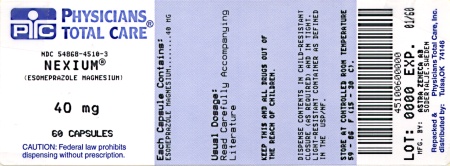
NEXIUM is supplied as delayed-release capsules for oral administration or in packets for preparation of delayed-release oral suspensions. The recommended dosages are outlined in Table 1. NEXIUM should be taken at least one hour before meals.
The duration of proton pump inhibitor administration should be based on available safety and efficacy data specific to the defined indication and dosing frequency, as described in the prescribing information, and individual patient medical needs. Proton pump inhibitor treatment should only be initiated and continued if the benefits outweigh the risks of treatment.
Table 1: Recommended Dosage Schedule of NEXIUM
*
[ . ]The majority of patients are healed within 4 to 8 weeks. For patients who do not heal after 4 to 8 weeks, an additional 4 to 8 weeks of treatment may be considered.
See (14.1) Clinical Studies
†
Controlled studies did not extend beyond six months.
‡
If symptoms do not resolve completely after 4 weeks, an additional 4 weeks of treatment may be considered.
§
Doses over 1 mg/kg/day have not been studied.
¶
Doses over 1.33 mg/kg/day have not been studied.
#
The dosage of NEXIUM in patients with pathological hypersecretory conditions varies with the individual patient. Dosage regimens should be adjusted to individual patient needs.
Þ
Doses up to 240 mg daily have been administered [ ].
see Drug Interactions (7)
Indication
Dose
Frequency
Gastroesophageal Reflux Disease (GERD)
Healing of Erosive Esophagitis
20 mg or 40 mg
Once Daily for 4 to 8 Weeks *
Maintenance of Healing of Erosive Esophagitis
20 mg
Once Daily †
Symptomatic Gastroesophageal Reflux Disease
20 mg
Once Daily for 4 Weeks ‡
Pediatric GERD
12 to 17 Year Olds
Short-term Treatment of GERD
20 mg or 40 mg
Once Daily for up to 8 Weeks
1 to 11 Year Olds§
Short-term Treatment of Symptomatic GERD
10 mg
Once Daily for up to 8 Weeks
Healing of Erosive Esophagitis
weight < 20 kg
10 mg
Once Daily for 8 Weeks
weight ≥ 20 kg
10 mg or 20 mg
Once Daily for 8 Weeks
1 month to < 1 year old¶
Erosive esophagitis due to acid-mediated GERD
weight 3 kg to 5 kg
2.5 mg
Once Daily for up to 6 Weeks
weight > 5 kg to 7.5 kg
5 mg
Once Daily for up to 6 Weeks
weight >7.5 kg to 12 kg
10 mg
Once Daily for up to 6 Weeks
Risk Reduction of NSAID-Associated Gastric Ulcer
20 mg or 40 mg
Once Daily for up to 6 months †
Eradication to Reduce the Risk of Duodenal Ulcer Recurrence H. pylori
Triple Therapy:
NEXIUM
40 mg
Once Daily for 10 Days
Amoxicillin
1000 mg
Twice Daily for 10 Days
Clarithromycin
500 mg
Twice Daily for 10 Days
Pathological Hypersecretory Conditions Including Zollinger-Ellison Syndrome
40 mg #
Twice Daily Þ
Please refer to amoxicillin and clarithromycin prescribing information for Contraindications, Warnings, and dosing in elderly and renally-impaired patients.
Special Populations
Hepatic Insufficiency
In patients with mild to moderate liver impairment (Child Pugh Classes A and B), no dosage adjustment is necessary. For patients with severe liver impairment (Child Pugh Class C), a dose of 20 mg of NEXIUM should not be exceeded [ ]. see Clinical Pharmacology (12.3)
Directions for use specific to the route and available methods of administration for each of these dosage forms are presented in Table 2.
Table 2: Administration Options
Administration Options
(See text following table for additional instructions.)
Dosage Form
Route
Options
Delayed-Release Capsules
Oral
Capsule can be swallowed whole.
-or-
Capsule can be opened and mixed with applesauce.
Delayed-Release Capsules
Nasogastric Tube
Capsule can be opened and the intact granules emptied into a syringe and delivered through the nasogastric tube.
For Delayed-Release Oral Suspension
Oral
For the 2.5 mg and 5 mg strengths, mix the contents of packet with 5 mL of water, leave 2 to 3 minutes to thicken, stir and drink within 30 minutes.
For the 10 mg, 20 mg and 40 mg strengths, mix contents of packet with 15 mL of water, and follow the instructions above.
For Delayed-Release Oral Suspension
Nasogastric or Gastric Tube
For the 2.5 mg and 5 mg strengths, add 5 mL of water to a syringe and then add contents of packet. Shake the syringe; leave 2 to 3 minutes to thicken. Shake the syringe and inject through the nasogastric or gastric tube within 30 minutes.
For the 10 mg, 20 mg and 40 mg strengths, add 15 mL of water, and follow the instructions above.
NEXIUM Delayed-Release Capsules
NEXIUM Delayed-Release Capsules should be swallowed whole.
Alternatively, for patients who have difficulty swallowing capsules, one tablespoon of applesauce can be added to an empty bowl and the NEXIUM Delayed-Release Capsule can be opened, and the granules inside the capsule carefully emptied onto the applesauce. The granules should be mixed with the applesauce and then swallowed immediately: do not store for future use. The applesauce used should not be hot and should be soft enough to be swallowed without chewing. The granules should not be chewed or crushed. If the granules/applesauce mixture is not used in its entirety, the remaining mixture should be discarded immediately.
For patients who have a nasogastric tube in place, NEXIUM Delayed-Release Capsules can be opened and the intact granules emptied into a 60 mL catheter tipped syringe and mixed with 50 mL of water. It is important to only use a catheter tipped syringe when administering NEXIUM through a nasogastric tube. Replace the plunger and shake the syringe vigorously for 15 seconds. Hold the syringe with the tip up and check for granules remaining in the tip. Attach the syringe to a nasogastric tube and deliver the contents of the syringe through the nasogastric tube into the stomach. After administering the granules, the nasogastric tube should be flushed with additional water. Do not administer the granules if they have dissolved or disintegrated.
The mixture must be used immediately after preparation.
NEXIUM For Delayed-Release Oral Suspension
NEXIUM For Delayed-Release Oral Suspension should be administered as follows:
Empty the contents of a 2.5 mg or 5 mg packet into a container containing 5 mL of water. For the 10 mg, 20 mg, and 40 mg strengths, the contents of a packet should be emptied into a container containing 15 mL of water.
Stir.
Leave 2 to 3 minutes to thicken.
Stir and drink within 30 minutes.
If any medicine remains after drinking, add more water, stir, and drink immediately.
In cases where there is a need to use two packets, they may be mixed in a similar way by adding twice the required amount of water or follow the mixing instructions provided by your pharmacist or doctor.
For patients who have a nasogastric or gastric tube in place, NEXIUM For Delayed-Release Oral Suspension can be administered as follows:
Add 5 mL of water to a catheter tipped syringe and then add the contents of a 2.5 mg or 5 mg NEXIUM packet. For the 10 mg, 20 mg, and 40 mg strengths, the volume of water in the syringe should be 15 mL. It is important to only use a catheter tipped syringe when administering NEXIUM through a nasogastric tube or gastric tube.
Immediately shake the syringe and leave 2 to 3 minutes to thicken.
Shake the syringe and inject through the nasogastric or gastric tube, French size 6 or larger, into the stomach within 30 minutes.
Refill the syringe with an equal amount of water (5 mL or 15 mL).
Shake and flush any remaining contents from the nasogastric or gastric tube into the stomach.