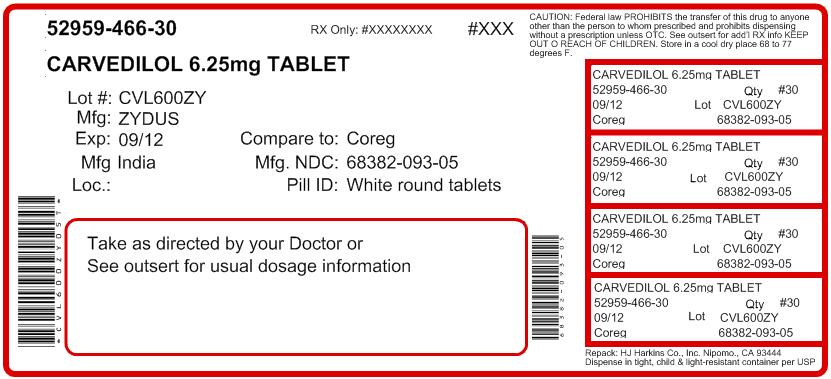
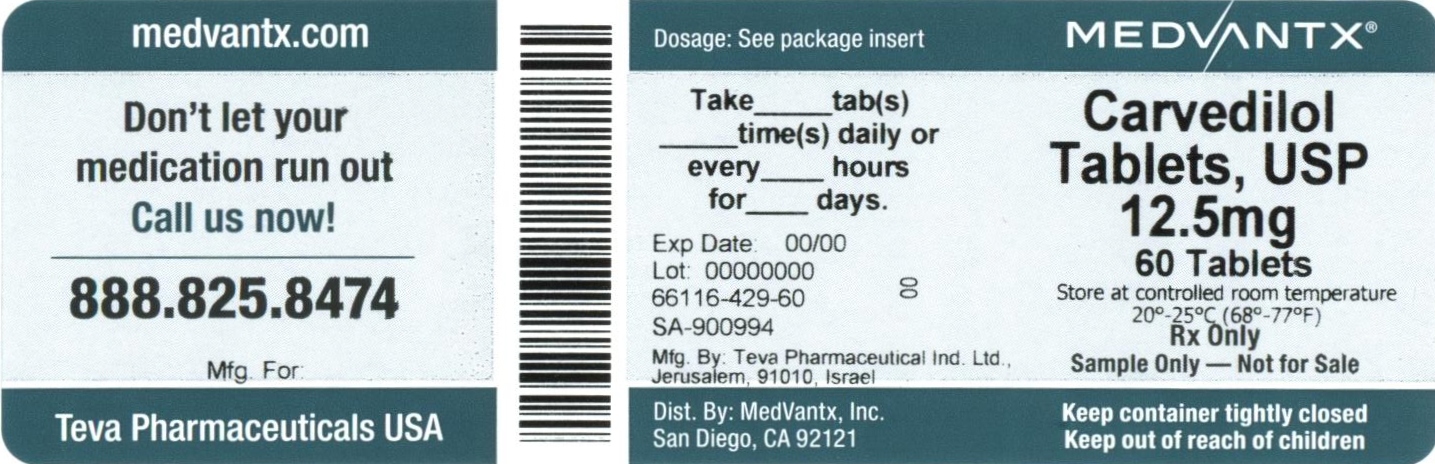
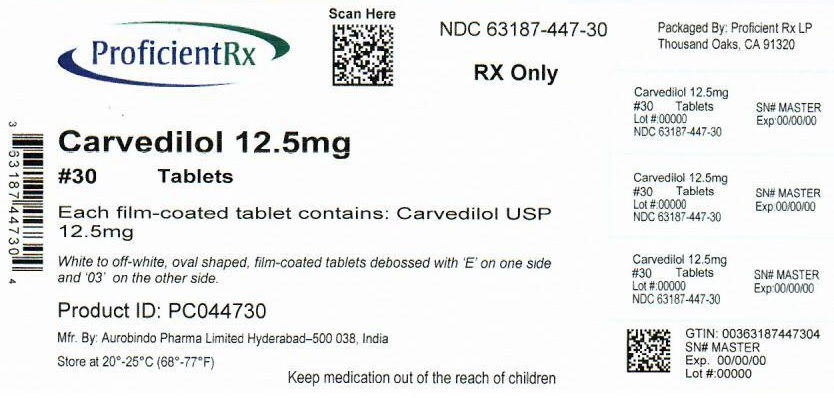
Carvedilol label

Carvedilol

Carvedilol Recall

Get an alert when a recall is issued.

Side Effects & Adverse Reactions

There is currently no warning information available for this product. We apologize for any inconvenience.

FDA Safety Alerts

There are currently no FDA safety alerts available for this drug.

Manufacturer Warnings

There is currently no manufacturer warning information available for this drug.

FDA Labeling Changes

There are currently no FDA labeling changes available for this drug.

Uses

Carvedilol Tablet is an alpha/beta-adrenergic blocking agent indicated for the treatment of:

  • Left ventricular dysfunction following myocardial infarction in clinically stable patients (1.2)
  • Hypertension (1.3)

Carvedilol Tablet is indicated to reduce cardiovascular mortality in clinically stable patients who have survived the acute phase of a myocardial infarction and have a left ventricular ejection fraction of less than or equal to 40% (with or without symptomatic heart failure) [see Clinical Studies (14.2)].

Carvedilol Tablet is indicated for the management of essential hypertension [see Clinical Studies (14.3, 14.4)]. It can be used alone or in combination with other antihypertensive agents, especially thiazide-type diuretics [see Drug Interactions (7.2)].

History

There is currently no drug history available for this drug.

Other Information

Carvedilol Tablet is a nonselective β-adrenergic blocking agent with α1-blocking activity. It is (±)-1-(carbazol-4-yloxy)-3-[[2-(o-methoxyphenoxy)ethyl]amino]-2-propanol. Carvedilol Tablet is a racemic mixture with the following structure:

MM1

Carvedilol Tablet is a white, oval-shaped, biconvex film-coated tablet containing 3.125 mg, 6.25 mg, 12.5 mg, or 25 mg of Carvedilol Tablet. Inactive ingredients consist of colloidal silicon dioxide, crospovidone, hypromellose, lactose monohydrate, magnesium stearate, microcrystalline cellulose, polyethylene glycol, sodium citrate dihydrate, sucrose, and titanium dioxide.

Carvedilol Tablet is a white to off-white powder with a molecular weight of 406.5 and molecular formula of C24H26N2O4. It is freely soluble in dimethylsulfoxide; soluble in methylene chloride and methanol; sparingly soluble in 95% ethanol and isopropanol; slightly soluble in ethyl ether; and practically insoluble in water, gastric fluid (simulated, TS, pH 1.1), and intestinal fluid (simulated, TS without pancreatin, pH 7.5).

Carvedilol Manufacturers

  • Remedyrepack Inc.
    Carvedilol | Remedyrepack Inc.
    No Recall

    Carvedilol | Remedyrepack Inc.

    Carvedilol | Remedyrepack Inc.

    Carvedilol Tablet should be taken with food to slow the rate of absorption and reduce the incidence of orthostatic effects.


    DOSAGE MUST BE INDIVIDUALIZED AND MONITORED DURING UP-TITRATION. Treatment with Carvedilol Tablet may be started as an inpatient or outpatient and should be started after the patient is hemodynamically stable and fluid retention has been minimized. It is recommended that Carvedilol Tablets be started at 6.25 mg twice daily and increased after 3 to 10 days, based on tolerability, to 12.5 mg twice daily, then again to the target dose of 25 mg twice daily. A lower starting dose may be used (3.125 mg twice daily) and/or the rate of up-titration may be slowed if clinically indicated (e.g., due to low blood pressure or heart rate, or fluid retention). Patients should be maintained on lower doses if higher doses are not tolerated. The recommended dosing regimen need not be altered in patients who received treatment with an IV or oral β-blocker during the acute phase of the myocardial infarction.


    DOSAGE MUST BE INDIVIDUALIZED. The recommended starting dose of Carvedilol Tablet is 6.25 mg twice daily. If this dose is tolerated, using standing systolic pressure measured about 1 hour after dosing as a guide, the dose should be maintained for 7 to 14 days, and then increased to 12.5 mg twice daily if needed, based on trough blood pressure, again using standing systolic pressure one hour after dosing as a guide for tolerance. This dose should also be maintained for 7 to 14 days and can then be adjusted upward to 25 mg twice daily if tolerated and needed. The full antihypertensive effect of Carvedilol Tablets is seen within 7 to 14 days. Total daily dose should not exceed 50 mg.

    Concomitant administration with a diuretic can be expected to produce additive effects and exaggerate the orthostatic component of Carvedilol Tablet action.


    Carvedilol Tablets should not be given to patients with severe hepatic impairment [see Contraindications (4)].


  • Legacy Pharmaceutical Packaging
    Carvedilol | Legacy Pharmaceutical Packaging
    No Recall

    Carvedilol | Legacy Pharmaceutical Packaging

    Carvedilol | Legacy Pharmaceutical Packaging

    Carvedilol should be taken with food to slow the rate of absorption and reduce the incidence of orthostatic effects.

    2.1 Left Ventricular Dysfunction Following Myocardial Infarction

    DOSAGE MUST BE INDIVIDUALIZED AND MONITORED DURING UP-TITRATION. Treatment with carvedilol tablets may be started as an inpatient or outpatient and should be started after the patient is hemodynamically stable and fluid retention has been minimized. It is recommended that carvedilol tablets be started at 6.25 mg twice daily and increased after 3 to 10 days, based on tolerability, to 12.5 mg twice daily, then again to the target dose of 25 mg twice daily. A lower starting dose may be used (3.125 mg twice daily) and/or the rate of up-titration may be slowed if clinically indicated (e.g., due to low blood pressure or heart rate, or fluid retention). Patients should be maintained on lower doses if higher doses are not tolerated. The recommended dosing regimen need not be altered in patients who received treatment with an IV or oral β-blocker during the acute phase of the myocardial infarction.

    2.2 Hypertension

    DOSAGE MUST BE INDIVIDUALIZED. The recommended starting dose of carvedilol tablets is 6.25 mg twice daily. If this dose is tolerated, using standing systolic pressure measured about 1 hour after dosing as a guide, the dose should be maintained for 7 to 14 days, and then increased to 12.5 mg twice daily if needed, based on trough blood pressure, again using standing systolic pressure one hour after dosing as a guide for tolerance. This dose should also be maintained for 7 to 14 days and can then be adjusted upward to 25 mg twice daily if tolerated and needed. The full antihypertensive effect of carvedilol tablet is seen within 7 to 14 days. Total daily dose should not exceed 50 mg.

    Concomitant administration with a diuretic can be expected to produce additive effects and exaggerate the orthostatic component of carvedilol action.

    2.3 Hepatic Impairment

    Carvedilol tablets should not be given to patients with severe hepatic impairment [see CONTRAINDICATIONS  (4)].

  • Remedyrepack Inc.
    Carvedilol | Remedyrepack Inc.
    No Recall

    Carvedilol | Remedyrepack Inc.

    Carvedilol | Remedyrepack Inc.

    Carvedilol Tablet should be taken with food to slow the rate of absorption and reduce the incidence of orthostatic effects.


    DOSAGE MUST BE INDIVIDUALIZED AND MONITORED DURING UP-TITRATION. Treatment with Carvedilol Tablet may be started as an inpatient or outpatient and should be started after the patient is hemodynamically stable and fluid retention has been minimized. It is recommended that Carvedilol Tablets be started at 6.25 mg twice daily and increased after 3 to 10 days, based on tolerability, to 12.5 mg twice daily, then again to the target dose of 25 mg twice daily. A lower starting dose may be used (3.125 mg twice daily) and/or the rate of up-titration may be slowed if clinically indicated (e.g., due to low blood pressure or heart rate, or fluid retention). Patients should be maintained on lower doses if higher doses are not tolerated. The recommended dosing regimen need not be altered in patients who received treatment with an IV or oral β-blocker during the acute phase of the myocardial infarction.


    DOSAGE MUST BE INDIVIDUALIZED. The recommended starting dose of Carvedilol Tablet is 6.25 mg twice daily. If this dose is tolerated, using standing systolic pressure measured about 1 hour after dosing as a guide, the dose should be maintained for 7 to 14 days, and then increased to 12.5 mg twice daily if needed, based on trough blood pressure, again using standing systolic pressure one hour after dosing as a guide for tolerance. This dose should also be maintained for 7 to 14 days and can then be adjusted upward to 25 mg twice daily if tolerated and needed. The full antihypertensive effect of Carvedilol Tablets is seen within 7 to 14 days. Total daily dose should not exceed 50 mg.

    Concomitant administration with a diuretic can be expected to produce additive effects and exaggerate the orthostatic component of Carvedilol Tablet action.


    Carvedilol Tablets should not be given to patients with severe hepatic impairment [see Contraindications (4)].


  • Proficient Rx Lp
    Carvedilol | Rugby Laboratories
    No Recall

    Carvedilol | Rugby Laboratories

    Carvedilol | Rugby Laboratories
    Adults and children 12 years of age: chew 2 - 4 tablets as symptoms occur, or as directed by a doctor Do not take for symptoms that persist for more than 2 weeks unless advised by a doctor
  • Northwind Pharmaceuticals, Llc
    Carvedilol | Northwind Pharmaceuticals, Llc
    No Recall

    Carvedilol | Northwind Pharmaceuticals, Llc

    Carvedilol | Northwind Pharmaceuticals, Llc

    Carvedilol should be taken with food to slow the rate of absorption and reduce the incidence of orthostatic effects.

    2.1 Left Ventricular Dysfunction Following Myocardial Infarction

    DOSAGE MUST BE INDIVIDUALIZED AND MONITORED DURING UP-TITRATION. Treatment with carvedilol tablets may be started as an inpatient or outpatient and should be started after the patient is hemodynamically stable and fluid retention has been minimized. It is recommended that carvedilol tablets be started at 6.25 mg twice daily and increased after 3 to 10 days, based on tolerability, to 12.5 mg twice daily, then again to the target dose of 25 mg twice daily. A lower starting dose may be used (3.125 mg twice daily) and/or the rate of up-titration may be slowed if clinically indicated (e.g., due to low blood pressure or heart rate, or fluid retention). Patients should be maintained on lower doses if higher doses are not tolerated. The recommended dosing regimen need not be altered in patients who received treatment with an IV or oral β-blocker during the acute phase of the myocardial infarction.

    2.2 Hypertension

    DOSAGE MUST BE INDIVIDUALIZED. The recommended starting dose of carvedilol tablets is 6.25 mg twice daily. If this dose is tolerated, using standing systolic pressure measured about 1 hour after dosing as a guide, the dose should be maintained for 7 to 14 days, and then increased to 12.5 mg twice daily if needed, based on trough blood pressure, again using standing systolic pressure one hour after dosing as a guide for tolerance. This dose should also be maintained for 7 to 14 days and can then be adjusted upward to 25 mg twice daily if tolerated and needed. The full antihypertensive effect of carvedilol tablet is seen within 7 to 14 days. Total daily dose should not exceed 50 mg.

    Concomitant administration with a diuretic can be expected to produce additive effects and exaggerate the orthostatic component of carvedilol action.

    2.3 Hepatic Impairment

    Carvedilol tablets should not be given to patients with severe hepatic impairment [see CONTRAINDICATIONS (4)].

  • Remedyrepack Inc.
    Carvedilol | Remedyrepack Inc.
    No Recall

    Carvedilol | Remedyrepack Inc.

    Carvedilol | Remedyrepack Inc.

    Carvedilol tablets should be taken with food to slow the rate of absorption and reduce the incidence of orthostatic effects.


    DOSAGE MUST BE INDIVIDUALIZED AND MONITORED DURING UP-TITRATION. Treatment with carvedilol tablets may be started as an inpatient or outpatient and should be started after the patient is hemodynamically stable and fluid retention has been minimized. It is recommended that carvedilol tablets be started at 6.25 mg twice daily and increased after 3 to 10 days, based on tolerability, to 12.5 mg twice daily, then again to the target dose of 25 mg twice daily. A lower starting dose may be used (3.125 mg twice daily) and/or the rate of up-titration may be slowed if clinically indicated (e.g., due to low blood pressure or heart rate, or fluid retention). Patients should be maintained on lower doses if higher doses are not tolerated. The recommended dosing regimen need not be altered in patients who received treatment with an IV or oral β-blocker during the acute phase of the myocardial infarction. 


    DOSAGE MUST BE INDIVIDUALIZED. The recommended starting dose of carvedilol tablets is 6.25 mg twice daily. If this dose is tolerated, using standing systolic pressure measured about 1 hour after dosing as a guide, the dose should be maintained for 7 to 14 days, and then increased to 12.5 mg twice daily if needed, based on trough blood pressure, again using standing systolic pressure one hour after dosing as a guide for tolerance. This dose should also be maintained for 7 to 14 days and can then be adjusted upward to 25 mg twice daily if tolerated and needed. The full antihypertensive effect of carvedilol tablets is seen within 7 to 14 days. Total daily dose should not exceed 50 mg.


    Concomitant administration with a diuretic can be expected to produce additive effects and exaggerate the orthostatic component of carvedilol action. 


    Carvedilol tablets should not be given to patients with severe hepatic impairment

    [see Contraindications (4)]

    .


  • Remedyrepack Inc.
    Carvedilol | Laboratoires Clarins S.a.
    No Recall

    Carvedilol | Laboratoires Clarins S.a.

    Carvedilol | Laboratoires Clarins S.a.
    apply liberally 15 minutes before sun exposure apply to all skin exposed to the sun children under 6 months: Ask a doctor reapply at least every 2 hours use a water resistant sunscreen if swimming or sweating.
  • Remedyrepack Inc.
    Carvedilol | Direct Rx
    No Recall

    Carvedilol | Direct Rx

    Carvedilol | Direct Rx

    Use lowest effective dose for the shortest duration consistent with treatment goals for the individual patient.

    These doses can be given without regard to timing of meals.

    2.1 Osteoarthritis

    For relief of the signs and symptoms of OA the recommended oral dose is 200 mg per day administered as a single dose or as 100 mg twice daily.

    2.2 Rheumatoid Arthritis

    For relief of the signs and symptoms of RA the recommended oral dose is 100 to 200 mg twice daily.

    2.3 Juvenile Rheumatoid Arthritis

    For the relief of the signs and symptoms of JRA the recommended oral dose for pediatric patients (age 2 years and older) is based on weight. For patients ≥10 kg to ≤25 kg the recommended dose is 50 mg twice daily. For patients >25 kg the recommended dose is 100 mg twice daily.

    For patients who have difficulty swallowing capsules, the contents of a celecoxib capsule can be added to applesauce. The entire capsule contents are carefully emptied onto a level teaspoon of cool or room temperature applesauce and ingested immediately with water. The sprinkled capsule contents on applesauce are stable for up to 6 hours under refrigerated conditions (2–8° C/ 35–45° F).

    2.4 Ankylosing Spondylitis

    For the management of the signs and symptoms of AS, the recommended dose of celecoxib is 200 mg daily in single (once per day) or divided (twice per day) doses. If no effect is observed after 6 weeks, a trial of 400 mg daily may be worthwhile. If no effect is observed after 6 weeks on 400 mg daily, a response is not likely and consideration should be given to alternate treatment options.

    2.5 Management of Acute Pain and Treatment of Primary Dysmenorrhea

    The recommended dose of celecoxib is 400 mg initially, followed by an additional 200 mg dose if needed on the first day. On subsequent days, the recommended dose is 200 mg twice daily as needed.

    2.6 Special Populations

    Hepatic insufficiency: The daily recommended dose of celecoxib capsules in patients with moderate hepatic impairment (Child-Pugh Class B) should be reduced by 50%. The use of celecoxib in patients with severe hepatic impairment is not recommended [see Warnings and Precautions (5.5), Use in Specific Populations (8.6) and Clinical Pharmacology (12.3)].

    Poor Metabolizers of CYP2C9 Substrates: Patients who are known or suspected to be poor CYP2C9 metabolizers based on genotype or previous history/experience with other CYP2C9 substrates (such as warfarin, phenytoin) should be administered celecoxib with caution. Consider starting treatment at half the lowest recommended dose in poor metabolizers (i.e. CYP2C9*3/*3). Consider using alternative management in JRA patients who are poor metabolizers. [see Use in Specific populations (8.8), and Clinical Pharmacology (12.5)].

  • Blenheim Pharmacal, Inc.
    Carvedilol | Blenheim Pharmacal, Inc.
    No Recall

    Carvedilol | Blenheim Pharmacal, Inc.

    Carvedilol | Blenheim Pharmacal, Inc.

    Carvedilol should be taken with food to slow the rate of absorption and reduce the incidence of orthostatic effects.

    2.2 Left Ventricular Dysfunction Following Myocardial Infarction

    DOSAGE MUST BE INDIVIDUALIZED AND MONITORED DURING UP-TITRATION. Treatment with carvedilol may be started as an inpatient or outpatient and should be started after the patient is hemodynamically stable and fluid retention has been minimized. It is recommended that carvedilol be started at 6.25 mg twice daily and increased after 3 to 10 days, based on tolerability, to 12.5 mg twice daily, then again to the target dose of 25 mg twice daily. A lower starting dose may be used (3.125 mg twice daily) and/or the rate of up-titration may be slowed if clinically indicated (e.g., due to low blood pressure or heart rate, or fluid retention). Patients should be maintained on lower doses if higher doses are not tolerated. The recommended dosing regimen need not be altered in patients who received treatment with an IV or oral β-blocker during the acute phase of the myocardial infarction.

    2.3 Hypertension

    DOSAGE MUST BE INDIVIDUALIZED. The recommended starting dose of carvedilol is 6.25 mg twice daily. If this dose is tolerated, using standing systolic pressure measured about 1 hour after dosing as a guide, the dose should be maintained for 7 to 14 days, and then increased to 12.5 mg twice daily if needed, based on trough blood pressure, again using standing systolic pressure one hour after dosing as a guide for tolerance. This dose should also be maintained for 7 to 14 days and can then be adjusted upward to 25 mg twice daily if tolerated and needed. The full antihypertensive effect of carvedilol is seen within 7 to 14 days. Total daily dose should not exceed 50 mg.

    Concomitant administration with a diuretic can be expected to produce additive effects and exaggerate the orthostatic component of carvedilol action.

    2.4 Hepatic Impairment

    Carvedilol should not be given to patients with severe hepatic impairment [see Contraindications (4)].

  • Carvedilol | Cvs Pharmacy
    No Recall

    Carvedilol | Cvs Pharmacy

    Carvedilol | Cvs Pharmacy
    take softgels with a full glass (8 oz) of water  adults and children 12 years and older  take 1-3 softgels daily or as directed by a doctor. This dose may be taken as a single daily dose or in divided doses.   children 6 to under 12 years of age  take 1 softgel daily or as directed by a doctor  children under 6 years of age  ask a doctor
  • State Of Florida Doh Central Pharmacy
    Carvedilol | State Of Florida Doh Central Pharmacy
    No Recall

    Carvedilol | State Of Florida Doh Central Pharmacy

    Carvedilol | State Of Florida Doh Central Pharmacy

    Carvedilol Tablet should be taken with food to slow the rate of absorption and reduce the incidence of orthostatic effects.

    2.2 Left Ventricular Dysfunction Following Myocardial Infarction

    DOSAGE MUST BE INDIVIDUALIZED AND MONITORED DURING UP-TITRATION. Treatment with Carvedilol Tablet may be started as an inpatient or outpatient and should be started after the patient is hemodynamically stable and fluid retention has been minimized. It is recommended that Carvedilol Tablets be started at 6.25 mg twice daily and increased after 3 to 10 days, based on tolerability, to 12.5 mg twice daily, then again to the target dose of 25 mg twice daily. A lower starting dose may be used (3.125 mg twice daily) and/or the rate of up-titration may be slowed if clinically indicated (e.g., due to low blood pressure or heart rate, or fluid retention). Patients should be maintained on lower doses if higher doses are not tolerated. The recommended dosing regimen need not be altered in patients who received treatment with an IV or oral β-blocker during the acute phase of the myocardial infarction.

    2.3 Hypertension

    DOSAGE MUST BE INDIVIDUALIZED. The recommended starting dose of Carvedilol Tablet is 6.25 mg twice daily. If this dose is tolerated, using standing systolic pressure measured about 1 hour after dosing as a guide, the dose should be maintained for 7 to 14 days, and then increased to 12.5 mg twice daily if needed, based on trough blood pressure, again using standing systolic pressure one hour after dosing as a guide for tolerance. This dose should also be maintained for 7 to 14 days and can then be adjusted upward to 25 mg twice daily if tolerated and needed. The full antihypertensive effect of Carvedilol Tablets is seen within 7 to 14 days. Total daily dose should not exceed 50 mg.

    Concomitant administration with a diuretic can be expected to produce additive effects and exaggerate the orthostatic component of Carvedilol Tablet action.

    2.4 Hepatic Impairment

    Carvedilol Tablets should not be given to patients with severe hepatic impairment [see Contraindications (4)].

  • Carvedilol | American Health Packaging
    No Recall

    Carvedilol | American Health Packaging

    Carvedilol | American Health Packaging

    Carvedilol should be taken with food to slow the rate of absorption and reduce the incidence of orthostatic effects.

    2.2 Left Ventricular Dysfunction Following Myocardial Infarction:

    DOSAGE MUST BE INDIVIDUALIZED AND MONITORED DURING UP-TITRATION. Treatment with carvedilol tablets may be started as an inpatient or outpatient and should be started after the patient is hemodynamically stable and fluid retention has been minimized. It is recommended that carvedilol tablets be started at 6.25 mg twice daily and increased after 3 to 10 days, based on tolerability, to 12.5 mg twice daily, then again to the target dose of 25 mg twice daily. A lower starting dose may be used (3.125 mg twice daily) and/or the rate of up-titration may be slowed if clinically indicated (e.g., due to low blood pressure or heart rate, or fluid retention). Patients should be maintained on lower doses if higher doses are not tolerated. The recommended dosing regimen need not be altered in patients who received treatment with an IV or oral β-blocker during the acute phase of the myocardial infarction.

    2.3 Hypertension

    DOSAGE MUST BE INDIVIDUALIZED. The recommended starting dose of carvedilol tablets is 6.25 mg twice daily. If this dose is tolerated, using standing systolic pressure measured about 1 hour after dosing as a guide, the dose should be maintained for 7 to 14 days, and then increased to 12.5 mg twice daily if needed, based on trough blood pressure, again using standing systolic pressure one hour after dosing as a guide for tolerance. This dose should also be maintained for 7 to 14 days and can then be adjusted upward to 25 mg twice daily if tolerated and needed. The full antihypertensive effect of carvedilol tablet is seen within 7 to 14 days. Total daily dose should not exceed 50 mg.

    Concomitant administration with a diuretic can be expected to produce additive effects and exaggerate the orthostatic component of carvedilol action.

    2.4 Hepatic Impairment

    Carvedilol tablets should not be given to patients with severe hepatic impairment [see CONTRAINDICATIONS (4)].

  • Carvedilol | Ranbaxy Pharmaceuticals Inc.
    No Recall

    Carvedilol | Ranbaxy Pharmaceuticals Inc.

    Carvedilol | Ranbaxy Pharmaceuticals Inc.

    Carvedilol should be taken with food to slow the rate of absorption and reduce the incidence of orthostatic effects.

    2.1 Left Ventricular Dysfunction Following Myocardial Infarction

    DOSAGE MUST BE INDIVIDUALIZED AND MONITORED DURING UP- TITRATION. Treatment with carvedilol may be started as an inpatient or outpatient and should be started after the patient is hemodynamically stable and fluid retention has been minimized. It is recommended that carvedilol be started at 6.25 mg twice daily and increased after 3 to 10 days, based on tolerability, to 12.5 mg twice daily, then again to the target dose of 25 mg twice daily. A lower starting dose may be used (3.125 mg twice daily) and/or the rate of up-titration may be slowed if clinically indicated (e.g., due to low blood pressure or heart rate, or fluid retention). Patients should be maintained on lower doses if higher doses are not tolerated. The recommended dosing regimen need not be altered in patients who received treatment with an IV or oral β-blocker during the acute phase of the myocardial infarction.

    2.2 Hypertension

    DOSAGE MUST BE INDIVIDUALIZED. The recommended starting dose of carvedilol is 6.25 mg twice daily. If this dose is tolerated, using standing systolic pressure measured about 1 hour after dosing as a guide, the dose should be maintained for 7 to 14 days, and then increased to 12.5 mg twice daily if needed, based on trough blood pressure, again using standing systolic pressure one hour after dosing as a guide for tolerance. This dose should also be maintained for 7 to 14 days and can then be adjusted upward to 25 mg twice daily if tolerated and needed. The full antihypertensive effect of carvedilol is seen within 7 to 14 days. Total daily dose should not exceed 50 mg.

    Concomitant administration with a diuretic can be expected to produce additive effects and exaggerate the orthostatic component of carvedilol action.

    2.3 Hepatic Impairment

    Carvedilol should not be given to patients with severe hepatic impairment [see Contraindications (4)].

  • Carvedilol | Actavis Elizabeth Llc
    No Recall

    Carvedilol | Actavis Elizabeth Llc

    Carvedilol | Actavis Elizabeth Llc

    Carvedilol should be taken with food to slow the rate of absorption and reduce the incidence of orthostatic effects.

    2.1  Left Ventricular Dysfunction Following Myocardial Infarction

    DOSAGE MUST BE INDIVIDUALIZED AND MONITORED DURING UP-TITRATION. Treatment with carvedilol may be started as an inpatient or outpatient and should be started after the patient is hemodynamically stable and fluid retention has been minimized. It is recommended that carvedilol be started at 6.25 mg twice daily and increased after 3 to 10 days, based on tolerability, to 12.5 mg twice daily, then again to the target dose of 25 mg twice daily. A lower starting dose may be used (3.125 mg twice daily) and/or the rate of up-titration may be slowed if clinically indicated (e.g., due to low blood pressure or heart rate, or fluid retention). Patients should be maintained on lower doses if higher doses are not tolerated. The recommended dosing regimen need not be altered in patients who received treatment with an IV or oral β-blocker during the acute phase of the myocardial infarction.

    2.2  Hypertension

    DOSAGE MUST BE INDIVIDUALIZED. The recommended starting dose of carvedilol is 6.25 mg twice daily. If this dose is tolerated, using standing systolic pressure measured about 1 hour after dosing as a guide, the dose should be maintained for 7 to 14 days, and then increased to 12.5 mg twice daily if needed, based on trough blood pressure, again using standing systolic pressure one hour after dosing as a guide for tolerance. This dose should also be maintained for 7 to 14 days and can then be adjusted upward to 25 mg twice daily if tolerated and needed. The full antihypertensive effect of carvedilol is seen within 7 to 14 days. Total daily dose should not exceed 50 mg.

    Concomitant administration with a diuretic can be expected to produce additive effects and exaggerate the orthostatic component of carvedilol action.

    2.3  Hepatic Impairment

    Carvedilol should not be given to patients with severe hepatic impairment [see Contraindications (4)].

  • Major Pharmaceuticals
    Carvedilol | Major Pharmaceuticals
    No Recall

    Carvedilol | Major Pharmaceuticals

    Carvedilol | Major Pharmaceuticals

    Carvedilol tablets should be taken with food to slow the rate of absorption and reduce the incidence of orthostatic effects.

    2.1 Heart Failure

    DOSAGE MUST BE INDIVIDUALIZED AND CLOSELY MONITORED BY A PHYSICIAN DURING UP-TITRATION. Prior to initiation of carvedilol tablets, it is recommended that fluid retention be minimized. The recommended starting dose of carvedilol tablets is 3.125 mg twice daily for 2 weeks. If tolerated, patients may have their dose increased to 6.25, 12.5, and 25 mg twice daily over successive intervals of at least 2 weeks. Patients should be maintained on lower doses if higher doses are not tolerated. A maximum dose of 50 mg twice daily has been administered to patients with mild-to-moderate heart failure weighing over 85 kg (187 lbs).

    Patients should be advised that initiation of treatment and (to a lesser extent) dosage increases may be associated with transient symptoms of dizziness or lightheadedness (and rarely syncope) within the first hour after dosing. During these periods, patients should avoid situations such as driving or hazardous tasks, where symptoms could result in injury. Vasodilatory symptoms often do not require treatment, but it may be useful to separate the time of dosing of carvedilol tablets from that of the ACE inhibitor or to reduce temporarily the dose of the ACE inhibitor. The dose of carvedilol tablets should not be increased until symptoms of worsening heart failure or vasodilation have been stabilized.

    Fluid retention (with or without transient worsening heart failure symptoms) should be treated by an increase in the dose of diuretics.The dose of carvedilol tablets should be reduced if patients experience bradycardia (heart rate < 55 beats/minute).

    Episodes of dizziness or fluid retention during initiation of carvedilol tablets can generally be managed without discontinuation of treatment and do not preclude subsequent successful titration of, or a favorable response to, carvedilol.

    2.2 Left Ventricular Dysfunction Following Myocardial Infarction

    DOSAGE MUST BE INDIVIDUALIZED AND MONITORED DURING UP-TITRATION. Treatment with carvedilol tablets may be started as an inpatient or outpatient and should be started after the patient is hemodynamically stable and fluid retention has been minimized. It is recommended that carvedilol tablets be started at 6.25 mg twice daily and increased after 3 to 10 days, based on tolerability, to 12.5 mg twice daily, then again to the target dose of 25 mg twice daily. A lower starting dose may be used (3.125 mg twice daily) and/or the rate of up-titration may be slowed if clinically indicated (e.g., due to low blood pressure or heart rate, or fluid retention). Patients should be maintained on lower doses if higher doses are not tolerated. The recommended dosing regimen need not be altered in patients who received treatment with an IV or oral β-blocker during the acute phase of the myocardial infarction.

    2.3 Hypertension

    DOSAGE MUST BE INDIVIDUALIZED. The recommended starting dose of carvedilol tablets is 6.25 mg twice daily. If this dose is tolerated, using standing systolic pressure measured about 1 hour after dosing as a guide, the dose should be maintained for 7 to 14 days, and then increased to 12.5 mg twice daily if needed, based on trough blood pressure, again using standing systolic pressure one hour after dosing as a guide for tolerance. This dose should also be maintained for 7 to 14 days and can then be adjusted upward to 25 mg twice daily if tolerated and needed. The full antihypertensive effect of carvedilol tablets is seen within 7 to 14 days. Total daily dose should not exceed 50 mg.

    Concomitant administration with a diuretic can be expected to produce additive effects and exaggerate the orthostatic component of carvedilol action.

    2.4 Hepatic Impairment

    Carvedilol tablets should not be given to patients with severe hepatic impairment [see Contraindications (4)].

  • State Of Florida Doh Central Pharmacy
    Carvedilol | State Of Florida Doh Central Pharmacy
    No Recall

    Carvedilol | State Of Florida Doh Central Pharmacy

    Carvedilol | State Of Florida Doh Central Pharmacy

    Carvedilol should be taken with food to slow the rate of absorption and reduce the incidence of orthostatic effects.

    2.1 Left Ventricular Dysfunction Following Myocardial Infarction:

    DOSAGE MUST BE INDIVIDUALIZED AND MONITORED DURING UP-TITRATION. Treatment with carvedilol tablets may be started as an inpatient or outpatient and should be started after the patient is hemodynamically stable and fluid retention has been minimized. It is recommended that carvedilol tablets be started at 6.25 mg twice daily and increased after 3 to 10 days, based on tolerability, to 12.5 mg twice daily, then again to the target dose of 25 mg twice daily. A lower starting dose may be used (3.125 mg twice daily) and/or the rate of up-titration may be slowed if clinically indicated (e.g., due to low blood pressure or heart rate, or fluid retention). Patients should be maintained on lower doses if higher doses are not tolerated. The recommended dosing regimen need not be altered in patients who received treatment with an IV or oral β-blocker during the acute phase of the myocardial infarction.

    2.2 Hypertension

    DOSAGE MUST BE INDIVIDUALIZED. The recommended starting dose of carvedilol tablets is 6.25 mg twice daily. If this dose is tolerated, using standing systolic pressure measured about 1 hour after dosing as a guide, the dose should be maintained for 7 to 14 days, and then increased to 12.5 mg twice daily if needed, based on trough blood pressure, again using standing systolic pressure one hour after dosing as a guide for tolerance. This dose should also be maintained for 7 to 14 days and can then be adjusted upward to 25 mg twice daily if tolerated and needed. The full antihypertensive effect of carvedilol tablet is seen within 7 to 14 days. Total daily dose should not exceed 50 mg.

    Concomitant administration with a diuretic can be expected to produce additive effects and exaggerate the orthostatic component of carvedilol action.

    2.3 Hepatic Impairment

    Carvedilol tablets should not be given to patients with severe hepatic impairment [see CONTRAINDICATIONS  (4)].

  • Carvedilol | Hikma Pharmaceutical
    No Recall

    Carvedilol | Hikma Pharmaceutical

    Carvedilol | Hikma Pharmaceutical
    1.1 Left Ventricular Dysfunction Following Myocardial Infarction Carvedilol  is indicated to reduce cardiovascular mortality in clinically stable patients who have survived the acute phase of a myocardial infarction and have a left ventricular ejection fraction of ≤ 40% (with or without symptomatic heart failure) [see Clinical Studies (14.2)].

    Carvedilol should be taken with food to slow the rate of absorption and reduce the incidence of orthostatic effects.

    2.1 Left Ventricular Dysfunction Following Myocardial Infarction

    DOSAGE MUST BE INDIVIDUALIZED AND MONITORED DURING UP-TITRATION. Treatment with CARVEDILOL may be started as an inpatient or outpatient and should be started after the patient is hemodynamically stable and fluid retention has been minimized. It is recommended that CARVEDILOL be started at 6.25 mg twice daily and increased after 3 to 10 days, based on tolerability, to 12.5 mg twice daily, then again to the target dose of 25 mg twice daily. A lower starting dose may be used (3.125 mg twice daily) and/or the rate of up-titration may be slowed if clinically indicated (e.g., due to low blood pressure or heart rate, or fluid retention). Patients should be maintained on lower doses if higher doses are not tolerated. The recommended dosing regimen need not be altered in patients who received treatment with an IV or oral β-blocker during the acute phase of the myocardial infarction.

    2.2 Hypertension

    DOSAGE MUST BE INDIVIDUALIZED. The recommended starting dose of carvedilol is 6.25 mg twice daily. If this dose is tolerated, using standing systolic pressure measured about 1 hour after dosing as a guide, the dose should be maintained for 7 to 14 days, and then increased to 12.5 mg twice daily if needed, based on trough blood pressure, again using standing systolic pressure one hour after dosing as a guide for tolerance. This dose should also be maintained for 7 to 14 days and can then be adjusted upward to 25 mg twice daily if tolerated and needed. The full antihypertensive effect of carvedilol is seen within 7 to 14 days. Total daily dose should not exceed 50 mg.

    Concomitant administration with a diuretic can be expected to produce additive effects and exaggerate the orthostatic component of carvedilol action.

    2.3 Hepatic Impairment

    Carvedilol should not be given to patients with severe hepatic impairment [see Contraindications (4)].

  • Aurolife Pharma Llc
    Carvedilol | Aurolife Pharma Llc
    No Recall

    Carvedilol | Aurolife Pharma Llc

    Carvedilol | Aurolife Pharma Llc

    Carvedilol tablets should be taken with food to slow the rate of absorption and reduce the incidence of orthostatic effects. 2.2 Left Ventricular Dysfunction Following Myocardial Infarction
    DOSAGE MUST BE INDIVIDUALIZED AND MONITORED DURING UP-TITRATION. Treatment with carvedilol tablets may be started as an inpatient or outpatient and should be started after the patient is hemodynamically stable and fluid retention has been minimized. It is recommended that carvedilol tablets be started at 6.25 mg twice daily and increased after 3 to 10 days, based on tolerability, to 12.5 mg twice daily, then again to the target dose of 25 mg twice daily. A lower starting dose may be used (3.125 mg twice daily) and/or the rate of up-titration may be slowed if clinically indicated (e.g., due to low blood pressure or heart rate, or fluid retention). Patients should be maintained on lower doses if higher doses are not tolerated. The recommended dosing regimen need not be altered in patients who received treatment with an IV or oral β-blocker during the acute phase of the myocardial infarction. 2.3 Hypertension
    DOSAGE MUST BE INDIVIDUALIZED. The recommended starting dose of carvedilol tablets is 6.25 mg twice daily. If this dose is tolerated, using standing systolic pressure measured about 1 hour after dosing as a guide, the dose should be maintained for 7 to 14 days, and then increased to 12.5 mg twice daily if needed, based on trough blood pressure, again using standing systolic pressure one hour after dosing as a guide for tolerance. This dose should also be maintained for 7 to 14 days and can then be adjusted upward to 25 mg twice daily if tolerated and needed. The full antihypertensive effect of carvedilol tablets is seen within 7 to 14 days. Total daily dose should not exceed 50 mg.
     
    Concomitant administration with a diuretic can be expected to produce additive effects and exaggerate the orthostatic component of carvedilol action. 2.4 Hepatic Impairment
    Carvedilol tablets should not be given to patients with severe hepatic impairment [see Contraindications (4)].
  • Redpharm Drug Inc.
    Carvedilol | Redpharm Drug Inc.
    No Recall

    Carvedilol | Redpharm Drug Inc.

    Carvedilol | Redpharm Drug Inc.

    Carvedilol tablets, USP should be taken with food to slow the rate of absorption and reduce the incidence of orthostatic effects.

    2.2 Left Ventricular Dysfunction Following Myocardial Infarction

    DOSAGE MUST BE INDIVIDUALIZED AND MONITORED DURING UP-TITRATION. Treatment with carvedilol tablets, USP may be started as an inpatient or outpatient and should be started after the patient is hemodynamically stable and fluid retention has been minimized. It is recommended that carvedilol tablets, USP be started at 6.25 mg twice daily and increased after 3 to 10 days, based on tolerability, to 12.5 mg twice daily, then again to the target dose of 25 mg twice daily. A lower starting dose may be used (3.125 mg twice daily) and/or the rate of up-titration may be slowed if clinically indicated (e.g., due to low blood pressure or heart rate, or fluid retention). Patients should be maintained on lower doses if higher doses are not tolerated. The recommended dosing regimen need not be altered in patients who received treatment with an IV or oral β-blocker during the acute phase of the myocardial infarction.

    2.3 Hypertension

    DOSAGE MUST BE INDIVIDUALIZED. The recommended starting dose of carvedilol tablets, USP is 6.25 mg twice daily. If this dose is tolerated, using standing systolic pressure measured about 1 hour after dosing as a guide, the dose should be maintained for 7 to 14 days, and then increased to 12.5 mg twice daily if needed, based on trough blood pressure, again using standing systolic pressure one hour after dosing as a guide for tolerance. This dose should also be maintained for 7 to 14 days and can then be adjusted upward to 25 mg twice daily if tolerated and needed. The full antihypertensive effect of carvedilol tablets, USP is seen within 7 to 14 days. Total daily dose should not exceed 50 mg.

    Concomitant administration with a diuretic can be expected to produce additive effects and exaggerate the orthostatic component of carvedilol action.

    2.4 Hepatic Impairment

    Carvedilol tablets, USP should not be given to patients with severe hepatic impairment [see Contraindications (4)].

  • Remedyrepack Inc.
    Carvedilol | Remedyrepack Inc.
    No Recall

    Carvedilol | Remedyrepack Inc.

    Carvedilol | Remedyrepack Inc.
    COREG should be taken with food to slow the rate of absorption and reduce the incidence of orthostatic effects.
    Heart Failure
    DOSAGE MUST BE INDIVIDUALIZED AND CLOSELY MONITORED BY A PHYSICIAN DURING UP-TITRATION. Prior to initiation of COREG, it is recommended that fluid retention be minimized. The recommended starting dose of COREG is 3.125 mg twice daily for 2 weeks. If tolerated, patients may have their dose increased to 6.25, 12.5, and 25 mg twice daily over successive intervals of at least 2 weeks. Patients should be maintained on lower doses if higher doses are not tolerated. A maximum dose of 50 mg twice daily has been administered to patients with mild-to-moderate heart failure weighing over 85 kg (187 lbs).
    Patients should be advised that initiation of treatment and (to a lesser extent) dosage increases may be associated with transient symptoms of dizziness or lightheadedness (and rarely syncope) within the first hour after dosing. During these periods, patients should avoid situations such as driving or hazardous tasks, where symptoms could result in injury. Vasodilatory symptoms often do not require treatment, but it may be useful to separate the time of dosing of COREG from that of the ACE inhibitor or to reduce temporarily the dose of the ACE inhibitor. The dose of COREG should not be increased until symptoms of worsening heart failure or vasodilation have been stabilized.
    Fluid retention (with or without transient worsening heart failure symptoms) should be treated by an increase in the dose of diuretics.
    The dose of COREG should be reduced if patients experience bradycardia (heart rate greater then 55 beats/minute).
    Episodes of dizziness or fluid retention during initiation of COREG can generally be managed without discontinuation of treatment and do not preclude subsequent successful titration of, or a favorable response to, carvedilol.
    Left Ventricular Dysfunction Following Myocardial Infarction
    DOSAGE MUST BE INDIVIDUALIZED AND MONITORED DURING UP-TITRATION. Treatment with COREG may be started as an inpatient or outpatient and should be started after the patient is hemodynamically stable and fluid retention has been minimized. It is recommended that COREG be started at 6.25 mg twice daily and increased after 3 to 10 days, based on tolerability, to 12.5 mg twice daily, then again to the target dose of 25 mg twice daily. A lower starting dose may be used (3.125 mg twice daily) and/or the rate of up-titration may be slowed if clinically indicated (e.g., due to low blood pressure or heart rate, or fluid retention). Patients should be maintained on lower doses if higher doses are not tolerated. The recommended dosing regimen need not be altered in patients who received treatment with an IV or oralduring the acute phase of the myocardial infarction.
    Hypertension
    DOSAGE MUST BE INDIVIDUALIZED. The recommended starting dose of COREG is 6.25 mg twice daily. If this dose is tolerated, using standing systolic pressure measured about 1 hour after dosing as a guide, the dose should be maintained for 7 to 14 days, and then increased to 12.5 mg twice daily if needed, based on trough blood pressure, again using standing systolic pressure one hour after dosing as a guide for tolerance. This dose should also be maintained for 7 to 14 days and can then be adjusted upward to 25 mg twice daily if tolerated and needed. The full antihypertensive effect of COREG is seen within 7 to 14 days. Total daily dose should not exceed 50 mg.
    Concomitant administration with a diuretic can be expected to produce additive effects and exaggerate the orthostatic component of carvedilol action.
    Hepatic Impairment
    COREG should not be given to patients with severe hepatic impairment [see Contraindications].


  • Sandoz Inc
    Carvedilol | Sandoz Inc
    No Recall

    Carvedilol | Sandoz Inc

    Carvedilol | Sandoz Inc

    Carvedilol should be taken with food to slow the rate of absorption and reduce the incidence of orthostatic effects.

    2.1 Left Ventricular Dysfunction Following Myocardial Infarction

    DOSAGE MUST BE INDIVIDUALIZED AND MONITORED DURING UP-TITRATION. Treatment with carvedilol may be started as an inpatient or outpatient and should be started after the patient is hemodynamically stable and fluid retention has been minimized. It is recommended that carvedilol be started at 6.25 mg twice daily and increased after 3 to 10 days, based on tolerability, to 12.5 mg twice daily, then again to the target dose of 25 mg twice daily. A lower starting dose may be used (3.125 mg twice daily) and/or the rate of up-titration may be slowed if clinically indicated (e.g., due to low blood pressure or heart rate, or fluid retention). Patients should be maintained on lower doses if higher doses are not tolerated. The recommended dosing regimen need not be altered in patients who received treatment with an IV or oral β-blocker during the acute phase of the myocardial infarction.

    2.2 Hypertension

    DOSAGE MUST BE INDIVIDUALIZED. The recommended starting dose of carvedilol is 6.25 mg twice daily. If this dose is tolerated, using standing systolic pressure measured about 1 hour after dosing as a guide, the dose should be maintained for 7 to 14 days, and then increased to 12.5 mg twice daily if needed, based on trough blood pressure, again using standing systolic pressure one hour after dosing as a guide for tolerance. This dose should also be maintained for 7 to 14 days and can then be adjusted upward to 25 mg twice daily if tolerated and needed. The full antihypertensive effect of carvedilol is seen within 7 to 14 days. Total daily dose should not exceed 50 mg.

    Concomitant administration with a diuretic can be expected to produce additive effects and exaggerate the orthostatic component of carvedilol action.

    2.3 Hepatic Impairment

    Carvedilol should not be given to patients with severe hepatic impairment [see  CONTRAINDICATIONS (4 )].

  • Mckesson Contract Packaging
    Carvedilol | Mckesson Contract Packaging
    No Recall

    Carvedilol | Mckesson Contract Packaging

    Carvedilol | Mckesson Contract Packaging

    Carvedilol should be taken with food to slow the rate of absorption and reduce the incidence of orthostatic effects.

    2.1 Left Ventricular Dysfunction Following Myocardial Infarction

    DOSAGE MUST BE INDIVIDUALIZED AND MONITORED DURING UP-TITRATION. Treatment with carvedilol may be started as an inpatient or outpatient and should be started after the patient is hemodynamically stable and fluid retention has been minimized. It is recommended that carvedilol be started at 6.25 mg twice daily and increased after 3 to 10 days, based on tolerability to 12.5 mg twice daily, then again to the target dose of 25 mg twice daily. A lower starting dose may be used (3.125 mg twice daily) and/or the rate of up-titration may be slowed if clinically indicated (e.g., due to low blood pressure or heart rate, or fluid retention). Patients should be maintained on lower doses if higher doses are not tolerated. The recommended dosing regimen need not be altered in patients who received treatment with an IV or oral β-blocker during the acute phase of the myocardial infarction.

    2.2 Hypertension

    DOSAGE MUST BE INDIVIDUALIZED. The recommended starting dose of carvedilol is 6.25 mg twice daily. If this dose is tolerated, using standing systolic pressure measured about 1 hour after dosing as a guide, the dose should be maintained for 7 to 14 days, and then increased to 12.5 mg twice daily if needed, based on trough blood pressure, again using standing systolic pressure one hour after dosing as a guide for tolerance. This dose should also be maintained for 7 to 14 days and can then be adjusted upward to 25 mg twice daily if tolerated and needed. The full antihypertensive effect of carvedilol is seen within 7 to 14 days. Total daily dose should not exceed 50 mg.

    Concomitant administration with a diuretic can be expected to produce additive effects and exaggerate the orthostatic component of carvedilol action.

    2.3 Hepatic Impairment

    Carvedilol should not be given to patients with severe hepatic impairment [see  CONTRAINDICATIONS (4)].

  • Caraco Pharmaceutical Laboratories, Ltd.
    Carvedilol | Caraco Pharmaceutical Laboratories, Ltd.
    No Recall

    Carvedilol | Caraco Pharmaceutical Laboratories, Ltd.

    Carvedilol | Caraco Pharmaceutical Laboratories, Ltd.

    Carvedilol should be taken with food to slow the rate of absorption and reduce the incidence of orthostatic effects.

    2.2 Left Ventricular Dysfunction Following Myocardial Infarction

    DOSAGE MUST BE INDIVIDUALIZED AND MONITORED DURING UP-TITRATION. Treatment with carvedilol may be started as an inpatient or outpatient and should be started after the patient is hemodynamically stable and fluid retention has been minimized. It is recommended that carvedilol be started at 6.25 mg twice daily and increased after 3 to 10 days, based on tolerability, to 12.5 mg twice daily, then again to the target dose of 25 mg twice daily. A lower starting dose may be used (3.125 mg twice daily) and/or the rate of up-titration may be slowed if clinically indicated (e.g., due to low blood pressure or heart rate, or fluid retention). Patients should be maintained on lower doses if higher doses are not tolerated. The recommended dosing regimen need not be altered in patients who received treatment with an IV or oral β-blocker during the acute phase of the myocardial infarction.

    2.3 Hypertension

    DOSAGE MUST BE INDIVIDUALIZED. The recommended starting dose of carvedilol is 6.25 mg twice daily. If this dose is tolerated, using standing systolic pressure measured about 1 hour after dosing as a guide, the dose should be maintained for 7 to 14 days, and then increased to 12.5 mg twice daily if needed, based on trough blood pressure, again using standing systolic pressure one hour after dosing as a guide for tolerance. This dose should also be maintained for 7 to 14 days and can then be adjusted upward to 25 mg twice daily if tolerated and needed. The full antihypertensive effect of carvedilol is seen within 7 to 14 days. Total daily dose should not exceed 50 mg.

    Concomitant administration with a diuretic can be expected to produce additive effects and exaggerate the orthostatic component of carvedilol action.

    2.4 Hepatic Impairment

    Carvedilol should not be given to patients with severe hepatic impairment (see CONTRAINDICATIONS [4]).

  • Medvantx, Inc.
    Carvedilol | Medvantx, Inc.
    No Recall

    Carvedilol | Medvantx, Inc.

    Carvedilol | Medvantx, Inc.

    Carvedilol tablets USP should be taken with food to slow the rate of absorption and reduce the incidence of orthostatic effects.

    2.1 Heart Failure

    DOSAGE MUST BE INDIVIDUALIZED AND CLOSELY MONITORED BY A PHYSICIAN DURING UP-TITRATION. Prior to initiation of carvedilol tablets USP, it is recommended that fluid retention be minimized. The recommended starting dose of carvedilol tablets USP is 3.125 mg twice daily for 2 weeks. If tolerated, patients may have their dose increased to 6.25, 12.5, and 25 mg twice daily over successive intervals of at least 2 weeks. Patients should be maintained on lower doses if higher doses are not tolerated. A maximum dose of 50 mg twice daily has been administered to patients with mild-to-moderate heart failure weighing over 85 kg (187 lbs).

    Patients should be advised that initiation of treatment and (to a lesser extent) dosage increases may be associated with transient symptoms of dizziness or lightheadedness (and rarely syncope) within the first hour after dosing. During these periods, patients should avoid situations such as driving or hazardous tasks, where symptoms could result in injury. Vasodilatory symptoms often do not require treatment, but it may be useful to separate the time of dosing of carvedilol tablets USP from that of the ACE inhibitor or to reduce temporarily the dose of the ACE inhibitor. The dose of carvedilol tablets USP should not be increased until symptoms of worsening heart failure or vasodilation have been stabilized.

    Fluid retention (with or without transient worsening heart failure symptoms) should be treated by an increase in the dose of diuretics.

    The dose of carvedilol tablets USP should be reduced if patients experience bradycardia (heart rate < 55 beats/minute).

    Episodes of dizziness or fluid retention during initiation of carvedilol tablets USP can generally be managed without discontinuation of treatment and do not preclude subsequent successful titration of, or a favorable response to, carvedilol.

    2.2 Left Ventricular Dysfunction Following Myocardial Infarction

    DOSAGE MUST BE INDIVIDUALIZED AND MONITORED DURING UP-TITRATION. Treatment with carvedilol tablets USP may be started as an inpatient or outpatient and should be started after the patient is hemodynamically stable and fluid retention has been minimized. It is recommended that carvedilol tablets USP be started at 6.25 mg twice daily and increased after 3 to 10 days, based on tolerability, to 12.5 mg twice daily, then again to the target dose of 25 mg twice daily. A lower starting dose may be used (3.125 mg twice daily) and/or the rate of up-titration may be slowed if clinically indicated (e.g., due to low blood pressure or heart rate, or fluid retention). Patients should be maintained on lower doses if higher doses are not tolerated. The recommended dosing regimen need not be altered in patients who received treatment with an IV or oral β-blocker during the acute phase of the myocardial infarction.

    2.3 Hypertension

    DOSAGE MUST BE INDIVIDUALIZED. The recommended starting dose of carvedilol tablets USP is 6.25 mg twice daily. If this dose is tolerated, using standing systolic pressure measured about 1 hour after dosing as a guide, the dose should be maintained for 7 to 14 days, and then increased to 12.5 mg twice daily if needed, based on trough blood pressure, again using standing systolic pressure one hour after dosing as a guide for tolerance. This dose should also be maintained for 7 to 14 days and can then be adjusted upward to 25 mg twice daily if tolerated and needed. The full antihypertensive effect of carvedilol tablets USP is seen within 7 to 14 days. Total daily dose should not exceed 50 mg.

    Concomitant administration with a diuretic can be expected to produce additive effects and exaggerate the orthostatic component of carvedilol action.

    2.4 Hepatic Impairment

    Carvedilol tablets USP should not be given to patients with severe hepatic impairment [see Contraindications (4)].

  • Carvedilol | H.j. Harkins Company, Inc.
    No Recall

    Carvedilol | H.j. Harkins Company, Inc.

    Carvedilol | H.j. Harkins Company, Inc.

    Carvedilol should be taken with food to slow the rate of absorption and reduce the incidence of orthostatic effects.

    2.1 Left Ventricular Dysfunction Following Myocardial Infarction:

    DOSAGE MUST BE INDIVIDUALIZED AND MONITORED DURING UP-TITRATION. Treatment with carvedilol tablets may be started as an inpatient or outpatient and should be started after the patient is hemodynamically stable and fluid retention has been minimized. It is recommended that carvedilol tablets be started at 6.25 mg twice daily and increased after 3 to 10 days, based on tolerability, to 12.5 mg twice daily, then again to the target dose of 25 mg twice daily. A lower starting dose may be used (3.125 mg twice daily) and/or the rate of up-titration may be slowed if clinically indicated (e.g., due to low blood pressure or heart rate, or fluid retention). Patients should be maintained on lower doses if higher doses are not tolerated. The recommended dosing regimen need not be altered in patients who received treatment with an IV or oral β-blocker during the acute phase of the myocardial infarction.

    2.2 Hypertension

    DOSAGE MUST BE INDIVIDUALIZED. The recommended starting dose of carvedilol tablets is 6.25 mg twice daily. If this dose is tolerated, using standing systolic pressure measured about 1 hour after dosing as a guide, the dose should be maintained for 7 to 14 days, and then increased to 12.5 mg twice daily if needed, based on trough blood pressure, again using standing systolic pressure one hour after dosing as a guide for tolerance. This dose should also be maintained for 7 to 14 days and can then be adjusted upward to 25 mg twice daily if tolerated and needed. The full antihypertensive effect of carvedilol tablet is seen within 7 to 14 days. Total daily dose should not exceed 50 mg.

    Concomitant administration with a diuretic can be expected to produce additive effects and exaggerate the orthostatic component of carvedilol action.

    2.3 Hepatic Impairment

    Carvedilol tablets should not be given to patients with severe hepatic impairment [see CONTRAINDICATIONS  (4)].

  • Carvedilol | H.j. Harkins Company, Inc.
    No Recall

    Carvedilol | H.j. Harkins Company, Inc.

    Carvedilol | H.j. Harkins Company, Inc.

    Carvedilol tablets, USP should be taken with food to slow the rate of absorption and reduce the incidence of orthostatic effects.

    2.2 Left Ventricular Dysfunction Following Myocardial Infarction

    DOSAGE MUST BE INDIVIDUALIZED AND MONITORED DURING UP-TITRATION. Treatment with carvedilol tablets, USP may be started as an inpatient or outpatient and should be started after the patient is hemodynamically stable and fluid retention has been minimized. It is recommended that carvedilol tablets, USP be started at 6.25 mg twice daily and increased after 3 to 10 days, based on tolerability, to 12.5 mg twice daily, then again to the target dose of 25 mg twice daily. A lower starting dose may be used (3.125 mg twice daily) and/or the rate of up-titration may be slowed if clinically indicated (e.g., due to low blood pressure or heart rate, or fluid retention). Patients should be maintained on lower doses if higher doses are not tolerated. The recommended dosing regimen need not be altered in patients who received treatment with an IV or oral β-blocker during the acute phase of the myocardial infarction.

    2.3 Hypertension

    DOSAGE MUST BE INDIVIDUALIZED. The recommended starting dose of carvedilol tablets, USP is 6.25 mg twice daily. If this dose is tolerated, using standing systolic pressure measured about 1 hour after dosing as a guide, the dose should be maintained for 7 to 14 days, and then increased to 12.5 mg twice daily if needed, based on trough blood pressure, again using standing systolic pressure one hour after dosing as a guide for tolerance. This dose should also be maintained for 7 to 14 days and can then be adjusted upward to 25 mg twice daily if tolerated and needed. The full antihypertensive effect of carvedilol tablets, USP is seen within 7 to 14 days. Total daily dose should not exceed 50 mg.

    Concomitant administration with a diuretic can be expected to produce additive effects and exaggerate the orthostatic component of carvedilol action.

    2.4 Hepatic Impairment

    Carvedilol tablets, USP should not be given to patients with severe hepatic impairment [see Contraindications (4)].

  • Remedyrepack Inc.
    Carvedilol | Remedyrepack Inc.
    No Recall

    Carvedilol | Remedyrepack Inc.

    Carvedilol | Remedyrepack Inc.
    Carvedilol tablets should be taken with food to slow the rate of absorption and reduce the incidence of orthostatic effects.

    2.2 Left Ventricular Dysfunction Following Myocardial Infarction

    DOSAGE MUST BE INDIVIDUALIZED AND MONITORED DURING UP-TITRATION. Treatment with carvedilol tablets may be started as an inpatient or outpatient and should be started after the patient is hemodynamically stable and fluid retention has been minimized. It is recommended that carvedilol tablets be started at 6.25 mg twice daily and increased after 3 to 10 days, based on tolerability, to 12.5 mg twice daily, then again to the target dose of 25 mg twice daily. A lower starting dose may be used (3.125 mg twice daily) and/or the rate of up-titration may be slowed if clinically indicated (e.g., due to low blood pressure or heart rate, or fluid retention). Patients should be maintained on lower doses if higher doses are not tolerated. The recommended dosing regimen need not be altered in patients who received treatment with an IV or oralduring the acute phase of the myocardial infarction.

    2.3 Hypertension

    DOSAGE MUST BE INDIVIDUALIZED. The recommended starting dose of carvedilol tablets is 6.25 mg twice daily. If this dose is tolerated, using standing systolic pressure measured about 1 hour after dosing as a guide, the dose should be maintained for 7 to 14 days, and then increased to 12.5 mg twice daily if needed, based on trough blood pressure, again using standing systolic pressure one hour after dosing as a guide for tolerance. This dose should also be maintained for 7 to 14 days and can then be adjusted upward to 25 mg twice daily if tolerated and needed. The full antihypertensive effect of carvedilol tablets is seen within 7 to 14 days. Total daily dose should not exceed 50 mg.

    Concomitant administration with a diuretic can be expected to produce additive effects and exaggerate the orthostatic component of carvedilol action.

    2.4 Hepatic Impairment

    Carvedilol tablets should not be given to patients with severe hepatic impairment [see Contraindications (4)].

  • Physicians Total Care, Inc.
    Carvedilol | Physicians Total Care, Inc.
    No Recall

    Carvedilol | Physicians Total Care, Inc.

    Carvedilol | Physicians Total Care, Inc.

    Carvedilol tablets should be taken with food to slow the rate of absorption and reduce the incidence of orthostatic effects. 2.2 Left Ventricular Dysfunction Following Myocardial Infarction
    DOSAGE MUST BE INDIVIDUALIZED AND MONITORED DURING UP-TITRATION. Treatment with carvedilol tablets may be started as an inpatient or outpatient and should be started after the patient is hemodynamically stable and fluid retention has been minimized. It is recommended that carvedilol tablets be started at 6.25 mg twice daily and increased after 3 to 10 days, based on tolerability, to 12.5 mg twice daily, then again to the target dose of 25 mg twice daily. A lower starting dose may be used (3.125 mg twice daily) and/or the rate of up-titration may be slowed if clinically indicated (e.g., due to low blood pressure or heart rate, or fluid retention). Patients should be maintained on lower doses if higher doses are not tolerated. The recommended dosing regimen need not be altered in patients who received treatment with an IV or oral β-blocker during the acute phase of the myocardial infarction.  2.3 Hypertension
    DOSAGE MUST BE INDIVIDUALIZED. The recommended starting dose of carvedilol tablets is 6.25 mg twice daily. If this dose is tolerated, using standing systolic pressure measured about 1 hour after dosing as a guide, the dose should be maintained for 7 to 14 days, and then increased to 12.5 mg twice daily if needed, based on trough blood pressure, again using standing systolic pressure one hour after dosing as a guide for tolerance. This dose should also be maintained for 7 to 14 days and can then be adjusted upward to 25 mg twice daily if tolerated and needed. The full antihypertensive effect of carvedilol tablets is seen within 7 to 14 days. Total daily dose should not exceed 50 mg.
     
    Concomitant administration with a diuretic can be expected to produce additive effects and exaggerate the orthostatic component of carvedilol action.  2.4 Hepatic Impairment
    Carvedilol tablets should not be given to patients with severe hepatic impairment [see Contraindications (4)].
  • Legacy Pharmaceutical Packaging
    Carvedilol | Chattem, Inc.
    No Recall

    Carvedilol | Chattem, Inc.

    Carvedilol | Chattem, Inc.
    chew 2-3 tablets as symptoms occur, or as directed by a doctor
  • Carvedilol | Cadila Healthcare Limited
    No Recall

    Carvedilol | Cadila Healthcare Limited

    Carvedilol | Cadila Healthcare Limited

    Carvedilol should be taken with food to slow the rate of absorption and reduce the incidence of orthostatic effects.

    2.1 Left Ventricular Dysfunction Following Myocardial Infarction:

    DOSAGE MUST BE INDIVIDUALIZED AND MONITORED DURING UP-TITRATION. Treatment with carvedilol tablets may be started as an inpatient or outpatient and should be started after the patient is hemodynamically stable and fluid retention has been minimized. It is recommended that carvedilol tablets be started at 6.25 mg twice daily and increased after 3 to 10 days, based on tolerability, to 12.5 mg twice daily, then again to the target dose of 25 mg twice daily. A lower starting dose may be used (3.125 mg twice daily) and/or the rate of up-titration may be slowed if clinically indicated (e.g., due to low blood pressure or heart rate, or fluid retention). Patients should be maintained on lower doses if higher doses are not tolerated. The recommended dosing regimen need not be altered in patients who received treatment with an IV or oral β-blocker during the acute phase of the myocardial infarction.

    2.2 Hypertension

    DOSAGE MUST BE INDIVIDUALIZED. The recommended starting dose of carvedilol tablets is 6.25 mg twice daily. If this dose is tolerated, using standing systolic pressure measured about 1 hour after dosing as a guide, the dose should be maintained for 7 to 14 days, and then increased to 12.5 mg twice daily if needed, based on trough blood pressure, again using standing systolic pressure one hour after dosing as a guide for tolerance. This dose should also be maintained for 7 to 14 days and can then be adjusted upward to 25 mg twice daily if tolerated and needed. The full antihypertensive effect of carvedilol tablet is seen within 7 to 14 days. Total daily dose should not exceed 50 mg.

    Concomitant administration with a diuretic can be expected to produce additive effects and exaggerate the orthostatic component of carvedilol action.

    2.3 Hepatic Impairment

    Carvedilol tablets should not be given to patients with severe hepatic impairment [see CONTRAINDICATIONS  (4)].

  • Carvedilol | Rebel Distributors Corp
    No Recall

    Carvedilol | Rebel Distributors Corp

    Carvedilol | Rebel Distributors Corp

    Carvedilol tablets should be taken with food to slow the rate of absorption and reduce the incidence of orthostatic effects.

    2.2 Left Ventricular Dysfunction Following Myocardial Infarction

    DOSAGE MUST BE INDIVIDUALIZED AND MONITORED DURING UP-TITRATION. Treatment with carvedilol tablets may be started as an inpatient or outpatient and should be started after the patient is hemodynamically stable and fluid retention has been minimized. It is recommended that carvedilol tablets be started at 6.25 mg twice daily and increased after 3 to 10 days, based on tolerability, to 12.5 mg twice daily, then again to the target dose of 25 mg twice daily. A lower starting dose may be used (3.125 mg twice daily) and/or the rate of up-titration may be slowed if clinically indicated (e.g., due to low blood pressure or heart rate, or fluid retention). Patients should be maintained on lower doses if higher doses are not tolerated. The recommended dosing regimen need not be altered in patients who received treatment with an IV or oral β-blocker during the acute phase of the myocardial infarction.

    2.3 Hypertension

    DOSAGE MUST BE INDIVIDUALIZED. The recommended starting dose of carvedilol tablets is 6.25 mg twice daily. If this dose is tolerated, using standing systolic pressure measured about 1 hour after dosing as a guide, the dose should be maintained for 7 to 14 days, and then increased to 12.5 mg twice daily if needed, based on trough blood pressure, again using standing systolic pressure one hour after dosing as a guide for tolerance. This dose should also be maintained for 7 to 14 days and can then be adjusted upward to 25 mg twice daily if tolerated and needed. The full antihypertensive effect of carvedilol tablets is seen within 7 to 14 days. Total daily dose should not exceed 50 mg.

    Concomitant administration with a diuretic can be expected to produce additive effects and exaggerate the orthostatic component of carvedilol action.

    2.4 Hepatic Impairment

    Carvedilol tablets should not be given to patients with severe hepatic impairment [see Contraindications (4)].

  • Pd-rx Pharmaceuticals, Inc.
    Carvedilol | Pd-rx Pharmaceuticals, Inc.
    No Recall

    Carvedilol | Pd-rx Pharmaceuticals, Inc.

    Carvedilol | Pd-rx Pharmaceuticals, Inc.

    Carvedilol tablets should be taken with food to slow the rate of absorption and reduce the incidence of orthostatic effects. 2.2 Left Ventricular Dysfunction Following Myocardial Infarction
    DOSAGE MUST BE INDIVIDUALIZED AND MONITORED DURING UP-TITRATION. Treatment with carvedilol tablets may be started as an inpatient or outpatient and should be started after the patient is hemodynamically stable and fluid retention has been minimized. It is recommended that carvedilol tablets be started at 6.25 mg twice daily and increased after 3 to 10 days, based on tolerability, to 12.5 mg twice daily, then again to the target dose of 25 mg twice daily. A lower starting dose may be used (3.125 mg twice daily) and/or the rate of up-titration may be slowed if clinically indicated (e.g., due to low blood pressure or heart rate, or fluid retention). Patients should be maintained on lower doses if higher doses are not tolerated. The recommended dosing regimen need not be altered in patients who received treatment with an IV or oral β-blocker during the acute phase of the myocardial infarction. 2.3 Hypertension
    DOSAGE MUST BE INDIVIDUALIZED. The recommended starting dose of carvedilol tablets is 6.25 mg twice daily. If this dose is tolerated, using standing systolic pressure measured about 1 hour after dosing as a guide, the dose should be maintained for 7 to 14 days, and then increased to 12.5 mg twice daily if needed, based on trough blood pressure, again using standing systolic pressure one hour after dosing as a guide for tolerance. This dose should also be maintained for 7 to 14 days and can then be adjusted upward to 25 mg twice daily if tolerated and needed. The full antihypertensive effect of carvedilol tablets is seen within 7 to 14 days. Total daily dose should not exceed 50 mg.
     
    Concomitant administration with a diuretic can be expected to produce additive effects and exaggerate the orthostatic component of carvedilol action. 2.4 Hepatic Impairment
    Carvedilol tablets should not be given to patients with severe hepatic impairment [see Contraindications (4)].
  • Dr. Reddy’s Laboratories Limited
    Carvedilol | Dr. Reddy's Laboratories Limited
    No Recall

    Carvedilol | Dr. Reddy's Laboratories Limited

    Carvedilol | Dr. Reddy's Laboratories Limited

    Carvedilol tablets should be taken with food to slow the rate of absorption and reduce the incidence of orthostatic effects.

    2.2 Left Ventricular Dysfunction Following Myocardial Infarction

    DOSAGE MUST BE INDIVIDUALIZED AND MONITORED DURING UP-TITRATION. Treatment with carvedilol tablets may be started as an inpatient or outpatient and should be started after the patient is hemodynamically stable and fluid retention has been minimized. It is recommended that carvedilol tablets be started at 6.25 mg twice daily and increased after 3 to 10 days, based on tolerability, to 12.5 mg twice daily, then again to the target dose of 25 mg twice daily. A lower starting dose may be used (3.125 mg twice daily) and/or the rate of up-titration may be slowed if clinically indicated (e.g., due to low blood pressure or heart rate, or fluid retention). Patients should be maintained on lower doses if higher doses are not tolerated. The recommended dosing regimen need not be altered in patients who received treatment with an IV or oral β-blocker during the acute phase of the myocardial infarction.

    2.3 Hypertension

    DOSAGE MUST BE INDIVIDUALIZED. The recommended starting dose of carvedilol tablets is 6.25 mg twice daily. If this dose is tolerated, using standing systolic pressure measured about 1 hour after dosing as a guide, the dose should be maintained for 7 to 14 days, and then increased to 12.5 mg twice daily if needed, based on trough blood pressure, again using standing systolic pressure one hour after dosing as a guide for tolerance. This dose should also be maintained for 7 to 14 days and can then be adjusted upward to 25 mg twice daily if tolerated and needed. The full antihypertensive effect of carvedilol tablets is seen within 7 to 14 days. Total daily dose should not exceed 50 mg.

    Concomitant administration with a diuretic can be expected to produce additive effects and exaggerate the orthostatic component of carvedilol action.

    2.4 Hepatic Impairment

    Carvedilol tablets should not be given to patients with severe hepatic impairment [see Contraindications (4)].

  • Carvedilol | Glenmark Generics Inc., Usa
    No Recall

    Carvedilol | Glenmark Generics Inc., Usa

    Carvedilol | Glenmark Generics Inc., Usa

    Carvedilol tablets USP should be taken with food to slow the rate of absorption and reduce the incidence of orthostatic effects.

    2.2 Left Ventricular Dysfunction Following Myocardial Infarction

    DOSAGE MUST BE INDIVIDUALIZED AND MONITORED DURING UP-TITRATION. Treatment with carvedilol tablets USP may be started as an inpatient or outpatient and should be started after the patient is hemodynamically stable and fluid retention has been minimized. It is recommended that carvedilol tablets USP be started at 6.25 mg twice daily and increased after 3 to 10 days, based on tolerability, to 12.5 mg twice daily, then again to the target dose of 25 mg twice daily. A lower starting dose may be used (3.125 mg twice daily) and/or the rate of up-titration may be slowed if clinically indicated (e.g., due to low blood pressure or heart rate, or fluid retention). Patients should be maintained on lower doses if higher doses are not tolerated. The recommended dosing regimen need not be altered in patients who received treatment with an IV or oral β-blocker during the acute phase of the myocardial infarction.

    2.3 Hypertension

    DOSAGE MUST BE INDIVIDUALIZED. The recommended starting dose of carvedilol tablets USP is 6.25 mg twice daily. If this dose is tolerated, using standing systolic pressure measured about 1 hour after dosing as a guide, the dose should be maintained for 7 to 14 days, and then increased to 12.5 mg twice daily if needed, based on trough blood pressure, again using standing systolic pressure one hour after dosing as a guide for tolerance. This dose should also be maintained for 7 to 14 days and can then be adjusted upward to 25 mg twice daily if tolerated and needed. The full antihypertensive effect of carvedilol tablets USP is seen within 7 to 14 days. Total daily dose should not exceed 50 mg.

    Concomitant administration with a diuretic can be expected to produce additive effects and exaggerate the orthostatic component of carvedilol action.

    2.4 Hepatic Impairment

    Carvedilol tablets USP should not be given to patients with severe hepatic impairment [see Contraindications (4)].

  • Aidarex Pharmaceuticals Llc
    Carvedilol | Aidarex Pharmaceuticals Llc
    No Recall

    Carvedilol | Aidarex Pharmaceuticals Llc

    Carvedilol | Aidarex Pharmaceuticals Llc

    Carvedilol tablets USP should be taken with food to slow the rate of absorption and reduce the incidence of orthostatic effects.

    2.2 Left Ventricular Dysfunction Following Myocardial Infarction

    DOSAGE MUST BE INDIVIDUALIZED AND MONITORED DURING UP-TITRATION. Treatment with carvedilol tablets USP may be started as an inpatient or outpatient and should be started after the patient is hemodynamically stable and fluid retention has been minimized. It is recommended that carvedilol tablets USP be started at 6.25 mg twice daily and increased after 3 to 10 days, based on tolerability, to 12.5 mg twice daily, then again to the target dose of 25 mg twice daily. A lower starting dose may be used (3.125 mg twice daily) and/or the rate of up-titration may be slowed if clinically indicated (e.g., due to low blood pressure or heart rate, or fluid retention). Patients should be maintained on lower doses if higher doses are not tolerated. The recommended dosing regimen need not be altered in patients who received treatment with an IV or oral β-blocker during the acute phase of the myocardial infarction.

    2.3 Hypertension

    DOSAGE MUST BE INDIVIDUALIZED. The recommended starting dose of carvedilol tablets USP is 6.25 mg twice daily. If this dose is tolerated, using standing systolic pressure measured about 1 hour after dosing as a guide, the dose should be maintained for 7 to 14 days, and then increased to 12.5 mg twice daily if needed, based on trough blood pressure, again using standing systolic pressure one hour after dosing as a guide for tolerance. This dose should also be maintained for 7 to 14 days and can then be adjusted upward to 25 mg twice daily if tolerated and needed. The full antihypertensive effect of carvedilol tablets USP is seen within 7 to 14 days. Total daily dose should not exceed 50 mg.

    Concomitant administration with a diuretic can be expected to produce additive effects and exaggerate the orthostatic component of carvedilol action.

    2.4 Hepatic Impairment

    Carvedilol tablets USP should not be given to patients with severe hepatic impairment [see Contraindications (4)].

  • Bryant Ranch Prepack
    Carvedilol | Bryant Ranch Prepack
    No Recall

    Carvedilol | Bryant Ranch Prepack

    Carvedilol | Bryant Ranch Prepack

    Carvedilol should be taken with food to slow the rate of absorption and reduce the incidence of orthostatic effects.

    2.1 Left Ventricular Dysfunction Following Myocardial Infarction:

    DOSAGE MUST BE INDIVIDUALIZED AND MONITORED DURING UP-TITRATION. Treatment with carvedilol tablets may be started as an inpatient or outpatient and should be started after the patient is hemodynamically stable and fluid retention has been minimized. It is recommended that carvedilol tablets be started at 6.25 mg twice daily and increased after 3 to 10 days, based on tolerability, to 12.5 mg twice daily, then again to the target dose of 25 mg twice daily. A lower starting dose may be used (3.125 mg twice daily) and/or the rate of up-titration may be slowed if clinically indicated (e.g., due to low blood pressure or heart rate, or fluid retention). Patients should be maintained on lower doses if higher doses are not tolerated. The recommended dosing regimen need not be altered in patients who received treatment with an IV or oral β-blocker during the acute phase of the myocardial infarction.

    2.2 Hypertension

    DOSAGE MUST BE INDIVIDUALIZED. The recommended starting dose of carvedilol tablets is 6.25 mg twice daily. If this dose is tolerated, using standing systolic pressure measured about 1 hour after dosing as a guide, the dose should be maintained for 7 to 14 days, and then increased to 12.5 mg twice daily if needed, based on trough blood pressure, again using standing systolic pressure one hour after dosing as a guide for tolerance. This dose should also be maintained for 7 to 14 days and can then be adjusted upward to 25 mg twice daily if tolerated and needed. The full antihypertensive effect of carvedilol tablet is seen within 7 to 14 days. Total daily dose should not exceed 50 mg.

    Concomitant administration with a diuretic can be expected to produce additive effects and exaggerate the orthostatic component of carvedilol action.

    2.3 Hepatic Impairment

    Carvedilol tablets should not be given to patients with severe hepatic impairment [see CONTRAINDICATIONS  (4)].

  • Aurobindo Pharma Limited
    Carvedilol | Aurobindo Pharma Limited
    No Recall

    Carvedilol | Aurobindo Pharma Limited

    Carvedilol | Aurobindo Pharma Limited

    Carvedilol tablets should be taken with food to slow the rate of absorption and reduce the incidence of orthostatic effects. 2.2 Left Ventricular Dysfunction Following Myocardial Infarction
    DOSAGE MUST BE INDIVIDUALIZED AND MONITORED DURING UP-TITRATION. Treatment with carvedilol tablets may be started as an inpatient or outpatient and should be started after the patient is hemodynamically stable and fluid retention has been minimized. It is recommended that carvedilol tablets be started at 6.25 mg twice daily and increased after 3 to 10 days, based on tolerability, to 12.5 mg twice daily, then again to the target dose of 25 mg twice daily. A lower starting dose may be used (3.125 mg twice daily) and/or the rate of up-titration may be slowed if clinically indicated (e.g., due to low blood pressure or heart rate, or fluid retention). Patients should be maintained on lower doses if higher doses are not tolerated. The recommended dosing regimen need not be altered in patients who received treatment with an IV or oral β-blocker during the acute phase of the myocardial infarction.  2.3 Hypertension
    DOSAGE MUST BE INDIVIDUALIZED. The recommended starting dose of carvedilol tablets is 6.25 mg twice daily. If this dose is tolerated, using standing systolic pressure measured about 1 hour after dosing as a guide, the dose should be maintained for 7 to 14 days, and then increased to 12.5 mg twice daily if needed, based on trough blood pressure, again using standing systolic pressure one hour after dosing as a guide for tolerance. This dose should also be maintained for 7 to 14 days and can then be adjusted upward to 25 mg twice daily if tolerated and needed. The full antihypertensive effect of carvedilol tablets is seen within 7 to 14 days. Total daily dose should not exceed 50 mg.
     
    Concomitant administration with a diuretic can be expected to produce additive effects and exaggerate the orthostatic component of carvedilol action.  2.4 Hepatic Impairment
    Carvedilol tablets should not be given to patients with severe hepatic impairment [see Contraindications (4)].
  • Carvedilol | Woonsocket Prescription Center,incorporated
    No Recall

    Carvedilol | Woonsocket Prescription Center,incorporated

    Carvedilol | Woonsocket Prescription Center,incorporated

    adults and children 12 years and over: take 1 tablet not more often than every 3 to 4 hours

  • Mylan Institutional Inc.
    Carvedilol | Twi Pharmaceuticals, Inc.
    No Recall

    Carvedilol | Twi Pharmaceuticals, Inc.

    Carvedilol | Twi Pharmaceuticals, Inc.
    2.1 Dosing in Mild to Moderate Alzheimer’s Disease

    The recommended starting dosage of donepezil hydrochloride tablets is 5 mg administered once per day in the evening, just prior to retiring. The maximum recommended dosage of donepezil hydrochloride tablets in patients with mild to moderate Alzheimer’s disease is 10 mg per day. A dose of 10 mg should not be administered until patients have been on a daily dose of 5 mg for 4 to 6 weeks.

    2.2 Dosing in Moderate to Severe Alzheimer’s Disease

    The recommended starting dosage of donepezil hydrochloride tablets is 5 mg administered once per day in the evening, just prior to retiring. The maximum recommended dosage of donepezil hydrochloride tablets in patients with moderate to severe Alzheimer’s disease is 23 mg per day. A dose of 10 mg should not be administered until patients have been on a daily dose of 5 mg for 4 to 6 weeks. A dose of 23 mg per day should not be administered until patients have been on a daily dose of 10 mg for at least 3 months.

    2.3 Administration Information

    Donepezil hydrochloride tablets should be taken in the evening, just prior to retiring. Donepezil hydrochloride tablets can be taken with or without food.

    The donepezil hydrochloride 23 mg tablet should not be split, crushed, or chewed.

  • Carvedilol | Unit Dose Services
    No Recall

    Carvedilol | Unit Dose Services

    Carvedilol | Unit Dose Services
    Carvedilol tablets should be taken with food to slow the rate of absorption and reduce the incidence of orthostatic effects.
    2.2 Left Ventricular Dysfunction Following Myocardial InfarctionDOSAGE MUST BE INDIVIDUALIZED AND MONITORED DURING UP-TITRATION. Treatment with carvedilol tablets may be started as an inpatient or outpatient and should be started after the patient is hemodynamically stable and fluid retention has been minimized. It is recommended that carvedilol tablets be started at 6.25 mg twice daily and increased after 3 to 10 days, based on tolerability, to 12.5 mg twice daily, then again to the target dose of 25 mg twice daily. A lower starting dose may be used (3.125 mg twice daily) and/or the rate of up-titration may be slowed if clinically indicated (e.g., due to low blood pressure or heart rate, or fluid retention). Patients should be maintained on lower doses if higher doses are not tolerated. The recommended dosing regimen need not be altered in patients who received treatment with an IV or oral β-blocker during the acute phase of the myocardial infarction.
    2.3 HypertensionDOSAGE MUST BE INDIVIDUALIZED. The recommended starting dose of carvedilol tablets is 6.25 mg twice daily. If this dose is tolerated, using standing systolic pressure measured about 1 hour after dosing as a guide, the dose should be maintained for 7 to 14 days, and then increased to 12.5 mg twice daily if needed, based on trough blood pressure, again using standing systolic pressure one hour after dosing as a guide for tolerance. This dose should also be maintained for 7 to 14 days and can then be adjusted upward to 25 mg twice daily if tolerated and needed. The full antihypertensive effect of carvedilol tablets is seen within 7 to 14 days. Total daily dose should not exceed 50 mg.   Concomitant administration with a diuretic can be expected to produce additive effects and exaggerate the orthostatic component of carvedilol action.


    2.4 Hepatic ImpairmentCarvedilol tablets should not be given to patients with severe hepatic impairment .
    [see ] Contraindications (4)
  • Carvedilol | Unit Dose Services
    No Recall

    Carvedilol | Unit Dose Services

    Carvedilol | Unit Dose Services

    Carvedilol tablets USP should be taken with food to slow the rate of absorption and reduce the incidence of orthostatic effects.

    2.2 Left Ventricular Dysfunction Following Myocardial Infarction

    DOSAGE MUST BE INDIVIDUALIZED AND MONITORED DURING UP-TITRATION. Treatment with carvedilol tablets USP may be started as an inpatient or outpatient and should be started after the patient is hemodynamically stable and fluid retention has been minimized. It is recommended that carvedilol tablets USP be started at 6.25 mg twice daily and increased after 3 to 10 days, based on tolerability, to 12.5 mg twice daily, then again to the target dose of 25 mg twice daily. A lower starting dose may be used (3.125 mg twice daily) and/or the rate of up-titration may be slowed if clinically indicated (e.g., due to low blood pressure or heart rate, or fluid retention). Patients should be maintained on lower doses if higher doses are not tolerated. The recommended dosing regimen need not be altered in patients who received treatment with an IV or oral β-blocker during the acute phase of the myocardial infarction.

    2.3 Hypertension

    DOSAGE MUST BE INDIVIDUALIZED. The recommended starting dose of carvedilol tablets USP is 6.25 mg twice daily. If this dose is tolerated, using standing systolic pressure measured about 1 hour after dosing as a guide, the dose should be maintained for 7 to 14 days, and then increased to 12.5 mg twice daily if needed, based on trough blood pressure, again using standing systolic pressure one hour after dosing as a guide for tolerance. This dose should also be maintained for 7 to 14 days and can then be adjusted upward to 25 mg twice daily if tolerated and needed. The full antihypertensive effect of carvedilol tablets USP is seen within 7 to 14 days. Total daily dose should not exceed 50 mg.

    Concomitant administration with a diuretic can be expected to produce additive effects and exaggerate the orthostatic component of carvedilol action.

    2.4 Hepatic Impairment

    Carvedilol tablets USP should not be given to patients with severe hepatic impairment . [see ] Contraindications (4)

  • Carvedilol | Unit Dose Services
    No Recall

    Carvedilol | Unit Dose Services

    Carvedilol | Unit Dose Services

    Carvedilol should be taken with food to slow the rate of absorption and reduce the incidence of orthostatic effects.

    2.1 Left Ventricular Dysfunction Following Myocardial Infarction

    DOSAGE MUST BE INDIVIDUALIZED AND MONITORED DURING UP-TITRATION. Treatment with carvedilol tablets may be started as an inpatient or outpatient and should be started after the patient is hemodynamically stable and fluid retention has been minimized. It is recommended that carvedilol tablets be started at 6.25 mg twice daily and increased after 3 to 10 days, based on tolerability, to 12.5 mg twice daily, then again to the target dose of 25 mg twice daily. A lower starting dose may be used (3.125 mg twice daily) and/or the rate of up-titration may be slowed if clinically indicated (e.g., due to low blood pressure or heart rate, or fluid retention). Patients should be maintained on lower doses if higher doses are not tolerated. The recommended dosing regimen need not be altered in patients who received treatment with an IV or oral β-blocker during the acute phase of the myocardial infarction.

    2.2 Hypertension

    DOSAGE MUST BE INDIVIDUALIZED. The recommended starting dose of carvedilol tablets is 6.25 mg twice daily. If this dose is tolerated, using standing systolic pressure measured about 1 hour after dosing as a guide, the dose should be maintained for 7 to 14 days, and then increased to 12.5 mg twice daily if needed, based on trough blood pressure, again using standing systolic pressure one hour after dosing as a guide for tolerance. This dose should also be maintained for 7 to 14 days and can then be adjusted upward to 25 mg twice daily if tolerated and needed. The full antihypertensive effect of carvedilol tablet is seen within 7 to 14 days. Total daily dose should not exceed 50 mg.

    Concomitant administration with a diuretic can be expected to produce additive effects and exaggerate the orthostatic component of carvedilol action.

    2.3 Hepatic Impairment

    Carvedilol tablets should not be given to patients with severe hepatic impairment [see  (4)]. CONTRAINDICATIONS

  • Solco Healthcare Us Llc
    Carvedilol | Rising Pharmaceuticals, Inc
    No Recall

    Carvedilol | Rising Pharmaceuticals, Inc

    Carvedilol | Rising Pharmaceuticals, Inc
    Adult Hypertensive Patients

    Losartan potassium may be administered with other antihypertensive agents, and with or without food.

    Dosing must be individualized. The usual starting dose of Losartan potassium is 50 mg once daily, with 25 mg used in patients with possible depletion of intravascular volume (e.g., patients treated with diuretics) (see WARNINGS, Hypotension — Volume-Depleted Patients) and patients with a history of hepatic impairment (see PRECAUTIONS, General). Losartan potassium can be administered once or twice daily with total daily doses ranging from 25 mg to 100 mg.

    If the antihypertensive effect measured at trough using once-a-day dosing is inadequate, a twice-a-day regimen at the same total daily dose or an increase in dose may give a more satisfactory response. The effect of losartan is substantially present within one week but in some studies the maximal effect occurred in 3-6 weeks (see CLINICAL PHARMACOLOGY, Pharmacodynamics and Clinical Effects, Hypertension).

    If blood pressure is not controlled by Losartan potassium alone, a low dose of a diuretic may be added. Hydrochlorothiazide has been shown to have an additive effect (see CLINICAL PHARMACOLOGY, Pharmacodynamics and Clinical Effects, Hypertension).

    No initial dosage adjustment is necessary for elderly patients or for patients with renal impairment, including patients on dialysis.

    Pediatric Hypertensive Patients greater than or equal to 6 years of age

    The usual recommended starting dose is 0.7 mg/kg once daily (up to 50 mg total) administered as a tablet or a suspension (see Preparation of Suspension). Dosage should be adjusted according to blood pressure response. Doses above 1.4 mg/kg (or in excess of 100 mg) daily have not been studied in pediatric patients. (See CLINICAL PHARMACOLOGY, Pharmacokinetics, Special Populations and Pharmacodynamics and Clinical Effects, and WARNINGS, Hypotension — Volume-Depleted Patients.)

    Losartan potassium is not recommended in pediatric patients less than 6 years of age or in pediatric patients with glomerular filtration rate less than 30 mL/min/1.73 m2 (see CLINICAL PHARMACOLOGY, Pharmacokinetics, Special Populations, Pharmacodynamics and Clinical Effects, and PRECAUTIONS).

    Preparation of Suspension (for 200 mL of a 2.5 mg/mL suspension)

    Add 10 mL of Purified Water USP to an 8 ounce (240 mL) amber polyethylene terephthalate (PET) bottle containing ten 50 mg Losartan potassium tablets. Immediately shake for at least 2 minutes. Let the concentrate stand for 1 hour and then shake for 1 minute to disperse the tablet contents. Separately prepare a 50/50 volumetric mixture of Ora-Plus™ and Ora-Sweet SF™. Add 190 mL of the 50/50 Ora-Plus™/Ora-Sweet SF™ mixture to the tablet and water slurry in the PET bottle and shake for 1 minute to disperse the ingredients. The suspension should be refrigerated at 2-8°C (36-46°F) and can be stored for up to 4 weeks. Shake the suspension prior to each use and return promptly to the refrigerator.

    Nephropathy in Type 2 Diabetic Patients

    The usual starting dose is 50 mg once daily. The dose should be increased to 100 mg once daily based on blood pressure response (see CLINICAL PHARMACOLOGY, Pharmacodynamics and Clinical Effects, Nephropathy in Type 2 Diabetic Patients). Losartan potassium may be administered with insulin and other commonly used hypoglycemic agents (e.g., sulfonylureas, glitazones and glucosidase inhibitors).

  • Bryant Ranch Prepack
    Carvedilol | Bryant Ranch Prepack
    No Recall

    Carvedilol | Bryant Ranch Prepack

    Carvedilol | Bryant Ranch Prepack

    Carvedilol tablets should be taken with food to slow the rate of absorption and reduce the incidence of orthostatic effects. 2.2 Left Ventricular Dysfunction Following Myocardial Infarction
    DOSAGE MUST BE INDIVIDUALIZED AND MONITORED DURING UP-TITRATION. Treatment with carvedilol tablets may be started as an inpatient or outpatient and should be started after the patient is hemodynamically stable and fluid retention has been minimized. It is recommended that carvedilol tablets be started at 6.25 mg twice daily and increased after 3 to 10 days, based on tolerability, to 12.5 mg twice daily, then again to the target dose of 25 mg twice daily. A lower starting dose may be used (3.125 mg twice daily) and/or the rate of up-titration may be slowed if clinically indicated (e.g., due to low blood pressure or heart rate, or fluid retention). Patients should be maintained on lower doses if higher doses are not tolerated. The recommended dosing regimen need not be altered in patients who received treatment with an IV or oral β-blocker during the acute phase of the myocardial infarction. 2.3 Hypertension
    DOSAGE MUST BE INDIVIDUALIZED. The recommended starting dose of carvedilol tablets is 6.25 mg twice daily. If this dose is tolerated, using standing systolic pressure measured about 1 hour after dosing as a guide, the dose should be maintained for 7 to 14 days, and then increased to 12.5 mg twice daily if needed, based on trough blood pressure, again using standing systolic pressure one hour after dosing as a guide for tolerance. This dose should also be maintained for 7 to 14 days and can then be adjusted upward to 25 mg twice daily if tolerated and needed. The full antihypertensive effect of carvedilol tablets is seen within 7 to 14 days. Total daily dose should not exceed 50 mg.
     
    Concomitant administration with a diuretic can be expected to produce additive effects and exaggerate the orthostatic component of carvedilol action. 2.4 Hepatic Impairment
    Carvedilol tablets should not be given to patients with severe hepatic impairment [see Contraindications (4)].
  • Remedyrepack Inc.
    Carvedilol | Remedyrepack Inc.
    No Recall

    Carvedilol | Remedyrepack Inc.

    Carvedilol | Remedyrepack Inc.


    Carvedilol tablets should be taken with food to slow the rate of absorption and reduce the incidence of orthostatic effects.


    DOSAGE MUST BE INDIVIDUALIZED AND MONITORED DURING UP-TITRATION. Treatment with carvedilol tablets may be started as an inpatient or outpatient and should be started after the patient is hemodynamically stable and fluid retention has been minimized. It is recommended that carvedilol tablets be started at 6.25 mg twice daily and increased after 3 to 10 days, based on tolerability, to 12.5 mg twice daily, then again to the target dose of 25 mg twice daily. A lower starting dose may be used (3.125 mg twice daily) and/or the rate of up-titration may be slowed if clinically indicated (e.g., due to low blood pressure or heart rate, or fluid retention). Patients should be maintained on lower doses if higher doses are not tolerated. The recommended dosing regimen need not be altered in patients who received treatment with an IV or oral β-blocker during the acute phase of the myocardial infarction.


    DOSAGE MUST BE INDIVIDUALIZED. The recommended starting dose of carvedilol tablets is 6.25 mg twice daily. If this dose is tolerated, using standing systolic pressure measured about 1 hour after dosing as a guide, the dose should be maintained for 7 to 14 days, and then increased to 12.5 mg twice daily if needed, based on trough blood pressure, again using standing systolic pressure one hour after dosing as a guide for tolerance. This dose should also be maintained for 7 to 14 days and can then be adjusted upward to 25 mg twice daily if tolerated and needed. The full antihypertensive effect of carvedilol tablets is seen within 7 to 14 days. Total daily dose should not exceed 50 mg.
     
    Concomitant administration with a diuretic can be expected to produce additive effects and exaggerate the orthostatic component of carvedilol action.


    Carvedilol tablets should not be given to patients with severe hepatic impairment [see Contraindications (4)].


  • Remedyrepack Inc.
    Carvedilol | Remedyrepack Inc.
    No Recall

    Carvedilol | Remedyrepack Inc.

    Carvedilol | Remedyrepack Inc.

    Carvedilol tablets USP should be taken with food to slow the rate of absorption and reduce the incidence of orthostatic effects.


    DOSAGE MUST BE INDIVIDUALIZED AND MONITORED DURING UP-TITRATION. Treatment with carvedilol tablets USP may be started as an inpatient or outpatient and should be started after the patient is hemodynamically stable and fluid retention has been minimized. It is recommended that carvedilol tablets USP be started at 6.25 mg twice daily and increased after 3 to 10 days, based on tolerability, to 12.5 mg twice daily, then again to the target dose of 25 mg twice daily. A lower starting dose may be used (3.125 mg twice daily) and/or the rate of up-titration may be slowed if clinically indicated (e.g., due to low blood pressure or heart rate, or fluid retention). Patients should be maintained on lower doses if higher doses are not tolerated. The recommended dosing regimen need not be altered in patients who received treatment with an IV or oral β-blocker during the acute phase of the myocardial infarction.


    DOSAGE MUST BE INDIVIDUALIZED. The recommended starting dose of carvedilol tablets USP is 6.25 mg twice daily. If this dose is tolerated, using standing systolic pressure measured about 1 hour after dosing as a guide, the dose should be maintained for 7 to 14 days, and then increased to 12.5 mg twice daily if needed, based on trough blood pressure, again using standing systolic pressure one hour after dosing as a guide for tolerance. This dose should also be maintained for 7 to 14 days and can then be adjusted upward to 25 mg twice daily if tolerated and needed. The full antihypertensive effect of carvedilol tablets USP is seen within 7 to 14 days. Total daily dose should not exceed 50 mg.

    Concomitant administration with a diuretic can be expected to produce additive effects and exaggerate the orthostatic component of carvedilol action.


    Carvedilol tablets USP should not be given to patients with severe hepatic impairment [see Contraindications (4)].


  • Remedyrepack Inc.
    Carvedilol | Remedyrepack Inc.
    No Recall

    Carvedilol | Remedyrepack Inc.

    Carvedilol | Remedyrepack Inc.

    Carvedilol tablets should be taken with food to slow the rate of absorption and reduce the incidence of orthostatic effects.


    DOSAGE MUST BE INDIVIDUALIZED AND MONITORED DURING UP-TITRATION. Treatment with carvedilol tablets may be started as an inpatient or outpatient and should be started after the patient is hemodynamically stable and fluid retention has been minimized. It is recommended that carvedilol tablets be started at 6.25 mg twice daily and increased after 3 to 10 days, based on tolerability, to 12.5 mg twice daily, then again to the target dose of 25 mg twice daily. A lower starting dose may be used (3.125 mg twice daily) and/or the rate of up-titration may be slowed if clinically indicated (e.g., due to low blood pressure or heart rate, or fluid retention). Patients should be maintained on lower doses if higher doses are not tolerated. The recommended dosing regimen need not be altered in patients who received treatment with an IV or oral β-blocker during the acute phase of the myocardial infarction.


    DOSAGE MUST BE INDIVIDUALIZED. The recommended starting dose of carvedilol tablets is 6.25 mg twice daily. If this dose is tolerated, using standing systolic pressure measured about 1 hour after dosing as a guide, the dose should be maintained for 7 to 14 days, and then increased to 12.5 mg twice daily if needed, based on trough blood pressure, again using standing systolic pressure one hour after dosing as a guide for tolerance. This dose should also be maintained for 7 to 14 days and can then be adjusted upward to 25 mg twice daily if tolerated and needed. The full antihypertensive effect of carvedilol tablets is seen within 7 to 14 days. Total daily dose should not exceed 50 mg.

    Concomitant administration with a diuretic can be expected to produce additive effects and exaggerate the orthostatic component of carvedilol action.


    Carvedilol tablets should not be given to patients with severe hepatic impairment [see Contraindications (4)].


  • Remedyrepack Inc.
    Carvedilol | Remedyrepack Inc.
    No Recall

    Carvedilol | Remedyrepack Inc.

    Carvedilol | Remedyrepack Inc.

    Carvedilol tablets should be taken with food to slow the rate of absorption and reduce the incidence of orthostatic effects.


    DOSAGE MUST BE INDIVIDUALIZED AND CLOSELY MONITORED BY A PHYSICIAN DURING UP-TITRATION. Prior to initiation of carvedilol tablets, it is recommended that fluid retention be minimized. The recommended starting dose of carvedilol tablets is 3.125 mg twice daily for 2 weeks. If tolerated, patients may have their dose increased to 6.25, 12.5, and 25 mg twice daily over successive intervals of at least 2 weeks. Patients should be maintained on lower doses if higher doses are not tolerated. A maximum dose of 50 mg twice daily has been administered to patients with mild-to-moderate heart failure weighing over 85 kg (187 lbs).

    Patients should be advised that initiation of treatment and (to a lesser extent) dosage increases may be associated with transient symptoms of dizziness or lightheadedness (and rarely syncope) within the first hour after dosing. During these periods, patients should avoid situations such as driving or hazardous tasks, where symptoms could result in injury. Vasodilatory symptoms often do not require treatment, but it may be useful to separate the time of dosing of carvedilol tablets from that of the ACE inhibitor or to reduce temporarily the dose of the ACE inhibitor. The dose of carvedilol tablets should not be increased until symptoms of worsening heart failure or vasodilation have been stabilized.

    Fluid retention (with or without transient worsening heart failure symptoms) should be treated by an increase in the dose of diuretics.

    The dose of carvedilol tablets should be reduced if patients experience bradycardia (heart rate < 55 beats/minute).

    Episodes of dizziness or fluid retention during initiation of carvedilol tablets can generally be managed without discontinuation of treatment and do not preclude subsequent successful titration of, or a favorable response to, carvedilol.


    DOSAGE MUST BE INDIVIDUALIZED AND MONITORED DURING UP-TITRATION. Treatment with carvedilol tablets may be started as an inpatient or outpatient and should be started after the patient is hemodynamically stable and fluid retention has been minimized. It is recommended that carvedilol tablets be started at 6.25 mg twice daily and increased after 3 to 10 days, based on tolerability, to 12.5 mg twice daily, then again to the target dose of 25 mg twice daily. A lower starting dose may be used (3.125 mg twice daily) and/or the rate of up-titration may be slowed if clinically indicated (e.g., due to low blood pressure or heart rate, or fluid retention). Patients should be maintained on lower doses if higher doses are not tolerated. The recommended dosing regimen need not be altered in patients who received treatment with an IV or oral β-blocker during the acute phase of the myocardial infarction.


    DOSAGE MUST BE INDIVIDUALIZED. The recommended starting dose of carvedilol tablets is 6.25 mg twice daily. If this dose is tolerated, using standing systolic pressure measured about 1 hour after dosing as a guide, the dose should be maintained for 7 to 14 days, and then increased to 12.5 mg twice daily if needed, based on trough blood pressure, again using standing systolic pressure one hour after dosing as a guide for tolerance. This dose should also be maintained for 7 to 14 days and can then be adjusted upward to 25 mg twice daily if tolerated and needed. The full antihypertensive effect of carvedilol tablets is seen within 7 to 14 days. Total daily dose should not exceed 50 mg.

    Concomitant administration with a diuretic can be expected to produce additive effects and exaggerate the orthostatic component of carvedilol action.


    Carvedilol tablets should not be given to patients with severe hepatic impairment [see Contraindications (4)].


  • Ncs Healthcare Of Ky, Inc Dba Vangard Labs
    Carvedilol | Prometheus Laboratories Inc.
    No Recall

    Carvedilol | Prometheus Laboratories Inc.

    Carvedilol | Prometheus Laboratories Inc.

    The recommended Proleukin® (aldesleukin) treatment regimen is administered by a 15-minute intravenous infusion every 8 hours. Before initiating treatment, carefully review the “INDICATIONS AND USAGE”, “CONTRAINDICATIONS”, “WARNINGS”, “PRECAUTIONS”, and “ADVERSE REACTIONS” sections, particularly regarding patient selection, possible serious adverse events, patient monitoring and withholding dosage. The following schedule has been used to treat adult patients with metastatic renal cell carcinoma (metastatic RCC) or metastatic melanoma. Each course of treatment consists of two 5-day treatment cycles separated by a rest period.

    600,000 International Units/kg (0.037 mg/kg) dose administered every 8 hours by a 15-minute intravenous infusion for a maximum of 14 doses. Following 9 days of rest, the schedule is repeated for another 14 doses, for a maximum of 28 doses per course, as tolerated. During clinical trials, doses were frequently withheld for toxicity (See “CLINICAL STUDIES” section and “Dose Modifications” subsection). Metastatic RCC patients treated with this schedule received a median of 20 of the 28 doses during the first course of therapy. Metastatic melanoma patients received a median of 18 doses during the first course of therapy.

    Retreatment

    Patients should be evaluated for response approximately 4 weeks after completion of a course of therapy and again immediately prior to the scheduled start of the next treatment course. Additional courses of treatment should be given to patients only if there is some tumor shrinkage following the last course and retreatment is not contraindicated (See “CONTRAINDICATIONS” section). Each treatment course should be separated by a rest period of at least 7 weeks from the date of hospital discharge.

    Dose Modifications

    Dose modification for toxicity should be accomplished by withholding or interrupting a dose rather than reducing the dose to be given. Decisions to stop, hold, or restart Proleukin therapy must be made after a global assessment of the patient. With this in mind, the following guidelines should be used:

    Retreatment with Proleukin is contraindicated in patients who have experienced the following toxicities:

    Body System Cardiovascular Sustained ventricular tachycardia (≥5 beats) Cardiac rhythm disturbances not controlled or unresponsive to management Chest pain with ECG changes, consistent with angina or myocardial infarction Cardiac tamponade Respiratory Intubation for >72 hours Urogenital Renal failure requiring dialysis >72 hours Nervous Coma or toxic psychosis lasting >48 hours Repetitive or difficult to control seizures Digestive Bowel ischemia/perforation GI bleeding requiring surgery

    Doses should be held and restarted according to the following:

    Body System Hold dose for Subsequent doses may be given if Cardiovascular Atrial fibrillation, supraventricular tachycardia or bradycardia that requires treatment or is recurrent or persistent Patient is asymptomatic with full recovery to normal sinus rhythm Systolic bp <90 mm Hg with increasing requirements for pressors Systolic bp ≥90 mm Hg and stable or improving requirements for pressors Any ECG change consistent with MI, ischemia or myocarditis with or without chest pain; suspicion of cardiac ischemia Patient is asymptomatic, MI and myocarditis have been ruled out, clinical suspicion of angina is low; there is no evidence of ventricular hypokinesia Respiratory O2 saturation <90% O2 saturation >90% Nervous Mental status changes, including moderate confusion or agitation Mental status changes completely resolved Body as a Whole Sepsis syndrome, patient is clinically unstable Sepsis syndrome has resolved, patient is clinically stable, infection is under treatment Urogenital Serum creatinine >4.5 mg/dL or a serum creatinine of ≥4 mg/dL in the presence of severe volume overload, acidosis, or hyperkalemia Serum creatinine <4 mg/dL and fluid and electrolyte status is stable Persistent oliguria, urine output of <10 mL/hour for 16 to 24 hours with rising serum creatinine Urine output >10 mL/hour with a decrease of serum creatinine >1.5 mg/dL or normalization of serum creatinine Digestive Signs of hepatic failure including encephalopathy, increasing ascites, liver pain, hypoglycemia All signs of hepatic failure have resolved* Stool guaiac repeatedly >3-4+ Stool guaiac negative Skin Bullous dermatitis or marked worsening of pre-existing skin condition, avoid topical steroid therapy Resolution of all signs of bullous dermatitis

    * Discontinue all further treatment for that course. A new course of treatment, if warranted, should be initiated no sooner than 7 weeks after cessation of adverse event and hospital discharge.

    Reconstitution and Dilution Directions: Reconstitution and dilution procedures other than those recommended may alter the delivery and/or pharmacology of Proleukin and thus should be avoided.

    Proleukin® (aldesleukin) is a sterile, white to off-white, preservative-free, lyophilized powder suitable for IV infusion upon reconstitution and dilution. EACH VIAL CONTAINS 22 MILLION International Units (1.3 mg) OF PROLEUKIN AND SHOULD BE RECONSTITUTED ASEPTICALLY WITH 1.2 mL OF STERILE WATER FOR INJECTION, USP. WHEN RECONSTITUTED AS DIRECTED, EACH mL CONTAINS 18 MILLION International Units (1.1 mg) OF PROLEUKIN. The resulting solution should be a clear, colorless to slightly yellow liquid. The vial is for single-use only and any unused portion should be discarded.
    During reconstitution, the Sterile Water for Injection, USP should be directed at the side of the vial and the contents gently swirled to avoid excess foaming. DO NOT SHAKE.
    The dose of Proleukin, reconstituted with Sterile Water for Injection, USP (without preservative) should be diluted aseptically in 50 mL of 5% Dextrose Injection, USP (D5W) and infused over a 15-minute period.

    In cases where the total dose of Proleukin is 1.5 mg or less (e.g., a patient with a body weight of less than 40 kilograms), the dose of Proleukin should be diluted in a smaller volume of D5W. Concentrations of Proleukin below 0.03 mg/mL and above 0.07 mg/mL have shown increased variability in drug delivery. Dilution and delivery of Proleukin outside of this concentration range should be avoided.
    Glass bottles and plastic (polyvinyl chloride) bags have been used in clinical trials with comparable results. It is recommended that plastic bags be used as the dilution container since experimental studies suggest that use of plastic containers results in more consistent drug delivery. In-line filters should not be used when administering Proleukin.
    Before and after reconstitution and dilution, store in a refrigerator at 2° to 8°C (36° to 46°F). Do not freeze. Administer Proleukin within 48 hours of reconstitution. The solution should be brought to room temperature prior to infusion in the patient.
    Reconstitution or dilution with Bacteriostatic Water for Injection, USP, or 0.9% Sodium Chloride Injection, USP should be avoided because of increased aggregation. Proleukin should not be coadministered with other drugs in the same container.
    Parenteral drug products should be inspected visually for particulate matter and discoloration prior to administration, whenever solution and container permit.
  • Remedyrepack Inc.
    Carvedilol | Remedyrepack Inc.
    No Recall

    Carvedilol | Remedyrepack Inc.

    Carvedilol | Remedyrepack Inc.

    Carvedilol tablets should be taken with food to slow the rate of absorption and reduce the incidence of orthostatic effects.


    DOSAGE MUST BE INDIVIDUALIZED AND CLOSELY MONITORED BY A PHYSICIAN DURING UP-TITRATION. Prior to initiation of carvedilol tablets, it is recommended that fluid retention be minimized. The recommended starting dose of carvedilol tablets is 3.125 mg twice daily for 2 weeks. If tolerated, patients may have their dose increased to 6.25, 12.5, and 25 mg twice daily over successive intervals of at least 2 weeks. Patients should be maintained on lower doses if higher doses are not tolerated. A maximum dose of 50 mg twice daily has been administered to patients with mild-to-moderate heart failure weighing over 85 kg (187 lbs).

    Patients should be advised that initiation of treatment and (to a lesser extent) dosage increases may be associated with transient symptoms of dizziness or lightheadedness (and rarely syncope) within the first hour after dosing. During these periods, patients should avoid situations such as driving or hazardous tasks, where symptoms could result in injury. Vasodilatory symptoms often do not require treatment, but it may be useful to separate the time of dosing of carvedilol tablets from that of the ACE inhibitor or to reduce temporarily the dose of the ACE inhibitor. The dose of carvedilol tablets should not be increased until symptoms of worsening heart failure or vasodilation have been stabilized.

    Fluid retention (with or without transient worsening heart failure symptoms) should be treated by an increase in the dose of diuretics.

    The dose of carvedilol tablets should be reduced if patients experience bradycardia (heart rate < 55 beats/minute).

    Episodes of dizziness or fluid retention during initiation of carvedilol tablets can generally be managed without discontinuation of treatment and do not preclude subsequent successful titration of, or a favorable response to, carvedilol.


    DOSAGE MUST BE INDIVIDUALIZED AND MONITORED DURING UP-TITRATION. Treatment with carvedilol tablets may be started as an inpatient or outpatient and should be started after the patient is hemodynamically stable and fluid retention has been minimized. It is recommended that carvedilol tablets be started at 6.25 mg twice daily and increased after 3 to 10 days, based on tolerability, to 12.5 mg twice daily, then again to the target dose of 25 mg twice daily. A lower starting dose may be used (3.125 mg twice daily) and/or the rate of up-titration may be slowed if clinically indicated (e.g., due to low blood pressure or heart rate, or fluid retention). Patients should be maintained on lower doses if higher doses are not tolerated. The recommended dosing regimen need not be altered in patients who received treatment with an IV or oral β-blocker during the acute phase of the myocardial infarction.


    DOSAGE MUST BE INDIVIDUALIZED. The recommended starting dose of carvedilol tablets is 6.25 mg twice daily. If this dose is tolerated, using standing systolic pressure measured about 1 hour after dosing as a guide, the dose should be maintained for 7 to 14 days, and then increased to 12.5 mg twice daily if needed, based on trough blood pressure, again using standing systolic pressure one hour after dosing as a guide for tolerance. This dose should also be maintained for 7 to 14 days and can then be adjusted upward to 25 mg twice daily if tolerated and needed. The full antihypertensive effect of carvedilol tablets is seen within 7 to 14 days. Total daily dose should not exceed 50 mg.

    Concomitant administration with a diuretic can be expected to produce additive effects and exaggerate the orthostatic component of carvedilol action.


    Carvedilol tablets should not be given to patients with severe hepatic impairment [see Contraindications (4)].


  • Remedyrepack Inc.
    Carvedilol | Remedyrepack Inc.
    No Recall

    Carvedilol | Remedyrepack Inc.

    Carvedilol | Remedyrepack Inc.

    Carvedilol tablets should be taken with food to slow the rate of absorption and reduce the incidence of orthostatic effects.


    DOSAGE MUST BE INDIVIDUALIZED AND MONITORED DURING UP-TITRATION. Treatment with carvedilol tablets may be started as an inpatient or outpatient and should be started after the patient is hemodynamically stable and fluid retention has been minimized. It is recommended that carvedilol tablets be started at 6.25 mg twice daily and increased after 3 to 10 days, based on tolerability, to 12.5 mg twice daily, then again to the target dose of 25 mg twice daily. A lower starting dose may be used (3.125 mg twice daily) and/or the rate of up-titration may be slowed if clinically indicated (e.g., due to low blood pressure or heart rate, or fluid retention). Patients should be maintained on lower doses if higher doses are not tolerated. The recommended dosing regimen need not be altered in patients who received treatment with an IV or oral β-blocker during the acute phase of the myocardial infarction.


    DOSAGE MUST BE INDIVIDUALIZED. The recommended starting dose of carvedilol tablets is 6.25 mg twice daily. If this dose is tolerated, using standing systolic pressure measured about 1 hour after dosing as a guide, the dose should be maintained for 7 to 14 days, and then increased to 12.5 mg twice daily if needed, based on trough blood pressure, again using standing systolic pressure one hour after dosing as a guide for tolerance. This dose should also be maintained for 7 to 14 days and can then be adjusted upward to 25 mg twice daily if tolerated and needed. The full antihypertensive effect of carvedilol tablets is seen within 7 to 14 days. Total daily dose should not exceed 50 mg.


    Concomitant administration with a diuretic can be expected to produce additive effects and exaggerate the orthostatic component of carvedilol action.


    Carvedilol tablets should not be given to patients with severe hepatic impairment

    [see Contraindications (4)]

    .


  • Remedyrepack Inc.
    Carvedilol | Remedyrepack Inc.
    No Recall

    Carvedilol | Remedyrepack Inc.

    Carvedilol | Remedyrepack Inc.

    Carvedilol tablets should be taken with food to slow the rate of absorption and reduce the incidence of orthostatic effects.


    DOSAGE MUST BE INDIVIDUALIZED AND MONITORED DURING UP-TITRATION. Treatment with carvedilol tablets may be started as an inpatient or outpatient and should be started after the patient is hemodynamically stable and fluid retention has been minimized. It is recommended that carvedilol tablets be started at 6.25 mg twice daily and increased after 3 to 10 days, based on tolerability, to 12.5 mg twice daily, then again to the target dose of 25 mg twice daily. A lower starting dose may be used (3.125 mg twice daily) and/or the rate of up-titration may be slowed if clinically indicated (e.g., due to low blood pressure or heart rate, or fluid retention). Patients should be maintained on lower doses if higher doses are not tolerated. The recommended dosing regimen need not be altered in patients who received treatment with an IV or oral β-blocker during the acute phase of the myocardial infarction.


    DOSAGE MUST BE INDIVIDUALIZED. The recommended starting dose of carvedilol tablets is 6.25 mg twice daily. If this dose is tolerated, using standing systolic pressure measured about 1 hour after dosing as a guide, the dose should be maintained for 7 to 14 days, and then increased to 12.5 mg twice daily if needed, based on trough blood pressure, again using standing systolic pressure one hour after dosing as a guide for tolerance. This dose should also be maintained for 7 to 14 days and can then be adjusted upward to 25 mg twice daily if tolerated and needed. The full antihypertensive effect of carvedilol tablets is seen within 7 to 14 days. Total daily dose should not exceed 50 mg.

    Concomitant administration with a diuretic can be expected to produce additive effects and exaggerate the orthostatic component of carvedilol action.


    Carvedilol tablets should not be given to patients with severe hepatic impairment [see Contraindications (4)].


  • Remedyrepack Inc.
    Carvedilol | Remedyrepack Inc.
    No Recall

    Carvedilol | Remedyrepack Inc.

    Carvedilol | Remedyrepack Inc.

    Carvedilol tablets should be taken with food to slow the rate of absorption and reduce the incidence of orthostatic effects.


    DOSAGE MUST BE INDIVIDUALIZED AND MONITORED DURING UP-TITRATION. Treatment with carvedilol tablets may be started as an inpatient or outpatient and should be started after the patient is hemodynamically stable and fluid retention has been minimized. It is recommended that carvedilol tablets be started at 6.25 mg twice daily and increased after 3 to 10 days, based on tolerability, to 12.5 mg twice daily, then again to the target dose of 25 mg twice daily. A lower starting dose may be used (3.125 mg twice daily) and/or the rate of up-titration may be slowed if clinically indicated (e.g., due to low blood pressure or heart rate, or fluid retention). Patients should be maintained on lower doses if higher doses are not tolerated. The recommended dosing regimen need not be altered in patients who received treatment with an IV or oral β-blocker during the acute phase of the myocardial infarction.


    DOSAGE MUST BE INDIVIDUALIZED. The recommended starting dose of carvedilol tablets is 6.25 mg twice daily. If this dose is tolerated, using standing systolic pressure measured about 1 hour after dosing as a guide, the dose should be maintained for 7 to 14 days, and then increased to 12.5 mg twice daily if needed, based on trough blood pressure, again using standing systolic pressure one hour after dosing as a guide for tolerance. This dose should also be maintained for 7 to 14 days and can then be adjusted upward to 25 mg twice daily if tolerated and needed. The full antihypertensive effect of carvedilol tablets is seen within 7 to 14 days. Total daily dose should not exceed 50 mg.

    Concomitant administration with a diuretic can be expected to produce additive effects and exaggerate the orthostatic component of carvedilol action.


    Carvedilol tablets should not be given to patients with severe hepatic impairment [see Contraindications (4)].


  • Preferred Pharmaceuticals, Inc.
    Carvedilol | Preferred Pharmaceuticals, Inc.
    No Recall

    Carvedilol | Preferred Pharmaceuticals, Inc.

    Carvedilol | Preferred Pharmaceuticals, Inc.

    Carvedilol tablets should be taken with food to slow the rate of absorption and reduce the incidence of orthostatic effects.

    2.2 Left Ventricular Dysfunction Following Myocardial Infarction

    DOSAGE MUST BE INDIVIDUALIZED AND MONITORED DURING UP-TITRATION. Treatment with carvedilol tablets may be started as an inpatient or outpatient and should be started after the patient is hemodynamically stable and fluid retention has been minimized. It is recommended that carvedilol tablets be started at 6.25 mg twice daily and increased after 3 to 10 days, based on tolerability, to 12.5 mg twice daily, then again to the target dose of 25 mg twice daily. A lower starting dose may be used (3.125 mg twice daily) and/or the rate of up-titration may be slowed if clinically indicated (e.g., due to low blood pressure or heart rate, or fluid retention). Patients should be maintained on lower doses if higher doses are not tolerated. The recommended dosing regimen need not be altered in patients who received treatment with an IV or oral β-blocker during the acute phase of the myocardial infarction. 

    2.3 Hypertension

    DOSAGE MUST BE INDIVIDUALIZED. The recommended starting dose of carvedilol tablets is 6.25 mg twice daily. If this dose is tolerated, using standing systolic pressure measured about 1 hour after dosing as a guide, the dose should be maintained for 7 to 14 days, and then increased to 12.5 mg twice daily if needed, based on trough blood pressure, again using standing systolic pressure one hour after dosing as a guide for tolerance. This dose should also be maintained for 7 to 14 days and can then be adjusted upward to 25 mg twice daily if tolerated and needed. The full antihypertensive effect of carvedilol tablets is seen within 7 to 14 days. Total daily dose should not exceed 50 mg.


    Concomitant administration with a diuretic can be expected to produce additive effects and exaggerate the orthostatic component of carvedilol action. 

    2.4 Hepatic Impairment

    Carvedilol tablets should not be given to patients with severe hepatic impairment

    [see Contraindications (4)].

  • Remedyrepack Inc.
    Carvedilol | Remedyrepack Inc.
    No Recall

    Carvedilol | Remedyrepack Inc.

    Carvedilol | Remedyrepack Inc.

    Carvedilol tablets should be taken with food to slow the rate of absorption and reduce the incidence of orthostatic effects.


    DOSAGE MUST BE INDIVIDUALIZED AND MONITORED DURING UP-TITRATION. Treatment with carvedilol tablets may be started as an inpatient or outpatient and should be started after the patient is hemodynamically stable and fluid retention has been minimized. It is recommended that carvedilol tablets be started at 6.25 mg twice daily and increased after 3 to 10 days, based on tolerability, to 12.5 mg twice daily, then again to the target dose of 25 mg twice daily. A lower starting dose may be used (3.125 mg twice daily) and/or the rate of up-titration may be slowed if clinically indicated (e.g., due to low blood pressure or heart rate, or fluid retention). Patients should be maintained on lower doses if higher doses are not tolerated. The recommended dosing regimen need not be altered in patients who received treatment with an IV or oral β-blocker during the acute phase of the myocardial infarction.


    DOSAGE MUST BE INDIVIDUALIZED. The recommended starting dose of carvedilol tablets is 6.25 mg twice daily. If this dose is tolerated, using standing systolic pressure measured about 1 hour after dosing as a guide, the dose should be maintained for 7 to 14 days, and then increased to 12.5 mg twice daily if needed, based on trough blood pressure, again using standing systolic pressure one hour after dosing as a guide for tolerance. This dose should also be maintained for 7 to 14 days and can then be adjusted upward to 25 mg twice daily if tolerated and needed. The full antihypertensive effect of carvedilol tablets is seen within 7 to 14 days. Total daily dose should not exceed 50 mg.

    Concomitant administration with a diuretic can be expected to produce additive effects and exaggerate the orthostatic component of carvedilol action.


    Carvedilol tablets should not be given to patients with severe hepatic impairment [see Contraindications (4)].


  • Gen-source Rx
    Carvedilol | Gen-source Rx
    No Recall

    Carvedilol | Gen-source Rx

    Carvedilol | Gen-source Rx

    Carvedilol tablets should be taken with food to slow the rate of absorption and reduce the incidence of orthostatic effects.

    2.2 Left Ventricular Dysfunction Following Myocardial Infarction

    DOSAGE MUST BE INDIVIDUALIZED AND MONITORED DURING UP-TITRATION. Treatment with carvedilol tablets may be started as an inpatient or outpatient and should be started after the patient is hemodynamically stable and fluid retention has been minimized. It is recommended that carvedilol tablets be started at 6.25 mg twice daily and increased after 3 to 10 days, based on tolerability, to 12.5 mg twice daily, then again to the target dose of 25 mg twice daily. A lower starting dose may be used (3.125 mg twice daily) and/or the rate of up-titration may be slowed if clinically indicated (e.g., due to low blood pressure or heart rate, or fluid retention). Patients should be maintained on lower doses if higher doses are not tolerated. The recommended dosing regimen need not be altered in patients who received treatment with an IV or oral β-blocker during the acute phase of the myocardial infarction. 

    2.3 Hypertension

    DOSAGE MUST BE INDIVIDUALIZED. The recommended starting dose of carvedilol tablets is 6.25 mg twice daily. If this dose is tolerated, using standing systolic pressure measured about 1 hour after dosing as a guide, the dose should be maintained for 7 to 14 days, and then increased to 12.5 mg twice daily if needed, based on trough blood pressure, again using standing systolic pressure one hour after dosing as a guide for tolerance. This dose should also be maintained for 7 to 14 days and can then be adjusted upward to 25 mg twice daily if tolerated and needed. The full antihypertensive effect of carvedilol tablets is seen within 7 to 14 days. Total daily dose should not exceed 50 mg.

    Concomitant administration with a diuretic can be expected to produce additive effects and exaggerate the orthostatic component of carvedilol action. 

    2.4 Hepatic Impairment

    Carvedilol tablets should not be given to patients with severe hepatic impairment [see Contraindications (4)].

  • Preferred Pharmaceuticals, Inc
    Carvedilol | Preferred Pharmaceuticals, Inc
    No Recall

    Carvedilol | Preferred Pharmaceuticals, Inc

    Carvedilol | Preferred Pharmaceuticals, Inc

    Carvedilol should be taken with food to slow the rate of absorption and reduce the incidence of orthostatic effects.

    2.1 Left Ventricular Dysfunction Following Myocardial Infarction:

    DOSAGE MUST BE INDIVIDUALIZED AND MONITORED DURING UP-TITRATION. Treatment with carvedilol tablets may be started as an inpatient or outpatient and should be started after the patient is hemodynamically stable and fluid retention has been minimized. It is recommended that carvedilol tablets be started at 6.25 mg twice daily and increased after 3 to 10 days, based on tolerability, to 12.5 mg twice daily, then again to the target dose of 25 mg twice daily. A lower starting dose may be used (3.125 mg twice daily) and/or the rate of up-titration may be slowed if clinically indicated (e.g., due to low blood pressure or heart rate, or fluid retention). Patients should be maintained on lower doses if higher doses are not tolerated. The recommended dosing regimen need not be altered in patients who received treatment with an IV or oral β-blocker during the acute phase of the myocardial infarction.

    2.2 Hypertension

    DOSAGE MUST BE INDIVIDUALIZED. The recommended starting dose of carvedilol tablets is 6.25 mg twice daily. If this dose is tolerated, using standing systolic pressure measured about 1 hour after dosing as a guide, the dose should be maintained for 7 to 14 days, and then increased to 12.5 mg twice daily if needed, based on trough blood pressure, again using standing systolic pressure one hour after dosing as a guide for tolerance. This dose should also be maintained for 7 to 14 days and can then be adjusted upward to 25 mg twice daily if tolerated and needed. The full antihypertensive effect of carvedilol tablet is seen within 7 to 14 days. Total daily dose should not exceed 50 mg.

    Concomitant administration with a diuretic can be expected to produce additive effects and exaggerate the orthostatic component of carvedilol action.

    2.3 Hepatic Impairment

    Carvedilol tablets should not be given to patients with severe hepatic impairment [see CONTRAINDICATIONS  (4)].

  • Carvedilol | Cardinal Health
    No Recall

    Carvedilol | Cardinal Health

    Carvedilol | Cardinal Health

    Carvedilol tablets should be taken with food to slow the rate of absorption and reduce the incidence of orthostatic effects.

    2.1 Heart Failure

    DOSAGE MUST BE INDIVIDUALIZED AND CLOSELY MONITORED BY A PHYSICIAN DURING UP-TITRATION. Prior to initiation of carvedilol tablets, it is recommended that fluid retention be minimized. The recommended starting dose of carvedilol tablets is 3.125 mg twice daily for 2 weeks. If tolerated, patients may have their dose increased to 6.25, 12.5, and 25 mg twice daily over successive intervals of at least 2 weeks. Patients should be maintained on lower doses if higher doses are not tolerated. A maximum dose of 50 mg twice daily has been administered to patients with mild-to-moderate heart failure weighing over 85 kg (187 lbs).

    Patients should be advised that initiation of treatment and (to a lesser extent) dosage increases may be associated with transient symptoms of dizziness or lightheadedness (and rarely syncope) within the first hour after dosing. During these periods, patients should avoid situations such as driving or hazardous tasks, where symptoms could result in injury. Vasodilatory symptoms often do not require treatment, but it may be useful to separate the time of dosing of carvedilol tablets from that of the ACE inhibitor or to reduce temporarily the dose of the ACE inhibitor. The dose of carvedilol tablets should not be increased until symptoms of worsening heart failure or vasodilation have been stabilized.

    Fluid retention (with or without transient worsening heart failure symptoms) should be treated by an increase in the dose of diuretics.The dose of carvedilol tablets should be reduced if patients experience bradycardia (heart rate < 55 beats/minute).

    Episodes of dizziness or fluid retention during initiation of carvedilol tablets can generally be managed without discontinuation of treatment and do not preclude subsequent successful titration of, or a favorable response to, carvedilol.

    2.2 Left Ventricular Dysfunction Following Myocardial Infarction

    DOSAGE MUST BE INDIVIDUALIZED AND MONITORED DURING UP-TITRATION. Treatment with carvedilol tablets may be started as an inpatient or outpatient and should be started after the patient is hemodynamically stable and fluid retention has been minimized. It is recommended that carvedilol tablets be started at 6.25 mg twice daily and increased after 3 to 10 days, based on tolerability, to 12.5 mg twice daily, then again to the target dose of 25 mg twice daily. A lower starting dose may be used (3.125 mg twice daily) and/or the rate of up-titration may be slowed if clinically indicated (e.g., due to low blood pressure or heart rate, or fluid retention). Patients should be maintained on lower doses if higher doses are not tolerated. The recommended dosing regimen need not be altered in patients who received treatment with an IV or oral β-blocker during the acute phase of the myocardial infarction.

    2.3 Hypertension

    DOSAGE MUST BE INDIVIDUALIZED. The recommended starting dose of carvedilol tablets is 6.25 mg twice daily. If this dose is tolerated, using standing systolic pressure measured about 1 hour after dosing as a guide, the dose should be maintained for 7 to 14 days, and then increased to 12.5 mg twice daily if needed, based on trough blood pressure, again using standing systolic pressure one hour after dosing as a guide for tolerance. This dose should also be maintained for 7 to 14 days and can then be adjusted upward to 25 mg twice daily if tolerated and needed. The full antihypertensive effect of carvedilol tablets is seen within 7 to 14 days. Total daily dose should not exceed 50 mg.

    Concomitant administration with a diuretic can be expected to produce additive effects and exaggerate the orthostatic component of carvedilol action.

    2.4 Hepatic Impairment

    Carvedilol tablets should not be given to patients with severe hepatic impairment [see Contraindications (4)].

  • Preferred Pharmaceuticals, Inc
    Carvedilol | Preferred Pharmaceuticals, Inc
    No Recall

    Carvedilol | Preferred Pharmaceuticals, Inc

    Carvedilol | Preferred Pharmaceuticals, Inc

    Carvedilol should be taken with food to slow the rate of absorption and reduce the incidence of orthostatic effects.

    2.1 Left Ventricular Dysfunction Following Myocardial Infarction:

    DOSAGE MUST BE INDIVIDUALIZED AND MONITORED DURING UP-TITRATION. Treatment with carvedilol tablets may be started as an inpatient or outpatient and should be started after the patient is hemodynamically stable and fluid retention has been minimized. It is recommended that carvedilol tablets be started at 6.25 mg twice daily and increased after 3 to 10 days, based on tolerability, to 12.5 mg twice daily, then again to the target dose of 25 mg twice daily. A lower starting dose may be used (3.125 mg twice daily) and/or the rate of up-titration may be slowed if clinically indicated (e.g., due to low blood pressure or heart rate, or fluid retention). Patients should be maintained on lower doses if higher doses are not tolerated. The recommended dosing regimen need not be altered in patients who received treatment with an IV or oral β-blocker during the acute phase of the myocardial infarction.

    2.2 Hypertension

    DOSAGE MUST BE INDIVIDUALIZED. The recommended starting dose of carvedilol tablets is 6.25 mg twice daily. If this dose is tolerated, using standing systolic pressure measured about 1 hour after dosing as a guide, the dose should be maintained for 7 to 14 days, and then increased to 12.5 mg twice daily if needed, based on trough blood pressure, again using standing systolic pressure one hour after dosing as a guide for tolerance. This dose should also be maintained for 7 to 14 days and can then be adjusted upward to 25 mg twice daily if tolerated and needed. The full antihypertensive effect of carvedilol tablet is seen within 7 to 14 days. Total daily dose should not exceed 50 mg.

    Concomitant administration with a diuretic can be expected to produce additive effects and exaggerate the orthostatic component of carvedilol action.

    2.3 Hepatic Impairment

    Carvedilol tablets should not be given to patients with severe hepatic impairment [see CONTRAINDICATIONS  (4)].

  • Remedyrepack Inc.
    Carvedilol | Remedyrepack Inc.
    No Recall

    Carvedilol | Remedyrepack Inc.

    Carvedilol | Remedyrepack Inc.

    Carvedilol tablets should be taken with food to slow the rate of absorption and reduce the incidence of orthostatic effects.


    DOSAGE MUST BE INDIVIDUALIZED AND CLOSELY MONITORED BY A PHYSICIAN DURING UP-TITRATION. Prior to initiation of carvedilol tablets, it is recommended that fluid retention be minimized. The recommended starting dose of carvedilol tablets is 3.125 mg twice daily for 2 weeks. If tolerated, patients may have their dose increased to 6.25, 12.5, and 25 mg twice daily over successive intervals of at least 2 weeks. Patients should be maintained on lower doses if higher doses are not tolerated. A maximum dose of 50 mg twice daily has been administered to patients with mild-to-moderate heart failure weighing over 85 kg (187 lbs).

    Patients should be advised that initiation of treatment and (to a lesser extent) dosage increases may be associated with transient symptoms of dizziness or lightheadedness (and rarely syncope) within the first hour after dosing. During these periods, patients should avoid situations such as driving or hazardous tasks, where symptoms could result in injury. Vasodilatory symptoms often do not require treatment, but it may be useful to separate the time of dosing of carvedilol tablets from that of the ACE inhibitor or to reduce temporarily the dose of the ACE inhibitor. The dose of carvedilol tablets should not be increased until symptoms of worsening heart failure or vasodilation have been stabilized.

    Fluid retention (with or without transient worsening heart failure symptoms) should be treated by an increase in the dose of diuretics.

    The dose of carvedilol tablets should be reduced if patients experience bradycardia (heart rate < 55 beats/minute).

    Episodes of dizziness or fluid retention during initiation of carvedilol tablets can generally be managed without discontinuation of treatment and do not preclude subsequent successful titration of, or a favorable response to, carvedilol.


    DOSAGE MUST BE INDIVIDUALIZED AND MONITORED DURING UP-TITRATION. Treatment with carvedilol tablets may be started as an inpatient or outpatient and should be started after the patient is hemodynamically stable and fluid retention has been minimized. It is recommended that carvedilol tablets be started at 6.25 mg twice daily and increased after 3 to 10 days, based on tolerability, to 12.5 mg twice daily, then again to the target dose of 25 mg twice daily. A lower starting dose may be used (3.125 mg twice daily) and/or the rate of up-titration may be slowed if clinically indicated (e.g., due to low blood pressure or heart rate, or fluid retention). Patients should be maintained on lower doses if higher doses are not tolerated. The recommended dosing regimen need not be altered in patients who received treatment with an IV or oral β-blocker during the acute phase of the myocardial infarction.


    DOSAGE MUST BE INDIVIDUALIZED. The recommended starting dose of carvedilol tablets is 6.25 mg twice daily. If this dose is tolerated, using standing systolic pressure measured about 1 hour after dosing as a guide, the dose should be maintained for 7 to 14 days, and then increased to 12.5 mg twice daily if needed, based on trough blood pressure, again using standing systolic pressure one hour after dosing as a guide for tolerance. This dose should also be maintained for 7 to 14 days and can then be adjusted upward to 25 mg twice daily if tolerated and needed. The full antihypertensive effect of carvedilol tablets is seen within 7 to 14 days. Total daily dose should not exceed 50 mg.

    Concomitant administration with a diuretic can be expected to produce additive effects and exaggerate the orthostatic component of carvedilol action.


    Carvedilol tablets should not be given to patients with severe hepatic impairment [see Contraindications (4)].


  • Remedyrepack Inc.
    Carvedilol | Remedyrepack Inc.
    No Recall

    Carvedilol | Remedyrepack Inc.

    Carvedilol | Remedyrepack Inc.

    Carvedilol tablets should be taken with food to slow the rate of absorption and reduce the incidence of orthostatic effects.


    DOSAGE MUST BE INDIVIDUALIZED AND MONITORED DURING UP-TITRATION. Treatment with carvedilol tablets may be started as an inpatient or outpatient and should be started after the patient is hemodynamically stable and fluid retention has been minimized. It is recommended that carvedilol tablets be started at 6.25 mg twice daily and increased after 3 to 10 days, based on tolerability, to 12.5 mg twice daily, then again to the target dose of 25 mg twice daily. A lower starting dose may be used (3.125 mg twice daily) and/or the rate of up-titration may be slowed if clinically indicated (e.g., due to low blood pressure or heart rate, or fluid retention). Patients should be maintained on lower doses if higher doses are not tolerated. The recommended dosing regimen need not be altered in patients who received treatment with an IV or oral β-blocker during the acute phase of the myocardial infarction.


    DOSAGE MUST BE INDIVIDUALIZED. The recommended starting dose of carvedilol tablets is 6.25 mg twice daily. If this dose is tolerated, using standing systolic pressure measured about 1 hour after dosing as a guide, the dose should be maintained for 7 to 14 days, and then increased to 12.5 mg twice daily if needed, based on trough blood pressure, again using standing systolic pressure one hour after dosing as a guide for tolerance. This dose should also be maintained for 7 to 14 days and can then be adjusted upward to 25 mg twice daily if tolerated and needed. The full antihypertensive effect of carvedilol tablets is seen within 7 to 14 days. Total daily dose should not exceed 50 mg.


    Concomitant administration with a diuretic can be expected to produce additive effects and exaggerate the orthostatic component of carvedilol action.


    Carvedilol tablets should not be given to patients with severe hepatic impairment

    [see Contraindications (4)]

    .


  • Remedyrepack Inc.
    Carvedilol | Remedyrepack Inc.
    No Recall

    Carvedilol | Remedyrepack Inc.

    Carvedilol | Remedyrepack Inc.

    Carvedilol tablets should be taken with food to slow the rate of absorption and reduce the incidence of orthostatic effects.


    DOSAGE MUST BE INDIVIDUALIZED AND MONITORED DURING UP-TITRATION. Treatment with carvedilol tablets may be started as an inpatient or outpatient and should be started after the patient is hemodynamically stable and fluid retention has been minimized. It is recommended that carvedilol tablets be started at 6.25 mg twice daily and increased after 3 to 10 days, based on tolerability, to 12.5 mg twice daily, then again to the target dose of 25 mg twice daily. A lower starting dose may be used (3.125 mg twice daily) and/or the rate of up-titration may be slowed if clinically indicated (e.g., due to low blood pressure or heart rate, or fluid retention). Patients should be maintained on lower doses if higher doses are not tolerated. The recommended dosing regimen need not be altered in patients who received treatment with an IV or oral β-blocker during the acute phase of the myocardial infarction. 


    DOSAGE MUST BE INDIVIDUALIZED. The recommended starting dose of carvedilol tablets is 6.25 mg twice daily. If this dose is tolerated, using standing systolic pressure measured about 1 hour after dosing as a guide, the dose should be maintained for 7 to 14 days, and then increased to 12.5 mg twice daily if needed, based on trough blood pressure, again using standing systolic pressure one hour after dosing as a guide for tolerance. This dose should also be maintained for 7 to 14 days and can then be adjusted upward to 25 mg twice daily if tolerated and needed. The full antihypertensive effect of carvedilol tablets is seen within 7 to 14 days. Total daily dose should not exceed 50 mg.


    Concomitant administration with a diuretic can be expected to produce additive effects and exaggerate the orthostatic component of carvedilol action. 


    Carvedilol tablets should not be given to patients with severe hepatic impairment

    [see Contraindications (4)]

    .


  • Lake Erie Medical Dba Quality Care Products Llc
    Carvedilol | Lake Erie Medical Dba Quality Care Products Llc
    No Recall

    Carvedilol | Lake Erie Medical Dba Quality Care Products Llc

    Carvedilol | Lake Erie Medical Dba Quality Care Products Llc

    Carvedilol tablets USP should be taken with food to slow the rate of absorption and reduce the incidence of orthostatic effects.

    2.2 Left Ventricular Dysfunction Following Myocardial Infarction

    DOSAGE MUST BE INDIVIDUALIZED AND MONITORED DURING UP-TITRATION. Treatment with carvedilol tablets USP may be started as an inpatient or outpatient and should be started after the patient is hemodynamically stable and fluid retention has been minimized. It is recommended that carvedilol tablets USP be started at 6.25 mg twice daily and increased after 3 to 10 days, based on tolerability, to 12.5 mg twice daily, then again to the target dose of 25 mg twice daily. A lower starting dose may be used (3.125 mg twice daily) and/or the rate of up-titration may be slowed if clinically indicated (e.g., due to low blood pressure or heart rate, or fluid retention). Patients should be maintained on lower doses if higher doses are not tolerated. The recommended dosing regimen need not be altered in patients who received treatment with an IV or oral β-blocker during the acute phase of the myocardial infarction.

    2.3 Hypertension

    DOSAGE MUST BE INDIVIDUALIZED. The recommended starting dose of carvedilol tablets USP is 6.25 mg twice daily. If this dose is tolerated, using standing systolic pressure measured about 1 hour after dosing as a guide, the dose should be maintained for 7 to 14 days, and then increased to 12.5 mg twice daily if needed, based on trough blood pressure, again using standing systolic pressure one hour after dosing as a guide for tolerance. This dose should also be maintained for 7 to 14 days and can then be adjusted upward to 25 mg twice daily if tolerated and needed. The full antihypertensive effect of carvedilol tablets USP is seen within 7 to 14 days. Total daily dose should not exceed 50 mg.

    Concomitant administration with a diuretic can be expected to produce additive effects and exaggerate the orthostatic component of carvedilol action.

    2.4 Hepatic Impairment

    Carvedilol tablets USP should not be given to patients with severe hepatic impairment [see Contraindications (4)].

  • Remedyrepack Inc.
    Carvedilol | Remedyrepack Inc.
    No Recall

    Carvedilol | Remedyrepack Inc.

    Carvedilol | Remedyrepack Inc.

    Carvedilol tablets should be taken with food to slow the rate of absorption and reduce the incidence of orthostatic effects.


    DOSAGE MUST BE INDIVIDUALIZED AND MONITORED DURING UP-TITRATION. Treatment with carvedilol tablets may be started as an inpatient or outpatient and should be started after the patient is hemodynamically stable and fluid retention has been minimized. It is recommended that carvedilol tablets be started at 6.25 mg twice daily and increased after 3 to 10 days, based on tolerability, to 12.5 mg twice daily, then again to the target dose of 25 mg twice daily. A lower starting dose may be used (3.125 mg twice daily) and/or the rate of up-titration may be slowed if clinically indicated (e.g., due to low blood pressure or heart rate, or fluid retention). Patients should be maintained on lower doses if higher doses are not tolerated. The recommended dosing regimen need not be altered in patients who received treatment with an IV or oral β-blocker during the acute phase of the myocardial infarction.


    DOSAGE MUST BE INDIVIDUALIZED. The recommended starting dose of carvedilol tablets is 6.25 mg twice daily. If this dose is tolerated, using standing systolic pressure measured about 1 hour after dosing as a guide, the dose should be maintained for 7 to 14 days, and then increased to 12.5 mg twice daily if needed, based on trough blood pressure, again using standing systolic pressure one hour after dosing as a guide for tolerance. This dose should also be maintained for 7 to 14 days and can then be adjusted upward to 25 mg twice daily if tolerated and needed. The full antihypertensive effect of carvedilol tablets is seen within 7 to 14 days. Total daily dose should not exceed 50 mg.


    Concomitant administration with a diuretic can be expected to produce additive effects and exaggerate the orthostatic component of carvedilol action.


    Carvedilol tablets should not be given to patients with severe hepatic impairment

    [see Contraindications (4)]

    .


  • Remedyrepack Inc.
    Carvedilol | Remedyrepack Inc.
    No Recall

    Carvedilol | Remedyrepack Inc.

    Carvedilol | Remedyrepack Inc.

    Carvedilol tablets should be taken with food to slow the rate of absorption and reduce the incidence of orthostatic effects.


    DOSAGE MUST BE INDIVIDUALIZED AND MONITORED DURING UP-TITRATION. Treatment with carvedilol tablets may be started as an inpatient or outpatient and should be started after the patient is hemodynamically stable and fluid retention has been minimized. It is recommended that carvedilol tablets be started at 6.25 mg twice daily and increased after 3 to 10 days, based on tolerability, to 12.5 mg twice daily, then again to the target dose of 25 mg twice daily. A lower starting dose may be used (3.125 mg twice daily) and/or the rate of up-titration may be slowed if clinically indicated (e.g., due to low blood pressure or heart rate, or fluid retention). Patients should be maintained on lower doses if higher doses are not tolerated. The recommended dosing regimen need not be altered in patients who received treatment with an IV or oral β-blocker during the acute phase of the myocardial infarction. 


    DOSAGE MUST BE INDIVIDUALIZED. The recommended starting dose of carvedilol tablets is 6.25 mg twice daily. If this dose is tolerated, using standing systolic pressure measured about 1 hour after dosing as a guide, the dose should be maintained for 7 to 14 days, and then increased to 12.5 mg twice daily if needed, based on trough blood pressure, again using standing systolic pressure one hour after dosing as a guide for tolerance. This dose should also be maintained for 7 to 14 days and can then be adjusted upward to 25 mg twice daily if tolerated and needed. The full antihypertensive effect of carvedilol tablets is seen within 7 to 14 days. Total daily dose should not exceed 50 mg.


    Concomitant administration with a diuretic can be expected to produce additive effects and exaggerate the orthostatic component of carvedilol action. 


    Carvedilol tablets should not be given to patients with severe hepatic impairment

    [see Contraindications (4)]

    .


  • Remedyrepack Inc.
    Carvedilol | Remedyrepack Inc.
    No Recall

    Carvedilol | Remedyrepack Inc.

    Carvedilol | Remedyrepack Inc.

    Carvedilol tablets should be taken with food to slow the rate of absorption and reduce the incidence of orthostatic effects.


    DOSAGE MUST BE INDIVIDUALIZED AND MONITORED DURING UP-TITRATION. Treatment with carvedilol tablets may be started as an inpatient or outpatient and should be started after the patient is hemodynamically stable and fluid retention has been minimized. It is recommended that carvedilol tablets be started at 6.25 mg twice daily and increased after 3 to 10 days, based on tolerability, to 12.5 mg twice daily, then again to the target dose of 25 mg twice daily. A lower starting dose may be used (3.125 mg twice daily) and/or the rate of up-titration may be slowed if clinically indicated (e.g., due to low blood pressure or heart rate, or fluid retention). Patients should be maintained on lower doses if higher doses are not tolerated. The recommended dosing regimen need not be altered in patients who received treatment with an IV or oral β-blocker during the acute phase of the myocardial infarction. 


    DOSAGE MUST BE INDIVIDUALIZED. The recommended starting dose of carvedilol tablets is 6.25 mg twice daily. If this dose is tolerated, using standing systolic pressure measured about 1 hour after dosing as a guide, the dose should be maintained for 7 to 14 days, and then increased to 12.5 mg twice daily if needed, based on trough blood pressure, again using standing systolic pressure one hour after dosing as a guide for tolerance. This dose should also be maintained for 7 to 14 days and can then be adjusted upward to 25 mg twice daily if tolerated and needed. The full antihypertensive effect of carvedilol tablets is seen within 7 to 14 days. Total daily dose should not exceed 50 mg.


    Concomitant administration with a diuretic can be expected to produce additive effects and exaggerate the orthostatic component of carvedilol action. 


    Carvedilol tablets should not be given to patients with severe hepatic impairment

    [see Contraindications (4)]

    .


  • Carvedilol | Apotex Corp.
    No Recall

    Carvedilol | Apotex Corp.

    Carvedilol | Apotex Corp.

    Carvedilol should be taken with food to slow the rate of absorption and reduce the incidence of orthostatic effects.

    2.2 Left Ventricular Dysfunction Following Myocardial Infarction

    DOSAGE MUST BE INDIVIDUALIZED AND MONITORED DURING UP-TITRATION. Treatment with carvedilol may be started as an inpatient or outpatient and should be started after the patient is hemodynamically stable and fluid retention has been minimized. It is recommended that carvedilol be started at 6.25 mg twice daily and increased after 3 to 10 days, based on tolerability, to 12.5 mg twice daily, then again to the target dose of 25 mg twice daily. A lower starting dose may be used (3.125 mg twice daily) and/or the rate of up-titration may be slowed if clinically indicated (e.g., due to low blood pressure or heart rate, or fluid retention). Patients should be maintained on lower doses if higher doses are not tolerated. The recommended dosing regimen need not be altered in patients who received treatment with an IV or oral β-blocker during the acute phase of the myocardial infarction.

    2.3 Hypertension

    DOSAGE MUST BE INDIVIDUALIZED. The recommended starting dose of carvedilol is 6.25 mg twice daily. If this dose is tolerated, using standing systolic pressure measured about 1 hour after dosing as a guide, the dose should be maintained for 7 to 14 days, and then increased to 12.5 mg twice daily if needed, based on trough blood pressure, again using standing systolic pressure one hour after dosing as a guide for tolerance. This dose should also be maintained for 7 to 14 days and can then be adjusted upward to 25 mg twice daily if tolerated and needed. The full antihypertensive effect of carvedilol is seen within 7 to 14 days. Total daily dose should not exceed 50 mg.

    Concomitant administration with a diuretic can be expected to produce additive effects and exaggerate the orthostatic component of carvedilol action.

    2.4 Hepatic Impairment

    Carvedilol should not be given to patients with severe hepatic impairment [see Contraindications (4)].

  • Lake Erie Medical Dba Quality Care Products Llc
    Carvedilol | Lake Erie Medical Dba Quality Care Products Llc
    No Recall

    Carvedilol | Lake Erie Medical Dba Quality Care Products Llc

    Carvedilol | Lake Erie Medical Dba Quality Care Products Llc

    Carvedilol tablets USP should be taken with food to slow the rate of absorption and reduce the incidence of orthostatic effects.

    2.2 Left Ventricular Dysfunction Following Myocardial Infarction

    DOSAGE MUST BE INDIVIDUALIZED AND MONITORED DURING UP-TITRATION. Treatment with carvedilol tablets USP may be started as an inpatient or outpatient and should be started after the patient is hemodynamically stable and fluid retention has been minimized. It is recommended that carvedilol tablets USP be started at 6.25 mg twice daily and increased after 3 to 10 days, based on tolerability, to 12.5 mg twice daily, then again to the target dose of 25 mg twice daily. A lower starting dose may be used (3.125 mg twice daily) and/or the rate of up-titration may be slowed if clinically indicated (e.g., due to low blood pressure or heart rate, or fluid retention). Patients should be maintained on lower doses if higher doses are not tolerated. The recommended dosing regimen need not be altered in patients who received treatment with an IV or oral β-blocker during the acute phase of the myocardial infarction.

    2.3 Hypertension

    DOSAGE MUST BE INDIVIDUALIZED. The recommended starting dose of carvedilol tablets USP is 6.25 mg twice daily. If this dose is tolerated, using standing systolic pressure measured about 1 hour after dosing as a guide, the dose should be maintained for 7 to 14 days, and then increased to 12.5 mg twice daily if needed, based on trough blood pressure, again using standing systolic pressure one hour after dosing as a guide for tolerance. This dose should also be maintained for 7 to 14 days and can then be adjusted upward to 25 mg twice daily if tolerated and needed. The full antihypertensive effect of carvedilol tablets USP is seen within 7 to 14 days. Total daily dose should not exceed 50 mg.

    Concomitant administration with a diuretic can be expected to produce additive effects and exaggerate the orthostatic component of carvedilol action.

    2.4 Hepatic Impairment

    Carvedilol tablets USP should not be given to patients with severe hepatic impairment [see Contraindications (4)].

  • Lake Erie Medical Dba Quality Care Products Llc
    Carvedilol | Lake Erie Medical Dba Quality Care Products Llc
    No Recall

    Carvedilol | Lake Erie Medical Dba Quality Care Products Llc

    Carvedilol | Lake Erie Medical Dba Quality Care Products Llc

    Carvedilol tablets should be taken with food to slow the rate of absorption and reduce the incidence of orthostatic effects.

    2.2 Left Ventricular Dysfunction Following Myocardial Infarction

    DOSAGE MUST BE INDIVIDUALIZED AND MONITORED DURING UP-TITRATION. Treatment with carvedilol tablets may be started as an inpatient or outpatient and should be started after the patient is hemodynamically stable and fluid retention has been minimized. It is recommended that carvedilol tablets be started at 6.25 mg twice daily and increased after 3 to 10 days, based on tolerability, to 12.5 mg twice daily, then again to the target dose of 25 mg twice daily. A lower starting dose may be used (3.125 mg twice daily) and/or the rate of up-titration may be slowed if clinically indicated (e.g., due to low blood pressure or heart rate, or fluid retention). Patients should be maintained on lower doses if higher doses are not tolerated. The recommended dosing regimen need not be altered in patients who received treatment with an IV or oral β-blocker during the acute phase of the myocardial infarction. 

    2.3 Hypertension

    DOSAGE MUST BE INDIVIDUALIZED. The recommended starting dose of carvedilol tablets is 6.25 mg twice daily. If this dose is tolerated, using standing systolic pressure measured about 1 hour after dosing as a guide, the dose should be maintained for 7 to 14 days, and then increased to 12.5 mg twice daily if needed, based on trough blood pressure, again using standing systolic pressure one hour after dosing as a guide for tolerance. This dose should also be maintained for 7 to 14 days and can then be adjusted upward to 25 mg twice daily if tolerated and needed. The full antihypertensive effect of carvedilol tablets is seen within 7 to 14 days. Total daily dose should not exceed 50 mg.

    Concomitant administration with a diuretic can be expected to produce additive effects and exaggerate the orthostatic component of carvedilol action. 

    2.4 Hepatic Impairment

    Carvedilol tablets should not be given to patients with severe hepatic impairment [see Contraindications (4)].

  • Lake Erie Medical Dba Quality Care Products Llc
    Carvedilol | Lake Erie Medical Dba Quality Care Products Llc
    No Recall

    Carvedilol | Lake Erie Medical Dba Quality Care Products Llc

    Carvedilol | Lake Erie Medical Dba Quality Care Products Llc

    Carvedilol should be taken with food to slow the rate of absorption and reduce the incidence of orthostatic effects.

    2.2 Left Ventricular Dysfunction Following Myocardial Infarction

    DOSAGE MUST BE INDIVIDUALIZED AND MONITORED DURING UP-TITRATION. Treatment with carvedilol may be started as an inpatient or outpatient and should be started after the patient is hemodynamically stable and fluid retention has been minimized. It is recommended that carvedilol be started at 6.25 mg twice daily and increased after 3 to 10 days, based on tolerability, to 12.5 mg twice daily, then again to the target dose of 25 mg twice daily. A lower starting dose may be used (3.125 mg twice daily) and/or the rate of up-titration may be slowed if clinically indicated (e.g., due to low blood pressure or heart rate, or fluid retention). Patients should be maintained on lower doses if higher doses are not tolerated. The recommended dosing regimen need not be altered in patients who received treatment with an IV or oral β-blocker during the acute phase of the myocardial infarction.

    2.3 Hypertension

    DOSAGE MUST BE INDIVIDUALIZED. The recommended starting dose of carvedilol is 6.25 mg twice daily. If this dose is tolerated, using standing systolic pressure measured about 1 hour after dosing as a guide, the dose should be maintained for 7 to 14 days, and then increased to 12.5 mg twice daily if needed, based on trough blood pressure, again using standing systolic pressure one hour after dosing as a guide for tolerance. This dose should also be maintained for 7 to 14 days and can then be adjusted upward to 25 mg twice daily if tolerated and needed. The full antihypertensive effect of carvedilol is seen within 7 to 14 days. Total daily dose should not exceed 50 mg.

    Concomitant administration with a diuretic can be expected to produce additive effects and exaggerate the orthostatic component of carvedilol action.

    2.4 Hepatic Impairment

    Carvedilol should not be given to patients with severe hepatic impairment (see CONTRAINDICATIONS [4]).

  • Medvantx, Inc.
    Carvedilol | Medvantx, Inc.
    No Recall

    Carvedilol | Medvantx, Inc.

    Carvedilol | Medvantx, Inc.

    Carvedilol tablets should be taken with food to slow the rate of absorption and reduce the incidence of orthostatic effects.

    2.1 Heart Failure

    DOSAGE MUST BE INDIVIDUALIZED AND CLOSELY MONITORED BY A PHYSICIAN DURING UP-TITRATION. Prior to initiation of carvedilol tablets, it is recommended that fluid retention be minimized. The recommended starting dose of carvedilol tablets is 3.125 mg twice daily for 2 weeks. If tolerated, patients may have their dose increased to 6.25, 12.5, and 25 mg twice daily over successive intervals of at least 2 weeks. Patients should be maintained on lower doses if higher doses are not tolerated. A maximum dose of 50 mg twice daily has been administered to patients with mild-to-moderate heart failure weighing over 85 kg (187 lbs).

    Patients should be advised that initiation of treatment and (to a lesser extent) dosage increases may be associated with transient symptoms of dizziness or lightheadedness (and rarely syncope) within the first hour after dosing. During these periods, patients should avoid situations such as driving or hazardous tasks, where symptoms could result in injury. Vasodilatory symptoms often do not require treatment, but it may be useful to separate the time of dosing of carvedilol tablets from that of the ACE inhibitor or to reduce temporarily the dose of the ACE inhibitor. The dose of carvedilol tablets should not be increased until symptoms of worsening heart failure or vasodilation have been stabilized.

    Fluid retention (with or without transient worsening heart failure symptoms) should be treated by an increase in the dose of diuretics.

    The dose of carvedilol tablets should be reduced if patients experience bradycardia (heart rate < 55 beats/minute).

    Episodes of dizziness or fluid retention during initiation of carvedilol tablets can generally be managed without discontinuation of treatment and do not preclude subsequent successful titration of, or a favorable response to, carvedilol.

    2.2 Left Ventricular Dysfunction Following Myocardial Infarction

    DOSAGE MUST BE INDIVIDUALIZED AND MONITORED DURING UP-TITRATION. Treatment with carvedilol tablets may be started as an inpatient or outpatient and should be started after the patient is hemodynamically stable and fluid retention has been minimized. It is recommended that carvedilol tablets be started at 6.25 mg twice daily and increased after 3 to 10 days, based on tolerability, to 12.5 mg twice daily, then again to the target dose of 25 mg twice daily. A lower starting dose may be used (3.125 mg twice daily) and/or the rate of up-titration may be slowed if clinically indicated (e.g., due to low blood pressure or heart rate, or fluid retention). Patients should be maintained on lower doses if higher doses are not tolerated. The recommended dosing regimen need not be altered in patients who received treatment with an IV or oral β-blocker during the acute phase of the myocardial infarction.

    2.3 Hypertension

    DOSAGE MUST BE INDIVIDUALIZED. The recommended starting dose of carvedilol tablets is 6.25 mg twice daily. If this dose is tolerated, using standing systolic pressure measured about 1 hour after dosing as a guide, the dose should be maintained for 7 to 14 days, and then increased to 12.5 mg twice daily if needed, based on trough blood pressure, again using standing systolic pressure one hour after dosing as a guide for tolerance. This dose should also be maintained for 7 to 14 days and can then be adjusted upward to 25 mg twice daily if tolerated and needed. The full antihypertensive effect of carvedilol tablets is seen within 7 to 14 days. Total daily dose should not exceed 50 mg.

    Concomitant administration with a diuretic can be expected to produce additive effects and exaggerate the orthostatic component of carvedilol action.

    2.4 Hepatic Impairment

    Carvedilol tablets should not be given to patients with severe hepatic impairment [see Contraindications (4)].

  • Legacy Pharmaceutical Packaging
    Carvedilol | Legacy Pharmaceutical Packaging
    No Recall

    Carvedilol | Legacy Pharmaceutical Packaging

    Carvedilol | Legacy Pharmaceutical Packaging

    Carvedilol tablets should be taken with food to slow the rate of absorption and reduce the incidence of orthostatic effects.

    2.2 Left Ventricular Dysfunction Following Myocardial Infarction

    DOSAGE MUST BE INDIVIDUALIZED AND MONITORED DURING UP-TITRATION. Treatment with carvedilol tablets may be started as an inpatient or outpatient and should be started after the patient is hemodynamically stable and fluid retention has been minimized. It is recommended that carvedilol tablets be started at 6.25 mg twice daily and increased after 3 to 10 days, based on tolerability, to 12.5 mg twice daily, then again to the target dose of 25 mg twice daily. A lower starting dose may be used (3.125 mg twice daily) and/or the rate of up-titration may be slowed if clinically indicated (e.g., due to low blood pressure or heart rate, or fluid retention). Patients should be maintained on lower doses if higher doses are not tolerated. The recommended dosing regimen need not be altered in patients who received treatment with an IV or oral β-blocker during the acute phase of the myocardial infarction.

    2.3 Hypertension

    DOSAGE MUST BE INDIVIDUALIZED. The recommended starting dose of carvedilol tablets is 6.25 mg twice daily. If this dose is tolerated, using standing systolic pressure measured about 1 hour after dosing as a guide, the dose should be maintained for 7 to 14 days, and then increased to 12.5 mg twice daily if needed, based on trough blood pressure, again using standing systolic pressure one hour after dosing as a guide for tolerance. This dose should also be maintained for 7 to 14 days and can then be adjusted upward to 25 mg twice daily if tolerated and needed. The full antihypertensive effect of carvedilol tablets is seen within 7 to 14 days. Total daily dose should not exceed 50 mg.
     
    Concomitant administration with a diuretic can be expected to produce additive effects and exaggerate the orthostatic component of carvedilol action.

    2.4 Hepatic Impairment

    Carvedilol tablets should not be given to patients with severe hepatic impairment [see Contraindications (4)].

  • Remedyrepack Inc.
    Carvedilol | Remedyrepack Inc.
    No Recall

    Carvedilol | Remedyrepack Inc.

    Carvedilol | Remedyrepack Inc.

    Carvedilol tablets USP should be taken with food to slow the rate of absorption and reduce the incidence of orthostatic effects.


    DOSAGE MUST BE INDIVIDUALIZED AND MONITORED DURING UP-TITRATION. Treatment with carvedilol tablets USP may be started as an inpatient or outpatient and should be started after the patient is hemodynamically stable and fluid retention has been minimized. It is recommended that carvedilol tablets USP be started at 6.25 mg twice daily and increased after 3 to 10 days, based on tolerability, to 12.5 mg twice daily, then again to the target dose of 25 mg twice daily. A lower starting dose may be used (3.125 mg twice daily) and/or the rate of up-titration may be slowed if clinically indicated (e.g., due to low blood pressure or heart rate, or fluid retention). Patients should be maintained on lower doses if higher doses are not tolerated. The recommended dosing regimen need not be altered in patients who received treatment with an IV or oral β-blocker during the acute phase of the myocardial infarction.


    DOSAGE MUST BE INDIVIDUALIZED. The recommended starting dose of carvedilol tablets USP is 6.25 mg twice daily. If this dose is tolerated, using standing systolic pressure measured about 1 hour after dosing as a guide, the dose should be maintained for 7 to 14 days, and then increased to 12.5 mg twice daily if needed, based on trough blood pressure, again using standing systolic pressure one hour after dosing as a guide for tolerance. This dose should also be maintained for 7 to 14 days and can then be adjusted upward to 25 mg twice daily if tolerated and needed. The full antihypertensive effect of carvedilol tablets USP is seen within 7 to 14 days. Total daily dose should not exceed 50 mg.

    Concomitant administration with a diuretic can be expected to produce additive effects and exaggerate the orthostatic component of carvedilol action.


    Carvedilol tablets USP should not be given to patients with severe hepatic impairment [see Contraindications (4)].


  • Pd-rx Pharmaceuticals, Inc.
    Carvedilol | Pd-rx Pharmaceuticals, Inc.
    No Recall

    Carvedilol | Pd-rx Pharmaceuticals, Inc.

    Carvedilol | Pd-rx Pharmaceuticals, Inc.

    Carvedilol tablets should be taken with food to slow the rate of absorption and reduce the incidence of orthostatic effects.

    2.2 Left Ventricular Dysfunction Following Myocardial Infarction

    DOSAGE MUST BE INDIVIDUALIZED AND MONITORED DURING UP-TITRATION. Treatment with carvedilol tablets may be started as an inpatient or outpatient and should be started after the patient is hemodynamically stable and fluid retention has been minimized. It is recommended that carvedilol tablets be started at 6.25 mg twice daily and increased after 3 to 10 days, based on tolerability, to 12.5 mg twice daily, then again to the target dose of 25 mg twice daily. A lower starting dose may be used (3.125 mg twice daily) and/or the rate of up-titration may be slowed if clinically indicated (e.g., due to low blood pressure or heart rate, or fluid retention). Patients should be maintained on lower doses if higher doses are not tolerated. The recommended dosing regimen need not be altered in patients who received treatment with an IV or oral β-blocker during the acute phase of the myocardial infarction. 

    2.3 Hypertension

    DOSAGE MUST BE INDIVIDUALIZED. The recommended starting dose of carvedilol tablets is 6.25 mg twice daily. If this dose is tolerated, using standing systolic pressure measured about 1 hour after dosing as a guide, the dose should be maintained for 7 to 14 days, and then increased to 12.5 mg twice daily if needed, based on trough blood pressure, again using standing systolic pressure one hour after dosing as a guide for tolerance. This dose should also be maintained for 7 to 14 days and can then be adjusted upward to 25 mg twice daily if tolerated and needed. The full antihypertensive effect of carvedilol tablets is seen within 7 to 14 days. Total daily dose should not exceed 50 mg.
     
    Concomitant administration with a diuretic can be expected to produce additive effects and exaggerate the orthostatic component of carvedilol action. 

    2.4 Hepatic Impairment

    Carvedilol tablets should not be given to patients with severe hepatic impairment [see Contraindications (4)].

  • Major Pharmaceuticals
    Carvedilol | Major Pharmaceuticals
    No Recall

    Carvedilol | Major Pharmaceuticals

    Carvedilol | Major Pharmaceuticals

    Carvedilol should be taken with food to slow the rate of absorption and reduce the incidence of orthostatic effects.

    2.1 Left Ventricular Dysfunction Following Myocardial Infarction

    DOSAGE MUST BE INDIVIDUALIZED AND MONITORED DURING UP-TITRATION. Treatment with carvedilol may be started as an inpatient or outpatient and should be started after the patient is hemodynamically stable and fluid retention has been minimized. It is recommended that carvedilol be started at 6.25 mg twice daily and increased after 3 to 10 days, based on tolerability, to 12.5 mg twice daily, then again to the target dose of 25 mg twice daily. A lower starting dose may be used (3.125 mg twice daily) and/or the rate of up-titration may be slowed if clinically indicated (e.g., due to low blood pressure or heart rate, or fluid retention). Patients should be maintained on lower doses if higher doses are not tolerated. The recommended dosing regimen need not be altered in patients who received treatment with an IV or oral β-blocker during the acute phase of the myocardial infarction.

    2.2 Hypertension

    DOSAGE MUST BE INDIVIDUALIZED. The recommended starting dose of carvedilol is 6.25 mg twice daily. If this dose is tolerated, using standing systolic pressure measured about 1 hour after dosing as a guide, the dose should be maintained for 7 to 14 days, and then increased to 12.5 mg twice daily if needed, based on trough blood pressure, again using standing systolic pressure one hour after dosing as a guide for tolerance. This dose should also be maintained for 7 to 14 days and can then be adjusted upward to 25 mg twice daily if tolerated and needed. The full antihypertensive effect of carvedilol is seen within 7 to 14 days. Total daily dose should not exceed 50 mg.

    Concomitant administration with a diuretic can be expected to produce additive effects and exaggerate the orthostatic component of carvedilol action.

    2.3 Hepatic Impairment

    Carvedilol should not be given to patients with severe hepatic impairment [see  CONTRAINDICATIONS (4 )].

  • Mylan Pharmaceuticals Inc.
    Carvedilol | B. Braun Medical Inc.
    No Recall

    Carvedilol | B. Braun Medical Inc.

    Carvedilol | B. Braun Medical Inc.

    This solution is for intravenous use only after admixture or dilution.

    70% Dextrose Injection USP is designed for use with automated compounding devices for preparing intravenous nutritional admixtures or for the filling of empty sterile syringes. Dosages will be in accordance with the recommendation of the prescribing physician. 70% Dextrose Injection USP is not intended for direct infusion. Admixtures should be made by, or under the direction of, a pharmacist using strict aseptic technique under a laminar flow hood. Compounded admixtures may be stored under refrigeration for up to 24 hours. Administration of admixtures should be completed within 24 hours after removal from refrigeration.

    Dosage is to be directed by a physician and is dependent upon age, weight, clinical condition of the patient and laboratory determinations. Frequent laboratory determinations and clinical evaluation are essential to monitor changes in blood glucose and electrolyte concentrations, and fluid and electrolyte balance during prolonged parenteral therapy.

    Fluid administration should be based on calculated maintenance or replacement fluid requirements for each patient.

    Pediatric Use

    The dosage selection and constant infusion rate of intravenous dextrose must be selected with caution in pediatric patients, particularly neonates and low birth weight infants, because of the increased risk of hyperglycemia/hypoglycemia. Frequent monitoring of serum glucose concentrations is required when dextrose is prescribed to pediatric patients, particularly neonates and low birth weight infants. The infusion rate and volume depends on the age, weight, clinical and metabolic conditions of the patient, concomitant therapy and should be determined by the consulting physician experienced in pediatric intravenous fluid therapy.

  • Remedyrepack Inc.
    Carvedilol | Remedyrepack Inc.
    No Recall

    Carvedilol | Remedyrepack Inc.

    Carvedilol | Remedyrepack Inc.

    Carvedilol tablets should be taken with food to slow the rate of absorption and reduce the incidence of orthostatic effects.


    DOSAGE MUST BE INDIVIDUALIZED AND MONITORED DURING UP-TITRATION. Treatment with carvedilol tablets may be started as an inpatient or outpatient and should be started after the patient is hemodynamically stable and fluid retention has been minimized. It is recommended that carvedilol tablets be started at 6.25 mg twice daily and increased after 3 to 10 days, based on tolerability, to 12.5 mg twice daily, then again to the target dose of 25 mg twice daily. A lower starting dose may be used (3.125 mg twice daily) and/or the rate of up-titration may be slowed if clinically indicated (e.g., due to low blood pressure or heart rate, or fluid retention). Patients should be maintained on lower doses if higher doses are not tolerated. The recommended dosing regimen need not be altered in patients who received treatment with an IV or oral β-blocker during the acute phase of the myocardial infarction.


    DOSAGE MUST BE INDIVIDUALIZED. The recommended starting dose of carvedilol tablets is 6.25 mg twice daily. If this dose is tolerated, using standing systolic pressure measured about 1 hour after dosing as a guide, the dose should be maintained for 7 to 14 days, and then increased to 12.5 mg twice daily if needed, based on trough blood pressure, again using standing systolic pressure one hour after dosing as a guide for tolerance. This dose should also be maintained for 7 to 14 days and can then be adjusted upward to 25 mg twice daily if tolerated and needed. The full antihypertensive effect of carvedilol tablets is seen within 7 to 14 days. Total daily dose should not exceed 50 mg.


    Concomitant administration with a diuretic can be expected to produce additive effects and exaggerate the orthostatic component of carvedilol action.


    Carvedilol tablets should not be given to patients with severe hepatic impairment

    [see Contraindications (4)]

    .


  • Remedyrepack Inc.
    Carvedilol | Remedyrepack Inc.
    No Recall

    Carvedilol | Remedyrepack Inc.

    Carvedilol | Remedyrepack Inc.

    Carvedilol tablets USP should be taken with food to slow the rate of absorption and reduce the incidence of orthostatic effects.


    DOSAGE MUST BE INDIVIDUALIZED AND MONITORED DURING UP-TITRATION. Treatment with carvedilol tablets USP may be started as an inpatient or outpatient and should be started after the patient is hemodynamically stable and fluid retention has been minimized. It is recommended that carvedilol tablets USP be started at 6.25 mg twice daily and increased after 3 to 10 days, based on tolerability, to 12.5 mg twice daily, then again to the target dose of 25 mg twice daily. A lower starting dose may be used (3.125 mg twice daily) and/or the rate of up-titration may be slowed if clinically indicated (e.g., due to low blood pressure or heart rate, or fluid retention). Patients should be maintained on lower doses if higher doses are not tolerated. The recommended dosing regimen need not be altered in patients who received treatment with an IV or oral β-blocker during the acute phase of the myocardial infarction.


    DOSAGE MUST BE INDIVIDUALIZED. The recommended starting dose of carvedilol tablets USP is 6.25 mg twice daily. If this dose is tolerated, using standing systolic pressure measured about 1 hour after dosing as a guide, the dose should be maintained for 7 to 14 days, and then increased to 12.5 mg twice daily if needed, based on trough blood pressure, again using standing systolic pressure one hour after dosing as a guide for tolerance. This dose should also be maintained for 7 to 14 days and can then be adjusted upward to 25 mg twice daily if tolerated and needed. The full antihypertensive effect of carvedilol tablets USP is seen within 7 to 14 days. Total daily dose should not exceed 50 mg.

    Concomitant administration with a diuretic can be expected to produce additive effects and exaggerate the orthostatic component of carvedilol action.


    Carvedilol tablets USP should not be given to patients with severe hepatic impairment [see Contraindications (4)].


  • Aidarex Pharmaceuticals Llc
    Carvedilol | Aidarex Pharmaceuticals Llc
    No Recall

    Carvedilol | Aidarex Pharmaceuticals Llc

    Carvedilol | Aidarex Pharmaceuticals Llc

    Carvedilol tablets should be taken with food to slow the rate of absorption and reduce the incidence of orthostatic effects.

    2.2 Left Ventricular Dysfunction Following Myocardial Infarction

    DOSAGE MUST BE INDIVIDUALIZED AND MONITORED DURING UP-TITRATION. Treatment with carvedilol tablets may be started as an inpatient or outpatient and should be started after the patient is hemodynamically stable and fluid retention has been minimized. It is recommended that carvedilol tablets be started at 6.25 mg twice daily and increased after 3 to 10 days, based on tolerability, to 12.5 mg twice daily, then again to the target dose of 25 mg twice daily. A lower starting dose may be used (3.125 mg twice daily) and/or the rate of up-titration may be slowed if clinically indicated (e.g., due to low blood pressure or heart rate, or fluid retention). Patients should be maintained on lower doses if higher doses are not tolerated. The recommended dosing regimen need not be altered in patients who received treatment with an IV or oral β-blocker during the acute phase of the myocardial infarction.

    2.3 Hypertension

    DOSAGE MUST BE INDIVIDUALIZED. The recommended starting dose of carvedilol tablets is 6.25 mg twice daily. If this dose is tolerated, using standing systolic pressure measured about 1 hour after dosing as a guide, the dose should be maintained for 7 to 14 days, and then increased to 12.5 mg twice daily if needed, based on trough blood pressure, again using standing systolic pressure one hour after dosing as a guide for tolerance. This dose should also be maintained for 7 to 14 days and can then be adjusted upward to 25 mg twice daily if tolerated and needed. The full antihypertensive effect of carvedilol tablets is seen within 7 to 14 days. Total daily dose should not exceed 50 mg.
     
    Concomitant administration with a diuretic can be expected to produce additive effects and exaggerate the orthostatic component of carvedilol action.

    2.4 Hepatic Impairment

    Carvedilol tablets should not be given to patients with severe hepatic impairment [see Contraindications (4)].

  • Carvedilol | American Health Packaging
    No Recall

    Carvedilol | American Health Packaging

    Carvedilol | American Health Packaging

    Carvedilol should be taken with food to slow the rate of absorption and reduce the incidence of orthostatic effects.

    2.2 Left Ventricular Dysfunction Following Myocardial Infarction

    DOSAGE MUST BE INDIVIDUALIZED AND MONITORED DURING UP-TITRATION. Treatment with carvedilol tablets may be started as an inpatient or outpatient and should be started after the patient is hemodynamically stable and fluid retention has been minimized. It is recommended that carvedilol tablets be started at 6.25 mg twice daily and increased after 3 to 10 days, based on tolerability, to 12.5 mg twice daily, then again to the target dose of 25 mg twice daily. A lower starting dose may be used (3.125 mg twice daily) and/or the rate of up-titration may be slowed if clinically indicated (e.g., due to low blood pressure or heart rate, or fluid retention). Patients should be maintained on lower doses if higher doses are not tolerated. The recommended dosing regimen need not be altered in patients who received treatment with an IV or oral β-blocker during the acute phase of the myocardial infarction.

    2.3 Hypertension

    DOSAGE MUST BE INDIVIDUALIZED. The recommended starting dose of carvedilol tablets is 6.25 mg twice daily. If this dose is tolerated, using standing systolic pressure measured about 1 hour after dosing as a guide, the dose should be maintained for 7 to 14 days, and then increased to 12.5 mg twice daily if needed, based on trough blood pressure, again using standing systolic pressure one hour after dosing as a guide for tolerance. This dose should also be maintained for 7 to 14 days and can then be adjusted upward to 25 mg twice daily if tolerated and needed. The full antihypertensive effect of carvedilol tablet is seen within 7 to 14 days. Total daily dose should not exceed 50 mg.

    Concomitant administration with a diuretic can be expected to produce additive effects and exaggerate the orthostatic component of carvedilol action.

    2.4 Hepatic Impairment

    Carvedilol tablets should not be given to patients with severe hepatic impairment [see CONTRAINDICATIONS  (4)].

  • Avkare, Inc.
    Carvedilol | Avkare, Inc.
    No Recall

    Carvedilol | Avkare, Inc.

    Carvedilol | Avkare, Inc.

    Carvedilol should be taken with food to slow the rate of absorption and reduce the incidence of orthostatic effects.

    2.2 Left Ventricular Dysfunction Following Myocardial Infarction

    DOSAGE MUST BE INDIVIDUALIZED AND MONITORED DURING UP-TITRATION. Treatment with carvedilol may be started as an inpatient or outpatient and should be started after the patient is hemodynamically stable and fluid retention has been minimized. It is recommended that carvedilol be started at 6.25 mg twice daily and increased after 3 to 10 days, based on tolerability, to 12.5 mg twice daily, then again to the target dose of 25 mg twice daily. A lower starting dose may be used (3.125 mg twice daily) and/or the rate of up-titration may be slowed if clinically indicated (e.g., due to low blood pressure or heart rate, or fluid retention). Patients should be maintained on lower doses if higher doses are not tolerated. The recommended dosing regimen need not be altered in patients who received treatment with an IV or oral β-blocker during the acute phase of the myocardial infarction.

    2.3 Hypertension

    DOSAGE MUST BE INDIVIDUALIZED. The recommended starting dose of carvedilol is 6.25 mg twice daily. If this dose is tolerated, using standing systolic pressure measured about 1 hour after dosing as a guide, the dose should be maintained for 7 to 14 days, and then increased to 12.5 mg twice daily if needed, based on trough blood pressure, again using standing systolic pressure one hour after dosing as a guide for tolerance. This dose should also be maintained for 7 to 14 days and can then be adjusted upward to 25 mg twice daily if tolerated and needed. The full antihypertensive effect of carvedilol is seen within 7 to 14 days. Total daily dose should not exceed 50 mg.

    Concomitant administration with a diuretic can be expected to produce additive effects and exaggerate the orthostatic component of carvedilol action.

    2.4 Hepatic Impairment

    Carvedilol should not be given to patients with severe hepatic impairment (see CONTRAINDICATIONS [4]).

  • Pd-rx Pharmaceuticals, Inc.
    Carvedilol | Pd-rx Pharmaceuticals, Inc.
    No Recall

    Carvedilol | Pd-rx Pharmaceuticals, Inc.

    Carvedilol | Pd-rx Pharmaceuticals, Inc.


    Carvedilol tablets should be taken with food to slow the rate of absorption and reduce the incidence of orthostatic effects.

    2.2 Left Ventricular Dysfunction Following Myocardial Infarction


    DOSAGE MUST BE INDIVIDUALIZED AND MONITORED DURING UP-TITRATION. Treatment with carvedilol tablets may be started as an inpatient or outpatient and should be started after the patient is hemodynamically stable and fluid retention has been minimized. It is recommended that carvedilol tablets be started at 6.25 mg twice daily and increased after 3 to 10 days, based on tolerability, to 12.5 mg twice daily, then again to the target dose of 25 mg twice daily. A lower starting dose may be used (3.125 mg twice daily) and/or the rate of up-titration may be slowed if clinically indicated (e.g., due to low blood pressure or heart rate, or fluid retention). Patients should be maintained on lower doses if higher doses are not tolerated. The recommended dosing regimen need not be altered in patients who received treatment with an IV or oral β-blocker during the acute phase of the myocardial infarction. 

    2.3 Hypertension


    DOSAGE MUST BE INDIVIDUALIZED. The recommended starting dose of carvedilol tablets is 6.25 mg twice daily. If this dose is tolerated, using standing systolic pressure measured about 1 hour after dosing as a guide, the dose should be maintained for 7 to 14 days, and then increased to 12.5 mg twice daily if needed, based on trough blood pressure, again using standing systolic pressure one hour after dosing as a guide for tolerance. This dose should also be maintained for 7 to 14 days and can then be adjusted upward to 25 mg twice daily if tolerated and needed. The full antihypertensive effect of carvedilol tablets is seen within 7 to 14 days. Total daily dose should not exceed 50 mg.
     
    Concomitant administration with a diuretic can be expected to produce additive effects and exaggerate the orthostatic component of carvedilol action. 

    2.4 Hepatic Impairment


    Carvedilol tablets should not be given to patients with severe hepatic impairment [see Contraindications (4)].

  • Carvedilol | Cardinal Health
    No Recall

    Carvedilol | Cardinal Health

    Carvedilol | Cardinal Health

    Carvedilol tablets USP should be taken with food to slow the rate of absorption and reduce the incidence of orthostatic effects.

    2.2 Left Ventricular Dysfunction Following Myocardial Infarction

    DOSAGE MUST BE INDIVIDUALIZED AND MONITORED DURING UP-TITRATION. Treatment with carvedilol tablets USP may be started as an inpatient or outpatient and should be started after the patient is hemodynamically stable and fluid retention has been minimized. It is recommended that carvedilol tablets USP be started at 6.25 mg twice daily and increased after 3 to 10 days, based on tolerability, to 12.5 mg twice daily, then again to the target dose of 25 mg twice daily. A lower starting dose may be used (3.125 mg twice daily) and/or the rate of up-titration may be slowed if clinically indicated (e.g., due to low blood pressure or heart rate, or fluid retention). Patients should be maintained on lower doses if higher doses are not tolerated. The recommended dosing regimen need not be altered in patients who received treatment with an IV or oral β-blocker during the acute phase of the myocardial infarction.

    2.3 Hypertension

    DOSAGE MUST BE INDIVIDUALIZED. The recommended starting dose of carvedilol tablets USP is 6.25 mg twice daily. If this dose is tolerated, using standing systolic pressure measured about 1 hour after dosing as a guide, the dose should be maintained for 7 to 14 days, and then increased to 12.5 mg twice daily if needed, based on trough blood pressure, again using standing systolic pressure one hour after dosing as a guide for tolerance. This dose should also be maintained for 7 to 14 days and can then be adjusted upward to 25 mg twice daily if tolerated and needed. The full antihypertensive effect of carvedilol tablets USP is seen within 7 to 14 days. Total daily dose should not exceed 50 mg.

    Concomitant administration with a diuretic can be expected to produce additive effects and exaggerate the orthostatic component of carvedilol action.

    2.4 Hepatic Impairment

    Carvedilol tablets USP should not be given to patients with severe hepatic impairment [see Contraindications (4)].

  • Remedyrepack Inc.
    Carvedilol | Remedyrepack Inc.
    No Recall

    Carvedilol | Remedyrepack Inc.

    Carvedilol | Remedyrepack Inc.

    Carvedilol tablets should be taken with food to slow the rate of absorption and reduce the incidence of orthostatic effects.


    DOSAGE MUST BE INDIVIDUALIZED AND MONITORED DURING UP-TITRATION. Treatment with carvedilol tablets may be started as an inpatient or outpatient and should be started after the patient is hemodynamically stable and fluid retention has been minimized. It is recommended that carvedilol tablets be started at 6.25 mg twice daily and increased after 3 to 10 days, based on tolerability, to 12.5 mg twice daily, then again to the target dose of 25 mg twice daily. A lower starting dose may be used (3.125 mg twice daily) and/or the rate of up-titration may be slowed if clinically indicated (e.g., due to low blood pressure or heart rate, or fluid retention). Patients should be maintained on lower doses if higher doses are not tolerated. The recommended dosing regimen need not be altered in patients who received treatment with an IV or oral β-blocker during the acute phase of the myocardial infarction. 


    DOSAGE MUST BE INDIVIDUALIZED. The recommended starting dose of carvedilol tablets is 6.25 mg twice daily. If this dose is tolerated, using standing systolic pressure measured about 1 hour after dosing as a guide, the dose should be maintained for 7 to 14 days, and then increased to 12.5 mg twice daily if needed, based on trough blood pressure, again using standing systolic pressure one hour after dosing as a guide for tolerance. This dose should also be maintained for 7 to 14 days and can then be adjusted upward to 25 mg twice daily if tolerated and needed. The full antihypertensive effect of carvedilol tablets is seen within 7 to 14 days. Total daily dose should not exceed 50 mg.


    Concomitant administration with a diuretic can be expected to produce additive effects and exaggerate the orthostatic component of carvedilol action. 


    Carvedilol tablets should not be given to patients with severe hepatic impairment

    [see Contraindications (4)]

    .


  • Remedyrepack Inc.
    Carvedilol | Remedyrepack Inc.
    No Recall

    Carvedilol | Remedyrepack Inc.

    Carvedilol | Remedyrepack Inc.

    Carvedilol tablets should be taken with food to slow the rate of absorption and reduce the incidence of orthostatic effects.


    DOSAGE MUST BE INDIVIDUALIZED AND MONITORED DURING UP-TITRATION. Treatment with carvedilol tablets may be started as an inpatient or outpatient and should be started after the patient is hemodynamically stable and fluid retention has been minimized. It is recommended that carvedilol tablets be started at 6.25 mg twice daily and increased after 3 to 10 days, based on tolerability, to 12.5 mg twice daily, then again to the target dose of 25 mg twice daily. A lower starting dose may be used (3.125 mg twice daily) and/or the rate of up-titration may be slowed if clinically indicated (e.g., due to low blood pressure or heart rate, or fluid retention). Patients should be maintained on lower doses if higher doses are not tolerated. The recommended dosing regimen need not be altered in patients who received treatment with an IV or oral β-blocker during the acute phase of the myocardial infarction. 


    DOSAGE MUST BE INDIVIDUALIZED. The recommended starting dose of carvedilol tablets is 6.25 mg twice daily. If this dose is tolerated, using standing systolic pressure measured about 1 hour after dosing as a guide, the dose should be maintained for 7 to 14 days, and then increased to 12.5 mg twice daily if needed, based on trough blood pressure, again using standing systolic pressure one hour after dosing as a guide for tolerance. This dose should also be maintained for 7 to 14 days and can then be adjusted upward to 25 mg twice daily if tolerated and needed. The full antihypertensive effect of carvedilol tablets is seen within 7 to 14 days. Total daily dose should not exceed 50 mg.


    Concomitant administration with a diuretic can be expected to produce additive effects and exaggerate the orthostatic component of carvedilol action. 


    Carvedilol tablets should not be given to patients with severe hepatic impairment

    [see Contraindications (4)]

    .


  • State Of Florida Doh Central Pharmacy
    Carvedilol | State Of Florida Doh Central Pharmacy
    No Recall

    Carvedilol | State Of Florida Doh Central Pharmacy

    Carvedilol | State Of Florida Doh Central Pharmacy

    Carvedilol tablets should be taken with food to slow the rate of absorption and reduce the incidence of orthostatic effects.

    2.2 Left Ventricular Dysfunction Following Myocardial Infarction

    DOSAGE MUST BE INDIVIDUALIZED AND MONITORED DURING UP-TITRATION. Treatment with carvedilol tablets may be started as an inpatient or outpatient and should be started after the patient is hemodynamically stable and fluid retention has been minimized. It is recommended that carvedilol tablets be started at 6.25 mg twice daily and increased after 3 to 10 days, based on tolerability, to 12.5 mg twice daily, then again to the target dose of 25 mg twice daily. A lower starting dose may be used (3.125 mg twice daily) and/or the rate of up-titration may be slowed if clinically indicated (e.g., due to low blood pressure or heart rate, or fluid retention). Patients should be maintained on lower doses if higher doses are not tolerated. The recommended dosing regimen need not be altered in patients who received treatment with an IV or oral β-blocker during the acute phase of the myocardial infarction.

    2.3 Hypertension

    DOSAGE MUST BE INDIVIDUALIZED. The recommended starting dose of carvedilol tablets is 6.25 mg twice daily. If this dose is tolerated, using standing systolic pressure measured about 1 hour after dosing as a guide, the dose should be maintained for 7 to 14 days, and then increased to 12.5 mg twice daily if needed, based on trough blood pressure, again using standing systolic pressure one hour after dosing as a guide for tolerance. This dose should also be maintained for 7 to 14 days and can then be adjusted upward to 25 mg twice daily if tolerated and needed. The full antihypertensive effect of carvedilol tablets is seen within 7 to 14 days. Total daily dose should not exceed 50 mg.

    Concomitant administration with a diuretic can be expected to produce additive effects and exaggerate the orthostatic component of carvedilol action.

    2.4 Hepatic Impairment

    Carvedilol tablets should not be given to patients with severe hepatic impairment [see Contraindications (4)].

  • State Of Florida Doh Central Pharmacy
    Carvedilol | State Of Florida Doh Central Pharmacy
    No Recall

    Carvedilol | State Of Florida Doh Central Pharmacy

    Carvedilol | State Of Florida Doh Central Pharmacy


    Carvedilol tablets should be taken with food to slow the rate of absorption and reduce the incidence of orthostatic effects.

    2.2 Left Ventricular Dysfunction Following Myocardial Infarction


    DOSAGE MUST BE INDIVIDUALIZED AND MONITORED DURING UP-TITRATION. Treatment with carvedilol tablets may be started as an inpatient or outpatient and should be started after the patient is hemodynamically stable and fluid retention has been minimized. It is recommended that carvedilol tablets be started at 6.25 mg twice daily and increased after 3 to 10 days, based on tolerability, to 12.5 mg twice daily, then again to the target dose of 25 mg twice daily. A lower starting dose may be used (3.125 mg twice daily) and/or the rate of up-titration may be slowed if clinically indicated (e.g., due to low blood pressure or heart rate, or fluid retention). Patients should be maintained on lower doses if higher doses are not tolerated. The recommended dosing regimen need not be altered in patients who received treatment with an IV or oral β-blocker during the acute phase of the myocardial infarction.

    2.3 Hypertension


    DOSAGE MUST BE INDIVIDUALIZED. The recommended starting dose of carvedilol tablets is 6.25 mg twice daily. If this dose is tolerated, using standing systolic pressure measured about 1 hour after dosing as a guide, the dose should be maintained for 7 to 14 days, and then increased to 12.5 mg twice daily if needed, based on trough blood pressure, again using standing systolic pressure one hour after dosing as a guide for tolerance. This dose should also be maintained for 7 to 14 days and can then be adjusted upward to 25 mg twice daily if tolerated and needed. The full antihypertensive effect of carvedilol tablets is seen within 7 to 14 days. Total daily dose should not exceed 50 mg.
     
    Concomitant administration with a diuretic can be expected to produce additive effects and exaggerate the orthostatic component of carvedilol action.

    2.4 Hepatic Impairment


    Carvedilol tablets should not be given to patients with severe hepatic impairment [see Contraindications (4)].

  • Carvedilol | Tris Pharma Inc
    No Recall

    Carvedilol | Tris Pharma Inc

    Carvedilol | Tris Pharma Inc

    Morphine sulfate oral solution is available in three concentrations: 10 mg per 5 mL, 20 mg per 5 mL and 100 mg per 5 mL (20 mg/mL).

    Take care when prescribing and administering morphine sulfate oral solution to avoid dosing errors due to confusion between different concentrations and between mg and mL, which could result in accidental overdose and death. Take care to ensure the proper dose is communicated and dispensed. When writing prescriptions, include both the total dose in mg and the total dose in volume. Always use the enclosed calibrated oral syringe when administering morphine sulfate oral solution 100 mg per 5 mL (20 mg/mL) to ensure the dose is measured and administered accurately.

    Selection of patients for treatment with morphine sulfate should be governed by the same principles that apply to the use of similar opioid analgesics. Individualize treatment in every case, using non-opioid analgesics, opioids on an as needed basis and/or combination products, and chronic opioid therapy in a progressive plan of pain management such as outlined by the World Health Organization, the Agency for Healthcare Research and Quality, and the American Pain Society.

    2.1 Individualization of Dosage

    As with any opioid drug product, adjust the dosing regimen for each patient individually, taking into account the patient’s prior analgesic treatment experience. In the selection of the initial dose of morphine sulfate oral solution, give attention to the following:

    the total daily dose, potency and specific characteristics of the opioid the patient has been taking previously; the reliability of the relative potency estimate used to calculate the equivalent morphine sulfate dose needed; the patient’s degree of opioid tolerance; the general condition and medical status of the patient; concurrent medications; the type and severity of the patient’s pain; risk factors for abuse, addiction or diversion, including a prior history of abuse, addiction or diversion.

    The following dosing recommendations, therefore, can only be considered suggested approaches to what is actually a series of clinical decisions over time in the management of the pain of each individual patient.

    Continual reevaluation of the patient receiving morphine sulfate is important, with special attention to the maintenance of pain control and the relative incidence of side effects associated with therapy. During chronic therapy, especially for non-cancer-related pain, periodically reassess the continued need for the use of opioid analgesics.

    During periods of changing analgesic requirements, including initial titration, frequent contact is recommended between physician, other members of the healthcare team, the patient, and the caregiver/family.

    2.2 Initiation of Therapy in Opioid-Naïve Patients

    Start patients who have not been receiving opioid analgesics on morphine sulfate in the following dosing range using Oral Solution, 10 mg per 5 mL or 20 mg per 5 mL strengths:

    Morphine sulfate oral solution: 10 to 20 mg every 4 hours as needed for pain.

    Titrate the dose based upon the individual patient’s response to their initial dose of morphine sulfate. Adjust the dose to an acceptable level of analgesia taking into account the improvement in pain intensity and the tolerability of the morphine by the patient.

    The 100 mg per 5 mL (20 mg/mL) oral solution formulation is for use in opioid-tolerant patients only who have already been receiving opioid therapy. Use this strength only for patients that have already been titrated to a stable analgesic regimen using lower strengths of morphine sulfate and who can benefit from use of a smaller volume of oral solution.

    2.3 Conversion to Oral Morphine Sulfate

    ​There is inter-patient variability in the potency of opioid drugs and opioid formulations. Therefore, a conservative approach is advised when determining the total daily dose of morphine sulfate. It is better to underestimate a patient’s 24-hour oral morphine sulfate dose and make available rescue medication than to overestimate the 24-hour oral morphine sulfate dose and manage an adverse experience of overdose.

    Consider the following general points regarding opioid conversions.

    Conversion From Parenteral Morphine to Oral Morphine Sulfate

    For conversion from parenteral to oral morphine sulfate, anywhere from 3 to 6 mg of oral morphine sulfate may be required to provide pain relief equivalent to 1 mg of parenteral morphine.

    Conversion From Parenteral Oral Non-Morphine Opioids to Oral Morphine Sulfate

    In converting patients from other opioids to morphine sulfate, close observation and adjustment of dosage based upon the patient’s response to morphine sulfate is imperative. Physicians and other healthcare professionals are advised to refer to published relative potency information, keeping in mind that conversion ratios are only approximate.

    Conversion From Controlled-Release Oral Morphine to Oral Morphine Sulfate

    For a given dose, the same total amount of morphine sulfate is available from morphine sulfate oral solution, morphine sulfate tablets, and controlled-release and extended-release morphine capsules. The extended duration of release of morphine sulfate from controlled-release tablets or extended-release tablets results in reduced maximum and increased minimum plasma morphine sulfate concentrations than with shorter acting morphine sulfate products. Conversion from oral solution or immediate-release tablets to the same total daily dose of controlled-release tablets or extended-release tablets could lead to excessive sedation at peak serum levels. Therefore, dosage adjustment with close observation is necessary.

    2.4 Maintenance of Therapy

    Continual reevaluation of the patient receiving morphine sulfate is important, with special attention to the maintenance of pain control and the relative incidence of side effects associated with therapy. If the level of pain increases, effort should be made to identify the source of increased pain, while adjusting the dose as described above to decrease the level of pain. During chronic therapy, especially for non-cancer-related pain (or pain associated with other terminal illnesses), periodically reassess the continued need for the use of opioid analgesics.

    2.5 Cessation of Therapy

    When the patient no longer requires therapy with morphine sulfate, gradually taper the dose to prevent signs and symptoms of withdrawal in the physically dependent patient.

  • Carvedilol | Amgen Inc
    No Recall

    Carvedilol | Amgen Inc

    Carvedilol | Amgen Inc

    The recommended starting dose of Corlanor is 5 mg twice daily with meals. Assess patient after two weeks and adjust dose to achieve a resting heart rate between 50 and 60 beats per minute (bpm) as shown in Table 1. Thereafter, adjust dose as needed based on resting heart rate and tolerability. The maximum dose is 7.5 mg twice daily.

    In patients with a history of conduction defects, or other patients in whom bradycardia could lead to hemodynamic compromise, initiate therapy at 2.5 mg twice daily before increasing the dose based on heart rate [see Warnings and Precautions (5.3)].

    Table 1. Dose Adjustment  Heart Rate  Dose Adjustment  > 60 bpm  Increase dose by 2.5 mg (given twice daily) up to a maximum dose of 7.5 mg twice daily  50-60 bpm  Maintain dose  < 50 bpm or signs and symptoms of bradycardia  Decrease dose by 2.5 mg (given twice daily); if current dose is 2.5 mg twice daily, discontinue therapy*

    *[see Warnings and Precautions (5.3).]

  • Aphena Pharma Solutions – Tennessee, Llc
    Carvedilol | Aphena Pharma Solutions - Tennessee, Llc
    No Recall

    Carvedilol | Aphena Pharma Solutions - Tennessee, Llc

    Carvedilol | Aphena Pharma Solutions - Tennessee, Llc

    Carvedilol tablets should be taken with food to slow the rate of absorption and reduce the incidence of orthostatic effects.

    2.2 Left Ventricular Dysfunction Following Myocardial Infarction

    DOSAGE MUST BE INDIVIDUALIZED AND MONITORED DURING UP-TITRATION. Treatment with carvedilol tablets may be started as an inpatient or outpatient and should be started after the patient is hemodynamically stable and fluid retention has been minimized. It is recommended that carvedilol tablets be started at 6.25 mg twice daily and increased after 3 to 10 days, based on tolerability, to 12.5 mg twice daily, then again to the target dose of 25 mg twice daily. A lower starting dose may be used (3.125 mg twice daily) and/or the rate of up-titration may be slowed if clinically indicated (e.g., due to low blood pressure or heart rate, or fluid retention). Patients should be maintained on lower doses if higher doses are not tolerated. The recommended dosing regimen need not be altered in patients who received treatment with an IV or oral β-blocker during the acute phase of the myocardial infarction. 

    2.3 Hypertension

    DOSAGE MUST BE INDIVIDUALIZED. The recommended starting dose of carvedilol tablets is 6.25 mg twice daily. If this dose is tolerated, using standing systolic pressure measured about 1 hour after dosing as a guide, the dose should be maintained for 7 to 14 days, and then increased to 12.5 mg twice daily if needed, based on trough blood pressure, again using standing systolic pressure one hour after dosing as a guide for tolerance. This dose should also be maintained for 7 to 14 days and can then be adjusted upward to 25 mg twice daily if tolerated and needed. The full antihypertensive effect of carvedilol tablets is seen within 7 to 14 days. Total daily dose should not exceed 50 mg.

    Concomitant administration with a diuretic can be expected to produce additive effects and exaggerate the orthostatic component of carvedilol action. 

    2.4 Hepatic Impairment

    Carvedilol tablets should not be given to patients with severe hepatic impairment [see Contraindications (4)].

  • Aphena Pharma Solutions – Tennessee, Llc
    Carvedilol | Aphena Pharma Solutions - Tennessee, Llc
    No Recall

    Carvedilol | Aphena Pharma Solutions - Tennessee, Llc

    Carvedilol | Aphena Pharma Solutions - Tennessee, Llc

    Carvedilol tablets should be taken with food to slow the rate of absorption and reduce the incidence of orthostatic effects.

    2.2 Left Ventricular Dysfunction Following Myocardial Infarction

    DOSAGE MUST BE INDIVIDUALIZED AND MONITORED DURING UP-TITRATION. Treatment with carvedilol tablets may be started as an inpatient or outpatient and should be started after the patient is hemodynamically stable and fluid retention has been minimized. It is recommended that carvedilol tablets be started at 6.25 mg twice daily and increased after 3 to 10 days, based on tolerability, to 12.5 mg twice daily, then again to the target dose of 25 mg twice daily. A lower starting dose may be used (3.125 mg twice daily) and/or the rate of up-titration may be slowed if clinically indicated (e.g., due to low blood pressure or heart rate, or fluid retention). Patients should be maintained on lower doses if higher doses are not tolerated. The recommended dosing regimen need not be altered in patients who received treatment with an IV or oral β-blocker during the acute phase of the myocardial infarction.

    2.3 Hypertension

    DOSAGE MUST BE INDIVIDUALIZED. The recommended starting dose of carvedilol tablets is 6.25 mg twice daily. If this dose is tolerated, using standing systolic pressure measured about one hour after dosing as a guide, the dose should be maintained for 7 to 14 days, and then increased to 12.5 mg twice daily if needed, based on trough blood pressure, again using standing systolic pressure one hour after dosing as a guide for tolerance. This dose should also be maintained for 7 to 14 days and can then be adjusted upward to 25 mg twice daily if tolerated and needed. The full antihypertensive effect of carvedilol is seen within 7 to 14 days. Total daily dose should not exceed 50 mg.

    Concomitant administration with a diuretic can be expected to produce additive effects and exaggerate the orthostatic component of carvedilol action.

    2.4 Hepatic Impairment

    Carvedilol tablets should not be given to patients with severe hepatic impairment [see Contraindications (4)].

  • Carvedilol | Taro Pharmaceuticals U.s.a., Inc.
    No Recall

    Carvedilol | Taro Pharmaceuticals U.s.a., Inc.

    Carvedilol | Taro Pharmaceuticals U.s.a., Inc.
    use only with enclosed dosing cup find right dose on chart below mL = milliliter adults and children 6 years and over 5 mL or 10 mL once daily depending upon severity of symptoms; do not take more than 10 mL in 24 hours. adults 65 years and over 5 mL once daily; do not take more than 5 mL in 24 hours. children 2 to under 6 years of age 2.5 mL once daily. If needed, dose can be increased to a maximum of 5 mL once daily or 2.5 mL every 12 hours. Do not give more than 5 mL in 24 hours. children under 2 years of age ask a doctor consumers with liver or kidney disease ask a doctor
  • Northwind Pharmaceuticals
    Carvedilol | Northwind Pharmaceuticals
    No Recall

    Carvedilol | Northwind Pharmaceuticals

    Carvedilol | Northwind Pharmaceuticals

    There is currently no dosage information available for this product. We apologize for any inconvenience.

  • Clinical Solutions Wholesale
    Carvedilol | Clinical Solutions Wholesale
    No Recall

    Carvedilol | Clinical Solutions Wholesale

    Carvedilol | Clinical Solutions Wholesale

    Carvedilol tablets USP should be taken with food to slow the rate of absorption and reduce the incidence of orthostatic effects.

    2.2 Left Ventricular Dysfunction Following Myocardial Infarction

    DOSAGE MUST BE INDIVIDUALIZED AND MONITORED DURING UP-TITRATION. Treatment with carvedilol tablets USP may be started as an inpatient or outpatient and should be started after the patient is hemodynamically stable and fluid retention has been minimized. It is recommended that carvedilol tablets USP be started at 6.25 mg twice daily and increased after 3 to 10 days, based on tolerability, to 12.5 mg twice daily, then again to the target dose of 25 mg twice daily. A lower starting dose may be used (3.125 mg twice daily) and/or the rate of up-titration may be slowed if clinically indicated (e.g., due to low blood pressure or heart rate, or fluid retention). Patients should be maintained on lower doses if higher doses are not tolerated. The recommended dosing regimen need not be altered in patients who received treatment with an IV or oral β-blocker during the acute phase of the myocardial infarction.

    2.3 Hypertension

    DOSAGE MUST BE INDIVIDUALIZED. The recommended starting dose of carvedilol tablets USP is 6.25 mg twice daily. If this dose is tolerated, using standing systolic pressure measured about 1 hour after dosing as a guide, the dose should be maintained for 7 to 14 days, and then increased to 12.5 mg twice daily if needed, based on trough blood pressure, again using standing systolic pressure one hour after dosing as a guide for tolerance. This dose should also be maintained for 7 to 14 days and can then be adjusted upward to 25 mg twice daily if tolerated and needed. The full antihypertensive effect of carvedilol tablets USP is seen within 7 to 14 days. Total daily dose should not exceed 50 mg.

    Concomitant administration with a diuretic can be expected to produce additive effects and exaggerate the orthostatic component of carvedilol action.

    2.4 Hepatic Impairment

    Carvedilol tablets USP should not be given to patients with severe hepatic impairment [see Contraindications (4)].

  • Bryant Ranch Prepack
    Carvedilol | Bryant Ranch Prepack
    No Recall

    Carvedilol | Bryant Ranch Prepack

    Carvedilol | Bryant Ranch Prepack

    Carvedilol tablets should be taken with food to slow the rate of absorption and reduce the incidence of orthostatic effects.

    2.2 Left Ventricular Dysfunction Following Myocardial Infarction

    DOSAGE MUST BE INDIVIDUALIZED AND MONITORED DURING UP-TITRATION. Treatment with carvedilol tablets may be started as an inpatient or outpatient and should be started after the patient is hemodynamically stable and fluid retention has been minimized. It is recommended that carvedilol tablets be started at 6.25 mg twice daily and increased after 3 to 10 days, based on tolerability, to 12.5 mg twice daily, then again to the target dose of 25 mg twice daily. A lower starting dose may be used (3.125 mg twice daily) and/or the rate of up-titration may be slowed if clinically indicated (e.g., due to low blood pressure or heart rate, or fluid retention). Patients should be maintained on lower doses if higher doses are not tolerated. The recommended dosing regimen need not be altered in patients who received treatment with an IV or oral β-blocker during the acute phase of the myocardial infarction.

    2.3 Hypertension

    DOSAGE MUST BE INDIVIDUALIZED. The recommended starting dose of carvedilol tablets is 6.25 mg twice daily. If this dose is tolerated, using standing systolic pressure measured about 1 hour after dosing as a guide, the dose should be maintained for 7 to 14 days, and then increased to 12.5 mg twice daily if needed, based on trough blood pressure, again using standing systolic pressure one hour after dosing as a guide for tolerance. This dose should also be maintained for 7 to 14 days and can then be adjusted upward to 25 mg twice daily if tolerated and needed. The full antihypertensive effect of carvedilol tablets is seen within 7 to 14 days. Total daily dose should not exceed 50 mg.

    Concomitant administration with a diuretic can be expected to produce additive effects and exaggerate the orthostatic component of carvedilol action.

    2.4 Hepatic Impairment

    Carvedilol tablets should not be given to patients with severe hepatic impairment [see Contraindications (4)].

  • Preferred Pharmaceuticals,inc.
    Carvedilol | Preferred Pharmaceuticals,inc.
    No Recall

    Carvedilol | Preferred Pharmaceuticals,inc.

    Carvedilol | Preferred Pharmaceuticals,inc.

    Carvedilol should be taken with food to slow the rate of absorption and reduce the incidence of orthostatic effects.

    2.1 Left Ventricular Dysfunction Following Myocardial Infarction

    DOSAGE MUST BE INDIVIDUALIZED AND MONITORED DURING UP-TITRATION. Treatment with carvedilol tablets may be started as an inpatient or outpatient and should be started after the patient is hemodynamically stable and fluid retention has been minimized. It is recommended that carvedilol tablets be started at 6.25 mg twice daily and increased after 3 to 10 days, based on tolerability, to 12.5 mg twice daily, then again to the target dose of 25 mg twice daily. A lower starting dose may be used (3.125 mg twice daily) and/or the rate of up-titration may be slowed if clinically indicated (e.g., due to low blood pressure or heart rate, or fluid retention). Patients should be maintained on lower doses if higher doses are not tolerated. The recommended dosing regimen need not be altered in patients who received treatment with an IV or oral β-blocker during the acute phase of the myocardial infarction.

    2.2 Hypertension

    DOSAGE MUST BE INDIVIDUALIZED. The recommended starting dose of carvedilol tablets is 6.25 mg twice daily. If this dose is tolerated, using standing systolic pressure measured about 1 hour after dosing as a guide, the dose should be maintained for 7 to 14 days, and then increased to 12.5 mg twice daily if needed, based on trough blood pressure, again using standing systolic pressure one hour after dosing as a guide for tolerance. This dose should also be maintained for 7 to 14 days and can then be adjusted upward to 25 mg twice daily if tolerated and needed. The full antihypertensive effect of carvedilol tablet is seen within 7 to 14 days. Total daily dose should not exceed 50 mg.

    Concomitant administration with a diuretic can be expected to produce additive effects and exaggerate the orthostatic component of carvedilol action.

    2.3 Hepatic Impairment

    Carvedilol tablets should not be given to patients with severe hepatic impairment [see CONTRAINDICATIONS  (4)].

  • Proficient Rx Lp
    Carvedilol | Proficient Rx Lp
    No Recall

    Carvedilol | Proficient Rx Lp

    Carvedilol | Proficient Rx Lp

    Carvedilol tablets USP should be taken with food to slow the rate of absorption and reduce the incidence of orthostatic effects.

    2.2 Left Ventricular Dysfunction Following Myocardial Infarction

    DOSAGE MUST BE INDIVIDUALIZED AND MONITORED DURING UP-TITRATION. Treatment with carvedilol tablets USP may be started as an inpatient or outpatient and should be started after the patient is hemodynamically stable and fluid retention has been minimized. It is recommended that carvedilol tablets USP be started at 6.25 mg twice daily and increased after 3 to 10 days, based on tolerability, to 12.5 mg twice daily, then again to the target dose of 25 mg twice daily. A lower starting dose may be used (3.125 mg twice daily) and/or the rate of up-titration may be slowed if clinically indicated (e.g., due to low blood pressure or heart rate, or fluid retention). Patients should be maintained on lower doses if higher doses are not tolerated. The recommended dosing regimen need not be altered in patients who received treatment with an IV or oral β-blocker during the acute phase of the myocardial infarction.

    2.3 Hypertension

    DOSAGE MUST BE INDIVIDUALIZED. The recommended starting dose of carvedilol tablets USP is 6.25 mg twice daily. If this dose is tolerated, using standing systolic pressure measured about 1 hour after dosing as a guide, the dose should be maintained for 7 to 14 days, and then increased to 12.5 mg twice daily if needed, based on trough blood pressure, again using standing systolic pressure one hour after dosing as a guide for tolerance. This dose should also be maintained for 7 to 14 days and can then be adjusted upward to 25 mg twice daily if tolerated and needed. The full antihypertensive effect of carvedilol tablets USP is seen within 7 to 14 days. Total daily dose should not exceed 50 mg.

    Concomitant administration with a diuretic can be expected to produce additive effects and exaggerate the orthostatic component of carvedilol action.

    2.4 Hepatic Impairment

    Carvedilol tablets USP should not be given to patients with severe hepatic impairment [see Contraindications (4)].

  • Carvedilol | Cardinal Health
    No Recall

    Carvedilol | Cardinal Health

    Carvedilol | Cardinal Health

    Carvedilol should be taken with food to slow the rate of absorption and reduce the incidence of orthostatic effects.

    2.2 Left Ventricular Dysfunction Following Myocardial Infarction

    DOSAGE MUST BE INDIVIDUALIZED AND MONITORED DURING UP-TITRATION. Treatment with carvedilol tablets may be started as an inpatient or outpatient and should be started after the patient is hemodynamically stable and fluid retention has been minimized. It is recommended that carvedilol tablets be started at 6.25 mg twice daily and increased after 3 to 10 days, based on tolerability, to 12.5 mg twice daily, then again to the target dose of 25 mg twice daily. A lower starting dose may be used (3.125 mg twice daily) and/or the rate of up-titration may be slowed if clinically indicated (e.g., due to low blood pressure or heart rate, or fluid retention). Patients should be maintained on lower doses if higher doses are not tolerated. The recommended dosing regimen need not be altered in patients who received treatment with an IV or oral β-blocker during the acute phase of the myocardial infarction.

    2.3 Hypertension

    DOSAGE MUST BE INDIVIDUALIZED. The recommended starting dose of carvedilol tablets is 6.25 mg twice daily. If this dose is tolerated, using standing systolic pressure measured about 1 hour after dosing as a guide, the dose should be maintained for 7 to 14 days, and then increased to 12.5 mg twice daily if needed, based on trough blood pressure, again using standing systolic pressure one hour after dosing as a guide for tolerance. This dose should also be maintained for 7 to 14 days and can then be adjusted upward to 25 mg twice daily if tolerated and needed. The full antihypertensive effect of carvedilol tablet is seen within 7 to 14 days. Total daily dose should not exceed 50 mg.

    Concomitant administration with a diuretic can be expected to produce additive effects and exaggerate the orthostatic component of carvedilol action.

    2.4 Hepatic Impairment

    Carvedilol tablets should not be given to patients with severe hepatic impairment [see CONTRAINDICATIONS  (4)].

  • Direct Rx
    Carvedilol | Direct Rx
    No Recall

    Carvedilol | Direct Rx

    Carvedilol | Direct Rx

    Carvedilol Tablet should be taken with food to slow the rate of absorption and reduce the incidence of orthostatic effects.

    2.2 Left Ventricular Dysfunction Following Myocardial Infarction

    DOSAGE MUST BE INDIVIDUALIZED AND MONITORED DURING UP-TITRATION. Treatment with Carvedilol Tablet may be started as an inpatient or outpatient and should be started after the patient is hemodynamically stable and fluid retention has been minimized. It is recommended that Carvedilol Tablets be started at 6.25 mg twice daily and increased after 3 to 10 days, based on tolerability, to 12.5 mg twice daily, then again to the target dose of 25 mg twice daily. A lower starting dose may be used (3.125 mg twice daily) and/or the rate of up-titration may be slowed if clinically indicated (e.g., due to low blood pressure or heart rate, or fluid retention). Patients should be maintained on lower doses if higher doses are not tolerated. The recommended dosing regimen need not be altered in patients who received treatment with an IV or oral β-blocker during the acute phase of the myocardial infarction.

    2.3 Hypertension

    DOSAGE MUST BE INDIVIDUALIZED. The recommended starting dose of Carvedilol Tablet is 6.25 mg twice daily. If this dose is tolerated, using standing systolic pressure measured about 1 hour after dosing as a guide, the dose should be maintained for 7 to 14 days, and then increased to 12.5 mg twice daily if needed, based on trough blood pressure, again using standing systolic pressure one hour after dosing as a guide for tolerance. This dose should also be maintained for 7 to 14 days and can then be adjusted upward to 25 mg twice daily if tolerated and needed. The full antihypertensive effect of Carvedilol Tablets is seen within 7 to 14 days. Total daily dose should not exceed 50 mg.

    Concomitant administration with a diuretic can be expected to produce additive effects and exaggerate the orthostatic component of Carvedilol Tablet action.

    2.4 Hepatic Impairment

    Carvedilol Tablets should not be given to patients with severe hepatic impairment [see Contraindications (4)].

    3 DOSAGE FORMS AND STRENGTHS

    The white, oval shaped, biconvex, film-coated tablets are available in the following strengths: 3.125 mg – Each white, oval shaped, biconvex, film-coated tablet engraved with 254 on one side and plain on the other side, 6.25 mg – Each white, oval shaped, biconvex, film-coated tablet engraved with 255 on one side and plain on the other side, 12.5 mg – Each white, oval shaped, biconvex, film-coated tablet engraved with 256 on one side and plain on the other side, and 25 mg – Each white, oval shaped, biconvex, film-coated tablet engraved with 257 on one side and plain on the other side.

    The white, oval shaped, biconvex, film-coated tablets are available in the following strengths: 3.125 mg – Each white, oval shaped, biconvex, film-coated tablet engraved with 254 on one side and plain on the other side, 6.25 mg – Each white, oval shaped, biconvex, film-coated tablet engraved with 255 on one side and plain on the other side, 12.5 mg – Each white, oval shaped, biconvex, film-coated tablet engraved with 256 on one side and plain on the other side, and 25 mg – Each white, oval shaped, biconvex, film-coated tablet engraved with 257 on one side and plain on the other side.

  • Carvedilol | Cardinal Health
    No Recall

    Carvedilol | Cardinal Health

    Carvedilol | Cardinal Health

    Carvedilol tablets should be taken with food to slow the rate of absorption and reduce the incidence of orthostatic effects.

    2.2 Left Ventricular Dysfunction Following Myocardial Infarction

    DOSAGE MUST BE INDIVIDUALIZED AND MONITORED DURING UP-TITRATION. Treatment with carvedilol tablets may be started as an inpatient or outpatient and should be started after the patient is hemodynamically stable and fluid retention has been minimized. It is recommended that carvedilol tablets be started at 6.25 mg twice daily and increased after 3 to 10 days, based on tolerability, to 12.5 mg twice daily, then again to the target dose of 25 mg twice daily. A lower starting dose may be used (3.125 mg twice daily) and/or the rate of up-titration may be slowed if clinically indicated (e.g., due to low blood pressure or heart rate, or fluid retention). Patients should be maintained on lower doses if higher doses are not tolerated. The recommended dosing regimen need not be altered in patients who received treatment with an IV or oral β-blocker during the acute phase of the myocardial infarction.

    2.3 Hypertension

    DOSAGE MUST BE INDIVIDUALIZED. The recommended starting dose of carvedilol tablets is 6.25 mg twice daily. If this dose is tolerated, using standing systolic pressure measured about one hour after dosing as a guide, the dose should be maintained for 7 to 14 days, and then increased to 12.5 mg twice daily if needed, based on trough blood pressure, again using standing systolic pressure one hour after dosing as a guide for tolerance. This dose should also be maintained for 7 to 14 days and can then be adjusted upward to 25 mg twice daily if tolerated and needed. The full antihypertensive effect of carvedilol is seen within 7 to 14 days. Total daily dose should not exceed 50 mg.

    Concomitant administration with a diuretic can be expected to produce additive effects and exaggerate the orthostatic component of carvedilol action.

    2.4 Hepatic Impairment

    Carvedilol tablets should not be given to patients with severe hepatic impairment [see Contraindications (4)].

  • St Marys Medical Park Pharmacy
    Carvedilol | St Marys Medical Park Pharmacy
    No Recall

    Carvedilol | St Marys Medical Park Pharmacy

    Carvedilol | St Marys Medical Park Pharmacy


    Carvedilol tablets should be taken with food to slow the rate of absorption and reduce the incidence of orthostatic effects.

    2.2 Left Ventricular Dysfunction Following Myocardial Infarction


    DOSAGE MUST BE INDIVIDUALIZED AND MONITORED DURING UP-TITRATION. Treatment with carvedilol tablets may be started as an inpatient or outpatient and should be started after the patient is hemodynamically stable and fluid retention has been minimized. It is recommended that carvedilol tablets be started at 6.25 mg twice daily and increased after 3 to 10 days, based on tolerability, to 12.5 mg twice daily, then again to the target dose of 25 mg twice daily. A lower starting dose may be used (3.125 mg twice daily) and/or the rate of up-titration may be slowed if clinically indicated (e.g., due to low blood pressure or heart rate, or fluid retention). Patients should be maintained on lower doses if higher doses are not tolerated. The recommended dosing regimen need not be altered in patients who received treatment with an IV or oral β-blocker during the acute phase of the myocardial infarction.

    2.3 Hypertension


    DOSAGE MUST BE INDIVIDUALIZED. The recommended starting dose of carvedilol tablets is 6.25 mg twice daily. If this dose is tolerated, using standing systolic pressure measured about 1 hour after dosing as a guide, the dose should be maintained for 7 to 14 days, and then increased to 12.5 mg twice daily if needed, based on trough blood pressure, again using standing systolic pressure one hour after dosing as a guide for tolerance. This dose should also be maintained for 7 to 14 days and can then be adjusted upward to 25 mg twice daily if tolerated and needed. The full antihypertensive effect of carvedilol tablets is seen within 7 to 14 days. Total daily dose should not exceed 50 mg.

    Concomitant administration with a diuretic can be expected to produce additive effects and exaggerate the orthostatic component of carvedilol action.

    2.4 Hepatic Impairment


    Carvedilol tablets should not be given to patients with severe hepatic impairment [see Contraindications (4)].

  • Remedyrepack Inc.
    Carvedilol | Remedyrepack Inc.
    No Recall

    Carvedilol | Remedyrepack Inc.

    Carvedilol | Remedyrepack Inc.

    Carvedilol Tablet should be taken with food to slow the rate of absorption and reduce the incidence of orthostatic effects.


    DOSAGE MUST BE INDIVIDUALIZED AND MONITORED DURING UP-TITRATION. Treatment with Carvedilol Tablet may be started as an inpatient or outpatient and should be started after the patient is hemodynamically stable and fluid retention has been minimized. It is recommended that Carvedilol Tablets be started at 6.25 mg twice daily and increased after 3 to 10 days, based on tolerability, to 12.5 mg twice daily, then again to the target dose of 25 mg twice daily. A lower starting dose may be used (3.125 mg twice daily) and/or the rate of up-titration may be slowed if clinically indicated (e.g., due to low blood pressure or heart rate, or fluid retention). Patients should be maintained on lower doses if higher doses are not tolerated. The recommended dosing regimen need not be altered in patients who received treatment with an IV or oral β-blocker during the acute phase of the myocardial infarction.


    DOSAGE MUST BE INDIVIDUALIZED. The recommended starting dose of Carvedilol Tablet is 6.25 mg twice daily. If this dose is tolerated, using standing systolic pressure measured about 1 hour after dosing as a guide, the dose should be maintained for 7 to 14 days, and then increased to 12.5 mg twice daily if needed, based on trough blood pressure, again using standing systolic pressure one hour after dosing as a guide for tolerance. This dose should also be maintained for 7 to 14 days and can then be adjusted upward to 25 mg twice daily if tolerated and needed. The full antihypertensive effect of Carvedilol Tablets is seen within 7 to 14 days. Total daily dose should not exceed 50 mg.

    Concomitant administration with a diuretic can be expected to produce additive effects and exaggerate the orthostatic component of Carvedilol Tablet action.


    Carvedilol Tablets should not be given to patients with severe hepatic impairment [see Contraindications (4)].


  • Proficient Rx Lp
    Carvedilol | Proficient Rx Lp
    No Recall

    Carvedilol | Proficient Rx Lp

    Carvedilol | Proficient Rx Lp


    Carvedilol tablets should be taken with food to slow the rate of absorption and reduce the incidence of orthostatic effects.

    2.2 Left Ventricular Dysfunction Following Myocardial Infarction


    DOSAGE MUST BE INDIVIDUALIZED AND MONITORED DURING UP-TITRATION. Treatment with carvedilol tablets may be started as an inpatient or outpatient and should be started after the patient is hemodynamically stable and fluid retention has been minimized. It is recommended that carvedilol tablets be started at 6.25 mg twice daily and increased after 3 to 10 days, based on tolerability, to 12.5 mg twice daily, then again to the target dose of 25 mg twice daily. A lower starting dose may be used (3.125 mg twice daily) and/or the rate of up-titration may be slowed if clinically indicated (e.g., due to low blood pressure or heart rate, or fluid retention). Patients should be maintained on lower doses if higher doses are not tolerated. The recommended dosing regimen need not be altered in patients who received treatment with an IV or oral β-blocker during the acute phase of the myocardial infarction. 

    2.3 Hypertension


    DOSAGE MUST BE INDIVIDUALIZED. The recommended starting dose of carvedilol tablets is 6.25 mg twice daily. If this dose is tolerated, using standing systolic pressure measured about 1 hour after dosing as a guide, the dose should be maintained for 7 to 14 days, and then increased to 12.5 mg twice daily if needed, based on trough blood pressure, again using standing systolic pressure one hour after dosing as a guide for tolerance. This dose should also be maintained for 7 to 14 days and can then be adjusted upward to 25 mg twice daily if tolerated and needed. The full antihypertensive effect of carvedilol tablets is seen within 7 to 14 days. Total daily dose should not exceed 50 mg.
     
    Concomitant administration with a diuretic can be expected to produce additive effects and exaggerate the orthostatic component of carvedilol action. 

    2.4 Hepatic Impairment


    Carvedilol tablets should not be given to patients with severe hepatic impairment [see Contraindications (4)].

  • Clinical Solutions Wholesale, Llc
    Carvedilol | Clinical Solutions Wholesale, Llc
    No Recall

    Carvedilol | Clinical Solutions Wholesale, Llc

    Carvedilol | Clinical Solutions Wholesale, Llc


    Carvedilol tablets should be taken with food to slow the rate of absorption and reduce the incidence of orthostatic effects.

    2.2 Left Ventricular Dysfunction Following Myocardial Infarction


    DOSAGE MUST BE INDIVIDUALIZED AND MONITORED DURING UP-TITRATION. Treatment with carvedilol tablets may be started as an inpatient or outpatient and should be started after the patient is hemodynamically stable and fluid retention has been minimized. It is recommended that carvedilol tablets be started at 6.25 mg twice daily and increased after 3 to 10 days, based on tolerability, to 12.5 mg twice daily, then again to the target dose of 25 mg twice daily. A lower starting dose may be used (3.125 mg twice daily) and/or the rate of up-titration may be slowed if clinically indicated (e.g., due to low blood pressure or heart rate, or fluid retention). Patients should be maintained on lower doses if higher doses are not tolerated. The recommended dosing regimen need not be altered in patients who received treatment with an IV or oral β-blocker during the acute phase of the myocardial infarction. 

    2.3 Hypertension


    DOSAGE MUST BE INDIVIDUALIZED. The recommended starting dose of carvedilol tablets is 6.25 mg twice daily. If this dose is tolerated, using standing systolic pressure measured about 1 hour after dosing as a guide, the dose should be maintained for 7 to 14 days, and then increased to 12.5 mg twice daily if needed, based on trough blood pressure, again using standing systolic pressure one hour after dosing as a guide for tolerance. This dose should also be maintained for 7 to 14 days and can then be adjusted upward to 25 mg twice daily if tolerated and needed. The full antihypertensive effect of carvedilol tablets is seen within 7 to 14 days. Total daily dose should not exceed 50 mg.
     
    Concomitant administration with a diuretic can be expected to produce additive effects and exaggerate the orthostatic component of carvedilol action. 

    2.4 Hepatic Impairment


    Carvedilol tablets should not be given to patients with severe hepatic impairment [see Contraindications (4)] .

  • Proficient Rx Lp
    Carvedilol | Proficient Rx Lp
    No Recall

    Carvedilol | Proficient Rx Lp

    Carvedilol | Proficient Rx Lp

    Carvedilol should be taken with food to slow the rate of absorption and reduce the incidence of orthostatic effects.

    2.1 Left Ventricular Dysfunction Following Myocardial Infarction

    DOSAGE MUST BE INDIVIDUALIZED AND MONITORED DURING UP-TITRATION. Treatment with carvedilol tablets may be started as an inpatient or outpatient and should be started after the patient is hemodynamically stable and fluid retention has been minimized. It is recommended that carvedilol tablets be started at 6.25 mg twice daily and increased after 3 to 10 days, based on tolerability, to 12.5 mg twice daily, then again to the target dose of 25 mg twice daily. A lower starting dose may be used (3.125 mg twice daily) and/or the rate of up-titration may be slowed if clinically indicated (e.g., due to low blood pressure or heart rate, or fluid retention). Patients should be maintained on lower doses if higher doses are not tolerated. The recommended dosing regimen need not be altered in patients who received treatment with an IV or oral β-blocker during the acute phase of the myocardial infarction.

    2.2 Hypertension

    DOSAGE MUST BE INDIVIDUALIZED. The recommended starting dose of carvedilol tablets is 6.25 mg twice daily. If this dose is tolerated, using standing systolic pressure measured about 1 hour after dosing as a guide, the dose should be maintained for 7 to 14 days, and then increased to 12.5 mg twice daily if needed, based on trough blood pressure, again using standing systolic pressure one hour after dosing as a guide for tolerance. This dose should also be maintained for 7 to 14 days and can then be adjusted upward to 25 mg twice daily if tolerated and needed. The full antihypertensive effect of carvedilol tablet is seen within 7 to 14 days. Total daily dose should not exceed 50 mg.

    Concomitant administration with a diuretic can be expected to produce additive effects and exaggerate the orthostatic component of carvedilol action.

    2.3 Hepatic Impairment

    Carvedilol tablets should not be given to patients with severe hepatic impairment [see CONTRAINDICATIONS  (4)].