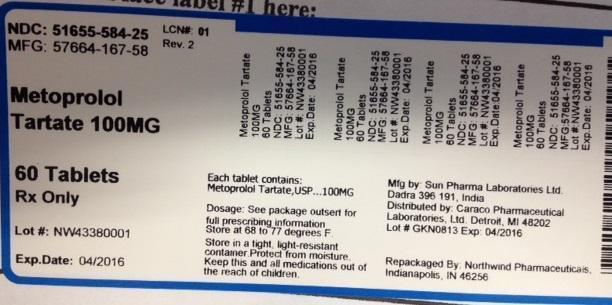
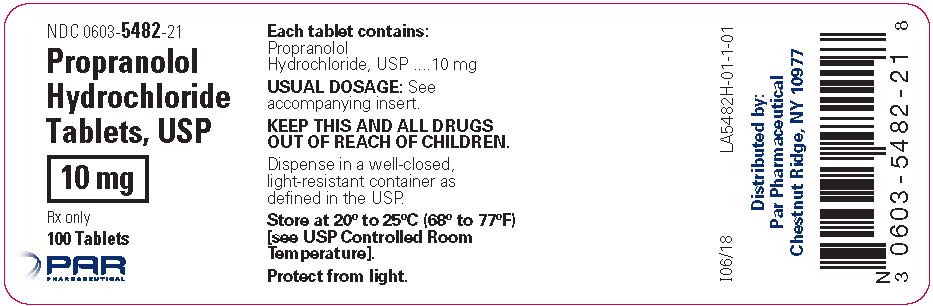
Propranolol Hydrochloride label

Propranolol Hydrochloride

Propranolol Hydrochloride Recall

Get an alert when a recall is issued.

Side Effects & Adverse Reactions

Angina Pectoris

There have been reports of exacerbation of angina and, in some cases, myocardial infarction, following abrupt discontinuance of propranolol therapy. Therefore, when discontinuance of propranolol is planned, the dosage should be gradually reduced over at least a few weeks and the patient should be cautioned against interruption or cessation of therapy without the physician’s advice. If propranolol therapy is interrupted and exacerbation of angina occurs, it usually is advisable to reinstitute propranolol therapy and take other measures appropriate for the management of angina pectoris. Since coronary artery disease may be unrecognized, it may be prudent to follow the above advice in patients considered at risk of having occult atherosclerotic heart disease who are given propranolol for other indications.

Hypersensitivity and Skin Reactions

Hypersensitivity reactions, including anaphylactic/anaphylactoid reactions, have been associated with the administration of propranolol (see ADVERSE REACTIONS).

Cutaneous reactions, including Stevens-Johnson Syndrome, toxic epidermal necrolysis, exfoliative dermatitis, erythema multiforme, and urticaria, have been reported with use of propranolol (see ADVERSE REACTIONS).

Cardiac Failure

Sympathetic stimulation may be a vital component supporting circulatory function in patients with congestive heart failure, and its inhibition by beta blockade may precipitate more severe failure. Although beta blockers should be avoided in overt congestive heart failure, some have been shown to be highly beneficial when used with close follow-up in patients with a history of failure who are well compensated and are receiving additional therapies, including diuretics as needed. Beta-adrenergic blocking agents do not abolish the inotropic action of digitalis on heart muscle.

In Patients without a History of Heart Failure, continued use of beta blockers can, in some cases, lead to cardiac failure.

Nonallergic Bronchospasm (e.g., Chronic Bronchitis, Emphysema)

In general, patients with bronchospastic lung disease should not receive beta blockers. Propranolol should be administered with caution in this setting since it may provoke a bronchial asthmatic attack by blocking bronchodilation produced by endogenous and exogenous catecholamine stimulation of beta-receptors.

Major Surgery

Chronically administered beta-blocking therapy should not be routinely withdrawn prior to major surgery, however the impaired ability of the heart to respond to reflex adrenergic stimuli may augment the risks of general anesthesia and surgical procedures.

Diabetes and Hypoglycemia

Beta-adrenergic blockade may prevent the appearance of certain premonitory signs and symptoms (pulse rate and pressure changes) of acute hypoglycemia, especially in labile insulin-dependent diabetics. In these patients, it may be more difficult to adjust the dosage of insulin.

Propranolol therapy, particularly when given to infants and children, diabetic or not, has been associated with hypoglycemia especially during fasting as in preparation for surgery. Hypoglycemia has been reported in patients taking propranolol after prolonged physical exertion and in patients with renal insufficiency.

Thyrotoxicosis

Beta-adrenergic blockade may mask certain clinical signs of hyperthyroidism. Therefore, abrupt withdrawal of propranolol may be followed by an exacerbation of symptoms of hyperthyroidism, including thyroid storm. Propranolol may change thyroid-function tests, increasing T4 and reverse T3 and decreasing T3.

Wolff-Parkinson-White Syndrome

Beta-adrenergic blockade in patients with Wolf-Parkinson-White Syndrome and tachycardia has been associated with severe bradycardia requiring treatment with a pacemaker. In one case, this result was reported after an initial dose of 5 mg propranolol.

Pheochromocytoma

Blocking only the peripheral dilator (beta) action of epinephrine with propranolol leaves its constrictor (alpha) action unopposed. In the event of hemorrhage or shock, there is a disadvantage in having both beta and alpha blockade since the combination prevents the increase in heart rate and peripheral vasoconstriction needed to maintain blood pressure.

FDA Safety Alerts

There are currently no FDA safety alerts available for this drug.

Manufacturer Warnings

There is currently no manufacturer warning information available for this drug.

FDA Labeling Changes

There are currently no FDA labeling changes available for this drug.

Uses

Hypertension

Propranolol hydrochloride tablets are indicated in the management of hypertension. It may be used alone or used in combination with other antihypertensive agents, particularly a thiazide diuretic. Propranolol hydrochloride is not indicated in the management of hypertensive emergencies.

Angina Pectoris Due to Coronary Atherosclerosis

Propranolol hydrochloride tablets are indicated to decrease angina frequency and increase exercise tolerance in patients with angina pectoris.

Atrial Fibrillation

Propranolol hydrochloride tablets are indicated to control ventricular rate in patients with atrial fibrillation and a rapid ventricular response.

Myocardial Infarction

Propranolol is indicated to reduce cardiovascular mortality in patients who have survived the acute phase of myocardial infarction and are clinically stable.

Migraine

Propranolol is indicated for the prophylaxis of common migraine headache. The efficacy of propranolol in the treatment of a migraine attack that has started has not been established, and propranolol is not indicated for such use.

Essential Tremor

Propranolol is indicated in the management of familial or hereditary essential tremor. Familial or essential tremor consists of involuntary, rhythmic, oscillatory movements, usually limited to the upper limbs. It is absent at rest, but occurs when the limb is held in a fixed posture or position against gravity and during active movement. Propranolol causes a reduction in the tremor amplitude, but not in the tremor frequency. Propranolol is not indicated for the treatment of tremor associated with Parkinsonism.

Hypertrophic Subaortic Stenosis

Propranolol improves NYHA functional class in symptomatic patients with hypertrophic subaortic stenosis.

Pheochromocytoma

Propranolol is indicated as an adjunct to alpha-adrenergic blockade to control blood pressure and reduce symptoms of catecholamine-secreting tumors.

History

There is currently no drug history available for this drug.

Other Information

Propranolol hydrochloride is a synthetic beta-adrenergic receptor blocking agent chemically described as 2-Propanol, 1-[(1-methylethyl)amino]-3-(1-naphthalenyloxy)-, hydrochloride,(±)-. Its molecular and structural formulae are:

MM1

C16H21NO2 • HCl                          M.W. 295.80

Propranolol hydrochloride is a stable, white crystalline solid which is readily soluble in water and ethanol.  Its molecular weight is 295.80.

Propranolol hydrochloride is available as 10 mg, 20 mg, 40 mg and 80 mg tablets for oral administration.

Propranolol Hydrochloride Tablets USP 10 mg, 20 mg, 40 mg, and 80 mg contain the following inactive ingredients: anhydrous lactose, colloidal silicon dioxide, croscarmellose sodium, D&C Yellow No. 10, magnesium stearate, microcrystalline cellulose and stearic acid.

Propranolol Hydrochloride Tablets USP 10 mg and 80 mg also contain FD&C Yellow No. 6.

Propranolol Hydrochloride Tablets USP 20 mg and 40 mg also contain FD&C Blue No. 1.

Propranolol Hydrochloride Manufacturers

  • Remedyrepack Inc.
    Propranolol Hydrochloride | Remedyrepack Inc.
    No Recall

    Propranolol Hydrochloride | Remedyrepack Inc.

    Propranolol Hydrochloride | Remedyrepack Inc.

    General

    Because of the variable bioavailability of propranolol, the dose should be individualized based on response.

    Hypertension

    The usual initial dosage is 40 mg propranolol hydrochloride twice daily, whether used alone or added to a diuretic. Dosage may be increased gradually until adequate blood pressure control is achieved. The usual maintenance dosage is 120 mg to 240 mg per day. In some instances a dosage of 640 mg a day may be required. The time needed for full antihypertensive response to a given dosage is variable and may range from a few days to several weeks.

    While twice-daily dosing is effective and can maintain a reduction in blood pressure throughout the day, some patients, especially when lower doses are used, may experience a modest rise in blood pressure toward the end of the 12-hour dosing interval. This can be evaluated by measuring blood pressure near the end of the dosing interval to determine whether satisfactory control is being maintained throughout the day. If control is not adequate, a larger dose, or 3-times-daily therapy may achieve better control.

    Angina Pectoris

    Total daily doses of 80 mg to 320 mg propranolol hydrochloride, when administered orally, twice a day, three times a day, or four times a day, have been shown to increase exercise tolerance and to reduce ischemic changes in the ECG. If treatment is to be discontinued, reduce dosage gradually over a period of several weeks. (See WARNINGS.)

    Atrial Fibrillation

    The recommended dose is 10 mg to 30 mg propranolol hydrochloride three or four times daily before meals and at bedtime.

    Myocardial Infarction

    In the Beta-Blocker Heart Attack Trial (BHAT), the initial dose was 40 mg t.i.d., with titration after 1 month to 60 mg to 80 mg t.i.d. as tolerated. The recommended daily dosage is 180 mg to 240 mg propranolol hydrochloride per day in divided doses. Although a t.i.d. regimen was used in the BHAT and a q.i.d. regimen in the Norwegian Multicenter Trial, there is a reasonable basis for the use of either a t.i.d. or b.i.d. regimen (see PHARMACODYNAMICS AND CLINICAL EFFECTS). The effectiveness and safety of daily dosages greater than 240 mg for prevention of cardiac mortality have not been established. However, higher dosages may be needed to effectively treat coexisting diseases such as angina or hypertension (see above).

    Migraine

    The initial dose is 80 mg propranolol hydrochloride daily in divided doses. The usual effective dose range is 160 mg to 240 mg per day. The dosage may be increased gradually to achieve optimum migraine prophylaxis. If a satisfactory response is not obtained within four to six weeks after reaching the maximum dose, propranolol therapy should be discontinued. It may be advisable to withdraw the drug gradually over a period of several weeks.

    Essential Tremor

    The initial dosage is 40 mg propranolol hydrochloride twice daily. Optimum reduction of essential tremor is usually achieved with a dose of 120 mg per day. Occasionally, it may be necessary to administer 240 mg to 320 mg per day.

    Hypertrophic Subaortic Stenosis

    The usual dosage is 20 mg to 40 mg propranolol hydrochloride three or four times daily before meals and at bedtime.

    Pheochromocytoma

    The usual dosage is 60 mg propranolol hydrochloride daily in divided doses for three days prior to surgery as adjunctive therapy to alpha-adrenergic blockade. For the management of inoperable tumors, the usual dosage is 30 mg daily in divided doses as adjunctive therapy to alpha-adrenergic blockade.


  • Lake Erie Medical Dba Quality Care Products Llc
    Propranolol Hydrochloride | Lake Erie Medical Dba Quality Care Products Llc
    No Recall

    Propranolol Hydrochloride | Lake Erie Medical Dba Quality Care Products Llc

    Propranolol Hydrochloride | Lake Erie Medical Dba Quality Care Products Llc
    General

    Propranolol Hydrochloride Extended-Release Capsules, USP, provide propranolol hydrochloride in a sustained-release capsule for administration once daily. If patients are switched from propranolol hydrochloride tablets to Propranolol Hydrochloride Extended-Release Capsules, USP, care should be taken to assure that the desired therapeutic effect is maintained. Propranolol Hydrochloride Extended-Release Capsules, USP, should not be considered a simple mg-for-mg substitute for propranolol hydrochloride tablets. Propranolol Hydrochloride Extended-Release Capsules, USP, have different kinetics and produces lower blood levels. Retitration may be necessary, especially to maintain effectiveness at the end of the 24-hour dosing interval.

    Hypertension

    The usual initial dosage is 80 mg Propranolol Hydrochloride Extended-Release Capsules, USP, once daily, whether used alone or added to a diuretic. The dosage may be increased to 120 mg once daily or higher until adequate blood pressure control is achieved. The usual maintenance dosage is 120 to 160 mg once daily. In some instances a dosage of 640 mg may be required. The time needed for full hypertensive response to a given dosage is variable and may range from a few days to several weeks.

    Angina Pectoris

    Starting with 80 mg Propranolol Hydrochloride Extended-Release Capsules, USP, once daily, dosage should be gradually increased at three- to seven-day intervals until optimal response is obtained. Although individual patients may respond at any dosage level, the average optimal dosage appears to be 160 mg once daily. In angina pectoris, the value and safety of dosage exceeding 320 mg per day have not been established.

    If treatment is to be discontinued, reduce dosage gradually over a period of a few weeks (see WARNINGS).

    Migraine

    The initial oral dose is 80 mg Propranolol Hydrochloride Extended-Release Capsules, USP, once daily. The usual effective dose range is 160 to 240 mg once daily. The dosage may be increased gradually to achieve optimal migraine prophylaxis. If a satisfactory response is not obtained within four to six weeks after reaching the maximal dose, Propranolol Hydrochloride Extended-Release Capsules, USP, therapy should be discontinued. It may be advisable to withdraw the drug gradually over a period of several weeks depending on the patient's age, comorbidity, and dose of Propranolol Hydrochloride Extended-Release Capsules, USP.

    Hypertrophic Subaortic Stenosis

    The usual dosage is 80 to 160 mg Propranolol Hydrochloride Extended-Release Capsules, USP, once daily.

  • Blenheim Pharmacal, Inc.
    Propranolol Hydrochloride | Blenheim Pharmacal, Inc.
    No Recall

    Propranolol Hydrochloride | Blenheim Pharmacal, Inc.

    Propranolol Hydrochloride | Blenheim Pharmacal, Inc.
    General

    Because of the variable bioavailability of propranolol, the dose should be individualized based on response.

    Hypertension

    The usual initial dosage is 40 mg propranolol hydrochloride twice daily, whether used alone or added to a diuretic. Dosage may be increased gradually until adequate blood pressure control is achieved. The usual maintenance dosage is 120 mg to 240 mg per day. In some instances a dosage of 640 mg a day may be required. The time needed for full antihypertensive response to a given dosage is variable and may range from a few days to several weeks.

    While twice-daily dosing is effective and can maintain a reduction in blood pressure throughout the day, some patients, especially when lower doses are used, may experience a modest rise in blood pressure toward the end of the 12-hour dosing interval. This can be evaluated by measuring blood pressure near the end of the dosing interval to determine whether satisfactory control is being maintained throughout the day. If control is not adequate, a larger dose, or 3-times-daily therapy may achieve better control.

    Angina Pectoris

    Total daily doses of 80 mg to 320 mg propranolol hydrochloride when administered orally, twice a day, three times a day, or four times a day, have been shown to increase exercise tolerance and to reduce ischemic changes in the ECG. If treatment is to be discontinued, reduce dosage gradually over a period of several weeks. (See WARNINGS)

    Atrial Fibrillation

    The recommended dose is 10 mg to 30 mg propranolol hydrochloride three or four times daily before meals and at bedtime.

    Myocardial Infarction

    In the Beta-Blocker Heart Attack Trial (BHAT), the initial dose was 40 mg t.i.d., with titration after 1- month to 60 mg to 80 mg t.i.d. as tolerated. The recommended daily dosage is 180 mg to 240 mg propranolol hydrochloride per day in divided doses. Although a t.i.d. regimen was used in BHAT and a q.i.d. regimen in the Norwegian Multicenter Trial, there is a reasonable basis for the use of either a t.i.d. or b.i.d. regimen (see PHARMACODYNAMICS AND CLINICAL EFFECTS). The effectiveness and safety of daily dosages greater than 240 mg for prevention of cardiac mortality have not been established. However, higher dosages may be needed to effectively treat coexisting diseases such as angina or hypertension (see above).

    Migraine

    The initial dose is 80 mg propranolol hydrochloride daily in divided doses. The usual effective dose range is 160 mg to 240 mg per day. The dosage may be increased gradually to achieve optimum migraine prophylaxis. If a satisfactory response is not obtained within four to six weeks after reaching the maximum dose, propranolol hydrochloride therapy should be discontinued. It may be advisable to withdraw the drug gradually over a period of several weeks.

    Essential Tremor

    The initial dosage is 40 mg propranolol hydrochloride twice daily. Optimum reduction of essential tremor is usually achieved with a dose of 120 mg per day. Occasionally, it may be necessary to administer 240 mg to 320 mg per day.

    Hypertrophic Subaortic Stenosis

    The usual dosage is 20 mg to 40 mg propranolol hydrochloride three or four times daily before meals and at bedtime.

    Pheochromocytoma

    The usual dosage is 60 mg propranolol hydrochloride daily in divided doses for three days prior to surgery as adjunctive therapy to alpha-adrenergic blockade. For the management of inoperable tumors, the usual dosage is 30 mg daily in divided doses as adjunctive therapy to alpha-adrenergic blockade.

  • Proficient Rx Lp
    Propranolol Hydrochloride | Proficient Rx Lp
    No Recall

    Propranolol Hydrochloride | Proficient Rx Lp

    Propranolol Hydrochloride | Proficient Rx Lp
    General

    Because of the variable bioavailability of propranolol, the dose should be individualized based on response.

    Hypertension

    The usual initial dosage is 40 mg propranolol hydrochloride tablets twice daily, whether used alone or added to a diuretic. Dosage may be increased gradually until adequate blood pressure control is achieved. The usual maintenance dosage is 120 mg to 240 mg per day. In some instances a dosage of 640 mg a day may be required. The time needed for full antihypertensive response to a given dosage is variable and may range from a few days to several weeks.

    While twice-daily dosing is effective and can maintain a reduction in blood pressure throughout the day, some patients, especially when lower doses are used, may experience a modest rise in blood pressure toward the end of the 12 hour dosing interval. This can be evaluated by measuring blood pressure near the end of the dosing interval to determine whether satisfactory control is being maintained throughout the day. If control is not adequate, a larger dose, or 3 times daily therapy may achieve better control.

    Angina Pectoris

    Total daily doses of 80 mg to 320 mg propranolol hydrochloride tablets, when administered orally, twice a day, three times a day, or four times a day, have been shown to increase exercise tolerance and to reduce ischemic changes in the ECG. If treatment is to be discontinued, reduce dosage gradually over a period of several weeks (see WARNINGS).

    Atrial Fibrillation

    The recommended dose is 10 mg to 30 mg propranolol hydrochloride tablets three or four times daily before meals and at bedtime.

    Myocardial Infarction

    In the Beta-Blocker Heart Attack Trial (BHAT), the initial dose was 40 mg t.i.d., with titration after 1 month to 60 mg to 80 mg t.i.d. as tolerated. The recommended daily dosage is 180 mg to 240 mg propranolol hydrochloride tablets per day in divided doses. Although a t.i.d. regimen was used in the BHAT and a q.i.d. regimen in the Norwegian Multicenter Trial, there is a reasonable basis for the use of either a t.i.d. or b.i.d. regimen (see PHARMACODYNAMICS AND CLINICAL EFFECTS). The effectiveness and safety of daily dosages greater than 240 mg for prevention of cardiac mortality have not been established. However, higher dosages may be needed to effectively treat coexisting diseases such as angina or hypertension (see above).

    Migraine

    The initial dose is 80 mg propranolol hydrochloride daily in divided doses. The usual effective dose range is 160 mg to 240 mg per day. The dosage may be increased gradually to achieve optimum migraine prophylaxis. If a satisfactory response is not obtained within four to six weeks after reaching the maximum dose, propranolol hydrochloride therapy should be discontinued. It may be advisable to withdraw the drug gradually over a period of several weeks.

    Essential Tremor

    The initial dosage is 40 mg propranolol hydrochloride tablets twice daily. Optimum reduction of essential tremor is usually achieved with a dose of 120 mg per day. Occasionally, it may be necessary to administer 240 mg to 320 mg per day.

    Hypertrophic Subaortic Stenosis

    The usual dosage is 20 mg to 40 mg propranolol hydrochloride tablets three or four times daily before meals and at bedtime.

    Pheochromocytoma

    The usual dosage is 60 mg propranolol hydrochloride daily in divided doses for three days prior to surgery as adjunctive therapy to alpha-adrenergic blockade. For the management of inoperable tumors, the usual dosage is 30 mg daily in divided doses as adjunctive therapy to alpha-adrenergic blockade.

  • Propranolol Hydrochloride | A-s Medication Solutions Llc
    No Recall

    Propranolol Hydrochloride | A-s Medication Solutions Llc

    Propranolol Hydrochloride | A-s Medication Solutions Llc
    General

    Because of the variable bioavailability of propranolol, the dose should be individualized based on response.

    Hypertension

    The usual initial dosage is 40 mg propranolol hydrochloride twice daily, whether used alone or added to a diuretic. Dosage may be increased gradually until adequate blood pressure control is achieved. The usual maintenance dosage is 120 mg to 240 mg per day. In some instances a dosage of 640 mg a day may be required. The time needed for full antihypertensive response to a given dosage is variable and may range from a few days to several weeks.

    While twice-daily dosing is effective and can maintain a reduction in blood pressure throughout the day, some patients, especially when lower doses are used, may experience a modest rise in blood pressure toward the end of the 12-hour dosing interval. This can be evaluated by measuring blood pressure near the end of the dosing interval to determine whether satisfactory control is being maintained throughout the day. If control is not adequate, a larger dose, or 3-times-daily therapy may achieve better control.

    Angina Pectoris

    Total daily doses of 80 mg to 320 mg propranolol hydrochloride when administered orally, twice a day, three times a day, or four times a day, have been shown to increase exercise tolerance and to reduce ischemic changes in the ECG. If treatment is to be discontinued, reduce dosage gradually over a period of several weeks. (See WARNINGS)

    Atrial Fibrillation

    The recommended dose is 10 mg to 30 mg propranolol hydrochloride three or four times daily before meals and at bedtime.

    Myocardial Infarction

    In the Beta-Blocker Heart Attack Trial (BHAT), the initial dose was 40 mg t.i.d., with titration after 1- month to 60 mg to 80 mg t.i.d. as tolerated. The recommended daily dosage is 180 mg to 240 mg propranolol hydrochloride per day in divided doses. Although a t.i.d. regimen was used in BHAT and a q.i.d. regimen in the Norwegian Multicenter Trial, there is a reasonable basis for the use of either a t.i.d. or b.i.d. regimen (see PHARMACODYNAMICS AND CLINICAL EFFECTS). The effectiveness and safety of daily dosages greater than 240 mg for prevention of cardiac mortality have not been established. However, higher dosages may be needed to effectively treat coexisting diseases such as angina or hypertension (see above).

    Migraine

    The initial dose is 80 mg propranolol hydrochloride daily in divided doses. The usual effective dose range is 160 mg to 240 mg per day. The dosage may be increased gradually to achieve optimum migraine prophylaxis. If a satisfactory response is not obtained within four to six weeks after reaching the maximum dose, propranolol hydrochloride therapy should be discontinued. It may be advisable to withdraw the drug gradually over a period of several weeks.

    Essential Tremor

    The initial dosage is 40 mg propranolol hydrochloride twice daily. Optimum reduction of essential tremor is usually achieved with a dose of 120 mg per day. Occasionally, it may be necessary to administer 240 mg to 320 mg per day.

    Hypertrophic Subaortic Stenosis

    The usual dosage is 20 mg to 40 mg propranolol hydrochloride three or four times daily before meals and at bedtime.

    Pheochromocytoma

    The usual dosage is 60 mg propranolol hydrochloride daily in divided doses for three days prior to surgery as adjunctive therapy to alpha-adrenergic blockade. For the management of inoperable tumors, the usual dosage is 30 mg daily in divided doses as adjunctive therapy to alpha-adrenergic blockade.

  • Propranolol Hydrochloride | A-s Medication Solutions Llc
    No Recall

    Propranolol Hydrochloride | A-s Medication Solutions Llc

    Propranolol Hydrochloride | A-s Medication Solutions Llc
    General

    Because of the variable bioavailability of propranolol, the dose should be individualized based on response.

    Hypertension

    The usual initial dosage is 40 mg propranolol hydrochloride twice daily, whether used alone or added to a diuretic. Dosage may be increased gradually until adequate blood pressure control is achieved. The usual maintenance dosage is 120 mg to 240 mg per day. In some instances a dosage of 640 mg a day may be required. The time needed for full antihypertensive response to a given dosage is variable and may range from a few days to several weeks.

    While twice-daily dosing is effective and can maintain a reduction in blood pressure throughout the day, some patients, especially when lower doses are used, may experience a modest rise in blood pressure toward the end of the 12-hour dosing interval. This can be evaluated by measuring blood pressure near the end of the dosing interval to determine whether satisfactory control is being maintained throughout the day. If control is not adequate, a larger dose, or 3‑times‑daily therapy may achieve better control.

    Angina Pectoris

    Total daily doses of 80 mg to 320 mg propranolol hydrochloride, when administered orally, twice a day, three times a day, or four times a day, have been shown to increase exercise tolerance and to reduce ischemic changes in the ECG. If treatment is to be discontinued, reduce dosage gradually over a period of several weeks. (See WARNINGS.)

    Atrial Fibrillation

    The recommended dose is 10 mg to 30 mg propranolol hydrochloride three or four times daily before meals and at bedtime.

    Myocardial Infarction

    In the Beta-Blocker Heart Attack Trial (BHAT), the initial dose was 40 mg t.i.d., with titration after 1 month to 60 mg to 80 mg t.i.d. as tolerated. The recommended daily dosage is 180 mg to 240 mg propranolol hydrochloride per day in divided doses. Although a t.i.d. regimen was used in the BHAT and a q.i.d. regimen in the Norwegian Multicenter Trial, there is a reasonable basis for the use of either a t.i.d. or b.i.d. regimen (see PHARMACODYNAMICS AND CLINICAL EFFECTS). The effectiveness and safety of daily dosages greater than 240 mg for prevention of cardiac mortality have not been established. However, higher dosages may be needed to effectively treat coexisting diseases such as angina or hypertension (see above).

    Migraine

    The initial dose is 80 mg propranolol hydrochloride daily in divided doses. The usual effective dose range is 160 mg to 240 mg per day. The dosage may be increased gradually to achieve optimum migraine prophylaxis. If a satisfactory response is not obtained within four to six weeks after reaching the maximum dose, propranolol hydrochloride therapy should be discontinued. It may be advisable to withdraw the drug gradually over a period of several weeks.

    Essential Tremor

    The initial dosage is 40 mg propranolol hydrochloride twice daily. Optimum reduction of essential tremor is usually achieved with a dose of 120 mg per day. Occasionally, it may be necessary to administer 240 mg to 320 mg per day.

    Hypertrophic Subaortic Stenosis

    The usual dosage is 20 mg to 40 mg propranolol hydrochloride three or four times daily before meals and at bedtime.

    Pheochromocytoma

    The usual dosage is 60 mg propranolol hydrochloride daily in divided doses for three days prior to surgery as adjunctive therapy to alpha-adrenergic blockade. For the management of inoperable tumors, the usual dosage is 30 mg daily in divided doses as adjunctive therapy to alpha-adrenergic blockade.

    General

    Because of the variable bioavailability of propranolol, the dose should be individualized based on response.

    Hypertension

    The usual initial dosage is 40 mg propranolol hydrochloride twice daily, whether used alone or added to a diuretic. Dosage may be increased gradually until adequate blood pressure control is achieved. The usual maintenance dosage is 120 mg to 240 mg per day. In some instances a dosage of 640 mg a day may be required. The time needed for full antihypertensive response to a given dosage is variable and may range from a few days to several weeks.

    While twice-daily dosing is effective and can maintain a reduction in blood pressure throughout the day, some patients, especially when lower doses are used, may experience a modest rise in blood pressure toward the end of the 12-hour dosing interval. This can be evaluated by measuring blood pressure near the end of the dosing interval to determine whether satisfactory control is being maintained throughout the day. If control is not adequate, a larger dose, or 3‑times‑daily therapy may achieve better control.

    Angina Pectoris

    Total daily doses of 80 mg to 320 mg propranolol hydrochloride, when administered orally, twice a day, three times a day, or four times a day, have been shown to increase exercise tolerance and to reduce ischemic changes in the ECG. If treatment is to be discontinued, reduce dosage gradually over a period of several weeks. (See WARNINGS.)

    Atrial Fibrillation

    The recommended dose is 10 mg to 30 mg propranolol hydrochloride three or four times daily before meals and at bedtime.

    Myocardial Infarction

    In the Beta-Blocker Heart Attack Trial (BHAT), the initial dose was 40 mg t.i.d., with titration after 1 month to 60 mg to 80 mg t.i.d. as tolerated. The recommended daily dosage is 180 mg to 240 mg propranolol hydrochloride per day in divided doses. Although a t.i.d. regimen was used in the BHAT and a q.i.d. regimen in the Norwegian Multicenter Trial, there is a reasonable basis for the use of either a t.i.d. or b.i.d. regimen (see PHARMACODYNAMICS AND CLINICAL EFFECTS). The effectiveness and safety of daily dosages greater than 240 mg for prevention of cardiac mortality have not been established. However, higher dosages may be needed to effectively treat coexisting diseases such as angina or hypertension (see above).

    Migraine

    The initial dose is 80 mg propranolol hydrochloride daily in divided doses. The usual effective dose range is 160 mg to 240 mg per day. The dosage may be increased gradually to achieve optimum migraine prophylaxis. If a satisfactory response is not obtained within four to six weeks after reaching the maximum dose, propranolol hydrochloride therapy should be discontinued. It may be advisable to withdraw the drug gradually over a period of several weeks.

    Essential Tremor

    The initial dosage is 40 mg propranolol hydrochloride twice daily. Optimum reduction of essential tremor is usually achieved with a dose of 120 mg per day. Occasionally, it may be necessary to administer 240 mg to 320 mg per day.

    Hypertrophic Subaortic Stenosis

    The usual dosage is 20 mg to 40 mg propranolol hydrochloride three or four times daily before meals and at bedtime.

    Pheochromocytoma

    The usual dosage is 60 mg propranolol hydrochloride daily in divided doses for three days prior to surgery as adjunctive therapy to alpha-adrenergic blockade. For the management of inoperable tumors, the usual dosage is 30 mg daily in divided doses as adjunctive therapy to alpha-adrenergic blockade.

  • Direct Rx
    Propranolol Hydrochloride | Direct Rx
    No Recall

    Propranolol Hydrochloride | Direct Rx

    Propranolol Hydrochloride | Direct Rx

    General

    Because of the variable bioavailability of propranolol, the dose should be individualized based on response.

    Hypertension

    The usual initial dosage is 40 mg propranolol hydrochloride twice daily, whether used alone or added to a diuretic. Dosage may be increased gradually until adequate blood pressure control is achieved. The usual maintenance dosage is 120 mg to 240 mg per day. In some instances a dosage of 640 mg a day may be required. The time needed for full antihypertensive response to a given dosage is variable and may range from a few days to several weeks.

    While twice-daily dosing is effective and can maintain a reduction in blood pressure throughout the day, some patients, especially when lower doses are used, may experience a modest rise in blood pressure toward the end of the 12-hour dosing interval. This can be evaluated by measuring blood pressure near the end of the dosing interval to determine whether satisfactory control is being maintained throughout the day. If control is not adequate, a larger dose, or 3-times-daily therapy may achieve better control.

    Angina Pectoris

    Total daily doses of 80 mg to 320 mg propranolol hydrochloride when administered orally, twice a day, three times a day, or four times a day, have been shown to increase exercise tolerance and to reduce ischemic changes in the ECG. If treatment is to be discontinued, reduce dosage gradually over a period of several weeks. (See WARNINGS)

    Atrial Fibrillation

    The recommended dose is 10 mg to 30 mg propranolol hydrochloride three or four times daily before meals and at bedtime.

    Myocardial Infarction

    In the Beta-Blocker Heart Attack Trial (BHAT), the initial dose was 40 mg t.i.d., with titration after 1- month to 60 mg to 80 mg t.i.d. as tolerated. The recommended daily dosage is 180 mg to 240 mg propranolol hydrochloride per day in divided doses. Although a t.i.d. regimen was used in BHAT and a q.i.d. regimen in the Norwegian Multicenter Trial, there is a reasonable basis for the use of either a t.i.d. or b.i.d. regimen (see PHARMACODYNAMICS AND CLINICAL EFFECTS). The effectiveness and safety of daily dosages greater than 240 mg for prevention of cardiac mortality have not been established. However, higher dosages may be needed to effectively treat coexisting diseases such as angina or hypertension (see above).

    Migraine

    The initial dose is 80 mg propranolol hydrochloride daily in divided doses. The usual effective dose range is 160 mg to 240 mg per day. The dosage may be increased gradually to achieve optimum migraine prophylaxis. If a satisfactory response is not obtained within four to six weeks after reaching the maximum dose, propranolol hydrochloride therapy should be discontinued. It may be advisable to withdraw the drug gradually over a period of several weeks.

    Essential Tremor

    The initial dosage is 40 mg propranolol hydrochloride twice daily. Optimum reduction of essential tremor is usually achieved with a dose of 120 mg per day. Occasionally, it may be necessary to administer 240 mg to 320 mg per day.

    Hypertrophic Subaortic Stenosis

    The usual dosage is 20 mg to 40 mg propranolol hydrochloride three or four times daily before meals and at bedtime.

    Pheochromocytoma

    The usual dosage is 60 mg propranolol hydrochloride daily in divided doses for three days prior to surgery as adjunctive therapy to alpha-adrenergic blockade. For the management of inoperable tumors, the usual dosage is 30 mg daily in divided doses as adjunctive therapy to alpha-adrenergic blockade.

  • Propranolol Hydrochloride | Cardinal Health
    No Recall

    Propranolol Hydrochloride | Cardinal Health

    Propranolol Hydrochloride | Cardinal Health
    General

    Because of the variable bioavailability of propranolol, the dose should be individualized based on response.

    Hypertension

    The usual initial dosage is 40 mg propranolol hydrochloride twice daily, whether used alone or added to a diuretic. Dosage may be increased gradually until adequate blood pressure control is achieved. The usual maintenance dosage is 120 mg to 240 mg per day. In some instances a dosage of 640 mg a day may be required. The time needed for full antihypertensive response to a given dosage is variable and may range from a few days to several weeks.

    While twice-daily dosing is effective and can maintain a reduction in blood pressure throughout the day, some patients, especially when lower doses are used, may experience a modest rise in blood pressure toward the end of the 12-hour dosing interval. This can be evaluated by measuring blood pressure near the end of the dosing interval to determine whether satisfactory control is being maintained throughout the day. If control is not adequate, a larger dose, or 3-times-daily therapy may achieve better control.

    Angina Pectoris

    Total daily doses of 80 mg to 320 mg propranolol hydrochloride when administered orally, twice a day, three times a day, or four times a day, have been shown to increase exercise tolerance and to reduce ischemic changes in the ECG. If treatment is to be discontinued, reduce dosage gradually over a period of several weeks. (See WARNINGS)

    Atrial Fibrillation

    The recommended dose is 10 mg to 30 mg propranolol hydrochloride three or four times daily before meals and at bedtime.

    Myocardial Infarction

    In the Beta-Blocker Heart Attack Trial (BHAT), the initial dose was 40 mg t.i.d., with titration after 1- month to 60 mg to 80 mg t.i.d. as tolerated. The recommended daily dosage is 180 mg to 240 mg propranolol hydrochloride per day in divided doses. Although a t.i.d. regimen was used in BHAT and a q.i.d. regimen in the Norwegian Multicenter Trial, there is a reasonable basis for the use of either a t.i.d. or b.i.d. regimen (see PHARMACODYNAMICS AND CLINICAL EFFECTS). The effectiveness and safety of daily dosages greater than 240 mg for prevention of cardiac mortality have not been established. However, higher dosages may be needed to effectively treat coexisting diseases such as angina or hypertension (see above).

    Migraine

    The initial dose is 80 mg propranolol hydrochloride daily in divided doses. The usual effective dose range is 160 mg to 240 mg per day. The dosage may be increased gradually to achieve optimum migraine prophylaxis. If a satisfactory response is not obtained within four to six weeks after reaching the maximum dose, propranolol hydrochloride therapy should be discontinued. It may be advisable to withdraw the drug gradually over a period of several weeks.

    Essential Tremor

    The initial dosage is 40 mg propranolol hydrochloride twice daily. Optimum reduction of essential tremor is usually achieved with a dose of 120 mg per day. Occasionally, it may be necessary to administer 240 mg to 320 mg per day.

    Hypertrophic Subaortic Stenosis

    The usual dosage is 20 mg to 40 mg propranolol hydrochloride three or four times daily before meals and at bedtime.

    Pheochromocytoma

    The usual dosage is 60 mg propranolol hydrochloride daily in divided doses for three days prior to surgery as adjunctive therapy to alpha-adrenergic blockade. For the management of inoperable tumors, the usual dosage is 30 mg daily in divided doses as adjunctive therapy to alpha-adrenergic blockade.

  • Tya Pharmaceuticals
    Propranolol Hydrochloride | Tya Pharmaceuticals
    No Recall

    Propranolol Hydrochloride | Tya Pharmaceuticals

    Propranolol Hydrochloride | Tya Pharmaceuticals
    General

    Because of the variable bioavailability of propranolol, the dose should be individualized based on response.

    Hypertension

    The usual initial dosage is 40 mg propranolol hydrochloride twice daily, whether used alone or added to a diuretic. Dosage may be increased gradually until adequate blood pressure control is achieved. The usual maintenance dosage is 120 mg to 240 mg per day. In some instances a dosage of 640 mg a day may be required. The time needed for full antihypertensive response to a given dosage is variable and may range from a few days to several weeks.

    While twice-daily dosing is effective and can maintain a reduction in blood pressure throughout the day, some patients, especially when lower doses are used, may experience a modest rise in blood pressure toward the end of the 12-hour dosing interval. This can be evaluated by measuring blood pressure near the end of the dosing interval to determine whether satisfactory control is being maintained throughout the day. If control is not adequate, a larger dose, or 3-times-daily therapy may achieve better control.

    Angina Pectoris

    Total daily doses of 80 mg to 320 mg propranolol hydrochloride when administered orally, twice a day, three times a day, or four times a day, have been shown to increase exercise tolerance and to reduce ischemic changes in the ECG. If treatment is to be discontinued, reduce dosage gradually over a period of several weeks. (See ) WARNINGS

    Atrial Fibrillation

    The recommended dose is 10 mg to 30 mg propranolol hydrochloride three or four times daily before meals and at bedtime.

    Myocardial Infarction

    In the Beta-Blocker Heart Attack Trial (BHAT), the initial dose was 40 mg t.i.d., with titration after 1- month to 60 mg to 80 mg t.i.d. as tolerated. The recommended daily dosage is 180 mg to 240 mg propranolol hydrochloride per day in divided doses. Although a t.i.d. regimen was used in BHAT and a q.i.d. regimen in the Norwegian Multicenter Trial, there is a reasonable basis for the use of either a t.i.d. or b.i.d. regimen (see The effectiveness and safety of daily dosages greater than 240 mg for prevention of cardiac mortality have not been established. However, higher dosages may be needed to effectively treat coexisting diseases such as angina or hypertension (see above). ). PHARMACODYNAMICS AND CLINICAL EFFECTS

    Migraine

    The initial dose is 80 mg propranolol hydrochloride daily in divided doses. The usual effective dose range is 160 mg to 240 mg per day. The dosage may be increased gradually to achieve optimum migraine prophylaxis. If a satisfactory response is not obtained within four to six weeks after reaching the maximum dose, propranolol hydrochloride therapy should be discontinued. It may be advisable to withdraw the drug gradually over a period of several weeks.

    Essential Tremor

    The initial dosage is 40 mg propranolol hydrochloride twice daily. Optimum reduction of essential tremor is usually achieved with a dose of 120 mg per day. Occasionally, it may be necessary to administer 240 mg to 320 mg per day.

    Hypertrophic Subaortic Stenosis

    The usual dosage is 20 mg to 40 mg propranolol hydrochloride three or four times daily before meals and at bedtime.

    Pheochromocytoma

    The usual dosage is 60 mg propranolol hydrochloride daily in divided doses for three days prior to surgery as adjunctive therapy to alpha-adrenergic blockade. For the management of inoperable tumors, the usual dosage is 30 mg daily in divided doses as adjunctive therapy to alpha-adrenergic blockade.

  • Baxter Healthcare Corporation
    Propranolol Hydrochloride | Baxter Healthcare Corporation
    No Recall

    Propranolol Hydrochloride | Baxter Healthcare Corporation

    Propranolol Hydrochloride | Baxter Healthcare Corporation

    Parenteral drug products should be inspected visually for particulate matter and discoloration prior to administration, whenever solution and container permit.

    The usual dose is 1 to 3 mg administered under careful monitoring, such as electrocardiography and central venous pressure. The rate of administration should not exceed 1 mg (1 mL) per minute to diminish the possibility of lowering blood pressure and causing cardiac standstill. Sufficient time should be allowed for the drug to reach the site of action even when a slow circulation is present. If necessary, a second dose may be given after two minutes. Thereafter, additional drug should not be given in less than four hours. Additional propranolol hydrochloride should not be given when the desired alteration in rate or rhythm is achieved.

    Transfer to oral therapy as soon as possible.

  • Physicians Total Care, Inc.
    Propranolol Hydrochloride | Physicians Total Care, Inc.
    No Recall

    Propranolol Hydrochloride | Physicians Total Care, Inc.

    Propranolol Hydrochloride | Physicians Total Care, Inc.
    General

    Because of the variable bioavailability of propranolol the dose should be individualized based on response.

    Hypertension

    The usual initial dosage is 40 mg propranolol hydrochloride twice daily, whether used alone or added to a diuretic. Dosage may be increased gradually until adequate blood pressure control is achieved. The usual maintenance dosage is 120 mg to 240 mg per day. In some instances a dosage of 640 mg a day may be required. The time needed for full antihypertensive response to a given dosage is variable and may range from a few days to several weeks.

    While twice-daily dosing is effective and can maintain a reduction in blood pressure throughout the day, some patients, especially when lower doses are used, may experience a modest rise in blood pressure toward the end of the 12-hour dosing interval. This can be evaluated by measuring blood pressure near the end of the dosing interval to determine whether satisfactory control is being maintained throughout the day. If control is not adequate, a larger dose, or 3-times-daily therapy may achieve better control.

    Angina Pectoris

    Total daily doses of 80 mg to 320 mg propranolol hydrochloride when administered orally, twice a day, three times a day, or four times a day, have been shown to increase exercise tolerance and to reduce ischemic changes in the ECG. If treatment is to be discontinued, reduce dosage gradually over a period of several weeks. (See WARNINGS)

    Atrial Fibrillation

    The recommended dose is 10 mg to 30 mg propranolol hydrochloride three or four times daily before meals and at bedtime.

    Myocardial Infarction

    In the Beta-Blocker Heart Attack Trial (BHAT), the initial dose was 40 mg t.i.d., with titration after 1- month to 60 mg to 80 mg t.i.d. as tolerated. The recommended daily dosage is 180 mg to 240 mg propranolol hydrochloride per day in divided doses. Although a t.i.d. regimen was used in BHAT and a q.i.d. regimen in the Norwegian Multicenter Trial, there is a reasonable basis for the use of either a t.i.d. or b.i.d. regimen (see PHARMACODYNAMICS AND CLINICAL EFFECTS). The effectiveness and safety of daily dosages greater than 240 mg for prevention of cardiac mortality have not been established. However, higher dosages may be needed to effectively treat coexisting diseases such as angina or hypertension (see above).

    Migraine

    The initial dose is 80 mg propranolol hydrochloride daily in divided doses. The usual effective dose range is 160 mg to 240 mg per day. The dosage may be increased gradually to achieve optimum migraine prophylaxis. If a satisfactory response is not obtained within four to six weeks after reaching the maximum dose, propranolol hydrochloride therapy should be discontinued. It may be advisable to withdraw the drug gradually over a period of several weeks.

    Essential Tremor

    The initial dosage is 40 mg propranolol hydrochloride twice daily. Optimum reduction of essential tremor is usually achieved with a dose of 120 mg per day. Occasionally, it may be necessary to administer 240 mg to 320 mg per day.

    Hypertrophic Subaortic Stenosis

    The usual dosage is 20 mg to 40 mg propranolol hydrochloride three or four times daily before meals and at bedtime.

    Pheochromocytoma

    The usual dosage is 60 mg propranolol hydrochloride daily in divided doses for three days prior to surgery as adjunctive therapy to alpha-adrenergic blockade. For the management of inoperable tumors, the usual dosage is 30 mg daily in divided doses as adjunctive therapy to alpha-adrenergic blockade.

  • State Of Florida Doh Central Pharmacy
    Propranolol Hydrochloride | State Of Florida Doh Central Pharmacy
    No Recall

    Propranolol Hydrochloride | State Of Florida Doh Central Pharmacy

    Propranolol Hydrochloride | State Of Florida Doh Central Pharmacy
    General

    Because of the variable bioavailability of propranolol the dose should be individualized based on response.

    Hypertension

    The usual initial dosage is 40 mg propranolol hydrochloride twice daily, whether used alone or added to a diuretic. Dosage may be increased gradually until adequate blood pressure control is achieved. The usual maintenance dosage is 120 mg to 240 mg per day. In some instances a dosage of 640 mg a day may be required. The time needed for full antihypertensive response to a given dosage is variable and may range from a few days to several weeks.

    While twice-daily dosing is effective and can maintain a reduction in blood pressure throughout the day, some patients, especially when lower doses are used, may experience a modest rise in blood pressure toward the end of the 12-hour dosing interval. This can be evaluated by measuring blood pressure near the end of the dosing interval to determine whether satisfactory control is being maintained throughout the day. If control is not adequate, a larger dose, or 3-times-daily therapy may achieve better control.

    Angina Pectoris

    Total daily doses of 80 mg to 320 mg propranolol hydrochloride when administered orally, twice a day, three times a day, or four times a day, have been shown to increase exercise tolerance and to reduce ischemic changes in the ECG. If treatment is to be discontinued, reduce dosage gradually over a period of several weeks. (See WARNINGS)

    Atrial Fibrillation

    The recommended dose is 10 mg to 30 mg propranolol hydrochloride three or four times daily before meals and at bedtime.

    Myocardial Infarction

    In the Beta-Blocker Heart Attack Trial (BHAT), the initial dose was 40 mg t.i.d., with titration after 1- month to 60 mg to 80 mg t.i.d. as tolerated. The recommended daily dosage is 180 mg to 240 mg propranolol hydrochloride per day in divided doses. Although a t.i.d. regimen was used in BHAT and a q.i.d. regimen in the Norwegian Multicenter Trial, there is a reasonable basis for the use of either a t.i.d. or b.i.d. regimen (see PHARMACODYNAMICS AND CLINICAL EFFECTS). The effectiveness and safety of daily dosages greater than 240 mg for prevention of cardiac mortality have not been established. However, higher dosages may be needed to effectively treat coexisting diseases such as angina or hypertension (see above).

    Migraine

    The initial dose is 80 mg propranolol hydrochloride daily in divided doses. The usual effective dose range is 160 mg to 240 mg per day. The dosage may be increased gradually to achieve optimum migraine prophylaxis. If a satisfactory response is not obtained within four to six weeks after reaching the maximum dose, propranolol hydrochloride therapy should be discontinued. It may be advisable to withdraw the drug gradually over a period of several weeks.

    Essential Tremor

    The initial dosage is 40 mg propranolol hydrochloride twice daily. Optimum reduction of essential tremor is usually achieved with a dose of 120 mg per day. Occasionally, it may be necessary to administer 240 mg to 320 mg per day.

    Hypertrophic Subaortic Stenosis

    The usual dosage is 20 mg to 40 mg propranolol hydrochloride three or four times daily before meals and at bedtime.

    Pheochromocytoma

    The usual dosage is 60 mg propranolol hydrochloride daily in divided doses for three days prior to surgery as adjunctive therapy to alpha-adrenergic blockade. For the management of inoperable tumors, the usual dosage is 30 mg daily in divided doses as adjunctive therapy to alpha-adrenergic blockade.

  • State Of Florida Doh Central Pharmacy
    Propranolol Hydrochloride | State Of Florida Doh Central Pharmacy
    No Recall

    Propranolol Hydrochloride | State Of Florida Doh Central Pharmacy

    Propranolol Hydrochloride | State Of Florida Doh Central Pharmacy

    General

    Because of the variable bioavailability of propranolol, the dose should be individualized based on response.

    Hypertension

    The usual initial dosage is 40 mg propranolol hydrochloride twice daily, whether used alone or added to a diuretic. Dosage may be increased gradually until adequate blood pressure control is achieved. The usual maintenance dosage is 120 mg to 240 mg per day. In some instances a dosage of 640 mg a day may be required. The time needed for full antihypertensive response to a given dosage is variable and may range from a few days to several weeks.

    While twice-daily dosing is effective and can maintain a reduction in blood pressure throughout the day, some patients, especially when lower doses are used, may experience a modest rise in blood pressure toward the end of the 12-hour dosing interval. This can be evaluated by measuring blood pressure near the end of the dosing interval to determine whether satisfactory control is being maintained throughout the day. If control is not adequate, a larger dose, or 3-times-daily therapy may achieve better control.

    Angina Pectoris

    Total daily doses of 80 mg to 320 mg propranolol hydrochloride, when administered orally, twice a day, three times a day, or four times a day, have been shown to increase exercise tolerance and to reduce ischemic changes in the ECG. If treatment is to be discontinued, reduce dosage gradually over a period of several weeks. (See WARNINGS.)

    Atrial Fibrillation

    The recommended dose is 10 mg to 30 mg propranolol hydrochloride three or four times daily before meals and at bedtime.

    Myocardial Infarction

    In the Beta-Blocker Heart Attack Trial (BHAT), the initial dose was 40 mg t.i.d., with titration after 1 month to 60 mg to 80 mg t.i.d. as tolerated. The recommended daily dosage is 180 mg to 240 mg propranolol hydrochloride per day in divided doses. Although a t.i.d. regimen was used in BHAT and a q.i.d. regimen in the Norwegian Multicenter Trial, there is a reasonable basis for the use of either a t.i.d. or b.i.d. regimen (see PHARMACOKINETICS AND DRUG METABOLISM). The effectiveness and safety of daily dosages greater than 240 mg for prevention of cardiac mortality have not been established. However, higher dosages may be needed to effectively treat coexisting diseases such as angina or hypertension (see above).

    Migraine

    The initial dose is 80 mg propranolol hydrochloride daily in divided doses. The usual effective dose range is 160 mg to 240 mg per day. The dosage may be increased gradually to achieve optimum migraine prophylaxis. If a satisfactory response is not obtained within four to six weeks after reaching the maximum dose, propranolol therapy should be discontinued. It may be advisable to withdraw the drug gradually over a period of several weeks.

    Essential Tremor

    The initial dosage is 40 mg propranolol hydrochloride twice daily. Optimum reduction of essential tremor is usually achieved with a dose of 120 mg per day. Occasionally, it may be necessary to administer 240 mg to 320 mg per day.

    Hypertrophic Subaortic Stenosis

    The usual dosage is 20 mg to 40 mg propranolol hydrochloride three or four times daily before meals and at bedtime.

    Pheochromocytoma

    The usual dosage is 60 mg propranolol hydrochloride daily in divided doses for three days prior to surgery as adjunctive therapy to alpha-adrenergic blockade. For the management of inoperable tumors, the usual dosage is 30 mg daily in divided doses as adjunctive therapy to alpha-adrenergic blockade.

  • State Of Florida Doh Central Pharmacy
    Propranolol Hydrochloride | State Of Florida Doh Central Pharmacy
    No Recall

    Propranolol Hydrochloride | State Of Florida Doh Central Pharmacy

    Propranolol Hydrochloride | State Of Florida Doh Central Pharmacy
    General

    Because of the variable bioavailability of propranolol the dose should be individualized based on response.

    Hypertension

    The usual initial dosage is 40 mg propranolol hydrochloride twice daily, whether used alone or added to a diuretic. Dosage may be increased gradually until adequate blood pressure control is achieved. The usual maintenance dosage is 120 mg to 240 mg per day. In some instances a dosage of 640 mg a day may be required. The time needed for full antihypertensive response to a given dosage is variable and may range from a few days to several weeks.

    While twice-daily dosing is effective and can maintain a reduction in blood pressure throughout the day, some patients, especially when lower doses are used, may experience a modest rise in blood pressure toward the end of the 12-hour dosing interval. This can be evaluated by measuring blood pressure near the end of the dosing interval to determine whether satisfactory control is being maintained throughout the day. If control is not adequate, a larger dose, or 3-times-daily therapy may achieve better control.

    Angina Pectoris

    Total daily doses of 80 mg to 320 mg propranolol hydrochloride when administered orally, twice a day, three times a day, or four times a day, have been shown to increase exercise tolerance and to reduce ischemic changes in the ECG. If treatment is to be discontinued, reduce dosage gradually over a period of several weeks. (See WARNINGS)

    Atrial Fibrillation

    The recommended dose is 10 mg to 30 mg propranolol hydrochloride three or four times daily before meals and at bedtime.

    Myocardial Infarction

    In the Beta-Blocker Heart Attack Trial (BHAT), the initial dose was 40 mg t.i.d., with titration after 1- month to 60 mg to 80 mg t.i.d. as tolerated. The recommended daily dosage is 180 mg to 240 mg propranolol hydrochloride per day in divided doses. Although a t.i.d. regimen was used in BHAT and a q.i.d. regimen in the Norwegian Multicenter Trial, there is a reasonable basis for the use of either a t.i.d. or b.i.d. regimen (see PHARMACODYNAMICS AND CLINICAL EFFECTS). The effectiveness and safety of daily dosages greater than 240 mg for prevention of cardiac mortality have not been established. However, higher dosages may be needed to effectively treat coexisting diseases such as angina or hypertension (see above).

    Migraine

    The initial dose is 80 mg propranolol hydrochloride daily in divided doses. The usual effective dose range is 160 mg to 240 mg per day. The dosage may be increased gradually to achieve optimum migraine prophylaxis. If a satisfactory response is not obtained within four to six weeks after reaching the maximum dose, propranolol hydrochloride therapy should be discontinued. It may be advisable to withdraw the drug gradually over a period of several weeks.

    Essential Tremor

    The initial dosage is 40 mg propranolol hydrochloride twice daily. Optimum reduction of essential tremor is usually achieved with a dose of 120 mg per day. Occasionally, it may be necessary to administer 240 mg to 320 mg per day.

    Hypertrophic Subaortic Stenosis

    The usual dosage is 20 mg to 40 mg propranolol hydrochloride three or four times daily before meals and at bedtime.

    Pheochromocytoma

    The usual dosage is 60 mg propranolol hydrochloride daily in divided doses for three days prior to surgery as adjunctive therapy to alpha-adrenergic blockade. For the management of inoperable tumors, the usual dosage is 30 mg daily in divided doses as adjunctive therapy to alpha-adrenergic blockade.

  • General Injectables & Vaccines, Inc
    Propranolol Hydrochloride | General Injectables & Vaccines, Inc
    No Recall

    Propranolol Hydrochloride | General Injectables & Vaccines, Inc

    Propranolol Hydrochloride | General Injectables & Vaccines, Inc

    The usual dose is 1 to 3 mg administered under careful monitoring, such as electrocardiography and central venous pressure. The rate of administration should not exceed 1 mg (1 mL) per minute to diminish the possibility of lowering blood pressure and causing cardiac standstill. Sufficient time should be allowed for the drug to reach the site of action even when a slow circulation is present. If necessary, a second dose may be given after two minutes. Thereafter, additional drug should not be given in less than four hours. Additional propranolol should not be given when the desired alteration in rate or rhythm is achieved. Transfer to oral therapy as soon as possible. Parenteral drug products should be inspected visually for particulate matter and discoloration prior to administration, whenever solution and container permit.

  • Propranolol Hydrochloride | Rebel Distributors Corp
    No Recall

    Propranolol Hydrochloride | Rebel Distributors Corp

    Propranolol Hydrochloride | Rebel Distributors Corp

    General

    Because of the variable bioavailability of propranolol, the dose should be individualized based on response.

    Hypertension

    The usual initial dosage is 40 mg propranolol hydrochloride twice daily, whether used alone or added to a diuretic. Dosage may be increased gradually until adequate blood pressure control is achieved. The usual maintenance dosage is 120 mg to 240 mg per day. In some instances a dosage of 640 mg a day may be required. The time needed for full antihypertensive response to a given dosage is variable and may range from a few days to several weeks.

    While twice-daily dosing is effective and can maintain a reduction in blood pressure throughout the day, some patients, especially when lower doses are used, may experience a modest rise in blood pressure toward the end of the 12-hour dosing interval. This can be evaluated by measuring blood pressure near the end of the dosing interval to determine whether satisfactory control is being maintained throughout the day. If control is not adequate, a larger dose, or 3-times-daily therapy may achieve better control.

    Angina Pectoris

    Total daily doses of 80 mg to 320 mg propranolol hydrochloride, when administered orally, twice a day, three times a day, or four times a day, have been shown to increase exercise tolerance and to reduce ischemic changes in the ECG. If treatment is to be discontinued, reduce dosage gradually over a period of several weeks. (See WARNINGS.)

    Atrial Fibrillation

    The recommended dose is 10 mg to 30 mg propranolol hydrochloride three or four times daily before meals and at bedtime.

    Myocardial Infarction

    In the Beta-Blocker Heart Attack Trial (BHAT), the initial dose was 40 mg t.i.d., with titration after 1 month to 60 mg to 80 mg t.i.d. as tolerated. The recommended daily dosage is 180 mg to 240 mg propranolol hydrochloride per day in divided doses. Although a t.i.d. regimen was used in BHAT and a q.i.d. regimen in the Norwegian Multicenter Trial, there is a reasonable basis for the use of either a t.i.d. or b.i.d. regimen (see PHARMACOKINETICS AND DRUG METABOLISM). The effectiveness and safety of daily dosages greater than 240 mg for prevention of cardiac mortality have not been established. However, higher dosages may be needed to effectively treat coexisting diseases such as angina or hypertension (see above).

    Migraine

    The initial dose is 80 mg propranolol hydrochloride daily in divided doses. The usual effective dose range is 160 mg to 240 mg per day. The dosage may be increased gradually to achieve optimum migraine prophylaxis. If a satisfactory response is not obtained within four to six weeks after reaching the maximum dose, propranolol therapy should be discontinued. It may be advisable to withdraw the drug gradually over a period of several weeks.

    Essential Tremor

    The initial dosage is 40 mg propranolol hydrochloride twice daily. Optimum reduction of essential tremor is usually achieved with a dose of 120 mg per day. Occasionally, it may be necessary to administer 240 mg to 320 mg per day.

    Hypertrophic Subaortic Stenosis

    The usual dosage is 20 mg to 40 mg propranolol hydrochloride three or four times daily before meals and at bedtime.

    Pheochromocytoma

    The usual dosage is 60 mg propranolol hydrochloride daily in divided doses for three days prior to surgery as adjunctive therapy to alpha-adrenergic blockade. For the management of inoperable tumors, the usual dosage is 30 mg daily in divided doses as adjunctive therapy to alpha-adrenergic blockade.

  • Remedyrepack Inc.
    Propranolol Hydrochloride | Remedyrepack Inc.
    No Recall

    Propranolol Hydrochloride | Remedyrepack Inc.

    Propranolol Hydrochloride | Remedyrepack Inc.
    General
    Because of the variable bioavailability of propranolol, the dose should be individualized based on response.

    Hypertension
    The usual initial dosage is 40 mg propranolol twice daily, whether used alone or added to a diuretic. Dosage may be increased gradually until adequate blood pressure control is achieved. The usual maintenance dosage is 120 mg to 240 mg per day. In some instances a dosage of 640 mg a day may be required. The time needed for full antihypertensive response to a given dosage is variable and may range from a few days to several weeks.
    While twice daily dosing is effective and can maintain a reduction in blood pressure throughout the day, some patients, especially when lower doses are used, may experience a modest rise in blood pressure toward the end of the 12 hour dosing interval. This can be evaluated by measuring blood pressure near the end of the dosing interval to determine whether satisfactory control is being maintained throughout the day. If control is not adequate, a larger dose, or 3 times daily therapy may achieve better control.

    Angina Pectoris
    Total daily doses of 80 mg to 320 mg propranolol, when administered orally, twice a day, three times a day, or four times a day, have been shown to increase exercise tolerance and to reduce ischemic changes in the ECG. If treatment is to be discontinued, reduce dosage gradually over a period of several weeks (see WARNINGS).

    Atrial Fibrillation
    The recommended dose is 10 mg to 30 mg propranolol three or four times daily before meals and at bedtime.

    Myocardial Infarction
    In the Beta-Blocker Heart Attack Trial (BHAT), the initial dose was 40 mg t.i.d., with titration after 1 month to 60 mg to 80 mg t.i.d. as tolerated. The recommended daily dosage is 180 mg to 240 mg propranolol per day in divided doses. Although a t.i.d. regimen was used in the BHAT and a q.i.d. regimen in the Norwegian Multicenter Trial, there is a reasonable basis for the use of either a t.i.d. or b.i.d. regimen (see PHARMACODYNAMICS AND CLINICAL EFFECTS). The effectiveness and safety of daily dosages greater than 240 mg for prevention of cardiac mortality have not been established. However, higher dosages may be needed to effectively treat coexisting diseases such as angina or hypertension (see above).

    Migraine
    The initial dose is 80 mg propranolol daily in divided doses. The usual effective dose range is 160 mg to 240 mg per day. The dosage may be increased gradually to achieve optimum migraine prophylaxis. If a satisfactory response is not obtained within four to six weeks after reaching the maximum dose, propranolol therapy should be discontinued. It may be advisable to withdraw the drug gradually over a period of several weeks.

    Essential Tremor
    The initial dosage is 40 mg propranolol twice daily. Optimum reduction of essential tremor is usually achieved with a dose of 120 mg per day. Occasionally, it may be necessary to administer 240 mg to 320 mg per day.

    Hypertrophic Subaortic Stenosis
    The usual dosage is 20 mg to 40 mg propranolol three or four times daily before meals and at bedtime.

    Pheochromocytoma
    The usual dosage is 60 mg propranolol daily in divided doses for three days prior to surgery as adjunctive therapy to alpha-adrenergic blockade. For the management of inoperable tumors, the usual dosage is 30 mg daily in divided doses as adjunctive therapy to alpha-adrenergic blockade.

  • Remedyrepack Inc.
    Propranolol Hydrochloride | Remedyrepack Inc.
    No Recall

    Propranolol Hydrochloride | Remedyrepack Inc.

    Propranolol Hydrochloride | Remedyrepack Inc.
    General
    Because of the variable bioavailability of propranolol the dose should be individualized based on response.

    Hypertension
    The usual initial dosage is 40 mg propranolol hydrochloride twice daily, whether used alone or added to a diuretic. Dosage may be increased gradually until adequate blood pressure control is achieved. The usual maintenance dosage is 120 mg to 240 mg per day. In some instances a dosage of 640 mg a day may be required. The time needed for full antihypertensive response to a given dosage is variable and may range from a few days to several weeks.
    While twice-daily dosing is effective and can maintain a reduction in blood pressure throughout the day, some patients, especially when lower doses are used, may experience a modest rise in blood pressure toward the end of the 12-hour dosing interval. This can be evaluated by measuring blood pressure near the end of the dosing interval to determine whether satisfactory control is being maintained throughout the day. If control is not adequate, a larger dose, or 3-times-daily therapy may achieve better control.

    Angina Pectoris
    Total daily doses of 80 mg to 320 mg propranolol hydrochloride when administered orally, twice a day, three times a day, or four times a day, have been shown to increase exercise tolerance and to reduce ischemic changes in the ECG. If treatment is to be discontinued, reduce dosage gradually over a period of several weeks. (See WARNINGS)

    Atrial Fibrillation
    The recommended dose is 10 mg to 30 mg propranolol hydrochloride three or four times daily before meals and at bedtime.

    Myocardial Infarction
    In the Beta-Blocker Heart Attack Trial (BHAT), the initial dose was 40 mg t.i.d., with titration after 1- month to 60 mg to 80 mg t.i.d. as tolerated. The recommended daily dosage is 180 mg to 240 mg propranolol hydrochloride per day in divided doses. Although a t.i.d. regimen was used in BHAT and a q.i.d. regimen in the Norwegian Multicenter Trial, there is a reasonable basis for the use of either a t.i.d. or b.i.d. regimen (see PHARMACODYNAMICS AND CLINICAL EFFECTS). The effectiveness and safety of daily dosages greater than 240 mg for prevention of cardiac mortality have not been established. However, higher dosages may be needed to effectively treat coexisting diseases such as angina or hypertension (see above).

    Migraine
    The initial dose is 80 mg propranolol hydrochloride daily in divided doses. The usual effective dose range is 160 mg to 240 mg per day. The dosage may be increased gradually to achieve optimum migraine prophylaxis. If a satisfactory response is not obtained within four to six weeks after reaching the maximum dose, propranolol hydrochloride therapy should be discontinued. It may be advisable to withdraw the drug gradually over a period of several weeks.

    Essential Tremor
    The initial dosage is 40 mg propranolol hydrochloride twice daily. Optimum reduction of essential tremor is usually achieved with a dose of 120 mg per day. Occasionally, it may be necessary to administer 240 mg to 320 mg per day.

    Hypertrophic Subaortic Stenosis
    The usual dosage is 20 mg to 40 mg propranolol hydrochloride three or four times daily before meals and at bedtime.

    Pheochromocytoma
    The usual dosage is 60 mg propranolol hydrochloride daily in divided doses for three days prior to surgery as adjunctive therapy to alpha-adrenergic blockade. For the management of inoperable tumors, the usual dosage is 30 mg daily in divided doses as adjunctive therapy to alpha-adrenergic blockade.

  • Remedyrepack Inc.
    Propranolol Hydrochloride | Remedyrepack Inc.
    No Recall

    Propranolol Hydrochloride | Remedyrepack Inc.

    Propranolol Hydrochloride | Remedyrepack Inc.
    General
    Because of the variable bioavailability of propranolol, the dose should be individualized based on response.

    Hypertension
    The usual initial dosage is 40 mg propranolol twice daily, whether used alone or added to a diuretic. Dosage may be increased gradually until adequate blood pressure control is achieved. The usual maintenance dosage is 120 mg to 240 mg per day. In some instances a dosage of 640 mg a day may be required. The time needed for full antihypertensive response to a given dosage is variable and may range from a few days to several weeks.
    While twice daily dosing is effective and can maintain a reduction in blood pressure throughout the day, some patients, especially when lower doses are used, may experience a modest rise in blood pressure toward the end of the 12 hour dosing interval. This can be evaluated by measuring blood pressure near the end of the dosing interval to determine whether satisfactory control is being maintained throughout the day. If control is not adequate, a larger dose, or 3 times daily therapy may achieve better control.

    Angina Pectoris
    Total daily doses of 80 mg to 320 mg propranolol, when administered orally, twice a day, three times a day, or four times a day, have been shown to increase exercise tolerance and to reduce ischemic changes in the ECG. If treatment is to be discontinued, reduce dosage gradually over a period of several weeks (see WARNINGS).

    Atrial Fibrillation
    The recommended dose is 10 mg to 30 mg propranolol three or four times daily before meals and at bedtime.

    Myocardial Infarction
    In the Beta-Blocker Heart Attack Trial (BHAT), the initial dose was 40 mg t.i.d., with titration after 1 month to 60 mg to 80 mg t.i.d. as tolerated. The recommended daily dosage is 180 mg to 240 mg propranolol per day in divided doses. Although a t.i.d. regimen was used in the BHAT and a q.i.d. regimen in the Norwegian Multicenter Trial, there is a reasonable basis for the use of either a t.i.d. or b.i.d. regimen (see PHARMACODYNAMICS AND CLINICAL EFFECTS). The effectiveness and safety of daily dosages greater than 240 mg for prevention of cardiac mortality have not been established. However, higher dosages may be needed to effectively treat coexisting diseases such as angina or hypertension (see above).

    Migraine
    The initial dose is 80 mg propranolol daily in divided doses. The usual effective dose range is 160 mg to 240 mg per day. The dosage may be increased gradually to achieve optimum migraine prophylaxis. If a satisfactory response is not obtained within four to six weeks after reaching the maximum dose, propranolol therapy should be discontinued. It may be advisable to withdraw the drug gradually over a period of several weeks.

    Essential Tremor
    The initial dosage is 40 mg propranolol twice daily. Optimum reduction of essential tremor is usually achieved with a dose of 120 mg per day. Occasionally, it may be necessary to administer 240 mg to 320 mg per day.

    Hypertrophic Subaortic Stenosis
    The usual dosage is 20 mg to 40 mg propranolol three or four times daily before meals and at bedtime.

    Pheochromocytoma
    The usual dosage is 60 mg propranolol daily in divided doses for three days prior to surgery as adjunctive therapy to alpha-adrenergic blockade. For the management of inoperable tumors, the usual dosage is 30 mg daily in divided doses as adjunctive therapy to alpha-adrenergic blockade.

  • Remedyrepack Inc.
    Propranolol Hydrochloride | Remedyrepack Inc.
    No Recall

    Propranolol Hydrochloride | Remedyrepack Inc.

    Propranolol Hydrochloride | Remedyrepack Inc.
    General
    Propranolol hydrochloride extended-release provides propranolol hydrochloride in a sustained-release capsule for administration once daily. If patients are switched from propranolol hydrochloride tablets to propranolol hydrochloride extended-release capsules, care should be
    taken to assure that the desired therapeutic effect is maintained. Propranolol hydrochloride extended-release should not be considered a simple mg-for-mg substitute for propranolol hydrochloride. Propranolol hydrochloride extended-release has different kinetics and produces lower blood levels. Retitration may be necessary, especially to maintain effectiveness at the end of the 24-hour dosing interval.

    Hypertension
    The usual initial dosage is 80 mg propranolol hydrochloride extended-release once daily, whether used alone or added to a diuretic. The dosage may be increased to 120 mg once daily or higher until adequate blood pressure control is achieved. The usual maintenance dosage is 120 to 160 mg once daily. In some instances a dosage of 640 mg may be required. The time needed for full hypertensive response to a given dosage is variable and may range from a few days to several weeks.

    Angina Pectoris
    Starting with 80 mg propranolol hydrochloride extended-release once daily, dosage should be gradually increased at three- to seven-day intervals until optimal response is obtained. Although individual patients may respond at any dosage level, the average optimal dosage appears to be 160 mg once daily. In angina pectoris, the value and safety of dosage exceeding 320 mg per day have not been established.
    If treatment is to be discontinued, reduce dosage gradually over a period of a few weeks (see WARNINGS).

    Migraine
    The initial oral dose is 80 mg propranolol hydrochloride extended-release once daily. The usual effective dose range is 160 to 240 mg once daily. The dosage may be increased gradually to achieve optimal migraine prophylaxis. If a satisfactory response is not obtained within four to six weeks after reaching the maximal dose, propranolol hydrochloride extended-release therapy should be discontinued. It may be advisable to withdraw the drug gradually over a period of several weeks depending on the patient's age, comorbidity, and dose of propranolol hydrochloride extended-release.

    Hypertrophic Subaortic Stenosis
    The usual dosage is 80 to 160 mg propranolol hydrochloride extended-release once daily.

  • Remedyrepack Inc.
    Propranolol Hydrochloride | Remedyrepack Inc.
    No Recall

    Propranolol Hydrochloride | Remedyrepack Inc.

    Propranolol Hydrochloride | Remedyrepack Inc.
    General
    Because of the variable bioavailability of propranolol, the dose should be individualized based on response.
    Hypertension
    The usual initial dosage is 40 mg propranolol hydrochloride twice daily, whether used alone or added to a diuretic. Dosage may be increased gradually until adequate blood pressure control is achieved. The usual maintenance dosage is 120 mg to 240 mg per day. In some instances a dosage of 640 mg a day may be required. The time needed for full antihypertensive response to a given dosage is variable and may range from a few days to several weeks.
    While twice-daily dosing is effective and can maintain a reduction in blood pressure throughout the day, some patients, especially when lower doses are used, may experience a modest rise in blood pressure toward the end of the 12-hour dosing interval. This can be evaluated by measuring blood pressure near the end of the dosing interval to determine whether satisfactory control is being maintained throughout the day. If control is not adequate, a larger dose, or 3-times-daily therapy may achieve better control.
    Angina Pectoris
    Total daily doses of 80 mg to 320 mg propranolol hydrochloride, when administered orally, twice a day, three times a day, or four times a day, have been shown to increase exercise tolerance and to reduce ischemic changes in the ECG. If treatment is to be discontinued, reduce dosage gradually over a period of several weeks. (See WARNINGS.)
    Atrial Fibrillation
    The recommended dose is 10 mg to 30 mg propranolol hydrochloride three or four times daily before meals and at bedtime.
    Myocardial Infarction
    In the Beta-Blocker Heart Attack Trial (BHAT), the initial dose was 40 mg t.i.d., with titration after 1 month to 60 mg to 80 mg t.i.d. as tolerated. The recommended daily dosage is 180 mg to 240 mg propranolol hydrochloride per day in divided doses. Although a t.i.d. regimen was used in BHAT and a q.i.d. regimen in the Norwegian Multicenter Trial, there is a reasonable basis for the use of either a t.i.d. or b.i.d. regimen (see PHARMACOKINETICS AND DRUG METABOLISM). The effectiveness and safety of daily dosages greater than 240 mg for prevention of cardiac mortality have not been established. However, higher dosages may be needed to effectively treat coexisting diseases such as angina or hypertension (see above).
    Migraine
    The initial dose is 80 mg propranolol hydrochloride daily in divided doses. The usual effective dose range is 160 mg to 240 mg per day. The dosage may be increased gradually to achieve optimum migraine prophylaxis. If a satisfactory response is not obtained within four to six weeks after reaching the maximum dose, propranolol therapy should be discontinued. It may be advisable to withdraw the drug gradually over a period of several weeks.
    Essential Tremor
    The initial dosage is 40 mg propranolol hydrochloride twice daily. Optimum reduction of essential tremor is usually achieved with a dose of 120 mg per day. Occasionally, it may be necessary to administer 240 mg to 320 mg per day.
    Hypertrophic Subaortic Stenosis
    The usual dosage is 20 mg to 40 mg propranolol hydrochloride three or four times daily before meals and at bedtime.
    Pheochromocytoma
    The usual dosage is 60 mg propranolol hydrochloride daily in divided doses for three days prior to surgery as adjunctive therapy to alpha-adrenergic blockade. For the management of inoperable tumors, the usual dosage is 30 mg daily in divided doses as adjunctive therapy to alpha-adrenergic blockade.

  • Remedyrepack Inc.
    Propranolol Hydrochloride | Remedyrepack Inc.
    No Recall

    Propranolol Hydrochloride | Remedyrepack Inc.

    Propranolol Hydrochloride | Remedyrepack Inc.


    General

    Because of the variable bioavailability of propranolol, the dose should be individualized based on response.

    Hypertension

    The usual initial dosage is 40 mg propranolol hydrochloride twice daily, whether used alone or added to a diuretic. Dosage may be increased gradually until adequate blood pressure control is achieved. The usual maintenance dosage is 120 mg to 240 mg per day. In some instances a dosage of 640 mg a day may be required. The time needed for full antihypertensive response to a given dosage is variable and may range from a few days to several weeks.

    While twice-daily dosing is effective and can maintain a reduction in blood pressure throughout the day, some patients, especially when lower doses are used, may experience a modest rise in blood pressure toward the end of the 12-hour dosing interval. This can be evaluated by measuring blood pressure near the end of the dosing interval to determine whether satisfactory control is being maintained throughout the day. If control is not adequate, a larger dose, or 3-times-daily therapy may achieve better control.

    Angina Pectoris

    Total daily doses of 80 mg to 320 mg propranolol hydrochloride, when administered orally, twice a day, three times a day, or four times a day, have been shown to increase exercise tolerance and to reduce ischemic changes in the ECG. If treatment is to be discontinued, reduce dosage gradually over a period of several weeks. (See WARNINGS.)

    Atrial Fibrillation

    The recommended dose is 10 mg to 30 mg propranolol hydrochloride three or four times daily before meals and at bedtime.

    Myocardial Infarction

    In the Beta-Blocker Heart Attack Trial (BHAT), the initial dose was 40 mg t.i.d., with titration after 1 month to 60 mg to 80 mg t.i.d. as tolerated. The recommended daily dosage is 180 mg to 240 mg propranolol hydrochloride per day in divided doses. Although a t.i.d. regimen was used in BHAT and a q.i.d. regimen in the Norwegian Multicenter Trial, there is a reasonable basis for the use of either a t.i.d. or b.i.d. regimen (see PHARMACOKINETICS AND DRUG METABOLISM). The effectiveness and safety of daily dosages greater than 240 mg for prevention of cardiac mortality have not been established. However, higher dosages may be needed to effectively treat coexisting diseases such as angina or hypertension (see above).

    Migraine

    The initial dose is 80 mg propranolol hydrochloride daily in divided doses. The usual effective dose range is 160 mg to 240 mg per day. The dosage may be increased gradually to achieve optimum migraine prophylaxis. If a satisfactory response is not obtained within four to six weeks after reaching the maximum dose, propranolol therapy should be discontinued. It may be advisable to withdraw the drug gradually over a period of several weeks.

    Essential Tremor

    The initial dosage is 40 mg propranolol hydrochloride twice daily. Optimum reduction of essential tremor is usually achieved with a dose of 120 mg per day. Occasionally, it may be necessary to administer 240 mg to 320 mg per day.

    Hypertrophic Subaortic Stenosis

    The usual dosage is 20 mg to 40 mg propranolol hydrochloride three or four times daily before meals and at bedtime.

    Pheochromocytoma

    The usual dosage is 60 mg propranolol hydrochloride daily in divided doses for three days prior to surgery as adjunctive therapy to alpha-adrenergic blockade. For the management of inoperable tumors, the usual dosage is 30 mg daily in divided doses as adjunctive therapy to alpha-adrenergic blockade.


  • Remedyrepack Inc.
    Propranolol Hydrochloride | Remedyrepack Inc.
    No Recall

    Propranolol Hydrochloride | Remedyrepack Inc.

    Propranolol Hydrochloride | Remedyrepack Inc.
    General
    Because of the variable bioavailability of propranolol, the dose should be individualized based on response.
    Hypertension
    The usual initial dosage is 40 mg propranolol hydrochloride twice daily, whether used alone or added to a diuretic. Dosage may be increased gradually until adequate blood pressure control is achieved. The usual maintenance dosage is 120 mg to 240 mg per day. In some instances a dosage of 640 mg a day may be required. The time needed for full antihypertensive response to a given dosage is variable and may range from a few days to several weeks.
    While twice-daily dosing is effective and can maintain a reduction in blood pressure throughout the day, some patients, especially when lower doses are used, may experience a modest rise in blood pressure toward the end of the 12-hour dosing interval. This can be evaluated by measuring blood pressure near the end of the dosing interval to determine whether satisfactory control is being maintained throughout the day. If control is not adequate, a larger dose, or 3-times-daily therapy may achieve better control.
    Angina Pectoris
    Total daily doses of 80 mg to 320 mg propranolol hydrochloride, when administered orally, twice a day, three times a day, or four times a day, have been shown to increase exercise tolerance and to reduce ischemic changes in the ECG. If treatment is to be discontinued, reduce dosage gradually over a period of several weeks. (See WARNINGS.)
    Atrial Fibrillation
    The recommended dose is 10 mg to 30 mg propranolol hydrochloride three or four times daily before meals and at bedtime.
    Myocardial Infarction
    In the Beta-Blocker Heart Attack Trial (BHAT), the initial dose was 40 mg t.i.d., with titration after 1 month to 60 mg to 80 mg t.i.d. as tolerated. The recommended daily dosage is 180 mg to 240 mg propranolol hydrochloride per day in divided doses. Although a t.i.d. regimen was used in BHAT and a q.i.d. regimen in the Norwegian Multicenter Trial, there is a reasonable basis for the use of either a t.i.d. or b.i.d. regimen (see PHARMACOKINETICS AND DRUG METABOLISM). The effectiveness and safety of daily dosages greater than 240 mg for prevention of cardiac mortality have not been established. However, higher dosages may be needed to effectively treat coexisting diseases such as angina or hypertension (see above).
    Migraine
    The initial dose is 80 mg propranolol hydrochloride daily in divided doses. The usual effective dose range is 160 mg to 240 mg per day. The dosage may be increased gradually to achieve optimum migraine prophylaxis. If a satisfactory response is not obtained within four to six weeks after reaching the maximum dose, propranolol therapy should be discontinued. It may be advisable to withdraw the drug gradually over a period of several weeks.
    Essential Tremor
    The initial dosage is 40 mg propranolol hydrochloride twice daily. Optimum reduction of essential tremor is usually achieved with a dose of 120 mg per day. Occasionally, it may be necessary to administer 240 mg to 320 mg per day.
    Hypertrophic Subaortic Stenosis
    The usual dosage is 20 mg to 40 mg propranolol hydrochloride three or four times daily before meals and at bedtime.
    Pheochromocytoma
    The usual dosage is 60 mg propranolol hydrochloride daily in divided doses for three days prior to surgery as adjunctive therapy to alpha-adrenergic blockade. For the management of inoperable tumors, the usual dosage is 30 mg daily in divided doses as adjunctive therapy to alpha-adrenergic blockade.

  • Remedyrepack Inc.
    Propranolol Hydrochloride | Remedyrepack Inc.
    No Recall

    Propranolol Hydrochloride | Remedyrepack Inc.

    Propranolol Hydrochloride | Remedyrepack Inc.
    General
    Propranolol hydrochloride extended-release provides propranolol hydrochloride in a sustained-release capsule for administration once daily. If patients are switched from propranolol hydrochloride tablets to propranolol hydrochloride extended-release capsules, care should be
    taken to assure that the desired therapeutic effect is maintained. Propranolol hydrochloride extended-release should not be considered a simple mg-for-mg substitute for propranolol hydrochloride. Propranolol hydrochloride extended-release has different kinetics and produces lower blood levels. Retitration may be necessary, especially to maintain effectiveness at the end of the 24-hour dosing interval.

    Hypertension
    The usual initial dosage is 80 mg propranolol hydrochloride extended-release once daily, whether used alone or added to a diuretic. The dosage may be increased to 120 mg once daily or higher until adequate blood pressure control is achieved. The usual maintenance dosage is 120 to 160 mg once daily. In some instances a dosage of 640 mg may be required. The time needed for full hypertensive response to a given dosage is variable and may range from a few days to several weeks.

    Angina Pectoris
    Starting with 80 mg propranolol hydrochloride extended-release once daily, dosage should be gradually increased at three- to seven-day intervals until optimal response is obtained. Although individual patients may respond at any dosage level, the average optimal dosage appears to be 160 mg once daily. In angina pectoris, the value and safety of dosage exceeding 320 mg per day have not been established.
    If treatment is to be discontinued, reduce dosage gradually over a period of a few weeks (see WARNINGS).

    Migraine
    The initial oral dose is 80 mg propranolol hydrochloride extended-release once daily. The usual effective dose range is 160 to 240 mg once daily. The dosage may be increased gradually to achieve optimal migraine prophylaxis. If a satisfactory response is not obtained within four to six weeks after reaching the maximal dose, propranolol hydrochloride extended-release therapy should be discontinued. It may be advisable to withdraw the drug gradually over a period of several weeks depending on the patient's age, comorbidity, and dose of propranolol hydrochloride extended-release.

    Hypertrophic Subaortic Stenosis
    The usual dosage is 80 to 160 mg propranolol hydrochloride extended-release once daily.

  • Remedyrepack Inc.
    Propranolol Hydrochloride | Remedyrepack Inc.
    No Recall

    Propranolol Hydrochloride | Remedyrepack Inc.

    Propranolol Hydrochloride | Remedyrepack Inc.
    General
    Because of the variable bioavailability of propranolol, the dose should be individualized based on response.
    Hypertension
    The usual initial dosage is 40 mg propranolol hydrochloride twice daily, whether used alone or added to a diuretic. Dosage may be increased gradually until adequate blood pressure control is achieved. The usual maintenance dosage is 120 mg to 240 mg per day. In some instances a dosage of 640 mg a day may be required. The time needed for full antihypertensive response to a given dosage is variable and may range from a few days to several weeks.
    While twice-daily dosing is effective and can maintain a reduction in blood pressure throughout the day, some patients, especially when lower doses are used, may experience a modest rise in blood pressure toward the end of the 12-hour dosing interval. This can be evaluated by measuring blood pressure near the end of the dosing interval to determine whether satisfactory control is being maintained throughout the day. If control is not adequate, a larger dose, or 3-times-daily therapy may achieve better control.
    Angina Pectoris
    Total daily doses of 80 mg to 320 mg propranolol hydrochloride, when administered orally, twice a day, three times a day, or four times a day, have been shown to increase exercise tolerance and to reduce ischemic changes in the ECG. If treatment is to be discontinued, reduce dosage gradually over a period of several weeks. (See WARNINGS.)
    Atrial Fibrillation
    The recommended dose is 10 mg to 30 mg propranolol hydrochloride three or four times daily before meals and at bedtime.
    Myocardial Infarction
    In the Beta-Blocker Heart Attack Trial (BHAT), the initial dose was 40 mg t.i.d., with titration after 1 month to 60 mg to 80 mg t.i.d. as tolerated. The recommended daily dosage is 180 mg to 240 mg propranolol hydrochloride per day in divided doses. Although a t.i.d. regimen was used in BHAT and a q.i.d. regimen in the Norwegian Multicenter Trial, there is a reasonable basis for the use of either a t.i.d. or b.i.d. regimen (see PHARMACOKINETICS AND DRUG METABOLISM). The effectiveness and safety of daily dosages greater than 240 mg for prevention of cardiac mortality have not been established. However, higher dosages may be needed to effectively treat coexisting diseases such as angina or hypertension (see above).
    Migraine
    The initial dose is 80 mg propranolol hydrochloride daily in divided doses. The usual effective dose range is 160 mg to 240 mg per day. The dosage may be increased gradually to achieve optimum migraine prophylaxis. If a satisfactory response is not obtained within four to six weeks after reaching the maximum dose, propranolol therapy should be discontinued. It may be advisable to withdraw the drug gradually over a period of several weeks.
    Essential Tremor
    The initial dosage is 40 mg propranolol hydrochloride twice daily. Optimum reduction of essential tremor is usually achieved with a dose of 120 mg per day. Occasionally, it may be necessary to administer 240 mg to 320 mg per day.
    Hypertrophic Subaortic Stenosis
    The usual dosage is 20 mg to 40 mg propranolol hydrochloride three or four times daily before meals and at bedtime.
    Pheochromocytoma
    The usual dosage is 60 mg propranolol hydrochloride daily in divided doses for three days prior to surgery as adjunctive therapy to alpha-adrenergic blockade. For the management of inoperable tumors, the usual dosage is 30 mg daily in divided doses as adjunctive therapy to alpha-adrenergic blockade.

  • Udl Laboratories, Inc.
    Propranolol Hydrochloride | Northwind Pharmaceuticals, Llc
    No Recall

    Propranolol Hydrochloride | Northwind Pharmaceuticals, Llc

    Propranolol Hydrochloride | Northwind Pharmaceuticals, Llc

    Hypertension

    The dosage of metoprolol tartrate tablets should be individualized. Metoprolol tartrate tablets should be taken with or immediately following meals.

    The usual initial dosage of Metoprolol tartrate tablets is 100 mg daily in single or divided doses, whether used alone or added to a diuretic. The dosage may be increased at weekly (or longer) intervals until optimum blood pressure reduction is achieved. In general, the maximum effect of any given dosage level will be apparent after 1 week of therapy. The effective dosage range of Metoprolol tartrate tablets is 100 to 450 mg per day. Dosages above 450 mg per day have not been studied. While once-daily dosing is effective and can maintain a reduction in blood pressure throughout the day, lower doses (especially 100 mg) may not maintain a full effect at the end of the 24-hour period, and larger or more frequent daily doses may be required. This can be evaluated by measuring blood pressure near the end of the dosing interval to determine whether satisfactory control is being maintained throughout the day. Beta1 selectivity diminishes as the dose of metoprolol is increased.

    Angina Pectoris

    The dosage of metoprolol tartrate tablets should be individualized. Metoprolol tartrate tablets should be taken with or immediately following meals.

    The usual initial dosage of Metoprolol tartrate tablets is 100 mg daily, given in two divided doses. The dosage may be gradually increased at weekly intervals until optimum clinical response has been obtained or there is pronounced slowing of the heart rate. The effective dosage range of Metoprolol tartrate tablets is 100 to 400 mg per day. Dosages above 400 mg per day have not been studied. If treatment is to be discontinued, the dosage should be reduced gradually over a period of 1 to 2 weeks (see WARNINGS).

    Myocardial Infarction

    Early Treatment

    During the early phase of definite or suspected acute myocardial infarction, treatment with metoprolol tartrate can be initiated as soon as possible after the patient’s arrival in the hospital. Such treatment should be initiated in a coronary care or similar unit immediately after the patient’s hemodynamic condition has stabilized.

    Treatment in this early phase should begin with the intravenous administration of three bolus injections of 5 mg of metoprolol tartrate each; the injections should be given at approximately 2-minute intervals. During the intravenous administration of metoprolol, blood pressure, heart rate, and electrocardiogram should be carefully monitored.

    In patients who tolerate the full intravenous dose (15 mg), metoprolol tartrate tablets, 50 mg every 6 hours, should be initiated 15 minutes after the last intravenous dose and continued for 48 hours. Thereafter, patients should receive a maintenance dosage of 100 mg twice daily (see Late Treatment below).

    Patients who appear not to tolerate the full intravenous dose should be started on metoprolol tartrate tablets either 25 mg or 50 mg every 6 hours (depending on the degree of intolerance) 15 minutes after the last intravenous dose or as soon as their clinical condition allows. In patients with severe intolerance, treatment with metoprolol should be discontinued (see WARNINGS).

    Late Treatment

    Patients with contraindications to treatment during the early phase of suspected or definite myocardial infarction, patients who appear not to tolerate the full early treatment, and patients in whom the physician wishes to delay therapy for any other reason should be started on metoprolol tartrate tablets, 100 mg twice daily, as soon as their clinical condition allows. Therapy should be continued for at least 3 months. Although the efficacy of metoprolol beyond 3 months has not been conclusively established, data from studies with other beta blockers suggest that treatment should be continued for 1 to 3 years.

    Special populations

    Pediatric patients: No pediatric studies have been performed. The safety and efficacy of Metoprolol Tartrate in pediatric patients have not been established.

    Renal impairment: No dose adjustment of Metoprolol Tartrate is required in patients with renal impairment.

    Hepatic impairment: Metoprolol Tartrate blood levels are likely to increase substantially in patients with hepatic impairment. Therefore, Metoprolol Tartrate should be initiated at low doses with cautious gradual dose titration according to clinical response.

    Geriatric patients (>65 years):In general, use a low initial starting dose in elderly patients given their greater frequency of decreased hepatic, renal, or cardiac function, and of concomitant disease or other drug therapy.

    Method of administration:
    For oral treatment, the tablets should be swallowed un-chewed with a glass of water. Metoprolol Tartrate should always be taken in standardized relation with meals. If the physician asks the patient to take Metoprolol Tartrate either before breakfast or with breakfast, then the patient should continue taking Metoprolol Tartrate with the same schedule during the course of therapy.

  • Remedyrepack Inc.
    Propranolol Hydrochloride | Remedyrepack Inc.
    No Recall

    Propranolol Hydrochloride | Remedyrepack Inc.

    Propranolol Hydrochloride | Remedyrepack Inc.
    General
    Because of the variable bioavailability of propranolol, the dose should be individualized based on response.
    Hypertension
    The usual initial dosage is 40 mg propranolol hydrochloride twice daily, whether used alone or added to a diuretic. Dosage may be increased gradually until adequate blood pressure control is achieved. The usual maintenance dosage is 120 mg to 240 mg per day. In some instances a dosage of 640 mg a day may be required. The time needed for full antihypertensive response to a given dosage is variable and may range from a few days to several weeks.
    While twice-daily dosing is effective and can maintain a reduction in blood pressure throughout the day, some patients, especially when lower doses are used, may experience a modest rise in blood pressure toward the end of the 12-hour dosing interval. This can be evaluated by measuring blood pressure near the end of the dosing interval to determine whether satisfactory control is being maintained throughout the day. If control is not adequate, a larger dose, or 3-times-daily therapy may achieve better control.
    Angina Pectoris
    Total daily doses of 80 mg to 320 mg propranolol hydrochloride, when administered orally, twice a day, three times a day, or four times a day, have been shown to increase exercise tolerance and to reduce ischemic changes in the ECG. If treatment is to be discontinued, reduce dosage gradually over a period of several weeks. (See WARNINGS.)
    Atrial Fibrillation
    The recommended dose is 10 mg to 30 mg propranolol hydrochloride three or four times daily before meals and at bedtime.
    Myocardial Infarction
    In the Beta-Blocker Heart Attack Trial (BHAT), the initial dose was 40 mg t.i.d., with titration after 1 month to 60 mg to 80 mg t.i.d. as tolerated. The recommended daily dosage is 180 mg to 240 mg propranolol hydrochloride per day in divided doses. Although a t.i.d. regimen was used in BHAT and a q.i.d. regimen in the Norwegian Multicenter Trial, there is a reasonable basis for the use of either a t.i.d. or b.i.d. regimen (see PHARMACOKINETICS AND DRUG METABOLISM). The effectiveness and safety of daily dosages greater than 240 mg for prevention of cardiac mortality have not been established. However, higher dosages may be needed to effectively treat coexisting diseases such as angina or hypertension (see above).
    Migraine
    The initial dose is 80 mg propranolol hydrochloride daily in divided doses. The usual effective dose range is 160 mg to 240 mg per day. The dosage may be increased gradually to achieve optimum migraine prophylaxis. If a satisfactory response is not obtained within four to six weeks after reaching the maximum dose, propranolol therapy should be discontinued. It may be advisable to withdraw the drug gradually over a period of several weeks.
    Essential Tremor
    The initial dosage is 40 mg propranolol hydrochloride twice daily. Optimum reduction of essential tremor is usually achieved with a dose of 120 mg per day. Occasionally, it may be necessary to administer 240 mg to 320 mg per day.
    Hypertrophic Subaortic Stenosis
    The usual dosage is 20 mg to 40 mg propranolol hydrochloride three or four times daily before meals and at bedtime.
    Pheochromocytoma
    The usual dosage is 60 mg propranolol hydrochloride daily in divided doses for three days prior to surgery as adjunctive therapy to alpha-adrenergic blockade. For the management of inoperable tumors, the usual dosage is 30 mg daily in divided doses as adjunctive therapy to alpha-adrenergic blockade.

  • Qualitest Pharmaceuticals
    Propranolol Hydrochloride | Qualitest Pharmaceuticals
    No Recall

    Propranolol Hydrochloride | Qualitest Pharmaceuticals

    Propranolol Hydrochloride | Qualitest Pharmaceuticals
    General

    Because of the variable bioavailability of propranolol, the dose should be individualized based on response.

    Hypertension

    The usual initial dosage is 40 mg propranolol hydrochloride twice daily, whether used alone or added to a diuretic. Dosage may be increased gradually until adequate blood pressure control is achieved. The usual maintenance dosage is 120 mg to 240 mg per day. In some instances a dosage of 640 mg a day may be required. The time needed for full antihypertensive response to a given dosage is variable and may range from a few days to several weeks.

    While twice-daily dosing is effective and can maintain a reduction in blood pressure throughout the day, some patients, especially when lower doses are used, may experience a modest rise in blood pressure toward the end of the 12-hour dosing interval. This can be evaluated by measuring blood pressure near the end of the dosing interval to determine whether satisfactory control is being maintained throughout the day. If control is not adequate, a larger dose, or 3‑times‑daily therapy may achieve better control.

    Angina Pectoris

    Total daily doses of 80 mg to 320 mg propranolol hydrochloride, when administered orally, twice a day, three times a day, or four times a day, have been shown to increase exercise tolerance and to reduce ischemic changes in the ECG. If treatment is to be discontinued, reduce dosage gradually over a period of several weeks. (See WARNINGS.)

    Atrial Fibrillation

    The recommended dose is 10 mg to 30 mg propranolol hydrochloride three or four times daily before meals and at bedtime.

    Myocardial Infarction

    In the Beta-Blocker Heart Attack Trial (BHAT), the initial dose was 40 mg t.i.d., with titration after 1 month to 60 mg to 80 mg t.i.d. as tolerated. The recommended daily dosage is 180 mg to 240 mg propranolol hydrochloride per day in divided doses. Although a t.i.d. regimen was used in the BHAT and a q.i.d. regimen in the Norwegian Multicenter Trial, there is a reasonable basis for the use of either a t.i.d. or b.i.d. regimen (see PHARMACODYNAMICS AND CLINICAL EFFECTS). The effectiveness and safety of daily dosages greater than 240 mg for prevention of cardiac mortality have not been established. However, higher dosages may be needed to effectively treat coexisting diseases such as angina or hypertension (see above).

    Migraine

    The initial dose is 80 mg propranolol hydrochloride daily in divided doses. The usual effective dose range is 160 mg to 240 mg per day. The dosage may be increased gradually to achieve optimum migraine prophylaxis. If a satisfactory response is not obtained within four to six weeks after reaching the maximum dose, propranolol hydrochloride therapy should be discontinued. It may be advisable to withdraw the drug gradually over a period of several weeks.

    Essential Tremor

    The initial dosage is 40 mg propranolol hydrochloride twice daily. Optimum reduction of essential tremor is usually achieved with a dose of 120 mg per day. Occasionally, it may be necessary to administer 240 mg to 320 mg per day.

    Hypertrophic Subaortic Stenosis

    The usual dosage is 20 mg to 40 mg propranolol hydrochloride three or four times daily before meals and at bedtime.

    Pheochromocytoma

    The usual dosage is 60 mg propranolol hydrochloride daily in divided doses for three days prior to surgery as adjunctive therapy to alpha-adrenergic blockade. For the management of inoperable tumors, the usual dosage is 30 mg daily in divided doses as adjunctive therapy to alpha-adrenergic blockade.

    General

    Because of the variable bioavailability of propranolol, the dose should be individualized based on response.

    Hypertension

    The usual initial dosage is 40 mg propranolol hydrochloride twice daily, whether used alone or added to a diuretic. Dosage may be increased gradually until adequate blood pressure control is achieved. The usual maintenance dosage is 120 mg to 240 mg per day. In some instances a dosage of 640 mg a day may be required. The time needed for full antihypertensive response to a given dosage is variable and may range from a few days to several weeks.

    While twice-daily dosing is effective and can maintain a reduction in blood pressure throughout the day, some patients, especially when lower doses are used, may experience a modest rise in blood pressure toward the end of the 12-hour dosing interval. This can be evaluated by measuring blood pressure near the end of the dosing interval to determine whether satisfactory control is being maintained throughout the day. If control is not adequate, a larger dose, or 3‑times‑daily therapy may achieve better control.

    Angina Pectoris

    Total daily doses of 80 mg to 320 mg propranolol hydrochloride, when administered orally, twice a day, three times a day, or four times a day, have been shown to increase exercise tolerance and to reduce ischemic changes in the ECG. If treatment is to be discontinued, reduce dosage gradually over a period of several weeks. (See WARNINGS.)

    Atrial Fibrillation

    The recommended dose is 10 mg to 30 mg propranolol hydrochloride three or four times daily before meals and at bedtime.

    Myocardial Infarction

    In the Beta-Blocker Heart Attack Trial (BHAT), the initial dose was 40 mg t.i.d., with titration after 1 month to 60 mg to 80 mg t.i.d. as tolerated. The recommended daily dosage is 180 mg to 240 mg propranolol hydrochloride per day in divided doses. Although a t.i.d. regimen was used in the BHAT and a q.i.d. regimen in the Norwegian Multicenter Trial, there is a reasonable basis for the use of either a t.i.d. or b.i.d. regimen (see PHARMACODYNAMICS AND CLINICAL EFFECTS). The effectiveness and safety of daily dosages greater than 240 mg for prevention of cardiac mortality have not been established. However, higher dosages may be needed to effectively treat coexisting diseases such as angina or hypertension (see above).

    Migraine

    The initial dose is 80 mg propranolol hydrochloride daily in divided doses. The usual effective dose range is 160 mg to 240 mg per day. The dosage may be increased gradually to achieve optimum migraine prophylaxis. If a satisfactory response is not obtained within four to six weeks after reaching the maximum dose, propranolol hydrochloride therapy should be discontinued. It may be advisable to withdraw the drug gradually over a period of several weeks.

    Essential Tremor

    The initial dosage is 40 mg propranolol hydrochloride twice daily. Optimum reduction of essential tremor is usually achieved with a dose of 120 mg per day. Occasionally, it may be necessary to administer 240 mg to 320 mg per day.

    Hypertrophic Subaortic Stenosis

    The usual dosage is 20 mg to 40 mg propranolol hydrochloride three or four times daily before meals and at bedtime.

    Pheochromocytoma

    The usual dosage is 60 mg propranolol hydrochloride daily in divided doses for three days prior to surgery as adjunctive therapy to alpha-adrenergic blockade. For the management of inoperable tumors, the usual dosage is 30 mg daily in divided doses as adjunctive therapy to alpha-adrenergic blockade.

  • Rebel Distributors Corp.
    Propranolol Hydrochloride | Rebel Distributors Corp.
    No Recall

    Propranolol Hydrochloride | Rebel Distributors Corp.

    Propranolol Hydrochloride | Rebel Distributors Corp.
    General

    Because of the variable bioavailability of propranolol the dose should be individualized based on response.

    Hypertension

    The usual initial dosage is 40 mg propranolol hydrochloride twice daily, whether used alone or added to a diuretic. Dosage may be increased gradually until adequate blood pressure control is achieved. The usual maintenance dosage is 120 mg to 240 mg per day. In some instances a dosage of 640 mg a day may be required. The time needed for full antihypertensive response to a given dosage is variable and may range from a few days to several weeks.

    While twice-daily dosing is effective and can maintain a reduction in blood pressure throughout the day, some patients, especially when lower doses are used, may experience a modest rise in blood pressure toward the end of the 12-hour dosing interval. This can be evaluated by measuring blood pressure near the end of the dosing interval to determine whether satisfactory control is being maintained throughout the day. If control is not adequate, a larger dose, or 3-times-daily therapy may achieve better control.

    Angina Pectoris

    Total daily doses of 80 mg to 320 mg propranolol hydrochloride when administered orally, twice a day, three times a day, or four times a day, have been shown to increase exercise tolerance and to reduce ischemic changes in the ECG. If treatment is to be discontinued, reduce dosage gradually over a period of several weeks. (See WARNINGS)

    Atrial Fibrillation

    The recommended dose is 10 mg to 30 mg propranolol hydrochloride three or four times daily before meals and at bedtime.

    Myocardial Infarction

    In the Beta-Blocker Heart Attack Trial (BHAT), the initial dose was 40 mg t.i.d., with titration after 1- month to 60 mg to 80 mg t.i.d. as tolerated. The recommended daily dosage is 180 mg to 240 mg propranolol hydrochloride per day in divided doses. Although a t.i.d. regimen was used in BHAT and a q.i.d. regimen in the Norwegian Multicenter Trial, there is a reasonable basis for the use of either a t.i.d. or b.i.d. regimen (see PHARMACODYNAMICS AND CLINICAL EFFECTS). The effectiveness and safety of daily dosages greater than 240 mg for prevention of cardiac mortality have not been established. However, higher dosages may be needed to effectively treat coexisting diseases such as angina or hypertension (see above).

    Migraine

    The initial dose is 80 mg propranolol hydrochloride daily in divided doses. The usual effective dose range is 160 mg to 240 mg per day. The dosage may be increased gradually to achieve optimum migraine prophylaxis. If a satisfactory response is not obtained within four to six weeks after reaching the maximum dose, propranolol hydrochloride therapy should be discontinued. It may be advisable to withdraw the drug gradually over a period of several weeks.

    Essential Tremor

    The initial dosage is 40 mg propranolol hydrochloride twice daily. Optimum reduction of essential tremor is usually achieved with a dose of 120 mg per day. Occasionally, it may be necessary to administer 240 mg to 320 mg per day.

    Hypertrophic Subaortic Stenosis

    The usual dosage is 20 mg to 40 mg propranolol hydrochloride three or four times daily before meals and at bedtime.

    Pheochromocytoma

    The usual dosage is 60 mg propranolol hydrochloride daily in divided doses for three days prior to surgery as adjunctive therapy to alpha-adrenergic blockade. For the management of inoperable tumors, the usual dosage is 30 mg daily in divided doses as adjunctive therapy to alpha-adrenergic blockade.

  • Dispensing Solutions, Inc.
    Propranolol Hydrochloride | Dispensing Solutions, Inc.
    No Recall

    Propranolol Hydrochloride | Dispensing Solutions, Inc.

    Propranolol Hydrochloride | Dispensing Solutions, Inc.

    There is currently no dosage information available for this product. We apologize for any inconvenience.

  • Lake Erie Medical & Surgical Supply Dba Quality Care Products Llc
    Propranolol Hydrochloride | Lake Erie Medical & Surgical Supply Dba Quality Care Products Llc
    No Recall

    Propranolol Hydrochloride | Lake Erie Medical & Surgical Supply Dba Quality Care Products Llc

    Propranolol Hydrochloride | Lake Erie Medical & Surgical Supply Dba Quality Care Products Llc
    General

    Because of the variable bioavailability of propranolol the dose should be individualized based on response.

    Hypertension

    The usual initial dosage is 40 mg propranolol hydrochloride twice daily, whether used alone or added to a diuretic. Dosage may be increased gradually until adequate blood pressure control is achieved. The usual maintenance dosage is 120 mg to 240 mg per day. In some instances a dosage of 640 mg a day may be required. The time needed for full antihypertensive response to a given dosage is variable and may range from a few days to several weeks.

    While twice-daily dosing is effective and can maintain a reduction in blood pressure throughout the day, some patients, especially when lower doses are used, may experience a modest rise in blood pressure toward the end of the 12-hour dosing interval. This can be evaluated by measuring blood pressure near the end of the dosing interval to determine whether satisfactory control is being maintained throughout the day. If control is not adequate, a larger dose, or 3-times-daily therapy may achieve better control.

    Angina Pectoris

    Total daily doses of 80 mg to 320 mg propranolol hydrochloride when administered orally, twice a day, three times a day, or four times a day, have been shown to increase exercise tolerance and to reduce ischemic changes in the ECG. If treatment is to be discontinued, reduce dosage gradually over a period of several weeks. (See WARNINGS)

    Atrial Fibrillation

    The recommended dose is 10 mg to 30 mg propranolol hydrochloride three or four times daily before meals and at bedtime.

    Myocardial Infarction

    In the Beta-Blocker Heart Attack Trial (BHAT), the initial dose was 40 mg t.i.d., with titration after 1- month to 60 mg to 80 mg t.i.d. as tolerated. The recommended daily dosage is 180 mg to 240 mg propranolol hydrochloride per day in divided doses. Although a t.i.d. regimen was used in BHAT and a q.i.d. regimen in the Norwegian Multicenter Trial, there is a reasonable basis for the use of either a t.i.d. or b.i.d. regimen (see PHARMACODYNAMICS AND CLINICAL EFFECTS). The effectiveness and safety of daily dosages greater than 240 mg for prevention of cardiac mortality have not been established. However, higher dosages may be needed to effectively treat coexisting diseases such as angina or hypertension (see above).

    Migraine

    The initial dose is 80 mg propranolol hydrochloride daily in divided doses. The usual effective dose range is 160 mg to 240 mg per day. The dosage may be increased gradually to achieve optimum migraine prophylaxis. If a satisfactory response is not obtained within four to six weeks after reaching the maximum dose, propranolol hydrochloride therapy should be discontinued. It may be advisable to withdraw the drug gradually over a period of several weeks.

    Essential Tremor

    The initial dosage is 40 mg propranolol hydrochloride twice daily. Optimum reduction of essential tremor is usually achieved with a dose of 120 mg per day. Occasionally, it may be necessary to administer 240 mg to 320 mg per day.

    Hypertrophic Subaortic Stenosis

    The usual dosage is 20 mg to 40 mg propranolol hydrochloride three or four times daily before meals and at bedtime.

    Pheochromocytoma

    The usual dosage is 60 mg propranolol hydrochloride daily in divided doses for three days prior to surgery as adjunctive therapy to alpha-adrenergic blockade. For the management of inoperable tumors, the usual dosage is 30 mg daily in divided doses as adjunctive therapy to alpha-adrenergic blockade.

  • Physicians Total Care, Inc.
    Propranolol Hydrochloride | Physicians Total Care, Inc.
    No Recall

    Propranolol Hydrochloride | Physicians Total Care, Inc.

    Propranolol Hydrochloride | Physicians Total Care, Inc.

    General

    Propranolol hydrochloride extended-release capsules provide propranolol hydrochloride in a sustained-release capsule for administration once daily. If patients are switched from propranolol hydrochloride tablets to propranolol hydrochloride extended-release capsules, care should be taken to assure that the desired therapeutic effect is maintained. Propranolol hydrochloride extended release capsules should not be considered a simple mg-for-mg substitute for propranolol hydrochloride tablets. Propranolol hydrochloride extended-release capsules has different kinetics and produces lower blood levels. Retitration may be necessary, especially to maintain effectiveness at the end of the 24-hour dosing interval.

    Hypertension

    The usual initial dosage is 80 mg propranolol hydrochloride extended release capsules once daily, whether used alone or added to a diuretic. The dosage may be increased to 120 mg once daily or higher until adequate blood pressure control is achieved. The usual maintenance dosage is 120 mg to 160 mg once daily. In some instances a dosage of 640 mg may be required. The time needed for full hypertensive response to a given dosage is variable and may range from a few days to several weeks.

    Angina Pectoris

    Starting with 80 mg propranolol hydrochloride extended release capsules once daily, dosage should be gradually increased at three-to-seven day intervals until optimal response is obtained. Although individual patients may respond at any dosage level, the average optimal dosage appears to be 160 mg once daily. In angina pectoris, the value and safety of dosage exceeding 320 mg per day have not been established.

    If treatment is to be discontinued, reduce dosage gradually over a period of a few weeks (see WARNINGS).

    Migraine

    The initial oral dose is 80 mg propranolol hydrochloride extended-release capsules once daily. The usual effective dose range is 160 mg to 240 mg once daily. The dosage may be increased gradually to achieve optimal migraine prophylaxis. If a satisfactory response is not obtained within four to six weeks after reaching the maximal dose, propranolol hydrochloride extended- release capsules therapy should be discontinued. It may be advisable to withdraw the drug gradually over a period of several weeks depending on the patient’s age, comorbidity, and dose of propranolol hydrochloride extended-release capsules.

    Hypertrophic Subaortic Stenosis

    The usual dosage is 80 mg to 160 mg propranolol hydrochloride extended-release once daily.

  • Propranolol Hydrochloride | Unit Dose Services
    No Recall

    Propranolol Hydrochloride | Unit Dose Services

    Propranolol Hydrochloride | Unit Dose Services
    General

    Because of the variable bioavailability of propranolol, the dose should be individualized based on response.

    Hypertension

    The usual initial dosage is 40 mg propranolol hydrochloride twice daily, whether used alone or added to a diuretic. Dosage may be increased gradually until adequate blood pressure control is achieved. The usual maintenance dosage is 120 mg to 240 mg per day. In some instances a dosage of 640 mg a day may be required. The time needed for full antihypertensive response to a given dosage is variable and may range from a few days to several weeks.

    While twice-daily dosing is effective and can maintain a reduction in blood pressure throughout the day, some patients, especially when lower doses are used, may experience a modest rise in blood pressure toward the end of the 12-hour dosing interval. This can be evaluated by measuring blood pressure near the end of the dosing interval to determine whether satisfactory control is being maintained throughout the day. If control is not adequate, a larger dose, or 3-times-daily therapy may achieve better control.

    Angina Pectoris

    Total daily doses of 80 mg to 320 mg propranolol hydrochloride when administered orally, twice a day, three times a day, or four times a day, have been shown to increase exercise tolerance and to reduce ischemic changes in the ECG. If treatment is to be discontinued, reduce dosage gradually over a period of several weeks. (See ) WARNINGS

    Atrial Fibrillation

    The recommended dose is 10 mg to 30 mg propranolol hydrochloride three or four times daily before meals and at bedtime.

    Myocardial Infarction

    In the Beta-Blocker Heart Attack Trial (BHAT), the initial dose was 40 mg t.i.d., with titration after 1- month to 60 mg to 80 mg t.i.d. as tolerated. The recommended daily dosage is 180 mg to 240 mg propranolol hydrochloride per day in divided doses. Although a t.i.d. regimen was used in BHAT and a q.i.d. regimen in the Norwegian Multicenter Trial, there is a reasonable basis for the use of either a t.i.d. or b.i.d. regimen (see The effectiveness and safety of daily dosages greater than 240 mg for prevention of cardiac mortality have not been established. However, higher dosages may be needed to effectively treat coexisting diseases such as angina or hypertension (see above). ). PHARMACODYNAMICS AND CLINICAL EFFECTS

    Migraine

    The initial dose is 80 mg propranolol hydrochloride daily in divided doses. The usual effective dose range is 160 mg to 240 mg per day. The dosage may be increased gradually to achieve optimum migraine prophylaxis. If a satisfactory response is not obtained within four to six weeks after reaching the maximum dose, propranolol hydrochloride therapy should be discontinued. It may be advisable to withdraw the drug gradually over a period of several weeks.

    Essential Tremor

    The initial dosage is 40 mg propranolol hydrochloride twice daily. Optimum reduction of essential tremor is usually achieved with a dose of 120 mg per day. Occasionally, it may be necessary to administer 240 mg to 320 mg per day.

    Hypertrophic Subaortic Stenosis

    The usual dosage is 20 mg to 40 mg propranolol hydrochloride three or four times daily before meals and at bedtime.

    Pheochromocytoma

    The usual dosage is 60 mg propranolol hydrochloride daily in divided doses for three days prior to surgery as adjunctive therapy to alpha-adrenergic blockade. For the management of inoperable tumors, the usual dosage is 30 mg daily in divided doses as adjunctive therapy to alpha-adrenergic blockade.

  • Propranolol Hydrochloride | Unit Dose Services
    No Recall

    Propranolol Hydrochloride | Unit Dose Services

    Propranolol Hydrochloride | Unit Dose Services
    General

    Because of the variable bioavailability of propranolol, the dose should be individualized based on response.

    Hypertension

    The usual initial dosage is 40 mg propranolol hydrochloride twice daily, whether used alone or added to a diuretic. Dosage may be increased gradually until adequate blood pressure control is achieved. The usual maintenance dosage is 120 mg to 240 mg per day. In some instances a dosage of 640 mg a day may be required. The time needed for full antihypertensive response to a given dosage is variable and may range from a few days to several weeks.

    While twice-daily dosing is effective and can maintain a reduction in blood pressure throughout the day, some patients, especially when lower doses are used, may experience a modest rise in blood pressure toward the end of the 12-hour dosing interval. This can be evaluated by measuring blood pressure near the end of the dosing interval to determine whether satisfactory control is being maintained throughout the day. If control is not adequate, a larger dose, or 3-times-daily therapy may achieve better control.

    Angina Pectoris

    Total daily doses of 80 mg to 320 mg propranolol hydrochloride when administered orally, twice a day, three times a day, or four times a day, have been shown to increase exercise tolerance and to reduce ischemic changes in the ECG. If treatment is to be discontinued, reduce dosage gradually over a period of several weeks. (See ) WARNINGS

    Atrial Fibrillation

    The recommended dose is 10 mg to 30 mg propranolol hydrochloride three or four times daily before meals and at bedtime.

    Myocardial Infarction

    In the Beta-Blocker Heart Attack Trial (BHAT), the initial dose was 40 mg t.i.d., with titration after 1- month to 60 mg to 80 mg t.i.d. as tolerated. The recommended daily dosage is 180 mg to 240 mg propranolol hydrochloride per day in divided doses. Although a t.i.d. regimen was used in BHAT and a q.i.d. regimen in the Norwegian Multicenter Trial, there is a reasonable basis for the use of either a t.i.d. or b.i.d. regimen (see The effectiveness and safety of daily dosages greater than 240 mg for prevention of cardiac mortality have not been established. However, higher dosages may be needed to effectively treat coexisting diseases such as angina or hypertension (see above). ). PHARMACODYNAMICS AND CLINICAL EFFECTS

    Migraine

    The initial dose is 80 mg propranolol hydrochloride daily in divided doses. The usual effective dose range is 160 mg to 240 mg per day. The dosage may be increased gradually to achieve optimum migraine prophylaxis. If a satisfactory response is not obtained within four to six weeks after reaching the maximum dose, propranolol hydrochloride therapy should be discontinued. It may be advisable to withdraw the drug gradually over a period of several weeks.

    Essential Tremor

    The initial dosage is 40 mg propranolol hydrochloride twice daily. Optimum reduction of essential tremor is usually achieved with a dose of 120 mg per day. Occasionally, it may be necessary to administer 240 mg to 320 mg per day.

    Hypertrophic Subaortic Stenosis

    The usual dosage is 20 mg to 40 mg propranolol hydrochloride three or four times daily before meals and at bedtime.

    Pheochromocytoma

    The usual dosage is 60 mg propranolol hydrochloride daily in divided doses for three days prior to surgery as adjunctive therapy to alpha-adrenergic blockade. For the management of inoperable tumors, the usual dosage is 30 mg daily in divided doses as adjunctive therapy to alpha-adrenergic blockade.

  • Sandoz Inc
    Propranolol Hydrochloride | Sandoz Inc
    No Recall

    Propranolol Hydrochloride | Sandoz Inc

    Propranolol Hydrochloride | Sandoz Inc

    Parenteral drug products should be inspected visually for particulate matter and discoloration prior to administration, whenever solution and container permit.

    The usual dose is 1 to 3 mg administered under careful monitoring, such as electrocardiography and central venous pressure. The rate of administration should not exceed 1 mg (1 mL) per minute to diminish the possibility of lowering blood pressure and causing cardiac standstill. Sufficient time should be allowed for the drug to reach the site of action even when a slow circulation is present. If necessary, a second dose may be given after two minutes. Thereafter, additional drug should not be given in less than four hours. Additional propranolol hydrochloride should not be given when the desired alteration in rate or rhythm is achieved.

    Transfer to oral therapy as soon as possible.

  • Pliva Inc.
    Propranolol Hydrochloride | Pliva Inc.
    No Recall

    Propranolol Hydrochloride | Pliva Inc.

    Propranolol Hydrochloride | Pliva Inc.
    General

    Because of the variable bioavailability of propranolol, the dose should be individualized based on response.

    Hypertension

    The usual initial dosage is 40 mg propranolol hydrochloride tablets twice daily, whether used alone or added to a diuretic. Dosage may be increased gradually until adequate blood pressure control is achieved. The usual maintenance dosage is 120 mg to 240 mg per day. In some instances a dosage of 640 mg a day may be required. The time needed for full antihypertensive response to a given dosage is variable and may range from a few days to several weeks.

    While twice-daily dosing is effective and can maintain a reduction in blood pressure throughout the day, some patients, especially when lower doses are used, may experience a modest rise in blood pressure toward the end of the 12 hour dosing interval. This can be evaluated by measuring blood pressure near the end of the dosing interval to determine whether satisfactory control is being maintained throughout the day. If control is not adequate, a larger dose, or 3 times daily therapy may achieve better control.

    Angina Pectoris

    Total daily doses of 80 mg to 320 mg propranolol hydrochloride tablets, when administered orally, twice a day, three times a day, or four times a day, have been shown to increase exercise tolerance and to reduce ischemic changes in the ECG. If treatment is to be discontinued, reduce dosage gradually over a period of several weeks (see WARNINGS).

    Atrial Fibrillation

    The recommended dose is 10 mg to 30 mg propranolol hydrochloride tablets three or four times daily before meals and at bedtime.

    Myocardial Infarction

    In the Beta-Blocker Heart Attack Trial (BHAT), the initial dose was 40 mg t.i.d., with titration after 1 month to 60 mg to 80 mg t.i.d. as tolerated. The recommended daily dosage is 180 mg to 240 mg propranolol hydrochloride tablets per day in divided doses. Although a t.i.d. regimen was used in the BHAT and a q.i.d. regimen in the Norwegian Multicenter Trial, there is a reasonable basis for the use of either a t.i.d. or b.i.d. regimen (see PHARMACODYNAMICS AND CLINICAL EFFECTS). The effectiveness and safety of daily dosages greater than 240 mg for prevention of cardiac mortality have not been established. However, higher dosages may be needed to effectively treat coexisting diseases such as angina or hypertension (see above).

    Migraine

    The initial dose is 80 mg propranolol hydrochloride daily in divided doses. The usual effective dose range is 160 mg to 240 mg per day. The dosage may be increased gradually to achieve optimum migraine prophylaxis. If a satisfactory response is not obtained within four to six weeks after reaching the maximum dose, propranolol hydrochloride therapy should be discontinued. It may be advisable to withdraw the drug gradually over a period of several weeks.

    Essential Tremor

    The initial dosage is 40 mg propranolol hydrochloride tablets twice daily. Optimum reduction of essential tremor is usually achieved with a dose of 120 mg per day. Occasionally, it may be necessary to administer 240 mg to 320 mg per day.

    Hypertrophic Subaortic Stenosis

    The usual dosage is 20 mg to 40 mg propranolol hydrochloride tablets three or four times daily before meals and at bedtime.

    Pheochromocytoma

    The usual dosage is 60 mg propranolol hydrochloride daily in divided doses for three days prior to surgery as adjunctive therapy to alpha-adrenergic blockade. For the management of inoperable tumors, the usual dosage is 30 mg daily in divided doses as adjunctive therapy to alpha-adrenergic blockade.

  • Preferred Pharmaceuticals, Inc.
    Propranolol Hydrochloride | Preferred Pharmaceuticals, Inc.
    No Recall

    Propranolol Hydrochloride | Preferred Pharmaceuticals, Inc.

    Propranolol Hydrochloride | Preferred Pharmaceuticals, Inc.
    General

    Because of the variable bioavailability of propranolol, the dose should be individualized based on response.

    Hypertension

    The usual initial dosage is 40 mg propranolol hydrochloride twice daily, whether used alone or added to a diuretic. Dosage may be increased gradually until adequate blood pressure control is achieved. The usual maintenance dosage is 120 mg to 240 mg per day. In some instances a dosage of 640 mg a day may be required. The time needed for full antihypertensive response to a given dosage is variable and may range from a few days to several weeks.

    While twice-daily dosing is effective and can maintain a reduction in blood pressure throughout the day, some patients, especially when lower doses are used, may experience a modest rise in blood pressure toward the end of the 12-hour dosing interval. This can be evaluated by measuring blood pressure near the end of the dosing interval to determine whether satisfactory control is being maintained throughout the day. If control is not adequate, a larger dose, or 3-times-daily therapy may achieve better control.

    Angina Pectoris

    Total daily doses of 80 mg to 320 mg propranolol hydrochloride when administered orally, twice a day, three times a day, or four times a day, have been shown to increase exercise tolerance and to reduce ischemic changes in the ECG. If treatment is to be discontinued, reduce dosage gradually over a period of several weeks. (See WARNINGS)

    Atrial Fibrillation

    The recommended dose is 10 mg to 30 mg propranolol hydrochloride three or four times daily before meals and at bedtime.

    Myocardial Infarction

    In the Beta-Blocker Heart Attack Trial (BHAT), the initial dose was 40 mg t.i.d., with titration after 1- month to 60 mg to 80 mg t.i.d. as tolerated. The recommended daily dosage is 180 mg to 240 mg propranolol hydrochloride per day in divided doses. Although a t.i.d. regimen was used in BHAT and a q.i.d. regimen in the Norwegian Multicenter Trial, there is a reasonable basis for the use of either a t.i.d. or b.i.d. regimen (see PHARMACODYNAMICS AND CLINICAL EFFECTS). The effectiveness and safety of daily dosages greater than 240 mg for prevention of cardiac mortality have not been established. However, higher dosages may be needed to effectively treat coexisting diseases such as angina or hypertension (see above).

    Migraine

    The initial dose is 80 mg propranolol hydrochloride daily in divided doses. The usual effective dose range is 160 mg to 240 mg per day. The dosage may be increased gradually to achieve optimum migraine prophylaxis. If a satisfactory response is not obtained within four to six weeks after reaching the maximum dose, propranolol hydrochloride therapy should be discontinued. It may be advisable to withdraw the drug gradually over a period of several weeks.

    Essential Tremor

    The initial dosage is 40 mg propranolol hydrochloride twice daily. Optimum reduction of essential tremor is usually achieved with a dose of 120 mg per day. Occasionally, it may be necessary to administer 240 mg to 320 mg per day.

    Hypertrophic Subaortic Stenosis

    The usual dosage is 20 mg to 40 mg propranolol hydrochloride three or four times daily before meals and at bedtime.

    Pheochromocytoma

    The usual dosage is 60 mg propranolol hydrochloride daily in divided doses for three days prior to surgery as adjunctive therapy to alpha-adrenergic blockade. For the management of inoperable tumors, the usual dosage is 30 mg daily in divided doses as adjunctive therapy to alpha-adrenergic blockade.

  • Watson Laboratories, Inc.
    Propranolol Hydrochloride | Watson Laboratories, Inc.
    No Recall

    Propranolol Hydrochloride | Watson Laboratories, Inc.

    Propranolol Hydrochloride | Watson Laboratories, Inc.

    General

    Because of the variable bioavailability of propranolol, the dose should be individualized based on response.

    Hypertension

    The usual initial dosage is 40 mg propranolol hydrochloride twice daily, whether used alone or added to a diuretic. Dosage may be increased gradually until adequate blood pressure control is achieved. The usual maintenance dosage is 120 mg to 240 mg per day. In some instances a dosage of 640 mg a day may be required. The time needed for full antihypertensive response to a given dosage is variable and may range from a few days to several weeks.

    While twice-daily dosing is effective and can maintain a reduction in blood pressure throughout the day, some patients, especially when lower doses are used, may experience a modest rise in blood pressure toward the end of the 12-hour dosing interval. This can be evaluated by measuring blood pressure near the end of the dosing interval to determine whether satisfactory control is being maintained throughout the day. If control is not adequate, a larger dose, or 3-times-daily therapy may achieve better control.

    Angina Pectoris

    Total daily doses of 80 mg to 320 mg propranolol hydrochloride, when administered orally, twice a day, three times a day, or four times a day, have been shown to increase exercise tolerance and to reduce ischemic changes in the ECG. If treatment is to be discontinued, reduce dosage gradually over a period of several weeks. (See WARNINGS.)

    Atrial Fibrillation

    The recommended dose is 10 mg to 30 mg propranolol hydrochloride three or four times daily before meals and at bedtime.

    Myocardial Infarction

    In the Beta-Blocker Heart Attack Trial (BHAT), the initial dose was 40 mg t.i.d., with titration after 1 month to 60 mg to 80 mg t.i.d. as tolerated. The recommended daily dosage is 180 mg to 240 mg propranolol hydrochloride per day in divided doses. Although a t.i.d. regimen was used in the BHAT and a q.i.d. regimen in the Norwegian Multicenter Trial, there is a reasonable basis for the use of either a t.i.d. or b.i.d. regimen (see PHARMACODYNAMICS AND CLINICAL EFFECTS). The effectiveness and safety of daily dosages greater than 240 mg for prevention of cardiac mortality have not been established. However, higher dosages may be needed to effectively treat coexisting diseases such as angina or hypertension (see above).

    Migraine

    The initial dose is 80 mg propranolol hydrochloride daily in divided doses. The usual effective dose range is 160 mg to 240 mg per day. The dosage may be increased gradually to achieve optimum migraine prophylaxis. If a satisfactory response is not obtained within four to six weeks after reaching the maximum dose, propranolol therapy should be discontinued. It may be advisable to withdraw the drug gradually over a period of several weeks.

    Essential Tremor

    The initial dosage is 40 mg propranolol hydrochloride twice daily. Optimum reduction of essential tremor is usually achieved with a dose of 120 mg per day. Occasionally, it may be necessary to administer 240 mg to 320 mg per day.

    Hypertrophic Subaortic Stenosis

    The usual dosage is 20 mg to 40 mg propranolol hydrochloride three or four times daily before meals and at bedtime.

    Pheochromocytoma

    The usual dosage is 60 mg propranolol hydrochloride daily in divided doses for three days prior to surgery as adjunctive therapy to alpha-adrenergic blockade. For the management of inoperable tumors, the usual dosage is 30 mg daily in divided doses as adjunctive therapy to alpha-adrenergic blockade.

  • Pd-rx Pharmaceuticals, Inc.
    Propranolol Hydrochloride | Pd-rx Pharmaceuticals, Inc.
    No Recall

    Propranolol Hydrochloride | Pd-rx Pharmaceuticals, Inc.

    Propranolol Hydrochloride | Pd-rx Pharmaceuticals, Inc.
    General

    Because of the variable bioavailability of propranolol the dose should be individualized based on response.

    Hypertension

    The usual initial dosage is 40 mg propranolol hydrochloride twice daily, whether used alone or added to a diuretic. Dosage may be increased gradually until adequate blood pressure control is achieved. The usual maintenance dosage is 120 mg to 240 mg per day. In some instances a dosage of 640 mg a day may be required. The time needed for full antihypertensive response to a given dosage is variable and may range from a few days to several weeks.

    While twice-daily dosing is effective and can maintain a reduction in blood pressure throughout the day, some patients, especially when lower doses are used, may experience a modest rise in blood pressure toward the end of the 12-hour dosing interval. This can be evaluated by measuring blood pressure near the end of the dosing interval to determine whether satisfactory control is being maintained throughout the day. If control is not adequate, a larger dose, or 3-times-daily therapy may achieve better control.

    Angina Pectoris

    Total daily doses of 80 mg to 320 mg propranolol hydrochloride when administered orally, twice a day, three times a day, or four times a day, have been shown to increase exercise tolerance and to reduce ischemic changes in the ECG. If treatment is to be discontinued, reduce dosage gradually over a period of several weeks. (See WARNINGS)

    Atrial Fibrillation

    The recommended dose is 10 mg to 30 mg propranolol hydrochloride three or four times daily before meals and at bedtime.

    Myocardial Infarction

    In the Beta-Blocker Heart Attack Trial (BHAT), the initial dose was 40 mg t.i.d., with titration after 1- month to 60 mg to 80 mg t.i.d. as tolerated. The recommended daily dosage is 180 mg to 240 mg propranolol hydrochloride per day in divided doses. Although a t.i.d. regimen was used in BHAT and a q.i.d. regimen in the Norwegian Multicenter Trial, there is a reasonable basis for the use of either a t.i.d. or b.i.d. regimen (see PHARMACODYNAMICS AND CLINICAL EFFECTS). The effectiveness and safety of daily dosages greater than 240 mg for prevention of cardiac mortality have not been established. However, higher dosages may be needed to effectively treat coexisting diseases such as angina or hypertension (see above).

    Migraine

    The initial dose is 80 mg propranolol hydrochloride daily in divided doses. The usual effective dose range is 160 mg to 240 mg per day. The dosage may be increased gradually to achieve optimum migraine prophylaxis. If a satisfactory response is not obtained within four to six weeks after reaching the maximum dose, propranolol hydrochloride therapy should be discontinued. It may be advisable to withdraw the drug gradually over a period of several weeks.

    Essential Tremor

    The initial dosage is 40 mg propranolol hydrochloride twice daily. Optimum reduction of essential tremor is usually achieved with a dose of 120 mg per day. Occasionally, it may be necessary to administer 240 mg to 320 mg per day.

    Hypertrophic Subaortic Stenosis

    The usual dosage is 20 mg to 40 mg propranolol hydrochloride three or four times daily before meals and at bedtime.

    Pheochromocytoma

    The usual dosage is 60 mg propranolol hydrochloride daily in divided doses for three days prior to surgery as adjunctive therapy to alpha-adrenergic blockade. For the management of inoperable tumors, the usual dosage is 30 mg daily in divided doses as adjunctive therapy to alpha-adrenergic blockade.

  • Upsher-smith Laboratories, Inc.
    Propranolol Hydrochloride | Upsher-smith Laboratories, Inc.
    No Recall

    Propranolol Hydrochloride | Upsher-smith Laboratories, Inc.

    Propranolol Hydrochloride | Upsher-smith Laboratories, Inc.
    General

    Propranolol hydrochloride extended-release capsules provide propranolol hydrochloride in a sustained-release capsule for administration once daily. If patients are switched from propranolol hydrochloride tablets to propranolol hydrochloride extended-release capsules, care should be taken to assure that the desired therapeutic effect is maintained. Propranolol hydrochloride extended-release capsules should not be considered a simple mg-for-mg substitute for propranolol hydrochloride tablets. Propranolol hydrochloride extended-release capsules have different kinetics and produces lower blood levels. Retitration may be necessary, especially to maintain effectiveness at the end of the 24-hour dosing interval.

    Hypertension

    The usual initial dosage is 80 mg propranolol hydrochloride extended-release capsules once daily, whether used alone or added to a diuretic. The dosage may be increased to 120 mg once daily or higher until adequate blood pressure control is achieved. The usual maintenance dosage is 120 to 160 mg once daily. In some instances a dosage of 640 mg may be required. The time needed for full hypertensive response to a given dosage is variable and may range from a few days to several weeks.

    Angina Pectoris

    Starting with 80 mg propranolol hydrochloride extended-release capsules once daily, dosage should be gradually increased at three- to seven-day intervals until optimal response is obtained. Although individual patients may respond at any dosage level, the average optimal dosage appears to be 160 mg once daily. In angina pectoris, the value and safety of dosage exceeding 320 mg per day have not been established.

    If treatment is to be discontinued, reduce dosage gradually over a period of a few weeks (see “WARNINGS”).

    Migraine

    The initial oral dose is 80 mg propranolol hydrochloride extended-release capsules once daily. The usual effective dose range is 160 to 240 mg once daily. The dosage may be increased gradually to achieve optimal migraine prophylaxis. If a satisfactory response is not obtained within four to six weeks after reaching the maximal dose, propranolol hydrochloride extended-release capsules therapy should be discontinued. It may be advisable to withdraw the drug gradually over a period of several weeks depending on the patient's age, comorbidity, and dose of propranolol hydrochloride extended-release capsules.

    Hypertrophic Subaortic Stenosis

    The usual dosage is 80 to 160 mg propranolol hydrochloride extended-release capsules once daily.

  • Major Pharmaceuticals
    Propranolol Hydrochloride | Major Pharmaceuticals
    No Recall

    Propranolol Hydrochloride | Major Pharmaceuticals

    Propranolol Hydrochloride | Major Pharmaceuticals
    General

    Because of the variable bioavailability of propranolol, the dose should be individualized based on response.

    Hypertension

    The usual initial dosage is 40 mg propranolol hydrochloride tablets twice daily, whether used alone or added to a diuretic. Dosage may be increased gradually until adequate blood pressure control is achieved. The usual maintenance dosage is 120 mg to 240 mg per day. In some instances a dosage of 640 mg a day may be required. The time needed for full antihypertensive response to a given dosage is variable and may range from a few days to several weeks.

    While twice daily dosing is effective and can maintain a reduction in blood pressure throughout the day, some patients, especially when lower doses are used, may experience a modest rise in blood pressure toward the end of the 12 hour dosing interval. This can be evaluated by measuring blood pressure near the end of the dosing interval to determine whether satisfactory control is being maintained throughout the day. If control is not adequate, a larger dose, or 3 times daily therapy may achieve better control.

    Angina Pectoris

    Total daily doses of 80 mg to 320 mg propranolol hydrochloride tablets, when administered orally, twice a day, three times a day, or four times a day, have been shown to increase exercise tolerance and to reduce ischemic changes in the ECG. If treatment is to be discontinued, reduce dosage gradually over a period of several weeks (see WARNINGS).

    Atrial Fibrillation

    The recommended dose is 10 mg to 30 mg propranolol hydrochloride tablets three or four times daily before meals and at bedtime.

    Myocardial Infarction

    In the Beta-Blocker Heart Attack Trial (BHAT), the initial dose was 40 mg t.i.d., with titration after 1 month to 60 mg to 80 mg t.i.d. as tolerated. The recommended daily dosage is 180 mg to 240 mg propranolol hydrochloride tablets per day in divided doses. Although a t.i.d. regimen was used in the BHAT and a q.i.d. regimen in the Norwegian Multicenter Trial, there is a reasonable basis for the use of either a t.i.d. or b.i.d. regimen (see PHARMACODYNAMICS AND CLINICAL EFFECTS). The effectiveness and safety of daily dosages greater than 240 mg for prevention of cardiac mortality have not been established. However, higher dosages may be needed to effectively treat coexisting diseases such as angina or hypertension (see above).

    Migraine

    The initial dose is 80 mg propranolol hydrochloride daily in divided doses. The usual effective dose range is 160 mg to 240 mg per day. The dosage may be increased gradually to achieve optimum migraine prophylaxis. If a satisfactory response is not obtained within four to six weeks after reaching the maximum dose, propranolol hydrochloride therapy should be discontinued. It may be advisable to withdraw the drug gradually over a period of several weeks.

    Essential Tremor

    The initial dosage is 40 mg propranolol hydrochloride tablets twice daily. Optimum reduction of essential tremor is usually achieved with a dose of 120 mg per day. Occasionally, it may be necessary to administer 240 mg to 320 mg per day.

    Hypertrophic Subaortic Stenosis

    The usual dosage is 20 mg to 40 mg propranolol hydrochloride tablets three or four times daily before meals and at bedtime.

    Pheochromocytoma

    The usual dosage is 60 mg propranolol hydrochloride daily in divided doses for three days prior to surgery as adjunctive therapy to alpha-adrenergic blockade. For the management of inoperable tumors, the usual dosage is 30 mg daily in divided doses as adjunctive therapy to alpha-adrenergic blockade.

  • Remedyrepack Inc.
    Propranolol Hydrochloride | Remedyrepack Inc.
    No Recall

    Propranolol Hydrochloride | Remedyrepack Inc.

    Propranolol Hydrochloride | Remedyrepack Inc.
    General
    Because of the variable bioavailability of propranolol, the dose should be individualized based on response.

    Hypertension
    The usual initial dosage is 40 mg propranolol hydrochloride tablets twice daily, whether used alone or added to a diuretic. Dosage may be increased gradually until adequate blood pressure control is achieved. The usual maintenance dosage is 120 mg to 240 mg per day. In some instances a dosage of 640 mg a day may be required. The time needed for full antihypertensive response to a given dosage is variable and may range from a few days to several weeks.
    While twice-daily dosing is effective and can maintain a reduction in blood pressure throughout the day, some patients, especially when lower doses are used, may experience a modest rise in blood pressure toward the end of the 12-hour dosing interval. This can be evaluated by measuring blood pressure near the end of the dosing interval to determine whether satisfactory control is being maintained throughout the day. If control is not adequate, a larger dose, or 3-times-daily therapy may achieve better control.

    Angina Pectoris
    Total daily doses of 80 mg to 320 mg propranolol hydrochloride tablets, when administered orally, twice a day, 3 times a day, or 4 times a day, have been shown to increase exercise tolerance and to reduce ischemic changes in the ECG. If treatment is to be discontinued, reduce dosage gradually over a period of several weeks. (See WARNINGS.)

    Atrial Fibrillation
    The recommended dose is 10 mg to 30 mg propranolol hydrochloride tablets 3 or 4 times daily before meals and at bedtime.

    Myocardial Infarction
    In the Beta-Blocker Heart Attack Trial (BHAT), the initial dose was 40 mg t.i.d., with titration after one month to 60 mg to 80 mg t.i.d. as tolerated. The recommended daily dosage is 180 mg to 240 mg propranolol hydrochloride tablets per day in divided doses. Although a t.i.d. regimen was used in BHAT and a q.i.d. regimen in the Norwegian Multicenter Trial, there is a reasonable basis for the use of either a t.i.d. or b.i.d. regimen (see CLINICAL PHARMACOLOGY). The effectiveness and safety of daily dosages greater than 240 mg for prevention of cardiac mortality have not been established. However, higher dosages may be needed to effectively treat coexisting diseases such as angina or hypertension (see above).

    Migraine
    The initial dose is 80 mg propranolol hydrochloride tablets daily in divided doses. The usual effective dose range is 160 mg to 240 mg per day. The dosage may be increased gradually to achieve optimum migraine prophylaxis. If a satisfactory response is not obtained within 4 to 6 weeks after reaching the maximum dose, propranolol hydrochloride tablet therapy should be discontinued. It may be advisable to withdraw the drug gradually over a period of several weeks.

    Essential Tremor
    The initial dosage is 40 mg propranolol hydrochloride tablets twice daily. Optimum reduction of essential tremor is usually achieved with a dose of 120 mg per day. Occasionally, it may be necessary to administer 240 mg to 320 mg per day.

    Hypertrophic Subaortic Stenosis
    The usual dosage is 20 mg to 40 mg propranolol hydrochloride tablets 3 or 4 times daily before meals and at bedtime.

    Pheochromocytoma
    The usual dosage is 60 mg propranolol hydrochloride tablets daily in divided doses for 3 days prior to surgery as adjunctive therapy to alpha-adrenergic blockade. For the management of inoperable tumors, the usual dosage is 30 mg daily in divided doses as adjunctive therapy to alpha-adrenergic blockade.
  • Propranolol Hydrochloride | Unit Dose Services
    No Recall

    Propranolol Hydrochloride | Unit Dose Services

    Propranolol Hydrochloride | Unit Dose Services
    General

    Propranolol hydrochloride extended-release capsules provide propranolol hydrochloride in a sustained-release capsule for administration once daily. If patients are switched from propranolol hydrochloride tablets to propranolol hydrochloride extended-release capsules, care should be

    taken to assure that the desired therapeutic effect is maintained. Propranolol hydrochloride extended-release capsules should not be considered a simple mg-for-mg substitute for propranolol hydrochloride tablets. Propranolol hydrochloride extended-release capsules have different kinetics and produces lower blood levels. Retitration may be necessary, especially to maintain effectiveness at the end of the 24-hour dosing interval.

    Hypertension

    The usual initial dosage is 80 mg propranolol hydrochloride extended-release capsules once daily, whether used alone or added to a diuretic. The dosage may be increased to 120 mg once daily or higher until adequate blood pressure control is achieved. The usual maintenance dosage is 120 to 160 mg once daily. In some instances a dosage of 640 mg may be required. The time needed for full hypertensive response to a given dosage is variable and may range from a few days to several weeks.

    Angina Pectoris

    Starting with 80 mg propranolol hydrochloride extended-release capsules once daily, dosage should be gradually increased at three- to seven-day intervals until optimal response is obtained. Although individual patients may respond at any dosage level, the average optimal dosage appears to be 160 mg once daily. In angina pectoris, the value and safety of dosage exceeding 320 mg per day have not been established.

    If treatment is to be discontinued, reduce dosage gradually over a period of a few weeks (see “ ”). WARNINGS

    Migraine

    The initial oral dose is 80 mg propranolol hydrochloride extended-release capsules once daily. The usual effective dose range is 160 to 240 mg once daily. The dosage may be increased gradually to achieve optimal migraine prophylaxis. If a satisfactory response is not obtained within four to six weeks after reaching the maximal dose, propranolol hydrochloride extended-release capsule therapy should be discontinued. It may be advisable to withdraw the drug gradually over a period of several weeks depending on the patient's age, comorbidity, and dose of propranolol hydrochloride extended-release capsules.

    Hypertrophic Subaortic Stenosis

    The usual dosage is 80 to 160 mg propranolol hydrochloride extended-release capsules once daily.

  • Bryant Ranch Prepack
    Propranolol Hydrochloride | Bryant Ranch Prepack
    No Recall

    Propranolol Hydrochloride | Bryant Ranch Prepack

    Propranolol Hydrochloride | Bryant Ranch Prepack
    General

    Propranolol hydrochloride extended-release capsules provide propranolol hydrochloride in a sustained-release capsule for administration once daily. If patients are switched from propranolol hydrochloride tablets to propranolol hydrochloride extended-release capsules, care should be

    taken to assure that the desired therapeutic effect is maintained. Propranolol hydrochloride extended-release capsules should not be considered a simple mg-for-mg substitute for propranolol hydrochloride tablets. Propranolol hydrochloride extended-release capsules have different kinetics and produces lower blood levels. Retitration may be necessary, especially to maintain effectiveness at the end of the 24-hour dosing interval.

    Hypertension

    The usual initial dosage is 80 mg propranolol hydrochloride extended-release capsules once daily, whether used alone or added to a diuretic. The dosage may be increased to 120 mg once daily or higher until adequate blood pressure control is achieved. The usual maintenance dosage is 120 to 160 mg once daily. In some instances a dosage of 640 mg may be required. The time needed for full hypertensive response to a given dosage is variable and may range from a few days to several weeks.

    Angina Pectoris

    Starting with 80 mg propranolol hydrochloride extended-release capsules once daily, dosage should be gradually increased at three- to seven-day intervals until optimal response is obtained. Although individual patients may respond at any dosage level, the average optimal dosage appears to be 160 mg once daily. In angina pectoris, the value and safety of dosage exceeding 320 mg per day have not been established.

    If treatment is to be discontinued, reduce dosage gradually over a period of a few weeks (see “WARNINGS”).

    Migraine

    The initial oral dose is 80 mg propranolol hydrochloride extended-release capsules once daily. The usual effective dose range is 160 to 240 mg once daily. The dosage may be increased gradually to achieve optimal migraine prophylaxis. If a satisfactory response is not obtained within four to six weeks after reaching the maximal dose, propranolol hydrochloride extended-release capsule therapy should be discontinued. It may be advisable to withdraw the drug gradually over a period of several weeks depending on the patient's age, comorbidity, and dose of propranolol hydrochloride extended-release capsules.

    Hypertrophic Subaortic Stenosis

    The usual dosage is 80 to 160 mg propranolol hydrochloride extended-release capsules once daily.

  • Bryant Ranch Prepack
    Propranolol Hydrochloride | Bryant Ranch Prepack
    No Recall

    Propranolol Hydrochloride | Bryant Ranch Prepack

    Propranolol Hydrochloride | Bryant Ranch Prepack

    General

    Because of the variable bioavailability of propranolol, the dose should be individualized based on response.

    Hypertension

    The usual initial dosage is 40 mg propranolol hydrochloride twice daily, whether used alone or added to a diuretic. Dosage may be increased gradually until adequate blood pressure control is achieved. The usual maintenance dosage is 120 mg to 240 mg per day. In some instances a dosage of 640 mg a day may be required. The time needed for full antihypertensive response to a given dosage is variable and may range from a few days to several weeks.

    While twice-daily dosing is effective and can maintain a reduction in blood pressure throughout the day, some patients, especially when lower doses are used, may experience a modest rise in blood pressure toward the end of the 12-hour dosing interval. This can be evaluated by measuring blood pressure near the end of the dosing interval to determine whether satisfactory control is being maintained throughout the day. If control is not adequate, a larger dose, or 3-times-daily therapy may achieve better control.

    Angina Pectoris

    Total daily doses of 80 mg to 320 mg propranolol hydrochloride, when administered orally, twice a day, three times a day, or four times a day, have been shown to increase exercise tolerance and to reduce ischemic changes in the ECG. If treatment is to be discontinued, reduce dosage gradually over a period of several weeks. (See WARNINGS.)

    Atrial Fibrillation

    The recommended dose is 10 mg to 30 mg propranolol hydrochloride three or four times daily before meals and at bedtime.

    Myocardial Infarction

    In the Beta-Blocker Heart Attack Trial (BHAT), the initial dose was 40 mg t.i.d., with titration after 1 month to 60 mg to 80 mg t.i.d. as tolerated. The recommended daily dosage is 180 mg to 240 mg propranolol hydrochloride per day in divided doses. Although a t.i.d. regimen was used in the BHAT and a q.i.d. regimen in the Norwegian Multicenter Trial, there is a reasonable basis for the use of either a t.i.d. or b.i.d. regimen (see PHARMACODYNAMICS AND CLINICAL EFFECTS). The effectiveness and safety of daily dosages greater than 240 mg for prevention of cardiac mortality have not been established. However, higher dosages may be needed to effectively treat coexisting diseases such as angina or hypertension (see above).

    Migraine

    The initial dose is 80 mg propranolol hydrochloride daily in divided doses. The usual effective dose range is 160 mg to 240 mg per day. The dosage may be increased gradually to achieve optimum migraine prophylaxis. If a satisfactory response is not obtained within four to six weeks after reaching the maximum dose, propranolol therapy should be discontinued. It may be advisable to withdraw the drug gradually over a period of several weeks.

    Essential Tremor

    The initial dosage is 40 mg propranolol hydrochloride twice daily. Optimum reduction of essential tremor is usually achieved with a dose of 120 mg per day. Occasionally, it may be necessary to administer 240 mg to 320 mg per day.

    Hypertrophic Subaortic Stenosis

    The usual dosage is 20 mg to 40 mg propranolol hydrochloride three or four times daily before meals and at bedtime.

    Pheochromocytoma

    The usual dosage is 60 mg propranolol hydrochloride daily in divided doses for three days prior to surgery as adjunctive therapy to alpha-adrenergic blockade. For the management of inoperable tumors, the usual dosage is 30 mg daily in divided doses as adjunctive therapy to alpha-adrenergic blockade.

  • Bryant Ranch Prepack
    Propranolol Hydrochloride | Bryant Ranch Prepack
    No Recall

    Propranolol Hydrochloride | Bryant Ranch Prepack

    Propranolol Hydrochloride | Bryant Ranch Prepack

    General

    Because of the variable bioavailability of propranolol, the dose should be individualized based on response.

    Hypertension

    The usual initial dosage is 40 mg propranolol hydrochloride twice daily, whether used alone or added to a diuretic. Dosage may be increased gradually until adequate blood pressure control is achieved. The usual maintenance dosage is 120 mg to 240 mg per day. In some instances a dosage of 640 mg a day may be required. The time needed for full antihypertensive response to a given dosage is variable and may range from a few days to several weeks.

    While twice-daily dosing is effective and can maintain a reduction in blood pressure throughout the day, some patients, especially when lower doses are used, may experience a modest rise in blood pressure toward the end of the 12-hour dosing interval. This can be evaluated by measuring blood pressure near the end of the dosing interval to determine whether satisfactory control is being maintained throughout the day. If control is not adequate, a larger dose, or 3-times-daily therapy may achieve better control.

    Angina Pectoris

    Total daily doses of 80 mg to 320 mg propranolol hydrochloride, when administered orally, twice a day, three times a day, or four times a day, have been shown to increase exercise tolerance and to reduce ischemic changes in the ECG. If treatment is to be discontinued, reduce dosage gradually over a period of several weeks. (See WARNINGS.)

    Atrial Fibrillation

    The recommended dose is 10 mg to 30 mg propranolol hydrochloride three or four times daily before meals and at bedtime.

    Myocardial Infarction

    In the Beta-Blocker Heart Attack Trial (BHAT), the initial dose was 40 mg t.i.d., with titration after 1 month to 60 mg to 80 mg t.i.d. as tolerated. The recommended daily dosage is 180 mg to 240 mg propranolol hydrochloride per day in divided doses. Although a t.i.d. regimen was used in the BHAT and a q.i.d. regimen in the Norwegian Multicenter Trial, there is a reasonable basis for the use of either a t.i.d. or b.i.d. regimen (see PHARMACODYNAMICS AND CLINICAL EFFECTS). The effectiveness and safety of daily dosages greater than 240 mg for prevention of cardiac mortality have not been established. However, higher dosages may be needed to effectively treat coexisting diseases such as angina or hypertension (see above).

    Migraine

    The initial dose is 80 mg propranolol hydrochloride daily in divided doses. The usual effective dose range is 160 mg to 240 mg per day. The dosage may be increased gradually to achieve optimum migraine prophylaxis. If a satisfactory response is not obtained within four to six weeks after reaching the maximum dose, propranolol therapy should be discontinued. It may be advisable to withdraw the drug gradually over a period of several weeks.

    Essential Tremor

    The initial dosage is 40 mg propranolol hydrochloride twice daily. Optimum reduction of essential tremor is usually achieved with a dose of 120 mg per day. Occasionally, it may be necessary to administer 240 mg to 320 mg per day.

    Hypertrophic Subaortic Stenosis

    The usual dosage is 20 mg to 40 mg propranolol hydrochloride three or four times daily before meals and at bedtime.

    Pheochromocytoma

    The usual dosage is 60 mg propranolol hydrochloride daily in divided doses for three days prior to surgery as adjunctive therapy to alpha-adrenergic blockade. For the management of inoperable tumors, the usual dosage is 30 mg daily in divided doses as adjunctive therapy to alpha-adrenergic blockade.

  • Bryant Ranch Prepack
    Propranolol Hydrochloride | Bryant Ranch Prepack
    No Recall

    Propranolol Hydrochloride | Bryant Ranch Prepack

    Propranolol Hydrochloride | Bryant Ranch Prepack
    General

    Because of the variable bioavailability of propranolol, the dose should be individualized based on response.

    Hypertension

    The usual initial dosage is 40 mg propranolol hydrochloride twice daily, whether used alone or added to a diuretic. Dosage may be increased gradually until adequate blood pressure control is achieved. The usual maintenance dosage is 120 mg to 240 mg per day. In some instances a dosage of 640 mg a day may be required. The time needed for full antihypertensive response to a given dosage is variable and may range from a few days to several weeks.

    While twice-daily dosing is effective and can maintain a reduction in blood pressure throughout the day, some patients, especially when lower doses are used, may experience a modest rise in blood pressure toward the end of the 12-hour dosing interval. This can be evaluated by measuring blood pressure near the end of the dosing interval to determine whether satisfactory control is being maintained throughout the day. If control is not adequate, a larger dose, or 3-times-daily therapy may achieve better control.

    Angina Pectoris

    Total daily doses of 80 mg to 320 mg propranolol hydrochloride when administered orally, twice a day, three times a day, or four times a day, have been shown to increase exercise tolerance and to reduce ischemic changes in the ECG. If treatment is to be discontinued, reduce dosage gradually over a period of several weeks. (See WARNINGS)

    Atrial Fibrillation

    The recommended dose is 10 mg to 30 mg propranolol hydrochloride three or four times daily before meals and at bedtime.

    Myocardial Infarction

    In the Beta-Blocker Heart Attack Trial (BHAT), the initial dose was 40 mg t.i.d., with titration after 1- month to 60 mg to 80 mg t.i.d. as tolerated. The recommended daily dosage is 180 mg to 240 mg propranolol hydrochloride per day in divided doses. Although a t.i.d. regimen was used in BHAT and a q.i.d. regimen in the Norwegian Multicenter Trial, there is a reasonable basis for the use of either a t.i.d. or b.i.d. regimen (see PHARMACODYNAMICS AND CLINICAL EFFECTS). The effectiveness and safety of daily dosages greater than 240 mg for prevention of cardiac mortality have not been established. However, higher dosages may be needed to effectively treat coexisting diseases such as angina or hypertension (see above).

    Migraine

    The initial dose is 80 mg propranolol hydrochloride daily in divided doses. The usual effective dose range is 160 mg to 240 mg per day. The dosage may be increased gradually to achieve optimum migraine prophylaxis. If a satisfactory response is not obtained within four to six weeks after reaching the maximum dose, propranolol hydrochloride therapy should be discontinued. It may be advisable to withdraw the drug gradually over a period of several weeks.

    Essential Tremor

    The initial dosage is 40 mg propranolol hydrochloride twice daily. Optimum reduction of essential tremor is usually achieved with a dose of 120 mg per day. Occasionally, it may be necessary to administer 240 mg to 320 mg per day.

    Hypertrophic Subaortic Stenosis

    The usual dosage is 20 mg to 40 mg propranolol hydrochloride three or four times daily before meals and at bedtime.

    Pheochromocytoma

    The usual dosage is 60 mg propranolol hydrochloride daily in divided doses for three days prior to surgery as adjunctive therapy to alpha-adrenergic blockade. For the management of inoperable tumors, the usual dosage is 30 mg daily in divided doses as adjunctive therapy to alpha-adrenergic blockade.

  • Bryant Ranch Prepack
    Propranolol Hydrochloride | Bryant Ranch Prepack
    No Recall

    Propranolol Hydrochloride | Bryant Ranch Prepack

    Propranolol Hydrochloride | Bryant Ranch Prepack
    General

    Because of the variable bioavailability of propranolol, the dose should be individualized based on response.

    Hypertension

    The usual initial dosage is 40 mg propranolol hydrochloride twice daily, whether used alone or added to a diuretic. Dosage may be increased gradually until adequate blood pressure control is achieved. The usual maintenance dosage is 120 mg to 240 mg per day. In some instances a dosage of 640 mg a day may be required. The time needed for full antihypertensive response to a given dosage is variable and may range from a few days to several weeks.

    While twice-daily dosing is effective and can maintain a reduction in blood pressure throughout the day, some patients, especially when lower doses are used, may experience a modest rise in blood pressure toward the end of the 12-hour dosing interval. This can be evaluated by measuring blood pressure near the end of the dosing interval to determine whether satisfactory control is being maintained throughout the day. If control is not adequate, a larger dose, or 3-times-daily therapy may achieve better control.

    Angina Pectoris

    Total daily doses of 80 mg to 320 mg propranolol hydrochloride when administered orally, twice a day, three times a day, or four times a day, have been shown to increase exercise tolerance and to reduce ischemic changes in the ECG. If treatment is to be discontinued, reduce dosage gradually over a period of several weeks. (See WARNINGS)

    Atrial Fibrillation

    The recommended dose is 10 mg to 30 mg propranolol hydrochloride three or four times daily before meals and at bedtime.

    Myocardial Infarction

    In the Beta-Blocker Heart Attack Trial (BHAT), the initial dose was 40 mg t.i.d., with titration after 1- month to 60 mg to 80 mg t.i.d. as tolerated. The recommended daily dosage is 180 mg to 240 mg propranolol hydrochloride per day in divided doses. Although a t.i.d. regimen was used in BHAT and a q.i.d. regimen in the Norwegian Multicenter Trial, there is a reasonable basis for the use of either a t.i.d. or b.i.d. regimen (see PHARMACODYNAMICS AND CLINICAL EFFECTS). The effectiveness and safety of daily dosages greater than 240 mg for prevention of cardiac mortality have not been established. However, higher dosages may be needed to effectively treat coexisting diseases such as angina or hypertension (see above).

    Migraine

    The initial dose is 80 mg propranolol hydrochloride daily in divided doses. The usual effective dose range is 160 mg to 240 mg per day. The dosage may be increased gradually to achieve optimum migraine prophylaxis. If a satisfactory response is not obtained within four to six weeks after reaching the maximum dose, propranolol hydrochloride therapy should be discontinued. It may be advisable to withdraw the drug gradually over a period of several weeks.

    Essential Tremor

    The initial dosage is 40 mg propranolol hydrochloride twice daily. Optimum reduction of essential tremor is usually achieved with a dose of 120 mg per day. Occasionally, it may be necessary to administer 240 mg to 320 mg per day.

    Hypertrophic Subaortic Stenosis

    The usual dosage is 20 mg to 40 mg propranolol hydrochloride three or four times daily before meals and at bedtime.

    Pheochromocytoma

    The usual dosage is 60 mg propranolol hydrochloride daily in divided doses for three days prior to surgery as adjunctive therapy to alpha-adrenergic blockade. For the management of inoperable tumors, the usual dosage is 30 mg daily in divided doses as adjunctive therapy to alpha-adrenergic blockade.

  • Ncs Healthcare Of Ky, Inc Dba Vangard Labs
    Propranolol Hydrochloride | Ncs Healthcare Of Ky, Inc Dba Vangard Labs
    No Recall

    Propranolol Hydrochloride | Ncs Healthcare Of Ky, Inc Dba Vangard Labs

    Propranolol Hydrochloride | Ncs Healthcare Of Ky, Inc Dba Vangard Labs
    General

    Because of the variable bioavailability of propranolol, the dose should be individualized based on response.

    Hypertension

    The usual initial dosage is 40 mg propranolol hydrochloride tablets twice daily, whether used alone or added to a diuretic. Dosage may be increased gradually until adequate blood pressure control is achieved. The usual maintenance dosage is 120 mg to 240 mg per day. In some instances a dosage of 640 mg a day may be required. The time needed for full antihypertensive response to a given dosage is variable and may range from a few days to several weeks.

    While twice-daily dosing is effective and can maintain a reduction in blood pressure throughout the day, some patients, especially when lower doses are used, may experience a modest rise in blood pressure toward the end of the 12-hour dosing interval. This can be evaluated by measuring blood pressure near the end of the dosing interval to determine whether satisfactory control is being maintained throughout the day. If control is not adequate, a larger dose, or 3-times-daily therapy may achieve better control.

    Angina Pectoris

    Total daily doses of 80 mg to 320 mg propranolol hydrochloride tablets, when administered orally, twice a day, 3 times a day, or 4 times a day, have been shown to increase exercise tolerance and to reduce ischemic changes in the ECG. If treatment is to be discontinued, reduce dosage gradually over a period of several weeks. (See WARNINGS.)

    Atrial Fibrillation

    The recommended dose is 10 mg to 30 mg propranolol hydrochloride tablets 3 or 4 times daily before meals and at bedtime.

    Myocardial Infarction

    In the Beta-Blocker Heart Attack Trial (BHAT), the initial dose was 40 mg t.i.d., with titration after one month to 60 mg to 80 mg t.i.d. as tolerated. The recommended daily dosage is 180 mg to 240 mg propranolol hydrochloride tablets per day in divided doses. Although a t.i.d. regimen was used in BHAT and a q.i.d. regimen in the Norwegian Multicenter Trial, there is a reasonable basis for the use of either a t.i.d. or b.i.d. regimen (see CLINICAL PHARMACOLOGY). The effectiveness and safety of daily dosages greater than 240 mg for prevention of cardiac mortality have not been established. However, higher dosages may be needed to effectively treat coexisting diseases such as angina or hypertension (see above).

    Migraine

    The initial dose is 80 mg propranolol hydrochloride tablets daily in divided doses. The usual effective dose range is 160 mg to 240 mg per day. The dosage may be increased gradually to achieve optimum migraine prophylaxis. If a satisfactory response is not obtained within 4 to 6 weeks after reaching the maximum dose, propranolol hydrochloride tablet therapy should be discontinued. It may be advisable to withdraw the drug gradually over a period of several weeks.

    Essential Tremor

    The initial dosage is 40 mg propranolol hydrochloride tablets twice daily. Optimum reduction of essential tremor is usually achieved with a dose of 120 mg per day. Occasionally, it may be necessary to administer 240 mg to 320 mg per day.

    Hypertrophic Subaortic Stenosis

    The usual dosage is 20 mg to 40 mg propranolol hydrochloride tablets 3 or 4 times daily before meals and at bedtime.

    Pheochromocytoma

    The usual dosage is 60 mg propranolol hydrochloride tablets daily in divided doses for 3 days prior to surgery as adjunctive therapy to alpha-adrenergic blockade. For the management of inoperable tumors, the usual dosage is 30 mg daily in divided doses as adjunctive therapy to alpha-adrenergic blockade.

  • Remedyrepack Inc.
    Propranolol Hydrochloride | Remedyrepack Inc.
    No Recall

    Propranolol Hydrochloride | Remedyrepack Inc.

    Propranolol Hydrochloride | Remedyrepack Inc.

    General

    Because of the variable bioavailability of propranolol, the dose should be individualized based on response.

    Hypertension

    The usual initial dosage is 40 mg propranolol hydrochloride twice daily, whether used alone or added to a diuretic. Dosage may be increased gradually until adequate blood pressure control is achieved. The usual maintenance dosage is 120 mg to 240 mg per day. In some instances a dosage of 640 mg a day may be required. The time needed for full antihypertensive response to a given dosage is variable and may range from a few days to several weeks.

    While twice-daily dosing is effective and can maintain a reduction in blood pressure throughout the day, some patients, especially when lower doses are used, may experience a modest rise in blood pressure toward the end of the 12-hour dosing interval. This can be evaluated by measuring blood pressure near the end of the dosing interval to determine whether satisfactory control is being maintained throughout the day. If control is not adequate, a larger dose, or 3-times-daily therapy may achieve better control.

    Angina Pectoris

    Total daily doses of 80 mg to 320 mg propranolol hydrochloride, when administered orally, twice a day, three times a day, or four times a day, have been shown to increase exercise tolerance and to reduce ischemic changes in the ECG. If treatment is to be discontinued, reduce dosage gradually over a period of several weeks. (See WARNINGS.)

    Atrial Fibrillation

    The recommended dose is 10 mg to 30 mg propranolol hydrochloride three or four times daily before meals and at bedtime.

    Myocardial Infarction

    In the Beta-Blocker Heart Attack Trial (BHAT), the initial dose was 40 mg t.i.d., with titration after 1 month to 60 mg to 80 mg t.i.d. as tolerated. The recommended daily dosage is 180 mg to 240 mg propranolol hydrochloride per day in divided doses. Although a t.i.d. regimen was used in the BHAT and a q.i.d. regimen in the Norwegian Multicenter Trial, there is a reasonable basis for the use of either a t.i.d. or b.i.d. regimen (see PHARMACODYNAMICS AND CLINICAL EFFECTS). The effectiveness and safety of daily dosages greater than 240 mg for prevention of cardiac mortality have not been established. However, higher dosages may be needed to effectively treat coexisting diseases such as angina or hypertension (see above).

    Migraine

    The initial dose is 80 mg propranolol hydrochloride daily in divided doses. The usual effective dose range is 160 mg to 240 mg per day. The dosage may be increased gradually to achieve optimum migraine prophylaxis. If a satisfactory response is not obtained within four to six weeks after reaching the maximum dose, propranolol therapy should be discontinued. It may be advisable to withdraw the drug gradually over a period of several weeks.

    Essential Tremor

    The initial dosage is 40 mg propranolol hydrochloride twice daily. Optimum reduction of essential tremor is usually achieved with a dose of 120 mg per day. Occasionally, it may be necessary to administer 240 mg to 320 mg per day.

    Hypertrophic Subaortic Stenosis

    The usual dosage is 20 mg to 40 mg propranolol hydrochloride three or four times daily before meals and at bedtime.

    Pheochromocytoma

    The usual dosage is 60 mg propranolol hydrochloride daily in divided doses for three days prior to surgery as adjunctive therapy to alpha-adrenergic blockade. For the management of inoperable tumors, the usual dosage is 30 mg daily in divided doses as adjunctive therapy to alpha-adrenergic blockade.


  • Ncs Healthcare Of Ky, Inc Dba Vangard Labs
    Propranolol Hydrochloride | Ncs Healthcare Of Ky, Inc Dba Vangard Labs
    No Recall

    Propranolol Hydrochloride | Ncs Healthcare Of Ky, Inc Dba Vangard Labs

    Propranolol Hydrochloride | Ncs Healthcare Of Ky, Inc Dba Vangard Labs
    General

    Because of the variable bioavailability of propranolol, the dose should be individualized based on response.

    Hypertension

    The usual initial dosage is 40 mg propranolol hydrochloride tablets twice daily, whether used alone or added to a diuretic. Dosage may be increased gradually until adequate blood pressure control is achieved. The usual maintenance dosage is 120 mg to 240 mg per day. In some instances a dosage of 640 mg a day may be required. The time needed for full antihypertensive response to a given dosage is variable and may range from a few days to several weeks.

    While twice-daily dosing is effective and can maintain a reduction in blood pressure throughout the day, some patients, especially when lower doses are used, may experience a modest rise in blood pressure toward the end of the 12 hour dosing interval. This can be evaluated by measuring blood pressure near the end of the dosing interval to determine whether satisfactory control is being maintained throughout the day. If control is not adequate, a larger dose, or 3 times daily therapy may achieve better control.

    Angina Pectoris

    Total daily doses of 80 mg to 320 mg propranolol hydrochloride tablets, when administered orally, twice a day, three times a day, or four times a day, have been shown to increase exercise tolerance and to reduce ischemic changes in the ECG. If treatment is to be discontinued, reduce dosage gradually over a period of several weeks (see WARNINGS).

    Atrial Fibrillation

    The recommended dose is 10 mg to 30 mg propranolol hydrochloride tablets three or four times daily before meals and at bedtime.

    Myocardial Infarction

    In the Beta-Blocker Heart Attack Trial (BHAT), the initial dose was 40 mg t.i.d., with titration after 1 month to 60 mg to 80 mg t.i.d. as tolerated. The recommended daily dosage is 180 mg to 240 mg propranolol hydrochloride tablets per day in divided doses. Although a t.i.d. regimen was used in the BHAT and a q.i.d. regimen in the Norwegian Multicenter Trial, there is a reasonable basis for the use of either a t.i.d. or b.i.d. regimen (see PHARMACODYNAMICS AND CLINICAL EFFECTS). The effectiveness and safety of daily dosages greater than 240 mg for prevention of cardiac mortality have not been established. However, higher dosages may be needed to effectively treat coexisting diseases such as angina or hypertension (see above).

    Migraine

    The initial dose is 80 mg propranolol hydrochloride daily in divided doses. The usual effective dose range is 160 mg to 240 mg per day. The dosage may be increased gradually to achieve optimum migraine prophylaxis. If a satisfactory response is not obtained within four to six weeks after reaching the maximum dose, propranolol hydrochloride therapy should be discontinued. It may be advisable to withdraw the drug gradually over a period of several weeks.

    Essential Tremor

    The initial dosage is 40 mg propranolol hydrochloride tablets twice daily. Optimum reduction of essential tremor is usually achieved with a dose of 120 mg per day. Occasionally, it may be necessary to administer 240 mg to 320 mg per day.

    Hypertrophic Subaortic Stenosis

    The usual dosage is 20 mg to 40 mg propranolol hydrochloride tablets three or four times daily before meals and at bedtime.

    Pheochromocytoma

    The usual dosage is 60 mg propranolol hydrochloride daily in divided doses for three days prior to surgery as adjunctive therapy to alpha-adrenergic blockade. For the management of inoperable tumors, the usual dosage is 30 mg daily in divided doses as adjunctive therapy to alpha-adrenergic blockade.

  • Propranolol Hydrochloride | Cardinal Health
    No Recall

    Propranolol Hydrochloride | Cardinal Health

    Propranolol Hydrochloride | Cardinal Health

    Parenteral drug products should be inspected visually for particulate matter and discoloration prior to administration, whenever solution and container permit.

    The usual dose is 1 to 3 mg administered under careful monitoring, such as electrocardiography and central venous pressure. The rate of administration should not exceed 1 mg (1 mL) per minute to diminish the possibility of lowering blood pressure and causing cardiac standstill. Sufficient time should be allowed for the drug to reach the site of action even when a slow circulation is present. If necessary, a second dose may be given after two minutes. Thereafter, additional drug should not be given in less than four hours. Additional propranolol hydrochloride should not be given when the desired alteration in rate or rhythm is achieved.

    Transfer to oral therapy as soon as possible.

  • Propranolol Hydrochloride | A-s Medication Solutions Llc
    No Recall

    Propranolol Hydrochloride | A-s Medication Solutions Llc

    Propranolol Hydrochloride | A-s Medication Solutions Llc
    General

    Because of the variable bioavailability of propranolol, the dose should be individualized based on response.

    Hypertension

    The usual initial dosage is 40 mg propranolol hydrochloride twice daily, whether used alone or added to a diuretic. Dosage may be increased gradually until adequate blood pressure control is achieved. The usual maintenance dosage is 120 mg to 240 mg per day. In some instances a dosage of 640 mg a day may be required. The time needed for full antihypertensive response to a given dosage is variable and may range from a few days to several weeks.

    While twice-daily dosing is effective and can maintain a reduction in blood pressure throughout the day, some patients, especially when lower doses are used, may experience a modest rise in blood pressure toward the end of the 12-hour dosing interval. This can be evaluated by measuring blood pressure near the end of the dosing interval to determine whether satisfactory control is being maintained throughout the day. If control is not adequate, a larger dose, or 3‑times‑daily therapy may achieve better control.

    Angina Pectoris

    Total daily doses of 80 mg to 320 mg propranolol hydrochloride, when administered orally, twice a day, three times a day, or four times a day, have been shown to increase exercise tolerance and to reduce ischemic changes in the ECG. If treatment is to be discontinued, reduce dosage gradually over a period of several weeks. (See WARNINGS.)

    Atrial Fibrillation

    The recommended dose is 10 mg to 30 mg propranolol hydrochloride three or four times daily before meals and at bedtime.

    Myocardial Infarction

    In the Beta-Blocker Heart Attack Trial (BHAT), the initial dose was 40 mg t.i.d., with titration after 1 month to 60 mg to 80 mg t.i.d. as tolerated. The recommended daily dosage is 180 mg to 240 mg propranolol hydrochloride per day in divided doses. Although a t.i.d. regimen was used in the BHAT and a q.i.d. regimen in the Norwegian Multicenter Trial, there is a reasonable basis for the use of either a t.i.d. or b.i.d. regimen (see PHARMACODYNAMICS AND CLINICAL EFFECTS). The effectiveness and safety of daily dosages greater than 240 mg for prevention of cardiac mortality have not been established. However, higher dosages may be needed to effectively treat coexisting diseases such as angina or hypertension (see above).

    Migraine

    The initial dose is 80 mg propranolol hydrochloride daily in divided doses. The usual effective dose range is 160 mg to 240 mg per day. The dosage may be increased gradually to achieve optimum migraine prophylaxis. If a satisfactory response is not obtained within four to six weeks after reaching the maximum dose, propranolol hydrochloride therapy should be discontinued. It may be advisable to withdraw the drug gradually over a period of several weeks.

    Essential Tremor

    The initial dosage is 40 mg propranolol hydrochloride twice daily. Optimum reduction of essential tremor is usually achieved with a dose of 120 mg per day. Occasionally, it may be necessary to administer 240 mg to 320 mg per day.

    Hypertrophic Subaortic Stenosis

    The usual dosage is 20 mg to 40 mg propranolol hydrochloride three or four times daily before meals and at bedtime.

    Pheochromocytoma

    The usual dosage is 60 mg propranolol hydrochloride daily in divided doses for three days prior to surgery as adjunctive therapy to alpha-adrenergic blockade. For the management of inoperable tumors, the usual dosage is 30 mg daily in divided doses as adjunctive therapy to alpha-adrenergic blockade.

    General

    Because of the variable bioavailability of propranolol, the dose should be individualized based on response.

    Hypertension

    The usual initial dosage is 40 mg propranolol hydrochloride twice daily, whether used alone or added to a diuretic. Dosage may be increased gradually until adequate blood pressure control is achieved. The usual maintenance dosage is 120 mg to 240 mg per day. In some instances a dosage of 640 mg a day may be required. The time needed for full antihypertensive response to a given dosage is variable and may range from a few days to several weeks.

    While twice-daily dosing is effective and can maintain a reduction in blood pressure throughout the day, some patients, especially when lower doses are used, may experience a modest rise in blood pressure toward the end of the 12-hour dosing interval. This can be evaluated by measuring blood pressure near the end of the dosing interval to determine whether satisfactory control is being maintained throughout the day. If control is not adequate, a larger dose, or 3‑times‑daily therapy may achieve better control.

    Angina Pectoris

    Total daily doses of 80 mg to 320 mg propranolol hydrochloride, when administered orally, twice a day, three times a day, or four times a day, have been shown to increase exercise tolerance and to reduce ischemic changes in the ECG. If treatment is to be discontinued, reduce dosage gradually over a period of several weeks. (See WARNINGS.)

    Atrial Fibrillation

    The recommended dose is 10 mg to 30 mg propranolol hydrochloride three or four times daily before meals and at bedtime.

    Myocardial Infarction

    In the Beta-Blocker Heart Attack Trial (BHAT), the initial dose was 40 mg t.i.d., with titration after 1 month to 60 mg to 80 mg t.i.d. as tolerated. The recommended daily dosage is 180 mg to 240 mg propranolol hydrochloride per day in divided doses. Although a t.i.d. regimen was used in the BHAT and a q.i.d. regimen in the Norwegian Multicenter Trial, there is a reasonable basis for the use of either a t.i.d. or b.i.d. regimen (see PHARMACODYNAMICS AND CLINICAL EFFECTS). The effectiveness and safety of daily dosages greater than 240 mg for prevention of cardiac mortality have not been established. However, higher dosages may be needed to effectively treat coexisting diseases such as angina or hypertension (see above).

    Migraine

    The initial dose is 80 mg propranolol hydrochloride daily in divided doses. The usual effective dose range is 160 mg to 240 mg per day. The dosage may be increased gradually to achieve optimum migraine prophylaxis. If a satisfactory response is not obtained within four to six weeks after reaching the maximum dose, propranolol hydrochloride therapy should be discontinued. It may be advisable to withdraw the drug gradually over a period of several weeks.

    Essential Tremor

    The initial dosage is 40 mg propranolol hydrochloride twice daily. Optimum reduction of essential tremor is usually achieved with a dose of 120 mg per day. Occasionally, it may be necessary to administer 240 mg to 320 mg per day.

    Hypertrophic Subaortic Stenosis

    The usual dosage is 20 mg to 40 mg propranolol hydrochloride three or four times daily before meals and at bedtime.

    Pheochromocytoma

    The usual dosage is 60 mg propranolol hydrochloride daily in divided doses for three days prior to surgery as adjunctive therapy to alpha-adrenergic blockade. For the management of inoperable tumors, the usual dosage is 30 mg daily in divided doses as adjunctive therapy to alpha-adrenergic blockade.

  • Remedyrepack Inc.
    Propranolol Hydrochloride | Remedyrepack Inc.
    No Recall

    Propranolol Hydrochloride | Remedyrepack Inc.

    Propranolol Hydrochloride | Remedyrepack Inc.

    General

    Because of the variable bioavailability of propranolol, the dose should be individualized based on response.

    Hypertension

    The usual initial dosage is 40 mg propranolol hydrochloride twice daily, whether used alone or added to a diuretic. Dosage may be increased gradually until adequate blood pressure control is achieved. The usual maintenance dosage is 120 mg to 240 mg per day. In some instances a dosage of 640 mg a day may be required. The time needed for full antihypertensive response to a given dosage is variable and may range from a few days to several weeks.

    While twice-daily dosing is effective and can maintain a reduction in blood pressure throughout the day, some patients, especially when lower doses are used, may experience a modest rise in blood pressure toward the end of the 12-hour dosing interval. This can be evaluated by measuring blood pressure near the end of the dosing interval to determine whether satisfactory control is being maintained throughout the day. If control is not adequate, a larger dose, or 3-times-daily therapy may achieve better control.

    Angina Pectoris

    Total daily doses of 80 mg to 320 mg propranolol hydrochloride, when administered orally, twice a day, three times a day, or four times a day, have been shown to increase exercise tolerance and to reduce ischemic changes in the ECG. If treatment is to be discontinued, reduce dosage gradually over a period of several weeks. (See WARNINGS.)

    Atrial Fibrillation

    The recommended dose is 10 mg to 30 mg propranolol hydrochloride three or four times daily before meals and at bedtime.

    Myocardial Infarction

    In the Beta-Blocker Heart Attack Trial (BHAT), the initial dose was 40 mg t.i.d., with titration after 1 month to 60 mg to 80 mg t.i.d. as tolerated. The recommended daily dosage is 180 mg to 240 mg propranolol hydrochloride per day in divided doses. Although a t.i.d. regimen was used in the BHAT and a q.i.d. regimen in the Norwegian Multicenter Trial, there is a reasonable basis for the use of either a t.i.d. or b.i.d. regimen (see PHARMACODYNAMICS AND CLINICAL EFFECTS). The effectiveness and safety of daily dosages greater than 240 mg for prevention of cardiac mortality have not been established. However, higher dosages may be needed to effectively treat coexisting diseases such as angina or hypertension (see above).

    Migraine

    The initial dose is 80 mg propranolol hydrochloride daily in divided doses. The usual effective dose range is 160 mg to 240 mg per day. The dosage may be increased gradually to achieve optimum migraine prophylaxis. If a satisfactory response is not obtained within four to six weeks after reaching the maximum dose, propranolol therapy should be discontinued. It may be advisable to withdraw the drug gradually over a period of several weeks.

    Essential Tremor

    The initial dosage is 40 mg propranolol hydrochloride twice daily. Optimum reduction of essential tremor is usually achieved with a dose of 120 mg per day. Occasionally, it may be necessary to administer 240 mg to 320 mg per day.

    Hypertrophic Subaortic Stenosis

    The usual dosage is 20 mg to 40 mg propranolol hydrochloride three or four times daily before meals and at bedtime.

    Pheochromocytoma

    The usual dosage is 60 mg propranolol hydrochloride daily in divided doses for three days prior to surgery as adjunctive therapy to alpha-adrenergic blockade. For the management of inoperable tumors, the usual dosage is 30 mg daily in divided doses as adjunctive therapy to alpha-adrenergic blockade.


  • Propranolol Hydrochloride | Sun Products Corporation
    No Recall

    Propranolol Hydrochloride | Sun Products Corporation

    Propranolol Hydrochloride | Sun Products Corporation

    Directions wash hands and rinse

  • Propranolol Hydrochloride | Cardinal Health
    No Recall

    Propranolol Hydrochloride | Cardinal Health

    Propranolol Hydrochloride | Cardinal Health
    General

    Because of the variable bioavailability of propranolol, the dose should be individualized based on response.

    Hypertension

    The usual initial dosage is 40 mg propranolol hydrochloride tablets twice daily, whether used alone or added to a diuretic. Dosage may be increased gradually until adequate blood pressure control is achieved. The usual maintenance dosage is 120 mg to 240 mg per day. In some instances a dosage of 640 mg a day may be required. The time needed for full antihypertensive response to a given dosage is variable and may range from a few days to several weeks.

    While twice-daily dosing is effective and can maintain a reduction in blood pressure throughout the day, some patients, especially when lower doses are used, may experience a modest rise in blood pressure toward the end of the 12-hour dosing interval. This can be evaluated by measuring blood pressure near the end of the dosing interval to determine whether satisfactory control is being maintained throughout the day. If control is not adequate, a larger dose, or 3-times-daily therapy may achieve better control.

    Angina Pectoris

    Total daily doses of 80 mg to 320 mg propranolol hydrochloride tablets, when administered orally, twice a day, 3 times a day, or 4 times a day, have been shown to increase exercise tolerance and to reduce ischemic changes in the ECG. If treatment is to be discontinued, reduce dosage gradually over a period of several weeks. (See WARNINGS.)

    Atrial Fibrillation

    The recommended dose is 10 mg to 30 mg propranolol hydrochloride tablets 3 or 4 times daily before meals and at bedtime.

    Myocardial Infarction

    In the Beta-Blocker Heart Attack Trial (BHAT), the initial dose was 40 mg t.i.d., with titration after one month to 60 mg to 80 mg t.i.d. as tolerated. The recommended daily dosage is 180 mg to 240 mg propranolol hydrochloride tablets per day in divided doses. Although a t.i.d. regimen was used in BHAT and a q.i.d. regimen in the Norwegian Multicenter Trial, there is a reasonable basis for the use of either a t.i.d. or b.i.d. regimen (see CLINICAL PHARMACOLOGY). The effectiveness and safety of daily dosages greater than 240 mg for prevention of cardiac mortality have not been established. However, higher dosages may be needed to effectively treat coexisting diseases such as angina or hypertension (see above).

    Migraine

    The initial dose is 80 mg propranolol hydrochloride tablets daily in divided doses. The usual effective dose range is 160 mg to 240 mg per day. The dosage may be increased gradually to achieve optimum migraine prophylaxis. If a satisfactory response is not obtained within 4 to 6 weeks after reaching the maximum dose, propranolol hydrochloride tablet therapy should be discontinued. It may be advisable to withdraw the drug gradually over a period of several weeks.

    Essential Tremor

    The initial dosage is 40 mg propranolol hydrochloride tablets twice daily. Optimum reduction of essential tremor is usually achieved with a dose of 120 mg per day. Occasionally, it may be necessary to administer 240 mg to 320 mg per day.

    Hypertrophic Subaortic Stenosis

    The usual dosage is 20 mg to 40 mg propranolol hydrochloride tablets 3 or 4 times daily before meals and at bedtime.

    Pheochromocytoma

    The usual dosage is 60 mg propranolol hydrochloride tablets daily in divided doses for 3 days prior to surgery as adjunctive therapy to alpha-adrenergic blockade. For the management of inoperable tumors, the usual dosage is 30 mg daily in divided doses as adjunctive therapy to alpha-adrenergic blockade.

  • Propranolol Hydrochloride | Actavis Elizabeth Llc
    No Recall

    Propranolol Hydrochloride | Actavis Elizabeth Llc

    Propranolol Hydrochloride | Actavis Elizabeth Llc
    General

    Propranolol hydrochloride extended-release capsules provide propranolol hydrochloride in a sustained-release capsule for administration once daily. If patients are switched from propranolol hydrochloride tablets to propranolol hydrochloride extended-release capsules, care should be

    taken to assure that the desired therapeutic effect is maintained. Propranolol hydrochloride extended-release capsules should not be considered a simple mg-for-mg substitute for propranolol hydrochloride tablets. Propranolol hydrochloride extended-release capsules have different kinetics and produces lower blood levels. Retitration may be necessary, especially to maintain effectiveness at the end of the 24-hour dosing interval.

    Hypertension

    The usual initial dosage is 80 mg propranolol hydrochloride extended-release capsules once daily, whether used alone or added to a diuretic. The dosage may be increased to 120 mg once daily or higher until adequate blood pressure control is achieved. The usual maintenance dosage is 120 to 160 mg once daily. In some instances a dosage of 640 mg may be required. The time needed for full hypertensive response to a given dosage is variable and may range from a few days to several weeks.

    Angina Pectoris

    Starting with 80 mg propranolol hydrochloride extended-release capsules once daily, dosage should be gradually increased at three- to seven-day intervals until optimal response is obtained. Although individual patients may respond at any dosage level, the average optimal dosage appears to be 160 mg once daily. In angina pectoris, the value and safety of dosage exceeding 320 mg per day have not been established.

    If treatment is to be discontinued, reduce dosage gradually over a period of a few weeks (see “WARNINGS”).

    Migraine

    The initial oral dose is 80 mg propranolol hydrochloride extended-release capsules once daily. The usual effective dose range is 160 to 240 mg once daily. The dosage may be increased gradually to achieve optimal migraine prophylaxis. If a satisfactory response is not obtained within four to six weeks after reaching the maximal dose, propranolol hydrochloride extended-release capsule therapy should be discontinued. It may be advisable to withdraw the drug gradually over a period of several weeks depending on the patient's age, comorbidity, and dose of propranolol hydrochloride extended-release capsules.

    Hypertrophic Subaortic Stenosis

    The usual dosage is 80 to 160 mg propranolol hydrochloride extended-release capsules once daily.

  • Physicians Total Care, Inc.
    Propranolol Hydrochloride | Physicians Total Care, Inc.
    No Recall

    Propranolol Hydrochloride | Physicians Total Care, Inc.

    Propranolol Hydrochloride | Physicians Total Care, Inc.
    General

    Propranolol hydrochloride extended-release capsules provide propranolol hydrochloride in a sustained-release capsule for administration once daily. If patients are switched from propranolol hydrochloride tablets to propranolol hydrochloride extended-release capsules, care should be

    taken to assure that the desired therapeutic effect is maintained. Propranolol hydrochloride extended-release capsules should not be considered a simple mg-for-mg substitute for propranolol hydrochloride tablets. Propranolol hydrochloride extended-release capsules have different kinetics and produces lower blood levels. Retitration may be necessary, especially to maintain effectiveness at the end of the 24-hour dosing interval.

    Hypertension

    The usual initial dosage is 80 mg propranolol hydrochloride extended-release capsules once daily, whether used alone or added to a diuretic. The dosage may be increased to 120 mg once daily or higher until adequate blood pressure control is achieved. The usual maintenance dosage is 120 to 160 mg once daily. In some instances a dosage of 640 mg may be required. The time needed for full hypertensive response to a given dosage is variable and may range from a few days to several weeks.

    Angina Pectoris

    Starting with 80 mg propranolol hydrochloride extended-release capsules once daily, dosage should be gradually increased at three- to seven-day intervals until optimal response is obtained. Although individual patients may respond at any dosage level, the average optimal dosage appears to be 160 mg once daily. In angina pectoris, the value and safety of dosage exceeding 320 mg per day have not been established.

    If treatment is to be discontinued, reduce dosage gradually over a period of a few weeks (see “WARNINGS”).

    Migraine

    The initial oral dose is 80 mg propranolol hydrochloride extended-release capsules once daily. The usual effective dose range is 160 to 240 mg once daily. The dosage may be increased gradually to achieve optimal migraine prophylaxis. If a satisfactory response is not obtained within four to six weeks after reaching the maximal dose, propranolol hydrochloride extended-release capsule therapy should be discontinued. It may be advisable to withdraw the drug gradually over a period of several weeks depending on the patient's age, comorbidity, and dose of propranolol hydrochloride extended-release capsules.

    Hypertrophic Subaortic Stenosis

    The usual dosage is 80 to 160 mg propranolol hydrochloride extended-release capsules once daily.

  • Heritage Pharmaceuticals Inc.
    Propranolol Hydrochloride | Heritage Pharmaceuticals Inc.
    No Recall

    Propranolol Hydrochloride | Heritage Pharmaceuticals Inc.

    Propranolol Hydrochloride | Heritage Pharmaceuticals Inc.
    General

    Because of the variable bioavailability of propranolol, the dose should be individualized based on response.

    Hypertension

    The usual initial dosage is 40 mg propranolol hydrochloride twice daily, whether used alone or added to a diuretic. Dosage may be increased gradually until adequate blood pressure control is achieved. The usual maintenance dosage is 120 mg to 240 mg per day. In some instances a dosage of 640 mg a day may be required. The time needed for full antihypertensive response to a given dosage is variable and may range from a few days to several weeks.

    While twice-daily dosing is effective and can maintain a reduction in blood pressure throughout the day, some patients, especially when lower doses are used, may experience a modest rise in blood pressure toward the end of the 12-hour dosing interval. This can be evaluated by measuring blood pressure near the end of the dosing interval to determine whether satisfactory control is being maintained throughout the day. If control is not adequate, a larger dose, or 3-times-daily therapy may achieve better control.

    Angina Pectoris

    Total daily doses of 80 mg to 320 mg propranolol hydrochloride when administered orally, twice a day, three times a day, or four times a day, have been shown to increase exercise tolerance and to reduce ischemic changes in the ECG. If treatment is to be discontinued, reduce dosage gradually over a period of several weeks. (See WARNINGS)

    Atrial Fibrillation

    The recommended dose is 10 mg to 30 mg propranolol hydrochloride three or four times daily before meals and at bedtime.

    Myocardial Infarction

    In the Beta-Blocker Heart Attack Trial (BHAT), the initial dose was 40 mg t.i.d., with titration after 1- month to 60 mg to 80 mg t.i.d. as tolerated. The recommended daily dosage is 180 mg to 240 mg propranolol hydrochloride per day in divided doses. Although a t.i.d. regimen was used in BHAT and a q.i.d. regimen in the Norwegian Multicenter Trial, there is a reasonable basis for the use of either a t.i.d. or b.i.d. regimen (see PHARMACODYNAMICS AND CLINICAL EFFECTS). The effectiveness and safety of daily dosages greater than 240 mg for prevention of cardiac mortality have not been established. However, higher dosages may be needed to effectively treat coexisting diseases such as angina or hypertension (see above).

    Migraine

    The initial dose is 80 mg propranolol hydrochloride daily in divided doses. The usual effective dose range is 160 mg to 240 mg per day. The dosage may be increased gradually to achieve optimum migraine prophylaxis. If a satisfactory response is not obtained within four to six weeks after reaching the maximum dose, propranolol hydrochloride therapy should be discontinued. It may be advisable to withdraw the drug gradually over a period of several weeks.

    Essential Tremor

    The initial dosage is 40 mg propranolol hydrochloride twice daily. Optimum reduction of essential tremor is usually achieved with a dose of 120 mg per day. Occasionally, it may be necessary to administer 240 mg to 320 mg per day.

    Hypertrophic Subaortic Stenosis

    The usual dosage is 20 mg to 40 mg propranolol hydrochloride three or four times daily before meals and at bedtime.

    Pheochromocytoma

    The usual dosage is 60 mg propranolol hydrochloride daily in divided doses for three days prior to surgery as adjunctive therapy to alpha-adrenergic blockade. For the management of inoperable tumors, the usual dosage is 30 mg daily in divided doses as adjunctive therapy to alpha-adrenergic blockade.

  • Aidarex Pharmaceuticals Llc
    Propranolol Hydrochloride | Aidarex Pharmaceuticals Llc
    No Recall

    Propranolol Hydrochloride | Aidarex Pharmaceuticals Llc

    Propranolol Hydrochloride | Aidarex Pharmaceuticals Llc
    General

    Because of the variable bioavailability of propranolol, the dose should be individualized based on response.

    Hypertension

    The usual initial dosage is 40 mg propranolol hydrochloride twice daily, whether used alone or added to a diuretic. Dosage may be increased gradually until adequate blood pressure control is achieved. The usual maintenance dosage is 120 mg to 240 mg per day. In some instances a dosage of 640 mg a day may be required. The time needed for full antihypertensive response to a given dosage is variable and may range from a few days to several weeks.

    While twice-daily dosing is effective and can maintain a reduction in blood pressure throughout the day, some patients, especially when lower doses are used, may experience a modest rise in blood pressure toward the end of the 12-hour dosing interval. This can be evaluated by measuring blood pressure near the end of the dosing interval to determine whether satisfactory control is being maintained throughout the day. If control is not adequate, a larger dose, or 3-times-daily therapy may achieve better control.

    Angina Pectoris

    Total daily doses of 80 mg to 320 mg propranolol hydrochloride when administered orally, twice a day, three times a day, or four times a day, have been shown to increase exercise tolerance and to reduce ischemic changes in the ECG. If treatment is to be discontinued, reduce dosage gradually over a period of several weeks. (See WARNINGS)

    Atrial Fibrillation

    The recommended dose is 10 mg to 30 mg propranolol hydrochloride three or four times daily before meals and at bedtime.

    Myocardial Infarction

    In the Beta-Blocker Heart Attack Trial (BHAT), the initial dose was 40 mg t.i.d., with titration after 1- month to 60 mg to 80 mg t.i.d. as tolerated. The recommended daily dosage is 180 mg to 240 mg propranolol hydrochloride per day in divided doses. Although a t.i.d. regimen was used in BHAT and a q.i.d. regimen in the Norwegian Multicenter Trial, there is a reasonable basis for the use of either a t.i.d. or b.i.d. regimen (see PHARMACODYNAMICS AND CLINICAL EFFECTS). The effectiveness and safety of daily dosages greater than 240 mg for prevention of cardiac mortality have not been established. However, higher dosages may be needed to effectively treat coexisting diseases such as angina or hypertension (see above).

    Migraine

    The initial dose is 80 mg propranolol hydrochloride daily in divided doses. The usual effective dose range is 160 mg to 240 mg per day. The dosage may be increased gradually to achieve optimum migraine prophylaxis. If a satisfactory response is not obtained within four to six weeks after reaching the maximum dose, propranolol hydrochloride therapy should be discontinued. It may be advisable to withdraw the drug gradually over a period of several weeks.

    Essential Tremor

    The initial dosage is 40 mg propranolol hydrochloride twice daily. Optimum reduction of essential tremor is usually achieved with a dose of 120 mg per day. Occasionally, it may be necessary to administer 240 mg to 320 mg per day.

    Hypertrophic Subaortic Stenosis

    The usual dosage is 20 mg to 40 mg propranolol hydrochloride three or four times daily before meals and at bedtime.

    Pheochromocytoma

    The usual dosage is 60 mg propranolol hydrochloride daily in divided doses for three days prior to surgery as adjunctive therapy to alpha-adrenergic blockade. For the management of inoperable tumors, the usual dosage is 30 mg daily in divided doses as adjunctive therapy to alpha-adrenergic blockade.

  • Pd-rx Pharmaceuticals, Inc.
    Propranolol Hydrochloride | Pd-rx Pharmaceuticals, Inc.
    No Recall

    Propranolol Hydrochloride | Pd-rx Pharmaceuticals, Inc.

    Propranolol Hydrochloride | Pd-rx Pharmaceuticals, Inc.

    General

    Because of the variable bioavailability of propranolol, the dose should be individualized based on response.

    Hypertension

    The usual initial dosage is 40 mg propranolol hydrochloride twice daily, whether used alone or added to a diuretic. Dosage may be increased gradually until adequate blood pressure control is achieved. The usual maintenance dosage is 120 mg to 240 mg per day. In some instances a dosage of 640 mg a day may be required. The time needed for full antihypertensive response to a given dosage is variable and may range from a few days to several weeks.

    While twice-daily dosing is effective and can maintain a reduction in blood pressure throughout the day, some patients, especially when lower doses are used, may experience a modest rise in blood pressure toward the end of the 12-hour dosing interval. This can be evaluated by measuring blood pressure near the end of the dosing interval to determine whether satisfactory control is being maintained throughout the day. If control is not adequate, a larger dose, or 3-times-daily therapy may achieve better control.

    Angina Pectoris

    Total daily doses of 80 mg to 320 mg propranolol hydrochloride, when administered orally, twice a day, three times a day, or four times a day, have been shown to increase exercise tolerance and to reduce ischemic changes in the ECG. If treatment is to be discontinued, reduce dosage gradually over a period of several weeks. (See WARNINGS.)

    Atrial Fibrillation

    The recommended dose is 10 mg to 30 mg propranolol hydrochloride three or four times daily before meals and at bedtime.

    Myocardial Infarction

    In the Beta-Blocker Heart Attack Trial (BHAT), the initial dose was 40 mg t.i.d., with titration after 1 month to 60 mg to 80 mg t.i.d. as tolerated. The recommended daily dosage is 180 mg to 240 mg propranolol hydrochloride per day in divided doses. Although a t.i.d. regimen was used in BHAT and a q.i.d. regimen in the Norwegian Multicenter Trial, there is a reasonable basis for the use of either a t.i.d. or b.i.d. regimen (see PHARMACOKINETICS AND DRUG METABOLISM). The effectiveness and safety of daily dosages greater than 240 mg for prevention of cardiac mortality have not been established. However, higher dosages may be needed to effectively treat coexisting diseases such as angina or hypertension (see above).

    Migraine

    The initial dose is 80 mg propranolol hydrochloride daily in divided doses. The usual effective dose range is 160 mg to 240 mg per day. The dosage may be increased gradually to achieve optimum migraine prophylaxis. If a satisfactory response is not obtained within four to six weeks after reaching the maximum dose, propranolol therapy should be discontinued. It may be advisable to withdraw the drug gradually over a period of several weeks.

    Essential Tremor

    The initial dosage is 40 mg propranolol hydrochloride twice daily. Optimum reduction of essential tremor is usually achieved with a dose of 120 mg per day. Occasionally, it may be necessary to administer 240 mg to 320 mg per day.

    Hypertrophic Subaortic Stenosis

    The usual dosage is 20 mg to 40 mg propranolol hydrochloride three or four times daily before meals and at bedtime.

    Pheochromocytoma

    The usual dosage is 60 mg propranolol hydrochloride daily in divided doses for three days prior to surgery as adjunctive therapy to alpha-adrenergic blockade. For the management of inoperable tumors, the usual dosage is 30 mg daily in divided doses as adjunctive therapy to alpha-adrenergic blockade.

  • State Of Florida Doh Central Pharmacy
    Propranolol Hydrochloride | State Of Florida Doh Central Pharmacy
    No Recall

    Propranolol Hydrochloride | State Of Florida Doh Central Pharmacy

    Propranolol Hydrochloride | State Of Florida Doh Central Pharmacy
    General

    Because of the variable bioavailability of propranolol, the dose should be individualized based on response.

    Hypertension

    The usual initial dosage is 40 mg propranolol hydrochloride twice daily, whether used alone or added to a diuretic. Dosage may be increased gradually until adequate blood pressure control is achieved. The usual maintenance dosage is 120 mg to 240 mg per day. In some instances a dosage of 640 mg a day may be required. The time needed for full antihypertensive response to a given dosage is variable and may range from a few days to several weeks.

    While twice-daily dosing is effective and can maintain a reduction in blood pressure throughout the day, some patients, especially when lower doses are used, may experience a modest rise in blood pressure toward the end of the 12-hour dosing interval. This can be evaluated by measuring blood pressure near the end of the dosing interval to determine whether satisfactory control is being maintained throughout the day. If control is not adequate, a larger dose, or 3-times-daily therapy may achieve better control.

    Angina Pectoris

    Total daily doses of 80 mg to 320 mg propranolol hydrochloride when administered orally, twice a day, three times a day, or four times a day, have been shown to increase exercise tolerance and to reduce ischemic changes in the ECG. If treatment is to be discontinued, reduce dosage gradually over a period of several weeks. (See WARNINGS)

    Atrial Fibrillation

    The recommended dose is 10 mg to 30 mg propranolol hydrochloride three or four times daily before meals and at bedtime.

    Myocardial Infarction

    In the Beta-Blocker Heart Attack Trial (BHAT), the initial dose was 40 mg t.i.d., with titration after 1- month to 60 mg to 80 mg t.i.d. as tolerated. The recommended daily dosage is 180 mg to 240 mg propranolol hydrochloride per day in divided doses. Although a t.i.d. regimen was used in BHAT and a q.i.d. regimen in the Norwegian Multicenter Trial, there is a reasonable basis for the use of either a t.i.d. or b.i.d. regimen (see PHARMACODYNAMICS AND CLINICAL EFFECTS). The effectiveness and safety of daily dosages greater than 240 mg for prevention of cardiac mortality have not been established. However, higher dosages may be needed to effectively treat coexisting diseases such as angina or hypertension (see above).

    Migraine

    The initial dose is 80 mg propranolol hydrochloride daily in divided doses. The usual effective dose range is 160 mg to 240 mg per day. The dosage may be increased gradually to achieve optimum migraine prophylaxis. If a satisfactory response is not obtained within four to six weeks after reaching the maximum dose, propranolol hydrochloride therapy should be discontinued. It may be advisable to withdraw the drug gradually over a period of several weeks.

    Essential Tremor

    The initial dosage is 40 mg propranolol hydrochloride twice daily. Optimum reduction of essential tremor is usually achieved with a dose of 120 mg per day. Occasionally, it may be necessary to administer 240 mg to 320 mg per day.

    Hypertrophic Subaortic Stenosis

    The usual dosage is 20 mg to 40 mg propranolol hydrochloride three or four times daily before meals and at bedtime.

    Pheochromocytoma

    The usual dosage is 60 mg propranolol hydrochloride daily in divided doses for three days prior to surgery as adjunctive therapy to alpha-adrenergic blockade. For the management of inoperable tumors, the usual dosage is 30 mg daily in divided doses as adjunctive therapy to alpha-adrenergic blockade.

  • State Of Florida Doh Central Pharmacy
    Propranolol Hydrochloride | State Of Florida Doh Central Pharmacy
    No Recall

    Propranolol Hydrochloride | State Of Florida Doh Central Pharmacy

    Propranolol Hydrochloride | State Of Florida Doh Central Pharmacy
    General

    Because of the variable bioavailability of propranolol, the dose should be individualized based on response.

    Hypertension

    The usual initial dosage is 40 mg propranolol hydrochloride twice daily, whether used alone or added to a diuretic. Dosage may be increased gradually until adequate blood pressure control is achieved. The usual maintenance dosage is 120 mg to 240 mg per day. In some instances a dosage of 640 mg a day may be required. The time needed for full antihypertensive response to a given dosage is variable and may range from a few days to several weeks.

    While twice-daily dosing is effective and can maintain a reduction in blood pressure throughout the day, some patients, especially when lower doses are used, may experience a modest rise in blood pressure toward the end of the 12-hour dosing interval. This can be evaluated by measuring blood pressure near the end of the dosing interval to determine whether satisfactory control is being maintained throughout the day. If control is not adequate, a larger dose, or 3‑times‑daily therapy may achieve better control.

    Angina Pectoris

    Total daily doses of 80 mg to 320 mg propranolol hydrochloride, when administered orally, twice a day, three times a day, or four times a day, have been shown to increase exercise tolerance and to reduce ischemic changes in the ECG. If treatment is to be discontinued, reduce dosage gradually over a period of several weeks. (See WARNINGS.)

    Atrial Fibrillation

    The recommended dose is 10 mg to 30 mg propranolol hydrochloride three or four times daily before meals and at bedtime.

    Myocardial Infarction

    In the Beta-Blocker Heart Attack Trial (BHAT), the initial dose was 40 mg t.i.d., with titration after 1 month to 60 mg to 80 mg t.i.d. as tolerated. The recommended daily dosage is 180 mg to 240 mg propranolol hydrochloride per day in divided doses. Although a t.i.d. regimen was used in the BHAT and a q.i.d. regimen in the Norwegian Multicenter Trial, there is a reasonable basis for the use of either a t.i.d. or b.i.d. regimen (see PHARMACODYNAMICS AND CLINICAL EFFECTS). The effectiveness and safety of daily dosages greater than 240 mg for prevention of cardiac mortality have not been established. However, higher dosages may be needed to effectively treat coexisting diseases such as angina or hypertension (see above).

    Migraine

    The initial dose is 80 mg propranolol hydrochloride daily in divided doses. The usual effective dose range is 160 mg to 240 mg per day. The dosage may be increased gradually to achieve optimum migraine prophylaxis. If a satisfactory response is not obtained within four to six weeks after reaching the maximum dose, propranolol hydrochloride therapy should be discontinued. It may be advisable to withdraw the drug gradually over a period of several weeks.

    Essential Tremor

    The initial dosage is 40 mg propranolol hydrochloride twice daily. Optimum reduction of essential tremor is usually achieved with a dose of 120 mg per day. Occasionally, it may be necessary to administer 240 mg to 320 mg per day.

    Hypertrophic Subaortic Stenosis

    The usual dosage is 20 mg to 40 mg propranolol hydrochloride three or four times daily before meals and at bedtime.

    Pheochromocytoma

    The usual dosage is 60 mg propranolol hydrochloride daily in divided doses for three days prior to surgery as adjunctive therapy to alpha-adrenergic blockade. For the management of inoperable tumors, the usual dosage is 30 mg daily in divided doses as adjunctive therapy to alpha-adrenergic blockade.

    General

    Because of the variable bioavailability of propranolol, the dose should be individualized based on response.

    Hypertension

    The usual initial dosage is 40 mg propranolol hydrochloride twice daily, whether used alone or added to a diuretic. Dosage may be increased gradually until adequate blood pressure control is achieved. The usual maintenance dosage is 120 mg to 240 mg per day. In some instances a dosage of 640 mg a day may be required. The time needed for full antihypertensive response to a given dosage is variable and may range from a few days to several weeks.

    While twice-daily dosing is effective and can maintain a reduction in blood pressure throughout the day, some patients, especially when lower doses are used, may experience a modest rise in blood pressure toward the end of the 12-hour dosing interval. This can be evaluated by measuring blood pressure near the end of the dosing interval to determine whether satisfactory control is being maintained throughout the day. If control is not adequate, a larger dose, or 3‑times‑daily therapy may achieve better control.

    Angina Pectoris

    Total daily doses of 80 mg to 320 mg propranolol hydrochloride, when administered orally, twice a day, three times a day, or four times a day, have been shown to increase exercise tolerance and to reduce ischemic changes in the ECG. If treatment is to be discontinued, reduce dosage gradually over a period of several weeks. (See WARNINGS.)

    Atrial Fibrillation

    The recommended dose is 10 mg to 30 mg propranolol hydrochloride three or four times daily before meals and at bedtime.

    Myocardial Infarction

    In the Beta-Blocker Heart Attack Trial (BHAT), the initial dose was 40 mg t.i.d., with titration after 1 month to 60 mg to 80 mg t.i.d. as tolerated. The recommended daily dosage is 180 mg to 240 mg propranolol hydrochloride per day in divided doses. Although a t.i.d. regimen was used in the BHAT and a q.i.d. regimen in the Norwegian Multicenter Trial, there is a reasonable basis for the use of either a t.i.d. or b.i.d. regimen (see PHARMACODYNAMICS AND CLINICAL EFFECTS). The effectiveness and safety of daily dosages greater than 240 mg for prevention of cardiac mortality have not been established. However, higher dosages may be needed to effectively treat coexisting diseases such as angina or hypertension (see above).

    Migraine

    The initial dose is 80 mg propranolol hydrochloride daily in divided doses. The usual effective dose range is 160 mg to 240 mg per day. The dosage may be increased gradually to achieve optimum migraine prophylaxis. If a satisfactory response is not obtained within four to six weeks after reaching the maximum dose, propranolol hydrochloride therapy should be discontinued. It may be advisable to withdraw the drug gradually over a period of several weeks.

    Essential Tremor

    The initial dosage is 40 mg propranolol hydrochloride twice daily. Optimum reduction of essential tremor is usually achieved with a dose of 120 mg per day. Occasionally, it may be necessary to administer 240 mg to 320 mg per day.

    Hypertrophic Subaortic Stenosis

    The usual dosage is 20 mg to 40 mg propranolol hydrochloride three or four times daily before meals and at bedtime.

    Pheochromocytoma

    The usual dosage is 60 mg propranolol hydrochloride daily in divided doses for three days prior to surgery as adjunctive therapy to alpha-adrenergic blockade. For the management of inoperable tumors, the usual dosage is 30 mg daily in divided doses as adjunctive therapy to alpha-adrenergic blockade.

  • Propranolol Hydrochloride | Zydus Pharmaceuticals (usa) Inc.
    No Recall

    Propranolol Hydrochloride | Zydus Pharmaceuticals (usa) Inc.

    Propranolol Hydrochloride | Zydus Pharmaceuticals (usa) Inc.
    General:

    Propranolol hydrochloride extended-release capsules provide propranolol hydrochloride in a sustained-release capsule for administration once daily. If patients are switched from propranolol hydrochloride tablets to propranolol hydrochloride extended-release capsules, care should be taken to assure that the desired therapeutic effect is maintained. Propranolol hydrochloride extended-release capsules should not be considered a simple mg-for-mg substitute for propranolol hydrochloride tablets. Propranolol hydrochloride extended-release capsules have different kinetics and produces lower blood levels. Retitration may be necessary, especially to maintain effectiveness at the end of the 24-hour dosing interval.

    Hypertension:

    The usual initial dosage is 80 mg propranolol hydrochloride extended-release capsules once daily, whether used alone or added to a diuretic. The dosage may be increased to 120 mg once daily or higher until adequate blood pressure control is achieved. The usual maintenance dosage is 120 to 160 mg once daily. In some instances a dosage of 640 mg may be required. The time needed for full hypertensive response to a given dosage is variable and may range from a few days to several weeks.

    Angina Pectoris:

    Starting with 80 mg propranolol hydrochloride extended-release capsules once daily, dosage should be gradually increased at three- to seven-day intervals until optimal response is obtained. Although individual patients may respond at any dosage level, the average optimal dosage appears to be 160 mg once daily. In angina pectoris, the value and safety of dosage exceeding 320 mg per day have not been established.

    If treatment is to be discontinued, reduce dosage gradually over a period of a few weeks (see "WARNINGS").

    Migraine:

    The initial oral dose is 80 mg propranolol hydrochloride extended-release capsules once daily. The usual effective dose range is 160 to 240 mg once daily. The dosage may be increased gradually to achieve optimal migraine prophylaxis. If a satisfactory response is not obtained within four to six weeks after reaching the maximal dose, propranolol hydrochloride extended-release capsules therapy should be discontinued. It may be advisable to withdraw the drug gradually over a period of several weeks depending on the patient’s age, comorbidity, and dose of propranolol hydrochloride extended-release capsules.

    Hypertrophic Subaortic Stenosis:

    The usual dosage is 80 to 160 mg propranolol hydrochloride extended-release capsules once daily.

  • Propranolol Hydrochloride | Cadila Healthcare Limited
    No Recall

    Propranolol Hydrochloride | Cadila Healthcare Limited

    Propranolol Hydrochloride | Cadila Healthcare Limited
    General:

    Propranolol hydrochloride extended-release capsules provide propranolol hydrochloride in a sustained-release capsule for administration once daily. If patients are switched from propranolol hydrochloride tablets to propranolol hydrochloride extended-release capsules, care should be taken to assure that the desired therapeutic effect is maintained. Propranolol hydrochloride extended-release capsules should not be considered a simple mg-for-mg substitute for propranolol hydrochloride tablets. Propranolol hydrochloride extended-release capsules have different kinetics and produces lower blood levels. Retitration may be necessary, especially to maintain effectiveness at the end of the 24-hour dosing interval.

    Hypertension:

    The usual initial dosage is 80 mg propranolol hydrochloride extended-release capsules once daily, whether used alone or added to a diuretic. The dosage may be increased to 120 mg once daily or higher until adequate blood pressure control is achieved. The usual maintenance dosage is 120 to 160 mg once daily. In some instances a dosage of 640 mg may be required. The time needed for full hypertensive response to a given dosage is variable and may range from a few days to several weeks.

    Angina Pectoris:

    Starting with 80 mg propranolol hydrochloride extended-release capsules once daily, dosage should be gradually increased at three- to seven-day intervals until optimal response is obtained. Although individual patients may respond at any dosage level, the average optimal dosage appears to be 160 mg once daily. In angina pectoris, the value and safety of dosage exceeding 320 mg per day have not been established.

    If treatment is to be discontinued, reduce dosage gradually over a period of a few weeks (see "WARNINGS").

    Migraine:

    The initial oral dose is 80 mg propranolol hydrochloride extended-release capsules once daily. The usual effective dose range is 160 to 240 mg once daily. The dosage may be increased gradually to achieve optimal migraine prophylaxis. If a satisfactory response is not obtained within four to six weeks after reaching the maximal dose, propranolol hydrochloride extended-release capsules therapy should be discontinued. It may be advisable to withdraw the drug gradually over a period of several weeks depending on the patient’s age, comorbidity, and dose of propranolol hydrochloride extended-release capsules.

    Hypertrophic Subaortic Stenosis:

    The usual dosage is 80 to 160 mg propranolol hydrochloride extended-release capsules once daily.

  • Remedyrepack Inc.
    Propranolol Hydrochloride | Remedyrepack Inc.
    No Recall

    Propranolol Hydrochloride | Remedyrepack Inc.

    Propranolol Hydrochloride | Remedyrepack Inc.

    Because of the variable bioavailability of propranolol, the dose should be individualized based on response.


    The usual initial dosage is 40 mg propranolol hydrochloride twice daily, whether used alone or added to a diuretic. Dosage may be increased gradually until adequate blood pressure control is achieved. The usual maintenance dosage is 120 mg to 240 mg per day. In some instances a dosage of 640 mg a day may be required. The time needed for full antihypertensive response to a given dosage is variable and may range from a few days to several weeks.

    While twice-daily dosing is effective and can maintain a reduction in blood pressure throughout the day, some patients, especially when lower doses are used, may experience a modest rise in blood pressure toward the end of the 12-hour dosing interval. This can be evaluated by measuring blood pressure near the end of the dosing interval to determine whether satisfactory control is being maintained throughout the day. If control is not adequate, a larger dose, or 3-times-daily therapy may achieve better control.


    Total daily doses of 80 mg to 320 mg propranolol hydrochloride when administered orally, twice a day, three times a day, or four times a day, have been shown to increase exercise tolerance and to reduce ischemic changes in the ECG. If treatment is to be discontinued, reduce dosage gradually over a period of several weeks. (See WARNINGS)


    The recommended dose is 10 mg to 30 mg propranolol hydrochloride three or four times daily before meals and at bedtime.


    In the Beta-Blocker Heart Attack Trial (BHAT), the initial dose was 40 mg t.i.d., with titration after 1- month to 60 mg to 80 mg t.i.d. as tolerated. The recommended daily dosage is 180 mg to 240 mg propranolol hydrochloride per day in divided doses. Although a t.i.d. regimen was used in BHAT and a q.i.d. regimen in the Norwegian Multicenter Trial, there is a reasonable basis for the use of either a t.i.d. or b.i.d. regimen (see PHARMACODYNAMICS AND CLINICAL EFFECTS). The effectiveness and safety of daily dosages greater than 240 mg for prevention of cardiac mortality have not been established. However, higher dosages may be needed to effectively treat coexisting diseases such as angina or hypertension (see above).


    The initial dose is 80 mg propranolol hydrochloride daily in divided doses. The usual effective dose range is 160 mg to 240 mg per day. The dosage may be increased gradually to achieve optimum migraine prophylaxis. If a satisfactory response is not obtained within four to six weeks after reaching the maximum dose, propranolol hydrochloride therapy should be discontinued. It may be advisable to withdraw the drug gradually over a period of several weeks.


    The initial dosage is 40 mg propranolol hydrochloride twice daily. Optimum reduction of essential tremor is usually achieved with a dose of 120 mg per day. Occasionally, it may be necessary to administer 240 mg to 320 mg per day.


    The usual dosage is 20 mg to 40 mg propranolol hydrochloride three or four times daily before meals and at bedtime.


    The usual dosage is 60 mg propranolol hydrochloride daily in divided doses for three days prior to surgery as adjunctive therapy to alpha-adrenergic blockade. For the management of inoperable tumors, the usual dosage is 30 mg daily in divided doses as adjunctive therapy to alpha-adrenergic blockade.


  • Lake Erie Medical Dba Quality Care Products Llc
    Propranolol Hydrochloride | Lake Erie Medical Dba Quality Care Products Llc
    No Recall

    Propranolol Hydrochloride | Lake Erie Medical Dba Quality Care Products Llc

    Propranolol Hydrochloride | Lake Erie Medical Dba Quality Care Products Llc

    General

    Because of the variable bioavailability of propranolol, the dose should be individualized based on response.

    Hypertension

    The usual initial dosage is 40 mg propranolol hydrochloride twice daily, whether used alone or added to a diuretic. Dosage may be increased gradually until adequate blood pressure control is achieved. The usual maintenance dosage is 120 mg to 240 mg per day. In some instances a dosage of 640 mg a day may be required. The time needed for full antihypertensive response to a given dosage is variable and may range from a few days to several weeks.

    While twice-daily dosing is effective and can maintain a reduction in blood pressure throughout the day, some patients, especially when lower doses are used, may experience a modest rise in blood pressure toward the end of the 12-hour dosing interval. This can be evaluated by measuring blood pressure near the end of the dosing interval to determine whether satisfactory control is being maintained throughout the day. If control is not adequate, a larger dose, or 3-times-daily therapy may achieve better control.

    Angina Pectoris

    Total daily doses of 80 mg to 320 mg propranolol hydrochloride, when administered orally, twice a day, three times a day, or four times a day, have been shown to increase exercise tolerance and to reduce ischemic changes in the ECG. If treatment is to be discontinued, reduce dosage gradually over a period of several weeks. (See WARNINGS.)

    Atrial Fibrillation

    The recommended dose is 10 mg to 30 mg propranolol hydrochloride three or four times daily before meals and at bedtime.

    Myocardial Infarction

    In the Beta-Blocker Heart Attack Trial (BHAT), the initial dose was 40 mg t.i.d., with titration after 1 month to 60 mg to 80 mg t.i.d. as tolerated. The recommended daily dosage is 180 mg to 240 mg propranolol hydrochloride per day in divided doses. Although a t.i.d. regimen was used in BHAT and a q.i.d. regimen in the Norwegian Multicenter Trial, there is a reasonable basis for the use of either a t.i.d. or b.i.d. regimen (see PHARMACOKINETICS AND DRUG METABOLISM). The effectiveness and safety of daily dosages greater than 240 mg for prevention of cardiac mortality have not been established. However, higher dosages may be needed to effectively treat coexisting diseases such as angina or hypertension (see above).

    Migraine

    The initial dose is 80 mg propranolol hydrochloride daily in divided doses. The usual effective dose range is 160 mg to 240 mg per day. The dosage may be increased gradually to achieve optimum migraine prophylaxis. If a satisfactory response is not obtained within four to six weeks after reaching the maximum dose, propranolol therapy should be discontinued. It may be advisable to withdraw the drug gradually over a period of several weeks.

    Essential Tremor

    The initial dosage is 40 mg propranolol hydrochloride twice daily. Optimum reduction of essential tremor is usually achieved with a dose of 120 mg per day. Occasionally, it may be necessary to administer 240 mg to 320 mg per day.

    Hypertrophic Subaortic Stenosis

    The usual dosage is 20 mg to 40 mg propranolol hydrochloride three or four times daily before meals and at bedtime.

    Pheochromocytoma

    The usual dosage is 60 mg propranolol hydrochloride daily in divided doses for three days prior to surgery as adjunctive therapy to alpha-adrenergic blockade. For the management of inoperable tumors, the usual dosage is 30 mg daily in divided doses as adjunctive therapy to alpha-adrenergic blockade.

  • Aphena Pharma Solutions – Tennessee, Llc
    Propranolol Hydrochloride | Aphena Pharma Solutions - Tennessee, Llc
    No Recall

    Propranolol Hydrochloride | Aphena Pharma Solutions - Tennessee, Llc

    Propranolol Hydrochloride | Aphena Pharma Solutions - Tennessee, Llc
    General

    Because of the variable bioavailability of propranolol, the dose should be individualized based on response.

    Hypertension

    The usual initial dosage is 40 mg propranolol hydrochloride twice daily, whether used alone or added to a diuretic. Dosage may be increased gradually until adequate blood pressure control is achieved. The usual maintenance dosage is 120 mg to 240 mg per day. In some instances a dosage of 640 mg a day may be required. The time needed for full antihypertensive response to a given dosage is variable and may range from a few days to several weeks.

    While twice-daily dosing is effective and can maintain a reduction in blood pressure throughout the day, some patients, especially when lower doses are used, may experience a modest rise in blood pressure toward the end of the 12-hour dosing interval. This can be evaluated by measuring blood pressure near the end of the dosing interval to determine whether satisfactory control is being maintained throughout the day. If control is not adequate, a larger dose, or 3‑times‑daily therapy may achieve better control.

    Angina Pectoris

    Total daily doses of 80 mg to 320 mg propranolol hydrochloride, when administered orally, twice a day, three times a day, or four times a day, have been shown to increase exercise tolerance and to reduce ischemic changes in the ECG. If treatment is to be discontinued, reduce dosage gradually over a period of several weeks. (See WARNINGS.)

    Atrial Fibrillation

    The recommended dose is 10 mg to 30 mg propranolol hydrochloride three or four times daily before meals and at bedtime.

    Myocardial Infarction

    In the Beta-Blocker Heart Attack Trial (BHAT), the initial dose was 40 mg t.i.d., with titration after 1 month to 60 mg to 80 mg t.i.d. as tolerated. The recommended daily dosage is 180 mg to 240 mg propranolol hydrochloride per day in divided doses. Although a t.i.d. regimen was used in the BHAT and a q.i.d. regimen in the Norwegian Multicenter Trial, there is a reasonable basis for the use of either a t.i.d. or b.i.d. regimen (see PHARMACODYNAMICS AND CLINICAL EFFECTS). The effectiveness and safety of daily dosages greater than 240 mg for prevention of cardiac mortality have not been established. However, higher dosages may be needed to effectively treat coexisting diseases such as angina or hypertension (see above).

    Migraine

    The initial dose is 80 mg propranolol hydrochloride daily in divided doses. The usual effective dose range is 160 mg to 240 mg per day. The dosage may be increased gradually to achieve optimum migraine prophylaxis. If a satisfactory response is not obtained within four to six weeks after reaching the maximum dose, propranolol hydrochloride therapy should be discontinued. It may be advisable to withdraw the drug gradually over a period of several weeks.

    Essential Tremor

    The initial dosage is 40 mg propranolol hydrochloride twice daily. Optimum reduction of essential tremor is usually achieved with a dose of 120 mg per day. Occasionally, it may be necessary to administer 240 mg to 320 mg per day.

    Hypertrophic Subaortic Stenosis

    The usual dosage is 20 mg to 40 mg propranolol hydrochloride three or four times daily before meals and at bedtime.

    Pheochromocytoma

    The usual dosage is 60 mg propranolol hydrochloride daily in divided doses for three days prior to surgery as adjunctive therapy to alpha-adrenergic blockade. For the management of inoperable tumors, the usual dosage is 30 mg daily in divided doses as adjunctive therapy to alpha-adrenergic blockade.

    General

    Because of the variable bioavailability of propranolol, the dose should be individualized based on response.

    Hypertension

    The usual initial dosage is 40 mg propranolol hydrochloride twice daily, whether used alone or added to a diuretic. Dosage may be increased gradually until adequate blood pressure control is achieved. The usual maintenance dosage is 120 mg to 240 mg per day. In some instances a dosage of 640 mg a day may be required. The time needed for full antihypertensive response to a given dosage is variable and may range from a few days to several weeks.

    While twice-daily dosing is effective and can maintain a reduction in blood pressure throughout the day, some patients, especially when lower doses are used, may experience a modest rise in blood pressure toward the end of the 12-hour dosing interval. This can be evaluated by measuring blood pressure near the end of the dosing interval to determine whether satisfactory control is being maintained throughout the day. If control is not adequate, a larger dose, or 3‑times‑daily therapy may achieve better control.

    Angina Pectoris

    Total daily doses of 80 mg to 320 mg propranolol hydrochloride, when administered orally, twice a day, three times a day, or four times a day, have been shown to increase exercise tolerance and to reduce ischemic changes in the ECG. If treatment is to be discontinued, reduce dosage gradually over a period of several weeks. (See WARNINGS.)

    Atrial Fibrillation

    The recommended dose is 10 mg to 30 mg propranolol hydrochloride three or four times daily before meals and at bedtime.

    Myocardial Infarction

    In the Beta-Blocker Heart Attack Trial (BHAT), the initial dose was 40 mg t.i.d., with titration after 1 month to 60 mg to 80 mg t.i.d. as tolerated. The recommended daily dosage is 180 mg to 240 mg propranolol hydrochloride per day in divided doses. Although a t.i.d. regimen was used in the BHAT and a q.i.d. regimen in the Norwegian Multicenter Trial, there is a reasonable basis for the use of either a t.i.d. or b.i.d. regimen (see PHARMACODYNAMICS AND CLINICAL EFFECTS). The effectiveness and safety of daily dosages greater than 240 mg for prevention of cardiac mortality have not been established. However, higher dosages may be needed to effectively treat coexisting diseases such as angina or hypertension (see above).

    Migraine

    The initial dose is 80 mg propranolol hydrochloride daily in divided doses. The usual effective dose range is 160 mg to 240 mg per day. The dosage may be increased gradually to achieve optimum migraine prophylaxis. If a satisfactory response is not obtained within four to six weeks after reaching the maximum dose, propranolol hydrochloride therapy should be discontinued. It may be advisable to withdraw the drug gradually over a period of several weeks.

    Essential Tremor

    The initial dosage is 40 mg propranolol hydrochloride twice daily. Optimum reduction of essential tremor is usually achieved with a dose of 120 mg per day. Occasionally, it may be necessary to administer 240 mg to 320 mg per day.

    Hypertrophic Subaortic Stenosis

    The usual dosage is 20 mg to 40 mg propranolol hydrochloride three or four times daily before meals and at bedtime.

    Pheochromocytoma

    The usual dosage is 60 mg propranolol hydrochloride daily in divided doses for three days prior to surgery as adjunctive therapy to alpha-adrenergic blockade. For the management of inoperable tumors, the usual dosage is 30 mg daily in divided doses as adjunctive therapy to alpha-adrenergic blockade.

  • Mylan Pharmaceuticals Inc.
    Propranolol Hydrochloride | Mylan Pharmaceuticals Inc.
    No Recall

    Propranolol Hydrochloride | Mylan Pharmaceuticals Inc.

    Propranolol Hydrochloride | Mylan Pharmaceuticals Inc.
    General

    Propranolol hydrochloride extended-release capsules provide propranolol hydrochloride in a sustained-release capsule for administration once daily. If patients are switched from propranolol hydrochloride tablets to propranolol hydrochloride extended-release capsules, care should be taken to assure that the desired therapeutic effect is maintained. Propranolol hydrochloride extended-release capsules should not be considered a simple mg-for-mg substitute for propranolol hydrochloride tablets. Propranolol hydrochloride extended-release capsules have different kinetics and produces lower blood levels. Retitration may be necessary, especially to maintain effectiveness at the end of the 24-hour dosing interval.

    Hypertension

    The usual initial dosage is 80 mg propranolol hydrochloride extended-release capsules once daily, whether used alone or added to a diuretic. The dosage may be increased to 120 mg once daily or higher until adequate blood pressure control is achieved. The usual maintenance dosage is 120 mg to 160 mg once daily. In some instances a dosage of 640 mg may be required. The time needed for full hypertensive response to a given dosage is variable and may range from a few days to several weeks.

    Angina Pectoris

    Starting with 80 mg propranolol hydrochloride extended-release capsules once daily, dosage should be gradually increased at 3- to 7-day intervals until optimal response is obtained. Although individual patients may respond at any dosage level, the average optimal dosage appears to be 160 mg once daily. In angina pectoris, the value and safety of dosage exceeding 320 mg per day have not been established.

    If treatment is to be discontinued, reduce dosage gradually over a period of a few weeks (see WARNINGS).

    Migraine

    The initial oral dose is 80 mg propranolol hydrochloride extended-release capsules once daily. The usual effective dose range is 160 mg to 240 mg once daily. The dosage may be increased gradually to achieve optimal migraine prophylaxis. If a satisfactory response is not obtained within 4 to 6 weeks after reaching the maximal dose, propranolol hydrochloride extended-release capsules therapy should be discontinued. It may be advisable to withdraw the drug gradually over a period of several weeks depending on the patient's age, comorbidity and dose of propranolol hydrochloride extended-release capsules.

    Hypertrophic Subaortic Stenosis

    The usual dosage is 80 mg to 160 mg propranolol hydrochloride extended-release capsules once daily.

  • Propranolol Hydrochloride | Carilion Materials Management
    No Recall

    Propranolol Hydrochloride | Carilion Materials Management

    Propranolol Hydrochloride | Carilion Materials Management
    General

    Because of the variable bioavailability of propranolol, the dose should be individualized based on response.

    Hypertension

    The usual initial dosage is 40 mg propranolol hydrochloride twice daily, whether used alone or added to a diuretic. Dosage may be increased gradually until adequate blood pressure control is achieved. The usual maintenance dosage is 120 mg to 240 mg per day. In some instances a dosage of 640 mg a day may be required. The time needed for full antihypertensive response to a given dosage is variable and may range from a few days to several weeks.

    While twice-daily dosing is effective and can maintain a reduction in blood pressure throughout the day, some patients, especially when lower doses are used, may experience a modest rise in blood pressure toward the end of the 12-hour dosing interval. This can be evaluated by measuring blood pressure near the end of the dosing interval to determine whether satisfactory control is being maintained throughout the day. If control is not adequate, a larger dose, or 3-times-daily therapy may achieve better control.

    Angina Pectoris

    Total daily doses of 80 mg to 320 mg propranolol hydrochloride when administered orally, twice a day, three times a day, or four times a day, have been shown to increase exercise tolerance and to reduce ischemic changes in the ECG. If treatment is to be discontinued, reduce dosage gradually over a period of several weeks. (See ) WARNINGS

    Atrial Fibrillation

    The recommended dose is 10 mg to 30 mg propranolol hydrochloride three or four times daily before meals and at bedtime.

    Myocardial Infarction

    In the Beta-Blocker Heart Attack Trial (BHAT), the initial dose was 40 mg t.i.d., with titration after 1- month to 60 mg to 80 mg t.i.d. as tolerated. The recommended daily dosage is 180 mg to 240 mg propranolol hydrochloride per day in divided doses. Although a t.i.d. regimen was used in BHAT and a q.i.d. regimen in the Norwegian Multicenter Trial, there is a reasonable basis for the use of either a t.i.d. or b.i.d. regimen (see The effectiveness and safety of daily dosages greater than 240 mg for prevention of cardiac mortality have not been established. However, higher dosages may be needed to effectively treat coexisting diseases such as angina or hypertension (see above). ). PHARMACODYNAMICS AND CLINICAL EFFECTS

    Migraine

    The initial dose is 80 mg propranolol hydrochloride daily in divided doses. The usual effective dose range is 160 mg to 240 mg per day. The dosage may be increased gradually to achieve optimum migraine prophylaxis. If a satisfactory response is not obtained within four to six weeks after reaching the maximum dose, propranolol hydrochloride therapy should be discontinued. It may be advisable to withdraw the drug gradually over a period of several weeks.

    Essential Tremor

    The initial dosage is 40 mg propranolol hydrochloride twice daily. Optimum reduction of essential tremor is usually achieved with a dose of 120 mg per day. Occasionally, it may be necessary to administer 240 mg to 320 mg per day.

    Hypertrophic Subaortic Stenosis

    The usual dosage is 20 mg to 40 mg propranolol hydrochloride three or four times daily before meals and at bedtime.

    Pheochromocytoma

    The usual dosage is 60 mg propranolol hydrochloride daily in divided doses for three days prior to surgery as adjunctive therapy to alpha-adrenergic blockade. For the management of inoperable tumors, the usual dosage is 30 mg daily in divided doses as adjunctive therapy to alpha-adrenergic blockade.

  • Bryant Ranch Prepack
    Propranolol Hydrochloride | Bryant Ranch Prepack
    No Recall

    Propranolol Hydrochloride | Bryant Ranch Prepack

    Propranolol Hydrochloride | Bryant Ranch Prepack
    General

    Because of the variable bioavailability of propranolol, the dose should be individualized based on response.

    Hypertension

    The usual initial dosage is 40 mg propranolol hydrochloride twice daily, whether used alone or added to a diuretic. Dosage may be increased gradually until adequate blood pressure control is achieved. The usual maintenance dosage is 120 mg to 240 mg per day. In some instances a dosage of 640 mg a day may be required. The time needed for full antihypertensive response to a given dosage is variable and may range from a few days to several weeks.

    While twice-daily dosing is effective and can maintain a reduction in blood pressure throughout the day, some patients, especially when lower doses are used, may experience a modest rise in blood pressure toward the end of the 12-hour dosing interval. This can be evaluated by measuring blood pressure near the end of the dosing interval to determine whether satisfactory control is being maintained throughout the day. If control is not adequate, a larger dose, or 3-times-daily therapy may achieve better control.

    Angina Pectoris

    Total daily doses of 80 mg to 320 mg propranolol hydrochloride when administered orally, twice a day, three times a day, or four times a day, have been shown to increase exercise tolerance and to reduce ischemic changes in the ECG. If treatment is to be discontinued, reduce dosage gradually over a period of several weeks. (See WARNINGS)

    Atrial Fibrillation

    The recommended dose is 10 mg to 30 mg propranolol hydrochloride three or four times daily before meals and at bedtime.

    Myocardial Infarction

    In the Beta-Blocker Heart Attack Trial (BHAT), the initial dose was 40 mg t.i.d., with titration after 1- month to 60 mg to 80 mg t.i.d. as tolerated. The recommended daily dosage is 180 mg to 240 mg propranolol hydrochloride per day in divided doses. Although a t.i.d. regimen was used in BHAT and a q.i.d. regimen in the Norwegian Multicenter Trial, there is a reasonable basis for the use of either a t.i.d. or b.i.d. regimen (see PHARMACODYNAMICS AND CLINICAL EFFECTS). The effectiveness and safety of daily dosages greater than 240 mg for prevention of cardiac mortality have not been established. However, higher dosages may be needed to effectively treat coexisting diseases such as angina or hypertension (see above).

    Migraine

    The initial dose is 80 mg propranolol hydrochloride daily in divided doses. The usual effective dose range is 160 mg to 240 mg per day. The dosage may be increased gradually to achieve optimum migraine prophylaxis. If a satisfactory response is not obtained within four to six weeks after reaching the maximum dose, propranolol hydrochloride therapy should be discontinued. It may be advisable to withdraw the drug gradually over a period of several weeks.

    Essential Tremor

    The initial dosage is 40 mg propranolol hydrochloride twice daily. Optimum reduction of essential tremor is usually achieved with a dose of 120 mg per day. Occasionally, it may be necessary to administer 240 mg to 320 mg per day.

    Hypertrophic Subaortic Stenosis

    The usual dosage is 20 mg to 40 mg propranolol hydrochloride three or four times daily before meals and at bedtime.

    Pheochromocytoma

    The usual dosage is 60 mg propranolol hydrochloride daily in divided doses for three days prior to surgery as adjunctive therapy to alpha-adrenergic blockade. For the management of inoperable tumors, the usual dosage is 30 mg daily in divided doses as adjunctive therapy to alpha-adrenergic blockade.

  • Mylan Pharmaceuticals Inc.
    Propranolol Hydrochloride | Mylan Pharmaceuticals Inc.
    No Recall

    Propranolol Hydrochloride | Mylan Pharmaceuticals Inc.

    Propranolol Hydrochloride | Mylan Pharmaceuticals Inc.
    General

    Because of the variable bioavailability of propranolol, the dose should be individualized based on response.

    Hypertension

    The usual initial dosage is 40 mg propranolol hydrochloride tablets twice daily, whether used alone or added to a diuretic. Dosage may be increased gradually until adequate blood pressure control is achieved. The usual maintenance dosage is 120 mg to 240 mg per day. In some instances a dosage of 640 mg a day may be required. The time needed for full antihypertensive response to a given dosage is variable and may range from a few days to several weeks.

    While twice-daily dosing is effective and can maintain a reduction in blood pressure throughout the day, some patients, especially when lower doses are used, may experience a modest rise in blood pressure toward the end of the 12-hour dosing interval. This can be evaluated by measuring blood pressure near the end of the dosing interval to determine whether satisfactory control is being maintained throughout the day. If control is not adequate, a larger dose, or 3-times-daily therapy may achieve better control.

    Angina Pectoris

    Total daily doses of 80 mg to 320 mg propranolol hydrochloride tablets, when administered orally, twice a day, 3 times a day, or 4 times a day, have been shown to increase exercise tolerance and to reduce ischemic changes in the ECG. If treatment is to be discontinued, reduce dosage gradually over a period of several weeks. (See WARNINGS.)

    Atrial Fibrillation

    The recommended dose is 10 mg to 30 mg propranolol hydrochloride tablets 3 or 4 times daily before meals and at bedtime.

    Myocardial Infarction

    In the Beta-Blocker Heart Attack Trial (BHAT), the initial dose was 40 mg t.i.d., with titration after one month to 60 mg to 80 mg t.i.d. as tolerated. The recommended daily dosage is 180 mg to 240 mg propranolol hydrochloride tablets per day in divided doses. Although a t.i.d. regimen was used in BHAT and a q.i.d. regimen in the Norwegian Multicenter Trial, there is a reasonable basis for the use of either a t.i.d. or b.i.d. regimen (see CLINICAL PHARMACOLOGY). The effectiveness and safety of daily dosages greater than 240 mg for prevention of cardiac mortality have not been established. However, higher dosages may be needed to effectively treat coexisting diseases such as angina or hypertension (see above).

    Migraine

    The initial dose is 80 mg propranolol hydrochloride tablets daily in divided doses. The usual effective dose range is 160 mg to 240 mg per day. The dosage may be increased gradually to achieve optimum migraine prophylaxis. If a satisfactory response is not obtained within 4 to 6 weeks after reaching the maximum dose, propranolol hydrochloride tablet therapy should be discontinued. It may be advisable to withdraw the drug gradually over a period of several weeks.

    Essential Tremor

    The initial dosage is 40 mg propranolol hydrochloride tablets twice daily. Optimum reduction of essential tremor is usually achieved with a dose of 120 mg per day. Occasionally, it may be necessary to administer 240 mg to 320 mg per day.

    Hypertrophic Subaortic Stenosis

    The usual dosage is 20 mg to 40 mg propranolol hydrochloride tablets 3 or 4 times daily before meals and at bedtime.

    Pheochromocytoma

    The usual dosage is 60 mg propranolol hydrochloride tablets daily in divided doses for 3 days prior to surgery as adjunctive therapy to alpha-adrenergic blockade. For the management of inoperable tumors, the usual dosage is 30 mg daily in divided doses as adjunctive therapy to alpha-adrenergic blockade.

  • Propranolol Hydrochloride | Carilion Materials Management
    No Recall

    Propranolol Hydrochloride | Carilion Materials Management

    Propranolol Hydrochloride | Carilion Materials Management
    General

    Propranolol hydrochloride extended-release capsules provide propranolol hydrochloride in a sustained-release capsule for administration once daily. If patients are switched from propranolol hydrochloride tablets to propranolol hydrochloride extended-release capsules, care should be

    taken to assure that the desired therapeutic effect is maintained. Propranolol hydrochloride extended-release capsules should not be considered a simple mg-for-mg substitute for propranolol hydrochloride tablets. Propranolol hydrochloride extended-release capsules have different kinetics and produces lower blood levels. Retitration may be necessary, especially to maintain effectiveness at the end of the 24-hour dosing interval.

    Hypertension

    The usual initial dosage is 80 mg propranolol hydrochloride extended-release capsules once daily, whether used alone or added to a diuretic. The dosage may be increased to 120 mg once daily or higher until adequate blood pressure control is achieved. The usual maintenance dosage is 120 to 160 mg once daily. In some instances a dosage of 640 mg may be required. The time needed for full hypertensive response to a given dosage is variable and may range from a few days to several weeks.

    Angina Pectoris

    Starting with 80 mg propranolol hydrochloride extended-release capsules once daily, dosage should be gradually increased at three- to seven-day intervals until optimal response is obtained. Although individual patients may respond at any dosage level, the average optimal dosage appears to be 160 mg once daily. In angina pectoris, the value and safety of dosage exceeding 320 mg per day have not been established.

    If treatment is to be discontinued, reduce dosage gradually over a period of a few weeks (see “ ”). WARNINGS

    Migraine

    The initial oral dose is 80 mg propranolol hydrochloride extended-release capsules once daily. The usual effective dose range is 160 to 240 mg once daily. The dosage may be increased gradually to achieve optimal migraine prophylaxis. If a satisfactory response is not obtained within four to six weeks after reaching the maximal dose, propranolol hydrochloride extended-release capsule therapy should be discontinued. It may be advisable to withdraw the drug gradually over a period of several weeks depending on the patient's age, comorbidity, and dose of propranolol hydrochloride extended-release capsules.

    Hypertrophic Subaortic Stenosis

    The usual dosage is 80 to 160 mg propranolol hydrochloride extended-release capsules once daily.

  • Remedyrepack Inc.
    Propranolol Hydrochloride | Remedyrepack Inc.
    No Recall

    Propranolol Hydrochloride | Remedyrepack Inc.

    Propranolol Hydrochloride | Remedyrepack Inc.

    Because of the variable bioavailability of propranolol, the dose should be individualized based on response.


    The usual initial dosage is 40 mg propranolol hydrochloride twice daily, whether used alone or added to a diuretic. Dosage may be increased gradually until adequate blood pressure control is achieved. The usual maintenance dosage is 120 mg to 240 mg per day. In some instances a dosage of 640 mg a day may be required. The time needed for full antihypertensive response to a given dosage is variable and may range from a few days to several weeks.

    While twice-daily dosing is effective and can maintain a reduction in blood pressure throughout the day, some patients, especially when lower doses are used, may experience a modest rise in blood pressure toward the end of the 12-hour dosing interval. This can be evaluated by measuring blood pressure near the end of the dosing interval to determine whether satisfactory control is being maintained throughout the day. If control is not adequate, a larger dose, or 3-times-daily therapy may achieve better control.


    Total daily doses of 80 mg to 320 mg propranolol hydrochloride when administered orally, twice a day, three times a day, or four times a day, have been shown to increase exercise tolerance and to reduce ischemic changes in the ECG. If treatment is to be discontinued, reduce dosage gradually over a period of several weeks. (See WARNINGS)


    The recommended dose is 10 mg to 30 mg propranolol hydrochloride three or four times daily before meals and at bedtime.


    In the Beta-Blocker Heart Attack Trial (BHAT), the initial dose was 40 mg t.i.d., with titration after 1- month to 60 mg to 80 mg t.i.d. as tolerated. The recommended daily dosage is 180 mg to 240 mg propranolol hydrochloride per day in divided doses. Although a t.i.d. regimen was used in BHAT and a q.i.d. regimen in the Norwegian Multicenter Trial, there is a reasonable basis for the use of either a t.i.d. or b.i.d. regimen (see PHARMACODYNAMICS AND CLINICAL EFFECTS). The effectiveness and safety of daily dosages greater than 240 mg for prevention of cardiac mortality have not been established. However, higher dosages may be needed to effectively treat coexisting diseases such as angina or hypertension (see above).


    The initial dose is 80 mg propranolol hydrochloride daily in divided doses. The usual effective dose range is 160 mg to 240 mg per day. The dosage may be increased gradually to achieve optimum migraine prophylaxis. If a satisfactory response is not obtained within four to six weeks after reaching the maximum dose, propranolol hydrochloride therapy should be discontinued. It may be advisable to withdraw the drug gradually over a period of several weeks.


    The initial dosage is 40 mg propranolol hydrochloride twice daily. Optimum reduction of essential tremor is usually achieved with a dose of 120 mg per day. Occasionally, it may be necessary to administer 240 mg to 320 mg per day.


    The usual dosage is 20 mg to 40 mg propranolol hydrochloride three or four times daily before meals and at bedtime.


    The usual dosage is 60 mg propranolol hydrochloride daily in divided doses for three days prior to surgery as adjunctive therapy to alpha-adrenergic blockade. For the management of inoperable tumors, the usual dosage is 30 mg daily in divided doses as adjunctive therapy to alpha-adrenergic blockade.


  • Northstar Rxllc
    Propranolol Hydrochloride | Sanofi-aventis U.s. Llc
    No Recall

    Propranolol Hydrochloride | Sanofi-aventis U.s. Llc

    Propranolol Hydrochloride | Sanofi-aventis U.s. Llc
    2.1 Dosing Information

    The individual dosage of JEVTANA is based on calculation of the Body Surface Area (BSA) and is 25 mg/m2 administered as a one-hour intravenous infusion every three weeks in combination with oral prednisone 10 mg administered daily throughout JEVTANA treatment.

    Premedicate at least 30 minutes prior to each dose of JEVTANA with the following intravenous medications to reduce the risk and/or severity of hypersensitivity [see Warnings and Precautions (5.2)]:

    antihistamine (dexchlorpheniramine 5 mg, or diphenhydramine 25 mg or equivalent antihistamine), corticosteroid (dexamethasone 8 mg or equivalent steroid), H2 antagonist (ranitidine 50 mg or equivalent H2 antagonist).

    Antiemetic prophylaxis is recommended and can be given orally or intravenously as needed [see Warnings and Precautions 5.3)].

    JEVTANA injection single-use vial requires two dilutions prior to administration [see Dosage and Administration (2.5)].

    2.2 Dose Modifications for Adverse Reactions

    Reduce or discontinue JEVTANA dosing for adverse reactions as described in Table 1.

    Table 1: Recommended Dosage Modifications for Adverse Reactions in Patients Treated with JEVTANA Toxicity Dosage Modification Prolonged grade ≥ 3 neutropenia (greater than 1 week) despite appropriate medication including granulocyte-colony stimulating factor (G-CSF) Delay treatment until neutrophil count is > 1,500 cells/mm3, then reduce dosage of JEVTANA to 20 mg/m2. Use G-CSF for secondary prophylaxis. Febrile neutropenia or neutropenic infection Delay treatment until improvement or resolution, and until neutrophil count is > 1,500 cells/mm3, then reduce dosage of JEVTANA to 20 mg/m2. Use G-CSF for secondary prophylaxis. Grade ≥ 3 diarrhea or persisting diarrhea despite appropriate medication, fluid and electrolytes replacement Delay treatment until improvement or resolution, then reduce dosage of JEVTANA to 20 mg/m2. Grade 2 peripheral neuropathy Delay treatment until improvement or resolution, then reduce dosage of JEVTANA to 20 mg/m2. Grade ≥3 peripheral neuropathy Discontinue JEVTANA

    Discontinue JEVTANA treatment if a patient continues to experience any of these reactions at the 20 mg/m2 dosage.

    2.3 Dose Modifications for Hepatic Impairment Mild hepatic impairment (total bilirubin > 1 to ≤ 1.5 × Upper Limit of Normal (ULN) or AST >1.5 × ULN): Reduce JEVTANA starting dose to 20 mg/m2. Moderate hepatic impairment (total bilirubin > 1.5 to ≤ 3 × ULN and AST = any): Reduce JEVTANA starting dose to 15 mg/m2 based on tolerability data in these patients; however, the efficacy of this dose is unknown. Severe hepatic impairment (total bilirubin > 3 × ULN): Cabazitaxel is contraindicated in patients with severe hepatic impairment [see Warning and Precautions (5.6) and Clinical Pharmacology (12.3)]. 2.4 Dose Modifications for Use with Strong CYP3A Inhibitors

    Concomitant drugs that are strong CYP3A inhibitors (e.g., ketoconazole, itraconazole, clarithromycin, atazanavir, indinavir, nefazodone, nelfinavir, ritonavir, saquinavir, telithromycin, voriconazole) may increase plasma concentrations of cabazitaxel. Avoid the coadministration of JEVTANA with these drugs. If patients require co-administration of a strong CYP3A inhibitor, consider a 25% JEVTANA dose reduction [see Drug Interactions (7.1) and Clinical Pharmacology (12.3)].

    2.5 Preparation and Administration

    JEVTANA is a cytotoxic anticancer drug. Follow applicable special handling and disposable procedures [see References (15)].1 If JEVTANA first diluted solution, or second (final) dilution for intravenous infusion should come into contact with the skin or mucous, immediately and thoroughly wash with soap and water.

    Do not use PVC infusion containers or polyurethane infusions sets for preparation and administration of JEVTANA infusion solution.

    JEVTANA should not be mixed with any other drugs.

    Preparation

    Read this entire section carefully before mixing and diluting. JEVTANA requires two dilutions prior to administration. Follow the preparation instructions provided below, as improper preparation may lead to overdose [see Overdosage (10)].

    Note: Both the JEVTANA injection and the diluent vials contain an overfill to compensate for liquid loss during preparation. This overfill ensures that after dilution with the entire contents of the accompanying diluent, there is an initial diluted solution containing 10 mg/mL JEVTANA.

    Inspect the JEVTANA injection and supplied diluent vials. The JEVTANA injection is a clear yellow to brownish-yellow viscous solution.

    Step 1 – First Dilution

    Each vial of JEVTANA (cabazitaxel) 60 mg/1.5 mL must first be mixed with the entire contents of supplied diluent. Once reconstituted, the resultant solution contains 10 mg/mL of JEVTANA.

    When transferring the diluent, direct the needle onto the inside wall of JEVTANA vial and inject slowly to limit foaming. Remove the syringe and needle and gently mix the initial diluted solution by repeated inversions for at least 45 seconds to assure full mixing of the drug and diluent. Do not shake.

    Let the solution stand for a few minutes to allow any foam to dissipate, and check that the solution is homogeneous and contains no visible particulate matter. It is not required that all foam dissipate prior to continuing the preparation process.

    The resulting initial diluted JEVTANA solution (cabazitaxel 10 mg/mL) requires further dilution before administration. The second dilution should be done immediately (within 30 minutes) to obtain the final infusion as detailed in Step 2.

    Step 2 – Second (Final) Dilution

    Withdraw the recommended dose from the JEVTANA solution containing 10 mg/mL as prepared in Step 1 using a calibrated syringe and further dilute into a sterile 250 mL PVC-free container of either 0.9% sodium chloride solution or 5% dextrose solution for infusion. If a dose greater than 65 mg of JEVTANA is required, use a larger volume of the infusion vehicle so that a concentration of 0.26 mg/mL JEVTANA is not exceeded. The concentration of the JEVTANA final infusion solution should be between 0.10 mg/mL and 0.26 mg/mL.

    Remove the syringe and thoroughly mix the final infusion solution by gently inverting the bag or bottle.

    As the final infusion solution is supersaturated, it may crystallize over time. Do not use if this occurs and discard.

    Fully prepared JEVTANA infusion solution (in either 0.9% sodium chloride solution or 5% dextrose solution) should be used within 8 hours at ambient temperature (including the one-hour infusion), or for a total of 24 hours (including the one-hour infusion) under the refrigerated conditions.

    Discard any unused portion.

    Administration

    Inspect visually for particulate matter, any crystals and discoloration prior to administration. If the JEVTANA first diluted solution or second (final) infusion solution is not clear or appears to have precipitation, it should be discarded.

    Use an in-line filter of 0.22 micrometer nominal pore size (also referred to as 0.2 micrometer) during administration.

    The final JEVTANA infusion solution should be administered intravenously as a one-hour infusion at room temperature.

  • Propranolol Hydrochloride | Golden State Medical Supply, Inc.
    No Recall

    Propranolol Hydrochloride | Golden State Medical Supply, Inc.

    Propranolol Hydrochloride | Golden State Medical Supply, Inc.
    General

    Propranolol hydrochloride extended-release capsules provide propranolol hydrochloride in a sustained-release capsule for administration once daily. If patients are switched from propranolol hydrochloride tablets to propranolol hydrochloride extended-release capsules, care should be

    taken to assure that the desired therapeutic effect is maintained. Propranolol hydrochloride extended-release capsules should not be considered a simple mg-for-mg substitute for propranolol hydrochloride tablets. Propranolol hydrochloride extended-release capsules have different kinetics and produces lower blood levels. Retitration may be necessary, especially to maintain effectiveness at the end of the 24-hour dosing interval.

    Hypertension

    The usual initial dosage is 80 mg propranolol hydrochloride extended-release capsules once daily, whether used alone or added to a diuretic. The dosage may be increased to 120 mg once daily or higher until adequate blood pressure control is achieved. The usual maintenance dosage is 120 to 160 mg once daily. In some instances a dosage of 640 mg may be required. The time needed for full hypertensive response to a given dosage is variable and may range from a few days to several weeks.

    Angina Pectoris

    Starting with 80 mg propranolol hydrochloride extended-release capsules once daily, dosage should be gradually increased at three- to seven-day intervals until optimal response is obtained. Although individual patients may respond at any dosage level, the average optimal dosage appears to be 160 mg once daily. In angina pectoris, the value and safety of dosage exceeding 320 mg per day have not been established.

    If treatment is to be discontinued, reduce dosage gradually over a period of a few weeks (see “WARNINGS”).

    Migraine

    The initial oral dose is 80 mg propranolol hydrochloride extended-release capsules once daily. The usual effective dose range is 160 to 240 mg once daily. The dosage may be increased gradually to achieve optimal migraine prophylaxis. If a satisfactory response is not obtained within four to six weeks after reaching the maximal dose, propranolol hydrochloride extended-release capsule therapy should be discontinued. It may be advisable to withdraw the drug gradually over a period of several weeks depending on the patient's age, comorbidity, and dose of propranolol hydrochloride extended-release capsules.

    Hypertrophic Subaortic Stenosis

    The usual dosage is 80 to 160 mg propranolol hydrochloride extended-release capsules once daily.

  • Propranolol Hydrochloride | Cardinal Health
    No Recall

    Propranolol Hydrochloride | Cardinal Health

    Propranolol Hydrochloride | Cardinal Health
    General

    Because of the variable bioavailability of propranolol, the dose should be individualized based on response.

    Hypertension

    The usual initial dosage is 40 mg propranolol hydrochloride tablets twice daily, whether used alone or added to a diuretic. Dosage may be increased gradually until adequate blood pressure control is achieved. The usual maintenance dosage is 120 mg to 240 mg per day. In some instances a dosage of 640 mg a day may be required. The time needed for full antihypertensive response to a given dosage is variable and may range from a few days to several weeks.

    While twice daily dosing is effective and can maintain a reduction in blood pressure throughout the day, some patients, especially when lower doses are used, may experience a modest rise in blood pressure toward the end of the 12 hour dosing interval. This can be evaluated by measuring blood pressure near the end of the dosing interval to determine whether satisfactory control is being maintained throughout the day. If control is not adequate, a larger dose, or 3 times daily therapy may achieve better control.

    Angina Pectoris

    Total daily doses of 80 mg to 320 mg propranolol hydrochloride tablets, when administered orally, twice a day, three times a day, or four times a day, have been shown to increase exercise tolerance and to reduce ischemic changes in the ECG. If treatment is to be discontinued, reduce dosage gradually over a period of several weeks (see WARNINGS).

    Atrial Fibrillation

    The recommended dose is 10 mg to 30 mg propranolol hydrochloride tablets three or four times daily before meals and at bedtime.

    Myocardial Infarction

    In the Beta-Blocker Heart Attack Trial (BHAT), the initial dose was 40 mg t.i.d., with titration after 1 month to 60 mg to 80 mg t.i.d. as tolerated. The recommended daily dosage is 180 mg to 240 mg propranolol hydrochloride tablets per day in divided doses. Although a t.i.d. regimen was used in the BHAT and a q.i.d. regimen in the Norwegian Multicenter Trial, there is a reasonable basis for the use of either a t.i.d. or b.i.d. regimen (see PHARMACODYNAMICS AND CLINICAL EFFECTS). The effectiveness and safety of daily dosages greater than 240 mg for prevention of cardiac mortality have not been established. However, higher dosages may be needed to effectively treat coexisting diseases such as angina or hypertension (see above).

    Migraine

    The initial dose is 80 mg propranolol hydrochloride daily in divided doses. The usual effective dose range is 160 mg to 240 mg per day. The dosage may be increased gradually to achieve optimum migraine prophylaxis. If a satisfactory response is not obtained within four to six weeks after reaching the maximum dose, propranolol hydrochloride therapy should be discontinued. It may be advisable to withdraw the drug gradually over a period of several weeks.

    Essential Tremor

    The initial dosage is 40 mg propranolol hydrochloride tablets twice daily. Optimum reduction of essential tremor is usually achieved with a dose of 120 mg per day. Occasionally, it may be necessary to administer 240 mg to 320 mg per day.

    Hypertrophic Subaortic Stenosis

    The usual dosage is 20 mg to 40 mg propranolol hydrochloride tablets three or four times daily before meals and at bedtime.

    Pheochromocytoma

    The usual dosage is 60 mg propranolol hydrochloride daily in divided doses for three days prior to surgery as adjunctive therapy to alpha-adrenergic blockade. For the management of inoperable tumors, the usual dosage is 30 mg daily in divided doses as adjunctive therapy to alpha-adrenergic blockade.

  • Clinical Solutions Wholesale
    Propranolol Hydrochloride | Clinical Solutions Wholesale
    No Recall

    Propranolol Hydrochloride | Clinical Solutions Wholesale

    Propranolol Hydrochloride | Clinical Solutions Wholesale
    General

    Because of the variable bioavailability of propranolol, the dose should be individualized based on response.

    Hypertension

    The usual initial dosage is 40 mg propranolol hydrochloride twice daily, whether used alone or added to a diuretic. Dosage may be increased gradually until adequate blood pressure control is achieved. The usual maintenance dosage is 120 mg to 240 mg per day. In some instances a dosage of 640 mg a day may be required. The time needed for full antihypertensive response to a given dosage is variable and may range from a few days to several weeks.

    While twice-daily dosing is effective and can maintain a reduction in blood pressure throughout the day, some patients, especially when lower doses are used, may experience a modest rise in blood pressure toward the end of the 12-hour dosing interval. This can be evaluated by measuring blood pressure near the end of the dosing interval to determine whether satisfactory control is being maintained throughout the day. If control is not adequate, a larger dose, or 3‑times‑daily therapy may achieve better control.

    Angina Pectoris

    Total daily doses of 80 mg to 320 mg propranolol hydrochloride, when administered orally, twice a day, three times a day, or four times a day, have been shown to increase exercise tolerance and to reduce ischemic changes in the ECG. If treatment is to be discontinued, reduce dosage gradually over a period of several weeks. (See WARNINGS.)

    Atrial Fibrillation

    The recommended dose is 10 mg to 30 mg propranolol hydrochloride three or four times daily before meals and at bedtime.

    Myocardial Infarction

    In the Beta-Blocker Heart Attack Trial (BHAT), the initial dose was 40 mg t.i.d., with titration after 1 month to 60 mg to 80 mg t.i.d. as tolerated. The recommended daily dosage is 180 mg to 240 mg propranolol hydrochloride per day in divided doses. Although a t.i.d. regimen was used in the BHAT and a q.i.d. regimen in the Norwegian Multicenter Trial, there is a reasonable basis for the use of either a t.i.d. or b.i.d. regimen (see PHARMACODYNAMICS AND CLINICAL EFFECTS). The effectiveness and safety of daily dosages greater than 240 mg for prevention of cardiac mortality have not been established. However, higher dosages may be needed to effectively treat coexisting diseases such as angina or hypertension (see above).

    Migraine

    The initial dose is 80 mg propranolol hydrochloride daily in divided doses. The usual effective dose range is 160 mg to 240 mg per day. The dosage may be increased gradually to achieve optimum migraine prophylaxis. If a satisfactory response is not obtained within four to six weeks after reaching the maximum dose, propranolol hydrochloride therapy should be discontinued. It may be advisable to withdraw the drug gradually over a period of several weeks.

    Essential Tremor

    The initial dosage is 40 mg propranolol hydrochloride twice daily. Optimum reduction of essential tremor is usually achieved with a dose of 120 mg per day. Occasionally, it may be necessary to administer 240 mg to 320 mg per day.

    Hypertrophic Subaortic Stenosis

    The usual dosage is 20 mg to 40 mg propranolol hydrochloride three or four times daily before meals and at bedtime.

    Pheochromocytoma

    The usual dosage is 60 mg propranolol hydrochloride daily in divided doses for three days prior to surgery as adjunctive therapy to alpha-adrenergic blockade. For the management of inoperable tumors, the usual dosage is 30 mg daily in divided doses as adjunctive therapy to alpha-adrenergic blockade.

    General

    Because of the variable bioavailability of propranolol, the dose should be individualized based on response.

    Hypertension

    The usual initial dosage is 40 mg propranolol hydrochloride twice daily, whether used alone or added to a diuretic. Dosage may be increased gradually until adequate blood pressure control is achieved. The usual maintenance dosage is 120 mg to 240 mg per day. In some instances a dosage of 640 mg a day may be required. The time needed for full antihypertensive response to a given dosage is variable and may range from a few days to several weeks.

    While twice-daily dosing is effective and can maintain a reduction in blood pressure throughout the day, some patients, especially when lower doses are used, may experience a modest rise in blood pressure toward the end of the 12-hour dosing interval. This can be evaluated by measuring blood pressure near the end of the dosing interval to determine whether satisfactory control is being maintained throughout the day. If control is not adequate, a larger dose, or 3‑times‑daily therapy may achieve better control.

    Angina Pectoris

    Total daily doses of 80 mg to 320 mg propranolol hydrochloride, when administered orally, twice a day, three times a day, or four times a day, have been shown to increase exercise tolerance and to reduce ischemic changes in the ECG. If treatment is to be discontinued, reduce dosage gradually over a period of several weeks. (See WARNINGS.)

    Atrial Fibrillation

    The recommended dose is 10 mg to 30 mg propranolol hydrochloride three or four times daily before meals and at bedtime.

    Myocardial Infarction

    In the Beta-Blocker Heart Attack Trial (BHAT), the initial dose was 40 mg t.i.d., with titration after 1 month to 60 mg to 80 mg t.i.d. as tolerated. The recommended daily dosage is 180 mg to 240 mg propranolol hydrochloride per day in divided doses. Although a t.i.d. regimen was used in the BHAT and a q.i.d. regimen in the Norwegian Multicenter Trial, there is a reasonable basis for the use of either a t.i.d. or b.i.d. regimen (see PHARMACODYNAMICS AND CLINICAL EFFECTS). The effectiveness and safety of daily dosages greater than 240 mg for prevention of cardiac mortality have not been established. However, higher dosages may be needed to effectively treat coexisting diseases such as angina or hypertension (see above).

    Migraine

    The initial dose is 80 mg propranolol hydrochloride daily in divided doses. The usual effective dose range is 160 mg to 240 mg per day. The dosage may be increased gradually to achieve optimum migraine prophylaxis. If a satisfactory response is not obtained within four to six weeks after reaching the maximum dose, propranolol hydrochloride therapy should be discontinued. It may be advisable to withdraw the drug gradually over a period of several weeks.

    Essential Tremor

    The initial dosage is 40 mg propranolol hydrochloride twice daily. Optimum reduction of essential tremor is usually achieved with a dose of 120 mg per day. Occasionally, it may be necessary to administer 240 mg to 320 mg per day.

    Hypertrophic Subaortic Stenosis

    The usual dosage is 20 mg to 40 mg propranolol hydrochloride three or four times daily before meals and at bedtime.

    Pheochromocytoma

    The usual dosage is 60 mg propranolol hydrochloride daily in divided doses for three days prior to surgery as adjunctive therapy to alpha-adrenergic blockade. For the management of inoperable tumors, the usual dosage is 30 mg daily in divided doses as adjunctive therapy to alpha-adrenergic blockade.