Anazaohealth Corporation

Manufacturer Details

There are currently no manufacturer details available.

Share This Page

Anazaohealth Corporation Drugs

  • Sincalide Injection, Powder, Lyophilized, For Solution [Anazaohealth Corporation]

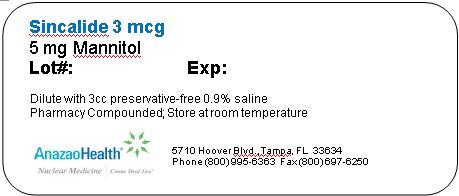
    Sincalide

    Sincalide Injection, Powder, Lyophilized, For Solution [Anazaohealth Corporation]

    To reconstitute, aseptically add 3 mL of preservative free 0.9% sodium chloride to the vial and swirl. This solution may be kept at room temperature and should be used within 8 hours of reconstitution, after which time any unused portion should be discarded.

    The vial should be inspected visually for particulate matter and discoloration prior to administration.

    For prompt contraction of the gallbladder, a dose of 0.02 mcg sincalide per kg (1.4 mcg/70 kg) is injected intravenously over a 30- to 60-second interval; if satisfactory contraction of the gallbladder does not occur in 15 minutes, a second dose, 0.04 mcg sincalide per kg, may be administered. To reduce the intestinal side effects, an intravenous infusion may be prepared at a dose of 0.12 mcg/kg in 100 mL of Sodium Chloride Injection USP and given at a rate of 2 mL per minute; alternatively, an intramuscular dose of 0.1 mcg/kg may be given.

    To accelerate the transit time of a barium meal through the small bowel, administer Sincalide after the barium meal is beyond the proximal jejunum. (Sincalide, like cholecystokinin, may cause pyloric contraction.) The recommended dose is 0.04 mcg sincalide per kg (2.8 mcg/70 kg) injected intravenously over a 30- to 60- second interval; if satisfactory transit of the barium meal has not occurred in 30 minutes, a second dose of 0.04 mcg sincalide per kg may be administered. For reduction of side effects, a 30-minute IV infusion of sincalide [0.12 mcg per kg (8.4 mcg/70 kg) diluted to approximately 100 mL with Sodium Chloride Injection USP] may be administered

    Storage and Handling

    The preparation should be stored at room temperature

  • Tetrofosmin Injection, Powder, Lyophilized, For Solution [Anazaohealth Corporation]

    Tetrofosmin

    Tetrofosmin Injection, Powder, Lyophilized, For Solution [Anazaohealth Corporation]

    Depending on the protocol for rest/stress imaging, doses of 10 to 30 mCi (370 to 1110 MBq) are given intravenously

    PREPARATION

    Snap off the plastic lid and place in appropriate lead shielding. Wipe the septum with 70% isopropyl alcohol and allow it to dry. Using a 10 mL syringe, dilute up to 360 mCi of Tc99m with saline and add to vial. The total volume should be between 6 mL -12 mL and the Tc99m concentration should not exceed 30 mCi/mL (360 mCi/12 mL). After adding the Tc99m, insert a 0.22 µm filtered vent needle and, using a separate syringe, withdraw 3 mL of gas from the vial, allowing sterile filtered air into the vial. Remove vent needle and syringe. Mix gently and invert several times for 10 seconds. Let stand for 15 minutes at room temperature as the complexes form. Inspect vial through a lead glass shield for particulate matter. Do not use if the solution is not clear. Store at 2°- 8°C (36°- 46°F) and use within 12 hours after mixing. Radiochemical purity should be at least 90% prior to administration QC info: Solvent – Ethyl Acetate, Strip – Whatman CHR% Tag = top counts/total counts X 100%
    STORAGE

    The preparation should be stored in the refrigerator at 2- 8(C (36 - 46(F) and protected from light.

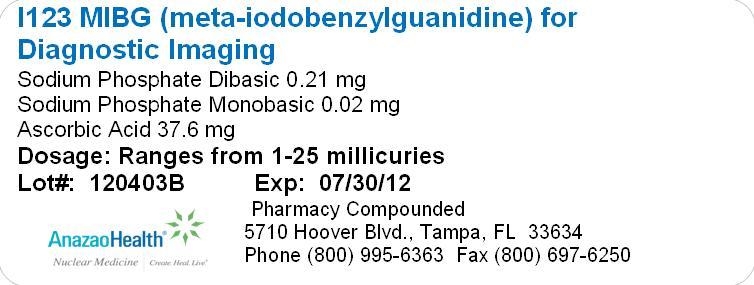
  • I 123 Mibg Meta Iodobenzylguanidine (I 123 Mibg) Injection, Powder, Lyophilized, For Solution [Anazaohealth Corporation]

    I 123 Mibg Meta Iodobenzylguanidine

    I 123 Mibg Meta Iodobenzylguanidine (I 123 Mibg) Injection, Powder, Lyophilized, For Solution [Anazaohealth Corporation]

    There is currently no dosage information available for this product. We apologize for any inconvenience.

  • Tetrofosmin Injection, Powder, Lyophilized, For Solution [Anazaohealth Corporation]

    Tetrofosmin

    Tetrofosmin Injection, Powder, Lyophilized, For Solution [Anazaohealth Corporation]

    Depending on the protocol for rest/stress imaging, doses of 10 to 30 mCi (370 to 1110 MBq) are given intravenously

    PREPARATION

    Snap off the plastic lid and place in appropriate lead shielding. Wipe the septum with 70% isopropyl alcohol and allow it to dry. Using a 10 mL syringe, dilute up to 360 mCi of Tc99m with saline and add to vial. The total volume should be between 6 mL -12 mL and the Tc99m concentration should not exceed 30 mCi/mL (360 mCi/12 mL). After adding the Tc99m, insert a 0.22 µm filtered vent needle and, using a separate syringe, withdraw 3 mL of gas from the vial, allowing sterile filtered air into the vial. Remove vent needle and syringe. Mix gently and invert several times for 10 seconds. Let stand for 15 minutes at room temperature as the complexes form. Inspect vial through a lead glass shield for particulate matter. Do not use if the solution is not clear. Store at 2°- 8°C (36°- 46°F) and use within 12 hours after mixing. Radiochemical purity should be at least 90% prior to administration QC info: Solvent – Ethyl Acetate, Strip – Whatman CHR% Tag = top counts/total counts X 100%
    STORAGE

    The preparation should be stored in the refrigerator at 2- 8(C (36 - 46(F) and protected from light.

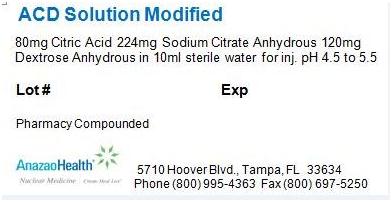
  • Acd Solution Modified Solution [Anazaohealth Corporation]

    Acd Solution Modified Solution

    Acd Solution Modified Solution [Anazaohealth Corporation]

    Red Blood Cell Labeling Procedure

    Labeling may be performed without washing or centrifugation steps directly in the reaction vial. A 30 to 50 mL sample of whole blood is withdrawn from the patient and added aseptically to a vial of ACD Solution Modified. 50 to 150 microcuries of Sodium Chromate 51 is then injected into the reaction vial using a shielded syringe. The amount of radioactivity added to the vial will

    depend on the intended use of the labeled red blood cells.

    The suspension is incubated for 30 to 60 minutes at room temperature with frequent, gentle agitation. After incubation, 100 mg Ascorbic Acid Injection is injected into the vial. The ascorbic acid reduces any remaining unbound dianionic chromium 51 to the anionic state which does not penetrate red blood cells; thus in vivo labeling of red blood cells is prevented.
    Storage and Handling

    Store the product at room temperature
  • Dipyridamole (Dipridamole) Solution [Anazaohealth Corporation]

    Dipyridamole

    Dipyridamole (Dipridamole) Solution [Anazaohealth Corporation]

    The recommended dose is 0.142 mg/kg/minute (0.57 mg/kg total) or 0.568 mg/kg or 60 mg total dose infused over 4 minutes. Although the maximum tolerated dose has not been determined, clinical experience suggests that a total dose beyond 60 mg is not needed for any patient.

    Prior to intravenous administration, dipyridamole should be diluted in at least a 1:2 ratio with 0.45% sodium chloride injection, 0.9% sodium chloride injection, or 5% dextrose injection for a total volume of approximately 20 to 50 mL. Infusion of undiluted dipyridamole injection may cause local irritation.

    Myocardial perfusion assessment should be started when maximal vasodilation is reached, usually after 3 minutes, which generally occurs approximately 7 minutes from onset of infusion

  • Isosulfan Blue Solution [Anazaohealth Corporation]

    Isosulfan Blue Solution

    Isosulfan Blue Solution [Anazaohealth Corporation]

    Isosulfan Blue 1% is to be administered subcutaneously, one-half (1/2) ml into three (3) interdigital spaces of each extremity per study. A maximum dose of 3 ml (30 mg) isosulfan blue is injected.

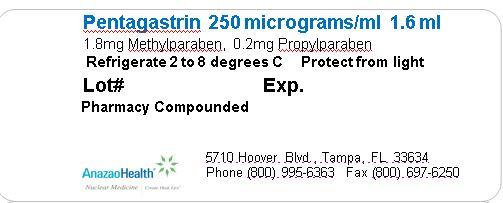
  • Pentagastrin Solution [Anazaohealth Corporation]

    Pentagastrin Solution

    Pentagastrin Solution [Anazaohealth Corporation]

    The intravenous infusion dose has ranged from 0.1 to 12 mcg (0.0001 to 0.012 mg) per kg of body weight per hour administered in a 0.9% sodium chloride injection. It can also be used as a subcutaneous injection for gastric function study with a dose of 6 mcg (0.006 mg) per kg of body weight.

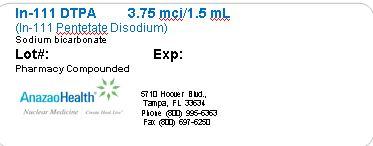
  • In-111 Dtpa Solution [Anazaohealth Corporation]

    In-111 Dtpa Solution

    In-111 Dtpa Solution [Anazaohealth Corporation]

    Extreme care must be exercised to assure aseptic conditions in intrathecal injections. The maximum recommended intrathecal dose in the average patient (70kg) is 18.5 megabecquerels (500 microcuries). The patient dose should be measured by a suitable radioactivity calibration system immediately prior to administration. Parenteral drug preparations should be inspected visually for particulate matter and discoloration prior to administration whenever solution and container permit.

    Storage and Handling

    Store vial in its lead shield at a temperature of 5-30º C. Do not freeze

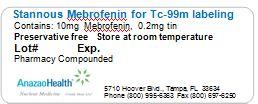
  • Mebrofenin Injection, Powder, Lyophilized, For Solution [Anazaohealth Corporation]

    Mebrofenin

    Mebrofenin Injection, Powder, Lyophilized, For Solution [Anazaohealth Corporation]

    The suggested intravenous dose range of Technetium Tc 99m Mebrofenin in the average patient (70 kg) is:

    Nonjaundiced patient: 74 - 185 MBq (2-5 mCi)

    Patient with serum bilirubin level greater than 1.5 mg/dL: 111-370 MBq (3-10 mCi)

    The patient should be in a fasting state, 4 hours is preferable. False positives (non-visualization) may result if the gallbladder has been emptied by ingestion of food.

    An interval of at least 24 hours should be allowed before repeat examination

  • Glucoheptonate Injection, Powder, Lyophilized, For Solution [Anazaohealth Corporation]

    Glucoheptonate

    Glucoheptonate Injection, Powder, Lyophilized, For Solution [Anazaohealth Corporation]

    There is currently no dosage information available for this product. We apologize for any inconvenience.

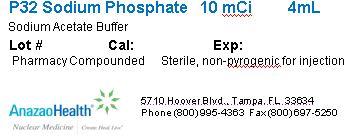
  • P32 Sodium Phosphate Solution [Anazaohealth Corporation]

    P32 Sodium Phosphate Solution

    P32 Sodium Phosphate Solution [Anazaohealth Corporation]

    For polycythemia vera, intravenous dosages from 1 to 8 mCi are usually given depending upon the stage of disease and the size of the patient. Repeat doses must be adjusted to individual needs. For chronic leukemia, the individual dose is 6 to 15 mCi, usually administered with concomitant hormone manipulation

  • Bicisate Injection, Powder, Lyophilized, For Solution [Anazaohealth Corporation]

    Bicisate

    Bicisate Injection, Powder, Lyophilized, For Solution [Anazaohealth Corporation]

    The recommended dose  for a 70 kg patient is 10-30 mCi

  • Sestamibi Injection, Powder, Lyophilized, For Solution [Anazaohealth Corporation]

    Sestamibi

    Sestamibi Injection, Powder, Lyophilized, For Solution [Anazaohealth Corporation]

    There is currently no dosage information available for this product. We apologize for any inconvenience.

  • P32 Sodium Phosphate Injection, Suspension [Anazaohealth Corporation]

    P32 Sodium Phosphate

    P32 Sodium Phosphate Injection, Suspension [Anazaohealth Corporation]

    Shake the vial well before injection.

    For intraperitoneal instillation, administer 10-20 mCi

    For intrapleural instillation, administer 6 to 12 mCi

    Doses for interstitial use should be based on estimated gram weight of tumor, about 0.1 to 0.5 mCi/gm.

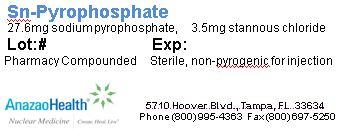
  • Pyrophosphate Injection, Powder, Lyophilized, For Solution [Anazaohealth Corporation]

    Pyrophosphate

    Pyrophosphate Injection, Powder, Lyophilized, For Solution [Anazaohealth Corporation]

    The recommended adult dose of Tc99m Pyrophosphate Injection is:

    5 to 15 mCi for skeletal imaging 10 to 15 mCi for cardiac imaging one-third (0.33) to the entire vial contents, followed 15 to 20 mCi of sodium pertechnetate Tc 99m, for blood pool imaging
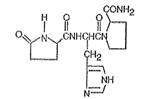
  • Thyrotropin Releasing Hormone Trh (Thyrotropin Releasing Hormone) Solution [Anazaohealth Corporation]

    Thyrotropin Releasing Hormone Trh

    Thyrotropin Releasing Hormone Trh (Thyrotropin Releasing Hormone) Solution [Anazaohealth Corporation]

    TRH is intended for intravenous administration with the patient in the supine position. The drug is administered as a bolus over a period of 15 to 30 seconds, with the patient remaining supine until all scheduled post injection blood samples have been taken. Blood pressure should be measured before TRH is administered and at frequent intervals during the first 15 minutes thereafter (see WARNINGS). Have the patient urinate before injecting TRH.

    Adults: 500 μg. Doses between 200 and 500 μg have been used. 500 μg is considered the optimum dose to give the maximum response in the greatest number of patients. Doses greater than 500 μg are unlikely to elicit a greater TSH response.

    Children age 6 to 16 years: 7 μg/kg body weight up to a dose of 500 μg.

    Infants and children up to 6 years: Experience is limited in this age group; doses of 7μg/kg have been administered.

    One blood sample for TSH assay should be drawn immediately prior to the injection of TRH, and a second sample should be obtained 30 minutes after injection.

    The TSH response to TRH is reduced by repetitive administration of the drug. Accordingly, if the TRH test is repeated, an interval of seven days before testing is recommended.

    Elevated serum lipids may interfere with the TSH assay. Thus, fasting (except in patients with hypopituitarism) or a low-fat meal is recommended prior to the test.

  • Sodium Chromate 51 Solution [Anazaohealth Corporation]

    Sodium Chromate 51 Solution

    Sodium Chromate 51 Solution [Anazaohealth Corporation]

    The suggested dose range in the average patient (70kg) is:Determination of red blood cell volume or mass-0.37 to 1.11 megabecquerels (10 to 30 microcuries). Study of red blood cell survival time-5.55 megabecquerels (150 microcuries). Evaluation of blood loss-7.40 megabecquerels (200 microcuries)

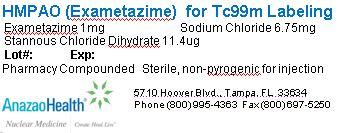
  • Exametazime Hmpao (Exametazime) Injection, Powder, Lyophilized, For Solution [Anazaohealth Corporation]

    Exametazime Hmpao

    Exametazime Hmpao (Exametazime) Injection, Powder, Lyophilized, For Solution [Anazaohealth Corporation]

    Cerebral Scintigraphy

    The recommended dose range for IV administration is 10 to 20 mCi (370 to 740 MBq).

    Leukocyte (WBC) Labeling

    The recommended dose range for IV administration is 7 to 25 mCi (259 to 925 MBq)

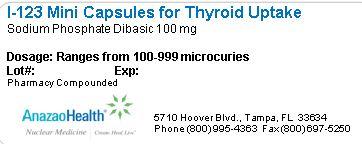
  • I 123 Mini Capsule [Anazaohealth Corporation]

    I 123 Mini

    I 123 Mini Capsule [Anazaohealth Corporation]

    Anti-thyroid therapy of a severely hyperthyroid patient is usually discontinued three to four days before administration of radioiodide.  For hyperthyroidism, the usual dose range is 4 to 10 mCi.  Toxic nodular goiter and other special situations will require the use of larger doses.  For thyroid carcinoma, 50 mCi is the usual dose for ablation of normal thyroid tissue, and 100 to 150 mCi is the usual subsequent therapeutic dose. Waterproof gloves should be used during the entire handling and administration procedure. Adequate shielding must be maintained.

  • Dextran 75 Injection, Powder, Lyophilized, For Solution [Anazaohealth Corporation]

    Dextran 75

    Dextran 75 Injection, Powder, Lyophilized, For Solution [Anazaohealth Corporation]

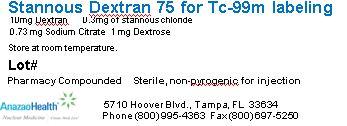
    To prepare injection, up to 40 mCi of an oxidant-free sodium pertechnetate Tc 99m solution is aseptically injected into the vial, minimum volume 1ml, mix gently and let Dextran dissolve completely for 10 minutes

    Storage and Handling

    Injection should be administered within 6 hours after preparation. Before and after reconstitution- Store at room temperature

  • Dimercaptosuccinic Acid Dmsa (Dimercaptosuccinic Acid) Injection, Powder, Lyophilized, For Solution [Anazaohealth Corporation]

    Dimercaptosuccinic Acid Dmsa

    Dimercaptosuccinic Acid Dmsa (Dimercaptosuccinic Acid) Injection, Powder, Lyophilized, For Solution [Anazaohealth Corporation]

    Preparation of Technetium Tc 99m DMSA is done by the following aseptic procedure:

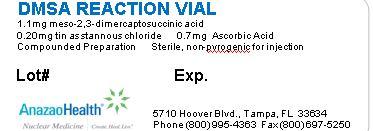
    Waterproof gloves should be worn during the preparation Snap off the plastic lid and place room temperature reaction vial in an appropriate lead shield. Swab the rubber closure of the vial with a germicide Inject as close to 1 cc as possible of sterile additive free sodium pertechnetate Tc 99m injection containing up to 1480 MBq (40 mCi) into the vial freshly eluded within 2 hours from a technetium generator. Be sure to maintain inert atmosphere in vial by introducing as little air as possible during reconstitution. NOTE: If sodium pertechnetate Tc 99m injection must be diluted, use  only Low Dissolved Oxygen (LDO) Secure the lead shield cover. Swirl the vial gently to mix contents and let stand for 15 minutes. Add 1 ml Acetate buffer at this time. (This will interfere with the tagging process if introduced any earlier). Buffer must be added (May be added up to 1 hour after Tc 99m) Examine vial contents; if the solution is not clear and free of particulate matter and discoloration on visual inspection, it should not be used Measure the radioactivity by a suitable calibration system and record prior to patient administration Buffered material should be used within 2 hours Appropriate quality control is recommended

    Tagging Tips

    If you need only a one or two mCi dose for your patient, use about 10 mCi of Tc 99m for your kit. Do not stretch your kit to 40 mCi if you do not need to. We have tested the kits to 40 mCi with a Friday generator eluted on Monday but recommend using only what you need Keep your volumes low. Take your Tc 99m and dilute to about 1cc with the Low Dissolved Oxygen saline and inject into the DMSA kit Let the kit stand for about 15 minutes with just the Tc 99m and DMSA (NO BUFFER) After 15 minutes, then add the buffer. This is only for patient comfort and will interfere with the tagging process if introduced any earlier After buffering you can add additional “Low Dissolved Oxygen” saline to dilute the kit You should inject the dose within 2 hours after making the kit for best results

    Storage and Handling

    Store the kit at 2°-8°C (36°-46°F) and protect from light

  • Sulfur Colloid Injection, Powder, Lyophilized, For Solution [Anazaohealth Corporation]

    Sulfur Colloid

    Sulfur Colloid Injection, Powder, Lyophilized, For Solution [Anazaohealth Corporation]

    Preparation of Technetium Tc 99m-Sulfur Colloid:

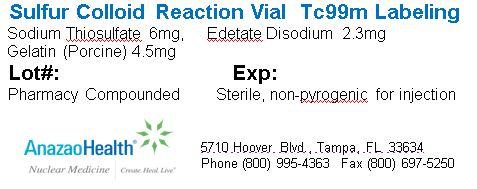
    Collect components: 10 ml. Reaction Vial, Solution A, Solution B, Lead Pig, Boiling Water Bath. Draw up 1 ml. Solution A. (HCl solution) in syringe. Draw up 2.5 ml. Tc-99m Pertechnetate containing desired activity, dilute with sterile normal saline if necessary. Add the 2.5 ml Tc-99m Pertechnetate to the shielded reaction vial. Immediately add the 1 ml. Solution A. Vent vial to release excess vacuum. Remove vent before boiling. Shake gently to mix. Place shielded vial in boiling water bath for 5 minutes for liver imaging and 3 minutes for lymphoscintigraphy imaging use. Remove from boiling water and let cool for a few minutes. Draw up 1 ml. Solution B. (Phosphate Buffer) while reaction vial is cooling After cooling Reaction vial, add the 1 ml Solution B and shake gently to mix. Caution: be sure vial is cool to avoid excess pressure Quality control: ITLC-SG in normal saline. Greater than 95% should stay at the origin Tc 99m  Sulfur Colloid expires 6 hours after mixing